Friday, May 6, 2011

ABOUT THAT “BUBBLE” IN US TREASURY BONDS….

by Cullen Roche

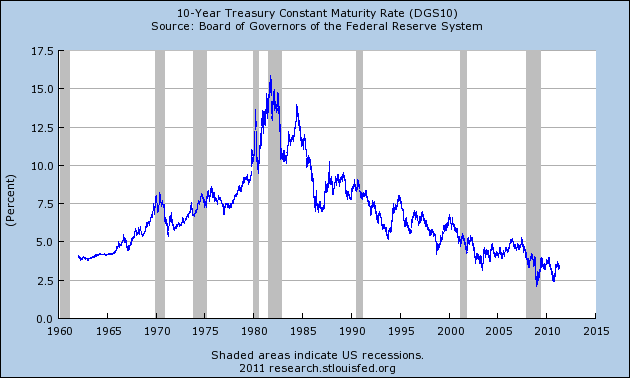
The US Treasury bubble continues to collapse HIGHER….If you bought long bonds exactly 12 months ago you have achieved a total return of ~5.5%. That’s not world beating, but it’s certainly not bad. What’s been so interesting about the US Treasury market, however, is that yields simply refuse to surge higher. Supposedly, there is high inflation. Supposedly, there are bond vigilantes just waiting to take out the USA on a slab and dump her in the ocean of default. Supposedly, we have a fiscal problem that will render us the next Greece. Supposedly, we are “running out of money”. Of course, none of this is really accurate and the US Treasury market is reflecting that reality.

In a death march similar to Japanese Government Bonds in the 90′s, US bond investors continue to try to call the US Treasury market a “bubble”. Some readers might think I spend most of my time trying to slay bubbles (given the recent surge in hate mail regarding my silver bubble call), but I have spent quite a bit of time trying to quell fears in the US Treasury market as well. After all, this bubble talk in treasuries has been going on for the better part of the past 5 years+ and an odd thing keeps happening – the bubble callers keep looking back in awe as yields simply refuse to surge as so many have predicted.
Of course, anyone with a sound understanding of our monetary system (see here for a guide) can see that there is no such thing as bond vigilantes for a nation that is the sovereign issuer of its currency in a floating exchange rate system. You also understand that it is nonsensical to argue that the USA is remotely similar to Greece, a household or a business (all of whom are currency USERS). And most importantly, you see that bonds have no relationship to the nation’s financing operations. The only reason yields would surge is if the country were in fact suffering high inflation or at risk of hyperinflation. The treasury market is sending a loud message, however – those calling for hyperinflation, default or even high inflation are dead wrong. The JGB death march (now the UST death march) continues…..

CLEAR CAPITAL: THE HOUSING DOUBLE DIP IS NOW OFFICIAL

by Cullen Roche

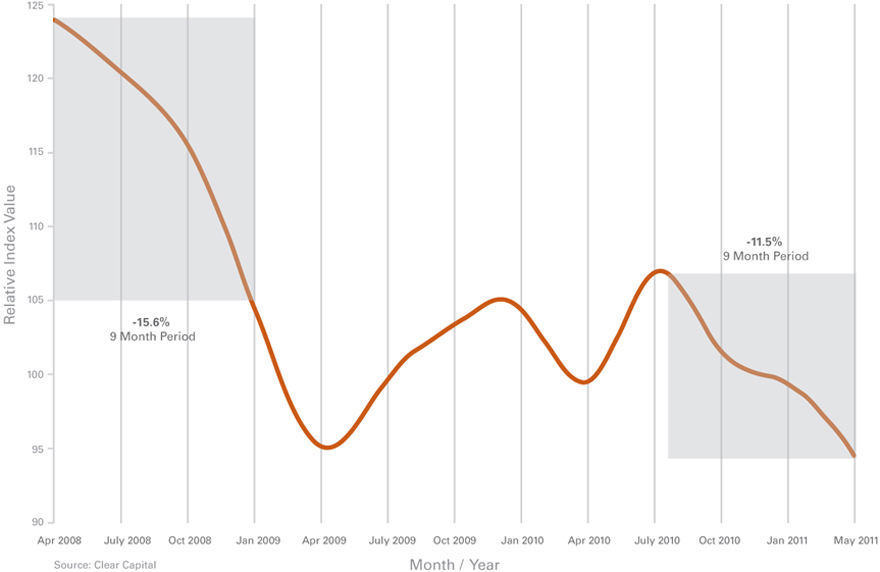
Well, this is no surprise to regular readers. We’ve been expecting a double dip in real estate for well over a year now. As soon as the government stepped out of the market the weakness was likely to reemerge and that is exactly what has happened. According to Clear Capital, the double dip in real estate is officially here as housing prices make fresh new lows:
TRUCKEE, CA – May 5, 2011 – Clear Capital (www.clearcapital.com) today released its monthly Home Data Index™ (HDI) Market Report, and reports prices have double dipped nationally 0.7 percent below prior lows experienced in March 2009. This month’s HDI Market Report provides the most current (through April 2011) and relevant analysis of how local markets performed compared to the national trend in home prices.
Report highlights include:
  • National quarterly home prices changed -4.9%; while year-over-year national price changes reached -5.0%.
  • National home prices have fallen 11.5% over the previous nine-month period, a rate of decline not experienced since 2008.
  • In a sign of the continued volatility and fragility of home prices, all the major Metropolitan Statistical Areas (MSA) tracked in this month’s report showed quarter-over-quarter price declines.
  • National REO saturation rate reaches 34.5%.
“The latest data through April shows a continued increase in the proportion of distressed sales that are taking hold in markets nationwide,” said Dr. Alex Villacorta, director of research and analytics at Clear Capital. “With more than one-third of national home sales being REO, market prices are being weighed down as many markets have not regained enough footing to withstand the strain of the high proportion of REO sales.


See the original article >>

TIME CYCLES AND MARKET PERFORMANCE

by Cullen Roche

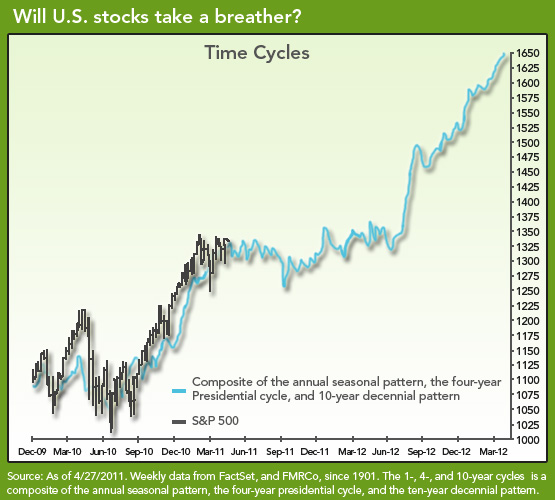
Here is an interesting expansion on the idea of Sell in May. Fidelity Investments elaborates by combining several time cycle indicators into one. The result – still Sell in May:
“On the negative side, it is coming to that point in the cycle where, seasonally, the market tends to take a pause, also known as Sell in May and Go Away.
Since, historically markets have tended to follow cyclical patterns such as this, I compiled the seasonal pattern, the four-year presidential cycle, and the 10-year decennial cycle into a composite performance index and projected the pattern. So far, the stock market has followed this roadmap very closely, so over the next two years. As you can see in the chart below, the market has closely tracked these historical cyclical patterns Since December 2009. Because of this, I think it bears watching. (Past performance is no guarantee of future results.)”

See the original article >>

U.S. Faces Dollar Decline as China Grows


According to a new statement from the International Monetary Fund, the United States will be the world’s leading economy for four more years, at which point China will overtake the US in total annual production of goods and services. While economists can and have expressed their doubts about how this plays into the world economy going forward, most everyone can agree that this news is not a positive release for the United States, nor the US dollar.

At present, the US accounts for roughly twenty-percent of total global output, whereas China represents only fifteen percent. However, by 2015, the two countries will come to settle at 17% of world output each, making China as economically important to the world as is the United States.

But where the trouble rests is in the greenback. While the US is responsible for twenty percent of global output, the US dollar is held by world governments at a disproportionate level. In 2010, 61% of all assets held as foreign exchange reserves were dollars. To compare, China only recently allowed investors in overseas markets easy access to its currency, and in 2010, the Chinese Reniminbi was found safely in the “other” column, which tallied only 4% of global reserves.

Investors should ask themselves how this could play out. If the United States economy represents only one-sixth of world output by 2015, what incentive will the world have to store more than 60% of its assets in dollars? Likewise, if China continues to grow to produce one-sixth of all goods and services produced across the world, why would foreign nations hold only a very small percentage (virtually zero) of their currency reserves in China? Wouldn’t it make sense that foreign governments and businesses would want to hold currency in proportion to their current importers and exporters?

Currency Crisis

There couldn’t be more bearish news for the US dollar, as stockpiles of the greenback grow against a decline in the relative value of the United States’ exports in world trade. Should governments around the world find that their dollar stockpiles are too large—China has already suggested it may cut its dollar holdings in half—wouldn’t it be the case that they would naturally flee to Chinese currency, which is already horribly underrepresented in world trade?

Flocking to the Renminbi looks to be a safe bet for most investors. China is tightening its interest rate policy and the economy has yet to respond poorly to the measures. Instead, China benefits in the long-run with lower prices for fuel, which are still mostly set in US Dollars.

The true play for this currency trade, however, isn’t in currency, but in metals. The Wall Street Journal found that Chinese and Indian demand for silver would grow 30% in 2011. But what happens when the dollar falls against the Renminbi? What happens when the Renminbi appreciates further, and Chinese factories, which consume 70% of imports for industrial use, can suddenly afford more silver?

The play here is three-fold; it is anti-dollar, pro-silver, and pro-emerging markets, but unlike equities or bond funds, silver has real, tangible and intrinsic value. Expect this trade to further explode through the rest of the year until the tailwinds of summer silver consumption in India take the trend even further. 

The fundamentals haven’t changed; they’re just developing faster than ever.

U.S. Dollar Weakness Shows Gold and Silver are the only Real Currencies

By: Bob_Chapman

Dollar weakness that has continued will continue. That is to make US goods cheaper and more saleable as exports, but the flip side is that imported goods are more expensive and that creates inflation. Such a policy is foolhardy versus foreign nations that have export advantages. Besides the US does not have the predominance of mass to compete on this level. If tariffs on goods and services were implemented that would be another story. That accompanied by a change in tax laws for transnational corporations, that would force them to return the $2 trillion they have offshore and pay normal taxation which would be very beneficial to solve tax, production and employment problems. 

Remember, we have lost about 9 million jobs over the past 11 years, as well as 440,000 businesses due to free trade, globalization, offshoring and outsourcing. Tariffs would level the playing field and leave no advantage to cheapening one’s currency, because it would be accounted for in their tariff structure. Having lost our export markets we have a jobless recovery that can never improve, nor can our balance of payments deficit and our increasing debt cause not only falling revenues, but falling job creation. This is just another artifice to try to stave off the inevitable. Lowering the dollar is not the answer. Having a level playing field is the answer.

Price fixing is an exercise in futility and so is a course of mandatory wage increases pursued to play catch up with runaway inflation. Even though higher numbers show sales growth they are misleading and only a reflection of higher pressing inflation. This is not economic growth; it is price inflation. Such an exercise is geared to keep people and business solvent, but in the long term it accelerates inflation and leads to worse problems down the road. The economy is exhibiting deterioration at the edges and that is to be expected for an economy that has been so badly misused. What is left of manufacturing is in decline and until the system is purged such deterioration will continue. It is not only the US, but also the UK and Europe that have followed the Keynesian course and then display suppression when inflationism overrides their systems. These governments are shortsighted and do not posses the strength to cut expenses and raise taxes. They will come slowly when it is to late. 

They do not seem to understand balance and sacrifice. Price regulation and wage controls are artificial answers and only expose economic decay and in time fail to work. This value distortion leads eventually to a barter type system, which is inefficient. Then again this would not be necessary if the currency system had not been abused as it had been. This is what happens to nations that wallow in debt in excess of 100% of GDP. The excuses are multifold but the results are always the same, and that is default. Those who created the system in which we are now enmeshed know exactly what they are doing. This game of controls and more money and credit only buys time to pick the right spot to pull the plug and begin another war. We can never understand how bankers can believe the system will collapse, but they remain immune. These same bankers have been in part responsible for current and future inflation and the proliferation of derivatives, which create a faux system within a system. Once these derivatives unravel they will create an explosion at the heart of the banking system. That will take out the top five banks in the US.

There has been no reform and there will not be any. Tariffs will come when it is too late, as will regulatory reform. The proliferation of fiscal debt will continue, as will the exorbitant creation of money and credit. They cannot stop. If they do the system will collapse. That will happen, but only when those driving and controlling the system allow it to do so. We have just witnessed the disinformation calculated to deceive the public into believing that there is a recovery afoot. Nothing could be further from the truth. What little upside that was seen was a lift via price inflation. When figures are released there is never an addendum explaining that if inflation were removed, what the statistics would really be. That is why we have a 5 to 10 year bull market in gold and silver ahead of us, whose presence is so powerful that no governments or central banks can regulate, suppress or overwhelm it.

We have learned from studying the history of currencies for the last 6,000 years, that gold and silver are the only real currencies. Recently we have seen a 40-year hiatus, but, of course, in the history that is the blink of an eye. Being mortal is disturbing because you can see history, but not the future. But we say you can approximate the future by learning about the past. His-story, the history of man. Bankers wed to the fractional banking system really despise gold as a backing for currencies, because it dos not allow them to create infinite amounts of money and credit. This leads in time to monetary debasement and the kind of conditions we are witnessing today. As we said previously, we have seen an almost entirely unnoticed titanic struggle between the US dollar and gold over the past 2-1/2 years, and gold has been the winner hands down. Now we are seeing the inflation factor come into play. The Fed at the same time continues to support the bond market to keep interest rates low, even going to the extent of manipulating the Treasury Inflation Protection Securities to create an illusion that inflation is a minor factor. The manipulation of bond prices in the US Treasury market has all but driven all investors, both foreign and domestic, away from these markets. Finally investors, particularly professionals, see the situation for what it is - plain and simple fraud. In addition, they are tired of observing the scams totally lacking in prosecution to say nothing of the selective corporate welfare, which has been doled out to fellow Illuminists. All they can see is unbridled monetization and inflation and lower dollars as far as the eye can see. 

In recent developments the US, England and France have declared a so-called NATO war against Libya. They have frozen $32 billion held in trust by the US in the US. That is the largest amount ever held by the US concerning a foreign country’s asset. The three countries want Libya’s oil, four water aquifers, central banks and their 484.5 tons of gold, plus the Libyan funds held by other countries. These three want to steal it all and leave the country destitute. The EU has in addition frozen $67 billion. It is thought that because the US is desperate for funds that they will now put into the economy those funds to help keep the economy from collapsing.

The US Treasury and the Fed have created a giant bond fraud and the world’s professionals and governments are well aware of it. If they have to take the US dollars in trade they have to take the inflation that comes with them. 

They not only have to tend to inflation in their own economies, but fight off dollar inflation as well. That is why nations are dumping US dollar as soon as they receive them by buying raw materials, investing in land, real estate, plant and equipment and gold and silver.

The bankers and the western governments now expect us to believe that Osama bin Laden is dead. He died years ago. This is just more propaganda for a distraction to more important matters, such as the deterioration and collapse of the western financial system. Anything to keep the game going, anything to deceive. We see no comment in any media that the US and European countries had frozen some $32 billion in US banks and $67 billion in European banks of Libyan sovereign wealth funds. As you have seen desperate people do desperate things. These funds do not belong to Mr. Gaddafi, they belong to the Libyan people. It is simple the west is broke and needed the funds. When you see Chatham House all over the European news you know the black nobility executed this.

As such events occur we have Fed Chairman Mr. Bernanke totally lacking integrity telling us there is little inflation and that the Fed just needs more time to complete recovery. What recovery, it must be hiding because we do not see it? What the Fed is doing is no monetary experiment. It has been tried over and over again through the centuries and it is well known among professionals that what Mr. Bernanke is doing does not work. When you hear from Mr. Bernanke that commodity price effects will likely prove transitory, when there has been a bull market in commodities since 1999, and that bull market is getting stronger, you have to question Mr. Bernanke’s integrity. He reminded us of the dollar’s previous comeback proved the safe-haven status of the dollar. How laughable. The rally created by banks was market rigging and we exposed what they were up to early. They are now running the euro up to make even more profits. This week or next the euro should reverse its rally as meetings resume in Greece. To these people currencies, gold and silver, commodities and markets are like footballs to be kicked around. It is not surprising that long-term confidence in the dollar is falling as uncertainty and instability, along with climbing inflation are becoming noticeable. There is no question the Fed has spent many years off course serving its owners and controllers in banking and on Wall Street. This time it is different. This time they are taking the whole system down deliberately to force the peoples of the US, UK and Europe to accept world government. This is not abrogation of responsibility or incompetence; this is willful greed and destruction. In QE1 and QE2, the banks and Wall Street were saved and then the Treasury. Little was done to address what was going on in the real economy. All credit, monetary and fiscal policy, was used to extend the health of the financial community and select transnational conglomerates.

Speculation has been the result of credit expansion almost all of which was pointed at Wall Street, banking and AAA rated transnational conglomerates. We find it interesting that all commentary and reports are based on Fed assumptions. Their policies and end game are rarely questioned, especially when other professionals know what they are up too and they know it does not work. Is it because they are Keynesians? In part yes, but the key is they are afraid to speak out, because if they do they lose their jobs, or in some cases are suicided. These people play hardball and they are unmerciful killers. If you don’t believe that just look at all the wars they have created and financed on both sides. You cannot approach what the money powers are up to with logic and reason. You are dealing with a predatory animal that will out of hand kill its own for power and survival. 

How can anyone believe the Fed Chairman when he tells us that there are well-anchored inflation expectations, when real inflation is about 10% and even the uneducated public understands that? This is a monstrous lie, all and sundry know that, yet the media and the powers behind government perpetuate that lie cloaked in propaganda.

As a results of such prevarication gold and silver hit new highs. That has of course brought a barrage of sell recommendations from the regular suspects on CNBC, CNN and Bloomberg, along with the comments of silver mania, bubble, etc. What is worse though are the 96% of newsletter writers who have been consistently wrong for the past five years. It is sell, sell and switch to gold. The coin dealers go right along with the program for profit of course. What a woeful gaggle of dunces and opportunists. 

The public doesn’t believe the Fed inflationary lie nor do professionals believe a weak dollar is good for the economy. For Bernanke to even allude to higher official interest rates is laughable. These same “expert”’ observers go right along with the perpetuation of what the Fed has done for a century and that is rob the public blind. Very few want to return monetary policy to the Treasury and perhaps honest transparent policies, that put the American people first, not Fed shareholders.

As we said three years ago, the Fed will expand money and credit until it cannot any more and then they’ll have a new world war to eliminate population and distract the public’s attention away from social, financial and economic chaos.

Right now the big push is to sell silver to buy gold based on the gold-silver ratio. We have been in the markets for 52 years and that ratio has never worked. All the traders who listen to this foolishness will end up last in line. Jackrabbit trading is for losers, we know we were traders for 25 years.

What does not seem to be self-evident among investors and others in that the same group controls Treasury and the Fed. They do what they feel like doing and the media, which they own and control, does exactly as they are told. Writers and commentators say we need more rules to control the Fed. What we need is an end to the Fed, but these weak willed characters refuse to say that because they do not want the wrath of the elitists down on them. What a scurrilous group. There are not going to heavy new rules, because the people who control the Fed have purchased 95% of congress and the judiciary. There has to be violent and radical change and unfortunately there is only one way that can come about.

China's Economy Continues to Ascend But Watch Out for Speed Bumps, Investment Plays


Jason Simpkins writes: Everyone knows that China's economy is hot. The only question is whether it may be a little too hot. 

China posted yet another quarter of stellar economic growth in the first quarter of 2011, with its gross domestic product (GDP) growing 9.7%. However, analysts are worried about some of the side effects that have accompanied that growth- namely soaring inflation and the emergence of speculative bubbles.

Inflation in China hit a 32-month high in March, and the country's real estate market is beyond scorching. 

Policymakers in Beijing insist they have the situation under control, and they've been trying to rein in liquidity and curb speculation to prove it. That's why China's economy, accustomed to double-digit growth, is only expected to grow 8% to 9% this year.

Of course, while China may be experiencing some acute growing pains, its economy regressed the least in the wake of the global financial crisis - and it will continue to operate as the engine of global economic growth going forward, even if the United States relapses into recession.

In fact, China's GDP will rise from $11.2 trillion in 2011 to $19 trillion in 2016, while the U.S. economy will increase from $15.2 trillion to $18.8 trillion, according to the International Monetary Fund (IMF). That means in five years China will have supplanted the United States as the world's No. 1 economy.

China's share of the global economy will ascend from 14% to 18% in that time, while the United States' share will descend to 17.7%.

A Guide to China's Economy
The rise of China's economy - now the world's second largest - has been meteoric. But the time has come for the country to evolve from a source of cheap labor and manufacturing to a fully developed economic power with a consumer class that's capable of sustaining domestic growth.

China already has made some remarkable progress in rebalancing its economy. The country's trade surplus is narrowing and wages are on the rise.

The central government is targeting an increase in minimum wages of 13% a year through 2015. Additionally, Chinese Premier Wen Jiabao aims to increase per capita household income by 7% a year in real terms during that period. He's also pledged to improve the social security and healthcare systems to help low-income households and to raise the personal income tax threshold - all in an effort to give the country's 1.3 billion people more spending power. 

"We will ensure that people's income increases keep pace with economic growth and people's salary growth keeps pace with the productivity rise," Wen said last month in an online chat with the Chinese public.

China's 31 provinces boosted minimum wages by an average of 24% last year, according to Yin Weimin, China's minister of human resources and social security. Meanwhile, the average monthly income for migrant workers rose 13% to $256.89 (1,690 yuan).

Six provinces have already raised minimum wages this year, with labor shortages and government mandates likely to compel the remaining 25 to follow suit.

Rising wages have directly translated to an increase in retail sales, which rose 16.3% to $657.29 billion (4.2922 trillion yuan) in the first quarter, according to the National Bureau of Statistics. Sales in March rose 17.4% from a year earlier, and edged up 1.34% from February.

"China is trying to rebalance its economy to become more consumer oriented. Wages are rising. People are earning more and will shop more, and that's good news for Chinese retailers," Andrew Sullivan, Director of Institutional Sales Trading at OSK Securities in Hong Kong, told CNBC.

Shockingly, the country that for so long has been infamous for its thriftiness has become the world's largest market for luxury goods. 

As of December 2010, sales of luxury goods in China rose to $10.7 billion, or 30% of total global sales, up from $9.4 billion in 2009, according to the World Luxury Association (WLA).

Luxury brands like Coach Inc.(NYSE: COH), LVMH Moet Hennessey Louis Vuitton SA (PINK: LVMHF), Burberry Group PLC (PINK: BURBY), and Hermes International SCA (PINK: HESAF) have all benefited from China's splurging.

Coach last week reported a better-than-expected 18% increase in fiscal third-quarter profit, thanks largely to China. China revenue currently totals about $185 million and continues to increase by double-digit percentages, the company said.

Rolls Royce saw its China sales rise 600% last year, putting it above Britain as the company's second-biggest customer behind the United States.

China's luxury car sales are expected to rise to more than 909,900 units this year, up from about 727,200 last year, according to forecasts by IHS Automotive. And that number could climb to 1.6 million by 2015.

China is already the world's largest auto market, with 18 million units sold last year. That figure is expected to grow to 23 million by 2015. 

As further testament to China's newfound consumer wealth, the GroupM Knowledge-Hurun Wealth Report 2011 showed the number of millionaires on the mainland is up 9.7% from a year ago. And the country has 115 billionaires according to Forbes magazine's 2011 list -- second only to the United States.

Indeed, China's domestic consumption has shown the rapid growth that has become the country's trademark. But more importantly, it's advanced the central government's goal of a more balanced economy by helping to reduce the nation's disproportionate trade surplus. 

China in March posted its first trade deficit - about $1 billion - since 2004.

Strong demand for imported consumer goods and higher prices for commodities drove the value of China's imports to $152 billion in March. The value of China's imports hit a record high of more than $400 billion in the first three months of the year.

Last year, China ran a trade surplus of about $15.25 billion a month. However, 2010 also was the second consecutive year in which the trade surplus shrank, falling 6.4% from 2009 to $183.1 billion.

The State Information Center forecast China's imports to rise 20% in 2011, while exports will increase by 16%. That would trim the trade surplus by 13.2%.

China wants to double its imports by 2015, reducing the trade surplus to zero and emancipating itself from an export-reliant economy.

Potential Setbacks to China's Economy
Of course, China's rapid transformation has not gone off without a hitch. Inflation remains uncomfortably high, and there are fears of a growing bubble in the nation's red-hot property market.
The most recent consumer price index showed inflation rising at 5.4% in March, the fastest pace in three years. 

China's inflation rate will likely rise above 5.5% in June, a team of economists at Bank of America-Merrill Lynch said in a report yesterday (Wednesday). However, that's likely to be the peak as Chinese policymakers are working overtime to stifle inflation at the expense of growth. 

The People's Bank of China (PBOC) has raised the benchmark interest rate four times- an increase of 100 basis points - and the reserve requirement seven times since October. 

"Stabilizing prices and managing inflation expectations are critical," the PBOC said in a first-quarter monetary policy report published yesterday.

Still, China's economy is overheating because capital is flowing into the mainland faster than it is flowing out. China's foreign exchange reserves, having increased by $197 billion in the first three months of the year, now exceed $3 trillion. 

Indeed, huge trade surpluses and the large-scale purchases of U.S. Treasuries - which China makes to suppress the yuan's value - have resulted in a 17-fold increase in the country's reserves over the past decade.
For every dollar that goes into China's reserves, the country prints 6.5 yuan.

Furthermore, lending and money supply in the country continue to grow faster than expected.
China's top four state-owned banks dispersed $40.1 billion (260.6 billion yuan) in new loans in April, slightly higher than the $37.3 billion (242 billion yuan) issued in March, according to local financial news provider Caixin. This is despite the fact that China's biggest banks are required to keep 20% of their deposits on hand as reserves.

"What China calls ‘total social financing' - conventional bank loans and most other external sources of finance - was still 38% of GDP in the first quarter of 2011, almost as high as in 2009 when China implemented a credit-centric stimulus program," UBS AG (NYSE: UBS) economist Robert Magnus said in a column in the Financial Times. "The credit intensity of growth, or the amount of new credit generated for each unit of GDP growth, has risen from 1-1.3 before 2009 to 4.3 in 2011."

Many of the new loans are going into China's property market, which is accelerating at a dangerous pace.
The value of homes sold in the first quarter increased to $132 billion (860.7 billion yuan), the Statistics Bureau said last month, driving overall property transactions 27% higher to $157 billion (1.02 trillion yuan).

The total value of homes sold in March alone rose to $63.7 billion (414 billion yuan), which is close to the total of the first two months of this year combined. New home construction rose 20% in the first quarter to 310.2 million square meters (3.34 billion square feet), the statistics bureau said. 

Overall investment in China's real estate rose 34% to $136.4 billion (885 billion yuan) in the first quarter, according to the government data.

Startlingly, these figures suggest that Beijing's attempts to cool the property market so far have been ineffective. 

"While these growth rates are below ones seen in early 2010, they remain high relative to what developers are reporting and what the policy tightening would have suggested," Citigroup Inc. (NYSE: C) analysts said in a report. "We see this as a sign that the tightening probably has not yet been fully implemented at the local level."

A rising number of institutions are growing concerned about China's real estate market. 

Even China Citic Bank Corp. Ltd. (OTC: CHCJY), the seventh-largest Chinese lender by assets, said yesterday that the country's property market has become too risky and it plans to cut lending to the sector.

"Citic Bank relatively clearly sees that real estate risk this year is severe," Shi Yuan, the general manager of the bank's risk management section, said on a quarterly teleconference. "We especially are paying attention to risks in the funding chain for developers. We believe as tightening continuously gets stronger, the true real estate risks will appear."

Still, it's important to remember that while bubbles may be forming - especially in the property market - the overall trend of China's growth is positive. 

"Yes there are probably pockets of bubbles in China and in the real estate market, but against that backdrop you have 500 million people expected to move into Chinese cities by 2020. That means the number of people expected to move into cities is almost double the population of the United States," said Money Morning Chief Investment Strategest Keith Fitz-Gerald. "So in the context of China's explosive growth, what we're looking at are some moderate setbacks over an extended period of high growth."

China Investment Plays
Indeed, China is a growth story too compelling to pass up. However, investors should focus on parts of the Chinese economy more stable than the real estate sector. 

That means playing trends like consumption.

The Claymore/Alpha Shares China Small Cap ETF (NYSE: HAO) has a large percentage of its holdings in consumer-focused firms. Consumer staples and consumer discretionary sectors represent 9.3% and 15.8%, respectively, of the fund's holdings.

You might also consider large U.S. multinationals that have a sizeable footprint in China. These companies continue to benefit from China's fast-growing consumer class and are less susceptible to potential setbacks.
McDonald's Corp. (NYSE: MCD) and Yum! Brands Inc. (NYSE: YUM) are two food operators profiting from China's growing consumerism.

Additionally, the revamped General Motors Co. (NYSE: GM) has a very strong presence in China. GM is expected to retake the crown for most global auto sales from Toyota Motor Corp. (NYSE ADR: TM), which has been devastated by the recent disasters in Japan.

The company intends to introduce more than 60 new or upgraded models for the Chinese market and aims to double sales to around 5 million units by 2015.

There's also China Yuchai International Ltd. (NYSE: CYD), which manufactures and sells diesel engines - most of which are distributed in China.

As mentioned earlier, luxury sales in China continue to rise as well. That stands to benefit luxury brands like Coach Inc. (NYSE: COH), Burberry Group PLC (PINK: BURBY), and Compagnie Finciere Richemont (PINK: CFRUY).

Finally, Money Morning's Fitz-Gerald likes the Morgan Stanley China A Shares Fund (NYSE: CAF). 

"I particularly like CAF because small business ventures in China have the most to gain and most of those companies are traded only in China A shares," said Fitz-Gerald. "And CAF is the only fund that gives U.S. investors ‘direct access' to the A-shares."

CAF is one of the best ways to profit from China's shifting growth model. A recent portfolio allocation of the fund showed 28% of its holdings were in consumer goods and services, 26% were in financials and 18% were in basic materials. 

CAF also holds shares in companies that make auto components and beverages, among other products, and has numerous stocks in the metals and mining sectors.
Follow Us