Monday, March 17, 2014

Control your risk with simple and winning rules

SIMPLE AND STRICT TRADING RULES

With our Super Commodity strategies can operate on all commodities markets with a simple, safe and reliable method, generating significant capital growth, with simple and strict trading rules and risk management rules.
Our Super Commodity Trading Signal Service takes + 269.35 % from 1 January 2009 to 31 January 2014!


BUY LOW AND SELL HIGH!

Super commodity System wants to be a solid reference point for all those investors which want to approach the commodities markets world with a robust tool with low risk levels.
This strategy works automatically searching for specific patterns around markets, those highly profitable patterns with a good success percentage. These graphic formations demonstrated during the years to be turning points in robust and reliable manner. Super Commodity was born in order to use these points as very good launch points for its trades.
Super Commodity must be considered a pattern recognition system which searches graphic formations with preselected features. The system uses six different patterns which determine particular rules the system uses to manage trades.

Download Historical Results Pdf

Dowload some trades example

31t1laf0.a1h

MANAGED ACCOUNT SERVICE

Minimum Account Size $ 100K

Historical Drawdon $ 25K

RisK Per Trade $ 2500/contract

Our company receives a limited power of attorney on an account that the client opens with the broker Berkeley Futures (www.bfl.co.uk) or Interactive Brokers (www.interactivebrokers.com).


TRADING SIGNALS SERVICE

Minimum Account Size $ 100K

Historical Drawdon $ 25K

Max RisK Per Trade $ 2500/contract

We pleased to offer to ours readers the opportunity to test and evaluate for free for 30 days the full version of Super Commodity system. The signals service with all trading signals will be sent by email at the end of day, around 6:00pm Eastern time, and in case again in the next day to intraday updates, through a daily report like this and this. In addition, customers may view at any time the trading signals also on a special page through secure internet access.

After the free trial period, the service will continue to pay a monthly $ 395.00 fee. To activate the service, use the free trial period and receive daily updates please contact me. 

Contact me at michele.giardina@quantusnews.com


Material in this post does not constitute investment advice or a recommendation and do not constitute solicitation to public savings. Operate with any financial instrument is safe, even higher if working on derivatives. Be sure to operate only with capital that you can lose. Past performance of the methods described on this blog do not constitute any guarantee for future earnings. The reader should be held responsible for the risks of their investments and for making use of the information contained in the pages of this blog. Trading Weeks should not be considered in any way responsible for any financial losses suffered by the user of the information contained on this blog.


Geopolitical risk in spades

By Phil Flynn

Crimea Vote

Crimea voted in an election to succeed from Ukraine and to join Russia leaving the markets to ask, what is next? We know that sanctions may follow assuming that Russia recognizes the vote and there is no sign that they will not. In the meantime the commodity markets are moving on not only Ukraine woes but China, Libya, Nigeria and the EU. While the initial risk on seems to be slowing, there is no doubt the markets remain on edge. Comments by Mario Draghi suggesting that the EU is looking to “act against deflation” adds a new element to buy euro, ask questions later trade is not a given.

Bloomberg News Reports that “Draghi said his forward guidance may help to weaken the euro and lower real interest rates, easing the risk that inflation won’t return to the goal set by policy makers.

Guidance “creates a de facto loosening of policy stance, as real interest rates are set to fall over the projection horizon,” Draghi said in Vienna yesterday. “At the same time, the real interest-rate spread between the euro area and the rest of the world will probably fall, thus putting downward pressure on the exchange rate, everything else being equal.”

China also is a risk as they try to engineer a soft landing and unwind and deleverage risk against a backdrop of Fed tapering. The Chinese yuan is taking a hit as the Chinese central bank widened the trading range but still will set the closing price. 

Reuters News reports that China's yuan eased against the dollar on Monday after the central bank doubled the currency's daily trading band as part of its commitment to let markets play a greater role in the economy. Yet the currency moved in a relatively narrow range reflecting market views that the People's Bank of China will seek to limit currency swings at a time when markets fret over China's cooling growth and the quality of corporate debt.

"The PBOC, with the help of major state-owned banks, will for certain tighten the grip on yuan's value in coming days and weeks to prevent what it sees as excessive volatility," said a dealer at a European bank in Shanghai.

In the longer run, however, the central bank is expected to allow the currency to move in a broader range in a sign of its confidence that it can keep speculators at bay and that the economy was mature enough to handle greater uncertainty about the exchange rate. "Over time, the widening will pave the way for the PBOC to gradually lessen intervention in daily trading and will help China's reforms to make the yuan fully convertible eventually."

On Saturday, the People's Bank of China doubled the yuan's daily trading range, so that it can now rise or fall 2% around the daily midpoint rate. The currency opened at 6.15 to the dollar, just 0.29% weaker of the official mid-point rate. It briefly fell to an intraday low of 6.1642, 0.2% weaker than Friday's close.

Since the start of this year the yuan has lost 1.8% against the dollar, largely as a result of central bank's efforts, reversing much of last year's near 3% rise as Beijing sought to change the perception the yuan was a safe one to one appreciation bet. Beijing's efforts to clamp down on such trades combined with concerns over China's economic health are expected to keep the yuan on the back foot in coming weeks.  Earlier this month, a Chinese company became the first to default on a corporate bond, and concerns about economic growth were highlighted by a dramatic 18% fall in exports in February and sluggish manufacturing. "Given China's recent relatively weak export performance, we see little upside for the yuan this coming year," said Tao Wang, an economist at UBS in Hong Kong.

Libyan oil production has played havoc with the Brent market and a tanker that was taken over by rebels has been boarded by the United States. The New York Times reports that U.S Navy commandos seized a fugitive oil tanker in the Mediterranean waters southeast of Cyprus on Monday morning, thwarting an attempt by a breakaway Libyan militia to sell its contents on the black market, the Pentagon said. No one was hurt in the operation, the Pentagon said in a statement. The fugitive tanker, called the Morning Glory, had sailed into the Libyan port of Sidra under a North Korean flag but North Korea disavowed the ship and denied providing any authorization. News reports have said it was operated by a company based in Alexandria, Egypt, and that after leaving Libyan waters it appeared to have sailed the Mediterranean in search of a buyer for its oil.

In a statement early Monday morning, the Pentagon said that the Libyan and Cypriot governments had requested American help in seizing control of the tanker. President Obama authorized the operation just after 10 p.m. Sunday night, the statement said. Within a few hours a Navy SEAL team on the guided missile destroyer Roosevelt boarded and took control of the tanker, “a stateless vessel seized earlier this month by three armed Libyans,” the statement said. The Roosevelt also provided helicopter support, the statement added, but it did not say how many Americans had participated in the seizure or what force might have been used.

The American intervention is a salvation to the fragile transitional government in Tripoli, the Libyan capital, which faced the loss of its main source of revenue and sole source of political power if renegade militias succeeded in selling Libya’s oil. Despite days of furious bluster, the Libyan authorities were unable to stop the tanker from arriving in the eastern port of Sidra early last week or from leaving with the oil a few days later. The loss of control over oil revenue threatened the government so gravely that the transitional government appeared to teeter, with Parliament voting to remove its prime minister without any consensus on his long-term replacement. The seizure of the oil, which the United States Navy says it is now returning.

The AP Is reporting that Officials say Fulani Muslim herders attacked three Christian villages and killed more than 100 civilians. Hundreds of thatched-roof huts were set ablaze. Thousands have been killed in recent years in competition for land and water between mainly Muslim Fulani herdsmen and Christian farmers across Nigeria’s Middle Belt. More than 100 people were killed in similar attacks in neighboring Katsina state last week.

Dow Jones reports that spot gold reached a fresh six-month high in early European trading hours Monday. Last week's jitters surrounding Chinese economic and credit conditions and ongoing tensions surrounding Ukraine briefly carried into the new week – gold touched $1,392.08 per troy ounce, its highest price since early September, before slightly to just below Friday's settlement price at $1,378.30 per ounce.

Bloomberg Reports that wheat traded near the highest level in almost five months, extending a weekly gain, after a referendum in Crimea to leave Ukraine and join Russia boosted concerns supplies from the Black Sea region will be disrupted. The contract for May delivery climbed as much 1% to $6.9425 a bushel on the Chicago Board of Trade and was at $6.9275 by 2:01 p.m. in Singapore. Prices climbed 5.1% last week, touching $6.965 on March 13, the highest since Oct. 25. Futures are set to gain 14% this quarter, the most since the three months through September 2012.

See the original article >>

Inflation evident as ETF flows converge with investor choices

By Cordell Eddings and Daniel Kruger

The Federal Reserve’s attempt to lift inflation to a level that would reflect a healthier U.S. economy is starting to take hold in the bond (CBOT:USM13) market.

For the first time in 19 months, investors are stepping up their buying of exchange-traded funds that hold Treasuries tied to cost-of-living increases, data compiled by Bloomberg show. At the same time, inflation expectations over the next five years surpassed 2% to reach the highest level since May after a government report showed hourly earnings among U.S. workers jumped more on average in February than economists forecast.

The shift in bond-market perceptions shows that some investors now anticipate consumer demand in the world’s largest economy will be strong enough to push inflation toward the Fed’s elusive 2% target. Last year, investors were so convinced the persistent lack of price pressure had become entrenched that Treasury Inflation Protected Securities, or TIPS, posted their worst losses since they were introduced in 1997.

“Inflation is coming,” Michael Pond, the head of global inflation-linked research at Barclays Plc, one of the 22 primary dealers that trade with the Fed, said in a telephone interview from New York. We’re starting to break “free from some of the deflationary shackles of last year. The labor market is picking up, which will cause wages to pick up.”

While a recovery in consumer spending would validate the Fed’s move to scale back its quantitative easing after flooding the U.S. economy with more than $3 trillion since the financial crisis, the risk of inflation has prompted some investors to favor TIPS over Treasuries that pay a fixed rate of interest.

Purchasing Power

Unlike Treasuries, whose fixed payments lose value as living costs increase, TIPS appreciate. The securities returned 2.75% this year, rebounding from a 9.4% plunge in 2013 and outperforming the broader market for U.S. government debt, index data compiled by Bank of America Merrill Lynch show.

Many investors have been overly optimistic “inflation will stay relatively contained and that the Fed will make a graceful exit from QE,” Zach Pandl, a senior interest-rate strategist at Columbia Management Investment Advisers, which oversees $340 billion, said by telephone from Minneapolis. “The economy has made a lot of progress and is accelerating.”

Pandl, who is avoiding Treasuries because of the likelihood the economy will strengthen, is buying TIPS. Yields on the benchmark 10-year TIPS have fallen 0.31 percentage point this year to 0.49%, while those on similar-maturity Treasuries have declined to 2.68% from a more than two-year high of 3.03% on Dec. 31.

Consumer Spending

Net purchases of the 12 ETFs that hold U.S. inflation- linked bonds have totaled $399 million in March, the first time combined inflows have surpassed redemptions from the funds since August 2012, data compiled by Bloomberg show.

The largest such ETF, the $13 billion iShares TIPS ETF run by BlackRock Inc., is poised to snap its longest streak of withdrawals since its inception a decade ago with the biggest monthly net increase in two years, the data show.

Inflation expectations have picked up on signs that wage growth will lead to more consumer spending. The gap between yields on five-year Treasuries and similar-maturity TIPS widened to a 10-month high on March 7, implying that consumer prices will rise an average 2.01% over that span.

As recently as June, the break-even inflation rate was 1.63%, the lowest since January 2012. It was at 1.95% as of 10:30 a.m. in New York.

Minimum Wage

Average hourly earnings for all U.S. workers climbed by 9 cents, or 0.4%, to $24.31 last month, according to the Labor Department, the biggest gain since June.

Employers added more workers than forecasters estimated, a sign the U.S. economy is starting to shake off the effects of severe winter weather that slowed growth at the start of 2014.

The Obama administration is also calling on Congress to raise the federal minimum wage by almost 40% to $10.10 an hour over the next three years, which may boost the ability of the lowest wage earners to buy more goods and services.

“Inflation may move up higher than people think,” David Leduc, the chief investment officer at Standish Mellon Asset Management Co., which manages $160 billion, said in a telephone interview. The Boston-based firm began buying TIPS with maturities as long as five years this month, he said.

After falling to a four-year low of 1% in October, the annual inflation rate has risen for three straight months to reach 1.6% in January, data compiled by Bloomberg show. Economists in a Bloomberg survey anticipate the cost of living will rise 1.7% this year and 2% in 2015.

Stagnant Incomes

It’s still too soon to start worrying about inflation because stagnant incomes will keep consumer spending in check, according to Jennifer Vail, head of fixed-income research of the Minneapolis-based U.S. Bank Wealth Management, which oversees $112 billion. Disinflation, or a slowdown in price gains, is instead the more immediate threat to the economy, she said.

Incomes in the U.S. have increased an average 2.1% over the past five years since the financial crisis, less than the 3.3% growth during the previous decade, according to data compiled by Bloomberg.

The Fed’s preferred gauge of inflation, known as the personal consumption expenditures deflator, has been below the central bank’s 2% goal for 21 straight months and rose just rose 1.2% in January from a year earlier. In the past year, the index has fallen below 1% three times and has never exceeded 1.5%. The last time inflation based on the Fed’s measure was so low during an expansion was in 1998.

Not Soon

Bond-market expectations for consumer prices in the latter half of the coming decade, another measure used by the Fed called the five-year, five-year forward break-even rate, has declined to 2.41%, the lowest since July.

“The Fed is still much more concerned with disinflation right now, and it’s a valid concern,” Vail said by telephone. “Will inflation rise eventually? Yes, but no time soon.”

More jobs, higher home values and record stock prices are helping to give consumers more reasons to spend, according to Wilmer Stith, a Baltimore-based money manager at Wilmington Trust Investment Managers, which oversees $14 billion.

Household wealth in the U.S. increased by $2.95 trillion last quarter to a record $80.7 trillion, data compiled by the Fed show. Last month, retail sales increased for the first time in three months, according to a Commerce Department, a sign the harsh weather that curtailed spending is abating.

‘Half-Full’

Consumer spending is one reason why economists are anticipating faster growth. They predict the U.S. economy will expand 2.7% this year and accelerate 3% in 2015, which would be the fastest in a decade, data compiled by Bloomberg show. Last year, the economy grew 1.9%.

While the strength of the U.S. economy has prompted economists to predict the Fed will continue to pare its monthly bond buying by $10 billion each month until ending its stimulus by year-end, the purchases will ultimately help to spur prices and buoy demand for inflation protection, Stith said.

“All of a sudden it seems the class is half-full instead of half-empty for TIPS,” Stith, who has been boosting his TIPS holdings, said by telephone. “There is upward pressure on wages and the Fed, while tapering, is still expanding its balance sheet, increasing the prospects of inflation.”

Inflation has already emerged across financial markets, with bond yields moving inversely to stock prices for the first time since 2007, according to Jim Paulsen, Minneapolis-based chief investment strategist at Wells Capital Management.

Latent Risks

Signs of price pressures may also be lurking in short-term unemployment data. The jobless rate for Americans who have been out of work less than 27 weeks was just 4.2% last month. That’s close to the lowest since April 2008 and 0.6 percentage point below the average since 1948, Labor Department data show.

The depressed level suggests the U.S. labor market is tightening, raising the odds a pick-up in wages will eventually lead to faster inflation, according to Michelle Girard, chief U.S. economist at RBS Securities Inc. in Stamford, Connecticut.

For bond investors, the latent risk means they should be buying TIPS now, said Matt Freund, chief investment officer of USAA Mutual Funds, who oversees more than $60 billion.

“Every day the potential for inflation grows,” Freund said in a telephone interview from San Antonio, Texas. “Once people are worried about inflation, it’s too late.”

See the original article >>

Did John Williams Just Predict The Next Recession??

by Lance Roberts

There are three things that are often spotted, widely believed, and actively sought after with little evidence they actually exist:  Big Foot, Ghosts and Economic "Soft Landings."  If you are interested in the first two, you can catch weekly episodes of Animal Planet's "Search For Bigfoot" and SyFy's "Ghost Hunters."   The funny thing is that both of these shows remind me of "Get Smart" because when it comes to actually finding any real evidence it is always "missed it by this much."

When it comes to "economic soft landings" the story line is really changed that much.  By definition an economic soft landing is:

"The process of an economy shifting from growth to slow-growth to potentially flat, as it approaches but avoids a recession."

The chart below is the annual change in economic growth from 1854 to present with recessions identified.

GDP-Recessions-1854-Present-031714

Over the past 159 years, there is not much evidence that an economic "soft landing" has ever occurred.  However, it is not without precedent that as the economy reaches the latter stage of the growth cycle that the words "soft landing" are uttered by economists and Federal Reserve members.

In 1999, according to the FOMC minutes, Ms. Johnson stated in her remarks:

"Provided foreign officials do not unnecessarily limit output growth from achieving its new potential, such a development could result in stronger demand for U.S. exports and more balanced growth in the global economy. Such a scenario is one version of a so-called soft landing."

In the August, 2000 FOMC press release Alan Greenspan stated:

"The incoming data seem to have convinced participants in the financial markets that the odds of a soft landing have risen."

Then again following the September 2000 FOMC Meeting:

"Financial market participants seem to be reading the recent economic data as further confirmation that a soft landing is in train."

Of course, as we know now, the recession soon followed in 2001.

One of the things you have to admire of those that hunt for ghosts, "Big Foot" or aliens is that they live by the "Jason Nesmith" motto of "Never give up...never surrender."

Apparently, the same holds true for the members of the Federal Reserve as during the December 12, 2006 FOMC meeting, the now Fed Chairwoman, Janet Yellen remarked:

"In summary, I continue to view a soft landing with moderating inflation as my best-guess forecast, conditional on maintaining the current stance of policy. But there are sizable risks on both sides to the outlook for growth, and the downside risks are now more palpable."

Followed by then Chairman Ben Bernanke:

"So like most people around the table, I think that a soft landing with growth a bit below potential in the short run looks like the most likely scenario."

Of course, it was just 12 months later that the US economy dipped into the worst recession since the great depression.

Why do I bring this up?  Bihnamin Appelbaum, via the New York Times, recently interviewed John Williams, the President of the Federal Reserve Bank of San Francisco, who stated:

"John Williams, president of the Federal Reserve Bank of San Francisco, is feeling pretty good about the economy. He is ready to continue the Fed’s retreat from bond-buying and forward guidance. And he says he’s optimistic that this time, the Fed will manage to produce a soft landing."

However, Bihnamin understands that "soft landings" are rare and gives John a chance to extract himself:

Q.  You've said several times during our conversation that we're returning to normalcy. A lot of people are uneasy about the Fed's ability to manage that return.

A.   I think we've got significant challenges ahead of us that are far greater than normal periods of monetary policy. Not only the communication around the taper but more generally that whole exit period of moving from zero interest rates after many, many years, and what happens to our balance sheet, these are clearly big issues that are ahead of us and getting the soft landing right is very difficult.

Q.  But the Fed almost never lands softly.

A.  Maybe this will be the one time we have a soft landing. We haven't had a lot of breaks in the last few years."

If history serves as any guide, John's prognostication started a 12-18 month countdown to the next recession.  Of course, as John suggests, "this time could certainly be different."   As I wrote previously:

"The next major market correction will very likely coincide with the next economic recession.  Of course, by simply writing the 'R' word this article will be summarily dismissed by the 'financial illuminati' who continue to marvel at the day to day levitations of the markets with the inherent belief 'trees can grow to the sky'.  Ultimately, all economic recoveries will eventually contract.  The chart below shows every post recession economic recovery from 1879 to present.

Economic-recoveries-112513

The statistics are quite interesting:

  • Number of economic recoveries = 29
  • Average number of months per recovery = 39
  • Current economic recovery = 57 months
  • Number of economic recoveries that lasted longer than current = 6
  • Percentage of economic recoveries lasting 53 months or longer = 24.14%

Think about this for a moment.  We are currently experiencing the 7th longest economic recovery in history with most analysts and economists giving no consideration for a recession in the near future."

While there is always the possibility that ghosts are real, "Big Foot" is alive and a "soft landing" will be achieved, there is just precious little historical evidence to support that claim.  Unfortunately, such claims of a "soft landing" have always come just prior to recessions as any claim different by a Federal Reserve member would likely spark a panic in the financial markets accelerating a recessionary event.

What it does suggest is that the Federal Reserve is far more worried about the current economic state than what they reveal.  For the Federal Reserve, "forward guidance" is their "Omega 13."  The hope of is that communication can put the markets, and economy, on a controllable "glide path."  The problem is that in order for forward guidance to work you have to make the assumption that the Federal Reserve, through monetary policy, can control, or potentially eliminate, real economic cycles.

Is that possible.  Sure.  Historical probabilities suggest something far different.  Regardless of the outcome, just remember to "Never Give Up, Never Surrender."

See the original article >>

SPX in a Position to Decline Further

By: Anthony_Cherniawski

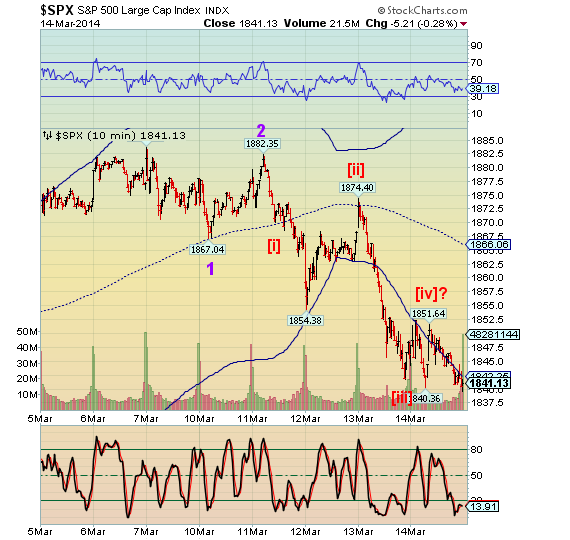
SPX futures tumbled 10 points at the open on Sunday, but were rescued by the JPY carry. There seems to be some confusion on how the Pre-market reads this morning. It shows the SPX up 10 points, but that appears to be from the Sunday open. The actual value is only 1843.00…maybe on the assumption that no one would read the news over the weekend.

Meanwhile, Crimea is moving ahead with the annexation by Russia, despite all the warnings from the West.

This leaves the SPX in an interesting position. There are clearly 3 waves down from the 1851.64 high on Friday, with a very modest bounce at the close. If SPX stays beneath 1845.00 this morning, it may continue its decline, completing a sub-minute impulse that may extend to the 50-day moving average at 1829.56 before the Minor Wave 4 bounce.

The point is, we must see the SPX break the lower trendline of the Orthodox Broadening Top (near 1820.00) before a larger-degree bounce this week. That implies an Intermediate Wave (1) decline to 1800.00 or even lower.


See the original article >>

No Lack of Opportunity in Ag Markets says M6 Capital

by Attain Capital

With planting season right around the corner, and spring just days away, it’s just about the time when investors looking for diversification turn their sights towards the Ag Markets. Lucky for us, M6 Capital recently published their opinion for what’s in store for the year to come, and the first tidbit is that speculators don’t appear to be waiting for spring to officially begin to make their decisions on where prices are headed…

“The Combined Speculative Position has increased…nearly 400,000 contracts [to net long] in the last 4 weeks, one of the largest 4 week speculative buying campaigns ever.”

Combined Spec Position(Disclaimer: Past performance is not necessarily indicative of future results)

While the early spike (in Corn and Wheat) has been mainly be attributed to tensions in Ukraine, M6 believes it isn’t Europe, but South America & U.S. conditions that might change the course of grain trends moving forward.

“M6 is of the opinion that Brazil and Argentina will return to selling and exporting large quantities of corn this summer. For Argentina, the largest single source of government revenue is grain export taxes. With a 24 million tonne crop and domestic use of only 8 million tonnes, there will be plenty to export. Their government is expected to issue export licenses shortly so exports can begin. At M6 Capital, we believe U.S. old crop (Sep 1) stocks will be a plentiful 1.5 billion bushels and new crop supplies (beginning stocks + new crop production) will be a record, large 15.9 billion bushels. Thus, we believe prices will eventually trade lower than current levels, and potentially much lower (Figure 2).”

CornChart Courtesy: M6 Capital
(Disclaimer: Past performance is not necessarily indicative of future results)

Much like corn, M6 predicts a plentiful crop of soybeans. Even though there’s an expected tight supply in the U.S., South America will pick up the slack, while China (the world’s largest soybean importer), might start taking in less. Even with a slimmer than usual supply coming from the U.S., it still represents a good portion of the estimated soybean supply when harvest time comes.

SoybeansChart Courtesy: M6 Capital
(Disclaimer: Past performance is not necessarily indicative of future results)

There is a caveat to this supply however. M6 believes that until investors and speculators gain confidence in the U.S. supply, pricing will remain strong.

How can we talk about Ag markets without mentioning Livestock, especially the Hog epidemic, sending Lean Hogs to all time highs. Under the assumption that farmers are unable to control the deadly virus that has thus far killed millions of young hogs, supply could hit its low from May-July.

PorkChart Courtesy: M6 Capital
(Disclaimer: Past performance is not necessarily indicative of future results)

Put all that together, and there’s no shortage of subplots in the Ag markets for the coming year – with viruses and geo-political tensions adding to the usual weather driven markets. After struggling for the first two months of the year, Ag Traders sure could use some good calls to get back on track for the year – but only time will tell how well the forecasts and analysis match up with price action moving forward.

See the original article >>

Follow Us