Thursday, July 18, 2013

Greece: Getting Even More Expensive

by Pater Tenebrarum

The Greek government is to consider fresh cuts to its still bloated public sector. A tragedy! Finally, he size of a government in Europe may actually shrink. We can already hear the wailing and gnashing of teeth from the port of Piraeus to the snow-decked peaks of the Alps up North.

Please note that this dreaded event has not happened yet, in spite of all the verbiage that has been spilled about 'austerity'. What has happened instead is that both government spending and government income from taxes have risen by leaps and bounds across the EU. In spite of their higher tax revenues, most governments continue to be fiscally incontinent. Their attempts to cut spending are the functional equivalent of gathering up water with a sieve – in fact, apart from three exceptions, they are all spending like drunken sailors. Greece's options in this regard are somewhat more limited, because a good chunk of its spending nowadays is being paid for by tax cows residing elsewhere, courtesy of the  'troika'.

This doesn't keep Greece from continually missing its ' fiscal targets' and keep asking for more money – in spite of having saddled private sector bondholders with a 70% haircut not once, but twice!  Of course one must keep in mind that a large percentage of Greece's bonds were owned by its own banks and banks in Cyprus. In Greece this has meant that the monies the banks lost were replaced with 'bailout' funds, so ultimately there was no haircut for the banks. In Cyprus something analogous happened, except that bank depositors – many of whom were suspected of dwelling in Russia – were asked to pay their share of the bailout. In a way this was a salutary event, because it served as a good reminder of the permanent de facto bankruptcy of  fractionally reserved banks. On the other hand, the population of euro-land is probably too busy either trying to survive (in the crisis countries) or getting dumbed down by shows on TV (elsewhere) to care much – so far, anyway.

Now it turns out that Greece may actually need another 10 billion euros, cuts or no cuts. Der Spiegel reports:

“The Greek recovery may be facing yet another hurdle. According to a report by German daily Süddeutsche Zeitung, the beleaguered country needs another massive influx of money if it is to avoid insolvency. The paper cites an unnamed official at the European Commission as saying that the "financial gap" could be as large as €10 billion.

The news comes at a difficult time for Greece and its relations with Germany. German Finance Minister Wolfgang Schäuble is set to visit Athens this Thursday for consultations with his Greek counterpart Yannis Stournaras and with Prime Minister Antonis Samaras. Schäuble is highly unpopular in Greece for his consistent insistence on austerity. And with German elections looming in September, it seems unlikely that additional aid money for Athens will be forthcoming anytime soon.

That, though, could create further problems for Greece. The International Monetary Fund — part of the troika of lenders keeping Athens afloat — is only allowed to provide aid to countries whose finances are guaranteed 12 months into the future. Otherwise, it must withdraw funding. Should that happen, countries like Germany and Finland, who have made their own participation in the bailout contingent on IMF involvement, could withdraw as well.

Concerns that Greece could be in need of additional assistance are not new. France, for example, recently called for direct EU assistance for wobbly Greek banks. In addition, Greek Economy Minister Kostis Hatzidakis told German daily Die Welt earlier this month that he expects Europe to agree to another debt haircut for the country, a conjecture with which he is not alone. Indeed, senior economists in Schäuble's own ministry told the daily Frankfurter Allgemeine Zeitung on Tuesday that a further reduction in the country's debt load is necessary.

"There will be a significant cut," Jörg Rocholl, president of the European School of Management and Technology and a member of an advisory council for the Finance Ministry, told the paper. "Greece's ability to shoulder its debts has not been guaranteed." The anticipated funding shortfall is partly a function of Greece's economy remaining stuck in recession as well as the slow pace of the country's privatization program and other reforms.”

(emphasis added)

The short version, with the important bits thrown in:

bla bla bla, another 10 billion, bla bla bla, evil Schäuble and IMF may withdraw funding (who are you kidding?), bla bla bla, banks STILL wobbly, need more money, bla, bla, debt haircut number three is coming! bla bla, bla…it's the fault of 'austerity'!

This is truly cringeworthy stuff. Why didn't they all just shrug right at the beginning and say: “OK; Greece is bankrupt. What can you do? It's no big deal. It's been bankrupt in 90 of the past 180 years. We've all survived its serial bankruptcies without problems before. Let's do so again.”

But no – instead Greece has been plunged into a never-ending economic crisis, its creditors have lost their shirt anyway (twice already, with the third time approaching fast), and it has turned into a bottom-less pit, a kind of black hole that sucks in money that is then never seen again, because it evidently leaves the known universe as soon as it is thrown in.

The ineptitude at display in the so-called 'rescue' of Greece is simply stunning. The people responsible for this must either be the biggest bunch of morons ever assembled on this planet,  or they are evil demons that have been sent from hell.


EU revenue and spending

Government revenues and spending in the EU 27. As we always stress, so-called EU 'austerity' is a complete myth. Their combined spending declined ever so slightly in just one year, when the markets really put pressure on them. They've made up for that by accelerating it just one year later. Whatever 'austerity' is about, it is certainly not about shrinking the State. For more charts in the same vein, see this article by Martin Masse, a researcher at the  Institut économique Molinari in Paris, who has just written about this very topic. A topic which has become the equivalent of a dead horse in these pages we might add, one that we must keep beating. At least we're no longer the only ones doing so – via Eurostat.


Let's Go On Strike

The Greeks themselves have a time-tested, if slightly odd way of reacting to their nation's plight. Apparently the many surplus to requirements bureaucrats feel strongly that someone owes them a living. If it is not the Greek state, then it must be Wolfgang Schäuble. To make their feelings known, they have decided to go on strike again. There is always a danger when civil servants go on strike – it could easily happen that they are not missed by anyone. What then? There are currently 600,000 civil servants in Greece, who preside over what one might charitably call 'total chaos plus corruption'.

Of course it must be acknowledged that losing one's job in an economy with a 27% unemployment rate is a scary prospect. We don't want to make light of the very real problems these people are about to face. However, it is in large part because Greece is home to an incredibly complex and corrupt bureaucracy that its economy is in such dire straits. When it takes 10 months and bizarre, Kafkaesque running battles with tens of different bureaucracies to get a simple permit for an internet business that one can get in the US within 24 hours (and the US are no longer the paragon of the free market they once were we might add), then it is time to admit that something is seriously wrong.

“Indeed, when EU leaders approved the latest tranche of aid money for Greece earlier this month, they elected to spread it out over several months so as to increase the reform pressure on Greece.

The results of that pressure are coming to a head on Wednesday, with parliament set to address the slashing of thousands of public sector jobs by the end of this year. To protest the measure, labor unions on Tuesday staged their fourth general strike of the year, paralyzing the capital with peaceful marches. While it is widely expected that the Antonis [sic! ed.] government will be able to pass the measures demanded by the EU and the IMF, his margin for error is tiny. One party recently left his coalition in protest at ongoing austerity, leaving Antonis with just a three seat parliamentary majority.

And public employees will be doing their part on Wednesday to remind parliamentarians of their opposition to austerity. Athens is seeing further protests with mayors from around the country marching on parliament as municipal police officers staged a demonstration as well.”

The people writing for 'Der Spiegel must be chums of Antonis Samaras, since they keep referring to the 'Antonis government' above. As to the idea of 'increasing reform pressure on Greece', we ask one more time: who are you kidding?

We are also continually wondering what people actually mean when they 'oppose austerity'. What austerity? Admittedly, Greece and Portugal (and Poland for some quirky reason), are the only countries in the EU that have indeed seen a decline in government spending – a decline so small, you almost need a magnifying glass to see it on a chart. But let's face it: these governments are bankrupt. So what is actually the choice? If they didn't get funded by bailout money, they could spend even less, since no private sector lender would have the guts or be foolish enough to lend them any more money, at least until the usual short attention span syndrome strikes again.

By the way, here is someone who should perhaps think hard about the impending 'haircut number three'. Apparently a hedge fund led by Paul Kazarian has decided to buy 10% of the currently outstanding Greek government debt for $3.8 billion. A 70% haircut would transform this small fortune into a slightly smaller fortune of $1.14 billion. It would be a bit like visiting the casino actually. Once again though, it would be a salutary event in a way. It would prove that contrary to the assumptions of lenders to governments, they are not safe just because governments have the arrogated the right to obtain their income by political means to themselves. Sometimes it is not enough, especially when the people expected to pay reside in a different territory.

There can be no great harm in strikes by public sector workers and mayors. In fact, when they are not working, they can at least not do much harm.  Apparently though in Greece these occasions are used for general strikes, 'paralyzing the capital' as noted above. That is definitely economically harmful and Greece needs such economic setbacks like a hole in the head. Why the unions would call for these strikes is slightly beyond us as well. Shouldn't they be more concerned with getting the country back on its feet rather than inflicting even more damage? After all, the strikes are utterly senseless; they cannot possibly change anything – on the contrary, after the strikes the government will be even more broke than it was before them.

Unsound Money Is No Solution

Some people argue that Greece should leave the euro as it could then devalue – as if economic prosperity could be restored by destroying one's currency. 'Devalue' means of course nothing but 'inflate'. The citizens of Greece however regularly confirm in surveys (with majorities of 80%) that the one thing they definitely do not want is a return to the drachma. This is by the way how citizens all over the euro zone think: in the crisis countries, they all want to retain the euro, because they regard it as a far sounder money than the currencies they have relinquished. They trust the ECB far more to keep the  currency's value intact than they would ever trust their own central banks, and rightly so. In the former 'hard currency' nations like Germany, the euro has a far more difficult stand: in those countries, the currency that was given up in favor of the euro is regarded as sounder than the euro, so people are pining for its return.

This may actually be the most valuable lesson from the crisis: everywhere citizens want sound rather than unsound money. Not even the false promise of government 'inflating away' the economic troubles can entice them to change their mind on this topic. Can there be any doubt as to what they would prefer to use for money if the money monopoly of the State were rescinded?

See the original article >>

Hogs face PED scare, while cattle futures watch cash

By Rich Nelson

Hogs: Wholesale pork prices fell yet again Wednesday. There is now a full 11.36 between June’s high for wholesale pork prices and the most recent settlement. It is hard moving this pork right now in the face of heat across the United States.

On the other end of the pork market, cash hogs, there is still a battle waging in psychology. We really have not fallen much on the cash hog end from the June highs. There is one pork analyst calling for a hole in market-ready numbers during December. There is also talk now that some operations with PED are simply culling all young piglets in the farrowing building. This news certainly sounds incredibly bullish.

The big problem here, like many other scares, is getting hard numbers. The number of new PED cases is actually beginning to fall. However, you must consider that many farms with it have not reported it or could be attributing symptoms to other problems. In other words, just like the bogus stories we heard about China buying incredible amounts of U.S. pork, there is no way to confirm or deny this talk. Until we can quantify numbers, and therefore compute the potential price impact, the “story” will be believed. That has provided some good support to cash hogs in the face of this pork price decline.

Allendale has discussed our expectation for a slight bounce in the second half of the month. That would be normal for this year and not a PED issue. For now, we cannot find the short-term change in fundamentals (wholesale pork) that is needed to get this expectation turned into reality.

For speculative trading, the profit-protecting stop on the cattle/hog spread was filled Wednesday due to the drop in cattle prices. As you remember, as that spread continued to gain, the stop was moved up in a stair-step fashion. We will look to apply this again next month using different contracts of each pit…Rich Nelson
Cattle: The trade is getting a little concerned about this near-term cash cattle situation. Allendale’s 10-year index measurement of cash cattle prices shows this week is the typical bottom for cash. Of course, that is made up of various summer lows ranging from May through August.

However, it represents an important issue. We are now moving into a “later than normal” potential bottom for this year’s cash. This fits in with some concerns noted in our commentaries recently. So far wholesale beef is still falling. You can also make an argument that spring placement numbers put an extra head or two in the August time frame. Hot temperatures along the East Coast, the #1 beef demand center, are also issues to consider. For the short term, this market is still waiting for cash cattle. This does not concern us at all with Q4 or Q1. Summer markets are a completely different issue than winter.

For Friday’s COF report, we are all looking at placements. The average guess is for a 5.3% decline for June feedlot inflows. Allendale is the lowest estimate of the group with our 10.7% decline estimate. Keep in mind cash cattle was still falling and cash corn was rising from May to June in the Plains. These numbers certainly support the long-term picture (November through February). For the near term, it would appear the trade is looking at the June marketing estimates and getting concerned. The average guess is for a 5.5% decline vs. June of last year. Allendale is right there with our 4.7% lower estimate.

If you didn’t know how these numbers are made you would assume that represents a drastically poor pace to last month’s numbers, right? Keep in mind that analysts are making these numbers recognizing there was one less weekday on the calendar in June of this year than June of last year. That “lowers” this number by 4%. Now, consider that July of this year will have one more weekday. That will make the August COF report, which shows July marketings, will be skewed “higher” by 4%. Bottom line here is the short term cattle/beef market is still sloppy and Friday’s COF report will make it “appear” even worse due to the marketing number.

For the speculative trades, we have been moving the stops higher with the market’s rally in previous weeks. The first of these “profit protectors” was filled Wednesday. Our long-term projections of $134 to $136 on the February remain wholly intact. If the market wants to set back for a couple weeks here, that is no problem…Rich Nelson

See the original article >>

Why crude oil inventories continue to decline?

by SoberLook

US crude oil inventories fell sharply for a third week in a row, dipping materially below the levels from the same time last year. As a result WTI crude price remains firmly above $106.

Source: EIA

This drop in supplies is surprising because US crude production has recently spiked.

BW: - U.S. crude inventories were forecast to decrease by 2 million in the week ended July 12, according to a Bloomberg News survey of analysts. Stockpiles dropped more than three times that much, even as production surged to the highest since December 1990. The supply gain was offset as refineries processed 16.2 million barrels a day, the most since August 2005...
US refineries, particularly in the Gulf Coast, are operating near full throttle. While this time of the year is peak production for refineries, this year's crude oil demand is clearly outstripping last summer's. And the nation's inadequate oil transport system is not helping matters.

Source: EIA

EIA: - Crude runs at U.S. refineries have increased steadily since early March to reach some of the highest levels on record. At 16.1 million barrels per day (bbl/d) for the week ending July 5, U.S. crude oil runs were the highest for any week since 2007. This level represented a 2.1-million-bbl/d increase from the first week of March, the low point for the first six months of 2013. While the increase in crude runs since March reflects a particularly strong rebound from spring maintenance, an underlying combination of recent refinery capacity expansions and relatively healthy margins helped drive the absolute level of runs to a multiyear high.
As the EIA points out, the refinery demand is driven by larger capacity and "healthy margins". Indeed the gasoline to Brent spread is near a multi-year record. At these levels refineries are quite profitable and will try to sell as much gasoline as possible.

See the original article >>

The Mirror Cracks

By John Mauldin

“Life invests itself with inevitable conditions, which the unwise seek to dodge, which one and another brags that he does not know, that they do not touch him; but the brag is on his lips, the conditions are in his soul. If he escapes them in one part they attack him in another more vital part. If he has escaped them in form and in the appearance, it is because he has resisted his life and fled from himself, and the retribution is so much death.”

– Ralph Waldo Emerson

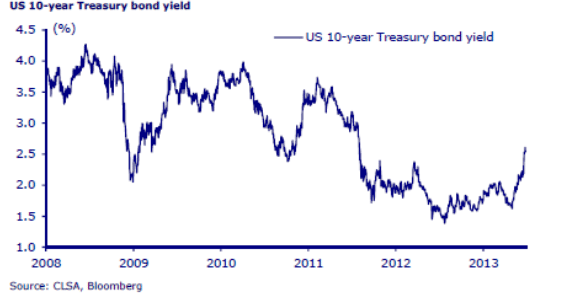
The financial markets have now seen what a world without quantitative easing is going to look like, and they don’t like what they see one bit. In fact, the mere possibility of an end to the Federal Reserve’s monetary experiment sent credit markets to some of their biggest losses in recent history both in absolute and percentage terms. All of these losses were triggered by a move in the benchmark 10-year Treasury yield from a low of 1.63% on May 2 to a high of 2.66% just a few days before ending the quarter at 2.49%. ISI Group has done some great work placing this move in context. In 1994, a year generally viewed as Armageddon for bond investors, the 10-year Treasury only increased by 90 basis points during a comparable 2-month period that started a sustained increase in rates. Moreover, in percentage terms, the 1994 move was only 20% over that period while the current move was 40%.

Figure 1 1994 Redux … Only Worse

Conditions today are far different than those in 1994, however; today they are far more conducive to rates staying low. During that period in 1994, the Federal Reserve hiked the Federal Funds rate by 70 basis points (the first leg of a move that would see the Federal Reserve raise rates by another 175 basis points by the end of that year – with 10 year Treasury yields following by another 100 basis points). In contrast, today there is no chance that the Federal Funds rate will be increased for at least the next two years. For another, the Federal Reserve’s balance sheet has already increased by more than $400 billion this year and is expected to increase by another $450-500 billion by year end. So while the Federal Reserve tightened by 250 basis points in 1994, the Federal Reserve’s bond purchases are effectively lowering interest rates on the order of 70 basis points (ISI’s estimate) today. The comparison between the recent interest rate spik e and 1994 underlines just how Fed-dependent markets have become and how incredibly difficult it is going to be for Mr. Bernanke and his colleagues to alter policy without causing serious market dislocations. What investors should learn from this is that they should be preparing their portfolios now for serious – perhaps unprecedented – volatility when the Federal Reserve finally does what it needs to do and stops propping up the markets. Some of us began doing this several months ago and avoided damage to our portfolios in May and June (while still earning decent returns in the interim).

The pain in credit markets was widespread. High yield bonds, which were trading at an oxymoronic yield of 4.8% in early May, closed June at 6.66% after reaching a high of 6.9%. Average bond prices fell about 6 points from a high of 107 in early May and spreads widened by more than 100 basis points. Historically, spreads have contracted when yields have increased, but as with many traditional correlations this one did not hold in an era of unprecedented central bank policy manipulation. This is likely because the duration of high yield portfolios has lengthened as issuers steadily stretched their debt maturities through refinancings. Despite all the talk of the importance of keeping portfolio durations short, many managers succumbed to the temptation to lengthen them as stable credit conditions persisted. The sell-off created some interesting anomalies (i.e. opportunities), including an inversion of high-quality cash curves, a widening of the cash/credit default swap basis, outperformance of high quality loans, and underperformance of high quality high yield bonds. For example, BB-rated bonds performed worse than CCC-rated bonds (the reverse of what has normally happened in the past), while the reverse happened in the loan space. As for credit default swaps, it appears that the use of these instruments by mortgage hedgers to protect their structured portfolios forced single name credit default swap spreads to widen; this has made it more attractive for investors to sell protection rather than own cash bonds in many credits. Before too many observers get too tempted by near 7% yields, however, they should take a deep breath and remind themselves that high yield bonds (and their derivatives) are hybrid debt-equity securities that on average still offer far too little reward for the risk involved in owning them. Relative value is not value.

Investors have clearly been shaken. High yield mutual funds and ETFs have reportedly seen $12 billion of outflows over the last five weeks, representing about 7% of their total assets. According to Citigroup, this reversed the total inflows of the past 14 months. Investors in this asset class are nothing if not fickle. Put another way, these assets – at least at the margin, which is what matters in markets – are held by weak hands. There lies the risk … and the opportunity.

By way of comparison, leveraged loans saw their average price drop by less than $1.00 in June; their yields increased by 56 basis points and their spreads widened by only 33 basis points according to J.P. Morgan, demonstrating again why they remain extremely compelling defensive holdings.

Investments that are considered the most conservative (not by me but by the consensus) – municipal and investment grade bonds – were also battered. For example, the iShares S&P National AMT-Free Muni Bond ETF (MUB) sold off from 111.60 on May 1 to a low of 100.28 before recovering to end the month at 105.04 (a loss of 5.88%). The iShares iBoxx Investment Grade Corporate Bond ETF (LQD) saw a loss of 3.56% in June (from $117.85 to $113.65). While significant, these losses should be seen in the context of the significant returns that these asset classes have generated in recent years. Mortgage-backed securities suffered their worst performance since 1994 with a 2% loss in the second quarter. Subprime mortgage bonds also lost 2% during the quarter including a whopping 4.9% drop in June alone. This is hardly surprising in view of the obvious dependence of the mortgage market on the Federal Reserve’s $40 billion monthly bid for paper. These losses may be painful but they are hardly catastrophic as long as they don’t persist.

Some of the best bond investors with the most impressive long-term track records were badly hurt. Bill Gross’s $285 billion Pimco Total Return Bond Fund (PTTRX) lost 2.8% in June (dropping from $11.07 to $10.76) and is down -4.27% for the year (from $11.24 on December 31, 2012), while his colleague Mark Kiesel’s $11 billion Pimco Investment Grade Corporate Bond Fund (PBDAX) lost -4.08% in June (from $11.01 to $10.56) and is down -5.04% for the year (from $11.12 on December 31, 2012). Even Jeffrey Gundlach was taken by surprise by the sudden sell-off in the 10-year Treasury as his DoubleLine Total Return Fund (DLTNX) lost 2.13% in June (from $11.26 to $11.02) and is down -2.38% for the year (from $11.33 at year end). Both Mr. Gross and Mr. Gundlach were apologetic about their performance, but neither man has anything to apologize for in view of their outstanding long-term records. Nonetheless, the fact that two of the market’s greatest long-term perf ormers were unprepared for the market’s reaction to Mr. Bernanke’s words suggests just how deeply embedded Fed-dependency has become in the financial markets. Both men have stated that they believe that Mr. Bernanke’s forecast of 3.0-3.5% GDP growth in 2014 is too optimistic, and both have reiterated their view that Treasuries are attractive at 2.5% (views first stated when Treasuries were at 2% after selling off from their low of just over 1.6% at the beginning of May). I concur with them that the economy is unlikely to grow at better than 3.0% in 2013, but I find nothing remotely compelling about lending to the U.S. government for ten years at 2.5%. Buying 10-year Treasuries as a trade may make sense for the most nimble, but it is difficult to be nimble when managing tens or hundreds of billions of dollars. Investing in Treasuries at their currently artificially depressed yields is playing with fire. It is one of the wonderful ironies of the English language that the word “taper” not only means to “gradually withdraw” but is also a noun used to describe a long, thin candle or a long, waxed wick used to light candles or fires. Perhaps the Princeton economics professor was playing with the market in more ways than people realize when he used that term to describe his future policy moves.         

There is little question that markets were overdue for a correction. That is why I advised investors to reduce their equity holdings two months ago and why I have been recommending limiting credit exposure to short duration corporate bonds and floating rate bank loans since the beginning of the year. By April, the most prudent posture was to be hedged against rising interest rate risk and widening spreads. In high yield, there are three risks that have to be addressed at any given time: interest rates, credit and systemic/macroeconomic risk. For the moment, credit risk is well-contained (the default risk is about 3.0% and any capable manager should be able to avoid defaults), so the focus is on hedging rising rates and an equity market correction. It is likely that the 4.8% average yield on high yield bonds reached in early May will prove to be a generational low, just as some believe that the March 2009 S&P 500 level of 666 will serve as a generational low for s tocks. The difference, of course, is that the S&P 500 low was expressing the depths of investor despair while the May 2013 low in yields was the apogee of investor complacency. And while it took only a short time (about six weeks) for high yield investors to be dealt a dose of reality, average yields of under 7% remain far below what is appropriate to reward them adequately for the equity risk inherent in the asset class.

Spreads of about 550 basis points over still shrunken Treasury yields may seem like a reasonable risk premium in historical terms, but it is highly misleading in measuring the true risk of these instruments. First, the prices of all financial assets – including high yield credit – is still being artificially depressed and distorted by years of zero interest rate policy and successive bouts of quantitative easing by the Federal Reserve and other central banks. Second, “spread” is a fixed income measurement tool being applied to a financial instrument – a high yield bond – that shares both fixed income and equity attributes. I often tell investors that high yield bonds are like a child who has inherited the worst attributes of both of his parents. When the bond market sells off, high yield bonds sell off; when stocks sell off, high yield bonds sell off as well! As the ultimate “risk-on” asset class, high yield bonds find any excuse to pile on to the “risk-on” trade and any excuse to run for the hills when the “risk-off” button flashes red. Any equity investor will tell you – or should tell you – that 7% is an inadequate return for taking equity risk (which involves the risk of loss of all or part of your principal).

Ben Bernanke, of course, is trying to lower investors’ threshold regarding the return they require for taking risk, but investors should not be fooled. By doing what he is doing, Mr. Bernanke is actually significantly increasing the systemic and other risks that investors are facing. And for that reason, investors should actually be demanding higher, not lower, real returns on their investments. I realize that last statement is directly contrary to the consensus that argues that the Federal Reserve (and other central banks) have taken the tail risk out of the markets with their extraordinary market interventions. My response to the consensus is that central banks have done nothing of the kind; at best, they have delayed the occurrence of tail risks, but in doing so have guaranteed that the consequences of trail risks will be far more severe when they inevitably materialize. The policies that are being employed to create the appearance of economic and market sta bility are not effectively addressing the underlying symptoms of economic malaise; in fact, they are exacerbating them. Debt is being used to cure a debt crisis in the hope that fiscal policies will be implemented that will foment sufficiently high economic growth to create the income necessary to service and ultimately repay that debt. But even in the best of all possible worlds such an outcome would be a long shot since the sheer amount of debt being generated to keep economies afloat is too large to be serviced or repaid. And as we are all painfully aware, we don’t live in the best of all possible worlds – we live in a world populated by corrupt and narcissistic politicians and business leaders who refuse to effect the necessary fiscal reforms that would at least give monetary policy a chance to work. As a result, the post-crisis world has been left more indebted and more interconnected than the pre-crisis world. The tails may be buried a little deeper than they were, but they are fatter than ever.

Mr. Bernanke is creating the conditions for a violent market reversal. As I wrote last month (“Delusions of Stability”), the dependence of markets on the continued beneficence of the Federal Reserve is profoundly unhealthy. When Mr. Bernanke said that the Federal Reserve expects 2014 growth to clock in at 3-3.5% (too high in my opinion – I expect 2.75-3.0%), and that if this growth comes to pass, the Fed will then begin to taper (which means to reduce gradually, not to stop suddenly) its bond purchases at the end of the year, the market’s reaction was sudden and violent. Yet at the end of the day, the S&P 500 barely lost 5% before Mr. Bernanke sent his minions out into the media to dispel any fears that the Federal Reserve would abandon the markets. Such backpedaling is highly dysfunctional. As David Rosenberg wrote, “I guess the premise is there should never ever be periodic setbacks even for a market that has surged 135% from the c ycle lows. Incredible.” (David Rosenberg, Gluskin Sheff, Breakfast with Dave, June 26, 2013, p. 3.) Mr. Bernanke mentioned at his post-FOMC news conference in June that he was surprised by the rise in interest rates after his May 22 testimony, which suggests that he may not appreciate just how Fed-dependent the financial markets have become since the financial crisis. Now that is really incredible.

Sometimes it seems like our central bankers populate a parallel universe completely detached from the real world of markets. Take their fear of deflation. There is an enormous difference between a debt-induced deflation of the kind we saw during the financial crisis, where massive debt destruction led to systemic stresses, and the type of low consumer inflation (which I don’t believe for a second, but that is a separate conversation) that the Federal Reserve is now obsessing about. As David Rosenberg notes, “as for ‘goods deflation’, what is wrong with consumers being able to buy more eggs, bread and T-shirts with the dollar they earn? This push against deflation is remarkable in its own right – historically, this was the norm and inflation was the hallmark of wartime, and the economy looking back at centuries of data did quite well in this respect, thank you very much.” (David Rosenberg, Gluskin Sheff, Breakfast with Dave , June 26, 2013, p. 3.) Uber-dovish St. Louis Fed President James Bullard not only dissented from the most recent Federal Reserve Open Committee statement (because he thought it was too hawkish), but later stated that the Fed might have to provide more accommodation to protect its inflation goal. In view of the trillions of dollars of direct and indirect accommodation that has already been provided, the gross distortion of the value of all financial assets (even after the recent minor correction), and the long-term risks of such an unprecedented policy, it would not be inappropriate to consider Mr. Bullard’s stance a form of lunacy. The United States is hardly at risk of experiencing a deflationary spiral downward in consumer prices, and the Federal Reserve’s focus on deflation is profoundly misguided.

Equities

The hysteria over a 5% correction suggests that the only thing that matters for stock market investors is what the Federal Reserve says and does (or doesn’t do). I believe that Ben Bernanke was trying to take some air out of the financial markets, including both stocks and bonds, with his cautionary comments about the possibility of the Federal Reserve tapering its bond purchases by year end if economic growth meets his expectations. Some argue it will happen as soon as September; others that it will not begin until sometime in 2014. Regardless of when it happens, what stock market investors need to be concerned about is the weak support for stock prices above 1600 on the S&P 500 (or above 15,000 on the Dow Jones Industrial Average) without the Federal Reserve’s current level of bond purchases (zero interest rates are here to stay until at least 2015). From that perspective, stocks may be living on borrowed time. Earnings momentum alone is unlikely to sustain stock prices in the next few quarters. Companies warning investors to expect disappointing results outnumbered those promising better results by a 6.5-to-1 margin, the worst ratio since 2001. And analysts are projecting second quarter profits growth of a modest 3%, down from the 8.4% they were expecting in January. Revenue growth, which disappointed in the first quarter, is projected to increase by only 1.8% in the second quarter. GDP growth is stretching to reach 2.0%. At this point, the strongest factor supporting the case for higher stock prices is the 90% correlation between rising stock prices and the growth of the Federal Reserve’s balance sheet. That balance sheet is likely to rise by another $450 billion over the rest of 2013. Investors willing to count on that correlation persisting may be rewarded, but they should limit their holdings to special situations (i.e. stocks where there is an identifiable catalyst to higher value) or those trading at discoun ts to the market’s price/earnings multiple (i.e. value stocks). I would expect growth stocks and dividend stocks to lag as growth struggles and interest rates edge higher over the next 12-18 months.

Credit

Many investors will be tempted to see value in suddenly battered debt instruments of all kinds – munis, investment grade and high yield bonds, mortgage-backed securities. It needs to be pointed out that this is only relative value – in absolute terms, all of these instruments – on an average basis – are still trading at artificially depressed yields as a result of the Federal Reserve’s policies (which, just to be clear, haven’t yet changed and are unlikely to change for at least several months). The fact that so few investors in credit were prepared for the recent sell-off is a classic example of Hyman Minsky’s financial-instability hypothesis whereby stability breeds instability: as stable financial market conditions persisted and extended since 2009, credit investors grew increasingly complacent and added leverage, duration and illiquidity to their portfolios. The correct approach was to do the opposite – as the cycle became more extended, they should have been shortening duration, eliminating leverage and selling their least liquid holdings. They might have been “early” and sacrificed some returns in the short-run, but in the long-run their returns would be much better. At this point, investments should be focused with managers who understood this. In the high yield space, the sell-off has created a new set of opportunities in short duration bonds and loans with low ratings (that overstate their default risk) issued by some of the large buyouts of the mid-2000s (these securities held up extremely well during the sell-off). In general, investments in credit need to be focused on event-driven special situations where there is (like in the equity space) an identifiable catalyst to near-term value realization. Investors do not want long-term exposure to interest rate or macroeconomic risk.

Currencies

I expect the Yen to resume its weakening against the U.S. Dollar and Euro again shortly. Japan remains set on its policy course and will not stop until the Yen trades at much weaker levels (at least 120 to the U.S. Dollar). This should allow the Yen carry trade (properly hedged) to remain attractive for a while longer. For the moment it appears that Japanese Government Bond rates have stopped rising although the possibility remains that the Bank of Japan could lose control over the long end of the curve at any time. The Euro continues to maintain its strength as the region’s economies wither on the vine, but there is no reason to believe that the currency’s strength will persist forever (although every time I recommend that investors stay short the euro, Keynes’ words “in the long run we are all dead” run through my head). Europe is still a mess and little is being done to fix it. Interestingly enough, the European Central Bank’s b alance sheet has actually been shrinking over the past year, something that is hardly conducive to economic growth. The fact that the European currency remains above $1.30 in the face of all of these factors has to make this among the most frustrating trades in recent memory. It is also a great example of why financial markets work in practice but not in theory and why investors have to be very careful using leverage when investing in currency markets. All that being said, the Euro will crack sooner or later and I would remain short (without leverage obviously).

Gold

Gold has been decimated in recent weeks, with the spot price closing the quarter at $1,234.57/oz. Gold was down -27% over the first half of the year (-23% in the second quarter), about twice the inverse of the rise in the equity markets. Even as a hedge, therefore, gold didn’t work. I would attribute the plunge in gold to several factors. First, a lot of gold was held by leveraged speculators who were forced out of the market as prices dropped. Second, investors who view gold as an inflation hedge are abandoning the trade based on the low level of reported consumer price inflation in the U.S. Third, investors who view gold as a hedge against the inevitable demise of the fiat paper standard are coming to believe – wrongly in my view – that central banks are going to change their ways. For all of these reasons, gold is back to levels last seen in 2010.

Gold remains an insurance policy against the inevitable decline of the fiat paper standard. There is far too much debt in the world that can never be repaid in constant dollars. This debt can only be repaid in one of three ways: (1) partially, which means through defaults and restructurings (see, for example, Greece, Cyprus); (2) through inflation; and (3) through currency devaluation. The global economy is simply incapable of generating sufficient income to service and then repay the trillions of dollars of debt on the balance sheets of the central banks not to mention all of the other public and private sector debt, nor the hundreds of trillions of dollars of future entitlement obligations of its governments. In the end, paper money will continue to be devalued and gold will be the beneficiary of that phenomenon. I would be perfectly comfortable adding to gold positions at this level as a long-term trade, and would strongly advise investors who do so to purchase phy sical gold.

See the original article >>

Coffee’s Latest Inflection Point

by Greg Harmon

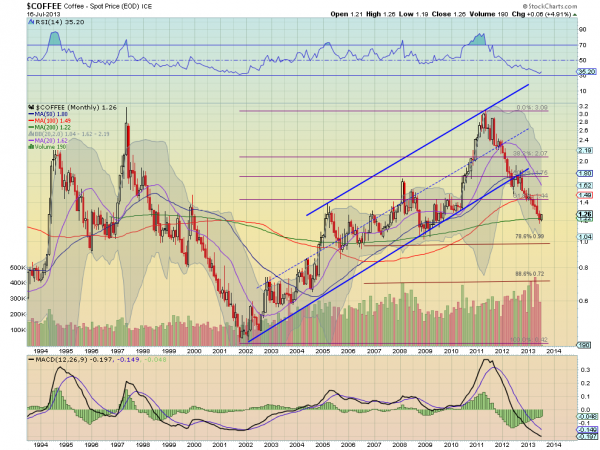
Coffee ($KC_F, $JO) has had a hard life the last 2 years. Falling from a high over 3.08 to the current level at 1.26. There have been points along the way where it could have reversed higher, and some that have caught myself and other wrongfooted. Yet it continues lower. The monthly chart below shows that is at another of those inflection points right now. The straight line trend lower is, if only for the moment, finding support at the 200 week Simple Moving Average (SMA). As it rests there it has a Relative Strength Index (RSI) that is starting to turn higher as it is very close to the technically oversold line, and a Moving Average Convergence Divergence indicator (MACD) that has been improving on the histogram for over

coffee m

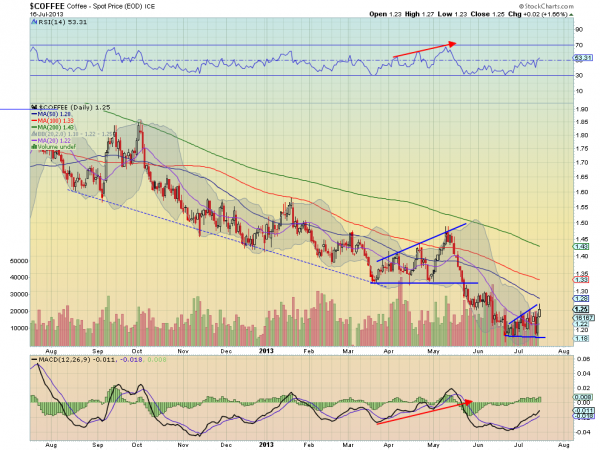
a year. That is no guarantee for a turn but does give a reference to trade against. In fact the Measured Move lower would take it to 28 cents, and the next Fibonacci level lower is at 99 cents, down another 25% from here. But the daily chart corroborates the case for a bounce. Price has been moving higher since mid June in an expanding wedge, a classic reversal pattern. The RSI is also making a 2 month high and crossing the mid line. Finally the MACD is moving higher on both the signal line and the histogram. If it wants to bounce it has the technicals aligned for it. Of course the daily chart also looked like this in April, and it did rise then, before falling over 20%. Use a stop if you trade it and that 200 month SMA seems like a good one.

coffee d

See the original article >>

Why the Easy-Money Markets Will Soon End

By George Leong

It seems like every day we’re seeing the stock market advance higher, which makes me wonder if traders are just trigger-happy and trading on the momentum in the market—and, trust me, there’s plenty of it.

Whether you are a day, swing, or longer-term trader, there’s easy money to be made. The Federal Reserve has provided you with this great opportunity, so take it.

The only issues that continue to cast a cloud over the situation are the state of the country’s finances, namely the national debt and the many municipalities and states experiencing economic hardship. Recall my previous commentary on the colossal financial crisis in Detroit. The city is burdened by a massive debt load, declining revenues, and a rapid decline in population migration that has spanned across more than three decades. But Detroit is not an aberration. There are other regions across America that have fallen into the same financial abyss.

What really puzzles me is that the stock market is acting as if everything around us is faring well—which is far from the truth.

The U.S. economy is not expanding at a pace that I would deem acceptable, given the reaction in the stock market. The media harps on about the fact that the growth of China’s gross domestic product (GDP) growth was only 7.5% in the first quarter, but that’s pretty darn good versus America’s GDP growth.

The scary part is that the Federal Reserve, in all of its great wisdom, has been downgrading the country’s GDP growth as Chairman Ben Bernanke and the other Fed members clearly realize that the economy is in trouble. That’s why interest rates continue to be near zero and why the Fed’s bond buying is continuing.

Not too long ago, the Fed estimated GDP growth would be 2.5%–3.0% for 2013, rising to 3.0%–3.8% for 2014.

You must be shaking your head like me. There’s little chance these GDP growth estimates are going to be met. Recall the June Federal Open Market Committee (FOMC) meeting, when the Fed cut its GDP growth target to 2.3%–2.6% for this year. My opinion is that the estimate will again be cut once the Fed accepts that the economy is stalling.

Just take a look at the first quarter, when the third estimate showed that GDP growth was a pitiful 1.8% versus the Briefing.com estimate calling for GDP growth of 2.4%. That’s a major miss.

As for second-quarter GDP growth, I think we will be underwhelmed. All four components that make up the GDP are stalling. One key component is government spending; and with the sequestration and the push to cut the deficit, we know GDP growth will be soft.

So continue to ride the market advance, but keep in mind that America really is struggling to grow.

See the original article >>

Follow Us