Tuesday, June 4, 2013

The Threat to the Central-Bank Brand

by Mohamed A. El-Erian

NEW YORK – The “branding” of modern central banking started in the United States in the early 1980’s under then-Federal Reserve Board Chairman Paul Volcker. Facing worrisomely high and debilitating inflation, Volcker declared war against it – and won. In delivering secular disinflation, he did more than change expectations and economic behavior. He also greatly enhanced the Fed’s standing among the general public, in financial markets, and in policy circles.

This illustration is by Dean Rohrer and comes from <a href="http://www.newsart.com">NewsArt.com</a>, and is the property of the NewsArt organization and of its artist. Reproducing this image is a violation of copyright law.

Illustration by Dean Rohrer

Volcker’s victory was institutionalized in legislation and practices that granted central banks greater autonomy and, in some cases, formal independence from long-standing political constraints. To many, central banks now stood for reliability and responsible power. Simply put, they could be trusted to do the right thing; and they delivered.

As any corporate executive will tell you, brands can be consequential drivers of behavior. In essence, a brand is a promise; and powerful brands deliver on their promise consistently – be it based on quality, price, or experience. In some cases, consumers have been known to act on the strength of brand alone, even purchasing a product with relatively limited knowledge about it.

Indeed, brands send signals that facilitate the task at hand. In some special cases – think of Apple, Berkshire Hathaway, Facebook, and Google – they have also acted as a significant catalyst for behavioral modification. In the process, they often insert a wedge that essentially disconnects fundamentals from pricing.

Building on Volcker’s success, Western central banks have used their brand to help maintain low and stable inflation. By signaling their intention to contain price pressures, they would alter inflation expectations – and thus essentially convince the public and the government to do the heavy lifting.

In the last few years, however, the threat of inflation has not been an issue. Instead, Western central banks have had to confront market failures, fragmented financial systems, clogged monetary-policy transmission mechanisms, and sluggish growth in output and employment. Facing greater challenges in delivering desired outcomes, they have essentially pushed both policies and their brand power to the limit.

This is apparent in central banks’ aggressive emphasis on communication and forward policy guidance. Both have been used more widely – indeed, taken to extreme levels – to supplement the unconventional expansion of balance sheets in the context of liquidity traps.

Now, corporate executives will also tell you that brand management is a tricky affair. It is particularly hard to maintain or control your brand when popular sentiment overshoots.

This is what happened to Apple’s stock this year. As brilliantly explained by Guy Kawasaki in his book on the company, the brand essentially created “enchantment.” Extrapolating this into a market view that Apple could not only innovate continuously, but also fend off any and all competitors, investors took the company’s share price to dizzying heights.

Elsewhere in California, Facebook found its brand fueling enormous hype for the company’s initial public offering. Encouraged by investor excitement and indications of over-subscription, underwriters hiked the IPO’s price well above what they had first deemed reasonable. Issuing the stock to the public at an inflated price a year ago, the shares initially traded even higher.

In both of these cases, and in many others, brand power did more than lead to price behavior that was disconnected from fundamentals; it also caused a dangerous overshoot, which, when subsequently reversed, damaged the brand.

However powerful, brands cannot divorce pricing from fundamentals entirely and forever. Accordingly, and despite a significant market rally that has taken many individual stocks to record highs, Apple and Facebook currently trade at almost half their record levels. Their dominance and influence are no longer unquestioned.

Western central bankers should spend some time reflecting on these experiences. Some have actively encouraged markets to take the prices of many financial assets to levels no longer warranted by fundamentals. Others have stood by passively. Indeed, it seems that only retiring central bankers, such as Mervyn King of the Bank of England, are willing to raise concerns publicly.

This behavior is understandable. Central bankers are basically hoping that financial-market hype by itself can help pull fundamentals higher. The idea is that price action will trigger both the “wealth effect” and “animal spirits,” thus inducing consumers to spend more and companies to invest in future capacity.

Count me among those who worry about this situation. Far from a world of optimal policy, central bankers have been forced into prolonged reliance on imperfect approaches. From my professional vantage point, I sense a mounting risk of collateral damage and unintended consequences.

Market signals are more distorted, fueling resource misallocations. Investors are piling on more risk at increasingly elevated prices. Fundamentals-based investing is giving way to a frantic search for relative bargains in an increasingly overpriced financial world.

All this will not matter much if central banks live up to their reputation as responsible and powerful institutions that deliver on their economic promises. But if they do not – essentially because they are not getting the required support from politicians and other policymakers – then the downside will involve more than just disappointed outcomes. They will have materially damaged their standing and, consequently, the future effectiveness of their policy stance.

By extending well beyond their comfort zone, today’s central banks face unusual brand-management risks. Their prior ability to deliver on promises and expectations has made today’s financial markets take the forward pricing of the economy to levels that exceed what central bankers alone can reasonably deliver.

The implication is not that central banks should immediately halt their hyper-activism and unconventional measures. It is that they should be much more open about the inherent limitations of their policy effectiveness in current circumstances.

Western central bankers need to become much more vocal and, one hopes, more persuasive in placing pressure on politicians and other policymakers. Otherwise, risking major brand damage, they will end up adding yet another item to an already-overloaded plate of challenges for the next generation.

See the original article >>

The Truth About Wall Street Analysts & Why You Need Independence

by Lance Roberts

Turn on financial television or pick up a financially related magazine or newspaper and you will hear or read about what some stock analyst from some major Wall Street brokerage has to say about the markets or a particular company.   For the average person, and for most financial advisors, this information as taken as "fact" and is used as basis for portfolio investment decisions.  But why wouldn't you?  After all Carl Gugasian of Dewey, Cheatham & Howe just rated Bianchi Corp. a "Strong Buy."   That rating is surely something that you can "take to the bank", right?

Maybe not.

For many years I have been counseling individuals to disregard mainstream analyst and Wall Street recommendations due to the inherent conflict of interest between the major brokerage firms and their "retail" clients.  For individuals it is important to understand the relationship between your financial advisor, their firm and you.   When you hire a realtor to sell your house there is a clear understanding that the realtor will sell your house for a commission.  It is spelled out in advance in a contract and compensation is based on performance.   However, when it comes to financial advisors at major Wall Street firms the relationship is not quite as clear.

Major brokerage firms are big business.  Really big business.   As such they are driven by the needs of increasing corporate profitability on an annual basis regardless of market conditions.  This is where the conflict of interest arises.  For example, look at the annual EPS of JP Morgan from 1999 to present.  Despite two major bear markets, which led to investor losses of 50% each time, JP Morgan never had a year with negative earnings per share.  How is that possible?

jpmorgan-EPS

When it comes to Wall Street profitability the most lucrative transactions are not coming from servicing "Mom and Pop" retail clients trying to work their way towards retirement.  Wall Street is not "invested" along with you but rather use you to make income.  This is why "buy and hold" investment strategies are so widely promoted.  As long as your dollars are invested the mutual funds and brokerage firms collect fees regardless of market conditions.  While "buy and hold" strategies are certainly in their best interest - it is not necessarily yours.  However, these fees are a byline to the really big money.

In reality, Wall Street is focused on the multi-million, and billion, dollar investment banking transactions, such as public offerings, mergers, acquisitions and bond offerings which generate hundreds of millions to billions of dollars in fees for Wall Street each year.

However, in order for a firm to "win" that business from its major clients the Wall Street firms must cater to those clients.  In this regard, it is extremely difficult for the firm to gain investment banking business from a company that they have a "sell" rating on.  This is why "hold" is so widely used rather than "sell" as it does not disparage the end client.  To see how prevalant the use of the "hold" rating is I have compiled a chart of all the stocks that are ranked by major Wall Street firms and broken them down into the percentages that are ranked "Buy", "Hold" or "Sell."   See the problem here.

Hold-Code-Sell-060413

It is not surprising that there is just 7% of all stocks with a "sell" or "strong sell" rating.  It's just not good for business.

However, the conflict doesn't end just at Wall Street's pocketbook.  Companies depend on their stock prices rising because it is a huge part of executive compensation packages.  Corporations apply pressure on Wall Street firms, and their analysts, to ensure positive research reports on their companies with the threat that they will take their business to another "friendlier" firm.  This is also why up to 40% of corporate earnings reports are "fudged" to produce better outcomes.

So, what about the retail investor?  If Wall Street is more concerned about big business why do they need the retail investor at all?  This is where the conflict of interest becomes more clear.  Wall Street needs someone to sell their products to.  When Wall Street wants to do a stock offering for a new company they have to sell that stock to someone in order to provide their client, a company, with the funds that they need.   The Wall Street firm also makes a very nice commission from the transaction.

Generally, these publically offered shares are sold to the firm's biggest clients such as hedge funds, mutual funds and other institutional clients.  But where do those frims get their money?  From you.   Whether it is the money you invested in your mutual funds, 401k plan, pension fund or insurance annuity - at the bottom of the money grabbing frenzy is you.  Much like a pyramid scheme - all the players above you are making their money...from you.

In a recently released study by Lawrence Brown, Andrew Call, Michael Clement and Nathan Sharp it is clear that Wall Street analysts are clearly not that interested in you.  The study surveyed analysts from the major Wall Street firms to try and understand what went on behind closed doors when research reports were being put together.  In an interview with the researchers John Reeves and Llan Moscovitz wrote:

"Countless studies have shown that the forecasts and stock recommendations of sell-side analysts are of questionable value to investors. As it turns out, Wall Street sell-side analysts aren't primarily interested in making accurate stock picks and earnings forecasts. Despite the attention lavished on their forecasts and recommendations, predictive accuracy just isn't their main job."

The chart below is from the survey conducted by the researchers which shows the main factors that play into analysts compensation.  It is quite clear that what analysts are "paid" to do is quite different than what retail investors "think" they do.

Analyst-Survey-1-060413

"Sharp and Call told us that ordinary investors, who may be relying on analysts' stock recommendations to make decisions, need to know that accuracy in these areas is 'not a priority.' One analyst told the researchers:

'The part to me that's shocking about the industry is that I came into the industry thinking [success] would be based on how well my stock picks do. But a lot of it ends up being "What are your broker votes?"'

A 'broker vote' is an internal process whereby clients of the sell-side analysts' firms assess the value of their research and decide which firms' services they wish to buy. This process is crucial to analysts because good broker votes results in revenue for their firm. One analyst noted that broker votes 'directly impact my compensation and directly impact the compensation of my firm.'"

The question really becomes then "If the retail client is not the focus of the firm then who is?"  The survey table below clearly answers that question.

Analyst-Survey-2-060413

Not surprisingly you are at the bottom of the list.  The incestuous relationship between companies, institutional clients and Wall Street is the root cause of the ongoing problems within the financial system.  It is a closed loop that is portrayed to be a fair and functional system; however, in reality it has become a "money grab" that has corrupted not only the system but the regulatory agencies that are supposed to oversee it.  

The Rise Of Independence

In the past few years there is a change that is occurring which is the rise of independence.  Independent, fee only, financial advisors, private investment analysts, research and ratings firms have begun to infiltrate the system.   Over the last several years the independent RIA (registered investment advisor) channel is growing faster than overall industry as retail investors are "catching on" to Wall Street's game.  The "Occupy Wall Street" movement, while very misguided in its approach, was the first to ring the bell of the wealth gap between "Wall Street" and Main Street.

As more and more "baby boomers" head into retirement the need for high quality, independent, registered investment advisors will continue to grow.  The need for firms that do organic research, analysis and make investment decisions free from "conflict," and in the client's best interest, will continue to be in high demand in the years to come as more "boomers" leave the workforce.  While the "Wall Street" game is not likely to change anytime soon; the trust of Wall Street is fading and fading fast.  The rise of algorithmic, program and high frequency trading, scandals, insider trading and "crony capitalism" with Washington is causing "retail investors" to turn away to seek other alternatives.

Of course, two nasty bear markets certainly have not helped Wall Street.  Over the last several years the number of investment advisors has been steadily falling as individuals have taken back control of their own money.  While individuals believed that Wall Street was out to take care of them the real truth was markedly different.  Wall Street got rich while they got poorer.  Now, those same individuals are hiding in bonds to find some return along with safety.  The chart below shows the cumulative increase in bond funds versus stock funds as individuals seek safety over return.

ICI-Cumulative-Equity-Bond-060413

Today, probably more than ever, the tide is shifting for retail investors.  Those that want to venture into the shark infested waters of Wall Street on their own can certainly find plenty of tools, data and research online.  Wall Street has the clear advantage in this game with billions of dollars invested in programs that can manipulate prices, front run trades and move markets to their benefit.

However, an independent advisor can help level the playing field between Wall Street and you.  Provided they have the right team, tools and data they can spend the time necessary to manage portfolios, monitor trends, adjust allocations and protect capital through risk management.  That expertise, combined with advances in technology, now allows individuals the freedom not to be locked into finding an advisor that lives down the street but to find the best fit for their personal goals and objectives.  Today, top quality advisors have clients worldwide and can manage portfolios, communicate and service those clients effectively through technology.

The rise of independence is a good thing.  Hopefully, it will continue to take root and grow into a dominant force in the marketplace that can affect regulatory change in the future for a more fair, transparent and less conflicted financial market.  In the meantime, it is crucially importnat to start asking the right questions to figure out who is on your side.

See the original article >>

The Great Plunge is Coming

By tothetick

Are you ready for the next stock-market crash of the century? The Hindenburg Omen was spotted by eagle eyes on April 15th. It was confirmed by a sighting on May 29th. That gives us 40 days approximately before the market takes a plunge (apparently). That’s enough to spark fears on the market that we are in for a shaky time, but are those fears really justified and will the market plunge as the Hindenburg Omen predicts?

The Hindenburg is a technical analysis pattern that predicts highs and lows of the stock market based upon Norman G. Fosback’s High Low Logic Index (HLLI). It was invented by Jim Miekka in 1995. It’s used as a way of predicting big turndowns.

The Hindenburg has to meet four criteria and it is calculated using Wall Street Journal figures daily.

1. The sum of new 52-week highs and the sum of new 52-week lows must be equal or greater to 2.8% of the sum of NYSE issues advancing or declining on any given day.

2.  NYSE must be greater in terms of value than it was 50 days beforehand.

3. The McClellan Oscillator (money entering and leaving the market) must be negative on that day also (in other words, below zero equals a bearish market).

4. The 52-week highs must not be more than twice the 52-week lows (but the opposite does not hold).

The two sightings mean that the Hindenburg Omen has met the criteria.

There’s no point in my telling you that the market is not a science. The Hindenburg Omen tries to turn it into probability. But zero probability doesn’t exist as a zero. If it were zero, then it would be impossible. Zero improbability in Bayesian terms is just the measurement of probability as an indicator of confidence and belief in the market. You can predict as much as you like until the prediction doesn’t work. It’s human nature to want to try to find out before what will happen actually happens, but that we all know is impossible to do down to a T.

But, the last time the Hindenburg Omen caused nose-twitchy reactions and people running for the white-rabbit feet or other such lucky amulets fearing a drop in the market there was great talk of the Federal Reserve and fretting over their policies. That was back in August 2010 and it was Ben Bernanke’s QE statement that saved the day (maybe).

The same thing is going on now on the jittery market, with the fear that the US Federal Reserve’s pulling the plugs on bond-buying programs on the market will lead to a decline. But, can we really believe in the hocus-pocus, waving of the magic wand business that the Hindenburg Omen will come true? I could list a thousand omens that we should be wary of (according to some). But, I’m weary of living in the pseudo Middle Ages. It’s not the prediction of the Hindenburg that is going to trip the market up and make it fall flat on its face. If that happens, it will be down to something else.

The Dow Jones 17 months out of the last 20. That’s the longest steam ahead since 1951. Shouldn’t we be looking at other indicators rather than one that tries to predict the future? A 17-month rise is bound to come to an end at some time. If the unemployment figures released on Friday are better than expected, that could mean the Federal Reserve might take some drastic decisions. It’s that which might be worrying the market rather than the Hindenburg Omen.

To a certain extent it works, but if it worked every time, we wouldn’t be playing the market and we wouldn’t be sitting here surrounded by recession in the world at the moment. We would be living it up. The Hindenburg Omen is nothing more than a zeppelin of the past, which is not likely to work at all.

Although having said that, it has only got the market wrong twice out of all (and that’s a total of 8%) 25 sightings. But, it failed to spot the mild declines. Anything can work if we believe in it. We can arrange the data in any way we want to make it fit in with the requirements. Mild Hindenburg, strong Hindenburg, no Hindenburg. So you decide. It comes to something when we start trying to predict the market with a German commercial passenger-carrying airship. By the way, its crash remained a mystery for seventy-odd years until someone came along and gave the right explanation.

See the original article >>

Stock Market SPX, VIX Winding Up For Bearish Punch

By: Anthony_Cherniawski

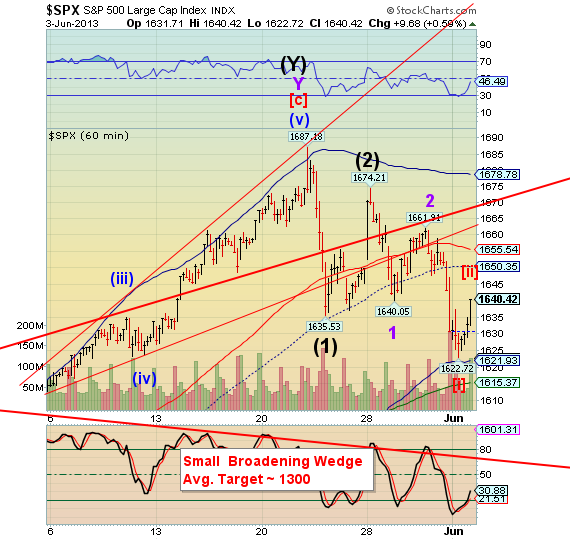
The SPX moves may appear disappointing at first glance. However, there is a lot of coiled up energy stored in these moves. All of these waves are impulsive and no matter how much they are being fought against, the waves are grinding down the opposition.

I have found that, when estimating the length of Wave threes, they are often a multiple of the cumulative wave ones. In this case, the cumulative value is 65 points, so the next wave down (assuming it’s a three) may have a minimum length of 130 points.

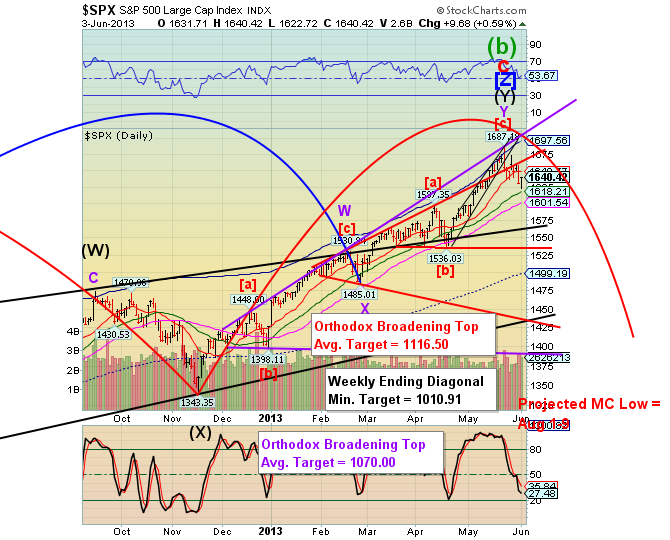
That may give SPX enough downside energy to break through both Intermediate-term support at 1618.21 and the 50-day moving average at 1601.54.

The downside target may be in the range of 1499.00 to 1510.00, below the smaller Orthodox Broadening Top. The bounce from that low may be contained by the Weekly Diagonal trendline, just below 1575.00. Remember, the SPX is still in throw-over territory in the weekly Ending Diagonal.

Once below the 50-day moving average, the speed of the decline may pick up. Those that are still bullish (there are many of them) may have a change of heart at that point.

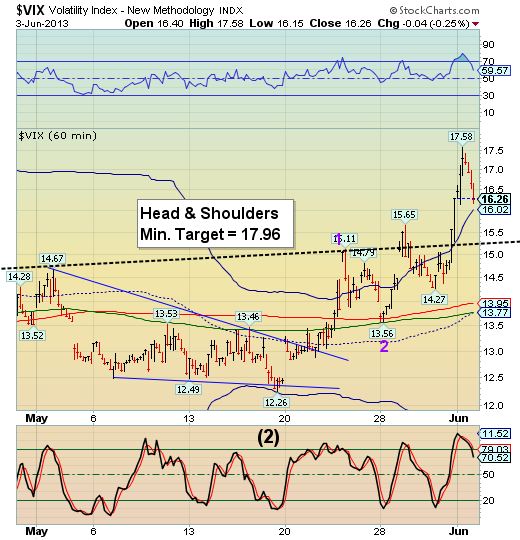
VIX has nearly made its Head & Shoulders target and it has not completed its pattern yet.

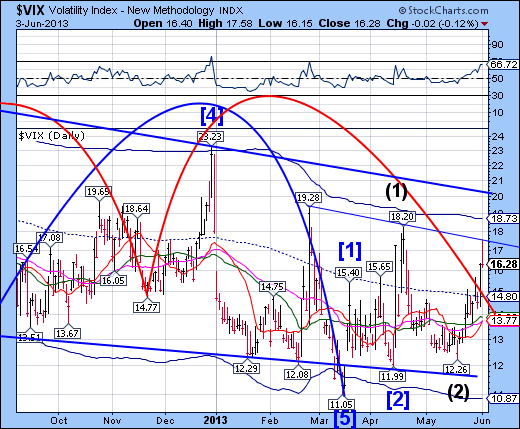
What seems to be holding the VIX from going higher at the moment is a small Diagonal formation that must be broken through. Once accomplished, the larger Diagonal formation must also be dealt with. The coiled up energy in the VIX may just do that very soon.

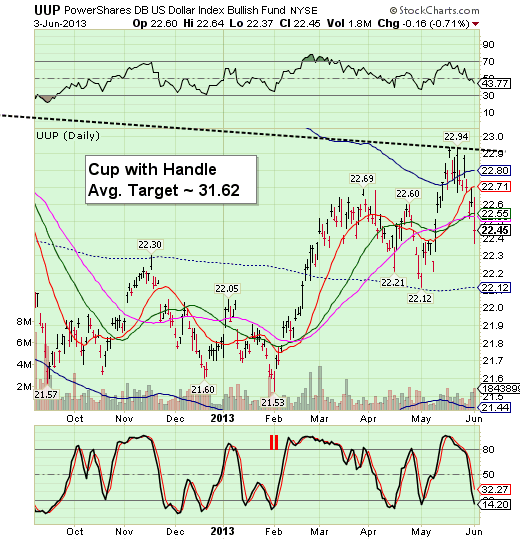
UUP is just completing a Trading Cycle low. The turn date for the new rally is tomorrow. There is a high correlation between the USD/UUP and the VIX. It appears that UUP/USD may have a breakout above the Lip of its Cup with Handle, which portends to be a very powerful move.

It just occurred to me that this may be the catalyst for the breakout in VIX and breakdown in SPX.

Good luck and happy trading!

See the original article >>

Sunday, June 2, 2013

The Fleeting Beauty of Bubbles and Bonds

by Charles Hugh Smith

Whatever painlessly masks the dysfunction and corruption of the Status Quo will be the policy of choice.


Here's the challenge the Status Quo monetary and fiscal authorities faced in the 2008 global financial meltdown: how do we maintain the power structure and keep the masses passive while masking the fact that the Status Quo is broken?

The solution: sell bonds to fund benefits to the masses, lower interest rates to zero to keep the explosive rise in fiscal deficits affordable, and rapidly inflate new bubbles in assets that painlessly enrich the top 25% of households who then increase their borrowing and spending, i.e. the "wealth effect."

Lowering interest rates to zero is a two-fer, as it not only enables the central state to borrow vast sums by selling low-yield bonds, it also drives everyone with financial assets into a desperate search for higher yields in risk assets such as stocks and housing. This herding of capital into risk assets helps inflate the bubbles needed to generate "growth."

Here's the beauty of asset bubbles. How do you get trillions of dollars into households without having to borrow the money? You inflate the assets owned by the households: stocks and houses. This magically creates money out of nothing, money that the households can borrow against or sell for cash.

Why not create and distribute cash directly? Two reasons: 1) spreading around trillions of dollars in cash could eventually spark inflation, which would kill the entire project by pushing bond yields higher, and 2) politically, the only cohort the authorities care about are the wealthy who fund the political Elite and the half of the adult populace who votes.

The political calculus is simple: the bottom half of households don't vote, don't contribute to political campaigns and don't have enough income to borrow huge sums of money to enrich the banks. They are thus non-entities in the fiscal-monetary project of maintaining the power structure of the Status Quo.

All the Status Quo needs to do is borrow enough money to fund social programs that keep the masses passive and silent: food stamps, Section 8 housing vouchers, Medicaid, Medicare, Social Security, SSI permanent disability, unemployment, etc.

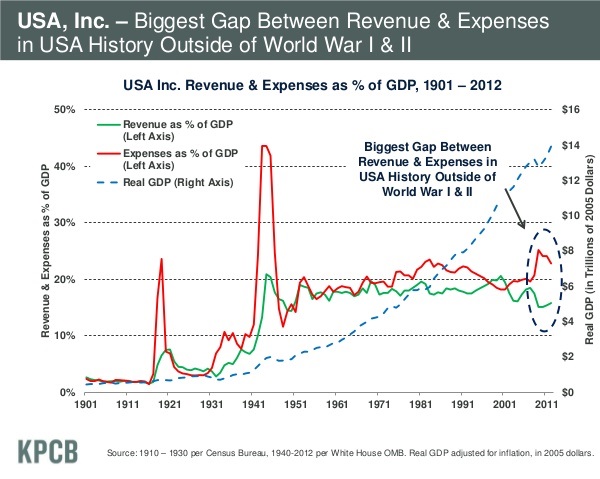
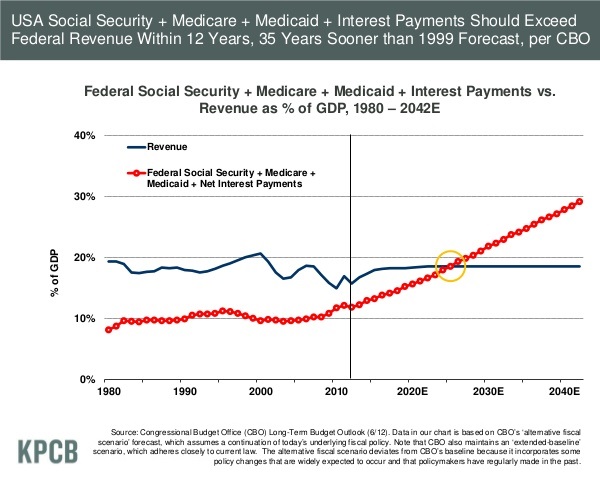
Unfortunately for the Powers That Be, the cost of placating the rapidly increasing marginalized populace is rising much faster than tax revenues. Here are two charts of interest (source: Kleiner Perkins Caufield Byers 2013 Internet Trends)


The happy story of 2013 is that tax revenues are rising fast while government spending has stopped rising. This is risible, as the same agencies drawing these projections have never forecast a recession or downturn. Taxes rise in bubbles, so no wonder tax revenues are up--and of course, tax rates increased on the margins.

Longer term, Federal expenditures will inexorably rise as the social programs for the elderly absorb 10,000 retiring Baby Boomers a day.


Here's the problem with bubbles: they pop, despite the best efforts of the fiscal and monetary authorities to keep them inflating forever. And when bubbles pop, assets decline in value. Borrowing, spending and tax revenues all decline.

Near-zero interest rates have problems, too: One, they stripmine pension funds and savers seeking save yields on cash, forcing everyone into risk asset bubbles, where those seeking higher yields are crushed when the bubbles pop, and two, nothing stays low or high forever. Piling up debt at near-zero rates is affordable fun, but when rates rise, the costs of servicing the debt pile skyrocket.

At that point, a feedback loop is set in motion that will bring down the entire system: investors will see fiscal authorities struggling to fund their social programs and pay rapidly rising interest on the vast mountain of government debt, and start wondering if the government will be able to meet its rapidly rising commitments with stagnant tax revenues.

The prudent investor, money manager and pension fund manager will demand a higher risk premium to reflect the possibility that the bond will be repaid with depreciated currency.

That will drive up the interest rate on all future borrowing, which will further stress government obligations which will increase the risk of default or depreciation of the currency, and so on.

The only way to stop this feedback from starting is for the central bank to buy essentially all the bonds sold by the government. This is the path that Japan and the U.S. have taken; both the Bank of Japan and the Federal Reserve are buying government bonds, essentially removing them from the tidal forces of the market with instantly created money.

Are there any limits on the balance sheets of the central banks? Why not transfer $100 trillion to the balance sheet of the Fed? Indeed, this path appears absolutely painless to all involved, and that's why Japan and the U.S. have pursued this strategy with such gusto.

Whatever painlessly masks the dysfunction and corruption of the Status Quo will be the policy of choice. And right now, that policy is transferring government bonds to the central banks so the fiscal authorities can continue to borrow and blow trillions of dollars rather than restructure their broken financial systems and economies.

The problem with neutering the market to mask systemic dysfunction is that the return on the policy diminishes at the same time that risk is transferred to the entire system. Risk cannot be disappeared, it can only be transferred or hedged. Burying immense debts in the balance sheets of central banks doesn't make risks disappear, it simply transfers the risk to the entire system.

And when you do that, you get a chart like this:

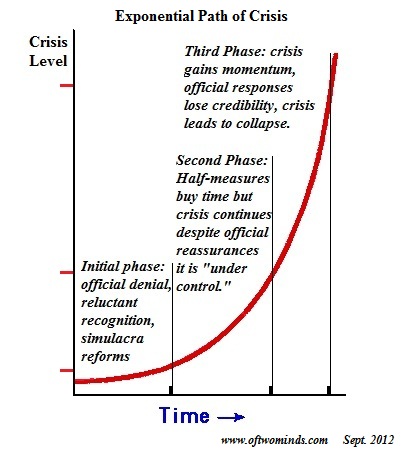
Anyone who is paying attention to the peculiar gyrations and dislocations in the Japanese bond and currency markets has to wonder if Japan has finally succeeded in entering Phase III, when official credibility and the illusion of central control both crumble.

The beauty of bonds and bubbles is fleeting. The fiscal and monetary authorities are claiming the beauty of bonds and bubbles is ageless, thanks to their magic; but no amount of false data and trickery can possibly eliminate the systemic risk piling up behind the rickety facade of illusory control.

See the original article >>

The American Consumer is Not Okay

by Stephen S. Roach

NEW HAVEN – The spin-doctors are hard at work talking up America’s subpar economic recovery. All eyes are on households. Thanks to falling unemployment, rising home values, and record stock prices, an emerging consensus of forecasters, market participants, and policymakers has now concluded that the American consumer is finally back.

This illustration is by Paul Lachine and comes from <a href="http://www.newsart.com">NewsArt.com</a>, and is the property of the NewsArt organization and of its artist. Reproducing this image is a violation of copyright law.

Illustration by Paul Lachine

Don’t believe it. First, consider the facts: Over the 21 quarters since the beginning of 2008, real (inflation-adjusted) personal consumption has risen at an average annual rate of just 0.9%. That is by far the most protracted period of weakness in real US consumer demand since the end of World War II – and a massive slowdown from the pre-crisis pace of 3.6% annual real consumption growth from 1996 to 2007.

With household consumption accounting for about 70% of the US economy, that 2.7-percentage-point gap between pre-crisis and post-crisis trends has been enough to knock 1.9 percentage points off the post-crisis trend in real GDP growth. Look no further for the cause of unacceptably high US unemployment.

To appreciate fully the unique character of this consumer-demand shortfall, trends over the past 21 quarters need to be broken down into two distinct sub-periods. First, there was a 2.2% annualized decline from the first quarter of 2008 through the second quarter of 2009. This was crisis-driven carnage, highlighted by a 4.5% annualized collapse in the final two quarters of 2008.

Second, this six-quarter plunge was followed, from mid-2009 through early 2013, by 15 quarters of annualized consumption growth averaging just 2% – an upturn that pales in comparison with what would have been expected based on past consumer-spending cycles.

That key point appears all but lost on the consumer-recovery crowd. In recent speeches and discussions with current and former central bankers, I have been criticized for focusing too much on the 0.9% trend of the past 21 quarters and paying too little attention to the 2% recovery phase of the post-crisis period. At least it’s a recovery, they claim, and a sign of healing that can be attributed mainly to the heroic, unconventional efforts of the US Federal Reserve.

This brings us to the second part of the argument against optimism: analytics. One of the first concepts to which an economics student is exposed in a basic macro course is “pent-up” consumer demand. Discretionary consumption is typically deferred during recessions, especially for long-lasting durable goods such as motor vehicles, furniture, and appliances. Once the recession ends and recovery begins, a “stock-adjustment” response takes hold, as households compensate for foregone replacement and update their aging durable goods.

Over most of the postwar period, this post-recession release of pent-up consumer demand has been a powerful source of support for economic recovery. In the eight recoveries since the early 1950’s (excluding the brief pop following the credit-controls-induced slump in the 1980’s), the stock-adjustment response lifted real consumption growth by 6.1%, on average, for five quarters following business-cycle downturns; spurts of 7-8% growth were not uncommon for a quarter or two.

By contrast, the release of pent-up demand in the current cycle amounted to just 3% annualized growth in the five quarters from early 2010 to early 2011. Moreover, the strongest quarterly gain was a 4.1% increase in the fourth quarter of 2010.

This is a stunning result. The worst consumer recession in modern history, featuring a record collapse in durable-goods expenditures in 2008-2009, should have triggered an outsize surge of pent-up demand. Yet it did anything but that. Instead, the release of pent-up consumer demand was literally half that of previous business cycles.

The third point is more diagnostic: The shockingly anemic pattern of post-crisis US consumer demand has resulted from a deep Japan-like balance-sheet recession. With the benefit of hindsight, we now know that the 12-year pre-crisis US consumer-spending binge was built on a precarious foundation of asset and credit bubbles. When those bubbles burst, consumers were left with a massive overhang of excess debt and subpar saving.

The post-bubble aversion to spending, and the related focus on balance-sheet repair, reflects what Nomura Research Institute economist Richard Koo has called a powerful “debt rejection” syndrome. While Koo applied this framework to Japanese firms in Japan’s first lost decade of the 1990’s, it rings true for America’s crisis-battered consumers, who are still struggling with the lingering pressures of excessive debt loads, underwater mortgages, and woefully inadequate personal saving.

Through its unconventional monetary easing, the Fed is attempting to create a shortcut around the imperative of household sector balance-sheet repair. This is where the wealth effects of now-rebounding housing prices and a surging stock market come into play. But are these newfound wealth effects really all that they are made out to be?

Yes, the stock market is now at an all-time high – but only in current dollars. In real terms, the S&P 500 is still 20% below its January 2000 peak. Similarly, while the Case-Shiller index of US home prices is now up 10.2% over the year ending March 2013, it remains 28% below its 2006 peak. Wealth creation matters, but not until it recoups the wealth destruction that preceded it. Sadly, most American households are still far from recovery on the asset side of their balance sheets.

Moreover, though the US unemployment rate has fallen, this largely reflects an alarming decline in labor-force participation, with more than 6.5 million Americans since 2006 having given up looking for work. At the same time, while consumer confidence is on the mend, it remains well below pre-crisis readings.

In short, the American consumer’s nightmare is far from over. Spin and frothy markets aside, the healing has only just begun.

See the original article >>

Follow Us