Sunday, February 1, 2015

SPY Trends and Influencers January 31, 2015

by Greg Harmon

Last week’s review of the macro market indicators suggested, heading into the last week of January, that the equity markets were churning, but at different paces. Elsewhere looked for Gold ($GLD) to continue in its uptrend while Crude Oil ($USO) continued lower. The US Dollar Index ($UUP) also looked to continue higher while US Treasuries ($TLT) consolidated in the uptrend. The Shanghai Composite ($ASHR) was taking a breather in its uptrend but Emerging Markets ($EEM) were breaking higher, at least in the short term.

Volatility ($VXX) looked to remain low but drifting gently higher over time slowing the wind at the back of the equity market. The equity index ETF’s were reacting differently to these factors. The $IWM was continuing its consolidation but with signs it may break higher, while the $SPY consolidated in its uptrend, perhaps passing the baton to the small caps. The $QQQ was been acting mostly like the SPY but looked much stronger, with a possible break of a bull flag higher brewing.

The week played out with Gold finding resistance at 1300 again and pulling back while Crude Oil continued to leak lower until a massive rebounded late in the week. The US Dollar consolidated its move until late in the week it moved back higher higher while Treasuries made a new all-time high.

The Shanghai Composite tested resistance again and pulled back slightly while Emerging Markets held higher over support early only to give it up at the end of the week. Volatility moved back higher ending the week at the highs, but below the prior high. The Equity Index ETF’s all pulled back in their recent consolidation zones, leaving Monday as the high of the week.

What does this mean for the coming week? Lets look at some charts.

SPY Daily, $SPY
spy d

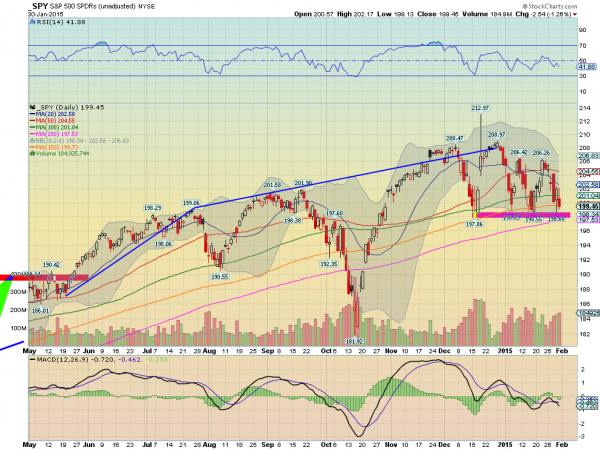
The SPY started the week holding over the 50 day SMA Monday but it was downhill from there. By Tuesday it broke below the 50 and 20 day SMA’s and printed a Spinning Top doji. This signals indecision and can resolve either up or down. It decided for the downside with a strong move lower Wednesday. After only a modest bounce Thursday it fell again Friday to end the week near the lows. It did hold the recent support zone that has been in place since mid December. The RSI on the daily chart is testing the 40 level again while the MACD has crossed down. The risk is to the downside on this timeframe.

SPY Weekly, $SPY
spy w

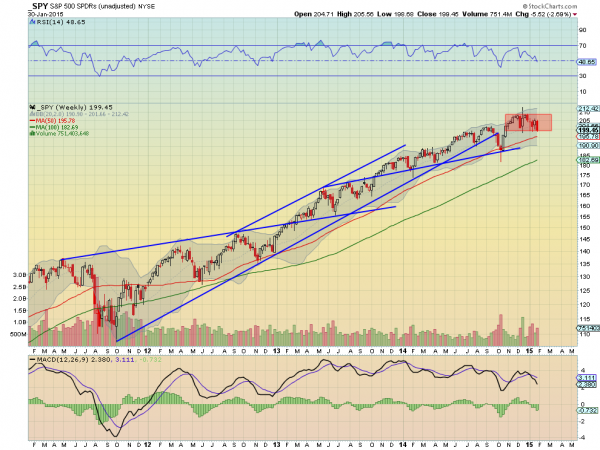
On the weekly chart the range since October remains in control with the 50 week SMA fast approaching. The RSI on this timeframe is about to cross down through the mid line while the MACD is running lower. More risk of downside on this timeframe as well. There is support lower at 198.60 and 196.60 followed by 194.40 and 191. Resistance higher may come at 200 and 202.30 followed by 204.30 and 205.70. Consolidation with a Chance of Pullback in the Uptrend.

Heading into February the equity markets look biased to the downside to start the month. Elsewhere look for Gold to continue to consolidate in the short term uptrend while Crude Oil may be ready for a bounce or reversal in the downtrend. The US Dollar Index seems ready to consolidate sideways in the uptrend while US Treasuries continue to be biased higher. The Shanghai Composite is also consolidating in its uptrend while Emerging Markets look to have failed in their attempt to rally and are biased to the downside.

Volatility looks to remain low but drifting up easing the wind behind the equity markets to a light breeze. The equity index ETF’s SPY, IWM and QQQ, all see risk to the downside in both the daily and weekly charts with the QQQ the strongest on the longer timeframe followed by the IWM and then the SPY, but the IWM possibly a bit stronger on the short timeframe over both the QQQ and SPY. Use this information as you prepare for the coming week and trad’em well.

See the original article >>

Saturday, January 31, 2015

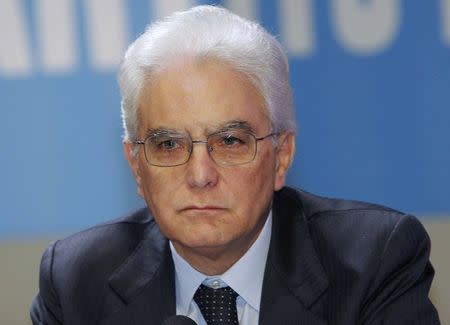
Italy elects senior judge Sergio Mattarella as president

By Steve Scherer and Paolo Biondi

ROME (Reuters) - Italian lawmakers elected Sergio Mattarella, a constitutional court judge and veteran center-left politician, as president on Saturday, handing a welcome political victory to Prime Minister Matteo Renzi.

Mattarella, speaking at his office in the Constitutional Court after the vote, said: "My first thoughts are of the difficulties and hopes of our citizens."

He later visited the site in Rome where German troops killed 335 Italians in World War Two, saying that Europe must unite to battle terrorism the same way allied nations banded together to defeat "Nazi hate, racism, anti-Semitism, and totalitarianism".

The election shows the 40-year-old Renzi in firm control of both his fractious party and his allies in the ruling majority as he seeks to pass reforms aimed at underpinning an economic recovery in Italy, where unemployment is soaring after six years of on-off recession.

After three inconclusive rounds of voting this week in which a two-thirds majority was needed, his candidate Mattarella was elected in the fourth round, when the required quorum fell to a simple majority.

As the ballots were counted out loud in the Chamber of Deputies, the 1,009 parliamentarians and regional officials eligible to vote burst into applause when Mattarella's name surpassed the 505-vote threshold, making him Italy's 12th president since World War Two.

Mattarella, 73, who is little known to most Italians, got 665 votes. He will be sworn in on Tuesday at 10 a.m. (0400 ET) for a seven-year term, taking over from 89-year-old Giorgio Napolitano, who resigned earlier this month.

"Keep up the good work, President Mattarella. Long live Italy!" Renzi tweeted after the vote, while Pope Francis sent his congratulations by old-fashioned telegram.

The Italian president is a largely ceremonial figure, but he wields important powers at times of political instability, a frequent scourge in Italy, when he can dissolve parliament, call elections and pick prime ministers.

Center-right rival Silvio Berlusconi's Forza Italia party appeared in disarray after the vote.

Berlusconi ordered his party to cast blank ballots after accusing Renzi of betraying what he said was a promise to give him a role in choosing the candidate. Instead, more than 30 refused, opening a wound in the party.

Renato Brunetta, Forza Italia's chief whip in the lower house, said the pact that Renzi and Berlusconi sealed last year to make institutional reforms was dead, but not all his party colleagues were so resolute and Berlusconi himself has yet to comment.

"Renzi made a unilateral decision to break the pact," Brunetta said. "Nothing will be the same now."

Mattarella is the first native of Sicily to become president. He has a reputation for being a reserved but straight-talking former constitutional law professor, whose career in politics began after his brother, Piersanti, was shot dead by the Sicilian Mafia in 1980.

Mattarella's political roots are in Italy's defunct Christian Democrat party that his father Bernardo, an anti-fascist, helped to found after the war.

Though Mattarella is not seen as having vast international experience, he did serve as defense minister in two different center-left governments, from 1999 to 2001.

In 1990, Mattarella resigned as education minister to protest a decree that favored Berlusconi's media empire, and three years later he drafted a voting law, which has since been changed, that was used when Berlusconi won his first of three national elections in 1994.

See the original article >>

Friday, January 30, 2015

Brazil's Economy Is On The Verge Of Total Collapse

by Tyler Durden

Back when the BRICs were the source of marginal global growth, the punditry couldn't stop praising them. However, in the past year, now that China's housing bubble has burst and its shadow banking system has imploded, those who remember what BRIC actually stood for are about as rare as those who recall what it means for the Fed to hike rates. Which is precisely why nobody in the mainstream financial media has commented on the absolutely abysmal economic update reported earlier today out Brazil.

We are happy to do so because today's data follows up quite well to our article from a month ago "Brazil's Economy Just Imploded" and as the earlier article on the crashing Brazilian Real hinted, things for the Brazilian economy how gone from imploding to, well, worse because not only did the twin fiscal and current account deficits rise even more, hitting a whopping 11% of GDP - the worst since August 1999, but its government debt soared to 63.4% in 2014, up from 56.7% a year ago, and the highest since at least 2006. In short - the entire economy is now on the verge of total collapse.

This is what happened in a few bullet points:

  • The fiscal picture has deteriorated very sharply since 2011 at both the flow (fiscal deficit) and stock (gross public debt) levels. The primary and overall nominal fiscal surpluses at year-end 2014 were at levels last seen in the late 1990s.
  • The steady decline of the public sector savings rate is leading to a wider current account deficit despite weaker growth and low investment. In fact, the twin fiscal and current account deficits are now tracking at a combined, very troublesome 10.9% of GDP, the worst picture in 15 years (since August 1999). Repairing the severely unbalanced macro picture would require a deep, structural and permanent fiscal and quasi-fiscal adjustment and a significantly weaker BRL.
  • The new economic team faces, among other things, the very significant challenge of repairing the severely deteriorated fiscal picture.
  • The steady erosion of the fiscal stance pushed net and gross public debt up. Furthermore, fiscal and quasi-fiscal activism undermined the effectiveness of monetary policy, contributed to keep inflation very high and drove the current account deficit to a very high level despite weak growth.

More details from Goldman:

The overall public sector fiscal deficit widened to a very high 6.7% of GDP (from 3.25% of GDP in 2013 and the highest fiscal deficit since August 1999) given the very high 6.1% of GDP net interest bill and steady erosion of the primary fiscal surplus. Given the BRL depreciation during the month, the interest on the stock of Dollar swaps issued by the central bank reached R$17.0bn (adding to the R$8.7bn accrued in November).

Gross general government debt rose to 63.4% of GDP in 2014, up from 56.7% of GDP in 2013 and 53.4% of GDP in 2010 (the highest level since at least 2006).

The consolidated public sector posted a very large and worse-than-expected R$12.9bn deficit in December, driven by the unexpectedly large R$11.3bn deficit recorded by the States and Municipalities. The state-owned enterprises also posted a large deficit in December: R$2.3bn surplus.

Overall, the consolidated public sector posted a 0.63% of GDP primary deficit in 2014, down from surpluses of 1.9% of GDP in 2013, and 2.4% of GDP in 2012. This is the worst fiscal outturn in 16 years (since November 1998) and very significantly below the 1.9% of GDP primary surplus promised by former Finance Minister Mantega. The erosion of the primary surplus in recent years was driven chiefly by the weak fiscal numbers of the Central Government, whose primary balance declined from 1.55% of GDP in 2013, to a deficit of 0.40% of GDP in 2014.

However, the primary surplus of subnational government (States and Municipalities) has also been eroding, a reflection of the authorizations given by the Treasury since 2011 for increased borrowing by the States. For instance, the States and Municipalities posted a 0.15% of GDP deficit in 2014, down from 0.80% of GDP surplus in 2011.

In charts:

And the key numbers:

  1. The Consolidated Public Sector (CPS) posted a significantly worse-than-expected R$12.9bn primary deficit in December, driven by local governments and state-owned enterprises. The Central Government posted a R$755mn surplus but the States and Municipalities recorded a very large R$11.3bn deficit and the state-owned companies an also large R$2.3bn deficit.
  2. Overall, the primary balance of the CPS worsened to a 0.63% of GDP deficit in 2014 from a 1.9% of GDP surplus in 2012 and 2.4% of GDP surplus in 2012.
  3. The overall fiscal deficit (primary surplus minus interest payments) deteriorated further: to a very high 6.7% of GDP given the large 6.1% of GDP net interest bill. This is the largest overall fiscal deficit since August 1999.
  4. Net public debt worsened to 36.7% of GDP in 2014, up from 33.6% in 2013. Gross general government debt rose to a high 63.4% of GDP in December, up from 56.7% of GDP in 2013.
See the original article >>

A Greek Burial for German Austerity

by Joschka Fischer

BERLIN – Not long ago, German politicians and journalists confidently declared that the euro crisis was over; Germany and the European Union, they believed, had weathered the storm. Today, we know that this was just another mistake in an ongoing crisis that has been full of them. The latest error, as with most of the earlier ones, stemmed from wishful thinking – and, once again, it is Greece that has broken the reverie.

Even before the leftist Syriza party’s overwhelming victory in Greece’s recent general election, it was obvious that, far from being over, the crisis was threatening to worsen. Austerity – the policy of saving your way out of a demand shortfall – simply does not work. In a shrinking economy, a country’s debt-to-GDP ratio rises rather than falls, and Europe’s recession-ridden crisis countries have now saved themselves into a depression, resulting in mass unemployment, alarming levels of poverty, and scant hope.

Warnings of a severe political backlash went unheeded. Shadowed by Germany’s deep-seated inflation taboo, Chancellor Angela Merkel’s government stubbornly insisted that the pain of austerity was essential to economic recovery; the EU had little choice but to go along. Now, with Greece’s voters having driven out their country’s exhausted and corrupt elite in favor of a party that has vowed to end austerity, the backlash has arrived.

But, though Syriza’s victory may mark the start of the next chapter in the euro crisis, the political – and possibly existential – danger that Europe faces runs deeper. The Swiss National Bank’s unexpected abandonment of the franc’s euro peg on January 15, though posing no immediate financial threat, was an enormous psychological blow, one that reflected and reinforced a massive loss of confidence. The euro, as the SNB’s move implied, remains as fragile as ever. And the subsequent decision by the European Central Bank to purchase more than €1 trillion ($1.14 trillion) in eurozone governments’ bonds, though correct and necessary, has dimmed confidence further.

The Greek election outcome was foreseeable for more than a year. If negotiations between the “troika” (the European Commission, the ECB, and the International Monetary Fund) and the new Greek government succeed, the result will be a face-saving compromise for both sides; if no agreement is reached, Greece will default.

Though no one can say what a Greek default would mean for the euro, it would certainly entail risks to the currency’s continued existence. Just as surely, the mega-disaster that might result from a eurozone breakup would not spare Germany.

A compromise would de facto result in a loosening of austerity, which entails significant domestic risks for Merkel (though less than a failure of the euro would). But, in view of her immense popularity at home, including within her own party, Merkel is underestimating the options at her disposal. She could do much more, if only she trusted herself.

In the end, she may have no choice. Given the impact of the Greek election outcome on political developments in Spain, Italy, and France, where anti-austerity sentiment is similarly running high, political pressure on the Eurogroup of eurozone finance ministers – from both the right and the left – will increase significantly. It does not take a prophet to predict that the latest chapter of the euro crisis will leave Germany’s austerity policy in tatters – unless Merkel really wants to take the enormous risk of letting the euro fail.

There is no indication that she does. So, regardless of which side – the troika or the new Greek government – moves first in the coming negotiations, Greece’s election has already produced an unambiguous defeat for Merkel and her austerity-based strategy for sustaining the euro. Simultaneous debt reduction and structural reforms, we now know, will overextend any democratically elected government because they overtax its voters. And, without growth, there will be no structural reforms, either, however necessary they may be.

That is Greece’s lesson for Europe. The question now is not whether the German government will accept it, but when. Will it take a similar debacle for Spain’s conservatives in that country’s coming election to force Merkel to come to terms with reality?

Nothing but growth will decide the future of the euro. Even Germany, the EU’s biggest economy, faces an enormous need for infrastructure investment. If its government stopped seeing “zero new debt” as the Holy Grail, and instead invested in modernizing the country’s transport, municipal infrastructure, and digitization of households and industry, the euro – and Europe – would receive a mighty boost. Moreover, a massive public-investment program could be financed at exceptionally low (and, for Germany, conceivably even negative) interest rates.

The eurozone’s cohesion and the success of its necessary structural reforms – and thus its very survival – now depend on whether it can overcome its growth deficit. Germany has room for fiscal maneuver. The message from Greece’s election is that Merkel should use it, before it is too late.

See the original article >>

Dow could peak right here, says Joe Friday!

by Chris Kimble

joefridaydowatfibresistancejan30

CLICK ON CHART TO ENLARGE

This chart is the Dow "Quarterly" dating back to 1965. I applied Fibonacci to the Dow's 2000 high and 2002 quarterly lows and then applied Fibonacci extension levels.

The Dow stopped on a dime in 2007, as it hit the 161% Fibonacci extension level at (1).

Now the Dow is hitting the Fibonacci 261% Fibonacci extension level at (2). While at this level, a long-term resistance line comes into play that ties in the 1987 highs and the 2002 lows.

Joe Friday, just the facts....This is not your typical resistance level and the Dow could put in a peak at this combo!

See the original article >>

60% Of Retail Sales Growth In Hong Kong Was Due To The iPhone 6

by Tyler Durden

The impact of the Apple juggernaut on earnings is already well known: as Reuters previously calculated, following the announcement of Apple's results earlier this week, S&P 500 Q4 revenue growth tripled to 1.4% from 0.5% the day before; while if one excludes AAPL S&P500 revenue growth falls to 0.8%.

But what about the impact of Apple on macroeconomics? For a good example we look at Hong Kong Q4 retail sales. As a reminder, in Q4, the Hong Kong economy was substantially impacted due to the Occupy Central movement peaking (and then suffering the same fate as its US peer, when it faded into obscurity), and many predicted the domestic economy would tumble if only until the impact of the city stoppage washed away.

As it turns out, most of those predictions were correct, however one place where pessimism was unfounded was in retail sales. The reason: the Apple iPhone 6.

UBS explains:

The launch of the popular iPhone 6 by Apple in September 2014 was the biggest, and perhaps the only, positive driver for Hong Kong's retail sector during late 2014. Thanks largely to Apple, retail sales grew better than expected at 3.5%y/y in value terms during September and November 2014, despite the temporary disruption from the 'Occupy Central' demonstration. The sales of iPhone, which are captured in other consumer durable sales, grew on average 60%y/y since September, propelled predominately by the launch of new product.

Excluding iPhones, retail sales value would have contracted almost 1%y/y in October, at the peak of the 'Occupy' movement, and expanded a more subdued 1.3%y/y during Sep-Nov 14 (see figure 1). In other words, over 60% of retail sales growth was attributable to iPhone in late 2014.


The strong demand for iPhone has mostly come from the Chinese tourists. The iPhone 6 was launched about a month earlier in Hong Kong (19 September versus 17 October in China). And the selling prices of which are also lower here, making the arbitrage trade profitable (buys in HK; sells in China). Those who live in Hong Kong will be very familiar with the long queues snapping up the phone as well as the big crowds outside the Apple stores trying to make a quick profitable trade.

This explained why tourist arrivals (over 80% of them Chinese) accelerated to 13%y/y during Sep-Nov 14, bucking the 'Occupy Central' disruption, as the timing of which happened to coincide with the iPhone euphoria. The incentives to buy the gadget before the Chinese launch or to gain from arbitrage trade have attracted many Chinese tourists since September. Most of them are day trippers. This is reflected in the average 18%y/y expansion in same-day visitor arrivals since September, which is up from 13.6%y/y in the three months before the iPhone launch. Overnight visitors, however, continued to ease and expand at mid-single digit pace (see figure 2). In particular, non-Mainland Chinese tourist, mostly overnight visitors, contracted in 4Q14. Both the share and, more recently, the absolute level of non-Chinese arrivals have been shrinking. As far as tourism is concerned, Hong Kong can hardly claim to be Asia's world city anymore.

In other words, if anything were to ever happen to the Apple "magic", not only does the S&P get it, but the macroeconomic ripple across the entire world will likely lead to a mini-recession all of its own.

See the original article >>

Follow Us