Thursday, January 29, 2015

A peg in a poke

by The Economist

Currency markets have suddenly become a lot more volatile

20150131_FNC858[1]

THE year is only a few weeks old but already there has been turmoil in the foreign-exchange markets. On January 28th Singapore eased monetary policy, allowing its currency to fall to its lowest level against the dollar since 2010. The Swiss have abandoned their policy of capping the franc against the euro and the European Central Bank (ECB) has unveiled a big programme of quantitative easing (QE), sending the euro to an 11-year low against the dollar (see chart). Meanwhile, a rate cut from the Bank of Canada has pushed the loonie down to around 80 American cents, from 94 cents a year ago.

The main reason for this sudden surge of volatility seems to be a divergence in monetary policy: no longer are central banks moving in the same direction. “There are two huge forces at work,” says David Bloom, a currency strategist at HSBC. “The ECB and Bank of Japan are printing money and devaluing their currencies while the US economy is growing strongly. Anyone who stands in the middle risks getting crushed.”

The Swiss were caught in the middle. Their cap involved creating Swiss francs and using them to buy euro-denominated assets, but they clearly balked at maintaining this policy in the face of QE in the euro area. A much stronger franc, however, will add to the deflationary pressures in the domestic economy.

Falling commodity prices mean this is a potential problem for much of the rich world. A stronger currency can be the difference between low inflation and outright deflation. But currencies are a zero-sum game: if the euro and yen weaken, something must gain. So foreign-exchange markets become a little like a game of pass-the-parcel, in which countries try to offload the threat of deflation somewhere else.

Meanwhile, emerging-market currencies, which took a bit of a battering in 2014, have been recovering. The Brazilian real, the Indian rupee and the Turkish lira have all risen by more than 10% against the euro since mid-December. Simon Derrick, a currency strategist at BNY Mellon, a fund-management group, says there are signs of a “carry trade” at work, with traders borrowing money cheaply in euros and investing in higher-yielding currencies in the developing world.

Volatility is a bit like a bouncy castle: sit down on one side and it will pop up somewhere else. Central banks have intervened heavily in the bond markets, bringing yields down to historic lows. Equity markets have also been boosted by the conviction that central banks will remain supportive. And corporate bond markets have been pretty steady; low government-bond yields have caused income-seeking investors to buy corporate debt and defaults have been very low.

So it is unsurprising that volatility is appearing in other markets—most dramatically in oil and now in currencies as well. However, sudden currency moves can be devastating for companies and individuals who have borrowed abroad. Many east Europeans took out mortgages in Swiss francs to take advantage of lower interest rates and are nursing big losses after the franc’s sudden rise.

Mismatching assets and liabilities by borrowing in a foreign currency is rarely a good idea. Of course, many of those home-owners will have been tempted to take out a Swiss-franc mortgage because of the franc’s peg to the euro. Therein lies the problem with currency pegs. They may eliminate volatility in the short term, but at the cost of a very big currency move if the peg gives way. The problem was faced on an even bigger scale by Thailand in the 1990s with its dollar peg, and by Argentina, which abandoned a currency board in 2002; that shift necessitated the forcible conversion of dollar deposits into pesos, the so-called corralito.

Pegs require a lot of discipline. If monetary policy in the target country changes, the pegging country has to follow suit, regardless of the consequences. Other economic priorities have to be subordinated to the currency target. The strain often proves too much, as it did when Britain left the European exchange-rate mechanism in September 1992.

A single currency is an extreme version of a peg. And Greece’s new government is chafing at the constraints imposed by being part of the euro zone. (Some of those constraints may be unnecessarily onerous but that is another matter.) Greek bank shares have been tanking on fears of capital flight. If the strains prove too much, the result may involve leaving the euro and capital controls—a Greek corralito. That would only reinforce 2015’s growing reputation for currency spasms.

See the original article >>

The Longer Outlook in ….. Gold

by Greg Harmon

Gold has a long and storied history. It has been prized by kings for centuries. Empires were built on it. It has backed entire countries. It has been used to monitor economic growth and inflation. And when there is global conflict it is seen as source of safety for capital. But much of that history, is history. In crisis money flocks to US Treasuries or the US Dollar now. I suppose that if the US were in crisis then Gold might make a comeback.

Many pundits have made a name for themselves during the big 10 year bull market run in Gold that went from 2001 until 2011. Unfortunately they still espouse on the virtues of Gold like nothing has changed. But in terms of its actual usefulness it is now pretty limited. That does not stop sentiment and emotional buying though. And It probably never will. And as one of the most active contracts in the futures market it trades well with technicals. So even with no real value or scarcity, what does the chart say about its future? Its at a crossroads.

gold

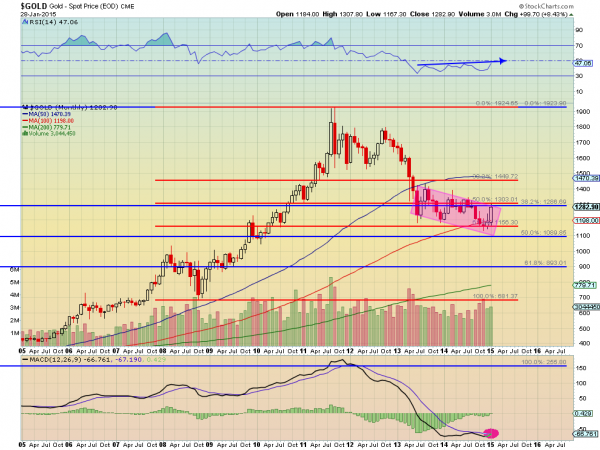
The monthly chart above shows only the last ten years. The full move from 2001 until 2011 is measured by the blue Fibonacci lines. The smaller move following the retracement in 2008 is shown with the red lines. These Fibonacci retracements can play a major role for traders.

There are a few things that stick out from these levels. First there are two retracements that are tightly bound at 1286 and 1303. This can help explain the magnetic like pull of the 1300 level. The second thing to note is that the break lower at the end of the year retraced to the 61.8% level on the shorter move.

This is a major retracement and weakness below this level would suggest a much deeper correction. So it is promising that it has moved higher back towards the 50% level into the end of January. On the broader scale the 38.2% retracement held it for a long time. And the move back toward that level is also promising. It would be a shallow retracement if it were to reverse higher from this point. But there is no reversal yet.

Aside from the Fibonacci’s there is the 100 month SMA that has come into play recently. It has acted as support the last few months and could contribute to the bottoming process. But there is also the falling channel in pink that has been active for 2 years. Notice that the latest move higher is testing the top of the channel. Also note that the channel is falling in the direction of the correction, more like a pennant than a bear flag. This type of price action often leads to a reversal.

Finally the momentum indicators are diverging from the price action. Not strongly, but the MACD is is leveling and has been so for a year, while the RSI has been in a slight upward trend for the last 18 months.

But all the indicators mean nothing if the price does not confirm. It would take a solid break and hold over 1340 to confirm a bottom and reversal higher. Then a move over 1450 would strengthen the trend and look for a major move higher. But a break of the channel to the downside, and below 1140 would look for an acceleration of the downtrend and a target of the 61.8% retracement of the broad move to 893. Until then look for the slow downward drift to continue, maybe as far as 1090.

See the original article >>

Greece's fight against "fiscal waterboarding" will halt economic recovery

by Sober Look

We are about to witness a historic showdown between the major euro area institutions and Greece. Greece's newly appointed finance minister Yanis Varoufakis, a staunch bailout critic, will lead the negotiations on debt haircuts. On the other side will be the creditors: the International Monetary Fund and the European Commission - with additional support from the ECB. Private bondholders may get dragged into the fight as well (although many of them are Greek banks who will do what the government tells them). A number of Eurozone politicians have already expressed skepticism about any debt forgiveness for Greece. But Varoufakis is likely to focus on the argument that Germany has to take a great deal of the blame for the situation in which Greece now finds itself - calling the imposed austerity measures "fiscal waterboarding". Here is a good quote from Strafor:

Stratfor (via Forbes): Another version, hardly heard in the early days [of the Eurozone crisis] but far more credible today, is that the crisis is the result of Germany’s irresponsibility. Germany, the fourth-largest economy in the world, exports the equivalent of about 50 percent of its gross domestic product because German consumers cannot support its oversized industrial output. The result is that Germany survives on an export surge. For Germany, the European Union — with its free-trade zone, the euro and regulations in Brussels — is a means for maintaining exports. The loans German banks made to countries such as Greece after 2009 were designed to maintain demand for its exports. The Germans knew the debts could not be repaid, but they wanted to kick the can down the road and avoid dealing with the fact that their export addiction could not be maintained.
The debate will also focus on the fact that Greece has done an amazing job in cutting its debt/GDP ratio - in spite of the falling GDP.

Source: @RBS_Economics

Greek government bond yields spiked on Syriza's escalating rhetoric as well as on the right-wing anti-austerity party (Independent Greeks) becoming Syriza's new coalition partner. Think about it - the only thing the two parties have in common is their hatred for the Eurozone and the fiscal pain that was imposed on Greece.

The Greek government bond yield curve has become more inverted as markets price in principal reductions that are likely to apply evenly across the curve (which is what typically causes such inversion).

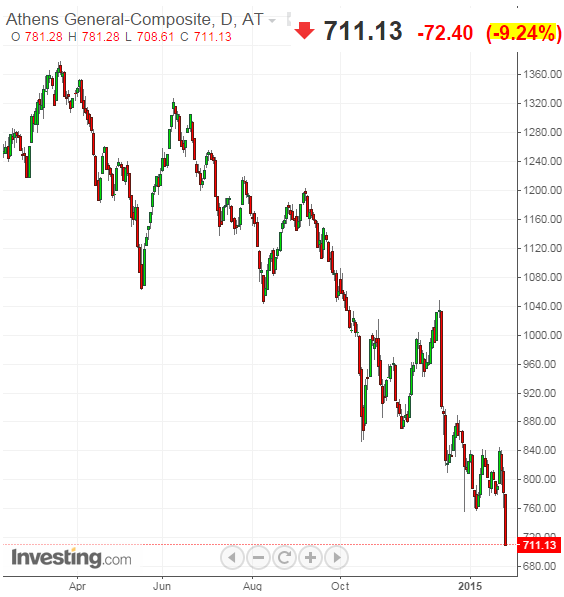
It is expected that if such haircuts are applied, they would hit both official and unofficial accounts (including bonds held by the ECB). Debt forgiveness would also cut principal on the government bonds held by Greek banks - who are some of the largest holders. That's why shares of Greek banks got decimated today. New bank bailouts will be required if there is any hope for credit availability to the private sector. For now most credit activity will come to a grinding halt - and with it any hopes for economic recovery.

Source: @WSJGraphics

The overall equity market fell over 9% today as government officials halt privatization and extend an olive branch to Russia (see story).

The newly elected government may ultimately get its debt forgiveness. But in the process the damage done to the nation's private sector will be severe - just as Greece begins to come out of a deep depression that rivals some of the worst downturns in global history.

See the original article >>

Tuesday, January 27, 2015

Greek elections 2015: a short overview

By Vassilis Paipais

images

First reactions after such ambiguous and hotly disputed events always hide considerable dangers and possible errors of judgement. Nevertheless, some analysis has to be attempted bearing in mind that many unknowns remain to be seen and many riddles to be solved. The Greek elections are already heralded across Europe as a watershed signalling consequences of enormous proportions for better or worse. The truth usually lies somewhere in the middle. Three things can be said with certainty.

First, what has to be granted unambiguously is that, despite the loss of the outright majority in parliament, this is a landslide victory for Syriza which managed to capitalise on the people’s frustration and anger after five stagnant years of brutal austerity. It is not a coincident that electoral support for Syriza cut across the dividing Left-Right fault lines as the Greek population experienced the troika-backed programme as a form of collective punishment. Syriza is now confronted with the challenges of the next day. ‘Re-negotiating’ a new package deal may prove a lot more dangerous than what the party’s masterminds might have initially expected. Even if some breathing space is granted to the new government and a new less burdensome agreement is eventually struck, some version of an austerity programme will have to be put in place possibly renamed as a ‘national reconstruction plan’. If Greece is going to benefit from Draghi’s huge QE scheme, the new government will have to call its revolutionary dreams off for a later stage.

However, if this new reconstructive plan does not combat widespread corruption, tax evasion and state bureaucracy the deadlocks that led to the collapse of the Samaras government will soon be reproduced. Syriza leaders seem to understand that the only way Europe will listen is if they are prepared to unravel the oligarchic structure of the Greek economy and bring down the domestic kleptocracy. This is a herculean task and doubts are raised about their ability, or even sincerity, to dismantle the clientelistic networks that hold the country captive and stifle its economic potential. After all, Syriza was quickly embraced by ex-members and voters of the totally discredited socialist party (Pasok) and many fear a repeat of the hollow hopes engendered by the rise to power of Andreas Papandreou in 1981, a figure Alexis Tsipras is often compared to. Despite the possible setbacks and doubts, however, the people’s feeling is that the country is making a fresh start. Yet, if this feeling is not to be quickly turned into a nightmare, Syriza has to rapidly show signs that it can achieve what Samaras failed to deliver, i.e. put the country on the track of sustainable growth by reforming the state and attracting investment. In other words, success for Syriza is a two-side story: negotiate a new debt restructuring deal that will inevitably include some austerity measures in order to secure the country’s inclusion in the QE programme and launch a large-scale plan of internal reform. Both tough to achieve and interrelated as one cannot be had without the other while time is extremely limited. A mind-blowing challenge even for experienced politicians.

On the other hand, the right-wing party ND was heavily pounded by the electorate for two main reasons. After the negative result of the last European elections, populist sentiments prevailed leading the party astray of its reform pledges. It seems that Samaras himself never really believed in the reform agenda preferring to introduce a hugely unpopular property tax (ENFIA) rather than fight corruption, reform the tax system and oppose crony capitalism that is eating up the Greek economy. The majority of the people felt that their sacrifices were being squandered by a government that was bent on raising revenue from the usual suspects (wage workers and pensioners) rather than squeeze its clients. The second reason is almost a necessary outcome of the first. ND’s electoral campaign was a sheer disaster investing on fear and admonitions of doomsday and bank runs should Syriza win. The pre-election competition became a Manichean struggle between ND’s petty fear-mongering and the promise of hope represented by Syriza. Passion and emotional investment are always inseparable elements of the democratic process but, when fury and despair abound, terrorising tactics tend to backfire. Reason, in any case, is a rare commodity in Europe at the moment given the slumber of the European elite that produces populist ‘monsters’ in the periphery, to remember Goya.

Speaking of monsters, the third remarkable feature of these elections is the tenacity of extreme-right wing populism. GD managed to secure 6.3% suffering only a slight reduction of its electoral power from the previous elections despite the fact that most of its leaders are incarcerated. GD represents a phenomenon that leaves most domestic commentators rather disoriented and at a loss for analysis. The Greek media and political system tried many tactics against them, first co-optation and then isolation. Both failed miserably inviting the conclusion that GD is a political formation with a rock solid base and permanent characteristics. However, the conclusion that Greeks were reborn racists or Nazi-sympathizers overnight must be resisted. This is a nationalistic party whose electoral base needs further investigation but the extreme right is not a new political force in Greece (it is often forgotten that it had scored a similar result (7%) in the 1977 elections). It was simply hibernating or subsumed under ND tutelage until the crisis unleashed centrifugal forces that restored the extreme-right as an autonomous contender.

Syriza is not a disaster for Europe neither a panacea for the toils of the Greek people. What the future probably holds in store for both sides (EU and the new Syriza government) is a series of hard negotiations and brad-de-fers that one can only hope won’t lead to an accident. Syriza’s victory might signal a long-overdue policy change that would remedy the imbalances of a poorly designed currency union. On the other hand, if the Greeks labour under maximalist illusions of debt write-off and return to a paradise lost they are surely in for a sorry landing.

See the original article >>

SYRIZA and Beyond – Political Volatility Enters the Scene

by Pater Tenebrarum

Greek Election – Decisive Victory by SYRIZA

With more than 95% of the votes in Greece’s parliamentary election counted as of the time of writing, Greece’s far-left Syriza led by Alexis Tsipras was already certain to have won a decisive victory.

Greek election result

Greek election results after more than 95% of the votes had been counted – click to enlarge.

Although this is not certain yet as we type this, the chart above suggests that Syriza may well have attained an absolute majority in terms of parliamentary seats (the winning party automatically gets an additional 50 seats in Greece’s 300 seat parliament).

Whether or not Syriza has an absolute majority in parliament, it will definitely form the next government, as it has already clinched a coalition deal with the small Independent Greeks party (ironically, a centre-right party that has broken away from Antonis Samaras’ New Democracy party, but is united with Syriza in its opposition to the bailout and austerity package). However, should Syriza turn out to be able to govern without a junior partner, there is a good chance that the more radical elements in the party (which itself is a hodge-podge coalition of various leftist parties) will gain greater influence over the new government’s policies.

This is not unimportant, as we have pointed out previously (see: “Grexitology, a Mexican Standoff” for details). While Syriza’s leadership has reportedly backed away from the threat of just “tearing up the bailout agreement”, this is definitely not a stance supported by everyone in the party. Syriza is the most left-wing party to attain political power in Europe since WW2 and the leader of its left-most wing, Panagiotis Lafazanis, is on record for stating the following:

“We want to exit the euro and a complete break with the totalitarian EU.”

If Syriza is forced to form a coalition, more moderate views are likely to prevail, not least because the Greek government doesn’t exactly have a great many choices given its fiscal condition, regardless of who runs it. Keep in mind that said condition is closely intertwined with that of the country’s banking system, which serves as one of the main conduits for funding the government whenever bailout tranches are late due to disagreements with the “troika”. Ahead of the election, the four largest Greek banks were already faced with a “mini-run” on deposits and all of them applied preemptively for ELA (emergency liquidity assistance). It is up to the ECB council whether such assistance is granted or not.

The left-wingers in the party may well overestimate the fiscal leeway the government would enjoy in the event of an outright default. Given that the government currently runs a primary surplus, it theoretically won’t require outside financing if it ceases to service its debt. However, since Syriza inter alia plans to rescind the property tax introduced by the previous government and intends to vastly increase government spending, the primary surplus could prove ephemeral. Needless to say, if the party’s militant left wing were to get its way, what little investment activity there is would dry up as well and capital flight would accelerate. As of the end of 2013, government spending had already reached a record 59% of GDP (we were unable to find more up to date figures):

greece-government-spending-to-gdp

Greek government spending as a percentage of GDP – click to enlarge.

This is not to say that Syriza and the Independent Greeks are incorrect in stating that repayment of the government’s mountainous debt burden is effectively impossible. It never made any sense to prevent a debt restructuring (i.e., an outright default) and replace it with an extend-and-pretend scheme courtesy of EU taxpayers. While this scheme makes it appear as though the debt still has some value, it cannot alter the reality of the situation.

Alexis Tsipras insists that he wants to retain the euro, but that actually rules out a unilateral default. It remains unclear to us how Tsipras can possibly deliver on his election promises and retain Greece’s euro membership. Admonishments were already uttered by creditors in the wake of Syriza’s victory, as the WSJ reports:

“Within minutes of the close of the polls, Germany’s powerful central-bank chief, Jens Weidmann, pushed back. “It is clear that Greece will remain dependent on support and it’s also clear that this aid will be provided only when it is in an aid program,” he said in an interview with television broadcaster ARD.

A message on U.K. Prime Minister David Cameron’s usual Twitter account, meanwhile, warned that the Greek result will “increase economic uncertainty across Europe.”

Exiting the euro can be done of course (technically, it would be similar to joining it, only in reverse), but such an exit would be a major headache, not least due to the private sector’s euro-denominated external debt. Obviously, devaluation would not magically create prosperity, and the government would eventually be greatly tempted to fund itself with the printing press in order to pay for all its promises.

The Syriza-led government will likely be able to get some concessions from the EU regarding the bailout terms – but there is a limit to those, since other countries that have been bailed out would otherwise make similar demands. It seems highly unlikely that such concessions would be sufficient to allow Syriza to implement everything it has promised.

Beyond Syriza – More Political Earthquakes Are Likely in Store

However, Syriza’s election victory is only a small part of the European puzzle. If Greece were to default and exit the euro, the greatest hit would be taken by taxpayers elsewhere in the EU, as about €250 billion, or 80% of the outstanding Greek government debt are now in the hands of public lenders, which have financed the bulk of Greece’s debt rollovers since 2011. European banks outside of Greece, although they remain in questionable shape overall, would be unlikely to suffer a mortal blow due to a Greek default (although a lot of private sector debt would likely have to be written off).

More important is though what Syriza’s victory may mean to developments elsewhere in Europe. On January 22, Alexis Tsipras posted the following message on Twitter:

Tsipras Tweet

Alexis Tsipras and Podemos leader Pablo Iglesias share a stage at a pre-election Syriza rally

A recent poll in Spain (from January 9) shows that Podemos is establishing a lead equal to that Syriza enjoyed in Greece about a year ago. And yes, there will be elections in Spain later this year. Presumably the victory of Syriza has further invigorated support for Podemos, but there is of course a chance that it could eventually end up undermining it, depending on what Syriza does once it begins to govern.

spain poll

In this recent poll, Podemos is shown to have a lead over prime minster Rajoy’s party similar to that enjoyed by Syriza over New Democracy about a year ago.

Other recent polls in Spain show an even bigger lead, with Podemos supported by more than 28% of the electorate. This is notwithstanding the fact that its leadership team includes one Juan Carlos Monedero, a former advisor to Hugo Chavez (former advisors to the socialist governments of Bolivia and Ecuador are included as well). Venezuela is of course a well-known socialist success story, with its collapsing currency, spiraling inflation, sharp rise in crime and growing shortages of goods after many years of increasing government regimentation of the economy. While Monedero denies that he wants to replicate the Venezuelan model in Spain, it is worth noting that he advised Chavez for a full nine years, so one must assume he is not opposed to Venezuela style socialism in principle.

Not only far left wing parties are gaining ground in Europe. In France, a poll conducted last November showed that the leader of the Front National, Marine Le Pen would win the first round of a presidential election, regardless of who her opponents are, and she would win the second round as well if she were to face off against Mr. Hollande.

Ms. Le Pen is on record for wanting a French exit from the euro. Not only that, her economic policies have a heavily mercantilistic slant and appear to be oriented along the lines of the “economic autarky” so beloved by nationalist parties throughout history. Among Europe’s “protest parties”, only UKIP in the UK seems to unequivocally support free market principles and free trade – but the UK is not directly relevant for the euro. France’s 10 year government bond currently yields a mere 0.55%, an all time low. In Spain, 10 year yields are just below 1.35%, likewise an all time low. Investors are extremely complacent and are evidently counting on the ECB taking these bonds off their hands regardless of how absurdly they are priced.

10 yr. france

France, 10 year government bond yield – at 0.55%, it reminds one of Japan – click to enlarge.

It remains to be seen if this complacency will continue to prevail after Syriza’s victory. That seems actually unlikely, especially if the trends evident in voter polls elsewhere in Europe continue.

marine_au_ze_nith1

Waiting in the wings in France: Marine Le Pen, leader of the Front National

Photo credit: Martin Bureau/AFP

The yields on euro area government bonds are of course reflecting the recent collapse in inflation expectations as well. They are probably also indicative of continued distrust of the banking system, as big depositors run the risk of being “bailed in” from 2016 onward in the event of bank failures (in some countries already from 2015) as a result of the EU’s Bank Recovery and Resolution Directive. There is also a sizable element of speculation in the bond markets and banks have a strong incentive to hold government bonds as they aren’t required to set any capital aside for these holdings (according to Basel III regulations, government bonds are considered “risk free”). Lastly, banks also need to hold a certain inventory of government bonds because they need them as collateral in repo transactions.

Nevertheless, it is clear that no risk premium whatsoever is imbedded in euro area government bonds at this juncture (Greek bonds are an exception) – in spite of the fact that the debt situation of almost all European governments has continued to worsen. So far, only Germany has managed to lower its debt-to-GDP ratio slightly. Even in the face of the ECB’s sovereign bond QE announcement this seems extraordinarily nonchalant.

Conclusion:

It has long been obvious that the euro area’s economic downturn would eventually result in voters kicking out established parties in some of the countries worst affected by the bust and the austerity policies imposed by the EU and trying their luck with different snake oil salesmen. We’d be enthusiastic about this development, if not for the fact that a great many of the parties attracting the protest vote are either Marxists or extreme nationalists.

Market participants have so far shown unbridled faith in central banks, and risk premiums for risk assets have collapsed to unprecedented levels (neither stocks nor bonds have ever been more overvalued in Europe than they are now).

However, the first cracks in the dam have already appeared with the SNB’s abandonment of the CHF-euro peg. Meanwhile, the political risk posed by parties like Syriza, Podemos, the Front National and others has been completely ignored by investors so far. Only the currency markets and lately also the gold market seem to be expressing a modicum of concern over central bank policies and political developments, but this is widely viewed as an intended outcome. The probability that the happy consensus will receive an unwelcome jolt seems currently higher than at any time since 2011.

See the original article >>

The Year in VIX and Volatility (2014)

by Bill Luby

This is the seventh year in a row I have offered a retrospective look at the year in VIX and Volatility, which is my attempt to cram some of the highlights of the year in volatility onto one eye chart graphic with a (somewhat) manageable number of annotations.

In aggregate, 2014 was a very quiet year for the VIX, with a mean close of just 14.19 for the year, which is the lowest the VIX has been since 2006 and third lowest since 1995. On the other hand, as I recently documented, VIX spikes were common last year, with 2014 registering the third highest number of 20% VIX spikes since the beginning of VIX data, in 1990. In short, the VIX was susceptible to large spikes, but these were typically followed by strong mean-reverting declines. For example, the peak VIX of 31.06 on October 15 was the highest VIX reading since 2011, yet just six weeks later the VIX was back in the 11s.

When asked in October what they perceived as the biggest threat to stocks, respondents to the VIX and More fear poll pointed to the end of quantitative easing and the removal of the Fed safety net as their top concern, with Ebola narrowly edging out the much more nebulous “market technical factors” for the second slot. As best as I am able to determine, it was the panic associated with fears of an Ebola epidemic that took an already elevated VIX and pushed it up into the 30s.

At various times during the year, Ukraine/Russia, crude oil, ISIS/ISIL, Israel/Gaza, the Fed and the European Central Bank all managed to increase anxiety and perceptions of risk among investors. Also, the narrow miss in the vote for Scottish independence created turmoil in the United Kingdom and across the euro zone, but managed to avoid morphing into another nationalist crisis. Early in the year, there was a currency crisis in emerging markets that was triggered by (unfounded, in retrospect) concerns about higher interest rates in the U.S. Throughout the year there were concerns about valuations and excesses momentum trading in the likes of biotechnology, social media, internet and solar stocks. To some extent, these concerns peaked in April (see The Correction as Seen in the ETP Landscape for additional details), only to return periodically throughout the balance of the year.

The Year in VIX and Volatility 2014

[source(s): StockCharts.com, VIX and More]

Last year at this time, the prevailing worries were focused on whether or not Fed Chair Janet Yellen was leaning toward a more hawkish stance, the inevitable march to higher interest rates in the U.S., the weakening of emerging markets currencies and the potential fallout from the Fed’s tapering of bond purchases. In retrospect, investors were largely worrying about the wrong things.

The first few weeks of 2015 have seen Greece, Saudi Arabia and Ukraine back in the spotlight, with the Swiss National Bank and European Central Bank dominating news on the central banking front. If the past is any guide, the big issue for 2015 has yet to rear its ugly head, whether it turns out to be a gray, charcoal or black swan.

See the original article >>

Follow Us