Wednesday, September 3, 2014

What record crop will mean for planting intentions

By Chad Burlet

The month of August continued this summer’s pattern of excellent growing weather in the United States and for most of the northern hemisphere. By most accounts it has been the best weather in decades. We have now reached a point where the only thing that could prevent record U.S. corn and soybean yields would be an early frost. Not surprisingly, U.S. crop ratings have remained at or near record levels and most of Europe and Asia has maintained a steady flow of upward revisions to their crop estimates.

Excess rain during winter wheat harvest has led to a few quality problems in parts of the U.S. and France, but it has not hurt overall crop size. In fact, production estimates for corn, wheat and soybeans now reflect record global production for all three.

Wheat(CBOT:ZWZ4) and corn(CBOT:ZCZ4) prices had experienced the steepest declines during the late spring and early summer, so those markets consolidated in a sideways pattern throughout the month. The soybean(CBOT:ZSX4) market had been the slowest to break, but it began to catch up in August, losing more than 5% of its value. We still feel that soybeans are carrying a considerable risk premium and that they are the market with the greatest downside potential. Additional acreage switches from corn to soybeans have been confirmed for this fall in South America, and early U.S. surveys confirm that U.S. farmers will do more of the same next spring.

The market did get a small lift mid-month when U.S. Department of Agriculture’s Farm Services Agency released its “preliminary certified acres” report. There were as many different conclusions from the numbers as there were analysts, but the average estimate reduced corn plantings by 1.5 million acres and soybean acres by half that amount. We are reluctant to agree with that because the data is incomplete and also because it doesn’t explain what happened to those acres.

For a number of reasons Russia and the Ukraine remained a key area of focus for the wheat market. U.S. wheat futures(CBOT:ZWZ4) ebbed and flowed with each update of military activity or peace talks.  Interestingly, the prices in the Black Sea never rallied. In fact, they ended the month slightly below where they started. The two key reasons for the price weakness were the size of the crop and currency weakness.  Both Russia and the Ukraine enjoyed record yields and harvested crops that were 10% to15% larger than what was expected two months ago.  Those yields, along with their weak currencies, created a windfall for farmers who quickly marketed their grain.  Exporters were equally happy to move their stocks and both countries reported record shipments for both July and August.

The other country with a currency concern is Argentina. Years of misguided policies and an anti-agriculture tax regime have taken a severe toll on its economy. Now Argentina’s legal defeat in U.S. courts has put them in technical default. Their foreign exchange reserves are depleted and the unofficial “blue” exchange rate is 72% weaker than the official rate. The current administration would like to hold off devaluation until after the October elections, but they may not be able to hold out.  When the devaluation does occur there will be a big round of selling by farmers who have been holding off sales as long as possible.

There have been a number of other factors that have contributed to the bearish tone in world prices.  China continues to de-stock via weekly auctions of corn and soybeans, and they are using a variety of different means to block feed grain imports. The Indian monsoon improved greatly and Asian palm oil production far exceeded expectations. In addition, Brazil has initiated their Pepro program where the government buys cheap corn in the interior and subsidizes the transportation to move it to the ports.

Looking ahead to this fall we see a number of interesting opportunities. The continuation of the bearish soybean market will be a major theme. We also expect soybeans to lose ground relative to corn. In addition, wheat is starting to become expensive to corn and the financial incentive for farmers to double crop winter wheat and soybeans vs. planting corn is becoming meaningful. It is not yet time to place the “long corn” leg of any spread, in fact it maybe another 30 or 60 days before this record crop is fully priced.

See the original article >>

Message from Top Managers: “Prepare for Turmoil”

by Sprout Money

It is slow season in the media and things have significantly calmed down on the financial markets as well. It is so quiet you could hear a pin drop, which is tremendously frustrating, because a market without direction is the last thing an investor wants. Investors are being lulled to sleep and in practice that usually leads to unpleasant surprises once tension returns to the markets. We are, moreover, in a sort of transition phase for the large group of retail investors who are getting sick and tired of the fear of a market correction; year after year they waited for a correction worthy of mention which should have followed in the aftermath of 2008. Even more, the most important market indices are at their highest levels… ever!

Investors are suffering from ‘crash fatigue’. They no longer fear a new market correction, because ‘it is not going to happen anyway’. Although their timing and attitude might be questionable - the current bull market has been going strong for more than 5 years - they are happily participating in the stock market. The fact that investors would pick this moment for a large scale change in sentiment is worrisome in our opinion, however. You know as well as we do that everyone is positive at the top of the bull market and, although we would not say that every investor is all-in at the moment, we are getting dangerously close to a consensus.

That is also the opinion of former Fed Chairman, Alan Greenspan. This man is responsible for the expansive monetary policy of the ‘90s, which was at the base of the hefty market correction around the turn of the century. Greenspan knows what he is talking about. In a recent interview with Bloomberg he pointed out that the surge in the stock market will inevitably lead to a strong correction, even more so because the equity risk premium (versus bonds) is not attractive enough. He did going into specifics about the possible timing of this correction, however.

More and more of the world’s top (hedge) fund managers are joining in. It will probably not be a surprise to you that the most critical investors, like Marc Faber, have been underlining this for a while already. It is much more interesting, however, to look at investors who felt positive until recently, among which is Jeffrey Gundlach. The ‘Bond King’ has clearly changed his mind about the markets and he is also one of the best market timers in the financial world. Gundlach has become increasingly cautious about stocks in particular and he feels that the stock market is generously valued in this economic climate. He foresees profits declining in the near future, which does not bode well for share prices. Gundlach also noticed that the masses are increasingly invested in the stock market; never before have investors taken on so much debt in order to buy stocks on the NYSE.

NYSE margin debt

Source chart: Dshort.com

This is also an indicator that seems to have hit its ceiling. When ‘margin debt’ declines, you can expect a strong correction; another great point from Gundlach. However, talking the talk does not equate to walking the walk. That is something we do not see yet in his case. Especially not with regards to stocks. He is taking up a position indirectly by doubling down on a further increase in bond prices, however, which is obviously the area where the Bond King feels best.

A reknowned investor that did take action recently is George Soros. As a speculator, Soros became (in)famous for betting against the British Pound. The fall of the currency turned him into a billionaire and gave him premier status as a speculator. Over the last few years, George Soros was mostly enjoying the rise of the stock market and dabbled a little bit into commodities or commodity related segments (such as gold mining stocks). In his latest fund report it became clear, however, that Soros is increasingly protecting his capital from a future market correction (through put options on the S&P 500). He increased his short position on the S&P 500 index from 299 million USD to 2.2 billion USD, which is an increase of more than 600%. The size of the position within Soros’ total fund was raised from 2.96% to almost 17%! Of course, we have to add that the rest of the billionaire’s portfolio remains strongly invested in stocks. The purpose of this position is to hedge his current positions against a potential (and temporary) bad stretch on the market.

George Soros does have remarkable timing. Do not forget that the S&P 500 recently crossed the 2,000 points level, which was also our 2014 target for the index since the end of last year. From our point of view, there are 2 possible scenarios now. Either the rally pushes on and transforms into a true melt-up as a result of mass buying (from short covering) or the rally dies down and turns into a a swift correction. The former breakout level between 1,500 to 1,600 points would be the next station if that happens.

See the original article >>

Gold’s plunge connected to dollar performance

By Przemyslaw Radomski

In our opinion no speculative positions in gold, silver and mining stocks are now justified from the risk/reward perspective. However, day-traders might consider a small speculative long position in silver.

The precious metals sector moved sharply lower yesterday--in tune with its medium-term trend. The decline was to a large extent connected with the breakout in the USD Index. It seems that it is the U.S. dollar that will determine the short-term moves in PMs and miners in the coming days and in today’s alert we focus on this relationship. The CCI Index seems to be in a particularly interesting position as well and this is something that gold & silver traders should be aware of.

Let’s start with the USD Index chart (charts courtesy of http://stockcharts.com).

  The USD Index moved higher once again – this time it managed to move above the Sep. 2013 high. The RSI indicator suggests an extremely overbought condition and the cyclical turning point is upon us. The combination of the above suggests that a corrective downswing has become very likely.

The breakout indeed materialized yesterday, but it has not been confirmed yet (only 1 daily close above the Sep. 2013 high and we would like to see 3 of them before saying that the move is confirmed), which means that this makes the situation only a little more bullish. The combination of these factors seems more important than the unconfirmed breakout, so it seems quite likely that we will see a move lower shortly.

In yesterday’s Forex Trading Alert we commented on the possible reversal in the currency markets this week:

Please note that we will have a decision or at least more information regarding the European QE on Thursday - perhaps this will be the day when currencies reverse their direction for some time. We will keep our eyes open and report to you accordingly.

It could be the case that even if the decision that will be made on Thursday is bullish for the USD Index (big QE in Europe), we could see a “sell rumor but buy the fact” type of reaction. In other words, given the significantly overbought situation in the USD Index and the proximity of the turning point, we could see a reversal no matter what the officials say on Thursday.

The unconfirmed breakout in the USD Index translated into an unconfirmed breakdown in gold.

The decline in gold took place on huge volume which is a bearish factor, but, just as it was the case with the USD Index, until we see a confirmation of the breakdown, we shouldn’t get too excited. Yes, in our opinion the medium-term trend remains down, so the surprises will be to the downside, but at this time it’s not that certain that the decline has already begun. The breakdown (below the previous lows and the rising medium-term support line) is not confirmed at this time and gold hasn’t moved below the declining support line (the upper of them, based on the daily closing prices).

In other words, if the USD Index corrects, then we will be likely to see gold move higher in the short term. If, given the correction, gold stays above the rising support/resistance line, we will have a good possibility that the next big downswing will already be underway and it will probably be a great time to enter a short position.

While we’re at discussing the gold-USD link, we were asked if there [was] a chance that we could see a month long rally in gold with the likelihood of a falling dollar as we [were] at the cyclical turning point. In our opinion such possibility exists, but yesterday’s big-volume decline made it more probable that we will see a rather limited upswing. If gold soars more than $100 or so and mining stocks also rally, then it could change the medium-term picture to bullish. At this time, however, the volume suggests something opposite – we have been seeing higher volume with lower prices and low volume with higher prices. We will be monitoring the markets for signs of significant strength and report to you if we see them. For now – we think the medium-term remains bearish.

Commenting yesterday’s SLV chart we wrote that “we [could] expect the volatility to increase in the coming days based on silver’s cyclical turning point” and we didn’t have to wait long for this to become reality. However, the move lower might not be the thing that was likely to take place based on the turning point – since silver is still before it, we could actually see a sharp upswing based on it. In fact, it still seems quite likely given the situation in the USD Index. Also, please note that the RSI indicator is once again oversold, which has previously meant that we were at a local bottom or a very close to one.

Our yesterday’s comments remain up-to-date:

The most interesting thing about the turning points in the USD and silver is that the one in silver is several days behind the one in the dollar. This paints a picture in which the USD Index declines first, causing silver and the rest of the precious metals sector to rally, perhaps sharply, but then silver’s turning point “kicks in” and metals and miners reverse and start declining. Let’s keep in mind that silver tends to outperform in the final part of a given upswing, so we could see a jump in the price of the white metal right before a downturn. Naturally, there are no guarantees that the above scenario will be realized, but it seems quite likely in our view.

What can we infer from the mining stocks chart?

Not much. The decline hasn’t taken mining stocks below the declining support line, which means that there has been no breakdown. Therefore, the situation hasn’t really changed based on yesterday’s decline. We could still see some short-term strength, based mainly on the buy signal from the Stochastic Indicator. Similarly, to what we’ve seen in gold, the volume on which miners rallied last week was small, suggesting that this rally was just a temporary phenomenon.

Before summarizing, we would like to reply to another question that we have just received and we would like to provide you with one additional chart.

We were asked about our best approximation of the HUI Index if Dow was at 17,000 and gold at $1,100. Of course, there are no guarantees, but our best bet at this time is 150. The 17,000 assumption about the Dow doesn’t change much, as the HUI to gold ratio managed to slide in the past 2 years despite the rally in the former (despite short-term upswings, that is). It seems quite likely to us that when the precious metals sector finally bottoms, the HUI to gold ratio will move to its 2000 and 2009 lows – close to the 0.13 level. Multiplying this by 1,100 leaves us with 143 and 150 is the strong support that is closest to this level.

The CCI Index (proxy for the commodity sector) has just moved to the major, long-term support and stopped the decline at this level. That’s the upper part of our target area for this index – the one that we featured weeks ago. The commodity sector is likely to at least take a breather before declining once again, and this is a short-term bullish sign for gold as well.

Summing up, while the medium-term has been down, the short-term outlook for the precious metals sector seems rather favorable based on the extremely overbought situation in the USD Index. The latter is likely to correct sooner rather than later based i.a. on its cyclical turning point and it’s quite likely that it will cause a move higher in PMs and miners.

To summarize:  Trading capital (our opinion): No positions Long-term capital (our opinion): No positions Insurance capital (our opinion): Full position

See the original article >>

Another dollar bullish fundamental

By Daniel Cancel

Argentine President Cristina Fernandez de Kirchner’s efforts to fortify the economy against the fallout from the country’s default are being undermined by a surge in demand for dollars.

Individuals bought $42 million yesterday, the most for a single day, after a monthly record of $260 million in August following the country’s July 30 debt default. Dollar sales by the government have drained $1.4 billion from international reserves this year, or about 5 percent of remaining funds used to pay foreign creditors and import goods.

Argentines are dumping pesos to buy dollars, shares or durable goods to shield their savings from inflation of 38 percent and a collapse in the currency. Since the default, the peso has fallen to record lows in unofficial markets. Fernandez, who imposed limits on dollar purchases and other capital controls after being re-elected in 2011, devalued the peso in January by the most since 2002 and has restricted imports in a bid to save hard currency.

“We’re seeing a growing gap between returns you get in pesos compared with dollars, and people are buying what they can on devaluation expectations,” said Luciano Cohan, the head economist at research organization Elypsis in Buenos Aires. He predicts dollar purchases will climb to as much as $400 million in the remaining months of this year.

The peso has lost 22 percent to 8.41 per dollar this year, the world’s third-worst performing currency. In the black market, the currency has weakened 30 percent to 14.25 pesos -- another indicator of how precious the greenbacks have become to Argentines.

Official Purchases

Under a system put in place in January, Argentines are allowed to make monthly dollar purchases at the official rate of as much as 20 percent of their salary, up to a maximum of $2,000.

According to tax agency figures, most people who buy dollars via the official channels opt to pay a 20 percent surcharge to hold bills instead of depositing the funds in an Argentine bank. That means they’re paying an effective rate of about 10 pesos for each dollar, still less than the black market rate.

A central bank press official declined to comment on the dollar sales.

Argentina defaulted on its foreign bonds after a $539 million interest payment was blocked by a U.S. judge, who said the country must first compensate holders of debt from the nation’s 2001 default that successfully sued for full repayment. Fernandez has said paying the so-called holdout creditors, led by Paul Singer’s Elliott Management Corp., would expose Argentina to additional claims that it can’t afford from investors who agreed to bond swaps in 2005 and 2010 at about 30 cents on the dollar.

‘Domestic Adjustment’

Before the most recent default, Argentina had been moving closer to reaching agreements that would allow it to return to overseas capital markets for the first time since its $95 billion default in 2001. Since October 2013, the government had settled arbitration cases at the World Bank, compensated Repsol SA for the nationalization of its stake in YPF SA and agreed to pay the Paris Club of creditor nations $9.7 billion in overdue debt.

The government has lost maneuvering room since the U.S. court ruling, making it more likely the government will be compelled to devalue the peso, according to Barclays Plc.

“Since the path to regain market access has been closed, your only option is a domestic adjustment,” Sebastian Vargas, an economist at Barclays in New York said. “There is a higher risk that reserves come under pressure, because domestic adjustment is politically and socially costly.”

Bank Reserves

Argentine dollar bonds due in 2033 rose 0.33 cent to 80.89 cents on the dollar as of 8:43 a.m. in New York.

Central bank reserves have fallen by more than a fifth in the past year to $28.5 billion. A record soybean harvest has failed to rebuild foreign currency reserves, as commodity prices tumbled to a four-year low and more farmers held onto a portion of their grains to get a better exchange rate in the future.

Currency traders expect the official peso to weaken 12 percent over the next three months to 9.5 per dollar, based on the market for non-deliverable forward contracts, which are used to speculate on future moves in the exchange rate.

Even with the economy in recession, annual inflation has accelerated to 38 percent, the highest since the end of a one- to-one peg to the dollar in 2002, according to estimates by Elypsis.

The government, which overhauled its inflation index in January, said accumulated inflation was 15.6 percent through July and hasn’t published an annual figure yet.

“It’s not clear in what direction policies are headed,” Vargas said.

See the original article >>

The Criminal Acts Of Large Banks: Are Substantial Fines/Penalties Enough?

by Elliott R. Morss

Summary

  • Since the banking collapse in 2008 leading to the global depression, fines, penalties and settlements levied on banks for criminal acts have increased.
  • Will these growing costs be enough to deter banks from future criminal activity?
  • These issues are addressed along with some thoughts for anyone considering bank stock purchases.

Elliott R. Morss ©All Rights Reserved

Introduction

In 1999, Sandy Weill, supported by a coterie of other bankers and lobbyists, got the US Congress to repeal Glass-Steagall. That Act had kept depository institutions safe since the '30s. With restrictions removed, US banks purchased, packaged and traded mortgages and their derivatives. In late-2008, the market for these financial packages disappeared resulting in the US banking collapse and the largest global depression since 1929.

Some claim there were other reasons for the '08 Depression. I argue that the banks losing track of what was actually in the mortgage packages they were selling was the primary reason the market for mortgage-backed securities suddenly disappeared. And this in turn led to the bank collapse et al.

Were the banks that caused the collapse acting legally? Apparently not. While the wheels of justice turn slowly, there have recently been a number of large fines and settlements won by governments and private firms against the largest banks. In most of the settlements, the banks have not conceded wrong-doing. Hard to believe - why would Bank of America (NYSE:BAC) agree to pay the Feds nearly $17 billion if they did nothing wrong? The answer: Bank of America committed numerous criminal acts. But admitting it would open the bank up to even more lawsuits and the Feds settled because they know how expensive lawsuits against the big banks can be.

This article provides detail on big bank crimes along with some thoughts on whether these large fines and settlements will be adequate to keep the banks in check going forward.

The Crimes Committed

There is long list. The crimes generating the largest penalty fees/settlements are:

  • Mortgage foreclosure abuses;
  • Fraud - misleading information on mortgage-related securities;
  • Money laundering;
  • Manipulating LIBOR and other prices; and
  • Tax evasion.

a. Foreclosure Abuses

In frenzied efforts to make money on the trading of mortgage securities, large banks lost track of who actually had title to properties underlying mortgages they wrote, bought, packaged, and sold off. Banks engaged in criminal acts when they initiated foreclosures on properties they did not own or know who did.

b. Fraud

Numerous settlements have been won against the large banks for fraudulent misrepresentations of the mortgage security packages they were selling. Goldman (NYSE:GS) actually urged its clients to buy mortgage packages while selling off its own holdings of the same securities. And while the banks were certainly at fault for fraud, it should be kept in mind that the buyers should have known better. Many of these packages were brought by the Federal Housing Finance Agency and its "offsprings" Fannie Mae and Freddy Mac. The well-paid officers of the Federal agencies buying this stuff should either have known or found out what they were getting before making the purchases. The reality is that as long as large commissions were made on these transactions, neither buyers nor sellers cared about product quality.

c. Money Laundering

The US had financial sanctions in place against Burma, Cuba, Iran, Libya, and Sudan. The sanctions said all banks doing business in the US should not conduct transactions for customers in these countries. The following banks got caught and the fines they agreed to pay are: BNP Paribas (BNP.PA) (OTC:BNPZY) - $8.9 billion, HSBC (NYSE:HSBC) - $2 billion, ING (NYSE:ING) - $619 million, Credit Suisse (NYSE:CS) - $536 million, Lloyds TSB Bank - $350 million, Barclays (NYSE:BCS) - $298 million, and Standard Chartered (STAN.L) (OTC:SCDRF) - $227 million.

d. Manipulating LIBOR and Other Prices

Large banks use depositors' monies to buy and sell huge blocs of financial assets. And they have used these funds to cause prices to rise and fall. Many have heard about the LIBOR scandal. But there have been others. For example, JPMorgan (NYSE:JPM) was fined $410 million for manipulating electricity prices in 2013.

e. Tax Evasion

For many years, Swiss banks aided Americans in avoiding US taxes. In recent years, the Swiss authorities reluctantly agreed to cooperate with the IRS on these matters. And not surprisingly, UBS agreed to pay a US fine of $780 million in 2009 for tax evading activities. But today, Switzerland is not alone. The Treasury reports that the Cayman Islands rank third behind the UK and Canada for US investments.

The Criminals

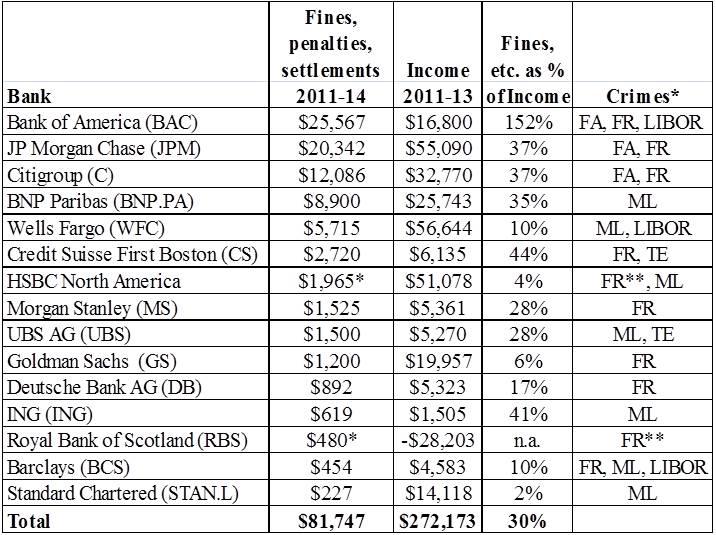
Table 1 provides data on the fines, penalties and settlements levied against the big banks. The final column gives fines, etc., for the 2011-14 period as a percent of reported income for 2011-13. There are several problems with these ratios1, but they are indicative of how significant the fines are relative to each bank's income.

Table 1. - Fines, Penalties, and Settlements Levied Against Large Banks

(in millions of US$)

(click to enlarge)
* Crimes: FA=Foreclosure Abuses; FR=Fraud; LIBOR = Manipulating Interest Rates and Prices;

ML=Money Laundering; TA=Aiding in Tax Evasion;

** Banks are in negotiation with Federal housing agencies - significant additional fines expected.

Sources: Newspaper reports and company SEC filings.

Do Fines Have Deterrent Effect?

There is no question that since the 2008 depression, a new regulatory era has started. And part of that are much higher penalties. But will they have the desired impact of reducing bank crime? I talked recently to a senior executive in one of the big US banks. He said: "Big banks are in the risk business. One of those risks is that either governments or private firms will take us to court. In deciding what to do, we have to consider that risk. However, the returns on some activities are high enough to risk lawsuits. And when they are, the penalties we incur will be viewed as a cost of doing business."

Take another look at Table 1 where fines are compared to banks' income. I don't care how large a bank is. When your fines exceed $1 billion, your stockholders will sooner or later take note. And the fines are not the only costs that banks incur for illegal acts. In 2013, Bank of America paid $2.9 billion in "Professional Fees" (I am sure a significant segment of this is for outside lawyers); JPMorgan's tab for said fees was $7.6 billion!

How About The Volcker Rule?

Paul Volcker, the former Federal Reserve Chief, has for some time argued that banks should not be allowed to trade using depositor assets. He points out that the Glass-Steagall Act did not allow it and we had no major bank problems while it was in force. A significant feature of the "true" Volcker Rule is that banks cannot sell off the loans/mortgages that they originated, but instead hold them to maturity. The "incentive effects" of adopting the Volcker Rule would be significant: instead of trying to maximize commission income from the sale of loan/mortgage packages (the driving force behind the 2008 collapse - nobody cared about the quality of loans), banks would instead focus on making sound loans.

At one point, Volcker had some influence in the White House. That ended when Larry Summers and Tim Geithner took over. Both Summers and Geithner, looking for paychecks from the finance industry in their next jobs, effectively eliminated Volcker's influence. However, Barney Frank and others in Congress insisted that the Dodd-Frank Bill does include a Volcker Rule. Unfortunately, just how it would be defined was left to the regulators. And the bank lobbyists have been at work. Open Secrets estimates that banks spent more than $60 million on lobbying in each of the last 3 years (2011-13).

So where are we today? I quote from the most recent JPMorgan annual report to the Security and Exchange Commission:

"On December 10, 2013, regulators adopted final regulations to implement the Volcker Rule. Under the final rules, "proprietary trading" is defined as the trading of securities, derivatives, or futures (or options on any of the foregoing) as principal, where such trading is principally for the purpose of short-term resale, benefiting from actual or expected short-term price movements and realizing short-term arbitrage profits or hedges of such positions. In order to distinguish permissible from impermissible principal risk taking, the final rules require the establishment of a complex compliance regime that includes the measurement and monitoring of seven metrics. The final rules specifically allow market-making-related activity, certain government-issued securities trading and certain risk management activities."

The banks' lobbyists have done a good job. The agreed-upon rule only applies to a segment of short-term trading. And "a complex compliance regime" that involves "seven metrics"? The banks will just hire a few more accountants and lawyers and again befuddle the regulators. And the banks have negotiated things so they will be able to "hedge". In sum, the banks got just about what they wanted, a very distant relative of the Volcker Rule.

In its SEC report, JPMorgan stated, "The Firm has ceased all prohibited proprietary trading activities." This is intended to convince the SEC and JPM's stockholders that the London Whale incident will not be repeated: speculative trading by a staffer in London that resulted in trading losses of $6.2 billion, and 2012 fines of $1 billion.

Senator John McCain made an apt comment on the incident: "JPMorgan's chief investment office increased risk by mislabeling the synthetic portfolio as a risk-reducing hedge when it was really involved in proprietary trading".

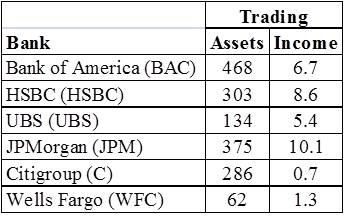
So will the "watered-down" version of the Volcker Rule have a meaningful impact? Table 2 provides data on the trading assets and income of banks at the end of 2103. It remains a big business and will continue as such.

Table 2. - Trading Assets and Income, Selected Banks

(bil. US$)
Source: SEC Submissions

Too Big To Fail - The Living Will Solution

Just after the 2008 bank collapse, there was considerable concern expressed about certain banks being "too big to fail". Congress's solution was to ask the big banks to write up plans for "orderly bankruptcies" that would not set off wider panics. This sounded like a dead-end, losing proposition from the start and it has proven to be just that. The banks have submitted their initial plans and the federal regulators have reacted. The Federal Deposit Insurance Corporation has determined that the living wills were "not credible." Thomas M. Hoenig, the vice chair of the FDIC, concluded: "Despite the thousands of pages of material these firms submitted, the plans provide no credible or clear path through bankruptcy that doesn't require unrealistic assumptions and direct or indirect public support."

The Only Thing That Will Make Banks Safe

We do not deposit money in banks so banks can gamble. We put money in banks for safe keeping. Depository institutions should not be allowed to trade any assets. Too risky. Let hedge funds, private equity funds, and venture capital funds take the risks. The simple and only solution that will make banks safe: limit FDIC insurance to banks that hold their own loans to maturity and do not engage in trading on their own accounts.

Investing in Big Banks

Given the bad press big banks have been getting, perhaps the best way to view them is like sin/vice investments. For example, the Vice Fund (VICEX)2 only invests in tobacco, alcohol, defense, and gambling companies. It has done well (5 year average return - 17.7%) .

There is an interesting literature on sin/vice investing3. In essence, the studies find that in the long run, sin stocks outperform the overall market. Why? Because some institutional investors shy away from sin stocks, sin industries have high entry barriers, and companies within sin sectors often have considerable pricing power.

However, you want to view large bank investments, I offer one recommendation: before investing in a big bank, take a look at its annual filing with the SEC. In particular, find and read the "Litigation" note to its Consolidated Financial Statements. For example, JPM's Litigation note appears on pg. 326-332 of its 2013 10-K Report to the SEC. It describes 37 major actions that have been investigated with numerous cases coming forth from them.

I end with a quote contained in JPM's Litigation note:

"The Firm has established reserves for several hundred of its currently outstanding legal proceedings….During the years ended December 31, 2013, 2012 and 2011, the Firm incurred $11.1 billion, $5.0 billion and $4.9 billion, respectively, of legal expense. There is no assurance that the Firm's litigation reserves will not need to be adjusted in the future."

1. The fines, etc. data reflect what has actually been settled on, either in court or in out-of-court settlements. Just when, how and if these fines, etc. will be collected remains uncertain. The banks set aside reserves (and in so doing, reduce income) for what they expect they will have to pay annually. That means their incomes are somewhat lower than they would have been in the absence of the fines, etc.

2. The "Vice Fund" was recently renamed the "USA Mutuals Barrier Investor Fund".

3. See F.J. Fabozzi, K.C. Ma, and B.J. Oliphant, "Sin Stock Returns", Journal of Portfolio Management, Fall, 2008, and H. Hong and M. Kacperczyk, "The Price of Sin: The Effects of Social Norms on Markets", Journal of Financial Economics, April, 2009.

See the original article >>

Handicapping the ECB Meeting

by Marc Chandler

The ECB meets tomorrow. The combination of soft inflation data and Draghi's speech at Jackson Hole has raised expectations for a policy response. 

Many observers have played up the risks of an asset-backed securities (ABS) purchase scheme for which Draghi said preparations are moving forward quickly.  We are more skeptical that the ECB is prepared for this.  There are many moving parts, and not all of them are controlled by the ECB.  Moreover, the issuance of ABS varies greatly through the eurozone, though if the ECB did announce a purchase plan, we could envision banks manufacturing more. 

Rather than an ABS purchase program or an outright QE, we expect more modest measures by the ECB. We think a 10 bp rate cut to bring the repo rate to 5 bp is likely.  The deposit rate, which is already set at minus 10 bp could be cut further, and the top of the corridor, the 40 bp lending rate could also be shaved. 

Recall that in June in response to the last rate cut, including the negative deposit rate, the euro initially sold off and then rallied to a two-week high. There was marginal follow through buying the following day, but then the euro slipped lower.  Still, it did not take out the low set initially on the ECB announcement until late July. 

ECB officials seem focused on the Targeted Long Term Repo Operation (TLTRO)  that will be launched toward the middle of this month.  Some observers share our concern that for various reasons the participation may be as strong as hoped.  The purpose of the TLTRO is to boost private sector lending, and demand is not particularly strong.  Banks are still paying down the LTRO borrowings.  The carry opportunity is not as great.  There are more reporting requirements. 

The ECB may announce more details of what it has called "modalities" or rules of engagement for the TLTROs.  Some small banks, which do not have access to the ECB's facilities, could participate in the TLTRO through a larger bank, for example.  Although the ECB has indicated this, few have focused on the implication.    Since the cost of TLTRO funds 10 bp above the repo rate, a repo rate cut on the eve of the TLTRO may also help encourage stronger participation. 

The purpose of the TLTRO funds are to facilitate lending to the private sector and not buying sovereign bonds (carry trade), there are not penalties for using the funds for precisely that. Our understanding is that if a bank's net lending is below the benchmark as of April 2016, the bank will simply have to repay the TLTRO funds in September 2016 instead of September 2018. 

That is to say; banks will get to have two-years of low cost funding regardless of the evolution of their loan portfolio.  On the assumption that banks will be reluctant to take on fresh maturity mismatches, we suspect that the prospect for a repo rate tomorrow and TLTRO borrowings has been a key factor behind the rally short-end of the euro area coupon curves.  The two-year yield in Germany and the Netherlands are negative.  France also flirted with negative territory in recent days. 

Given the rally rally in European bonds, the carry trade is not as attractive as it may have been previously.  However, the cost of the funds is still cheap and, if we are right about a repo rate cut, practically for free (5 bp annualized).  This is, of course, cheaper than any other funds that banks can source.  This is doubly true for smaller and weaker banks. 

What about a full fledged QE program from the ECB? With the OMT issue still before the European Court of Justice, we do not think there is a critical mass necessary to support the effort.  Moreover, given the euro's decline, about 3% against the dollar since the negative deposit rate was introduced, and a little more than trade weighted basis over the past six months, which is tantamount to some easing of monetary conditions, we suspect there is a reasonably good chance that inflation bottoms in the September-October period.   This may be reflected in the new staff forecasts that will be published tomorrow (and won't be updated until December. 

On the other hand, if inflation does continue to fall and deflation looms, we can envision a scenario for QE. In order to win the acceptance by Germany and other creditor members, a European-style deal would have to be arranged.  Consider that Italy's President Napolitano wants to step down.  He was persuaded to stay in office longer than he intended.  He turns 90 in the middle of next year, and reports make it clear that he would like to retire before then.

Draghi may get German support for QE if Germany could oversee its implementation. And recall that with Lithuania joining EMU, a new voting regime at the ECB will be instituted in January 2015.  Not only are the number of policy meetings reduced, but also, not all members, including Germany will vote at each meeting.  This is ruffling more than a few feathers in Germany. 

The proverbial circle can be squared if Draghi steps down as ECB President and takes the high profile post of Italy's president. Germany's Weidmann is the obvious choice as his successor.  After Trichet, it was supposed to go to the Bundesbank's Weber, who resigned over the ECB's SMP scheme in which sovereign bonds were purchased (and turned out to be quite a profitable investment). 

Some observers have stressed the poor economic performance as a reason for more aggressive ECB action. We disagree. While we recognize the weakness of the region's economy, we do not think European central banks generally see monetary policy as the instrument to address it.  At Jackson Hole, Draghi called for fiscal flexibility.  This apparently, according to some press accounts, raised the ire of senior German officials.  The German concern is not only over the well-worn moral hazard arguments,  it is about debt in the first place and the rejection of Keynesian demand management.  We have suggested it is very revealing that in German, the word for debt and guilt is the same. 

Structural reforms and the promotion of risk-taking and profit-seeking behavior over the traditional rent-seeking is  necessary.  This does not necessarily mean embracing neo-liberalism.   Germany instituted key reforms several years after the Berlin Wall fell, for example.  Spain appears to be engaging in a similar effort now. 

In fairness, the EU has shown willingness to explore the fiscal flexibility that is embedded in the Stability and Growth Pact.  Has not France, Italy, Spain and others been given more time to reach the 3% deficit target?  Perhaps Draghi's comments were not so much about the debtor countries, but the surplus countries, like Germany.  With the German economy slowing, is there really a compelling reason for it to strive for a budget surplus? 

We also take exception with arguments that contend that the problem in Europe is the lack of private investment. We think the problem is one of aggregate demand.    The large trade surplus shows that the EMU is producing more goods than it consumes.  Moreover, capacity is under-utilized.    I cannot think of a major country that has had an economic recovery that was led by investment for at least several decades.  Public investment in a different story.  Here it does not appear that all of the funds, including EU funds, that are for infra-structure spending have been used.  European countries are their own worse enemies in this context. 

European officials pride themselves on the rule-based approaches, but the rules are respected often only in the breach. One area of public investment that euro area countries consistently miss is their pledge to spend 2% of GDP on defense.  Greece is one of the only EMU members that does, and it is probably among the least able to do so (though it buys its weapons primarily from Germany and France, which participate in lending it funds).  In light of the events in Ukraine, and on the eve of the NATO meeting, an increase in defense spending may turn out to be a more viable path.  To be sure, this is not to advocate military Keynesianism, just merely to recognize that it is an area that may be explored on political, economic and ideological grounds.

The euro has fallen for seven consecutive weeks coming into this week. The gross speculative short euro position in the futures market is within a stone's throw of the record set just before Draghi uttered his famous pledge in July 2012.  While we expected the interest rate and growth trajectory to sustain the downtrend in the euro, we are concerned about the risks of either disappointment with the ECB or "sell the rumor, buy the fact" type of activity.  Medium term investors should be prepared for the a counter-trend move, which should seen as a better opportunity to get with the trend by reducing euro exposure directly or through hedges. 

See the original article >>

Follow Us