Thursday, July 14, 2011

The Disintegrating U.S. Economic Recovery


The word 'recover' always has the connotation of "getting back." But who is going to get back what when the economy "recovers"? Few at most. So what does an economic recovery look like? No one knows. The word 'recovery' can not be applied to objects willy-nilly. A sick person goes into the hospital to recover; a broken automobile is taken to a shop to be repaired. Automobiles do not recover. Neither do economies; they can only get better or worse, and specific information is needed to determine which. Few people realize just how close to the edge of disintegration America is. The Congress meets for one purpose and one purpose alone—to get reelected. The political posturing begins the day after each election, while the nation's problems go unaddressed, and our media aid and abet the posturing. Such is America today. This recession/depression will never "recover." Neither will America.

That successful, inveterate liars consistently use a specific group of practices has been known for ages. They, for instance, give long winded answers to questions to distract and confuse the questioner, make assertions that can't be easily refuted, and keep from saying very much that is specific, making it difficult to confirm or refute details. One prevalent way of doing this is to speak metaphorically.
 
Those of you old enough to remember the Vietnamese War may remember that whenever General Westmorland was asked how the war was going, he usually replied that there was "light at the end of the tunnel" 

Of course there was; there is light at both ends of every tunnel. But no one ever knew which end he was talking about or if we were getting any closer to the end that would get us out. We all now know, of course, that we were not. Telling us that there was light at the end of the tunnel told us nothing at all; yet many were led to believe that "there is light at the end of the tunnel" was synonymous with "we were getting closer to victory" even though there is absolutely no logical relationship between these two assertions. Why did Westmorland always answer this way? The only reasonable answer is to avoid telling the truth.

Likewise, President Obama is addicted to vapid metaphors: the US still has a "big hole to fill," “Headwinds” from the first half of 2011 are holding back the recovery," "There are going to be bumps in the road," and "on the right track"

The hole that needs to be filled is the lack of specificality in his speeches, but let's just consider the ubiquitous "on the right track." It's very similar to "light at the end of the tunnel." A train, for instance, can be on the right track but be going nowhere or perhaps even going backwards. When a train is on a siding, isn't it on the right track? What does this metaphor tell anyone? What kind of evidence could be cited to refute it? It's one of those perfectly safe, empty claims that people trying to hoodwink others make all the time.

But what has all of this to do with "recovery"? Well, just take a look at how the word is ordinarily used.
"My neighbor has recovered from pneumonia" usually means his previously impaired lungs are now working normally. They have gotten their normal functionality back.
”The police have recovered my friend's stolen property" usually means that his property has been returned to him. He has gotten his property back.
"The speculator recovered the money he lost" means that he got the amount of money he lost back.
The word 'recover' always has the connotation of "getting back."
But who is going to get back what when the economy "recovers"? Are the people who lost their homes going to get them back? No. Are the people who lost their jobs going to get them back? Not likely. Are the people who lost their savings for retirement going to get them back? Some may; most will not.
So what does an economic recovery look like? No one knows.

If the employed population rises to 94%, will the economy have recovered? What if the workers' total compensation is only half of what it was before the recession/depression? Will it still be a recovery?

What if GNP exceeds the GNP before the downturn but employment only rises to 85%? Will that be a recovery?

What if the Dow goes to 50,000 but the average wage is only $4.00 and people are starving? Will that be a recovery?

You see, the word 'recovery' when used in relation to the economy is just another vapid metaphor. It means nothing. It means whatever anyone wants it to mean. It is not used to describe anything real or concrete. It is used to pull the wool over people's eyes, to get them to believe what the speaker wants them to believe. If he wanted to tell you the truth, he'd use more specific words, such as, "a few more people are employed today than a month ago." "The Dow is somewhat higher today than it was last quarter." "The average wage is $5.00 less today than it was last year." If anyone ignores the last of these, he could say the economy is recovering. But could he say that if he takes the third into consideration?

The word 'recovery' cannot be applied to objects willy-nilly. A sick person goes into the hospital to recover; a broken automobile is taken to a shop to be repaired. Automobiles do not recover. A diseased tree can be treated and recover; a broken stone cannot. An erroneous calculation can be corrected; it cannot recover. Neither can economies; they can only get better or worse, and specific information is needed to determine which.

When people don't want you to know the truth or even what, if anything, they're talking about, they use abstract words and metaphors. Looking carefully at the words people use is a sure way of identifying scoundrels. I am no oracle; I don't have the slightest idea of what the President is up to. But I do know he's not being honest with the American people. Neither are the members of his Cabinet or even the Congress.

Few people seem to realize just how close to the edge of disintegration America is. Engineers have been warning us for decades about our collapsing infrastructure. This year's floods have demonstrated just how fragile our earthen dikes are. We have chosen the inefficient automobile as our basic means of transportation, but we lack the money to maintain our highways. Mr. Obama has recently spoken of building bullet trains while even our present railway system is slow and unsafe as two fatal accidents this week alone show. The war on drugs has been a monumental failure; yet we persist on fighting it. Even Congressmen admit that our government does not work. 

The President last year initiated a "race to the top" in our public schools; today teachers are being laid off for lack of funding. Up until 2008, many people had lost confidence in all of our institutions except the financial system, but even that confidence has now evaporated. Given the number of people Americans have incarcerated, this nation must be either the most crime ridden the world has ever seen or the most repressed. Homeland Security has done little but annoy people; yet it refuses to change its policies. Two years ago, the Democrats enacted a comprehensive health care bill; today the talk is about reducing its benefits. Our once mighty manufacturing base has been dismantled; yet the government wants more free trade agreements to increase exports. State governments are too impoverished to continue providing even basic services. The number of homeless, impoverished, and hungry Americans is increasing. The number of employed along with their wages is declining. Our superbly equipped and trained military forces have not won a major war since World War II; yet we continually engage them. I suspect the greatest contributor to GNP is political contributions, sanctioned by the Supreme Court, made to buy off our representatives. The Congress meets for one purpose and one purpose alone—to get reelected. The political posturing begins the day after each election, while the nation's problems go unaddressed, and our media aid and abet the posturing. Such is America today. This recession/depression will never "recover." Neither will America.
Europe and America are Financially Burning

By: Bob_Chapman

Markets are what they are today because that is the way government wants them. The stock market has stayed up for quite some time, but the best earnings are fading. The Street is well aware of what has been happening for a number of years. They just do not say anything and go along with the program. They have come to overlook situations worldwide as well as in America, because they believe that, “The President’s Working Group on Financial Markets” won’t let the market fall.

There are not many professionals that believe there will be no extension of the short-term debt limit to $16.7 trillion. They do not believe default is possible. That tells us that extension has already, at least 80%, been discounted in the market. If approved, the event should not cause much of a future rally. Extension of hostilities in the Middle East could put further pressure on the market. There certainly will be much less debt created and that will change fiscal policy. It will tend to further slowdown an economy that cannot stand on its own. In fact, without an $850 billion stimulus it will not most certainly fall into minus GDP growth. If the economy is to stay in growth the Fed will have to create the funds for both the funding of Treasury and Agency debt and perhaps purchase more toxic waste. They own almost $1 trillion now whose value we cannot determine, and simultaneously fund the economy. If all of this does not take place then the economy will fall as will earnings and the market will as well. As you are well aware governmental, personal and corporate debt are overwhelming, which means it is going to take many years to try to pay this debt off. We do not see it ever being paid off. We expect a series of wars or a Third World War, which could cause a debt settlement by many nations, or in absence of a war there could be currency devaluations, revaluations and multilateral partial or full default.

The QE2 program was in effect for a year and unemployment did not improve in spite of stimulus 2, or the injection of $862 billion. Housing isn’t going to improve anytime soon, nor is commercial real estate, both of which could remain moribund for many years. By the end of the year home inventories could be 3 to 3.5 million residences. Government has done almost nothing to create substantial numbers of jobs, as our Congress allows transnational conglomerates to keep foreign profits tax free offshore and under free trade, globalization, offshoring and outsourcing gut our job market. No effort is made to stop it. We have lost 11.7 million jobs in 11 years and 440,000 corporations that have moved offshore. We ask, why doesn’t the President and Congress start here and as well clear the 30 million illegal aliens out of the country? The administration is more interested in selling 30,000 weapons to criminals who operate drug cartels. Unemployment is 22.6% and government has to stop lying about the numbers. Government now wants to change the CPI, so ever more bogus figures can be produced. Do not worry we will always have the true figures.

Under such circumstances how can consumers increase debt and spend more? They simply cannot and that will soon show up in consumption as a percentage of GDP, when it again hits 69% on its way to the long-term average of 64%. Yes, the ratio of household debt to disposable personal income has fallen from 130% to 150%, but with major unemployment will it return to 75% that existed during the last 25 years of the 20th century? Momentum is only headed in one direction and that is down.

We are not the only country with these problems, just look at England and Europe - they are in the same boat. In addition, their financial conditions are continuing to deteriorate. In Asia, Japan is trying to recover from its terrible destruction and China and others are raising interest rates and mandatory bank reserves to combat inflation.

The agreement on short-term debt extension will not include any meaningful budget cuts. They will just pile on more debt until the system collapses. For the paid-off politicians and those behind the curtain pulling all the strings it is just another game to control the populace and enslave them. The public is so entrapped they want debt extension and QE3. They do not care what the cost is they just do not want the game to stop and the music to end. Like in Greece if they can they want both parties out of government, but that is not going to happen unless there is a revolution. We will have a 10-year deficit reduction to bamboozle the people and it will mean little. Some higher taxes for the rich and more bread and circuses for the people. Future congresses are not gong to be bound by legislation they’ll just bypass it or pass offsetting legislation. This is really all a game of political posturing and theatre.

Low interest on mortgage loans still is not luring or qualifying many people to buy homes. Most buyers are speculators – many of which pay cash and rent the dwellings. Those millions of homes in lender inventory are not being sold or depleted. That inventory somehow is never mentioned in the mainline media coverage. It tells a good part of the whole story, America was overbuilt and it will take years to clear the inventory, as builders, build 550,000 new homes a year. That means lower prices and years of illiquidity. 

The housing bubble is still being liquidated and as long as that is in progress there will be no American recovery. Manufacturing has in large part been shipped overseas, so what will create jobs and prosperity if housing and manufacturing are moribund? It certainly won’t be services that provide $10.00 per hour wages. The lost jobs paid $30.00 an hour. The tacks the US Congress and transnational conglomerates have taken are sure to destroy America as a first world nation. All they have done is enrich themselves and betrayed fellow Americans. Most banks are certainly insolvent and the government made the conscience decision to effectively nationalize housing. We believe that decision was made ten or more years ago, when we predicted this would be the outcome. If government owns all the houses the only people who can rent them are those that do what government tells them to do, such as where you will work and where you will live. This fits in perfect with fascist political and economic philosophy.

We are making major inroads into informing the US and world public about what is really going on, yet, at least 50% have no clue as to what is really going on. They are deeply in debt and psychologically they have been wiped out by real estate losses. They have no food storage; water filters or means to defend their families. They have no gold or silver to carry them through hard times. For years Wall Street and government anti-gold and silver propaganda has left them at best confused. They are totally unprotected and are very liable to end up in dire straights.

We again have been fortunate in predicting this past week’s moves in gold and silver. Gold rose almost $60.00, up some 6% versus euros and almost 4% in dollars. In many countries the yields are rising on government bonds and as we have said since 1967, that has been a harbinger of higher gold prices. Worldwide yields are at record lows, which means that yields have nowhere to go except up. Worse yet, debt is increasing everywhere if for no other reason than it is cheap to borrow. Add to the debts mix in a lack of confidence because of fiat currencies and you have major problems now and looking down the road. As time passes more investors will want gold and that means as currencies are dumped gold and silver will be the beneficiaries.

Investors are concerned because everything government does turns out poorly. Debt based money has always been a ticket for disaster. There is only the euro, which has about 5% gold backing, down from 15% ten years ago. As a result all currencies have lost an average of more than 20% annually versus silver and gold. That means there are some who just do not want paper if they can avoid it. In just the past ten years 60% of US debt has been added of the 97% loss since 8/15/71. Recently we have seen many sovereign-debt down grades, which should have taken place years ago. Why did they now all come at once? It is because those on Wall Street and at the Fed want investors looking at other nation’s problems, not America’s problems, which are 100 times worse than those of Greece and the other five European sovereigns.

Don’t forget the rating agencies are controlled by Wall Street; just look at their deliberate mis-rating of CDOs and MBSs. That should be proof enough. Just recently Germany refused to accept their ratings. They said they were bogus and politically charged. We realize the debt situation with these six countries is dire, and will worsen and more and more funds will be needed to pay interest to the bankers. Their market interest rates have risen and will continue to do so, at rates that will destroy these nations and perhaps the lending nations and the IMF as well. Delaying the inevitable is a very dangerous policy that will end up being terminal for all.
If these nations that are in trouble cannot borrow they cannot recover. Austerity eliminates jobs and reduces government income in the form of taxes. Then the victims need more loans, which eventually cause collapse, as we saw in Argentina in the late 1990s. These countries cannot devalue their debts because they are trapped within the euro and the only way to recover is to default and leave the euro and go back to their original currencies. The elitist powers in Washington want the euro to collapse so that the US dollar remains the world reserve currency. This is currency war aided and abetted by the rating agencies captive subsidiaries of Wall Street. 

How can a nation such as Greece with 11 million people pay off $675 billion? Obviously they cannot, so we see the exercise of one of destroying Greece, the other five nations, and eventually the euro. The key to the collapse of the weak euro zone members is that they cannot devalue and that is why they have to exit the euro, or remain in bondage for the next 50 or more years. The US on the other hand can raise the debt limit; euro zone members cannot do that. This is what the US has been doing since 2000 via the creation of money and credit and as a reflection of that in dollar terms is the rise of gold from $260 to $1,577 and silver from $3.50 to $50.00. That tells the whole story. Today it is worse as the US borrows about half the money it spends. Over the past three years that debt tripled at the rate of $1.5 trillion annually. Under present circumstances this scenario has to worsen, because just to maintain more and more money and credit has to be shoved into the system. We have just seen in Stimulus 1 and 2 and QE 1 and 2 that the results of almost $5 trillion in spending has brought two, six to nine months periods of growth that fizzled once the infusions ended. QE 3 is now upon us and the Fed will do the same thing again getting the same poor results. In the US economy the minute the money and credit stops the bottom falls out.

As we have said many times before the only way to end this crisis is to have a meeting of all nations. Revalue, devalue ad multilaterally complete debt default. That is what has been done in the past and that is what has to be done now. We know problems are far greater today than the past and the depression to follow will last for five or more years. That is far better than letting the system collapse, trying to rebuild and suffering 20 or more years of worldwide depression. Due to this indecision the crisis worsens with each passing day.

The world financial system has been built on sovereign debt once that system goes into crisis, which it is in the process of doing, and then the entire system will collapse. Europe is the beginning and we believe the interconnectivity will first take down Europe, then England, then the US, and in varying degrees the rest of the world, unless soon the meeting we mentioned begins.

The US needs to act and act quickly to bring about such a meeting - at least within the next few years. At the present pace the dollar problem could be stretched out for a number of years, but the longer it is stretched out the worst will be the final result. During the immediate timeframe the dollar’s world reserve status could be maintained, if the meeting’s held and the dollar returns to a gold standard.

Europe is figuratively financially burning. In Greece everyday there are demonstrations ranging from 200,000 to two million at any given time. The price of gold in euros hits a new high almost every day. The bankers and leadership in Europe are delusional. They simply refuse to face the reality they have created. The end of QE 2 is a joke. The Fed has not refrained from monetizing Treasury debt, as its balance sheet hit another high on July 6,2011. That was a total of $2.854 trillion, consisting of $1.625 trillion in Treasuries. The total was $600 billion plus $250 billion from reinvested funds. We had estimated more than a year ago participation of $900 billion net. This $850 billion will continue to be invested on a rolling basis. The maturities will dictate participation and how much more funds would have to be added to absorb 80% of Treasury issues and to stimulate the economy. As you can see the Fed has lied again and the crossover to QE 3 has been silent and seamless. There is no limit and as we pointed out long ago, there will be no limit. There cannot be because in the absence of perpetual funding comes collapses.

Fed Chairman Bernanke Says "Gold Is Not Money" ... But His Predecessor Alan Greenspan Disagrees


Fed Chairman Bernanke told congress today:
‘Gold isn’t money’
But Bernanke's predecessor - former Fed chair Alan Greenspan - disagrees.

As I noted in 2009:
Professor Emeritus of Mathematics Antal Fekete has argued for years that gold is the ultimate - and only - safe haven when things really hit the fan.
For example, in 2007 Fekete wrote:
The grand old man of the New York Federal Reserve bank’s gold department, the last Mohican, John Exter explained the devolution of money (not his term) using the model of an inverted pyramid, delicately balanced on its apex at the bottom consisting of pure gold. The pyramid has many other layers of asset classes graded according to safety, from the safest and least prolific at bottom to the least safe and most prolific asset layer, electronic dollar credits on top. (When Exter developed his model, electronic dollars had not yet existed; he talked about FR deposits.) In between you find, in decreasing order of safety, as you pass from the lower to the higher layer: silver, FR notes, T-bills, T-bonds, agency paper, other loans and liabilities denominated in dollars. In times of financial crisis people scramble downwards in the pyramid trying to get to the next and nearest safer and less prolific layer underneath. But down there the pyramid gets narrower. There is not enough of the safer and less prolific kind of assets to accommodate all who want to "devolve”. Devolution is also called "flight to
safety”.
Darryl Schoon makes the same argument.
Here's a visual depiction Exeter's inverted pyramid, courtesy of FOFOA:


(Click here for full image)
Are Exeter, Fekete and Schoon right?
I don't know. But Alan Greenspan just lent some support to the theory.
Gold prices that jumped above $1,000 an ounce this week are signaling that investors are buying metals to hedge against declines in currencies, former Federal Reserve Chairman Alan Greenspan said.

The gains are “strictly a monetary phenomenon,” Greenspan said today at an investment conference in New York. Rising prices of precious metals and other commodities are “an indication of a very early stage of an endeavor to move away from paper currencies,” he said...

“What is fascinating is the extent to which gold still holds reign over the financial system as the ultimate source of payment,” Greenspan said.
In other words, Greenspan is saying that investors are moving out of the second-to-lowest step on the pyramid (currencies and government bonds) and into the lowest step (gold).
Greenspan is also verifying what goldbugs like Exeter, Fekete and Schoon have been claiming: that "the barbarous relic" still holds an important place in the modern investor's psyche.
Moreover, as I reported last year:
Alan Greenspan told the Council of Foreign Relations last week:
Fiat money has no place to go but gold.
Greenspan also said that supply and demand explanations treating gold like other commodities “simply don’t pan out."
Greenspan also spoke of how, during World War II, the Allies going into North Africa found gold was insisted on in the payment of bribes, and said:
If all currencies are moving up or down together, the question is: relative to what? Gold is the canary in the coal mine. It signals problems with respect to currency markets. Central banks should pay attention to it.
As I pointed out last month:
Utah has declared gold and silver to be legal tender - with the value of the coin determined by the weight of precious metal it contains
As the New York Times notes:
The law is the first of its kind in the United States. Several other states, including Minnesota, Idaho and Georgia, have considered similar laws.
World Bank president Robert Zoellick noted last year:
Although textbooks may view gold as the old money, markets are using gold as an alternative monetary asset today.
Moreover, as FT reported last year:
Intercontinental Exchange, the US futures exchange group, has followed rival CME Group by allowing its European clearing house to accept gold bullion as collateral for transactions.
Zero Hedge notes:
JP Morgan Accepts Gold Bullion As Collateral.
And Phoenix Capital Research argues that central banks are themselves loading up on gold because they know that the entire fiat money scam will soon collapse.

QE3 & THE FED’S POLICY OPTIONS

by Cullen Roche

I had hoped that all of this QE talk was subsiding, but since the Fed has misdiagnosed this crisis incorrectly from its onset we really shouldn’t be surprised to see the wrong prescriptions continue. In his testimony this morning, Dr. Bernanke provided the various options the Fed has left in its toolkit:
“On the one hand, the possibility remains that the recent economic weakness may prove more persistent than expected and that deflationary risks might reemerge, implying a need for additional policy support. Even with the federal funds rate close to zero, we have a number of ways in which we could act to ease financial conditions further. One option would be to provide more explicit guidance about the period over which the federal funds rate and the balance sheet would remain at their current levels. Another approach would be to initiate more securities purchases or to increase the average maturity of our holdings. The Federal Reserve could also reduce the 25 basis point rate of interest it pays to banks on their reserves, thereby putting downward pressure on short-term rates more generally. Of course, our experience with these policies remains relatively limited, and employing them would entail potential risks and costs. However, prudent planning requires that we evaluate the efficacy of these and other potential alternatives for deploying additional stimulus if conditions warrant.”
Clearly, QE3 is on the table. What form of QE3 is still up in the air. QE3 in the form of open ended (no target size) interest rate targeting will “work” in the sense that it will control long rates. My fear is the response from the public. Open ended long bond purchases would most certainly fuel hyperinflation chatter and debt monetization fears. The cost push inflation from higher commodities would prove even more disastrous than it was during QE2. Is the Fed willing to take that risk? It certainly looks that way. A policy more similar to QE2 (not open ended, but size targeting) should be expected to have similar effects by squeezing households further as commodity price speculation strangles the economy.

The other two policy responses appear relatively weak. Cutting interest on reserves is unlikely to help much if at all because of the obvious limitations. More explicit guidance might provide some clarity on the future, but it’s not world changing. It’s more confidence fairy policy than anything else. These are marginally helpful, but in a $15T economy they’re not moving the needle much.

I still think the Fed’s rational response should be to acknowledge that we are in a household debt crisis and discuss the various ways in which they’ve attempted to help while also discussing the various reasons why history proves monetary policy to be particularly ineffective during this sort of unique environment. The Fed should emphasize the need for greater fiscal policy, emphasize that the US government is not bankrupt and serve as a guide to recovery rather than attempting to fix a problem you are not equipped to deal with. That’s clearly not the path we are taking though.

See the original article >>

THE DOLLAR DEBASEMENT MYTH & THE FED’S BALANCE SHEET

by Cullen Roche

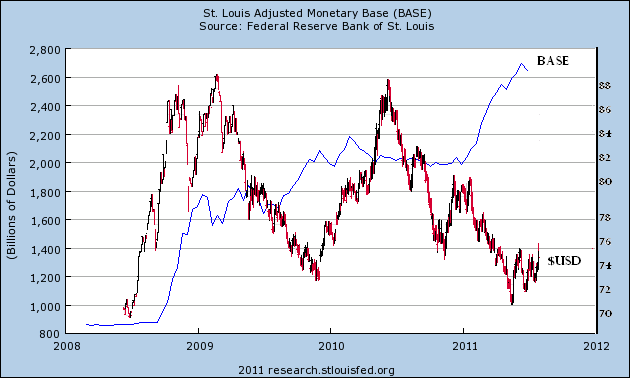
Mike Norman just posted a very good fact based story on the relationship between the Fed’s balance sheet and the US Dollar. As I have often noted, the Fed does not print money. QE2 is not money printing. It is not debt monetization. It will not cause high inflation. It will not cause hyperinflation. It will not cause a dollar collapse. And three years into this massive Fed balance sheet experiment we have the facts. Mike notes:
Below I give you the US Dollar Index and the size of the Fed’s balance sheet.
Date Dollar Index ValueFed’s Balance Sheet
3/14/2008 71.66 $921 bln
7/13/2011 75.24 $2.9 TRILLION!
Words don’t do this justice though. I put together this chart showing the dollar index versus the Fed’s balance sheet over the last three years. As you can clearly see – there is no real correlation between the size of the balance sheet and the USD. None at all. This has all been proven correct despite my repeated ramblings, yet the inflationists and fear mongerers still garner all of the attention. Clearly, people prefer to be scared as opposed to being told the truth.

See the original article >>

More or not more

By Peter Boockvar

Following the good 3 yr note auction yesterday, the 10 yr today was good as well. The yield was 1-2 bps below the when issued and the bid to cover of 3.17 was above the 12 month average of 3.11. Direct and indirect bidders totaled 55.9%, about in line with the prior two. Today’s auction had the influence of Bernanke’s comments on doing EVEN MORE, the weak payroll report and the obvious mess in Europe. In terms of QE3, or QE4, QE5, etc…, keep one thing in mind. Just as an alcoholic needs more and more booze each time to get drunk, each successive form of money printing from here on out has to be even greater for it to have an impact similar to the one before. Thus, it is not just the possibility of more, but the size of it that will matter compared to QE2. In terms of even lower interest rates mattering to the actual real world economy at this point, we know it doesn’t anymore. Asset prices again would be the only thing to benefit at the same time the US$ continues to lose purchasing power. What’s nuts and disturbing about this whole discussion is that its not even 2 weeks since QE2 ended.

Not to long after Bernanke today reiterated what was in yesterday’s FOMC minutes, that ‘more’ is always on the table, voting member Fisher is sounding like he will be one of the dissents on this. While he complained about QE2 over the past 6 months but still voted each time for continuing it, in a speech today he sounds like someone in the Fed saying ‘no more.’ He said, “I firmly believe that the Fed has already pressed the limits of monetary policy. So-called QE2, to my way of thinking, was of doubtful efficacy, which is why I did not support it to begin with. But even if you believe the costs of QE2 were worth its purported benefits, you would be hard pressed to now say that still more liquidity, or more fuel, is called for given the more than $1.5 trillion in excess bank reserves and the substantial liquid holdings above the normal working capital needs of corporate businesses…US banks and businesses are awash in liquidity. Adding more is not the answer to our problems.” I thus reiterate again and for last time as not to further annoy, while QE3 is always possible with this Fed, the bar is high and it won’t happen, I believe, unless we see a sharp downward move in both stocks and the economy.

Follow Us