Thursday, June 13, 2013

The Power of the Prize

by Kandeh K. Yumkella

VIENNA – The world faces two looming, interconnected energy challenges: how to provide reliable access to modern energy services to the one in five people worldwide who do not have it, while minimizing the damaging impact of climate change by reducing carbon emissions. Surmounting these challenges requires finding more diverse, cleaner energy sources, which implies the need for expanded funding and incentives for research and development of clean technology.

This illustration is by Paul Lachine and comes from <a href="http://www.newsart.com">NewsArt.com</a>, and is the property of the NewsArt organization and of its artist. Reproducing this image is a violation of copyright law.

Illustration by Paul Lachine

Free-market incentives are often viewed as the main catalyst for such solutions. But, while market forces reward innovation and creativity, their impact is substantially weakened in a global economy plagued by slow, uneven growth. Given this, it is up to governments to stimulate and support the development of critical energy capabilities by rewarding innovation.

For centuries, governments have used prizes to spur innovative research that yields creative solutions to pressing global challenges. Such prizes reflect genuine global leadership: transforming a major challenge into an opportunity to facilitate progress toward a better future.

Eighteenth-century British leadership provides a case in point. In 1714, seven years after one of the worst naval accidents in the history of Britain’s Royal Navy, the United Kingdom launched the Longitude Prize, a £20,000 reward (equal to $5 million today) for developing a simple and practical method to determine a ship’s longitude reliably.

At the time, maritime navigation was based on a combination of science, experience, and luck, making it difficult, expensive, and dangerous, especially for those – such as the British government – bearing the financial burden of devastating shipwrecks and lost fleets.

Mariners had long known that, to determine their precise location, they needed to compare the time aboard ship and the time at the home port. But, while they could figure out the former by watching the sun, clocks were not accurate on ships at sea, so they were unable to track the time elsewhere.

Even after the prize spurred scientists, inventors, and engineers from all walks of life into action, it took nearly a half-century for John Harrison, an English carpenter-turned-clockmaker, to win. Motivated by the prospect of a handsome reward, Harrison worked for decades to create the marine chronometer, a timepiece capable of keeping accurate time at sea over the course of a long voyage, enabling sea captains to plot their course accurately. The innovation revolutionized nautical and, later, aerial navigation, and served as a boon to British naval and commercial dominance.

Similarly, in 1795, the French government, with an army debilitated more by hunger than by enemies, offered prizes to anyone who could develop an effective food-preservation method. After experimenting for 15 years, the Parisian Nicolas Appert won the prize with his ground breaking technique for preserving food in glass jars. England’s Peter Durand subsequently built upon Appert’s method by using metal cans.

A half-century later, France’s Royal Academy of Sciences offered a cash prize to the scientist who could produce the best proof for or against spontaneous generation. The award both catalyzed and subsidized the work of the chemist and bacteriologist Louis Pasteur, whose breakthrough discoveries led him to develop revolutionary methods – including the process that came to be known as pasteurization – for the sanitary production and preservation of food.

In order to tackle the twenty-first century’s most pressing challenge – providing access to sustainable energy for all – the world needs the same inspired leadership and long-term vision that spurred innovations in maritime navigation and food preservation. The United Arab Emirates – where projected electricity demand will more than double by 2030 – is among the countries that are rising to the occasion.

The UAE enjoys substantial hydrocarbon resources, with oil and gas output accounting for 45% of GDP and 80% of national income, and fueling the country’s economic growth. Indeed, energy has enabled the UAE to become one of the Middle East’s most developed economies – and thus has played a crucial role in securing the country’s global standing. Nonetheless, its leaders have recognized the need to secure their country’s future by diversifying its energy sources; as a result, the UAE has emerged as a pioneer in the renewable-energy revolution.

The UAE’s toolkit for creative solutions includes the Zayed Future Energy Prize, an annual award for achievement in developing and deploying renewable energy and sustainable technologies. Since its launch in 2008, nearly $10 million has been awarded for innovations that have changed the lives of people worldwide.

In January, during Abu Dhabi Sustainability Week, the UAE honored eight winners in five recipient categories with prizes totaling $4 million, rewarding proven innovators and giving them the financial support that they need.

Global leaders should follow such examples and provide the needed investment and incentives to support innovation in both the public and private sectors. In this way, a brighter, cleaner future can be secured for all.

See the original article >>

Copycat Capitalists

by Alexander Friedman

ZURICH – It is all too easy to envy China. At current growth rates, the Chinese economy will double in size in only nine years, raising an estimated 100 million people above the poverty line in the process.

This illustration is by Paul Lachine and comes from <a href="http://www.newsart.com">NewsArt.com</a>, and is the property of the NewsArt organization and of its artist. Reproducing this image is a violation of copyright law.

Illustration by Paul Lachine

Compare this to the major economies of the Western world. The eurozone’s GDP remains mired below 2008 levels, and the United States last enjoyed Chinese-style growth back in 1984, when gasoline was $1.10 a gallon and the first Apple Macintosh was rolling off the production line in California.

Given the West’s anemic performance in recent years, it is hardly surprising that envy of China’s economic dynamism has manifested itself in official policy. Recent examples range from direct market interventions (such as America’s effort to boost its automotive industry via the “cash for clunkers” program), to the British government’s attempt to reflate the United Kingdom’s housing market by guaranteeing mortgages under its “Help to Buy” scheme.

Even hitherto independent central banks have not escaped the creep toward state-sponsored capitalism. The US Federal Reserve has been gently encouraged to buy 90% of annual net issuance of US Treasury bills, effectively funding the US fiscal deficit and ensuring, via the resulting negative real interest rates, that businesses and individuals wishing to save, rather than spend, will lose purchasing power by doing so.

Ironically, Western countries are shifting to statism at the very moment that China appears to be heading in the opposite direction – witness its recent moves to liberalize its financial system. In just 10 years, the share of state-directed bank lending in China has fallen from 92% of new credit creation to less than half.

But copycat capitalism is not without risk; indeed, it is unlikely to end without someone getting scratched. The West’s efforts to emulate China are hindered by its inability to replicate the conditions of Chinese growth, such as labor mobilization, and its unwillingness to pursue practices such as the one-child policy. Thus, the West’s forays into state capitalism are more likely to result in the misallocation of capital, more in the vein of China’s vastly oversupplied steel industry but without the stellar headline economic performance of the national economy.

Coming from the other direction, China’s crawl toward a more market-oriented brand of capitalism also has potential pitfalls. We need look no further than its recent problems with so-called wealth-management products (WMPs) for evidence that reform intentions without adequate regulatory institutions can cause problems.

WMPs were commonly marketed to individuals as alternatives to deposit accounts. But the funds contributed were then invested in riskier assets that included “trust loans” to companies such as property developers. The number of trust loans rose by 40% in 2012, which triggered serious concern among China’s authorities that WMPs could become the next financial “WMDs,” because banks had strong incentives to make uneconomic lending decisions.

The subsequent state-directed WMP regulation put a brake on credit creation and sent Chinese stock markets plunging. Ultimately, however, the measures should enable China’s shadow banking system to continue to grow at a more manageable pace and in a more sustainable way.

There is a risk that the lack of growth in the West may make economic transformation in the direction of the Chinese model appear more urgent to its governments. But the Western economic model has brought about unprecedented standards of living. This achievement should not be dismissed because of one crisis, no matter how prolonged, and the economic model that produced today’s living standards should not be cast aside without careful consideration.

By contrast, China’s rapid growth should not obscure its need for economic change. According to the International Monetary Fund, at some point between 2020 and 2025, China will pass what economists call the “Lewis Turning Point,” at which a country’s vast supply of low-cost workers is exhausted and factors such as labor mobilization provide a diminishing contribution to growth. With smaller demographic and resource advantages in the coming years, the consequences of capital misallocation, unavoidable under a state-directed economic model, will come to the fore.

As China’s recent experience with WMPs demonstrates, economic change can expose old problems and create new ones. Ironically, China’s transformation from a state-directed to a market-driven economy may require the greatest amount of planning of all.

See the original article >>

Lessons of a Greek Tragedy

by Barry Eichengreen

ATHENS – A visit to Greece leaves many vivid impressions. There are, of course, the country’s rich history, abundance of archeological sites, azure skies, and crystalline seas. But there is also the intense pressure under which Greek society is now functioning – and the extraordinary courage with which ordinary citizens are coping with economic disaster.

This illustration is by Paul Lachine and comes from <a href="http://www.newsart.com">NewsArt.com</a>, and is the property of the NewsArt organization and of its artist. Reproducing this image is a violation of copyright law.

Illustration by Paul Lachine

Inevitably, a visit also leaves questions. In particular, what should policymakers have done differently in confronting the country’s financial crisis?

The critical policy mistakes were those committed at the outset of the crisis. It was already clear in the first half of 2010, when Greece lost access to financial markets, that the public debt was unsustainable. The country’s sovereign debt should have been restructured without delay.

Had Greece quickly written down its debt burden by two-thirds, it would have been able to shed its crushing debt overhang. It could have used a portion of the interest savings to recapitalize the banks. It could have cut taxes, rather than raising them. It could have jump-started investment and gotten its economy moving again, if not in a matter of months, then, with luck, in no more than a year.

In its official post-mortem on the crisis, the International Monetary Fund now agrees that debt restructuring should have been undertaken earlier. But this was not its view at the time. Under the leadership of Dominique Strauss-Kahn, the Fund was in thrall to the French and German governments, which adamantly opposed debt relief.

The European Commission, for its part, has rejected the IMF’s mea culpa. Preoccupied by the state of the French and German banks, it continues to argue that delaying debt restructuring was the right thing to do. It has no regrets about throwing Greece to the wolves.

Given this opposition, the Greek government would have had to move unilaterally. Hindsight suggests that the authorities should have done just that. Faced with foreign opposition, the government should have announced its decision to restructure as a fait accompli.

Clearly, there would have been risks. The “troika” – the IMF, the European Commission, and the European Central Bank – might have refused to provide an aid package, forcing Greece to compress imports even more sharply. The ECB might have cut off emergency liquidity assistance, forcing the government to impose capital controls and even consider abandoning the euro.

But, by acting preemptively, Greek leaders could have shaped the dialogue. They could have said to their EU colleagues, “Look, we have no choice but to restructure what is clearly an unsustainable debt. But make no mistake: our preference is to remain in the eurozone. We are committed to reforms. Given this, don’t you agree that we are deserving of your support?”

Making a compelling case would have required Greece to get serious about those reforms. The government could have started by bringing together employers and unions to negotiate an equitable burden-sharing agreement, including an across-the-board reduction in wages and pensions, thereby getting a jump on internal devaluation. This could then have been complemented by a simultaneous agreement to restructure private debts. With everyone accepting sacrifices, it might have been possible to reach an accord on liberalizing closed professions and on comprehensive tax reform.

But, instead of working together with its social partners, the government, heeding the troika’s advice, dismantled the country’s collective-bargaining system, leaving workers unrepresented. Greece thus lacked a mechanism to negotiate a social compact to cut wages, pensions, and other obligations in an equitable way. With every vested interest fighting for itself, closed professions proved impossible to pry open. Doubting that there would be shared sacrifice, those same interest groups were unable to negotiate meaningful tax reform.

With the Greek government thus failing to push through structural reforms, it was unable to earn the trust of its creditors; and, skeptical that the government was committed to reform, the troika demanded a pound of flesh, in the form of front-loaded austerity, as the price of assistance. Those front-loaded tax increases and government-spending cuts plunged the economy deeper into recession, making a farce of claims that the public debt was sustainable – and forcing the inevitable debt restructuring after two more agonizing years.

Greece is now seeking to make the best of a difficult situation. It is attempting to breathe life into the campaign for structural reform. It is lobbying the troika for further debt relief. But the damage will not be easily undone. Past mistakes, committed not just by Greece, but also by its international partners, make a difficult short-term future unavoidable.

It is important that other countries draw the right lessons. If they do, Greece’s brave, beleaguered citizens can at least take comfort in knowing that many people elsewhere will be spared the same unnecessary sacrifices.

See the original article >>

Stock Market SPX Support Broken

By: Anthony_Cherniawski

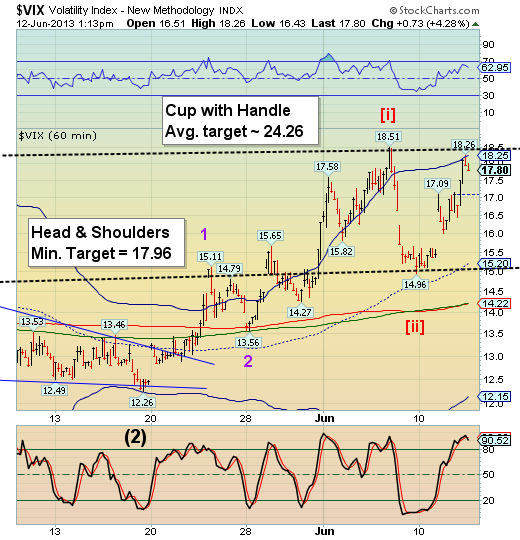
SPX broke the minor support at 1622.90 and has now gone back to retest it. The next support is the Cycle Bottom and 50-day moving average at 1610.00. SPX behavior here will tell us whether it will accelerate immediately to the downside or hesitate yet a few more days.

While SPX is testing a support line, VIX is testing its Cycle Top resistance at 18.25. The Head & Shoulders formation made its target and now we will move on to the next target…the Cup with Handle.

There’s no need for a lengthy pullback here, so we may see a breakout above resistance an the prior high later today.

See the original article >>

John Thain: 2008 Could Happen All Over Again

Via Bloomberg Television:

John Thain, former chairman and CEO of Merrill Lynch and COO at Goldman Sachs, told Bloomberg Television’s Erik Schatzker and Sara Eisen on “Market Makers” today that a crisis like the one in 2008 could “absolutely” happen again.” Thain said, “If anything, too big to fail is a bigger problem because the biggest financial institutions are more concentrated today than they were. Dodd Frank did not solve too big to fail.”

Thain, who is currently CEO of CIT Group, also commented on selling the company to a larger bank, saying that would be “obvious.” He said, “The big banks are awash in deposits and they can’t generate attractive assets. We, in all our businesses, are able to generate very high-yielding, attractive assets, so the logic of that is obvious.”

Thain on how comfortable we should be with what Wall Street has become since September 2008:

“If you are asking about too big to fail and can what happened in 2008 could happen again, the answer is yes, it absolutely can happen again. If anything, too big to fail is a bigger problem because the biggest financial institutions are more concentrated today than they were. Dodd Frank did not solve too big to fail.”

On why there is so much resistance from the leaders on Wall Street re: too big to fail and why anyone would put the financial system and economy at risk again by being so large and complex:

“There are different things. They push back against parts of Dodd Frank because a lot of parts of Dodd Frank have nothing to do with the financial crisis or too big to fail. Proprietary trading was not the problem in the financial crisis. There are a lot of things in Dodd Frank that don’t help the too big to fail problem. The higher capital levels do help the too big to fail problem and make the failure much less likely. Higher capital levels are fine. But the regulatory burden and all of the rulemaking that goes inside of Dodd Frank, a lot of that is not helping.”

On whether he has any desire to go back to Wall Street to run one of the largest institutions:

“I’ve been at bigger companies and I’ve been at smaller companies. The New York Stock Exchange was a relatively smaller company especially when I started. I enjoy the challenge of fixing things, whether it was Merrill Lynch, which was certainly broken when I got there, or the NYSE or CIT, it has been fun to take companies that have good core businesses that have been damaged by the prior management and fix them.”

On how Merrill Lynch today compares to the firm that it was:

“I regret having to sell Merrill Lynch because it was a great company with a great history. It had a very good culture, but in the environment we were in, it was not likely to survive. It was necessary to protect shareholders and employees.”

On whether firms like Merrill Lynch survive and thrive inside the global universal banking model differently than when they were independent:

“Merrill was already pretty broad in its businesses. It would have been better if it could stay independent. Right now it’s contributing a significant portion of Bank of America’s overall earnings, given the problems in BofA’s other business, but I think it would have been better for the company if it remained independent.”

On how Goldman Sachs is doing coming out of the crisis and trying to restore its reputation:

“I think they are doing very well. One of the things is they have gotten through the crisis in relatively good financial shape. If anything, there’s less competition for them now. I actually think they are doing fine.”

On whether he feels any sense of loyalty to the firms he used to work for:

“I worked at Goldman Sachs for 25 years. I basically grew up there. You can’t help but feel loyalty there. The New York Stock Exchange was a great place to work. I enjoyed that job a lot. I got to be on TV more. That was a big turnaround. When I left, it was in much better shape and a global player. Merrill – I wasn’t there that long, but it was a great company. I do feel an affinity to all of those places.”

On how far along CIT is in its transformation:

“When I started at CIT, there was a tremendous amount to do. It’s basically completed — the repairing of the damage coming out of the bankruptcy. The last piece was the lifting of the written agreement by the Federal Reserve. We got that a week or so ago…it is also a symbol of the fact that we are now a bank and bank holding company that’s in good standing with all of our regulators and we are now really focused on growing our business going forward.”

On whether CIT is still in restructuring mode and whether the company will have to announce more layoffs:

“We have been bringing our expense structure down. One of the things I had to do when I first started was to shrink the company. We had to get rid of the bad assets around the balance sheet and we refinanced $31 billion of debt. We are rationalizing some of our businesses. Our expenses are a little bit too high, we are working on bringing those down, but we are also working on growing assets.”

On how big he’d like the CIT bank to be and how much of its funding should be deposit based:

“Funding was absolutely one of the first challenges. Just to give an idea, on the day I started, our senior debt paid LIBOR plus 10 with a three percent floor. So you have a commercial finance company in this rate environment trying to make money with 13% debt. That’s basically impossible. We have refinanced or repaid all $31 billion of debt that came out of the bankruptcy. The other thing we have been doing is putting almost all of our new U.S. assets in our bank. We have a Utah bank that is FDIC regulated. It has been growing very nicely. We put all of those U.S. assets in there and we now have almost a third of our overall funding coming of that bank.”

On whether he’s been approached for a takeover:

“We would not talk about that on the air or anywhere else. I get asked this question a lot. If you look at the environment, the big banks are awash in deposits and cannot generate attractive assets. We and all of our businesses are able to generate high-yielding, attractive assets. The logic of that is obvious, but we are doing well I ourselves.”

On whether he would have to do right by shareholders if presented with an opportunity such as what happened with Merrill Lynch:

“I think I have a good track record of doing right by shareholders. I know who I work for.”

On the prospects for the universal banking model given the current regulatory environment:

“It’s a very normal thing, whatever you have a crisis, that there’s an overreaction to the crisis and an attempt to say, we’ll we’re going to make sure that this never happens again. If you look over many bubbles, this is the same thing that happened after the last bubble. The biggest issue right now for big global banks is the combination of higher capital standards, which is probably a good thing, but then excessive amounts of regulation in terms of their business. You don’t really need to have both. If you have significantly higher capital standards, than a lot of the regulatory burden that comes out of Dodd Frank is an overreaction.”

On the market conditions and whether we’re in store for another 1994:

“It’s hard to know…I think there’s no question that rates will go up and they will go up over time. It’s just a question of when and how violently. I’m less worried than sometimes the market seems to be about the Fed slowing down their purchases because I think they can slow down their purchases and still maintain their balance sheet and not adversely disrupt the market.”

On whether he’s worried about the impact it will have across the banking sector:

“No actually, such low rates actually makes it difficult for the banking sector because it’s hard to generate assets with yield. If interest rates were generally higher, I think that would help the financial sector. It would help us. We are asset sensitive. Our assets would re-price faster than our liabilities, so a higher rate environment would actually help our business.”

See the original article >>

Cyclical Stocks Appeal After Defensive-Led Rally

By Vadim Zlotnikov

This year’s equity market rally was initially led by defensive stocks, as macroeconomic concerns persisted despite improved risk appetite. With valuations in these sectors looking stretched and cyclically oriented stocks starting to rebound in May, is a bigger shift starting to unfold?

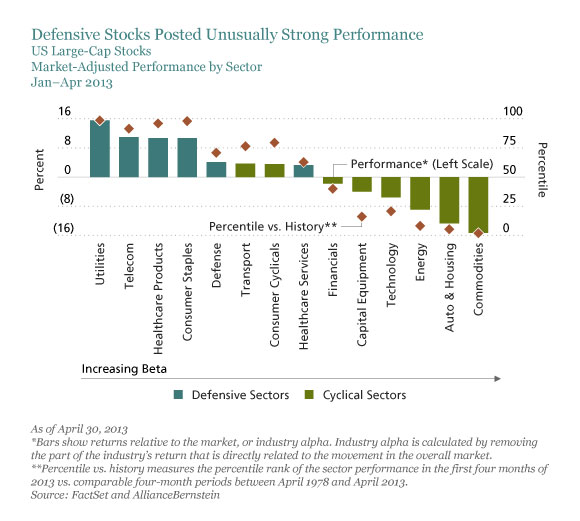
Defensive sectors—such as utilities, consumer staples and healthcare products—typically benefit from investor skepticism about the economic outlook. These sectors normally underperform in rising markets and have a beta of less than one, meaning they are less volatile than the broader market. Yet defensive sectors delivered well above expectations in the first four months of 2013 (display). Meanwhile, sectors more sensitive to economic cycles—such as commodities, autos and energy—underperformed the broader market. As Chinese economic growth disappointed, underperformance was particularly marked in sectors that are seen to be leveraged to emerging markets, such as commodities, energy and capital equipment.

ab1

Some people think this is a bad omen. Perhaps, they argue, an unusually strong run for defensive stocks might portend a collapse in market performance?

The problem is that there’s no evidence to support this argument. Our analysis of defensive-led stock rallies shows that they are no more or less likely to be followed by a broader market downturn than an upturn. However, it is true that after a defensive-led rally, the performance of defensive stocks themselves tends to be more muted.

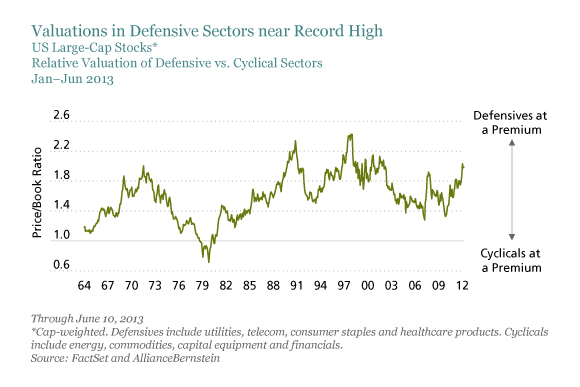
Might defensives continue to retreat? Valuations offer some clues to answer this question. If we look at price/book valuations, we find that defensive stocks are still trading near record highs in relation to cyclical stocks—even after the rebound in cyclicals since May (display). Price/forward earnings metrics show the same thing. Although the data I’m showing here are for US large-caps, similar observations can be made for international stocks as well. This may be a signal to start taking cyclically sensitive stocks more seriously again.

ab2

Still, for cyclically sensitive stocks to continue to outperform, some of the skepticism about future growth and profitability needs to dissipate. Trends in earnings revisions help illuminate the earnings outlook for cyclical stocks.

In the year through April, earnings revisions improved modestly in developed markets and deteriorated slightly in emerging markets, because of disappointing growth in China and India. However, high-volatility stocks—which are typically much more cyclically sensitive—saw significant deteriorations in earnings revisions across Europe, North America and Latin America. Sales growth decelerated across all regions, with developed Asia further affected by the yen’s depreciation.

I think this might be about to change. Over the next couple of quarters, comparative sales figures from the corresponding periods last year will be much easier for cyclical companies to beat. This could provide a near-term tailwind for profitability—and for a continued recovery by cyclical stocks in the coming months.

Given attractive spreads, significant recent underperformance and downward revisions, I think there could be more to come, and selective opportunities can still be found in economically sensitive stocks across various regions. In particular, I have my eye on high-beta stocks in companies with functioning business models, and with reasonable profitability and growth prospects, that have significantly underperformed in recent months on substantial downward revisions.

See the original article >>

Follow Us