By: John_Mauldin
Alice laughed: "There's no use trying," she said; "one can't believe impossible things."
"I daresay you haven't had much practice," said the Queen. "When I was younger, I always did it for half an hour a day. Why, sometimes I've believed as many as six impossible things before breakfast."
– Alice in Wonderland, Lewis Carroll
I wrote several years ago that Japan is a bug in search of a windshield. And in January I wrote that 2013 is the Year of the Windshield. The recent volatility in Japanese markets is breathtaking but characteristic of what one should come to expect from a country that is on the brink of fiscal and economic disaster. I don't mean to be trite, from a global perspective; Japan is not Greece: Japan is the third-largest economy in the world. Its biggest banks are on a par with those of the US. It is a global power in trade and trade finance. Its currency has reserve status. It has two of the world’s six largest corporations and 71 of the largest 500, surpassed only by the US and comfortably ahead of China, with 46. Even with the rest of Asia's big companies combined with China's, the total barely surpasses Japan's (CNN). In short, when Japan embarks on a very risky fiscal and monetary strategy, it delivers a serious impact on the rest of the world. And doubly so because global growth is now driven by Asia.
Japan has fired the first real shot in what future historians will record as the most significant global currency war since the 1930s and the first in a world dominated by true fiat money.
At the risk of glossing over details, I am going to try and summarize the problems of Japan in a single letter. First, a summary of the summary: Japan has painted itself into the mother all corners. There will be no clean or easy exit. There is going to be massive economic pain as they the Japanese try and find a way out of their problems, and sadly, the pain will not be confined to Japan. This will be the true test of the theories of neo-Keynesianism writ large. Japan is going to print and monetize and spend more than almost any observer can currently imagine. You like what Paul Krugman prescribes? You think he makes sense? You (we all!) are going to be participants in a real-world experiment on how that works out.
(Note: This letter will print longer than usual as there are a lot of graphs.)
But first, I want to mention a very special event, that is of great relevance to this discussion, and that will be coming your way in just a couple weeks. I'm going to get together in New York with five of the most powerful investing minds in the world – Kyle Bass, Mohamed El-Erian, John Hussman, Barry Ritholtz, and David Rosenberg – and we're going to totally take apart the New Normal environment in which we all find ourselves and then rethink and rebuild it in a way that will help you not only survive it but profit from it. Investing In the New Normal will feature a full hour of our unfiltered conversation and uncensored analysis. It will come to a computer screen near you on Tuesday, June 11, and you will want to be there! The event is free, and you can register here. Seriously, a full hour with those five guys. How cool is that? I will make sure you get a few powerful take-away s that will impact your thinking and your investing. And now, let’s take a look at that hard windshield and that big bug.
The Mother of All Painted-In Corners
In no particular order, let’s look at some facets of the daunting task facing Prime Minister Abe and the country of Japan.
After the collapse of what might still be the largest economic bubble in history, in 1989, Japan is still mired in a 24-year non-recovery. Nominal GDP in 2011 was almost exactly what it was 20 years earlier, in 1991 (MeasuringWorth.com). You can find other ways to measure nominal GDP which indicate limited growth; but compared to the US and China, nominal growth in Japan has been paltry.
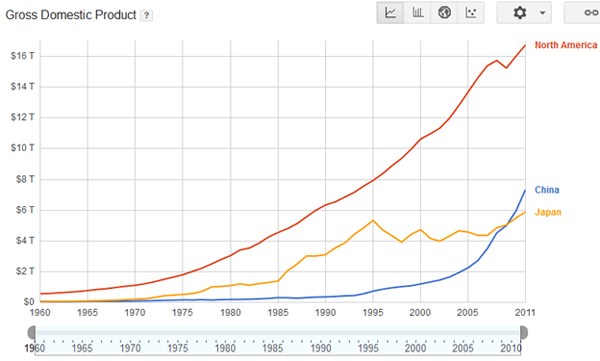
(Google Public Data Explorer)
That lack of growth takes on special importance because when we measure national debt-to-GDP we use nominal GDP as the denominator. If debt is growing and the economy is not, that debt-to-GDP ratio can grow very rapidly. From the Financial Times at the end of March:
Japan’s central bank governor has told parliament that the government’s vast and growing debt is "not sustainable," and that a loss of confidence in state finances could “have a very negative impact” on the entire economy. The warning comes as Shinzo Abe’s administration attempts to drag Japan out of more than a decade of deflation with aggressive monetary and fiscal stimulus.
In January, weeks after taking office, the government unveiled a Y10.3tn ($109bn) spending package while leaning on the Bank of Japan to buy more of its bonds – a strategy described by Morgan Stanley MUFG Securities as "print and spend". Speaking to lawmakers on Thursday, BoJ governor Haruhiko Kuroda noted that, while the government bond market has been "stable," Japan’s gross debt to GDP ratio – expected to top 245 per cent this year, according to estimates by the International Monetary Fund – is "extremely high" and "abnormal".
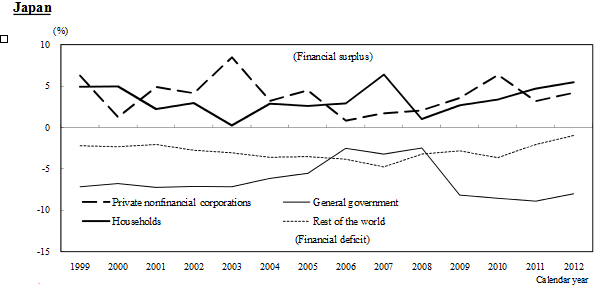
Japanese households and corporations are saving even as the government runs deficits close to 10%. As a way to compare, a 10% deficit in the US would be $1.6 trillion.
Damn the Torpedoes, Full Speed Ahead!
There are two and only two ways to grow an economy in real terms. You can grow your working population, or you can increase your productivity. That’s it. Japan does not have the option of growing its population (or has not chosen to), and it is actually quite difficult for an industrial economy to grow its productivity. If your population is actually shrinking (see chart below) and productivity growth is less than 1%, then real GDP growth is just not possible. We are going to revisit this uncomfortable fact later.
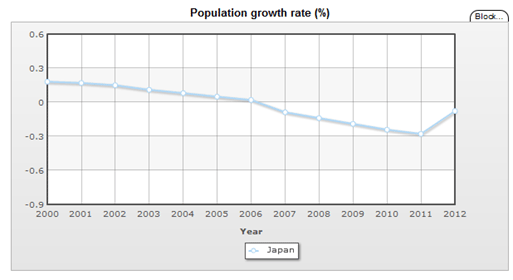
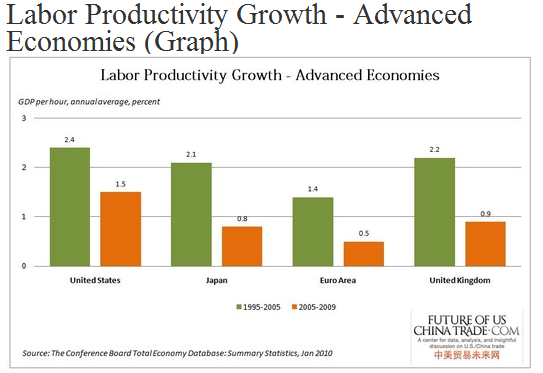
(ChinaGlobeTrade.com)
Japan ran a massive trade surplus for years. Now it is running a large trade deficit. If you run a trade deficit and a fiscal deficit, either private savings has to make up the difference, or the central bank has to print massive amounts of money. That is an accounting identity; there are no other choices. Absent massive monetization, you suck all the available investment capital from your private economy. But Japan needs growth to get out of its fiscal and economic morass. That means it desperately needs more exports, since its aging population cannot be the source of significant increases in consumer spending. The Japanese elderly are savers and hoarders, almost by definition.
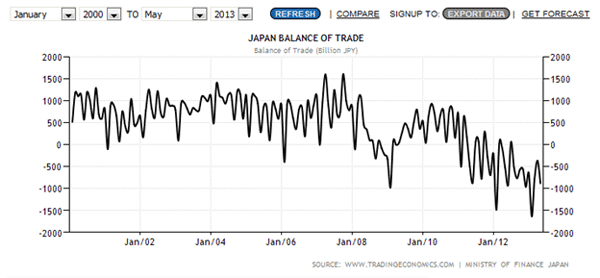
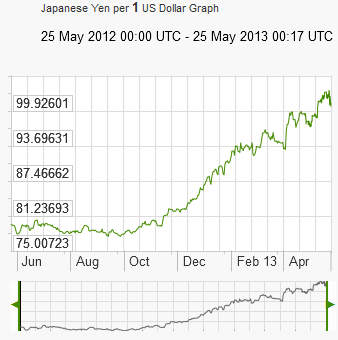
The Abe government and the Bank of Japan under Kuroda-san have targeted 2% inflation. Even with nominal GDP growth last quarter of 3.6% (annualized), the country was in deflation. They have been trying to generate inflation for 24 years. How will they now get 2% inflation? One way is to increase the cost of their imports. The problem is that Japan imports only about 16% of its GDP, according to recent World Bank data. That means to get to 2% inflation they would need their currency to drop by about 15-20% a year (as the effects are not one-to-one, but that takes a whole letter to explain). Easy enough: the yen has fallen that much since just the beginning of this year (see chart below). The problem is that you have to do that every year, on a trade-weighted basis, with all your trading partners.
This chart shows the fall of the yen against the US dollar. The yen closed around 101 today, from 75 less than a year ago. So mission accomplished, right?
Well, not so fast. Japan trades with the world, and what matters is the trade-weighted yen (just as the trade-weighted dollar is what makes the difference in the trade balance of the US). And while the trade-weighted yen is down over 20% against the average of the currencies of Japan's key trading partners, that is not as much as it is down against the dollar (see chart below). Australia and other Asian countries are just beginning to respond to Japan by lowering exchange rates and by other means, so the “easy” devaluation of the yen has already happened. The hard work is just starting, as other countries will increasingly feel forced to respond. No major country can export its deflation to the rest of the world without the rest of the world seeking to redress the balance.
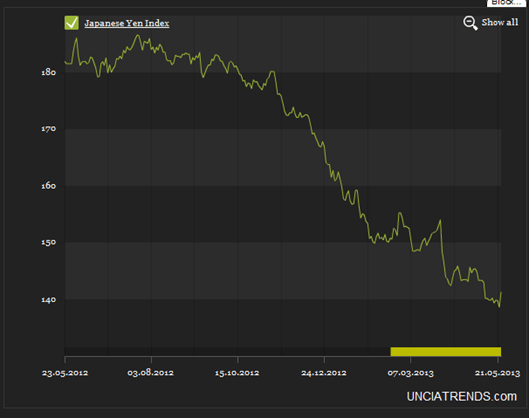
For Japan to get that 15-20% a year currency depreciation for the next five years would be such a tectonic-plate shift for the world that it is difficult to express the magnitude of the task. That would put the yen at 200 to the dollar by 2018 or sooner. If you are Germany, can you deal with that? Korea? China?
It will not be long before you can buy a Lexus cheaper than you can buy a Hyundai, and a Panasonic flat screen will be half the price of a Samsung or LG. But of course Japan does not act in a vacuum. As I wrote last week,
Let's put the recent drop in the yen in context. The Nihon Keizai Shimbun, the main Japanese business newspaper, has reported that every one-yen fall in the yen/dollar rate will translate into a $2.7 BILLION increase in profits for the 30 largest Japanese exporters.

For every one yen the currency drops in value against the dollar, Toyota estimates that its profits will increase by $340 million. PER ONE-YEN DROP! Toyota reported $3.33 billion in profits last quarter, so that additional $340 million of profit per one-yen fall could send its second-half profits – and its stock – to the moon.
But those profits don’t just magically appear; they come from sales. Sales that are in large part due to better terms of trade and lower costs. Those profits are from sales that might have gone to other companies based in other countries and that might have been valued in euros, dollars, yuan, or won. Which is why businesses and finance ministers all over the world are not happy with Japan.
Six Impossible Things
Abe and Japan are in an almost ridiculously impossible situation. Let’s look at what they have to do in the light of what we just read.
They cannot continue to grow their debt at the current rate. There is a limit. No one knows for sure what that is, but it is getting closer. And they know it. So they have to get their fiscal deficit below the growth rate of nominal GDP.
To do that they have to have both real growth and nominal growth. Real growth in a country with a shrinking population requires productivity increases on a scale not seen in any industrial country anywhere for any sustained period of time. So they have to get nominal growth, which means they absolutely must have inflation or their country will collapse in a massive debt deflation, with skyrocketing interest rates.
But 2% inflation implies that interest rates on Japanese bonds must be at least 2% if not 3% or more. That is double what they are now after the recent spike in the yield of JGBs (Japanese government bonds) from 0.5% to 1%, which sent the Japanese stock market into a tailspin on Thursday – down 7.3 percent.
As Kyle Bass and others have amply demonstrated, if JGB interest rates rise 2% in Japan, then the government must pay almost 80% of its revenues (as currently received) just to cover the interest on its debt. That is, of course, not a viable business model. Even a 1% rise would be fiscally devastating.
The Abe government plans to raise taxes. Japan’s current sales tax is 5%, due to increase to 8% next year and 10% by 2015, although they will look at economic data in October to decide whether taxes will indeed rise. That is a large tax increase, and it will, of course, hurt consumer spending. But the government has to reduce its fiscal deficit at some point. The question is when and how. For two decades the answer has been "Next year." Next year may actually arrive ahead of time if the bond market starts to get nervous. Look at the drop in 10-year JGB bond prices this week (through Thursday, hat tip The King Report). While such drops have happened in the recent past, you can be sure this is cause for concern in Tokyo. There are limits, even for Japan, to what bond investors will endure.
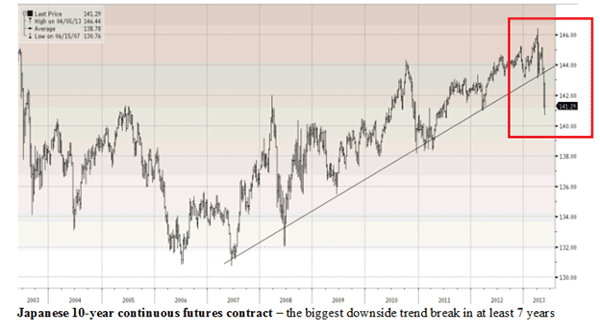
Reducing fiscal spending will by definition (an accounting identity again) reduce GDP or at the very least make it more difficult to attain inflation of 2%. Remember, austerity is not a punishment but a consequence of past failures to control spending.
Unwarranted Humility
The solution that Abe and Kuroda arrived at, to the applause of mainstream economists, is massive quantitative easing. Let’s look at a paper just published by UC Berkeley Professor Christina Romer, former chairwoman of the President’s Council of Economic Advisors. (Hat tip Barry Ritholtz at The Big Picture.) I will summarize, but you can read the paper here.
Basically, Romer (with a nod to Krugman, et al.) suggests that Abe and Kuroda have initiated what she calls a regime shift and that "it just might work." And then she proceeds to compare what Japan is doing to the policies of Roosevelt in the early '30s. Quoting from the introduction:
Last week, we witnessed one of the most exciting developments in monetary policymaking since the 1930s. The Japanese central bank staged an honest-to-goodness regime shift. The Bank of Japan went beyond vague promises and cheap talk. As I will describe in more detail later, it took dramatic actions and pledged convincingly to do whatever it takes to end deflation in Japan. The theoretical reasons why this regime shift may be important are well understood by economists. Persistent deflation and anemic growth suggest that Japan continues to suffer from a shortfall of demand. But their policy interest rate is already at the zero lower bound. Furthermore, riskier, long-term rates are also very low – suggesting that unconventional policies such as large-scale asset purchases are unlikely to do much to further reduce nominal rates. As discussed by Paul Krugman, Gauti Eggertsson and Michael Woodford, and others, if unconventional monetary policy can raise expected infl ation, this can push down real interest rates even though nominal rates cannot fall. This, in turn, can raise aggregate demand by stimulating interest-sensitive spending.
And in the conclusion she suggests that bold policies must be aggressively pursued:
In a recent paper, David Romer and I discuss that such views are potentially very destructive. We show that what are widely viewed as the two largest errors in Federal Reserve history – inaction in the wake of banking panics early in the Depression, and inaction in the face of high and rising inflation in the 1970s – were both borne of unwarranted humility. Fear that policies might not work or might be costly led policymakers to conclude that the prudent thing was to do nothing. Yet there is now widespread consensus that action would have been effective in both these periods.
We have nothing to fear but fear itself: this is the heart of Keynesian thinking. And if it is good for Japan then what of the rest of the world?
Earlier in the paper, Romer writes, after discussing recent US Federal Reserve policy actions:
But the truth is even these moves were pretty small steps. With its most recent action, the Fed has pushed the edges of its current regime. And I am sure that given the opposition in Congress and the difference of opinion within the FOMC, even those measures were a struggle. Nevertheless, the key fact remains that the Fed has been unwilling to do a regime shift. And because of that, monetary policy has not been able to play a decisive role in generating recovery. To paraphrase E. Cary Brown's famous conclusion about fiscal policy in the Great Depression: monetary policy has not been a strong recovery tool in recent years not because it did not work but because it was not tried – at least not on the scale and in the form that was necessary to have a large impact.
Wow. Double wow. Breath-taking triple wow. Read this paper. Absorb it. And then bookmark it and come back in five years. I give Romer this: she shows no unwarranted humility in this paper. She goes “all in” in backing this Japanese policy.
But I do agree with Professor Romer about one thing: this is the most serious and radical economic experiment undertaken in my lifetime by a major economic power. And the rest of the world must pay attention. If this has succeeded in working five years from now, if Japan is growing and its debt relative to GDP is shrinking and the rest of the world has allowed the yen to drop in half, then let me state here and now that I will have to rethink my understanding of economics.
But ironically, if I were Abe and faced with the question, “What do I do now with what I have inherited,” I am not sure that I could do anything else. He is a politician and a Japanese one at that. The Japanese are serious hometown players, as are the citizens of most countries. You do what is best for your hometown and don't worry about the neighbors all that much. You want to stay friends, but your first responsibility is the hometown.
If you're Abe, what are your choices? They are nothing but ugly. Perhaps the best of a very, very ugly-bad lot is that you have to try and inflate away that debt. Monetize as much as you can and then just “poof” it away. You destroy your currency in the process, but you have to destroy something. And maybe your derring do gives your exporters a boost and a competitive advantage, so you at least salvage that. Why not export your deflation? And then gamble that maybe Romer and Krugman are right. It could work! Damn the torpedoes, full speed ahead!
There Is No Turning Back
Now, some investing consequences. Let me repeat what I wrote months ago, that the largest single position in my personal portfolio, since January 1, is short Japan. Let me clarify that, as I am not short Japanese companies or businesses but rather short Japanese government economic policies. (I am executing that trade primarily through hedge funds, although there are ways to explore that trade in a more conventional manner.) I think the yen will still be under pressure for some time (this is a long-term trade) and that Japanese interest rates will be under pressure. But do NOT run out and short JGBs (see below)! First, let me agree with Joyce Poon of GaveKal, commenting on the recent violent moves in the financial markets in Japan (which echoes what I heard from Louis Gave at my conference):
No doubt many investors are wondering if this is the first hint that the emperor in fact has no clothes – that Abenomics is just a flash in the pan. We think it is just a reminder that riding a bull is never smooth; surely more market drawdowns lie ahead. But as Anatole recently wrote in The Arithmetic Of Abenomics, the fiscal and monetary expansion already implemented has been so extreme that there is no turning back from Abenomics. Unless Japan can achieve much faster economic growth, Prime Minister Shinzo Abe’s radical experiment with macroeconomic stimulus will create a debt and monetary overhang so huge that it will bankrupt the financial system and quite possibly trigger hyper-inflation. This is why Abe’s radical reforms will go forward, and in time aggressive monetary policy will be need to be backed up by larger structural reforms.
This brings us to a second, and potentially more dangerous, type of volatility in Japan: in JGBs. With Japanese banks holding huge JGB portfolios, a sharp rise in yields would generate capital losses. Indeed, according to the Bank of Japan, a 100 basis point increase in interest rates across all maturities would lead to mark-to-market losses of 20% of Tier 1 capital for regional banks and 10% for the major banks. As banks play a key role in the transmission mechanism in quantitative easing and reflationary economics, a damaged bank balance sheet can significantly reduce the effectiveness of Abenomics.
One problem is that the BoJ’s purchase operation is also crowding out other players in the JGB market, and this amplifies interest rate volatility. The reduction in JGB liquidity means that financial institutions are finding it difficult to quickly find counterparties to buy or sell large volumes of the bonds. The risk is that higher interest rate volatility could in turn induce further JGB sell-offs, completing a vicious circle of capital destruction for the banks.
To prevent a catastrophic crash of the JGB market, more BoJ action is needed. This is likely to include increased flexibility in liquidity injections, a broader range of purchase tactics and better verbal communication with the market. But shrinking liquidity, higher volatility, and even potential spillovers from rising yields globally, could continue to put upward pressure on JGB yields. This doesn’t mean the Japan bull market is over. But as we argued in our latest Five Corners, remain hedged!
Let me repeat the most important sentences, with which I totally agree:
… as Anatole recently wrote in The Arithmetic Of Abenomics, the fiscal and monetary expansion already implemented has been so extreme that there is no turning back from Abenomics. Unless Japan can achieve much faster economic growth, Prime Minister Shinzo Abe’s radical experiment with macroeconomic stimulus will create a debt and monetary overhang so huge that it will bankrupt the financial system and quite possibly trigger hyper-inflation. This is why Abe’s radical reforms will go forward, and in time aggressive monetary policy will be need to be backed up by larger structural reforms.
The government of Japan has no choice. They are painting themselves into the Mother of All Painted-In Corners, yet they must continue to paint or collapse. They have fired the first shot in what will be the first real currency war of our lives, not the little sandbox versions we have experienced so far. There is NO historical analogy. None. The last major currency war, in the 1930s, happened when the world was largely on a gold standard. We now live in a world awash in fiat currency. Can Europe sit by and watch the yen fall 50% from where it is today? Will Germany allow it?
What will China do? If they respond in kind, they risk inflation. If they don’t, they risk losing export sales and jobs. Malaysia is on a borrowing binge to finance its real estate growth. Indonesia? And Korea certainly can’t sit idle and watch its chaibols (the Korean version of the Japanese keiretsu) get hammered, can it?
For a time, then, major central banks are going to have to sit on their hands and do nothing, as they can’t stop printing or using monetary policy to improve their internal economic dynamics. Japan is in reality just catching up in terms of quantitative easing, as I showed last week.
Japan intends to export its deflation. And with the approval of the economic cognoscenti, it is going to do so in a manner and to an extent that the world has never experienced before. The old saw of “in for a dime, in for a dollar” will be the rule of the day. Japan cannot back down without suffering massive financial upheaval. I think they are likely to suffer no matter what they do, but this is the path to suffering they have chosen. So be it. All we can do is try and stay off the dance floor when the elephants are dancing. Or find a really good dance partner who knows the moves and follow! This will not be an environment in which to take dancing lessons. The Arthur Murray Dance School does not know the steps that will be in vogue at this party.
I can’t with any reasonable certainty tell you how all this will play out, as we are simply in uncharted territory. But I do know I want to own assets that central banks can’t print. Their actions will affect those assets, to be sure – we are going to see more volatility than we would like. But that creates opportunity. Of course, we are going to continue to look at the implications of these developments in future letters.
In closing, this is the last call to register for the upcoming webinar with my good friends Kyle Bass and Altegris President and CEO Jon Sundt. Kyle will just be back from Japan, where he has been talking with leaders, and I will be in Brussels, trying to get a view on all this from some of their leaders. I can tell you that I have never had a dull conversation with Kyle!
While we are sure to discuss Japan and the yen, we will also focus in depth on a new fund Kyle manages that was recently added to the Altegris platform. Please join us this Wednesday, May 29. If you are a qualified purchaser or a licensed investment adviser qualified to make private placement recommendations, be sure to register here for this event. Upon qualification by my partners at Altegris, you will receive an email invitation. If you are already an existing Mauldin Circle member, you will receive a separate email invitation to register for the event.
I apologize for limiting this discussion to qualified purchasers and investment advisors, but we must follow the rules and regulations. I look forward to having you at this exclusive Mauldin Circle event. (In this regard, I am president and a registered representative of Millennium Wave Securities, LLC, member FINRA and SIPC.)
Brussels, Washington, DC, NYC, Monaco, and Home?
I am probably on a plane to Brussels as you read this, where I will be with Geert Wellens and his team at Econopolis. They have a fascinating few days lined up for me, and I expect to learn a lot as well. The schedule looks to be quite enjoyable.
Then I am home for a few days before I head off to DC to meet with Newt Gingrich and tape a video or two, in which we will talk about our favorite topic, the positive transformation of society that is happening because of technology. Pat Cox will join us. I also have a few other meetings lined up there, and then I'll take a train with John Hussman to NYC to do the video webinar I mentioned at the beginning of the letter. Then I return home for a few weeks and enjoy Father’s Day before heading off to Monaco to speak at the GAIM conference (June 17-19). They have a nice line-up of speakers, and I get to meet with Nassim Taleb. I really do intend to review his new and very important book, Antifragility, at some point. If you qualify as an investor, you can attend for free by clicking on 19th Annual GAIM International 2013. If you are in the money-management business, you can regist er and get a 15% discount with the code VIP: FKN2355MAUL.
Finally, I will go to Cyprus, where I am hoping to meet with people who can give me insights into what is going on there. If you are in Cyprus the weekend of June 22-23, drop me a note.
I am still homeless and living in a hotel but getting closer to actually closing (or so they tell me) on my new apartments. I hope by the time I get back from Brussels everything will be ready to close. I have leased a small place in the same building to live in while my two apartments are combined into one. Construction will take 3-4 months. I am so ready to move. I am used to hotels, but not having access to my “stuff” is getting old, and the internet here is so slow it is driving me to distraction.
It is late and time to hit the send button. Have a great week!
Your looking forward to a better hotel in Brussels analyst,
John Mauldin
See the original article >>