Saturday, March 19, 2011

PREPARING FOR THE “BANG”

by Decision Point

My wife is something of an insomniac, so she listens to a lot of nighttime talk shows — not the best cure for insomnia, I’ll bet. Recently she told me about the comments of some guest on some talk show — sorry, but that’s as good as I can do for attribution — who had an analogy for the U.S. financial woes. He said we are like a person who makes $50,000 a year, spends $75,000 a year, and has $375,000 in credit card debt. Hopeless is what it is.

From Mauldin and Tepper’s Endgame: The End of the Debt Supercycle: There is a limit to how much debt you can pile on. As the work of Reinhart and Rogoff points out in This Time It’s Different (2009), there is not a fixed [emphasis mine] limit for debt or some certain percentage of GDP where it all breaks down. Rather, the limit is all about confidence. Everything goes along well, and then “bang!” it doesn’t.

“Confidence” has always been the keyword in financial markets. We get a daily diet of economic news with a determined spin about how the economy is gradually improving, but in the background the Fed and the politicians keep digging a deeper hole of debt. And the story is the same around the globe — governments trying to exacerbate the threat of horrible levels of debt by piling on even more debt.

The real question is if the collapse really will be a “bang!” moment, of whether there will be some kind of advance warning upon which we can act. As a technical analyst I believe there will most likely be a gradual deterioration ahead of the “bang!”, and we must assume that the deterioration has gone too far when the 20-EMA crosses down through the 50-EMA. To illustrate this point, let’s look at two of the most catastrophic financial events in the last 100 years — the 1929 Crash and the 1987 Crash.

The first chart is of the Dow Industrials in 1929. Note that the 20-EMA crossed down through the 50-EMA about two weeks ahead of the Crash. Some will complain about the two whipsaw signals earlier in the year, but this kind of activity characteristically precedes major tops and part of the cost of doing business if you want to avoid major declines. To mitigate the damage of these whipsaws, our timing model only generates a NEUTRAL signal (instead of a SELL) when the crossovers occur above the 200-EMA.
Chart
Next is the 1987 Crash. It is hard to see, but the 20/50-EMA crossover occurred four days ahead of the crash. Again, there was a short whipsaw earlier in the year.
Chart
Bottom Line: Catastrophic market events are usually a big surprise to most people, but they rarely take place without giving some advance technical warning signs. The moving average crossover has been a reliable, though by no means perfect, signal for impending trend changes. It is certainly one way we can attempt to be prepared ahead of the “bang!”.

See the original article >>

Friday, March 18, 2011

Is This Why Bill Gross Dumped Treasuries?

By Global Macro Monitor

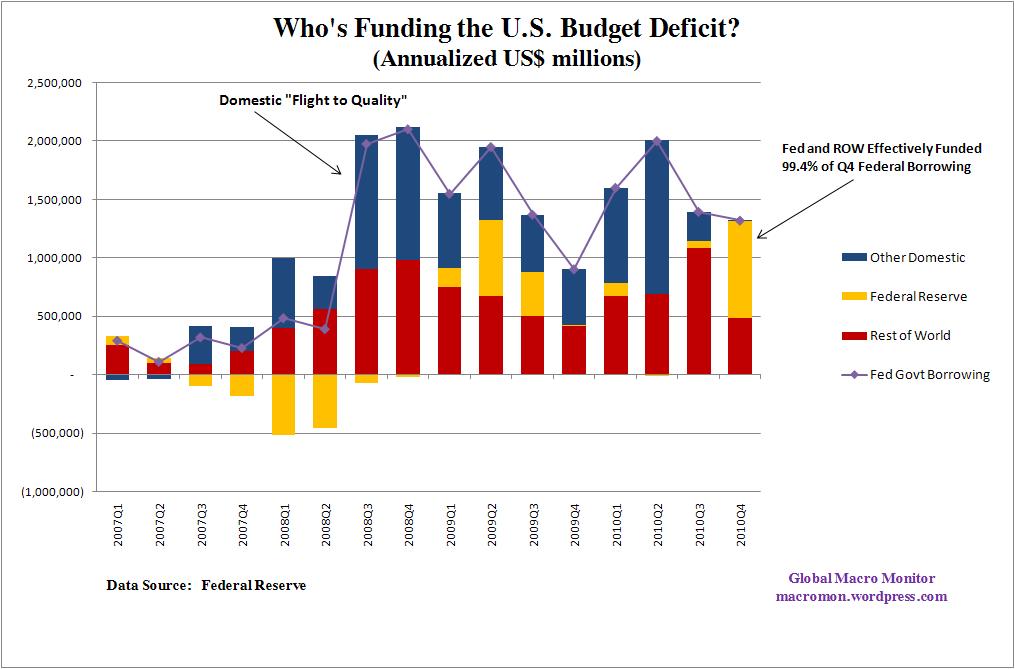
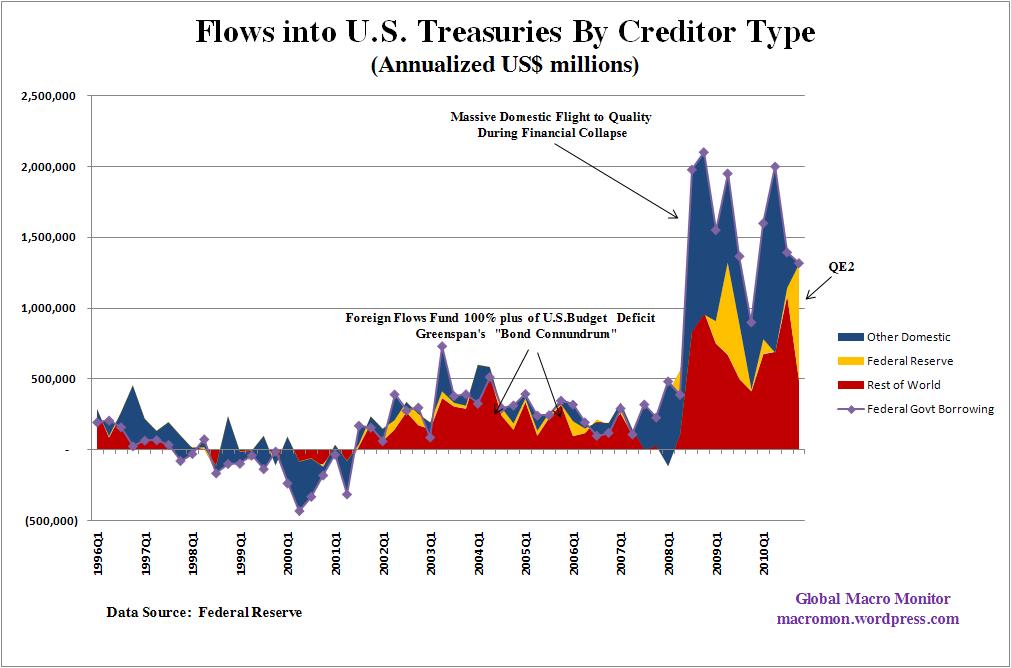
A couple of revealing charts from the Fed’s Flow of Funds data.   Both show net flows into Treasuries by creditor type and the Federal Government’s borrowing during each quarter.   Note, the quarterly data is annualized.

The first chart illustrates how QE2 flushed domestics out of Treasuries and effectively funded 63 percent of the budget deficit in Q4.  The Treasury is prohibited from directly selling bonds to the central bank, but effectively finances the government through POMO.

Given that a large portion of the Rest of World category are central banks recycling BOP surpluses,  it’s likely that 90 percent of the U.S. budget deficit in Q4 was funded by central banks.    You think this may have anything to do with what’s happening in the commodity markets?   That is, the central banks’ printing presses providing the fuel for speculators?

Furthermore, we ask: who is going to finance the U.S. budget deficit when QE2 ends, especially at a sub 3.50 percent 10-year Treasury rate?  Bill Gross knows!
>

See the original article >>

Japanese Fallout May Hit U.S. Treasury Bonds


Japan is facing two meltdowns in the wake of its devastating earthquake. The first, and more critical, is the meltdown at the Fukushima I Nuclear Plant, 150 miles north of Tokyo. Surely, this is the greater near-term threat. But long-term, another threat looms, having to do with the Japanese government's response to the former.

As the fourth largest economy in the world, behind the EU, US, and China, any major setback in Japan likely will have widespread repercussions. Japan is also the third largest holder of US Treasuries, behind the United States and China. While it is too early even to assess the Japanese damage accurately - let alone to forecast the full implications - it is possible to see the potential for a meltdown of the US Treasury market and international monetary system.

Current estimates hold that the Japanese disaster has already lowered world economic growth by a full percentage point for the year.

Leaving aside massive international aid, a complete nuclear meltdown, or other escalations, Japan already will have to spend a massive amount of money to cope with the current disaster. This raises the question: from where will such an enormous amount of money come?

Japan could borrow. However, with a debt-to-GDP ratio of some 200 percent, or twice as bad as that of the United States, and with the main credit rating agencies exercising more scrutiny than before the Credit Crunch, raising funds will be difficult at an economic rate of interest. Moreover, Japan will likely be spending a large chunk of its foreign exchange reserves to buy oil to replace its lost nuclear power generating capacity - diminishing its collateral in the eyes of creditors.

Japan could follow the US example and "paper over" its problems. But without the benefits of being the international reserve currency, the Japanese would immediately feel the effects of domestic inflation. The Bank of Japan has already pumped out ¥8 trillion ($98 billion) in the wake of the earthquake, but it is unlikely to try to match the Fed's $600 billion printing spree this quarter.

So, if Japan is limited in its ability to borrow or print money, it may have to sell part of its vast holdings of US Treasuries.

At the end of last month, the US Treasury had outstanding debt worth some $14.19 trillion. This represents 96.8 percent of the total $14.66 trillion value of business generated within the United States for the entire year of 2010. It is just short of the $14.294 trillion debt limit set in 2010 by a profligate Democrat Congress. To put it in perspective, the US government now owes $91,400 for every working American. However, this represents only some 22 percent of Washington's $62 trillion of unfunded obligations, which include Social Security, Medicare, housing, and other guarantees.

Japan is the third largest holder of US Treasuries ($877 billion), behind China ($896 billion) and the Fed ($1.108 trillion). Should Japan start selling Treasuries in large amounts to fund the repair of its economy, it could have a serious effect on US interest rates and the market value of Treasuries the world over. US bonds are widely held by central banks, international banks, and insurance companies, which already are concerned about their funding of loss claims arising from the damage in Japan.

Thus, a Japanese selloff could trigger a liquidity crisis like the one following the collapse of Lehman Bros. and AIG. Large institutions may not be willing or able to bear with US bonds through a steep correction.
Western economies are on thin ice as it is, even without a shock in their presumed "safe" asset.

Stock markets in the EU and US are weakening, destroying large amounts of private wealth and potential consumer confidence.

Further, the EU is facing the reality that the financial rescue programs it organized to save some of its members are not working. China and Japan offered to help. Now Japan may not be able to fulfill its promises. This could reignite further speculative downward pressure on the euro.

It seems that while we are all concerned about the effects of nuclear meltdown on the residents of Japan, we should also be aware that the fallout could spread further in the financial markets than it does in the atmosphere. Just as Californians are stocking up on iodide pills as a precautionary measure, investors should be stocking up on hard assets. After health, it's vital to guard your wealth - especially in emergency times like these.

Coffee squeeze may yet drive prices to record high

by Agrimoney.com

The rally in coffee prices could last for at least another season, and take out records set in the 1970s, driven by a market squeeze that will drive supplies to their tightest in 50 years, Rabobank said.
The tightness in the market for arabica coffee, traded in New York, which has already driven prices to 34-year highs looks set to increase further in 2011-12, as robust demand encounters a falling supply of the beans.
That will be an off-year in the two-year production cycle in Brazil, the top grower, leaving world output of arabica beans – generally considered the better quality coffee type – down 7.4% at just under 78m bags.
Although stocks are set to rebuild somewhat in the current season, "the surplus built up is not expected to be sufficient to counter the lower production expected in 2011-12", the bank said a report.
'Significant upside risk' 
"As demand growth will continue, we expect the stocks-to-use ratio for 2011-12 to be the lowest for the last half a century, resulting in high prices and continued competition for beans."
The report added that "significant upside risk" remained for prices, even after a doubling in the past year.
"If production is threatened by weather, prices could take out the record set in the 1970s."
Changing tastes 
The market tightness has been spurred by years of modest growth in arabica output, and little prospect of a significant uptick given the time needed for coffee trees to establish.
Meanwhile, demand for the beans has shown a significant increase, in line with a taste for upmarket coffee, such that even a 25% rise in prices of some US brands over the last nine months is not expected to dent consumption much.
Indeed, US demand is expected to remain flat in 2011-12 and grow by 2.0% in the European Union, while hitting 2.8% in Brazil, which is closing in on America as the top consumer of the beans.
"The growing demand comes despite the higher price tags," Rabobank said.
"The consumption of coffee was very resilient during the financial crisis, and we believe it will continue."

See the original article >>

I Hate Corn Ethanol.com

By Barry Ritholtz

So on a lark today, I grabbed a new URL: IHateCornEthanol.com
I was thinking that with all this newfound talk about fiscal responsibility, perhaps it might be time to put an end to one of the dumbest Energy/Ag subsidies in the history of the US: Burning food (corn) for fuel.
I do not have any issue with alt.fuels — but they have to make sense. Ethanol does not.

I am thinking of some interesting ideas to use this with in the coming 2012 Electoral season:

• Get candidates to sign a pledge to do away with Corn Ethanol Subsidies
• Clearing house for all corn ethanol related research, news, data.
• Community / Message board for ethanol related haters
Any ideas? What should be done of value with this web site?

Thursday, March 17, 2011

Everybody Knows Bernanke Is a Joke


As YouTube and other digital media move beyond computer-savvy young people into the ranks of even stodgy businessmen, these subversive outlets become serious problems for the ruling elite. This trend is epitomized by the radical change in the Federal Reserve's image. In just a few short years, the Fed has transformed in public opinion from a mysterious, wise, and boring institution into a fascinating engine of corruption and comedy.

Challenging Bernanke

The chinks in the Fed's armor of legitimacy are multiplying, all made possible by the ease of producing and distributing high-quality critiques. An early example was the spoof of The Police's "Every Breath You Take" that Columbia Business School students made in "honor" of Ben Bernanke's ascent to Fed chairman over their own dean, Glenn Hubbard.

It's true, the satirical music video really wasn't a critique of Bernanke's policies; after all, he had only just been given the keys to the printing press. Nonetheless, it illustrated the new power of the Internet. Creating the video took a lot of effort, and it would probably not have been worth doing had the students only been able to distribute it through, say, copying it on VHS cassettes.

At the same time, although the potential market — people who would have appreciated geeky references to "bips" (basis points) and the like — was substantial, it was dispersed throughout the population. Saturday Night Live certainly wouldn't have run such a video, and even higher-brow shows such as Bill Maher's wouldn't have done it either, simply because the niche was too limited.

The Internet, and specifically YouTube, solved these problems. As of this writing, the video has been watched some 1.7 million times, making it an obvious hit. The creative students were rewarded for their efforts in terms of esteem and fame, and hundreds of thousands of financially savvy people got a good laugh or two.

Laughing At "The Bernank," Not With Him

If the music satire was all in good fun, the more recent animated video, "Quantitative Easing Explained" was anything but. Relying on the same Xtranormal technology that I used for launching my debate challenge to Paul Krugman, this video features two bears discussing the Fed's program of massive bond purchases.

The tone of this video is much edgier and harsher than that of the music-video spoof. While the fake Sting dreams of punching Bernanke in the face, it is clearly in jest. In contrast, when the cute bears curse and accuse Bernanke of lying in order to shovel billions into the hands of his rich buddies, the creator really means it.

The Importance of "Common Knowledge"

As a grad student at NYU, I once listened to a fascinating presentation in the Austrian Colloquium on the importance of multiple levels of knowledge. The presenter argued that in certain areas of life, it wasn't enough for people to know (or believe) something, it was important that they know others know it too.

For example, if an advertiser buys a 30-second TV spot on the Super Bowl, it's not merely that tens of millions of people will see the ad. Beyond that is the crucial fact that tens of millions of people will know tens of millions of people are seeing the same ad. The presenter argued that this explains why advertisers push "network goods," such as smart phones or Macs versus PCs, during the Super Bowl and other events with high ratings.

In other words, if a particular good's value to a user depends not just on its intrinsic properties, but also on how many other people are using it, then (this presenter claimed) its producers tend to advertise it during the Super Bowl, or perhaps on a busy subway car, where people who see the ad will know that other people are seeing the ad too.

Moving to the political arena, the presenter elaborated on why totalitarian regimes are so quick to clean up graffiti and other public challenges to the authorities. It's possible for a dictator to remain in power even if a large number of his subjects hate him, so long as they think they are relatively isolated. But when someone writes, "Down with the Regime!" on a bridge, it is a signal that rallies the malcontents. Not only do they realize that they are not alone, but they know that other people like them are seeing the same subversive message.

In this context, the significance of YouTube and similar media is even larger than it seems at first glance. For example, I was thrilled when I saw "The Bernank" video, not because I learned something new from it — I already thought the Fed was a corrupt engine of inflation — but because I saw how many millions of other people had seen the video. And we can push it even further: I knew that they knew how many people were seeing the video.

This was the importance of "common knowledge," which the game theorists formally describe as something that (a) everyone knows, (b) everyone knows that everyone knows, (c) everyone knows that everyone knows that everyone knows … and so on forever. At first blush it might seem as if the deepening layers of knowledge are superfluous, but in some contexts they can be crucial.

To take an example adopted from the presenter at the NYU colloquium: Suppose Bill and John are on a crowded subway car, separated by dozens of people. The two are going to a Broadway show, and John is not familiar with the subway system, so Bill needs to signal to John when they should both get off the subway. However, because they are separated by so many densely packed people, the two men will have to use different exits to get off their car.

As the subway approaches the proper stop, Bill gives John a signal to get off. However, because there are so many people jostling about, Bill isn't quite sure that John saw his hand motion. So Bill isn't sure whether to get off himself, because it would be catastrophic if he stepped off and left John on the subway.

In this somewhat contrived example, we see the importance of layers of knowledge. Even if John did see the message — so that Bill knows it's time to get off, and John knows that it's time to get off — that isn't enough. Bill needs to know that John knows. Yet that too is insufficient, because John needs to know that Bill knows John knows, and so on. (If John thought that Bill didn't realize John had correctly interpreted Bill's signal, then John might expect Bill to stay on the subway car, not wanting to abandon John. Hence John might not get off the car himself, even though he knows it's the right stop, and even though Bill knows that John knows this.)

These fanciful musings shed more light on the power of YouTube's viewership statistics, which greatly amplify the impact of the Bernanke-bashing bears. It isn't merely that over 4 million people have seen the video blasting the Fed, but that we all know how many of us have seen it.

In a related vein, the surprising popularity of the Hayek-Keynes rap video, and the traffic rankings of explicitly Austrian sites such as Mises.org and LewRockwell.com, have encouraged more and more Austrians to come out of the closet, as it were. They can brush off the put-downs of the "respectable" mainstream economists, because they know that growing numbers of people agree that the Austrians have an important and neglected perspective when it comes to both economic theory and policy.

Not so long ago, the prevailing wisdom was that a young economist was committing career suicide by pursuing an explicitly Austrian research program. This is no longer the case. As I joked to the Grove City undergraduates at this year's Austrian Student Scholar's Conference, nowadays a young scholar is merely cutting off his left arm by announcing his love for Mises and Rothbard. This is progress!

Speaking Truth to Power

Commentators have extensively discussed the impact of Twitter and Facebook on the events in Egypt and elsewhere in the Middle East. What is less obvious is the tarnishing of the image of the Federal Reserve.
Last Saturday "AmpedStatus" (in affiliation with the hactivist group "Anonymous") announced "Operation Empire State Rebellion," in a YouTube video warning of nonviolent civil disobedience if the Federal Reserve doesn't change course. The creepy video — complete with a distorted voice — specifically demands the resignation of Ben Bernanke as a sign of good faith.

More generally, "disrespectful-punk" websites catering to financial readers, epitomized by ZeroHedge and EconomicPolicyJournal, take it as a matter of course that Bernanke has no clothes. The anonymity of the Internet ensures that plenty of respectable Wall Street pros turn to these alternative media to get the real news about the economy — when their boss isn't looking, of course.

The officials at the Federal Reserve and other power centers aren't ignoring the budding green shoots of dissent. Bernanke's duplicitous 60 Minutes appearance was a PR damage-control move that we normally would expect from politicians, not central bankers. Before the present financial crisis, the operations of the Federal Reserve were mysterious and boring.

"In central banking, as in politics, the ruling elite must keep the people in the dark."
But now — because of Bernanke's boldness, the ascendancy of the Ron Paul movement, and the resurgence in Austrian economics, among other factors — a large segment of the public is very interested indeed in what "the Bernank" is up to.

Conclusion

As Murray Rothbard emphasized, our modern banking system is based on fractional reserves, meaning the bankers are always vulnerable to a sudden loss in confidence. Just as political regimes can topple overnight with a change in public opinion, so too can the "strongest" of modern financial systems crumble in the face of a large-scale run on the banks.

In central banking, as in politics, the ruling elite must keep the people in the dark. The rise of the Internet, and in particular outlets such as YouTube, are making that task far more difficult.

See the original article >>

Follow Us