Tuesday, September 9, 2014

The Right Weights for Mortgage Risks

by Amit Tyagi

ABU DHABI – Ever since hunter-gatherers started to build their own dwellings some 14,000 years ago, homeownership has been a mark of high social and economic status. Today, the United States has built a mammoth financial bureaucracy to promote homeownership, and economists, bankers, politicians, and of course homeowners themselves keenly follow house-price indicators. But, as we have recently witnessed, unless mortgage risks are properly calculated, the dream of homeownership can all too easily become an economic nightmare.

Mortgage debt has become households’ biggest liability throughout the developed world. In the decade preceding the financial crisis, US mortgage debt increased almost threefold, while the real economy grew by only one-third. At its 2007 peak, US mortgage debt stood at $10.6 trillion – more than double the combined GDP of China and India.

The six major banking crises in the advanced economies since the mid-1970s were all associated with a housing bust. A real-estate price crash has also been a key cause of emerging-market crises, such as the 1997-98 Asian collapse. Research shows that lost output during recessions accompanied by a housing bust is double or triple what it might otherwise have been had real-estate prices held up. Moreover, housing busts tend to prolong recessions by almost three years.

Given the enormous social and economic costs when high levels of mortgage debt meet a crash in house prices, one would expect regulators to be fully engaged on the issue. Unfortunately, they are not. Although the Basel Committee on Banking Supervision, the primary global benchmark for bank regulations, proposed reforms after the 2008 crisis that are aimed at strengthening the financial system, mortgage regulations have changed little.

The key to mortgage regulation is the concept of “risk weight,” a measure that increases with the probability that a borrower will default. For example, a loan to AAA-rated Microsoft has a 0% risk weight, meaning that it is virtually risk-free. A loan to the Indian government will have a risk weight of 50%, and one to a riskier Argentina will be weighted at 150%.

When it comes to mortgages, the standard risk weight is 35% (down from 50% a decade ago). But banks can use internal mathematical models to calculate their own risk weights. This is akin to marking one’s own exam paper; unsurprisingly, banks’ risk scores are usually on the safe side.

Consider, for example, a $200,000 bank loan to buy a $235,000 home. If the bank attaches a 10% risk weight to the loan, the risk-weighted equivalent is $20,000. If the amount of bank capital needed to protect that risk-weighted equivalent is 10%, then the bank requires just $2,000 of its own capital to fund the mortgage, $198,000 of which the bank itself borrows.

All it takes to wipe out the bank’s own money is a 16% drop in the house’s price (from $235,000 to below $198,000). US house prices – as measured by the S&P/Case-Shiller National Home Price Index – fell by more than 30% from June 2006 to March 2009, while European countries, including Spain, Ireland, and the United Kingdom, experienced similar or greater declines.

The problem is that banks continue to offer big mortgages while having little of their own “skin in the game.” The IMF estimates that the average mortgage risk weight in Europe and Asia was 14% and 15%, respectively, with some banks using a risk weight as low as 6%.

Recently, some regulators have become suspicious of banks’ do-it-yourself risk weights. In 2012, the UK authorities asked banks to apply a temporary minimum 15% risk weight to their mortgage portfolios, though that guidance expired in July. The Swedish regulator has recommended that mortgage lenders raise their risk-weight floor from 15% to 25%.

Although welcome, these steps may still be too little; more important, they lack flexibility. A better option would be to implement time-varying, pro-cyclical floors, forcing banks to hold more capital during housing booms. And, whereas a single, fixed floor might push banks toward riskier loans that offer higher returns for the same amount of capital, a dynamic system would allow lower floors for the lowest-risk mortgages and require higher floors for riskier loans.

Moreover, while risk weight is an important macro-prudential lever, it must be used in conjunction with regulators’ other tools. These include mortgage eligibility criteria, such as loan-to-value and loan-to-income ratios, and dynamic provisioning (that is increasing banks’ mandatory loan-loss reserves during housing booms). It is important to calibrate the impact of risk weights on housing-market cycles relative to other measures, not least because excessive and overlapping intervention could itself fuel dangerous cycles.

The reliance of modern banking regulation on risk weighting is nowhere more important than in the mortgage market. If regulators get it wrong, the entire edifice could collapse – yet again.

See the original article >>

Russia's Response To European Capital Sanctions In One Word

by Tyler Durden

While the West continues to press the "Russia is increasingly isolated" meme, it appears - as we noted ironically previously, that Vladimir Putin is finding plenty of friends... most notably China. While threats of 'asymmetric' retaliation over European sanctions may have been enough to worry Europe's leaders, the slew of news overnight regarding increased cooperation between China and Russia is likely more damaging to Western strategy (and egos).

Not so isolated...

h/t @PersonOfAwesome

As overnight news shows... China and Russia are ramping up their cooperation...

First, as Reuters reports, Russia and China pledged on Tuesday to settle more bilateral trade in rouble and yuan and to enhance cooperation between banks, Russia's First Deputy Prime Minister Igor Shuvalov said, as Moscow seeks to cushion the effects of Western economic sanctions...

Russia's First Deputy Prime Minister Igor Shuvalov said told reporters in Beijing that he had agreed an economic cooperation pact with China's Vice Premier Zhang Gaoli that included boosting use of the rouble and yuan for trade transactions.

The pact also lets Russian banks set up accounts with Chinese banks, and makes provisions for Russian companies to seek loans from Chinese firms.

"We are not going to break old contracts, most of which were denominated in dollars," Shuvalov said through an interpreter.

"But, we're going to encourage companies from the two countries to settle more in local currencies, to avoid using a currency from a third country."

So that blows the oil/gas funding sanctions plan out of the water as Russian firms will merely fund via China.

Second, as RBTH reports, The Chinese company CNPC is to get up to 10 percent in Russia’s Vankor oilfields, Rosneft’s biggest production asset...

Russian President Vladimir Putin announced the plan at the construction launch of the Power of Siberia gas pipeline on 1 September, business newspaper Kommersant reported.

“The plan will secure state support, and we will encourage your participation,” said Putin to the members of the Chinese delegation.

“There are no restrictions for our Chinese friends,” he said. According to Kommersant, the Chinese state company CNPC could get up to 10 percent in Vankorneft for approximately $1 billion.

So that knocks another leg out of the sanctions stool as investment in energy infrastructure and technology is covered.

And finally, as ITAR-TASS reports, Russian Railways are set to get RUB400 Billion investment from Chinese investors...

Chinese investors have expressed their willingness to invest 400 billion rubles. in the construction of high-speed highway Moscow - Kazan. Itar-Tass said the first vice-president of Russian Railways Alexander Misharin.

"Even today, the Chinese banks, China Development Bank in the first place, ready to raise the funding needed for this project, we are talking about the order of 400 billion rubles." - Said Misharin, noting that the final decision on the construction of high-speed rail is in Russian government.

Misharin emphasized that the stated funds are sufficient to "provide funding for the project in terms of funds raised."

See the original article >>

Was Draghi's move too little to late?

By Nuno Fernandes

Last Thursday, European Central Bank (ECB) President Mario Draghi announced the bank’s latest steps in an effort to boost Europe’s economy — it will start buying bonds that are backed by loans to companies or individuals. The details will only be known in October, but we don’t need to see them to know that this is not a panacea for Europe’s problems.

It is true that bank loans to corporations have been shrinking since 2008. But that is because the credit-worthiness of most corporates, particularly small and medium-sized enterprises (SMEs), has fallen significantly, and thus banks are not really eager to finance them, or if they are, they include the added risk to the prices charged. In addition, the finances of SMEs have fallen due to the recession we have faced in the last years. On the other hand, large European Union (EU) corporates have cash holdings at historical highs. This means they cannot find, in the current economic depressive environment, good investment opportunities and prefer to keep the money in their coffers.

Another problem with the recent ECB announcement is that, though well-intentioned, unfortunately this will not have much of an impact due to the limited size of the loan-backed bonds in Europe. Since the 2008 crisis, the securitization market in Europe is at very low levels, which is fundamental for the existence of these asset-backed bonds.

With the limited issuance of asset-backed bonds in Europe, the ECB plan will be slow to have any impact.

Instead, the ECB should have announced similar plans three or four years ago, which should have been extended to the purchases of government bonds. This was what the United States Federal Reserve (FED) did — commonly known as quantitative easing — buying trillions of dollars’ worth of bonds, in order to avoid being in the situation Europe is now: stagflation.

Purchases of government bonds are clearly more complicated to implement in Europe than the US. Choosing which bonds to buy in Europe, since each country issues them separately with different risks, is not easy. What should the portfolio weights of the ECB be when buying sovereign bonds? Should it buy only southern European bonds? These are tough questions, but had the ECB acted three years ago, as the FED did, we could have avoided this European-wide stagnation that we currently face.

By not acting in time, due to all the political disagreements in the Euro area, the ECB missed its timing, and allowed interest rates to reach abnormally high levels in 2011-2012 as well as allowed the Euro to appreciate versus the USD. This hammered Euro exports, and ultimately led many European countries into recession due to austerity policies at a time when reforms were needed. Now, three years later, sovereign yields are at historical lows, and it is clear that the ECB has no longer any role to play here.

The current ECB plan will, however, allow banks to offload some of their loan-backed bonds to the ECB, and thus receive cash. Whether they lend that cash again to companies is a totally different story. They are not forced to. But in any case, the cash infusion will allow banks to meet capital targets in the upcoming stress tests giving them an easier time when the tests come. It should also help alleviate the pressure on the Euro, which is good for European exporters.

Overall, the leadership of Mario Draghi has been strong, but severely damaged by the political debacles that have paralyzed Europe for the last five years. Necessary reforms still need to be implemented. The common good of the EU must become a priority. But current politicians, unfortunately, have shown that they are not capable of making it such.

Even though the timing is off, Draghi is doing his share of the work. But he cannot end Europe’s woes all by himself.

See the original article >>

Obama’s Ukrainian Storm Troopers: The Azov Battalion And Other Evidence

By Robert Parry

In the Ukraine crisis, U.S. and European politicians and media have relentlessly condemned Russia for violations of international standards, particularly Moscow’s acceptance of Crimea’s hasty vote to secede from Ukraine and rejoin Russia. But the West has gone nearly silent regarding Kiev’s violation of rules for controlling armed militias, including neo-Nazi forces.

For instance, the Organization for Security and Cooperation in Europe, which has harshly criticized Russia’s annexation of Crimea, has refrained from similar outrage over Ukraine’s unleashing of extremist militias that have inflicted extensive bloodshed and abuse on ethnic Russians in rebellious eastern Ukraine.

The OSCE, which includes both Ukraine and Russia among its 57 member states, has a “Code of Conduct on Politico-Military Aspects of Security” which says that all members “will at all times provide for and maintain effective guidance to and control of its military, paramilitary and security forces” and that each state “will ensure that its armed forces as such are politically neutral.”

Yet, Ukraine has intentionally dispatched far-right militias, some waving neo-Nazi banners, to attack towns and cities in eastern Ukraine. Though this reality has drawn spotty recognition even in the Western media, there has been little criticism of the Kiev regime for these tactics.

Instead the typical response – especially from U.S. officialdom and media – has been to dismiss claims about the close association between the Ukrainian government and neo-Nazi extremists as “Russian propaganda.” That denial has held even as accounts of neo-Nazi militias have popped up in publications as hostile to Moscow as the New York Times, the London Telegraph and Foreign Policy.

An Aug. 10 article in the New York Times mentioned the neo-Nazi paramilitary role at the end of a long story on another topic. If you plowed through the story to the last three paragraphs, you would discover the remarkable fact that Nazi storm troopers were attacking a European population for the first time since World War II and that these neo-Nazi militias were largely out of control.

“The fighting for Donetsk has taken on a lethal pattern: The regular army bombards separatist positions from afar, followed by chaotic, violent assaults by some of the half-dozen or so paramilitary groups surrounding Donetsk who are willing to plunge into urban combat,” the Times reported.

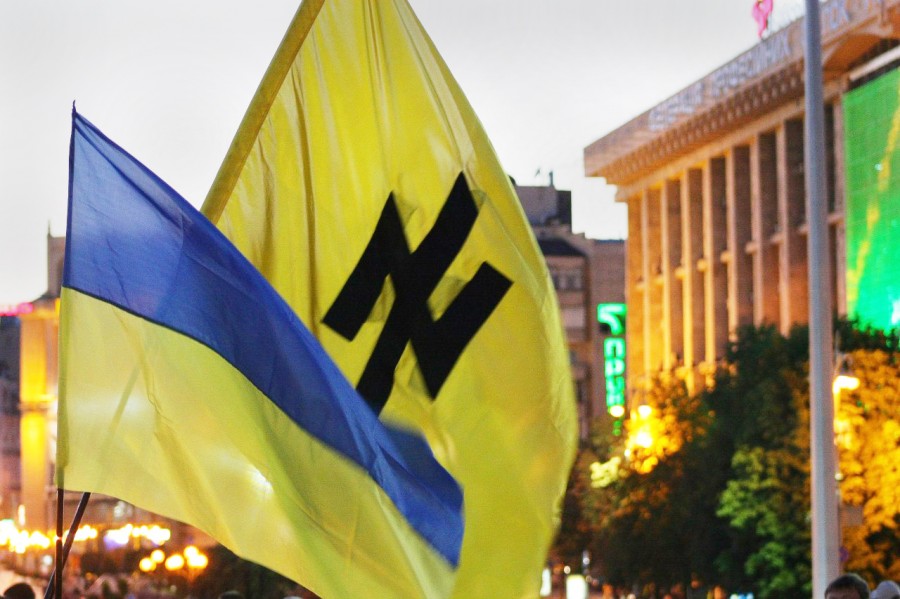
“Officials in Kiev say the militias and the army coordinate their actions, but the militias, which count about 7,000 fighters, are angry and, at times, uncontrollable. One known as Azov, which took over the village of Marinka, flies a neo-Nazi symbol resembling a Swastika as its flag.” [See Consortiumnews.com’s “NYT Discovers Ukraine’s Neo-Nazis at War.”]

The conservative London Telegraph offered more details about the Azov battalion in an article by correspondent Tom Parfitt, who wrote: “Kiev’s use of volunteer paramilitaries to stamp out the Russian-backed Donetsk and Luhansk ‘people’s republics’… should send a shiver down Europe’s spine.

“Recently formed battalions such as Donbas, Dnipro and Azov, with several thousand men under their command, are officially under the control of the interior ministry but their financing is murky, their training inadequate and their ideology often alarming. The Azov men use the neo-Nazi Wolfsangel (Wolf’s Hook) symbol on their banner and members of the battalion are openly white supremacists, or anti-Semites.”

Based on interviews with militia members, the Telegraph reported that some of the fighters doubted the Holocaust, expressed admiration for Adolf Hitler and acknowledged that they are indeed Nazis.

Andriy Biletsky, the Azov commander, “is also head of an extremist Ukrainian group called the Social National Assembly,” according to the Telegraph article which quoted a recent commentary by Biletsky as declaring: “The historic mission of our nation in this critical moment is to lead the White Races of the world in a final crusade for their survival. A crusade against the Semite-led Untermenschen.”

The Telegraph questioned Ukrainian authorities in Kiev who acknowledged that they were aware of the extremist ideologies of some militias but insisted that the higher priority was having troops who were strongly motivated to fight. [See Consortiumnews.com’s “Ignoring Ukraine’s Neo-Nazi Storm Troopers.”]

Inconvenient Truth

More recently, Foreign Policy’s reporter Alec Luhn encountered the neo-Nazis of the Azov and other militias in the port city of Mariupol. He wrote: “Blue and yellow Ukrainian flags fly over Mariupol’s burned-out city administration building and at military checkpoints around the city, but at a sport school near a huge metallurgical plant, another symbol is just as prominent: the wolfsangel (‘wolf trap’) symbol that was widely used in the Third Reich and has been adopted by neo-Nazi groups. …

“Pro-Russian forces have said they are fighting against Ukrainian nationalists and ‘fascists’ in the conflict, and in the case of Azov and other battalions, these claims are essentially true.”

The West’s silence about this inconvenient truth is especially startling because it should come as no surprise to the European Union, which has long been aware of the extremist positions held by the Svoboda party, which emerged as a major political force in Ukraine after the Feb. 22 coup ousting elected President Viktor Yanukovych.

In December 2012, barely a year before the coup, the European Parliament expressed concern about “the rising nationalistic sentiment in Ukraine” represented by Svoboda, whose founders included admirers of World War II Nazi collaborators, such as Stepan Bandera and Adolf Hitler’s Ukrainian auxiliary, the Galician SS.

A parliamentary statement from Brussels noted “that racist, anti-Semitic and xenophobic views go against the EU’s fundamental values and principles” and urged “pro-democratic parties” in Ukraine’s parliament “not to associate with, endorse or form coalitions with” Svoboda.

After the coup, which was strongly supported by Svoboda and spearheaded by its associated neo-Nazi militias from the west, Svoboda and other far-right political groups were given several ministries in recognition of their crucial role in the anti-Yanukovych putsch.

Now with Svoboda at the center of power in Kiev, the EU has muted its alarm, all the better to maintain the white hat/black hat scenario favored by Official Washington and the mainstream U.S. media. That narrative portrays the Kiev regime as the blameless white hats and Russia’s President Vladimir Putin and the ethnic Russian rebels in the east as the evil black hats.

Amnesty International’s Report

Besides the fascist leanings of some Ukrainian militias, there is also the issue of their brutality. On Monday, Amnesty International issued a report condemning abuses committed by Kiev’s Aidar militia against civilians north of the rebel-held city of Luhansk.

“Members of the Aidar territorial defence battalion, operating in the north Luhansk region, have been involved in widespread abuses, including abductions, unlawful detention, ill-treatment, theft, extortion, and possible executions,” the Amnesty International report said. “The Aidar battalion is one of over thirty so-called volunteer battalions to have emerged in the wake of the conflict, which have been loosely integrated into Ukrainian security structures as they seek to retake separatist held areas.”

The Aidar battalion commander told an Amnesty International researcher: “It’s not Europe. It’s a bit different. … There is a war here. The law has changed, procedures have been simplified. … If I choose to, I can have you arrested right now, put a bag over your head and lock you up in a cellar for 30 days on suspicion of aiding separatists.”

The AI report continued, “Our findings indicate that, while formally operating under the command of the Ukrainian security forces combined headquarters in the region members of the Aidar battalion act with virtually no oversight or control, and local police are either unwilling or unable to address the abuses.

“Some of the abuses committed by members of the Aidar battalion amount to war crimes, for which both the perpetrators and, possibly, the commanders would bear responsibility under national and international law. “

In other words, evidence is mounting that the Kiev regime has waged its so-called “anti-terrorist operation” against ethnic Russians in eastern Ukraine by using out-of-control paramilitaries, some guided by Nazi ideology. This behavior, fitting with the far-right political extremism previously known to EU leaders, also violates norms agreed to by the Ukrainian government in its commitment to the OSCE.

Yet, apparently for geopolitical reasons, the Obama administration, the EU and the OSCE have muted any criticism. This silent hypocrisy has been largely echoed in the Western mainstream media.

See the original article >>

Could the Alibaba Model Undo the Wal-Mart Model?

by Charles Hugh Smith

These are questions that arise as a consequence of the digitization of the global/local supply chain in the peer-to-peer model.


Longtime correspondent Bill M. reckoned I missed the longer-term story in my piece on the Alibaba IPO: namely, that the Alibaba Model of makers selling directly to buyers could undo the Wal-Mart Model of super-stores dependent on massive inventory. My essay The China Boom Story: Alibaba and the 40 Thieves addressed the China Boom rather than the Alibaba model, so let's compare and contrast the Alibaba model and the Wal-Mart model.

We all know the Wal-Mart Model: squeeze suppliers until they're gasping for air ("sure, you're losing money on every unit you sell us, but you'll make it up on volume") and then transport all this stuff across the Pacific to a vast warehousing and shipping operation that must keep hundreds of sprawling (and costly) superstores stocked with hundreds of different items.

This model gained supremacy because it lowered costs to consumers by outsourcing the production of most of the inventory. Generally built outside of towns, the superstores thrived in an era of low gasoline costs and cheap credit, i.e. the past few decades.

Competition was held at bay by the sheer size of the superstores' purchasing might: nobody ordering small lots could buy stuff at the same price as someone ordering a million units.

The Alibaba Model is a peer-to-peer system that enables makers/suppliers and buyers to link up supply and demand in real time. Let's say I want 100 bicycle wheels of various sizes for my bicycle repair shop, to replace all the wheels stolen from unsecured bikes with quick-release hubs.

In the peer-to-peer market (the Alibaba Model), my bid for the 100 bicycle wheels is visible to a universe of makers/suppliers. Maybe some supplier has an overstock, or a manufacturer has piled up some extras or has a slack day to fill on the production line. There are any number of reasons why a maker/supplier might be able to get close to Wal-Mart's price for a small batch order.

Depending on my own distribution network, the 100 wheels might not even be inventoried in a warehouse: the day they arrive, I might ship them to others who already ordered wheels from me--from individuals to institutions to other repair shops.

The digital overhead of the transaction is near-zero, and managing the logistical supply chain is low-cost as well. There is very little overhead compared to the vast hierarchy of corporate controls and management of the superstore model.

This enables both the maker and the buyer to offer better prices with higher margins than either could get in the Superstore Model. In essence, the profit and overhead skimmed by the Superstore Corporation can be split between buyer and seller.

The Alibaba Model is not limited to China. After reading Shenzhen trip report - visiting the world's manufacturing ecosystem, Correspondent Mark G. observed: The injection mold making they discuss as a strength in Shenzhen is precisely what Phil Kerner teaches at hisThe Tool And Die Guy website. Resurrecting that supporting skill community ecology is why I regard such teaching materials from Kerner and Tubal Cain on Youtube as so vital: Index of Tubal Cain "Machine Shop Tips" videos on YouTube.

Toss in the ongoing revolution in affordable desktop 3-D fabrication machines, and it's not too hard to discern the price advantages of the Superstore Model eroding fast, especially if consumers wise up that "low prices" are not low if the quality is so poor the product must soon be replaced.

How much would I pay to avoid the weeks-long shipping delay from Asia? Does that premium enable local shops to compete with Asian workshops, despite the lower wages paid in China, Vietnam, and other emerging economies?

How much would I pay to have the item I want delivered to me rather than have to drive miles to the Superstore? if I add up the maintenance costs, fuel and other expenses of operating my car, and the time wasted in traffic, standing in line, etc., how much cheaper is the Superstore price?

How much would I pay to direct my money went to a local worker/shop owner I know and trust rather than to some supplier in a distant city?

These are questions that arise as a consequence of the digitization of the global/local supply chain in the peer-to-peer model. Just as we have reached Peak Central Planning and Peak Central Banking, we may have reached Peak Centralization not just in government and finance but in the corporate-cartel model of "low quality at high margins."

See the original article >>

A Few Reflections on the Demonisation of Putin

by Roberto Orsi

Henry Kissinger once declared that “Putin’s demonisation is not a policy, but an alibi for the absence of one”. However authoritative the source of this recommendation, the collective fixation with the Russian President has reached new heights during the ongoing geopolitical crisis in the Ukraine. In many different ways, the idea that, if the President of the Russian Federation could meet a however premature end of his earthly journey, even by violent means, this would solve the Ukrainian crisis and the problem of Russia’s resurgence, is gaining momentum among Western elites.

The most explicit articulation of such thoughts can be found in a piece written by Herbert E. Meyer, Special Assistant to the Director of Central Intelligence and Vice Chairman of the CIA’s National Intelligence Council during the Reagan Administration. Meyer puts forward the view that “Russian President Vladimir Putin is a serious threat to world peace”, he is in essence a thug, and “thugs like Putin don’t stop because they’ve been punished [the reference here is to the EU sanctions] or because they see the error of their ways. Thugs have a high tolerance for pain, and they are incapable of changing their behavior. They keep going until someone takes them out – permanently – with a knockout punch”. Without Putin, Moscow would cease to be a threat to world peace, as Russia is a “one-man show”. The Russians should get rid of Putin in one way or the other, either peacefully or, “if Putin is too stubborn to acknowledge that his career is over, and the only way to get him out of the Kremlin is feet-first, with a bullet hole in the back of his head – that would also be okay with us”.

Meyer’s piece comes as the refinement, explicitation, and final outburst of a cluster of recurring motives which have overwhelmed Western media in the last few years. Putin as the murderer of journalist Anna Politkovskaya and of London-based ex-FSB officer Alexander Litvinenko, Putin the persecutors of the Pussy Riot punk rock group, Putin the “homophobe”, Putin who “lives in another world” according (allegedly) to German Chancellor Angela Merkel, Putin who is clearly “one the wrong side of history” (US President Barack Obama). Putin the mentally ill. Putin as the new Hitler.

The Hitler analogy deserves more attention. On the one hand its use is becoming ubiquitous. In his day, George W. Bush was Hitler. Saddam Hussein was Hitler. For the anti-austerity protesters, Merkel is Hitler. The reductio ad Hitlerum is a currency undergoing hyperinflation.

On the other hand, the Hitler analogy has replaced more sophisticated eschatological images which were fashionable in the European past, namely the figure of the Antichrist as the symbol of absolute evil and his coming as the sign of the impending end of the world and Last Judgment. Many European leaders have been labelled as the emissary of the devil: certainly Napoleon Bonaparte, but also Friedrich II of Prussia, and Peter the Great.

The identification of Putin as a manifestation of a metaphysical absolute evil, justifying the recourse to extreme measures, instead of being simply hinted through metaphors, and reduced to a trivial matter for low-level propagandistic efforts, should be become the centre of a more nuanced discussion, and in the context of European culture there is plenty of ways to approach the question of his possible removal.

Murder is considered a punishable act in most legal and moral systems. However, not all forms of physical elimination of other human beings is illegitimate and therefore classified as murder, as clearly in the case of self-defence, or while engaging legitimate targets on the battlefield. The intellectual problem of political leaders’ targeting is not at all new. It is possible to distinguish two general cases. One concerns the elimination of political and military leaders in war. The second one deals instead with the domestic ordering of a given polity.

From a strategic perspective, what has been termed the “decapitation strike” consists precisely in the targeting of centres of command and control, both military and political, in order to plunge the enemy into organisational chaos. This position has supporters and detractors, although the idea invariably refers to scenarios where open hostilities are at least either imminent or incipient, and certainly not as a practice, nor as a recipe, for inter-state peace. Clearly, such operation will automatically legitimise symmetrical acts of retaliation, opening scenarios of spiralling, indiscriminate violence with unpredictable consequences.

Judith beheads Holofernes, by Giorgio Vasari (Saint Louis Art Museum)

As readers familiar with the history of international political theory know, there has been an astonishing variety of views on the rightful conduct of war in Western thought (reflections on the so-called iustum bellum). Traditionally, wars among Christian nations were supposed to be highly regulated, while several degrees of unrestricted warfare were usually allowed against infidels.

In the biblical Book of Judith, the homonymous Jewish heroine saves her people during the siege of Bethulia by penetrating in the camp of the besiegers, seducing Holofernes, the general of the enemy army, and beheading him during his drunken sleep. As in this illustrious precedent, the assassination of the enemy’s leader appears to be an act of despair usually associated with all-out genocidal wars.

As a modern conception of international and global politics was arising, distancing itself from a Christian/non-Christian dichotomy, Immanuel Kant warned again this kind of practices in the sixth provisional article for perpetual peace of his Zum ewigen Frieden (1795). Kant calls for a ban in warfare of all those practices which will make reciprocal trust in future peace agreements impossible, such as assassination, poisoning, breach of capitulation, instigation to treason. Interestingly, the philosopher characterises such actions as “dishonourable stratagems” (ehrlose Stratagemen) and explains why this is the case, in two short paragraphs which, considering the current international situation, deserve to be quoted in full:

These are dishonourable stratagems. For some kind of confidence in the disposition of the enemy must exist even in the midst of war, as otherwise peace could not be concluded, and the hostilities would pass into a war of extermination (bellum internecinum). War, however, is only our wretched expedient of asserting a right by force, an expedient adopted in the state of nature, where no court of justice exists which could settle the matter in dispute. In circumstances like these, neither of the two parties can be called an unjust enemy, because this form of speech presupposes a legal decision: the issue of the conflict just as in the case of the so-called judgments of God decides on which side right is. Between states, however, no punitive war (bellum punitivum) is thinkable, because between them a relation of superior and inferior does not exist.

Whence it follows that a war of extermination, where the process of annihilation would strike both parties at once and all right as well, would bring about perpetual peace only in the great graveyard of the human race. Such a war then, and therefore also the use of all means which lead to it, must be absolutely forbidden. That the methods just mentioned do inevitably lead to this result is obvious from the fact that these infernal arts, already vile in themselves, on coming into use, are not long confined to the sphere of war. Take, for example, the use of spies (uti exploratoribus). Here only the dishonesty of others is made use of; but vices such as these, when once encouraged, cannot in the nature of things be stamped out and would be carried over into the state of peace, where their presence would be utterly destructive to the purpose of that state.
(Perpetual Peace, A Philosophical Essay, Translation by Mary Campbell Smith, London: 1917, pages 114-115.)

Arguing against the demonisation of the enemy, left alone his cold-blooded assassination, does not mean advocating the abolition of all hate and/or conflict. On the contrary, as an old and unfortunately still little appreciated argument goes, precisely the all-too familiar unrestricted war on any form of struggle contradicts itself by thus promoting yet another form of total war. The point is instead that of recognising the place of conflict in this world, and make it productive, particularly by reducing its destructive potential to the minimum, including – if possible – its sublimation towards symbolic forms. The argument here is to restrict and restrain conflict, by conferring upon it a legitimation within clearly demarcated boundaries (the Schmittian Hegung). There may be enmity between NATO and Russia, but there is no reason for it to turn into an unrestricted, total war. Within this framework, the denigration of the enemy diminishes the dignity of those who articulate it, and the value of the sacrifices faced during the struggle. Instead of engineering depictions of the enemy which constantly hint at his ontological sub-ordination, the point is not to descend into this form of demonisation, also in order to keep political compromise and diplomatic dialogue always a viable option.

Again, arguing against the demonisation of the enemy does not imply advocating the elimination of all hate. Hate is a human passion among many, and those are constitutive to the human person. This does not mean that the so called “human nature” is fixed, nor it constitutes the endorsement of some sort of “pessimistic” philosophical anthropology. The scope of the present, and admittedly limited reflection, is to warn against the dangers of another form of unrestricted hostility. Even the Gospel’s commandment to “love your enemy” (Matthew 5,44: ἀγαπᾶτε τοὺς ἐχθροὺς ὑμῶν) is circumscribed to the ἐχθρός, i.e. the adversary in private matters (the Latin inimicus), not extended to the πολέμιος, the Latin hostes or political foe. Hating one’s political enemy appears to be legitimate, but it is not good advice to excessively indulge in it, as to fall prey to one’s own passions rarely leads to constructive outcomes.

While Putin certainly constitutes a formidable adversary for the elites currently ruling the Western world, precisely for this reason they should appreciate the historical opportunity to demonstrate their valour. Humility (Bescheidenheit), one of the required virtues of political leaders, must encompass a positive disposition towards learning from anyone, including and perhaps especially from one’s own enemy. Men and women who have been called upon to rule nations and lead armies should also feel a sense of common destiny (fellowship) beyond the however contingent political divisions.
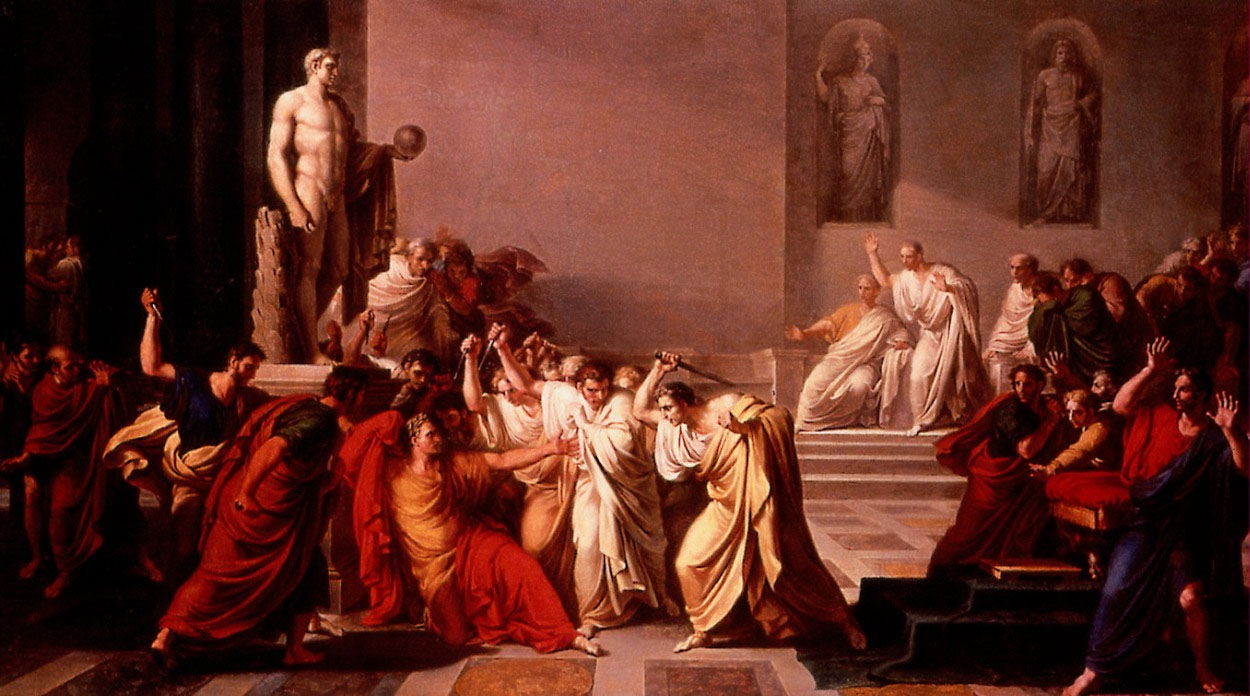
The death of Julius Caesar by Vincenzo Camuccini (1771-1844), Galleria Nazionale d’Arte Moderna (Rome)

A second line of thought refers to the intellectual tradition which allows or even recommends as a duty the assassination of political leader whenever these turn to tyrannical rule. It is therefore an issue of domestic politics. There are numerous historical examples of tyrannicide, which have generated controversial evaluations and debates, some of them lasting since antiquity, as in the case of Peisistratus of Athens, or Julius Caesar. However, tyrannicide raises at least two questions. The first one concerns the definition itself of tyranny, the second its relation to international politics.

Tyranny should be kept distinguished from other political forms, which are often and incorrectly confused. Tyranny, dictatorship, autocracy, authoritarianism, despotism, absolutism, are all different, despite the existence of overlapping areas. The concept of tyranny does not simply refer to the case in which an individual or group has concentrated in his hands all or most of political power in a given polity. It refers specifically to a degenerated autocratic form where power is exercised against the principle of the common good, outside and/or against established constitutional rules, and with systematic cruelty against his own subjects for the purpose of maintaining power.

It is questionable to what extent Putin can be classified under the label of a tyrant. There is little doubt that the Russian president is the most powerful individual in the Russian Federation. This is partially due to the design itself of Russia’s constitution and its political traditions, with particular reference to the Eusebian conceptions of political order and its further elaboration following Constantine Porphyrogenitus, partially to the political state of exception within which Putin rose to power in the chaotic 1990s. Putin’s Russia is certainly an authoritarian state whose ruling elite, a somehow heterogeneous alliance of intelligence and military officers, religious leaders, economic tycoons, and regional strongmen, is sufficiently cohesive to hold an effective control of the country, but not broad enough to enhance a more sophisticated pluralistic outlook.

However, nobody is currently arguing that Putin is exercising his power outside the constitutional framework of the Russian state, and even less by keeping the entire population hostage through sadistic and ubiquitous violence. If anything, Putin enjoys an authentic popular support, even discounting the Kremlin’s tight control of the main media. Besides, it is arguable that Putin represents a moderate figure in the landscape of Russian politics, and his ousting would probably open the way to significantly more radical politicians.

Observing the question of tyrannicide from the perspective of international politics, the decision, together with moral and political responsibility of such an extreme act cannot but rest with those who are subjected to a tyrannical power, not to outsiders. As noticed above, excluding the regrettable case of total war, there is no ground for considering such act as a recommendable foreign policy. More in general, the governing principle of international politics may not be so much identified in a somewhat utopian non-intervention rule, but in the conviction that it is the task of whose who constitute a certain political community to envisage its political and constitutional ordering, reflecting historical and lato sensu anthropological specificities, despite foreign meddling.

The often praised “celebration of diversity”, if it has to be taken seriously, cannot simply conceive culture as some sort of folklore, but it has to implicitly accept and endorse a pluralism of political forms, as cultures are often based not only on different, but rather on opposite fundamental principles. Such kind of pluralism entails necessarily some kind of agonism and territorialisation. As explained above, this agonism is to be legitimised within specific confinements, particularly with regard to the omnipresent danger of maximalism and the descent into total war.

In conclusion, coming back to the temptation of forcing Putin’s ousting, there are numerous reasons to reject this stream of thoughts as severely counterproductive. The demonisation of Putin is not a sound policy, not a morally honourable practice. With regard to the coming of the Antichrist and the end of the world, nobody knows its hour (Matthew 24,36: Περὶ δὲ τῆς ἡμέρας ἐκείνης καὶ ὥρας οὐδεὶς οἶδεν, οὐδὲ οἱ ἄγγελοι τῶν οὐρανῶν οὐδὲ ὁ υἱός, εἰ μὴ ὁ πατὴρ μόνος). In the words of Jorge of Burgos, the blind monk in Umberto Eco’s novel The Name of the Rose (1980): “The Antichrist comes in everyone and for everyone, and everyone is part of him”.

See the original article >>

Follow Us