Sunday, July 21, 2013

The Bang! Moment Shock

By John Mauldin

Future shock is the shattering stress and disorientation that we induce in individuals by subjecting them to too much change in too short a time.

– Alvin Toffler

What is it about humans that we fail to see a crisis in advance, yet when we look back, its likelihood or inevitability so often seems blindingly obvious? Rather than a flaw, our under-reliance on foresight as opposed to hindsight is perhaps a necessary evolutionary design feature that has allowed us to make rapid progress as a species (especially over the last few thousand years), but in a complex modern society it can really create quite the crisis for individuals. This week we resume our musings about Cyprus, to see what that tiny island can teach us about our own personal need to engage in ongoing critical analysis of our lives and investment portfolios. Cyprus is not Greece or France or Spain or Japan or the US or … (pick a country). I get that. No two situations are the same, but there may be a rhyme or two here that is instructive.

This Country Is Different

In 1974, Turkey invaded Cyprus. Eventually the island was divided into two zones, and Greeks in the Turkish zone, like Turks in the Greek zone, were forced to leave with only the clothes on their backs and little else. That was a defining moment for Cyprus, and the aftershock is still evident when you get past the normal polite conversation. Plus, the wall dividing the two countries is always there when you are in the capital city of Nicosia, although lately there are a few places where you can cross into the other zone. The first night I was in Nicosia, we ate dinner outside at a Greek taverna (what else?) that stands almost in the shadow of the wall.

One hundred years after the Civil War, the South of my childhood was still mixed up with the aftereffects of that war. The war in Cyprus was less than 40 years ago. Another evening we went to a local club where the members were Greeks who had been expelled from a particular neighborhood in the Turkish-occupied area. Many looked young enough that they could not have been alive during the war, but the memory of the "old neighborhood" was still strong among them.

These people lost homes and businesses, jobs – everything. They had to start over. (I am sure it was that way for the Turks who had to relocate as well.) But for the next 40 years there was very steady economic growth, 4% or so a year over time. The people took advantage of what they had. There was no university, so children went abroad to study and work and then came back, generally with skills. The legal and accounting professions grew particularly strong. Like two other former British island colonies, Singapore and Hong Kong, Cyprus became a financial center. Fifty double tax treaties later, the island had become a place to domicile companies, handle taxes and accounting, etc.

And then they branched out into banking. After the creation of the euro, the deposit base of Cypriot banks went through the roof, until it was up to six times the size of local GDP (depending on whom you believe – official sources make it closer to five times). By some measures, Cyprus had the second wealthiest population in Europe and certainly one of the best educated. Twenty-five percent of the world's ships were operated under the flag of Cyprus. Because the country had been a member of the nonaligned movement in the '80s (remember that?), it had good ties (and double tax treaties) with Eastern Europe and the USSR. Some of the kids went to university in Russia and developed contacts there. After the collapse of the Soviet Union, it was natural for Russians to use Cyprus as a conduit to the West.

Cyprus has, by some accounts, the best beaches in the Mediterranean, and so more and more people came and built vacation homes. They brought their money with them and deposited it in the local banks and took out loans to build their homes. Real estate prices climbed and climbed. Below are Cypriot bank deposits and loans from 2009 through April of this year (data from the central bank).

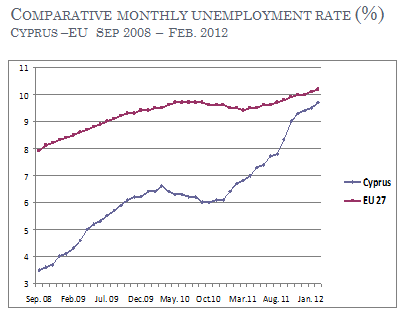
Unemployment was quite low, less than 4% in 2008, although the global credit crisis led to a gradual rise (though nothing like that seen in the rest of Europe). Much of the new unemployment was in the construction industry, which fell into a slump along with the rest of Europe during the crisis.
Banking soon became the biggest industry. There were more banking branches per capita in Cyprus than anywhere else in the world, more than double the European average. And there were over 40% more employees per branch than in the average eurozone country. Money was easy to get, so debt exploded by over 50% in both businesses and households in just six years, from 2005–2011.

The country had always run a current account deficit, but by 2008 that deficit had topped 15%, keeping pace with Greece's and Portugal's. However, earnings and productivity had more than kept up. Cypriots worked hard and offered good value for their services. They saw themselves as different from the other Southern European countries. But, as in much of the rest of Europe, public-sector employment doubled from 1990, with the second-highest government wage bill (behind Denmark's) and a monstrous 50% growth in social benefits in the last 10 years.

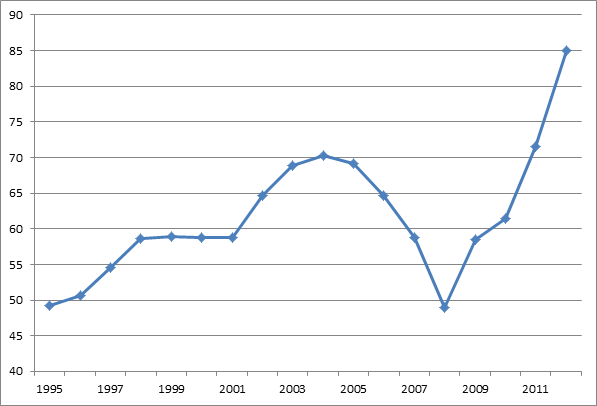
Still, starting in 2003, public debt-to-GDP actually fell. Why ring the alarm bell when things are getting better?

Cyprus: Public sector debt as % GDP 1995-2012
There were in fact no alarms bells ringing as 2012 opened. But there should have been. Cypriot banks were flush with cash. They bought foreign banks in Greece and Russia. They made ever more loans and then looked around and decided that Greek sovereign debt was something they needed more of. And then came the Greek sovereign debt crisis, and the capital base of the Cypriot banks was essentially wiped out. But the ECB and the EU had bailed out Irish and Spanish banks; and so depositors in Cyprus, many of them Russian, decided, along with the local citizens, to leave their money in the banks.

The country had been under the parliamentary control of the Communist Party since 2008. Seriously. Supported by the Orthodox Church. (Note that public debt began its serious rise after the communists came to power). No one reined in the banks, and they grew ever fatter and more exposed until the crisis hit. Then Cyprus could no longer fund its debt and needed EU help. Further, the Central Bank of Cyprus (not to be confused with the commercial Bank of Cyprus) had to make emergency liquidity loans to Cypriot banks that had to meet demands for withdrawals and could no longer raise capital. There was not a bank run, but there was a fast-paced walk.

The ECB balked, as the quality of the collateral offered did not come close to the standards of the Emergency Lending Assistance (ELA) program. The government of Cyprus needed money to fund its basic needs as well as to "roll over" its debt as it came due. The EU basically declined to negotiate, as there was a Cypriot election scheduled for late February, and the EU preferred to wait to see the results before acting. There was talk of a "bail-in" (where depositors would shoulder some of the loss), but as usual that proposal came from the Germans, and the rest of Europe would surely not agree.

The new president assumed office and saw immediately that the country was in trouble. He tapped Michael Sarris, a "technocrat," to be his finance minister. Sarris was the man who had helped bring Cyprus into the euro and who oversaw the reduction in Cypriot debt. While he was not a member of the winning political party, he had been at the World Bank and had relationships with many of the finance heads of Europe.

Sarris went to Brussels, only to find no friends of Cyprus there. The Germans privately told him they would approve no bailout of Russian depositors (rumored to account for over half of the base of some of the banks) prior to the German elections this fall. Cyprus was seen as a money haven and a place for rather loose tax accounting. I have to admit that many of the Cypriots I talked to knew that money laundering was going on. It was a very open secret. Cyprus had very strict rules, but it seems there were ways to engineer exceptions.

In the end, Cyprus makes no difference – that was the perception in Europe, and while they were just talking a few billion euros here and there, a fraction of what Ireland or Spain needed, there was just no sympathy for Cyprus. Many of the European finance ministers wanted to establish the questionable principle that bank deposits were no longer sacrosanct, and Cyprus was just not seen as a systemic risk. The best deal Sarris could get was a 6.75% "tax" on deposits of less than €100,000 and 9.9% above that, with the aim of raising €5.8 billion. That was on a weekend, and by Monday, when Sarris returned, the indignation in Cyprus had grown to the point that not one politician voted to accept the deal.

A bank holiday was declared and Laiki Bank was put into receivership and closed as a "bad bank," but within a week the EU decided to insure all deposits up to €100,000, the number that "everyone" had understood to be the safe deposit amount. The banks eventually reopened, but Cyprus placed capital controls on deposits and limited withdrawals. A euro in a Cypriot bank was no longer the same as a euro in an Irish bank.

The Economist wrote shortly thereafter:

"The Cypriot deal has no coherence in the larger context. The euro crisis has been in abeyance for a few months, thanks largely to the readiness of the European Central Bank to intervene to help struggling countries. The ECB's price for helping countries is to insist they go into a bail-out programme. The political price of going into a programme has just gone up, so the ECB's safety net looks a little thinner. The bail-out appears to move Europe further away from the institutional reforms that are needed to resolve the crisis once and for all. Rather than using the European Stability Mechanism to recapitalise banks, and thereby weaken the link between banks and their governments, the euro zone continues to equate bank bail-outs with sovereign bail-outs. As for debt mutualisation, after imposing losses on local depositors, the price of support from the rest of Europe is arguably costlier now than it ever has been."

Since then, the crisis has deepened. Deposits of over €100,000 in Laiki Bank, which was the second largest bank in Cyprus, have been completely wiped out. The bad debts of Laiki Bank were forced into the Bank of Cyprus, saddling their depositor base with approximately 60% losses.

If you had a business with over €100,000 deposited in Cyprus, you are likely out of business. Many businesses that were going concerns on March 14, 2013, when the crisis fully erupted, were out of business a few days later. All the employees lost their jobs and their benefits. Unemployment will soon reach 20%. For now, all of the branch banks are open, but at least half will soon be shut.

On an ironic note, the EU resisted any talk of Russian banks coming in to take over the failed Cypriot banks. Now it looks as if Russian citizens may own over 50% of whatever is left of the Bank of Cyprus.

The Bang! Moment Shock

Cypriots are deeply shocked by these events. From "insiders" who sat on boards to politicians and ordinary citizens, no one can believe that the EU treated them the way they did. I was asked time and again, "How could this happen?" and not just by ordinary citizens.

I talked with one lady who had just retired from the Bank of Cyprus. She had 100% of her pension and life savings at the bank and now faces losses of up to 60%. She had no idea the crisis was coming. Interestingly, she and others I spoke to insisted that the Bank of Cyprus was a good bank. But when asked if she would redeposit her money in a Cypriot bank when (if) she ever gets it out, she shook her head no. The trust in the system is gone.

I talked with Symeon Matsis, a man in his early 70s who was at one time in charge of planning at the Ministry of Finance. He carried a copy of This Time Is Different by Rogoff and Reinhart. It was dog-eared and full of notes. "I am reading it so I can try to understand what happened to us. The more I read the more I understand that they were describing Cyprus. And we did think that 'This country is different.' Which is why the crisis has been such a shock to our local culture."

The Cypriots believed not just that their country was different but also that the stability they had seen for 40 years was normal and easy to achieve. Why would it end? They were just doing their jobs, and everything seemed OK … until it wasn't.

Humans are hardwired to be optimists. Keeping our chins up is the only way we can keep working today and have hope for the future. If we lose that optimism, what Keynes called our "animal spirits," then why should we take risks? And the growth of free markets and capitalism over the last 500 years is nothing if not the growth in our ability to tame risk, through institutions such as insurance companies and corporations and mechanisms such as securitization and pensions. (I highly recommend the masterful book, Against the Gods: The Remarkable Story of Risk, by the late and sorely missed Peter Bernstein. This is on my list of must-read books for everyone who asks.)

But with all the controls we have created, we still have not reduced risk to nothing. And the biggest risk is that created by our own politicians and institutions – by those we trust to somehow protect us from risk.

We write laws to protect us from politicians and government, limiting the power of the state to encroach on our lives. The citizens of Cyprus thought they had rules protecting them, too, but at the end of the day, there were no rules.

The central bankers and finance ministers of Europe are making the rules up as they go along. The monstrously long EU treaties and other eurozone agreements are wide open to bureaucratic interpretation.

If you live in the EU, you now must understand that the central risk to your financial well-being is the very governments you have asked to protect you from that risk. Many of those governments have made promises they cannot keep. I wrote a few weeks ago about the problems in France. I heard from some French readers who disagreed with me. The gist of their arguments boiled down to "we are different."

I agree that France is different in the sense that France will find some uniquely French way to deal with its crisis of too much debt and leverage, a government that is too large, and a system that is sclerotic. But whatever that is, it won't save France. French citizens and their politicians feel that their pensions, investments, and lifestyles are safe. Yes, things may have to change, they say, but not in any fundamental sort of way. They feel pretty much like the citizens of Cyprus did until March.

The word catastrophe is the same in English and French. And at some time in the future, lacking serious reform, a catastrophe is what France is facing. The same is true of dozens of countries in the "developed" world.

We love to tell ourselves that this time is different. But outcomes among countries with debt and deficits out of control, constrained by a limited ability to grow their way out of their problems, are unmistakably similar. Each country has its own reasons for thinking it is different, and right up until the end it goes on telling itself that it is. And then people are shocked when one day they wake up to a very different reality.

Michael Sarris did not come back empty-handed. He came back with billions of euros from the EU and the ECB. It just wasn't enough to keep things the way they were. The same plotline is repeated in Greece, Spain, and the rest of peripheral Europe.

Europe is making up the rules to deal with its crisis. Do you remember my writing about the very creative way the Irish dealt with their debt? Where was that in the rules? When the next phase of the crisis hits, the Europeans will make up more new rules. And that near certainty poses a serious risk for Europe.

Of course, we in the US are different. We have the rule of law. That's what we all learn in school and what we keep telling ourselves, anyhow. Well, except that we find the President now wants not to have to deal with a law he helped pass, and so some third assistant at Treasury was appointed to mention as everyone went home for the holiday weekend that parts of the Affordable Care Act will be postponed without consulting with Congress, which is supposed to be involved in the whole law thing.

It's not just this president; it's everywhere. We have wandered far down the path from the rule of law to rule by lawyers. We have a Congress that refuses to deal with our deficit crisis in any manner. We have a central bank that is afraid to let the stock market learn to cope without easy money and financial repression, thereby making the bankers and finance world rich but hurting the average citizen. Indeed, low rates are killing those who worked and saved all their lives and now need to receive at least modest returns on their savings just to live.

My suggestion is that you pay attention to what is going on around you. If things are out of balance, do what you can to not get caught in the problem. It is almost never, ever different this time. You do not want to experience your own personal Bang! moment.

Newport, NYC, Maine, and Montana

After being seriously sick for 12 days, I am finally almost back to normal today; and I may even try to get to the gym tomorrow, although I may just touch the weights rather than actually lift them. Next Sunday I go to Newport, Rhode Island, for a week of intense involvment with a planning meeting of the Office of Net Assessment of the US Defense Department. A small group of us are tasked with developing a document that offers alternative scenarios for how things may work out in the future. It is quite the serious group, and I am honored to be invited. The sessions run all day and often into the evenings. It is a very eclectic group from a dozen disciplines, and I learn a great deal more than I impart.

Then I will stay in NYC (or somewhere up there) for a few days before going to Maine for the annual Shadow Fed Fishing Trip. That is always a good time with old friends. This year Bloomberg will cover the weekend with live broadcasts and interviews.

I will then return to Texas, and other than a trip to Montana to spend some vacation time on a lake with my friend and partner Darrell Cain, I really think I will stay in Texas, even through August. Home is just feeling very good after the last 12 months of almost constant travel. And while there are a few trips in the fall, the schedule seems oddly light, which is fine. I am sure things will come up. And I notice that WorldCon, the international science fiction and fantasy book conference, comes to San Antonio around Labor Day this year. I have always liked the Riverwalk. Might be a time to visit.

See the original article >>

France’s Midsummer Night’s Dream

by Dominique Moisi

PARIS – Bastille Day, the French national holiday, was glorious this year. The military parade, dominated by the celebration of “victory” in Mali and the joint participation of African and United Nations troops, had the perfection of a gracious, albeit muscular, ballet.

This illustration is by Margaret Scott and comes from <a href="http://www.newsart.com">NewsArt.com</a>, and is the property of the NewsArt organization and of its artist. Reproducing this image is a violation of copyright law.

Illustration by Margaret Scott

The classical concert that preceded the magisterial fireworks that ended the day was the closest thing to a French version of the Proms in London, mixing light classical and popular songs. The Eiffel Tower imbued the evening with its magic. Paris, in case anyone had any lingering doubts, remains the capital of the world – or so it seemed for a night.

The melancholia that began to seize France many years ago was all but forgotten. The celebration of the glory of the past, mixed with popular English songs of the present, seemed to indicate renewed national confidence. What was the meaning of this moment of grace? Was it purely the product of a collective delusion, an emotional Potemkin village of sorts, encouraged, if not conceived, by the authorities to restore some level of self-assurance among France’s depressed citizens?

Even if the positive emotions remain only fleeting (as seems most likely), they were real and palpable. The French seemed to be in the mood to celebrate. Of course, it could simply have been the weather; a gorgeous summer has finally settled in after a miserable spring.

But it might also have been one of those natural turning points, a collective and spontaneous decision to say: “Enough of depression, let’s move on.” We French may not be what we used to be, the celebrants seemed to be saying, but we are still much more than people think we are. We have a great revolutionary past that still conveys universal values – liberty, equality, fraternity – and an army that, as in Mali, continues to make a difference in the world.

One can draw two lessons from this collective form of escapism. The first is that, beyond the many layers of depression and distrust in France, there is potential for a new and collective departure. This would require, of course, less cynical political elites who can transcend their petty ambitions and divisions for the sake of the country.

The second lesson, even more obvious, is that reality cannot be changed with a simple public spectacle. France is not Imperial Rome, where panem et circenses made a fundamental difference. It is a weakened democracy mired in an economic and social crisis so deep that it verges on becoming an identity crisis.

The proof was provided by a third traditional event on Bastille Day, between the morning’s military parade and the evening’s music and fireworks: President François Hollande’s speech to the nation, which took the form of an interview with two prominent journalists. He, too, was in a reassuring mood.

According to Hollande, the economic upturn – la reprise – had just started, and hope was around the corner. His tone and message had changed. He was no longer the “normal man” of his election campaign and tenure until now; instead, he tried to present himself, like his predecessor, Nicolas Sarkozy, as a superhero.

Of course, given his personality and low public-approval ratings, his address was the least convincing event of the day. Who could have said with certainty that the economic upturn announced by Hollande was real rather than aspirational? Beyond his message’s wishful thinking, the public’s reaction to the messenger was a mixture of disbelief and indifference.

Seeing the behavior of friends, all French, listening with me to Hollande, I was reminded of another moment. It was December 31, 1989, and I was in the Soviet Union. I had found myself in a restaurant in the old city of Suzdal, listening to President Mikhail Gorbachev’s “New Year wishes.”

I was moved: The man who symbolized glasnost and perestroika, who had allowed the peaceful emancipation of most of Eastern and Central Europe, was speaking. But I was alone in paying attention to him. The restaurant’s customers, like my French friends now, could not have cared less. Their president had become background noise.

Has Hollande become, in this sense, a French Gorbachev? For the left and the Greens, he is close to being a traitor. These voters chose him a year ago not only because he was not Sarkozy, but because he incarnated the values of the true left, even if his centrist moderation seemed a bad omen. Voters of the center or even the center-right are disappointed, too, by their president’s lack of charisma, if not sheer incompetence.

After a year of Hollande, France is witnessing a fundamental political revolution. During the half-century of the Fifth Republic, a bipartisan system of left and right has traditionally prevailed. But now France is becoming a country dominated by a “tripartite system” of more or less equal strength: the left, the right, and the extreme right.

If France wants to capitalize on the positive emotions of Bastille Day, it needs much more responsible elites, ready to unite in the fight against unemployment and its causes (lack of competitiveness and labor-market rigidity) and consequences (the rise of populist, non-republican forces). What Bastille Day revealed, even briefly and superficially, is that the potential to unite France exists. But doing so requires more than shallow promises.

See the original article >>

The Crash Of 1929

by Tyler Durden

Based on eight years of continued prosperity, presidents and economists alike confidently predicted that America would soon enter a time when there would be no more poverty, no more depressions - a "New Era" when everyone could be rich. Then 1929 began - a time when the stock market epitomized the false promise of permanent prosperity... it's only when we learn the lessons of the past can we avoid the mistakes of the future - or this time it's really different.

Congress: "Is it fair to say that Wall Street has benefited more [from QE] than Main Street has?"

Bernanke: "I don't think so... I want to emphasize that we're very focused on Main Street... Our low interest rates have created a lot of ability to buy automobiles..."

"The United States is afflicted with 'New Eras'"

See the original article >>

Now That Detroit’s Gone Bust, Is Your City Next?

by ffwiley

detroit1

Detroit’s bankruptcy filing is one depressing read. Poverty, crime, blight – you name the malady and there’s plenty of data to back it up. And unfortunately, Detroit’s not alone. You may be wondering which city hits the wall next.

I’m not making predictions, but I’ve looked at one indicator that may offer some clues: population loss.

As any good Ponzi Schemer will tell you, your future looks much better when there are more people moving in than moving out. Once the population change turns negative, a vicious circle can take hold, and that’s exactly what we saw in Detroit.

In addition to spending excesses and mismanagement, the city’s financial problems stem from the challenges of downsizing infrastructure as quickly as the tax base contracts. Here are a few lowlights from the bankruptcy declaration:

  • The average cost to demolish an abandoned building – of which Detroit has about 78,000, or 20% of the housing stock – is approximately $8500.
  • Of about 11,000 to 12,000 fires each year, approximately 60% occur in abandoned buildings.
  • The city closed 210 parks in fiscal year 2009 and recently announced that 50 of the remaining 107 parks were slated for closure.
  • The city’s Public Lighting Department is able to keep only about 60% of the approximately 88,000 street lamps in operation.
  • The Detroit courts’ case clearance rates have been running at only 18.6% for violent crimes and 8.7% for all crimes.
  • Only 10 to 14 of the city’s 36 ambulances were in service in the first quarter of 2013.

And now for a look at other cities that are battling severe population loss. Here are the top 15, ranked by the decline from each city’s population peak, according to the decennial U.S. census:

detroit2

And here are the top 15 ranked by the percentage decline (for this list, I required a population of at least 125,000 in or before 1960):

detroit3

Nine cities have the dubious distinction of making both “top 15” lists. For these cities, I’ve added charts showing population histories using all of the data I could find. There’s one chart each for the Midwest, Northeast and South (and if you’re looking for St. Louis, I went with the last Missouri accent that I’ve heard – definitely a drawl):

detroit4

detroit5

detroit6

The rate of population decline in most of these cities was at least slower from 1980 to 2010 than it was from 1950 to 1980 (Detroit was one of the exceptions). Nonetheless, they’ll need to manage the exodus more carefully than Detroit did to avoid the same fate.

Other links

Here are links to a few interesting Motor City photo galleries, from Time, Zero Hedge (via the NY Daily News) and the BBC (where I sourced the photo above).

See the original article >>

On My Enthusiasm For Solar Energy

by Aziz

I am a solar energy enthusiast. The energetic parts of the universe are clustered around stars. We sit here on this dusty ball of rock and water, heated continually by the Sun. The difference between when we face toward our local star and when we face away from it is — in the most literal sense — day and night. Our lives on Earth are already solar-powered; the plants (and plant-eating animals) we eat get their energy from photosynthesis. The trees and other biomass we have used for energy for much of our history, as well as the fossil fuel reserves we use today are forms of stored solar energy from earlier organisms that died and were trapped under the Earth. Wind energy and tidal energy are perturbations of dynamical systems heated by solar energy. Even the nuclear energy we use extracted from fissionable uranium and plutonium is stored from supernovae in early stars that exploded and pushed the complex elements — including the carbon, nitrogen and oxygen in our bodies — out across the universe.

It is not so much a question of whether we use solar energy, but whether we use direct solar energy, or some derivative form. As our civilisation has advanced and grown, we have had to tap into larger sources to meet the demand for cheap and easily-accessible energy. Our technological sophistication and understanding of basic physics and chemistry has had to grow with our energy hunger to take advantage of different forms of energy; windmills, steam engines, oil refineries, cold water reactors and photovoltaic panels, and so on. In the long run, it is a mathematical certainty that to sustain our civilisation at present levels, or to grow and increase energy consumption we must transition to renewable energy both because quantities of fossil fuels and star fuels like uranium and plutonium on Earth are finite.

The availability of direct solar energy on Earth dwarfs other energy sources, including renewable energy:

planetary-energy-graphic-energy-resources-renewables-fossil-fuel-uranium-e1331370752412

All that is necessary in the long run for renewable energy sustainability is that the level of output exceeds the level of input enough to provide a reliable energy source. Even at current solar efficiencies — and thus assuming that the technology won’t improve — photovoltaic solar generates seven times more energy than it takes to generate:

2000px-eroi_-_ratio_of_energy_returned_on_energy_invested_-_usa-modified

While this is not currently as good as oil or natural gas or coal, it already beats shale oil and biofuels. The beautiful thing about solar energy is that there is so much of it that the technology does not have to be greatly efficient. And prices are falling and efficiencies are improving. While some renewables like wind and hydroelectric are more efficient, they are not abundant enough to even cover the bulk of our energy needs today. In the short run, combined with hydroelectric and wind and nuclear there is a real basis for long-term renewable energy sustainability. To smooth the transition, renewable technology needs investment and development.

In the long run, while obviously renewables still cost a lot more than non-renewables in the marketplace, but we have already established that that cannot last forever. Even the supply of uranium is limited. While we may discover superior technologies like cold fusion, we should be completely prepared for the eventuality that we don’t discover a better technology. While photovoltaic solar remains the largest and most long-term source of available energy — and thus the best hope for the continuation and expansion of sustainable human civilisation — it should receive a bulk of funding and development, and we should assume that in the very long run it should meet the bulk of our energy needs. There are still challenges like solar energy storage, but these challenges are being surmounted with improved battery technologies, and improved distribution technologies such as microgrids.

Of course, if the photovoltaic solar price trend known as the Swanson Effect that has seen solar fall over 99% in cost since the 1970s continues, then solar will reach and exceed parity with other energy sources and be crowned the winner by the market based simply on  low cost. After all, solar energy is superabundant compared to the alternatives, so it would not be at all surprising for it to become the cheapest. But even if the Swanson Effect does not play out and solar does not become super-cheap, direct photovoltaic solar is extremely likely to play a major role in continued human civilisation on this planet and elsewhere.

See the original article >>

Ban Goldman Sachs from Playing in Commodity Markets

By EconMatters

Federal Reserve Review

On Friday Reuters reported that the Federal Reserve is going to review the 2003 decision that allowed regulated banks to trade in physical commodity markets: “The one-sentence statement suggests the Fed is taking a much deeper, wide-ranging look at how banks operate in commodity markets than previously believed, amid intensifying scrutiny of everything from electricity trading to metals warehouses.” Reuters goes on to say, “While the Fed has been debating for years whether to allow banks including Morgan Stanley (MS.N) and JPMorgan (JPM.N) to continue owning assets like oil storage tanks or power plants, Friday's surprise statement suggests it is also reconsidering whether all bank holding firms should be able to trade raw materials such as gasoline tankers and coffee beans.”

Big Banks & Unintended Consequences of Fed Policy

The Fed is finally getting that the Big Banks are canceling out any intended good that may accrue to wealth creation by pushing up stock prices, if at the same time these same financial institutions also push up commodities like oil, gasoline, copper, heating oil, wheat, corn, and soybeans with the same cheap QE stimulus money.

The fed is trying to weed out some of the unintended consequences of their QE stimulus program. Because on one hand they are trying to stimulate the “Wealth Effect” with higher stock prices, but these bankers have so much cheap capital available to them, and with the fed mandate to boost asset prices, they cannot help but juice up commodities at the same time.

This leads to adding a huge tax drag on small business, consumers and the overall economy with commodity prices trading well above the fundamentals of a sluggish global economy, and a domestic US economy treading water at an anemic 1.8%.

The fed is finally realizing that they should be getting much more bang from their monetary stimulus efforts, and the added economic costs of over-inflated commodity prices just negates any positives of their stimulus programs.

Where have the Regulators been?

But it is a shame that it takes the Fed to finally clamp down on the banks in this area as regulators should have banned these firms for trading commodities after the oil run-up of 2007 when banks pushed oil to $150 a barrel.

The patterns of banks manipulating markets are so numerous and widespread in financial market history that there is no way regulators should have let them anywhere near economic sensitive staples for consumers like Wheat, Soybeans, Oil and Gasoline. Furthermore, if the regulators did any investigating at all they would find much more abusive market manipulation practices than Libor Rate Rigging.

Is there a market the Big Banks haven`t tried to Manipulate?

Name me one market these banks haven`t tried to manipulate or Rig? Whether it is the recent settlements or future settlements in the Power Industry or the many manipulative practices discussed regarding “Metals Warehousing” to outright manipulation of key commodities by artificially taking supply off the market which has happened many times in the history of the oil markets.

The point is these firms cannot be trusted, their past behavior in anything market related from CDS, MBS to levering up their balance sheets by 40 to 1 ratios, should serve as a warning to any critical regulative body that it is a bad idea to let them “play” around in any essential commodity that consumers rely on for daily living purposes.

Congress initiated the Fed Review

It is about time that Congress started doing their jobs and initiated this inquiry by the Federal Reserve. The bigger question is why did it take 5 years after the financial crisis to realize these banks are bad market participants?

The Oil Market is the most Manipulated Market in the World

Just look at Oil prices above $80 a barrel when the Global economy was in a full blown recession. You actually think Oil prices were there because of the fundamentals of supply and demand in the market? Please, the United States was importing 5 Billion barrels of oil a year in 2006, and now we are importing 3 and a half Billion barrels of oil in 2013, and prices are 40% higher with China`s economy at stall speed?

Banning the Banks brings back the Fundamentals into the Oil Market

This is an amazing reduction in imports of 1.5 Billion and prices are 40% higher with increased Global production. Consumers, Regulators, and Businesses have no clue how Big Banks have totally changed the pricing of everyday commodities like Oil and Gasoline once they started trading these markets electronically, and utilizing their other manipulative strategies to game these markets!

40 to 1 Leverage is never good for Markets

Excuse my French here, but Get these “Regulated” Banks out of Essential Commodities, and never let them back in! It is about Freaking Time, and it really took ‘Regulators’ that long to realize that banks trading gasoline was never going to be good for consumers and the economy? Where do you think that 40 to 1 leverage goes? The recent 20% gain in gasoline prices in a month in an over-supplied market is where that leverage goes!

See the original article >>

Follow Us