
Friday, June 21, 2013

Market Tops Form "At The Margin"
by Tyler Durden
Yesterday, Federal Reserve Chairman Ben Bernanke likened monetary policy to landing a jet on an aircraft carrier which reminded ConvergEx's Nick Colas of a few choice 'Top Gun' quotes... "Son, your ego is writing checks your body can’t cash" seems most appropriate. But Colas' review of a recent academic paper on the social dynamics of how long people applaud - and why they stop - is perhaps useful in comprehending the market's reaction. The funny thing about the work is that the distribution of ‘Clapping duration’ looks pretty much exactly like the P/E ratio of the U.S. equity market going back to the 1800s. Why do people start and stop their applause or buy into a stock market? It all happens "at the margin" in both cases, and just a few people putting their hands in their pockets is enough to get the rest to stop. We still can’t get “Highway to the Danger Zone” out of our head.
Via ConvergEx's Nick Colas:
One of the most entertaining features of the 1980s is that the entire decade is neatly summed up by just 2 movies: “Top Gun” and “Wall Street”. The first glamorized the defense industry, one of the big industrial winners of the day, and the other codified the public’s perception of modern finance. Who can forget “Greed is good” or Maverick buzzing the tower? Good times…
I had an 80s flashback today when Federal Reserve Chairman Ben Bernanke likened the challenges of managing monetary policy to landing a jet on an aircraft carrier. Now, the Chairman bears very little resemblance to Tom Cruise, to be sure. But in my mind’s eye there was Dr. Bernanke in a flight suit trash talking his fellow naval aviators in the ready room. The thought didn’t really get as far as figuring out who might play the doomed “Goose” character, but I suppose the current chatter about San Francisco President Janet Yellen taking the reins next year makes her the logical choice. Since her job isn’t as dangerous as the #2 on an F-18, I expect she will be fine.
As tempting as it would be – and consistent with the spirit of these notes - to find some similarities between dog fighting and monetary policy, that’s not where we are going today. If you need to take a moment and put on Kenny Loggins’ “Highway to the Danger Zone”, I understand.
I recently read a novel study by some European researchers about how long people applaud. They taped a variety of audiences at college lectures and then parsed out when and how long individuals gave the requisite round of clapping after a lecture. The goal of the work was to understand how “Social” issues – the manner in which individuals response to the actions of others – change human behavior and how long an impact they might have. This is a hot topic at the moment, given the valuations given to social networking companies. If there are discernible clues to how people join groups and how long they stay, leveraging these observations would be the veritable pot of gold at the end of the rainbow.
What struck me about the study, however, was distribution graph of how often the population being studied actually clapped. There is a link to the study at the end of this note, but here is a brief description:
- The distribution of claps is a typical “Bell curve, anchored at zero (no clapping) on the left and with a longish tail on the right. A few people clap a lot, evidently.
- The average number of times someone claps at a lecture was about 10. The fat part of the distribution is 5-15 claps.
- No one clap-count had more than 10% of the observations. It is unusual for people to clap exactly the same amount repeatedly, which also makes sense.
The bit that surprised me was that the clap-count graph looks pretty much like the typical market P/E ratio histogram we’re all used to seeing.

Yes, there are plenty of ways to value the stock market, but the Price/Earnings ratio is still the most widely quoted. The relevant data from this graph is:
- The most common P/E ratio based on current earnings is 14 times.
- The “Chunky middle” of the distribution is 12-18 times (remember this data goes back to 1871).
- There are a handful of long-tail high multiple periods (north of 30) and a few (10 years) at or below a 10 P/E.
Now, there are plenty of naturally occurring data sets which exhibit the same kind of sloppy “Normal” distributions, but this comparison makes some intuitive sense to me. Stock valuation is essentially a form of ‘Approval’ that investors are confidence in the fundamental underpinnings of the equity market. And, of course, clapping is a sign of approval from an audience about a just-witnessed performance. Consider that the U.S. stock market currently trades for 15x current year earnings, and you’ve got a pretty typical level of “Approval” that fundamentals are reasonably robust. At least as strong as the average of the last 130 years or so. Not bad.
So what gets a group of people to stop clapping, and are there any lessons for those of us who look at capital markets? Here is what the researchers found on this point:
- Applause starts with just a few people in an audience and gathers steam. The end of the clapping starts in much the same way, with a few participants putting their hands down. It’s not like everyone stops at the same time, followed by eerie silence.
- Humans are social animals, and once people see that others in the crowd have stopped applauding, they quickly cease as well.
- You don’t need to be near a just-stopped-clapping person to be aware that the number of people applauding has diminished. Just hearing the level of noise created diminish slightly is enough to get the rest of the group to stop quickly.
Put in Wall Street parlance, applause happens “At the margin” with a few people starting up and others joining in. The analogy to capital markets activity is clear. Bottoms form when investors begin to value potential investments more highly than the previous day or week or month. The resultant price action entices others to “Join in” and the perceived value of the assets in question rise further. One set of hands clapping becomes many, then all...
The reverse process is how markets form tops. When everyone is clapping there’s no one left to add to the noise. Then someone stops, and someone else sees that. They stop. The noise begins to fade, just a little at first. But as it becomes perceptible to everyone, human nature kicks in. Who wants to be the last guy or gal clapping? Everyone will stare… The applause stops quickly at that point.
In the end, this is a simple analysis, but one which speaks to capital markets as essentially large “Social networks”, and that is an intuitively appealing construct. Attention and engagement ebb and flow based on macro confidence, micro financial results, and other fundamental inputs. Valuation becomes an analysis of whether more or fewer investors will be clapping next month or next quarter. But one thing is for sure – you want to be among the first people to clap and quit when the noise is the loudest.
Getting that bit right is the hard part.
The Technical Argument to Buy Treasuries
by Greg Harmon
If only for a short term bounce. The charts of the yield of 5-, 10- and 30-year Treasuries have all had tremendous moves higher out of a base from early May. On a short term basis they all look overbought and ready for a a pullback. This could be a one or two day move or a longer travel back to the base. Here is what to look for.
5-Year Treasury Note Yield 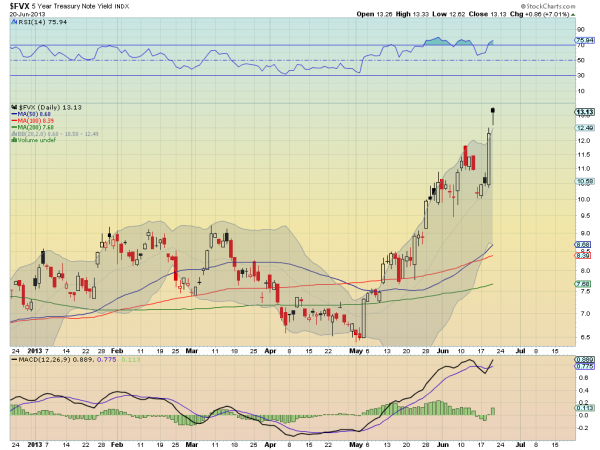
The 5-Year Treasury has moved from a yield of 75-90 basis points (bp) up to over 130bp. In doing so it has broken out of the top of the Bollinger bands, and Thursday printed a Hanging Man candle. Confirming lower Friday would signal a reversal with a target of a 38.3% retracement at least to 107bp. The Relative Strength Index is also in technically overbought territory, where it has triggered minor falls in yield previously. This is closest approximated by the ETF $SHY.
10-Year Treasury Note Yield 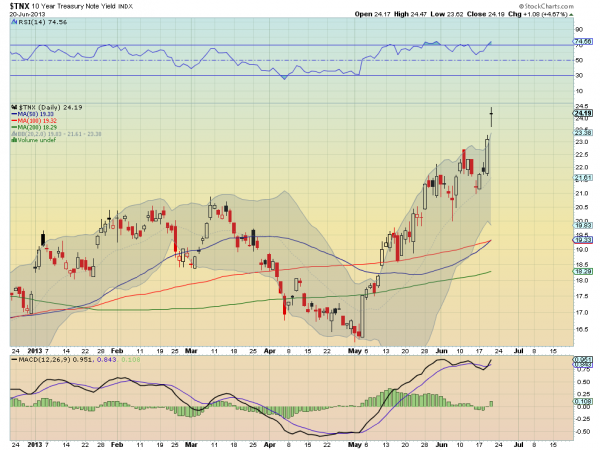
The 10-Year Treasury has moved from a yield of 1.63% in early May to a peak at 2.45% Thursday. The Shooting Star Doji print would also signal a reversal to lower yields if confirmed Friday. Out of the Bollinger bands as well, it too is technically overbought on the RSI. A 38.2% pullback on this targets the 2.14% area. The closet ETF to this is the $IEF.
30-Year Treasury Bond Yield 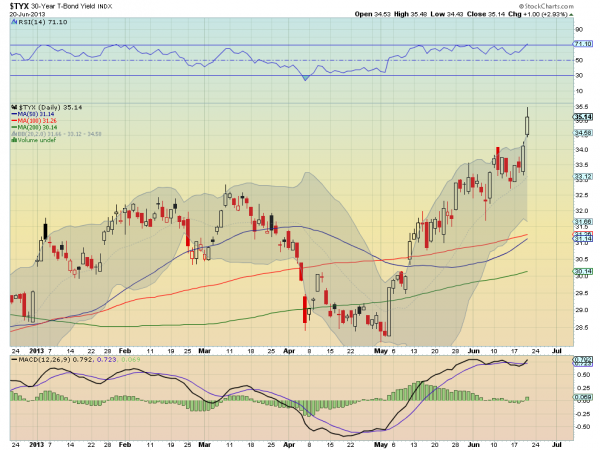
Finally the 30-Year Treasury has moved from 281bp up to a high of 355bp. This 74bp move has resulted the the yield moving out of the Bollinger bands and into technically overbought territory as well. A 38.2% retracement on the 30-year would take it back to 327bp. This is closest to the ETF $TLT.
Each of these instruments has a Moving Average Convergence Divergence indicator (MACD) that is leveled but trying to move higher. This is a reminder that they do not need to correct this time. They could continue and become more overbought. The confirmation lower is what is needed to turn the analysis into a trade. Remember that Treasury prices trade inversely to yields so to trade these corrections in the ETF’s you will need to buy them.
Joe Friday…Most index’s above support after 350 point Dow decline!
by Chris Kimble

CLICK ON CHART TO ENLARGE
The Dow declined 353 points yesterday, wiping out 6 weeks worth of gains. The decline has become a major focus of the media. Did the decline break support levels from where the rally started in the fall of 2012?
Joe Friday....Despite the large decline yesterday and the softness over the past month, support from last falls lows is still in place!
For the market to be in trouble, support first has to go and so far, it has NOT...
Eurozone Banks: Confidence Gone!
By tothetick
As if the Greeks don’t have enough to deal with right now with their country cut off from the benefits of a national television and radio station. What is it they say in the UK? Something like ‘when it rains it pours’. You might as well get your brollies out boys and girls, as this one looks like it is going to come down in torrents. You might also, with just a hint of imagery and poetic license, say that Europe has decided to pile it on with a shovel in heapfulls right now. Talk about kick a man while he is down.

Eurozone
The European Union prided itself on their motto of ‘United in Diversity’. That was chosen back in 2000, when the Euro was nothing more than a twinkle in the eye of the founding fathers. It still had two years of gestation before it would see the light of day on that historic 1st January 2002.
United in diversity, cultural diversity and ethnic origins, ideas and ways of thinking. The modern-day melting-pot-come-salad-bowl, with the French as the tangy onions and the Brits as the squashed tomatoes of the EU, with just a dash of sharp vinegar from the Germans to keep everybody smarting as it got tossed in the air. Literally, the diversity-unity conundrum did get tossed somewhere. Somewhere out of reach, it seems.

Eurozone: Diveristy
Today, the motto should be changed. It’s more like ‘Disunity with Adversity’. Now, the Eurozone banks have started refusing to lend to each other, spreading the word that confidence has ebbed yet lower in the stakes, in the wake of the bailouts that have taken place.
Data from the European Central Bank shows that interbank lending is back to what it was at the start of the Euro, when everybody had cold feet and nobody knew if Bank A was telling the truth to Bank B and if Country C was telling fibs over the state of its economy. Then, things picked up and lending went wild. But, the white lies are the worst ones to swallow. They leave a bitter taste. Insidious little baskets (of olives)! Some might say that they were right to have cold feet.
Cross-border lending between banks in the Eurozone dropped to 22.5% in April. It stood at 34.5% before the financial crisis put the dampers on all that. European banks have closed in upon themselves and gone into hiding like jack-rabbits. They are more interested and more confident in their domestic markets. Although, is that surprising? Get your own house into order before you can start helping somebody else out, right? Analysts have shown that German interbank funding fell by 11.2% compared with March 2012. That means that there has been the equivalent of €29.5 billion withdrawn from the German economy alone. Greece has suffered a loss of €18 billion being withdrawn from the banking system. Germany might be able to stand that sort of withdrawal, but the question as to whether or not Greece can is definitely not hard to answer. Portugal has had a reduction of 25%, on average.
The European Central Bank issued a statement saying that it had nothing to do with confidence or mistrust.
But, if the banks aren’t lending to each other, it means that there isn’t the money entering the economy. No money means the real economy isn’t getting its hands on the credit. Banks are wary about extending credit to other members of the EU when they look back at the bail-out that was necessary in Cyprus when one of its major banks had to close, making creditors put up with the losses incurred.
European Union Finance Ministers are meeting today in Luxemburg to discuss resolutions regarding how banks are wound up in order to create some sort of uniformity across the EU (member states do not have the same laws regarding which creditors are to be paid out in the event of a bank going bankrupt). The objective is to put the onus on the private creditors rather than making the taxpayer foot the bill. At last! If they do come to an agreement we won’t be talking of a bail-out, but a bail-in in the future.
However, those decisions might look good to the taxpayer, but they are eating away at confidence in the banking sector. Large deposit holders look like they are worrying about the fact that private creditors may not be able to bail-in the banks that fail in the future, simply because they too will be failing, crushed under the losses. Nervousness means that they might decide to withdraw deposits and nobody needs anyone to draw a picture of what will happen then.
All of this comes at the same time (remember: it never rains, but pours?) as the International Monetary Fund’s decision was announced that it will suspend payments that are aiding Greece in July if the Eurozone does not patch up the shortfall (roughly €3 billion-€4 billion) in the rescue plan (worth €172 billion). International-Monetary Fund regulations stipulate that governments must prove that they have financing that is 12 months ahead in order to receive disbursement. Funding will be interrupted (if they stick to the book) since Greece only has financing covered until this time 2014. Given the current mistrust of the finances of other economies in the Eurozone, it looks doubtful if pulling that one off is going to be an easy task.
Mistrust is viral. Once it has set in and it cankers away at the banking system, it will take a hell of a change to bring it back and make it swing the other way.
Chinese Banks Ready to Go Bust
By tothetick
Dive! Take cover! Or, at least, hold on to your pants in the scramble. The Chines bubble has just burst. It looks like the world is going to have egg on its face and elsewhere as Chinese banks are scrambling to get the hands on cash.
Chinese cash rates didn’t just increase they shot through the roof today, Friday June 21st. This is not hyperbole. This is not exaggeration. They reached 25% when they were at their peak, and the only thing that calmed them down was the talk of a possible cash injection from the Chinese central bank. Rates dropped to 10%.
Some analysts are saying that the People’s Bank of China is trying to make a point to smaller banks that are using short-term funding for trading rather than lending that money out. That’s dicing with death some analysts reckon as some of the smaller banks are nearing collapse.
Overnight bond purchase rates are the measure of the cost of liquidity and the rates are double what they are expected to be at the present time (8.4920% today, which is lower than Thursday’s 11.62%, but still higher than they should be).
Two banks have refused to acknowledge that they received emergency loans from the People’s Bank of China last night to bail them out of trouble. Others say that they are strapped for cash. To boot, they are not just the small fish in the financial banking sector. The world’s largest bank in terms of assets was mentioned as being one of those banks (The Industrial and Commercial Bank of China). If the biggest banks in the world are currently strapped for cash, because they have been trading with that cash, then we may be preparing for another financial meltdown around the world. This time the question is: will it be bigger than the 2008 one? By the looks of it, yes. In 2008, China suffered also from the financial crisis around the world, but managed to maintain some sort of economic growth. Have the financial crisis and poor banking practices trickled through to the Chinese banks today leaving them without a cent available?
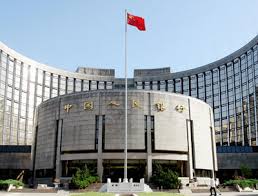
People's Bank of China
However, rates have not, according to analysts affected the economy as of yet. State-owned enterprises have enough cash for the moment to be able to get through a credit squeeze if there is one, although small companies are suffering already, apparently. Some are saying that the credit crisis is like nothing that we have ever had to go through yet.
All eyes are fixed on the Shibor (Shanghai Interbank Offered Rate), which is calculated by averaging all the interbank lending rates. There are 18 commercial banks included in the price quotation and it is the barometer of Chinese credit liquidity. The two charts show the worrying progression of the Shibor.
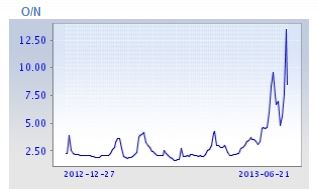
China: O/N Shibor
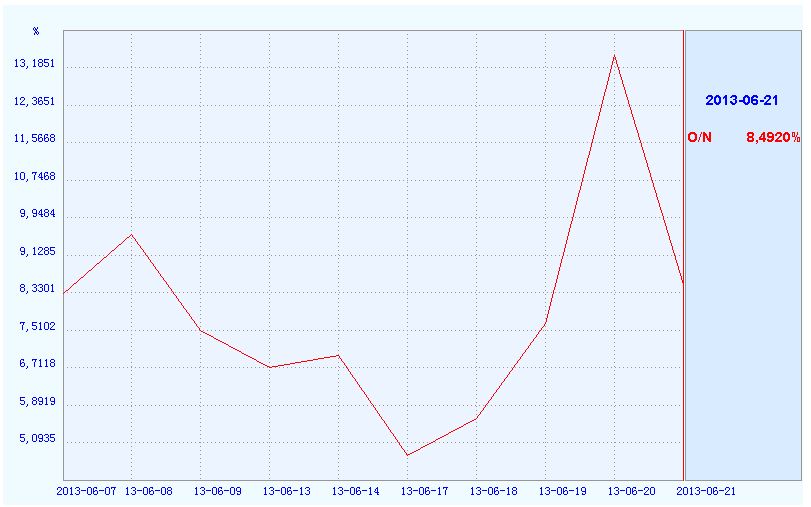
China: Shibor 21st June 2013
The Libor surge prior to the Lehman Brother’s bankruptcy and the ensuing spiraling fall to hell recall the somber times of the financial crisis in 2008. Are we in store for the same?
But, the economies of China and the western world back in 2008 are not identical. Mature economies would be begging the central bank to act and double quick. Such high rates of interbank lending in the western world would scare the banks out of their living daylights. China often sees banks strapped for cash in particular just before holiday seasons when people tend to withdraw greater quantities of cash. Deposits dry up regularly before Dragon Boat Festival, so that’s nothing new. What is new, however, is that the People’s Bank of China has done little to ease that situation. In fact, it has made it worse, by withdrawing liquidity by selling three-month bills. China sold CNY2 billion in bills on Tuesday (at a yield of 2.9089%). This was the starting gun for the message that was winging its way to the banks in China telling them that they had to start lending, as the People’s Bank of China would not come to their aid. With liquidity being withdrawn, banks decided to hoard cash and stop lending. The credit squeeze was on and liquidity became scarcer. The Shibor has shot through the roof because there is a fall in trust regarding the creditworthiness of Chinese banks right now.
Some might well criticize China’s madness regarding the flirting with the Shibor. But is there a method in their madness? Will banks have to maintain credit availability and also keep sufficient deposits on hand in case there is a run on the banks. Up until now, the banks have been slowing down their availability of loans which is causing damage to the Chinese economy, resulting in a slow-down in economic activity. But, now that the message has been given loud and clear that the People’s Bank of China is not prepared (at least, not immediately) to give a helping hand if they go under, they will have to stand on their own two feet. Trouble is, it seems a bit of a blast from the fire-eating dragon.
Subscribe to:
Posts (Atom)