Friday, June 3, 2011

Wheat prices revive as Black Sea fears ease

by Agrimoney.com

The wheat market revived, as Ukraine trimmed its export forecast amid forecasts of dry weather, while Fitch Ratings added its voice to those expecting prices to stay high despite Russia's return to foreign sales.
Chicago wheat, which fell more than 7% in two trading sessions after Russia unveiled it would next month lift a ban on grain exports, recovered some ground on Thursday, adding 1.0% to $7.67 a bushel, for July delivery, as of 15:45 GMT.
In Paris, November wheat, the best-traded lot, stood 0.5% higher at E237.50 a tonne, with London's November contract up 1.5% at £190.50 a tonne.
'One key serious threat'
The revival came as Ukraine cut to 15m-18m tonnes, from 19m-20m tonnes, its forecast for grain exports in 2011-12, without giving a reason for the downgrade.
"They did not cite whether this decision was based on increased competition [following Russia's move] or lacking crops," US Commodities noted.
However, the downgrade comes amid growing concerns over dryness in the former Soviet Union.
Jaime Nolan at FC Stone's Dublin office termed the "building dry pattern of weather forecast" for the region as "the one key serious threat" to plans to exports.
"The market will watch nervously for developments in this area, with last year fresh in everyone's mind," when a drought devastated Russia's harvest, in particular, forcing the grain export ban from August.
US-based weather service WxRisk.com said that weather models "show Poland east into Belarus and the Ukraine looks warm and dry with no rains over the next seven days".
Levies instead?
Furthermore, there is growing speculation that Russian will impose some fresh measures, such as export levies, to curb the risk of a hike in food prices.
Russia's domestic wheat prices have risen more than 10% since the announcement of a resumption of exports, to close the gap with international prices which have been well over $100 a tonne higher.
Sergei Ignatyev, head of Russia's central bank, which on Tuesday raised interest rates by 0.25 points to 3.5% after inflation hit an 18-month high of 9.7%, said that Russia could, to soften the impact of the resumption of trade "temporarily, say for one year, introduce a mechanism of floating tariffs".
The Russian Grain Union has suggested a tariff on exports price above 7,000 roubles a tonne.
"Trade will note the protestations among some influential institutions in Russia regarding the free-for-all export plan coming in July," Mr Nolan said.
Ukraine, which ditched grain export quotas last month, has imposed duties of 9%, or at least E17 a tonne, on wheat shipments, 12%, or at least E20 a tonne, for corn and for barley a charge of 14%, or at least E23 a tonne.
'Elevated prices'
Separately, Fitch Ratings forecast that Russia's return to international markets was "unlikely to ease agricultural commodity price inflation", warning that this "does not necessarily mean there is be sufficient supply to offset losses in Europe and the US", where weather extremes are threatening crops.
Many analysts are forecasting European Union production losses of 5m-7m tonnes from dry weather, compared with a US Department of Agriculture figure of 138.6m tonnes, with some estimates below 130m tones.
Combined wheat exports from the EU and US were, even before the drought, some 50% more than those from Russia and Ukraine, and accounted for 35-41% of world shipments.
"So any reduction in exportable wheat from [America and Europe] will likely translate into tightened stocks and upward price pressure," Fitch said.
Corn vs wheat
"At the same time, global wheat consumption in 2011-12 is expected to be boosted by the continuing rise in demand for wheat-based foods in developing markets, especially Asia, and by increased use for feed to replace high-priced corn," the credit ratings agency added.
"This is likely to translate into elevated wheat prices for the rest of 2011.
Shorter-term, investors are awaiting the results of a 25,000-tonne Lebanese wheat tender to judge the level of prive competitiveness that Russia poses.
The wheat is scheduled to arrive on July 5, four days after Russia's export ban lapses.

See the original article >>

ISM CONVERGENCE IN RECORD TIME

by Cullen Roche

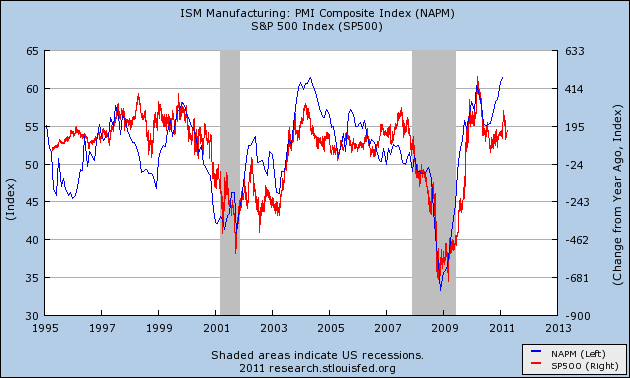
After last month’s ISM Services report I raised the prospect of a lower ISM Manufacturing report and the likelihood that this could all put downside pressure on equities. I was working off of the following chart (commentary from last month is also attached):
“What does it all mean? Well, the good news is that the index is still expanding. Although 52.8 is a big miss it is still an expansion. So it’s not yet time to panic. It is worth noting, however, that lower ISM reports have correlated very highly with equity returns (see here for more). Although the ISM Manufacturing report remains robust at 60.4 it would be surprising to see the two indexes diverge permanently. Because these are diffusion indexes we can likely expect the ISM Manufacturing report to decline in the coming months. And as I discussed last month, that could be a significant headwind for equities – even though it doesn’t point to economic doom.

For now, I still believe the US economy is strong enough to maintain meager growth. The risks still are exogenous – primarily foreign related as China eases their economy and Europe remains mired in a debt crisis. Our balance sheet recession is very much alive, however, the government has done just enough to offset the negative impacts. Unfortunately, the Fed appears to have added another risk to the scenario in commodity prices. We should all hope that the price boom in commodities does not lead to a price collapse. If anything, all of this only confirms the thinking that “hedge in May” is a good idea.”
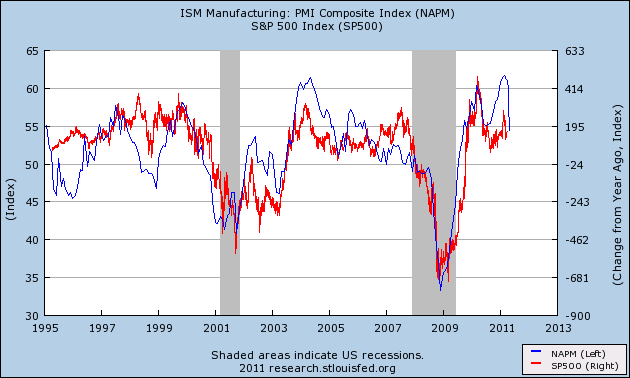
Given the sizable collapse in the ISM Manufacturing earlier this week I think it’s useful to update the chart. The results are astonishing:
We retraced the entire divergence in one month! Despite the convergence, the lesson from May still exists – lower ISM readings tend to correlate with lower year over year returns in the S&P 500.

Is QE3 The Next Stop For The US Fed? (Guest Post)

 economy

 economy

For more than two years students of Econ-101 have been chattering about how the irrefutable logic of the “insanity-of-America’s-money-printing and fiscal mismanagement” would cause yields on long-term US debt to skyrocket.

One of the more flamboyant proponents of that theory was the author of The Black Swan, Nassim Taleb, who pronounced in February 2010:
“So long as you see the picture of, what’s his name, Bernanke, and he still has that job, you gotta run to make sure that you are short” (Treasury bonds).
That was over a year ago when the 10-Year was 3.7%. 

Today it’s less than 3% so it looks suspiciously like he was completely wrong….and so was almost every hedge fund manager’s newsletter and Opinion Leader since 2009. So was Mark Faber, so was the explanation put up by Bill Gross of PIMCO when he announced in March, with much fanfare, that he had sold all his Treasuries in January and February, at what looks like pretty-much a (temporary?) bottom of the market. Perhaps he had a better deal elsewhere? Perhaps eventually his thesis will be vindicated; meanwhile The Students debate about how long he will have to hold his breath? 

So what’s with the Chimpanzee?

In the Black Swan Taleb talks disparagingly about “prediction”; he makes a point that a chimpanzee throwing darts at a piece of paper with numbers on it, will generally do better than The Students and The Opinion Leaders. He is of course absolutely right (generally), depending, of course, on the chimpanzee. 

What’s ironic is Taleb also wrote, “I don’t make predictions”; so that pronouncement in February 2010 signaled a “coming out” of the closet; sadly it looks like his first attempt didn’t score much better than a blind chimpanzee with arthritis could have.

Therefore, according to the well-known principles of Euclidean logic and the inscrutable philosophy of Econ-101, theoretically, [IF] “he/she” is not totally wrong most of the time, [THEN] “he/she” must be a Chimpanzee? 

I think that’s right? I did philosophy once (briefly – before they kicked me out for being “disruptive”), I have a vague recollection it was all about [IF] and [THEN]. 

Anyway, philosophy aside, this is how the Chimp did:
Picture1 economy
Some Chimp eh?! 

Although to be fair the he got the timing wrong; he said 3% would be hit by the end of April. Sorry about that, the problem with employing jungle-trash is they got no sense of time!! I got to remember, ultra-ripe bananas are essential if you want to get precise answers. 

But not everyone got it wrong; I noticed a quote from Hugh Henry in early 2010, trawling through the history on Google:
We all know that the U.S. Treasury has gotten itself into a jam with too much of the national debt now financed with short term paper.
This is a problem for two reasons. First, it creates rollover risk. Second, you can’t “inflate away” debts of very short tenor, for the simple reason that your creditors will have the opportunity to demand higher coupons at frequent intervals. They see you inflating and you end up digging a deeper hole because you are rolling over debt so often!
In retrospect that could perhaps explain the real logic behind QE-2 which might in reality have been nothing more than a cunning plan, for Ben & Tim-Boy to replace short-term paper with longer-term stuff.
[IF] so [THEN] QE-2 was nothing to do with stimulating the economy or creating inflation, or even hyper-inflation. 

In any case, it did not have any perceptible effect on either and it’s not as if it encouraged banks to rush out to write 125% LTV mortgages to people with trashed credit scores so as to “re-boot” the housing market and “get things back to normal”, as in to recreate the “happy-days” of 2006/7.

The Students must be awfully disappointed. Since longer than anyone can remember there has been a blind belief that the Federal Reserve is like Elvis Presley’s doctor, who can “make things better” by just injecting one more shot of the drug that used to work so well, in the “happy days”. But now, sadly, even a shot of $600 billion, appears to have no effect, outside of the initial rush of anticipation.
That’s why there will be QE-3:

When Ben announced QE-2, he spoke at length, and at more length, and on-and-on until everyone fell asleep, about how the “program” would help reduce long-term interest rates, and that would be “good for the economy…good for corporate America…and good for the housing market”. Significantly he didn’t say “good for the US Treasury” trying desperately to avoid a roll-over crisis.

As if under-employed consumers aren’t spending because they pay too much for credit, or as if that would make any difference to the rates pay-day lenders charge? As if corporate America (the healthy (non-unionized) part at least) isn’t sitting on a pile of cash they don’t know what to do with, and as if a tick-down in the mortgage rate will make any difference to a household that is underwater; where the breadwinner has lost his/her job, and they have a fixed-rate anyway? 

The next thing that happened, right after that announcement, was that the 10-year headed up from 2.4% to 3.7%, which was quite funny, like Err…didn’t Ben say it should go the other way?

Joking aside, (as is explained in the links below the chart), a possible reason for that was because in about June the traders got hold of the rumor of QE-2 and started to front-run the Fed. Those guys know from bitter experience that “you never fight the Fed”, but there again you can always lead it around by its nose if you know how, and so that’s what they did, using the money they got from TALF to finance that little game. 

The result was that for a good part of his purchase program Ben paid top-dollar for what he bought, because, as was explained in words of two syllables (also in the links) the “correct”, fundamental/intrinsic/other-than-market value for the 10-Year Treasury (use whichever term you like), right now, is about 3%.

That’s of course if you believe a black-swan-chimpanzee who wouldn’t know what to do with an Econ-101, even if you peeled it, cut it in slices and served it up with vanilla ice cream.

Of course that doesn’t mean 3% will stick, in point of fact, the chimp says it’s quite likely that it could go up to 4.2% for a while in the not too distant future, temporarily, as in it will go down towards 3% after, unless there is a miracle and the US economy starts to grow (nominal).

But that’s another story and for the avoidance of doubt, that’s not a prediction…the poor little thing is tired.

So what has been learned from this episode?

1. Contrary to what Econ-101 says and a huge body of conventional thought which says that things like “Fed Policy” and “expectations” drive yields (albeit both highly subjective numbers to put into a spreadsheet, which helps the “experts” avoid actually putting a number on their procrastinations), contrary to all that baloney, there is absolutely nothing the Fed can do to influence long-term Treasury yields. 

Except temporarily…for example by announcing they are willing to pay too much for them , as in standing on a street-corner and giving dollar bills away to anyone with the right credentials; in which case the market will happily oblige.

2. Doing a “helicopter-drop” of $600 billion when the National Debt is $14 trillion, and the private sector (which owes over $30 trillion) is frantically de-leveraging, won’t cause much inflation (if any) and it certainly won’t cause hyper-inflation.

3. Dropping the base-rate to zero when no one wants to borrow is just a way of handing out dollar-bills to banks, so they can repair their balance sheets, pay bigger bonuses and speculate in commodities.

So obviously, it’s a good idea to “Give-it-to-me-one-more-time…BABY”, as in help the Treasury swap more short-term notes for long-term ones. And who knows, the next shot “might” do some good, certainly QE-2 has proved that it can’t do any harm, so what the heck?

Death by a thousand syringes.

Drug addicts have short memories and bad tempers; you can see that in the frustration in The Students boiling over against Dr. Ben for not “fixing” the mess that they say “the Federal Reserve Created”. 

But perhaps at some point the penny will drop somewhere in the blinkered minds of the 200,000 or so PhD’s who make a living pontificating about Econ-101 that (a) the Federal Reserve did not “cause” the problem (although they didn’t do anything to prevent it), and (b) they can’t fix it. 

The “problem” was caused in the first instance by the democratically elected representatives of every single American; and it’s debatable although how “democratic” that process was, those elected representatives, in between lining their pockets with “entitlements”, were supposed to have been “in charge”. 

That was their job, that’s what they were paid to do, to protect America from danger, and the recent financial Armageddon has affected more Americans, that some deranged rich-kid with kidney disease, ever did.
If they were Chinese they would have by now have been rounded up, paraded in the middle of a soccer stadium, and shot. But then that’s not “democratic”; although I have no doubt that if that notion was put up as a motion in a referendum, where the vote would go.

Joseph Stiglitz worked out that by the end of 2008 the campaigns in Afghanistan and Iraq that were designed to achieve…I am still unclear about exactly what (?), had cost up to that point, $3 trillion. My pet-chimp keeps asking me, “OK, so where did the money to pay for that come from?”

Was it a divine gift from God that rained-down on the “Chosen-Ones” like manna from heaven?

Well actually, only “up to a point”, or in other words they borrowed it, plus they borrowed easily another $350 billion a year to “wave a big stick” as in make the Somali pirates and other “terrorists” quiver in their flip-flops. Let’s say $7 trillion of the $14 trillion can be attributed to America’s “Rambo Complex”.

Then of course there was that brilliant idea, started by Clinton and carried forwards by Bush to do what they could to make house prices more expensive so that the 70% of Americans who “owned” (as in owned a bit of) their own houses, felt richer, which was great for votes…”I will make the “value” of your house skyrocket – vote for me!!” How could anyone resist that campaign pledge in the World’s-Greatest-Democracy…well perhaps the second, don’t forget the birth-place of democracy…Greece?

And the stroke of genius was that thanks to the wonders of Econ-101, “ordinary” (i.e. poor) Americans would be able to “afford” to buy their dream house in the suburbs, because…wait for it…wait for it…houses were more expensive!!! 

Only in America!!

So putting aside the kickbacks that were paid by Fannie and Freddie to “supportive” members of Congress (in brown enveloped and in kind), how much did that exercise in drug-induced insanity cost? Well to figure that out, since no one of “The Representatives” is inclined to put a number on it, requires the wisdom of a chimpanzee, my pet-chimp says “$7 trillion by the time the dust settles”.

So there you have it, $7 trillion playing Rambo, plus $7 trillion playing “City-Ville”, and you can explain why the American National Debt is $14 trillion. And that’s got nothing to do with Ben Bernanke or the Federal Reserve.

So Who’s fault was it?

The credit crunch was not “caused” by Alan Greenspan dropping interest rates after 9/11 (which is why he says he kept them low for so long), it was caused by deliberate and cynical fraud in the process of securitization. If it hadn’t been possible to borrow money against what turned out to be lousy collateral, the credit crunch would not have happened.

But so far no one is talking about fixing securitization, which is a much better source of finance than relying on the “good intentions” of sovereign governments, or the threat of trashing someone’s credit scores.

No one is talking about setting up laws to make it illegal for manufacturers and sellers of that type of debt, to disguise the value of the underlying collateral. Nor for that matter is anyone talking about how come the PIIGS managed to pile on enough debt to bankrupt the Euro, by the simple expedient of cooking their books (with the helpful aid of God’s Workers).

Fraud is what Joseph Stiglitz was on about when he talked about “asymmetry of information”; ironically that’s what Alan Greenspan was talking about in his autobiography, when he wrote:
“An area in which more rather than less government involvement is needed, in my judgement, is the rooting out of fraud. It is the bane of any market system. Fraud is a destroyer of the market process itself because market participants need to rely on the veracity of other market participants”.
In July 2003 International Valuation Standards wrote to the Bank of International Settlements saying that “the valuations of assets used to determine capital adequacy (of banks), were fundamentally flawed and bound to be misleading”. They might have been a tribe of chimpanzees for all the attention that got. Yet that’s fundamentally what went wrong in the housing bust in USA and that is what slowly unravelling in Europe; the valuations of the collateral; were wrong.

The “prediction” presented initially in general terms in March 2010, more precisely of 3% or there-about in December 2010, was not a “prediction”.

It was a valuation (opinion). The only “prediction” in that was the knowledge that markets always return to their fundamental value (even if just for a moment), regardless of how badly they were distorted in the past.
That’s called Bubbleomix which is a clever way of doing valuation; not yet “approved” by International Valuation Standards; but give them time, after all they don’t even have the word (market) “disequilibrium” in the index. 

The two points I would like to make are 

(A): It is possible to make a reliable prediction, if you understand the principles of valuation, as is demonstrated here. And as was demonstrated when the “Chimp” said in January 2009 “the S&P will bottom at 675 then go up in a smooth line to 1,200, then reverse by 15% to 20%, but not for long)”.

(B): Students of Econ-101 are taught to see “the price of everything and the value of nothing”; perhaps it’s time for the science of valuation to get included in the curriculum? In which case moronic bankers wouldn’t have to put their hands in the pockets of decent, ordinary people, and steal their money. Like they have done over the past few years.

See the original article >>

The Sky Is Falling, It Is Time To Panic And The U.S. Economy Has Fallen And It Can’t Get Up

The Economic Collapse

So many economists and financial pundits seem absolutely shocked that the U.S. economy is slowing down again. It is as if this latest wave of bad economic data has caught them completely by surprise. Now, in the mainstream media we are seeing all kinds of headlines declaring that the U.S. economy is headed for disaster. But anyone with half a brain could have seen this coming. This year alone, we have seen the worst tsunami in Japanese history, the worst U.S. tornado season in recent memory and the worst Mississippi River flooding in decades. In addition, chaos in the Middle East has pushed the price of oil up to very high levels. Of course all of those things were going to have an effect on the economy. In addition, all of the long-term trends that have been destroying the U.S. economy for decades have not been taken a breather. In fact, the truth is that all of our long-term economic problems have been accelerating. So yes, the sky is falling, it is time to panic and the U.S. economy really has fallen and it really can't get up. It is just that everyone in the mainstream media seems to have believed that Ben Bernanke and Barack Obama would just sprinkle a bunch of fairy dust on the economy and everything would just magically get better. Well, in the real world things simply do not work that way.

Despite an unprecedented debt binge by the federal government and nightmarish money printing by the Federal Reserve, the economic downturn continues to drag on. Andrew Barber, a strategist at Waverly Advisors in Corning, New York recently told CNN the following....
"People are starting to see that this sort of malaise is not just going to go away no matter what you do."
And "malaise" is a really good word for what we have been experiencing. For those that remember the late 1970s, what we are going through today is similar in a lot of ways.

But what is perhaps even more frightening is that 2011 is starting to look a lot like 2008 all over again.

In particular, we are starting to see some real signs of instability in the financial markets.

When Moody's downgraded Greek debt again on Wednesday all the way down to Caa1, I was only moderately alarmed. The truth is that everyone knows Greece is a basket case so a debt downgrade wasn't really all that surprising.

When Moody’s announced that it plans to review the U.S. government’s AAA debt rating "if there is no progress on increasing the statutory debt limit in coming weeks" that got the attention of a lot of people around the world, but it was not totally unexpected. Moody's is telling Congress that they better raise the debt ceiling or else. A lot more pressure will be applied to Congress before this is over.

When Moody's warned that it may downgrade the debt ratings of Bank of America, Citigroup and Wells Fargo, that really set off alarm bells for me.

Do you all remember what set off the financial panic in 2008?

Do the names "Bear Stearns" and "Lehman Brothers" ring a bell?

Well, right now there are some frightening indications that we may see more trouble at some "too big to fail" institutions.
But will there be any willingness to do more bailouts this time?

Right now the financial markets are closely mirroring their performance just prior to the financial collapse of 2008. One great example of this is these charts which were recently posted by the Financial Armageddon blog. It looks like bank stocks may once again be leading the way down.

Hopefully the financial system can hold together and we won't have a repeat of 2008 right now, because if it happens it is going to be really messy.

But even without a "financial collapse" we already have all of the economic problems that we can handle.
Robert Brusca, the chief economist at FAO Economics, is being quoted by CNN as saying the following....
"We've had a poor economic recovery to begin with, and now it appears to be segueing into an end."
At this point, U.S. consumer confidence is already lower than it was back in September 2008 when Lehman Brothers collapsed. U.S. consumers are holding on to their money more tightly these days and that is not a good sign for an economy that is so highly dependent on consumer spending.

The latest manufacturing numbers have also been very distressing. Measures of manufacturing activity all over the world are indicating that we have now entered an economic slowdown. This is also similar to what we saw a few years ago.

We should all feel really bad for anyone that is entering the workforce right now. We are in the midst of graduation season, and the only thing that our new graduates have to look forward to is an economic crisis that never seems to end.

On a recent article entitled "Global Financial Markets Tremble As Bad Economic News Continues To Pour In" a reader named Esta left the following comment....
I feel sad for yet another year of graduates entering a horrible job market. I recently read, and I think it was in the mainstream media, that only half the 2010 college grads have found jobs of any kind, only half of those have found jobs requiring a college education, and that 85 percent of all grads moved right back in with their parents. The job growth rate is so low that we keep employing fewer and fewer people as a percentage of our adult population. Why isn’t that still a recession?
What a future our college graduates have to look forward to, eh? Moving back in with your parents, a crappy job (if you can find one) and a pile of student loan debt that will crush you financially for decades.
We are always told that "more education" is the answer, but even many of our most highly educated young people can't find jobs. In fact, it turns out that a third of last year's law school graduates aren't even practicing law....
The law school class of 2010 is making news for all the wrong reasons. The budding legal minds who managed to find employment last year have set a new record--only 68.4 percent of them are in jobs that require them to pass the bar exam, the lowest share since the Association for Legal Professionals began collecting data.
Now it looks like the economy is going to starting heading downhill once again.
What is that going to do to the job market?

Last year, only 45.4% of Americans had jobs. That was the lowest figure since 1983.
In some states it was even worse than that. In states like California, Arizona and Mississippi only about 37 percent of people had a job last year.

The economic news just seems to get worse and worse and worse. The American people have been relatively calm over the past several years as they have waited for the promised "economic recovery", but what do you think is going to happen if we have another major economic downturn and unemployment spikes back up by several more percentage points?

And what in the world can our "leaders" really do to "help" the economy if we do have a repeat of 2008?

We are already running trillion dollar deficits.

The Federal Reserve is already printing money like it is going out of style.

So what would their next moves be?

Most Americans have no idea how fragile our financial system and our economy really are.

Let us hope and pray that things can hold together for as long as possible, because when the next wave of the economic collapse happens it is going to be really, really messy.

See the original article >>

Lumber Prices: Leading Indicator for Private Nonfarm Payrolls?

By Global Macro Monitor

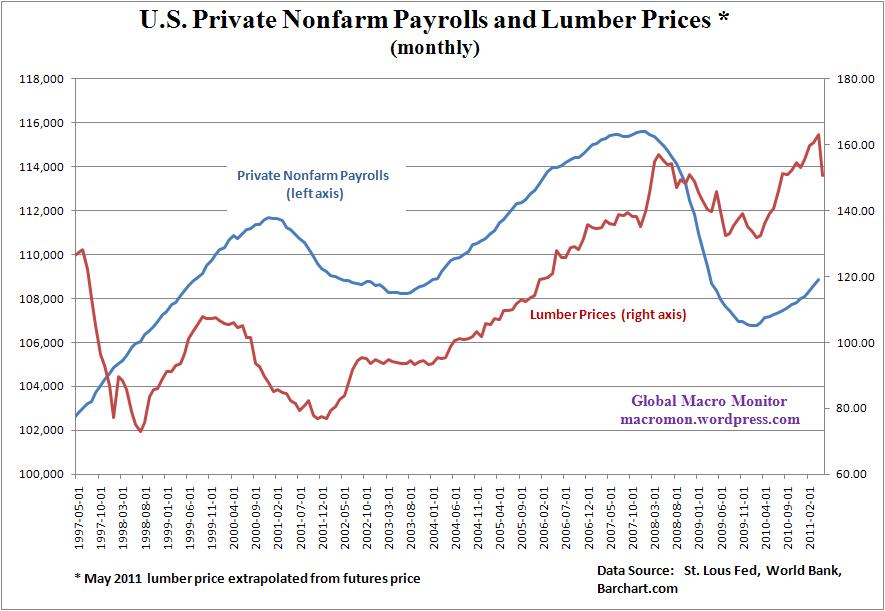
In the chart below we take a look at the relationship between lumber prices and private nonfarm payrolls. Clearly they tend to move together on a monthly basis. One of the transmission mechanisms of monetary policy is the impact of interest rate changes on the construction sector, which has historically been a leader of past economic recoveries.

This is clearly not the case in the current balance sheet growth recession, so we are not as confident in the lumber price/nonfarm payroll relationship. 

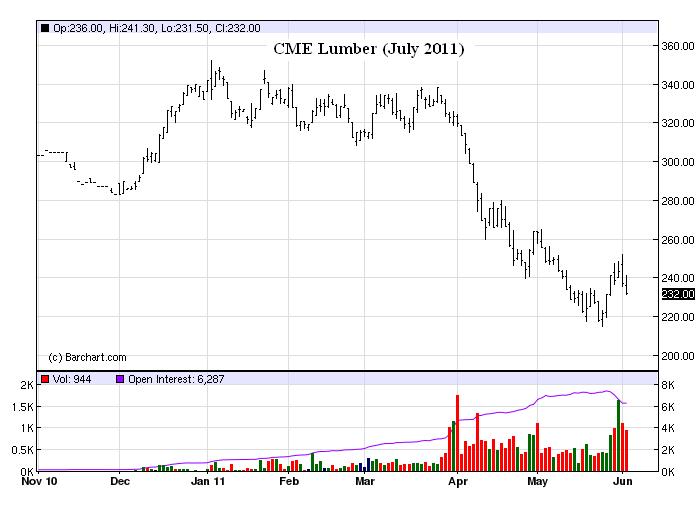
Nevertheless, lumber futures have been under heavy pressure since the end of March, down over 30 percent, no doubt, partially the result of the double dip in housing prices. It will interesting to see how, or if, the correction in lumber shows up in the private nonfarm payroll number tomorrow.


See the original article >>

Stock Market Warning ...

by Kimble Charting Solution


Follow Us