Showing posts with label rough rice. Show all posts

Wednesday, May 25, 2011

Farmers Closing in on Corn Planting


Major planting progress was made in many key corn states during the past week. As of May 22, 79% of the U.S. corn crop is in the ground. This compares to a five-year average of 87% for this point in the season.

Ten of the 18 corn states that planted 92% of the 2010 U.S. corn acreage has passed the 80% planted mark.
(click to enlarge)
Several states are still way behind average. Ohio only has 11% of its corn crop planted, which compares to the normal 74% planted by this time. Indiana, Pennsylvania and North Dakota have just under are under 50% planted this year, normally these states would be around 75% planted by this time.
Overall corn emergence went from around 20% emerged as of May 15 to 45% emerged by May 22. The five-year average for corn emergence by this time is 59%.
See the “Corn Planting Progress” reports.


Soybean Planting Progress Passes 40%

As of May 22, 41% of the country’s soybeans are in the ground. The five-year average for this time is 51%.
(click to enlarge)
Illinois, Iowa, Kansas, Louisiana, Mississippi, Missouri and Nebraska are all at a normal pace or exceeding the average of beans planted by this time.
Ohio has 4% of the 2011 crop planted, a staggering drop from the five-year average of 54%. North Dakota, Minnesota, Michigan, Indiana and Wisconsin are also all well behind their normal planting progress.
See the “Soybean Planting Progress” reports.


Cotton, Sorghum and Rice Planting on Track

As of this week, 57% of the U.S. cotton crop is planted. Normally just over 60% of the crop is planted by this time. Farmers in Arizona, California, Louisiana and Virginia all have more than 90% of their crops in the ground.
See the “Cotton Planting Progress” report.

The U.S. sorghum crop is on pace to be planted at a normal rate. The five-year average for this time is 40%, which is also the current planting progress.
States such as Arkansas, Texas and Louisiana are more than 70% planted, while South Dakota, Colorado and Illinois are around the 10% planted mark.
See the “Sorghum Planting Progress” report.
Of the six major rice-growing states, all but one has more than 70% of their crops in the ground. Missouri is the only state lagging behind with 53% planted, likely due to the major flooding earlier this spring in the rice-growing areas of the state.
Currently, 84% of the U.S. crop is planted, which is only slightly behind the five-year average of 90%.

See the original article >>

Thursday, March 17, 2011

Tsunami risk to Japan's self-sufficiency in rice

by Agrimoney.com

Soil damage caused by the tsunami may cost Japan its prized self-sufficiency in rice, a leading farm academic has said, adding his voice to those forecasting that the disaster will increase the country's crop imports.
The Tohuku region of northern Japan, which bore the brunt of the tsunami, may see its predominance in national rice production threatened if salt water left by the disaster caused significant fertility loss to land, grain economist Mark Welch said.
Salt water damage to land following tsunamis is a widely-recognised threat, by bodies including the UN's Food and Agriculture Organisation, which rates rice as a crop with medium-tolerance to salt, less than that of barley and cotton.
"Japan is self-sufficient in rice production but this capability may be threatened if sea water from the tsunami contaminated farm land," Mr Welch said.
Tohoku accounted for 26% of Japan's rice area last year, according to Japanese farm ministry data, with Kanto to the south, which includes Tokyo, and which suffered some tsunami damage, accounting for a further 19%.
Iconic crop
Japanese, while eating on average half as much rice as they did 50 years ago, still see the grain as a part of the national culture, prizing the sticky quality of home-grown grain, which is also used for making the alcoholic drink sake.
The country has encouraged self-sufficiency in rice, even while importing hefty quantities of other grains and, through subsidies, kept production near levels of consumption.
While the country typically imports some 700,000 tonnes of rice a year, this is often down merely to meeting World Trade Organisation requirements, imposed in recognition of the subsidy regime.
'Increase in imports' 
Mr Welch's comments came he warned that Japanese farming "may face long-term impacts" from the earthquake and tsunami.
Breakdown of Japan's rice-growing regions, 2010 - area, and % of total
Tohoku: 419,000 hectares, 26%
Kanto Tosan: 302,000 hectares, 19%
Hokuriku (NW Chubu): 211,000 hectares, 13%
Kyushu: 190,000 hectares, 12%
Chugoku: 118,000 hectares, 7%
Hokkaido: 115,000 hectares, 7%
Kinki: 111,000 hectares, 7%
Tokai (south Chubu): 104,000 hectares, 6%
Shikoku: 58,000 hectares, 4%
Data: MAFF, Tamu. Rounding takes total of percentages to 101%
"Even if the major ports are still functioning, inland transportation systems are seriously damaged," Mr Welch, at Texas-based agricultural university Tamu said.
"The net effect of the disaster on the grain trade may be an increase in commodity imports to replace domestic production."
A report from US Department of Agriculture attaches in Tokyo released late on Wednesday, but drawn up before the earthquake, had forecast Japan's corn imports – the world's biggest - holding steady  at around 16m tonnes in both 2010-11 and 2011-12.
While smaller livestock herds are decreasing use in fodder, "the general trend in recent years is that increases in food corn imports have been compensating for declines in feed corn imports", the attaches said.
"The driving force in food corn demand comes from the beverage sector, particularly for high fructose corn syrup used in low alcoholic drinks like happoshu [a light beer] and other alcoholic beverages.

Sunday, February 13, 2011

Rice Speculators Expect 50% Jump In Price

by Tyler Durden

Analyzing last week's CFTC Commitment of Trader data continues to confirm our assumption that ever more speculators are honing in on rice as the fulcrum commodity. Jumping to a fresh year high of 6,652, non-commercial net spec contracts are the highest they have been since December 2009, when they hit 6,773, and approaching the record from early 2008. Yet while the price of rough rice in late 2009 was comparable to recent price levels in the $16 region, the peak from early 2008 was 50% higher, approaching $25. Therefore it is safe to assume that should speculative interest continue surging at the current rate, and if it were to approach the spec exposure of ~8,000 last seen in early 2008, then the price of rice has a long way to go...


And some other CFTC charts, confirming that spec exposure in grains and softs continues to be near recent all time highs:


Looking at the 2, 5 and 10 Year Treasury spec exposure, we see a huge plunge in 2 Year spec positions, which dropped by 100k in the past week, the biggest drop in over a year, as increasing more spec are worried that the short end is about to surge. There was also a pick up in 10 year spec contracts, confirming that specs are expecting a flattening of the curve.


Lastly, and no surprise here, dollar non-commercial net specs have dropped to a fresh multi year low, declining by 3.8K contracts W/W to -7.4K. There was a modest increase in Yen and GBP specs, and a modest decline in CHF and EUR positions.


Asian crops boost global rice production


Global rice production may rise to a record in the 2010 season following improved prospects in China, Cambodia and Thailand, the United Nations Food & Agriculture Organization, or FAO, said.

Rough rice production may be 700.7 million metric tons, or 467.3 million tons of milled grain, up about 3 million tons from a November estimate, the agency said in an e-mailed report. The forecast would be a 3 percent rise from the 2009 season, it said.

The price of rice, the staple food for half the world, may increase as a rally in the cost of wheat drives consumers to seek alternatives, Robert Zeigler, director general of the International Rice Research Institute, said Feb. 11. The forecast for record output depends on secondary harvests in the northern hemisphere in the next few months that would bring the 2010 season to a close, according to the FAO.

“Asia is anticipated to account for the bulk of the production increase despite several climatic setbacks experienced over the season,” the FAO said. “Larger crops are also forecast to be harvested in Africa, North America, Europe and Oceania.”

Major buyers return to market

Thai rice prices, the benchmark for Asia, advanced to the highest in more than a month, according to the Thai Rice Exporters Association on Feb. 9. The price of 100 percent grade-B white rice increased to $558 a ton, it said. Rough-rice futures on the Chicago Board of Trade declined 1.7 percent to $15.885 per 100 pounds on Feb. 11.

Countries in Asia were estimated to have purchased 15.4 million tons of rice in calendar 2010, almost 600,000 tons more than previously reported and 1.9 million tons more than in 2009, the FAO said.

International trade in calendar 2011 was likely to be 31.4 million tons, it said, slightly below a year earlier. Thailand’s exports may rise to 9.7 million tons from 9 million tons in 2010, more than the official target of 9.5 million tons, partly boosted by prospects for secondary crops, the FAO said.

International prices would be influenced by the return of major buyers into the market in the coming months, while the effect of climate on the secondary crops will need to be monitored after the first harvest of the season was disappointing in many countries, according to the report.

“Currency factors and developments in other cereal markets will also exert an important influence on world rice quotations in the coming months,” it said.

Continue reading this article >>

Saturday, February 5, 2011

Rice May Triple in 18 Months, Duxton’s Peter Predicts

By Chanyaporn Chanjaroen

(Bloomberg) -- Rice, the staple food of more than three billion people, may as much as triple in 18 months as flooding in exporters including Thailand tightens supplies and demand climbs, according to Duxton Asset Management Pte.

“Rice will blow out the stocks,” said Ed Peter, chief executive officer, who co-founded the company last year with Managing Director Desmond Sheehy. Both worked at Deutsche Asset Management and the Deutsche Bank AG unit owns 19.9 percent of Duxton, while Peter, Sheehy and staff own the rest. Duxton, based in Singapore, invests in farmland, Asian stocks and wine.

Peter’s forecast, in an interview on Nov. 29, would put rice at more than the peak during the 2008 food crisis, which triggered social unrest in poorer states. Wheat and corn also surged that year, while record oil prices boosted fertilizer costs. Kiattisak Kanlayasirivat at Novel Commodities SA, which trades rice, said farmers can replant quickly as floods recede.

“A price increase of 10 percent to 20 percent would be considered quite a lot, not to mention double or triple,” said Kiattisak, a director at Novel Commodities’s Thai office, which handles about 1.5 million metric tons of rice a year.

Thai 100-percent grade-B white export rice, the Asian benchmark, peaked at $1,038 per ton in May 2008. The grain was at $551 last week, up 15 percent since the end of June, according to the Thai Rice Exporters Association. “Prices will triple over the next 18 months,” Peter said in the interview.

Investment Strategy

Duxton oversees about $600 million, allocating 50 percent to farmland in Australia, Argentina, Zambia and Tanzania and about 45 percent to Vietnamese shares. Peter had headed Deutsche Asset Management for Asia Pacific, Middle East and North Africa, while Sheehy was in charge of that unit’s complex-asset team, which focuses on non-traditional investments including farms.

The most severe floods in five decades in Thailand, the top exporter, may trigger a 7 percent fall in rough-rice production, which accounts for 70 percent of its total output, the Agriculture and Cooperative Ministry has said. Crops in Vietnam and Pakistan have also been hurt by severe weather, while a typhoon cut harvests in the Philippines, the biggest importer.

Rice inventories held by the world’s five biggest exporters will likely decline next year, tightening supply, Concepcion Calpe, senior economist at the Food & Agriculture Organization, said in October. Prices were “unlikely to fall,” Calpe said.

Global production will be 697.9 million tons, 6.5 million tons smaller than previously estimated, as crops around Asia “deteriorated,” the FAO said in a report yesterday. That’s the third forecast cut since April.

Rough rice on the Chicago Board of Trade gained as much as 1.7 percent to $14.115 per 100 pounds today, extending an advance from the year’s low of $9.55, which was set on June 30. In 2008, the price peaked at $25.07 per 100 pounds.

“Rice is a long-term bet,” Duxton’s Sheehy said. Farm products including rice may outperform metals and fuel over the long term as the global population expands, Sheehy said. [..]

With assistance from Luzi Ann Javier in Singapore and Supunnabul Suwannakij in Bangkok. Editors: Jake Lloyd-Smith, Matt Oakley

To contact the reporter on this story: Chanyaporn Chanjaroen in Singapore at cchanjaroen@bloomberg.net
To contact the editor responsible for this story: James Poole at Jpoole4@bloomberg.net

Continue reading this article >>

Sunday, January 30, 2011

Future scramble for rice supply

by JASON SZEP

Fresh demand for rice in two big Asian countries is sending a worrying signal the region’s main staple may join a surge in prices for other grains, worsening Asia’s spiralling food inflation.Asian rice traders say aggressive buying in heavily populated Indonesia and Bangladesh could spread, pushing up world rice prices even though bumper crops in Thailand and Vietnam should mean ample supplies.
“This is only the start of the panic buying,” said Ker Chung Yang, commodities analyst at Singapore-based Phillip Futures, referring to Bangladesh’s recent tripling of its rice import target and Indonesia’s purchase this week of 820,000 tons of Thai rice, nearly five times the volume initially sought. “I expect we’ll have more countries coming in and buying grain.”
Still, analysts see little risk of a 2008-like food crisis, when rice prices rose above $1,000 a ton, double their current level. Vietnam’s rising supply and lower imports from the Philippines, the world’s top importer last year, could mean rice continues to defy a broader trend of fast-rising global prices for wheat, soybeans and other foods.
Thailand’s benchmark 100 percent B grade white rice was offered at $540 per ton on Friday, unchanged so far this year after falling 13 percent last year. In comparison US wheat and corn futures have risen by more than half since the start of last year. A sustained rise in the price of rice, a staple in the diets of nearly half the world’s population, would squeeze the budgets of millions of Asians living near the poverty line, raising the risk of unrest in a reprise of the 2008 food security crisis.
The aggressive purchase by Indonesia seems aimed more at bringing down 20-month high inflation, a view reinforced after the country followed up Friday by scrapping import duties on rice, soybeans and wheat.
“The Indonesian buying is a classic example of countries doubling their imports of rice in a very short span of time,” said one Singapore-based trading manager with an international trading company. “The way Indonesia has bought smells of food security fears rather than genuine demand.” [..]
Continue reading this article »

Monday, November 15, 2010

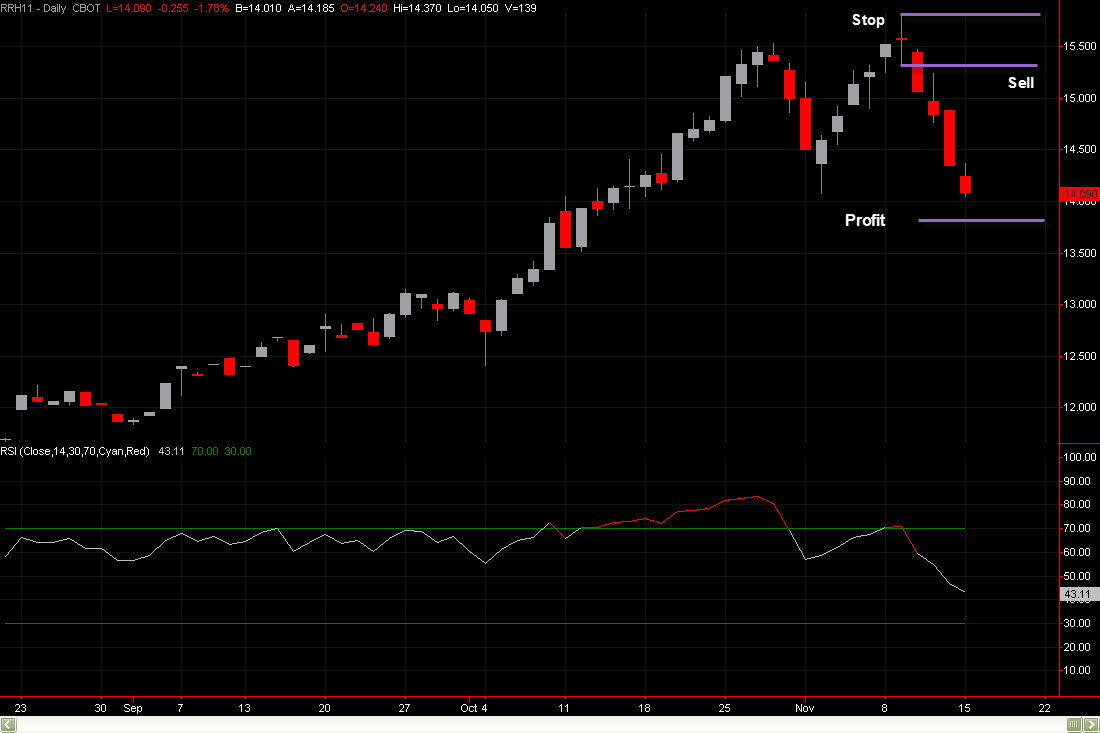
+ $ 2860/Contract Taken On Rough Rice By Our Super Commodity System.

Taken Profit!

Recent Trades Results of Super Commodity System

Qui a lato sono riportate le charts dei mercati su cui il nostro trading system Super Commodity ha dei trades in corso, oppure chiusi da poco.

At right shows the markets charts on which our Super Commodity system has trades in progress or recently closed.


Wednesday, June 30, 2010

Rough Rice

Il Rough Rice si sta avvicinando ai livelli di prezzo su cui potrebbe fermare la lunga discesa in essere da più di un anno. Cercare segnali di conferma intorno a 9.000. 

The Rough Rice is approaching price levels which could stop the long fall into being more than a year. Seeking confirmation signals around 9,000.

Follow Us