Showing posts with label platinum. Show all posts

Sunday, July 31, 2011

Buy Platinum and Sell Gold


Platinum’s rarity and many industrial uses could bring about solid opportunities, and investors may consider lightening up on gold in favor of select, liquid equities that track platinum.

As gold prices have continued to make a series of new highs this year, platinum prices have languished. The platinum futures are current trading just over $1800, which is below the 2011 high of $1889. In March 2008, platinum made a high of $2308, so it is currently more than 27% below the all-time highs.

Of course, platinum is much more rare than gold, as the annual supply is estimated to be around 130 tons, which is just a fraction of the world’s gold production. It terms of rarity, precious metal experts have concluded that platinum is 16 times more rare than gold.

The majority of the world’s platinum comes from South African or Russian mines. In order to get one troy ounce of platinum, it takes ten tons of ore, which is generally mined in miserable conditions. A small amount of the world’s platinum supply comes from Canada and the US.

Unlike gold, platinum has a number of industrial uses, with 80% going to the automotive industry for catalytic converters, although chemical companies also use a fair amount as well because platinum is resistant to corrosion.

The greater rarity of platinum and its extensive industrial demand are in clear contrast to this year’s lagging price action relative to gold. Historically, this spread will eventually widen out, which will provide some interesting investing opportunities.
chart
Click to Enlarge

Chart Analysis: This long-term chart features platinum prices on the top with the platinum/gold spread on the bottom. This chart goes back to 1995, showing the platinum price low of $332 in October 1998 as well as the 2008 high of $2308.
  • Platinum prices have been in a range between $1658 and $1889 all year, and the uptrend, line a, is now at $1672
  • The weekly on-balance volume (OBV) (not shown) is acting stronger than prices
  • The spread is currently at $179 after hitting a recent low of $165. This spread had a high of $525 at the end of January
  • The chart of the spread shows a well-defined downtrend with the 21-week weighted moving average (WMA) of the spread at $240. A move above this level would suggest that the spread had bottomed
chart
Click to Enlarge

As for individual stocks, there are very few pure platinum plays, as the ore it is mined from also contains nickel and copper. Anglo American plc (AAUKY) is a very large, $53 billion company that in addition to mining platinum, also mines diamonds, coal, base metals, and iron ore. Additionally the company mines, processes, and refines the platinum group metals.
  • The weekly chart looks quite similar to that of platinum prices. AAUKY has important chart support, line a, in the $21.60-$22.35 area. The longer-term uptrend, line b, is in the $19.40 area
  • The weekly OBV did confirm the recent highs but has now dropped below its weighted moving average. The daily OBV (not shown) is neutral
  • Prices seem ready to reverse to the downside this week, as they are below the highs at $24.35. Further resistance is in the $26.30-$27.53 area
There are several platinum ETFs or ETNs, but most have low average volumes, which means a wide bid/ask spread. ETFS Physical Platinum Shares (PPLT) seems to be the most liquid, trading with average daily volume over 60,000. It is designed to reflect the performance of the price of physical platinum, minus expenses.
  • PPLT looks ready to close lower this week (chart updated through July 28), which would leave a bearish candle formation. The doji that formed in June (see circle) also led to a sharp decline
  • There is initial support at $172 with more important support in the $166 area, line d. A violation of this level would indicate a drop to the 61.8% support at $163
  • The weekly OBV is acting stronger than prices, as it made new highs this month. It is also above its rising weighted moving average. Longer-term OBV support is at line e
  • The daily OBV (not shown) looks less positive
  • Resistance from the previous peaks stands at $183 and $186.60
What It Means: It had been many years since I looked at the spread between platinum and gold, but commodity expert and active spread trader John Person suggested I take a look at the spread, which he found quite interesting. Though he had no formal recommendation for the spread, he did provide this information for those who were looking to trade this spread:

“The margin requirement is quite significant, the spread is $4,132.00. We would have to do a ratio quantity like two platinum to one gold, since gold is $100.00 per dollar move while platinum is $50.00”


Though the spread is clearly at the lower end of its typical range, my analysis does not yet suggest that it has bottomed out. A pattern of higher highs and higher lows could be formed in the next few months.

Those who have a large, profitable position in gold ETFs like the Spyder Gold Trust (GLD) might consider selling some of their shares and scaling into a platinum ETF like PPLT.

How to Profit: The chart analysis for Anglo American plc (AAUKY) and ETFS Physical Platinum Shares (PPLT) suggests that they are likely to drop back to recent lows, which may provide a good entry point. Look for a test of support levels on AAUKY at $21.60-$22.30 and at $166-$171 for PPLT to signal buying opportunities.

Wednesday, July 27, 2011

Palladium Hits Highest Level Since February; Platinum Also Rises

by Kitco News


Palladium rose sharply and platinum also posted solid gains Tuesday, with analysts citing worries about a coal strike in South Africa ultimately cutting power to mines.

Additionally, traders cited worries about potential work stoppages at metals-mining companies themselves, as well as a weaker U.S. dollar and an improved outlook for the automobile industry.

At 2:05 p.m. EDT, September palladium was $28, or 3.5%, higher at $837 an ounce on the New York Mercantile Exchange. The contract hit a peak of $845.40 that was its strongest level since February. October platinum was up $14.50, or 0.8%, to $1,808.50.

One trader described heavy short covering—or buying to exit positions in which traders previously sold—in palladium.

Worries about the impact of a coal strike in South Africa appear to be having an impact on platinum group metals, said Jim Steel, precious-metals analyst with HSBC.

According to news reports, some 30,000 coal-mine workers in South Africa have gone on strike seeking a pay increase. This creates worries about availability of electricity needed for mining far below the ground in South Africa, the world’s largest producer of platinum and one of the two largest palladium producers. When platinum hit its record highs in 2008, electricity shortages curtailed mining operations and contributed to a spike in prices.

Power utility Eskom has indicated it has contingency plans, Steel said. Still, worries about the labor and power picture “prompted enough cautious buying to push both platinum and palladium higher,” Steel said.

Furthermore, the threat of strikes against mining companies themselves are supportive, said a research note from MKS Finance. “PGMs are seen supported by continued supply concerns, with unions in South Africa threatening strikes at the world’s biggest producers over wages.”

Some of the strength in PGMs may be a “catch-up” to the recent run to record highs in gold, Steel said. “Gold has tended to lead the PGMs. These strike and power issues may go some way to giving the market a reason to close the gap with gold.”

Some traders may have shifted from platinum to palladium, the analyst added.

A PGM trader linked the gains to movement in the foreign-exchange market.

“You have the euro up over $1.45, and the weak dollar is helping push the commodity indexes higher,” said the trader. This earlier fueled a rally oil back over $100 a barrel, he said.

George Gero, vice president and precious-metals strategist with RBC Capital Markets Global Futures, pointed to optimism for improving demand for PGMs from the automotive sector. He cited recovering Japanese industrial output after a spring earthquake, plus another profitable quarter for Ford. The company reported net income of $2.4 billion in the second quarter.

Gero cited trade, or industrial, buying. “There is physical demand,” he said.

Wednesday, July 20, 2011

Strike at South African Mines: Bullish for Platinum?


As wage talks between South African mines and labour have become deadlocked, the mood among mine workers and labour in general is for strikes and I doubt it will be averted.

Last year’s settlements were generally below 10% but expectations are much higher this time around. I think we are probably in for a minimum of two to three weeks – similar to what happened in 2009. The major two-week strike in 2009 from 24 August to 8 September saw Implats lose 50 000 oz of production and Aquarius about 17 000 oz.

With South Africa’s production approximately 88 000 oz per week, it means best 88 000 oz may be lost if all the mines close for one week. If the strike lasts three weeks, a total of 264 000 oz or the equivalent of 40% of last year’s total investment demand will be lost. There was very little industrial action in 2010 – in the spirit of the FIFA World Cup.

But let us have a look at what happened to the platinum price and the prices of other precious metals in 2009 from the time the strike started at Impala Platinum to when it ended.


Source: Plexus Asset Management (based on data from I-Net Bridge).


The platinum price did not react initially as it was felt the company had sufficient inventory to fulfil its obligations to its customers. The price surged after it became clear that the strike would last longer and intensified. On the day the strike started the platinum price closed at $1 239 per ounce. On the day the strike ended the price closed at $1 347 – a surge of $108 per ounce or 8.7%! The positive momentum also benefitted gold, which rose by $75 from $943 to $1 018 per ounce or 8% over the same period. Palladium, the other major platinum group metal, lagged, though, as the price rose by $16 from $282 to $298 per ounce or 5.7%.

I am of the opinion that this time around the impact of a strike could be much greater than in 2009. Platinum demand was then still subdued in the aftermath of the 2008/2009 global liquidity crisis and producers such as Anglo American Platinum were still slashing production to adjust to lower demand. Although global economic growth has slowed down mainly as a result of supply-line shortages due to Japan’s terrible twin disasters, supply and demand are relatively evenly matched. With the wheels of industry turning again and consumer confidence improving, Japan’s economy is heading for better times and that should rub-off on the rest of the globe.

A three-week strike resulting in a loss of 264 000 ounces of platinum is certainly going to lead to a blow-off in the platinum price. Yes, you can bet your bottom dollar the producers have probably used the recent weakness in the price to buy in the expected production shortfalls resulting from the strikes by purchasing futures and call options.

My message to the platinum bears: let the seller beware!

Wednesday, June 22, 2011

Platinum to Gold Ratio Declines

by Bespoke Investment Group

As gold has rallied over the past week or so, platinum has gone in the opposite direction. As shown in the first two charts below, gold remains in a nice long-term uptrend and close to all-time highs. Platinum, on the other hand, is currently closer to its lows of the last six months than its highs. 


This recent divergence between gold and platinum has caused the ratio of platinum to gold to drop by quite a bit. As shown below, the current ratio is just 1.13, which means platinum is trading at 1.13 times the price of gold. Throughout the 2000s, platinum traded at around twice the price of gold. Once the financial crisis hit, however, the ratio collapsed as platinum significantly underperformed gold. This is largely due to the fact that platinum actually has an industrial use, while gold is simply a currency/inflation play. When the economy went in the tank, demand for platinum declined while demand for gold as a protection play soared. The ratio did bounce back after dropping below 1 as the economy recovered from the recession, but it has now been trending lower for more than a year. Another reason for the gold outperformance likely has to do with the way gold is marketed these days as a can't lose investment. Even though platinum is much more rare than gold, the yellow metal gets all the attention. With the ratio as low as it is, however, platinum may be the way to go. 


Monday, April 25, 2011

Platinum's prospects to get better and better

by Geoff Candy

Growing demand for diesel cars and trucks and a continued tight supply side, mean platinum's outlook is pretty good.

According to Leon Esterhuizen of RBC Capital Markets, while the "pressure cooker" situation that was anticipated at the beginning of the year as a result of a supply side squeeze has reduced somewhat recently because of unforeseen events such as the earthquake in Japan, there is still likely to be a shortage of the metal this year.

Speaking on Mineweb.com's Metals Weekly podcast, Esterhuzien added that while the impact of the Japanese crisis remains uncertain, it is interesting to note that, "Impala [Platinum] said recently that all of its Japanese clients continue to take metal even though they offered them the opportunity not to take metal right now."

"That sort of tells you that the people who are fundamentally involved in this market understand that there is probably going to be a shortage of metal - even if you're not using it right now, you better take it and you better start building stockpiles."

Part of the reason for this is the continued concern about the supply of PGMs from South Africa. Last week, Anglo Platinum, for example, announced production numbers almost 200,000 ounces less than they should have been doing on an average quarterly rate.

Esterhuizen says, while Anglo Platinum says it believes it can make up the shortfall, "if you look at things like the labour union activity that's currently building up - unions really starting to flex their muscles saying that this is the year they want another 15% raise - there is a real possibility for disruption there."

Over and above that, the country's continued power worries, mean, he says, "There is a very significant probability of disruption" and "even if we squeeze through this year by some or other magic, it's known that it's going to get a lot worse in 2012 and 2013 in terms of power supply."

On the automobile front, which has long been the main driver of PGM demand, Esterhuizen says that, while Chinese auto sales growth for March disappointed the market at only 6% when the expectation was for a number closer to 10%, currently, US growth, which is well in excess of 15%, is making up for it.

"Remember that the Americans all drive fairly large cars compared to the Chinese who drive fairly small cars. Growth in the US is actually far more positive for the market than what the Chinese growth number would be," he says.

He adds, " I believe the clever money is now starting to shift to platinum. You can see the high oil price in particular driving people to buy fuel efficient cars, and that is where diesel comes into the picture. It's interesting to note that the European car numbers were down roughly 5% for the quarter, but inside of that the diesel car market share actually grew by 2%"

He says, another good sign for the platinum market is the "phenomenal increase in production numbers for big trucks - the 16-wheelers - we're talking 40% growth rates in that market. That's very good for platinum and for diesel. Then in the US - people don't point to this, but even though the diesel market there is pretty small, it's growing at double digit rates."

All in all, Esterhuizen believes that while we are likely to see a positive market this year, "it's really building up into a better market next year, which is a good story for any investor - you don't want to be plugged in just for three or six months." Especially when one considers that the stocks themselves have been de-rated rather aggressively in the last two years.

"When you look at them relative to price cash flow multiples - price earnings - relative to the underlying metal price - all of those metrics have come down nicely so they're not looking as expensive as they used to - they're not continuously pricing in much further metal price rises.. the long and the short of it is I see valuations are low enough to get investors in this space - I see a positive outlook for the metal prices - that makes for a good investment scenario," he says.

Tuesday, March 8, 2011

Platinum and Palladium: The New Normal?

By Julian Murdoch

In just over one year, the ETF Securities Platinum Trust (PPLT) and Palladium Trust (PALL) have swelled to $832.65 million and $932.66 million in assets under management, respectively. Is acceleration just a spillover effect from gold's stratospheric rise? Or is something else fundamentally driving these metals higher?

Factors Driving Today's Prices

On Friday, platinum closed at $1,841/oz, up 4 percent since the beginning of the year. Meanwhile, palladium, 2010's big winner, is up only 1.28 percent year-to-date, closing at $810/oz. While these year-to-date returns may seem lackluster, there are reasons to believe higher prices may be soon on the way:
White Metals: 3/4/10 - 3/4/11
Both metals have seen prices like these before. Back in 2008, platinum rose to almost $2,200/oz right before the crash. For palladium, you have to look back a bit further; in 2001, the metal briefly scaled the $1,000/oz mark, before quickly falling back under $400/oz.

But the impetus for today's price increases can be traced back to the after-effects of the 2008 crash. Demand for both metals dropped after the crash, and mining companies rushed to contract supply.

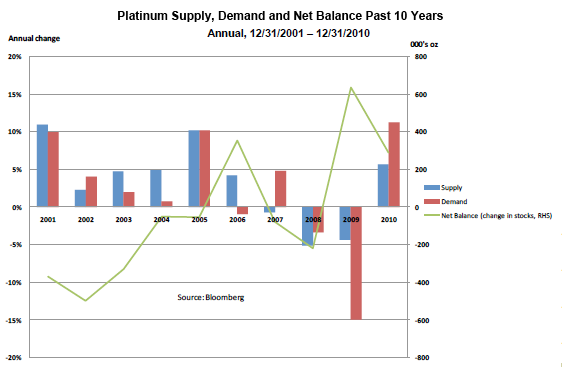
In platinum, 2009 demand contracted sharply, much more quickly than supply — which led to a market oversupply in 2010. Still, demand rebounded in 2010, which absorbed much of that oversupply, thus tempering any further price increase for the metal:

[Click all to enlarge]
Platinum Supply/Demand/Net Balance; Past 10 Years
Source: ETF Securities Platinum and Palladium - 2011 Outlook and Fundamentals

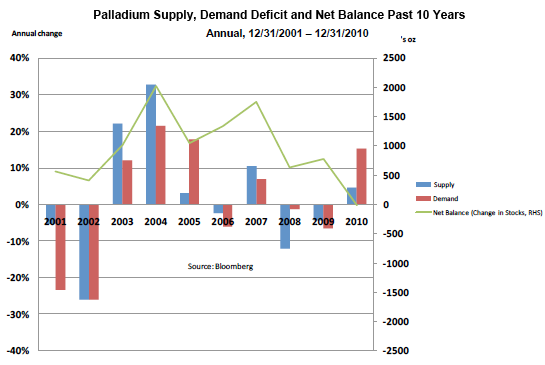
Without that oversupply created in 2009, platinum prices would have risen much higher last year — a scenario that played out in palladium:
Palladium Supply/Demand/Net Balance - Past 10 Years
Source: ETF Securities Platinum and Palladium - 2011 Outlook and Fundamentals

Palladium supply contracted by over 10 percent in 2008, and dropped another 4 to 5 percent in 2009. Demand also contracted, but not as sharply as supply. Thus, when demand for palladium rebounded sharply in 2010, it quickly outpaced supply, and prices rose accordingly.

Supply Constraints

Supply of both metals comes primarily from mining output in South Africa and Russia, with South Africa producing roughly 76 percent of all platinum and 35 percent of all palladium. Russia, meanwhile, supplies only 13 percent of platinum, but is the world's major palladium producer, supplying 52 percent of the metal. Mining supply of both of these metals has been constrained for a variety of reasons.

In South Africa, one of the main problems has been power — or the lack thereof. There just hasn't been enough steady electricity to meet mining industry needs. A new power policy is expected to be in place in South Africa by April, but it will still be a number of years before new capacity comes online. Eskom executive Kannan Lakmeeharan said that the supply-demand margin for power in South Africa will remain slim for the next five to six years, with the next two years being particularly tight. Not good news for mining production in the short run.

For Russia, figuring out the supply picture is trickier, because much of the palladium coming out of the country has originated from national stockpiles — and stockpile levels are considered a state secret. However, to get some indication of Russian inventories, the industry instead watches what gets sold in Switzerland — it being one of two major cargo hubs for the metal — and signs there suggest Russian stockpiles might be getting low. Last year, shipments from Russia to Switzerland dropped 12 percent, falling to 500,000 ounces, according to customs data reported by Bloomberg.

With palladium stockpiles most likely decreasing in Russia, and mine production forecast to decrease over 5 percent in 2011, palladium's supply picture thus remains tight.

David Davis, a mining investment analyst at Standard Bank's SBG Securities (Pty) Ltd, was quoted in Bloomberg as saying, "The palladium market, excluding any Russian stockpiles coming in, is going into an ever-increasing deficit. It'll put upward pressure on the price."

But just how high can the metal go? That depends on tomorrow's demand.

PGM Demand Depends On Jewelry, Cars

While platinum remains heavily used for jewelry, demand from that sector dropped from 40 percent to 32 percent in 2010, due to higher platinum prices. Investment demand accounted for another 7 percent, with the remainder allocated to the autocatalyst sector and for other industrial uses. (Although both platinum and palladium are commonly used in fume-scrubbing catalytic converters for cars, platinum remains the preferred choice for diesel engines. Palladium is preferred for gasoline engines.)

Palladium demand remains more concentrated in the autocatalyst sector and industrial use sectors, with only 7 percent used by jewelers in 2010 (although that is up from 3 percent in 2001). Another 7 percent was attributed to investment demand (up from 1 percent in 2006).

In 2010, palladium demand hit its highest levels in 10 years, boosted by increased environmental standards around the world and China's strong vehicle sales — over 17 million cars sold in 2010. Chinese vehicles are primarily gasoline-powered cars, as opposed to diesel; thus they require more palladium than platinum.

Global auto sales are forecasted to only increase; J.D. Power and Associates expects global light vehicle sales to rise 6 percent in 2011, with Asia leading the increase in automobile demand. Analysts predict China will sell 11 percent more cars in 2011. While that prediction is much lower than the growth rates seen in the past (33 percent in 2009 and 48 percent in 2008), it's still quite healthy and will ensure steady demand for both platinum and palladium.

But with tight supply and rising demand, price increases in platinum and palladium may begin to change the way the metals are used. Should prices rise too far, automobile manufacturers will be motivated to look for technological advances to decrease — or even eliminate — platinum and palladium usage.

In fact, that may already be occurring. As Bloomberg recently quoted Wulf-Peter Schmidt, manager for sustainability, Ford Motor Co. (F): "The amount of precious metals in catalytic converters is reduced. It's already being done."

In all likelihood, this tight supply/demand situation defines a new normal for the platinum group metals. The futures markets seem to agree; on Friday, Nymex raised the margin for palladium futures. While that doesn't really have an impact on anyone except individual futures traders, it does signal that perhaps NYMEX sees current palladium prices as a new baseline; after all, they wouldn't bother increasing the margins (which are a fixed dollar amount per contract) if they thought these prices were simply part of a bubble.

Thursday, February 17, 2011

Surging Gold Demand a “Global Phenomenon” – Chinese Demand for Silver “Voracious”

By GoldCore.com

Israeli comments led to dollar weakness and gold, silver and oil rallying yesterday. The Israeli government described the Iranian warships move into the Suez canal as a “provocation” and hinted at a possible response.
Gold in USD – 10 Day (Tick) GoldCore
Gold in USD – 10 Day (Tick)
An example, if one was needed, about how precarious the geopolitical situation in the Middle East is and how markets continue to underestimate the risk of military conflict.

Besides the very strong fundamentals, gold is looking better and better technically. After a 4 month period of correction and consolidation gold remains below levels seen last October (see chart below).

Gold bounced off support seen at the 150 day moving average and is now above the 100 day moving average. It is only 3.5% below the nominal record high of $1,423.75/oz seen in early December 2010.
Gold in USD – 1 Year (Daily) and 150 Day Moving Average GoldCore
Gold in USD – 1 Year (Daily) and 150 Day Moving Average
Even more important is the significant increase in demand seen in India, China and globally as people buy gold to protect themselves from macroeconomic risk and deepening inflation.

The World Gold Council reports that the increase in investment demand is a ‘global phenomenon’, reporting a 19% year-on-year rise across the world in its most recent report this morning.

In China alone, gold investment demand jumped 70% last year as Chinese people bought gold as a store of value. Demand is projected to grow a further 40 percent to 50 percent this year and jewelry demand will expand by 8 percent to 10 percent this year.

Gold imports by India, the largest buyer of gold in the world, climbed to a record of 918 metric tonnes in 2010, driven by a surge in jewelry demand with Indians continuing to buy jewelry as a store of value.

Reuters quoted a leading Chinese executive from Industrial and Commercial Bank of China (ICBC) (1398.HK) (601398.SS), the world’s largest bank by market value, as saying that demand for gold was growing at a voracious pace due to surging inflation.

Zhou said that the huge increase in Chinese demand seen last year would happen again in 2011 due to a “choppy stock market” and concerns about how rising interest rates will affect property markets.

Perhaps most importantly and rarely mentioned in the western media is the fact that the Chinese government is encouraging their citizens to buy physical gold and silver bullion having banned gold ownership from 1950 to 2003 (see video).

“Unlike the property market, investment in the gold sector is something the government is encouraging,” Zhou said.

Zhou said there was also voracious demand for silver, with ICBC bank alone selling about 13 tonnes of physical silver in January alone, compared with 33 tonnes in the whole of 2010. Were that demand to continue then demand for silver from ICBC alone could be as high as 156 tonnes this year. This would be a 370% increase on 2010.

Given the degree of demand for silver in China and internationally the forecast that silver could reach $36 an ounce this year, by Bloomberg analysts, is looking very conservative.

Those continuing to calling gold and silver “bubbles” continue to ignore the facts and the many, many extremely important developments in the gold and silver bullion markets.

Gold
Gold is trading at $1,377.75/oz, €1,017.01/oz and £854.68/oz

Silver
Silver is trading at $30.59/oz, €22.58/oz and £18.98/oz.

Platinum Group Metals
Platinum is trading at $1,825.50/oz, palladium at $835.00/oz and rhodium at $2,400/oz.

News

(Bloomberg) — China Investment Gold Demand to Grow 40-50% This Year, WGC SaysChina’s gold investment demand will grow 40 percent to 50 percent this year, Wang Lixin, the China representative for the World Gold Council, said today. The country’s jewelry demand will expand by 8 percent to 10 percent this year, he said.

(Bloomberg) — China’s Gold Investment Demand Jumps 70%, Council SaysGold investment in China jumped 70 percent last year and consumption by the jewelery sector gained to a record as investors stepped up purchases of the precious metal as a store of value, said the World Gold Council.

Investment demand jumped to 179.9 metric tons last year, surpassing Germany and the U.S., as buyers sought out gold bars and coins, according the London-based industry group. Demand from the jewelry sector was 400 tons, it said.

Gold reached a record $1,431.25 an ounce on Dec. 7 and soared nearly 30 percent last year as the dollar dropped and investors sought a store of value amid currency debasement. China’s consumer prices increased 4.9 percent in January from a year earlier, exceeding policy makers 4 percent inflation ceiling for a fourth month, data showed this week.

“The main motivation behind this demand has been concern over domestic inflation pressure and poor performance of alternative investments, combined with expectations of further gold price gains,” the council’s report said.
Bullion gained 0.3 percent to $1,379.50 at 3:34 p.m. in Shanghai.

Consumption in China, the second-largest buyer, may gain 15 percent in the first half, fueled by growing demand for alternative investments and a hedge against inflation, the China Gold Association’s deputy chairman Zhang Bingnan said last month.

China displaced South Africa as the world’s biggest gold producer in 2007. Imports through October rose almost fivefold from the total shipped in the previous year to 209 tons, according to the Shanghai Gold Exchange. Mine output reached a record 340 tons last year, the China Gold Association said.
The Industrial and Commercial Bank of China Ltd, the world’s biggest lender by market value, started physical-gold linked savings accounts in December in an initiative with the World Gold Council. Account openings surpassed 1 million with over 12 tons of gold stored on behalf of investors, it has said.

(Bloomberg) — Gold, Silver ‘Appealing’ as Long-Term Investments, Burns SaysGold and silver look “extremely appealing” for long-term investments as world currencies struggle to maintain their value, Pan American Silver Corp. Chief Executive Officer Geoff Burns said.
Pan American expects Argentina’s Chubut province to overturn a ban on open-pit mining this year to be able to develop the company’s Navidad silver deposit, Burns said today on a conference call.

(Bloomberg) — Pan American Silver Shifts Assets to Canadian DollarsPan American Silver Corp., the world’s fourth-largest silver producer, said it’s shifting its currency holdings into Canadian dollars, betting the U.S. dollar may fall further.

The world’s reserve currencies are struggling to maintain their value amid “ridiculous” debt levels, Chief Executive Officer Geoffrey Burns said today on a conference call with analysts. Gold and silver look “extremely appealing” as alternative long-term investments, he said.

“We diversified some of our currency holdings into Canadian dollars away from U.S. dollars to provide more stability in the event we do see continued weakness in the U.S. dollar,” Burns said. “It’s not just the U.S. dollar — the euro, the Japanese yen are going to have extreme difficulty hanging onto their long-term values as a commodity of trade.”

The dollar fell against most of its major counterparts today, while gold rose to the highest price in almost five weeks on speculation that the accelerating pace of inflation will boost demand for the precious metal as an investment hedge. Wholesale prices rose for a seventh straight month in the U.S., led by higher prices for fuel.

Gold futures for April delivery rose $1, or 0.1 percent, to settle at $1,375.10 an ounce at 1:34 p.m. on the Comex in New York. Silver futures for March delivery fell 6.7 cents, or 0.2 percent, to $30.629 an ounce.

Vancouver-based Pan American expects Argentina’s Chubut province to overturn a ban on open-pit mining after local elections in March, allowing the company to develop its Navidad silver deposit, Burns said. The company’s silver output will fall to 23 million ounces this year from 24 million ounces in 2010, he said. Industria Penoles SA, BHP Billiton Ltd. and KGMH Polska Miedz SA are the world’s largest silver producers.

(FT) — Investors look for a silver liningThe mint ratio, which shows how many ounces of silver it takes to buy an ounce of gold, is close to its lowest levels since 1998, currently about 45. Why?

With gold near a record high the simple explanation is that silver has been performing even better of late, driven by increased demand rather than any supply contraction.

Silver tends to hang on to gold’s coat tails when gold is stronger, during periods of inflation or political turmoil, perhaps. But gold’s recent gains have come at a time of improving economic fundamentals, so silver, which has a tight industrial demand correlation, has enjoyed extra impetus.

Another boost has come from retail investors who would rather spend their $200 on roughly five 1-ounce American Eagle silver coins, than one 10th-of-an-ounce gold coin. Doubtless the “penny-share syndrome” also applies a bit here too – when smaller priced assets are perceived as providing better opportunity for gains.

This is possibly why the US mint sold a record 6.4m Eagle silver coins in January, a 78 per cent increase on the previous year, when silver was more than 40 per cent cheaper. Gold sales were up 57 per cent over that period.

(Bloomberg) — Impala Platinum Sees 2011 Palladium Deficit of 560,000 OuncesImpala Platinum Holdings Ltd. said global palladium demand may outstrip supply by about 560,000 ounces this year. Platinum supplies may exceed demand by about 20,000 ounces in 2011 while the rhodium market may have a 55,000 ounces surplus, Impala said in a copy of a presentation posted on its website today.

(Bloomberg) — Gold Jewelry Demand Is ‘Still Very Strong,’ Council’s Grubb SaysGold jewelry demand is “still very strong,” after rising last year, World Gold Council managing director Marcus Grubb said on Bloomberg TV today.
“I certainly think we will see another very strong year for gold” this year, he said.

(Bloomberg) — Gold Jewelry Demand in India is Strong, World Gold Council SaysGold demand in India for jewelry is “outstanding” and high prices are no longer “a barrier” for consumers in the world’s largest user of bullion, according to Ajay Mitra, managing director of the World Gold Council for India and the Middle East.
Demand will stay “robust” this year, he told reporters in Mumbai today.

(Bloomberg) — Gold Imports by India Reach Record on Jewelry SalesGold imports by India, the largest user, climbed to a record in 2010, driven by a surge in jewelry demand and amid expectations that the 10-year rally in prices would extend, according to the World Gold Council.

Purchases totaled 918 metric tons, according to provisional data released by the producer-funded group today. That exceeds the projection of about 800 tons made last month by Ajay Mitra, the group’s managing director for India and the Middle East.

Bullion advanced 30 percent last year, reaching a record $1,431.25 an ounce on Dec. 7, as investors bought the metal as a protector of wealth. Jewelry demand in India jumped 69 percent in the year to the highest ever, helping drive global demand to a 10-year peak, according to the council.

“India was the strongest growth market in 2010,” said the report. “The rising price of gold, particularly in the latter half of the year, created a ‘virtuous circle’ of higher price expectations among Indian consumers, which fuelled purchases, thereby further driving up local prices.”

Fourth-quarter imports rose to 265 tons from 204 tons a year earlier, the group said. Jewelry demand gained 47 percent to 210.5 tons and investment demand grew 15 percent to 74.40 tons. Total demand in the period climbed 37 percent to 284.9 tons, according to the report.

Consumer demand for bullion in India rallied 66 percent in 2010 to 963.1 tons by volume from a year earlier and more than doubled in value to $38.2 billion, the council said.

(Reuters) — China gold demand growing at “explosive” pace: ICBCDemand in China for physical gold and gold-related investments is growing at an “explosive” pace and its appetite for the yellow metal is poised to remain robust amid inflation concerns, said an Industrial and Commercial Bank of China (ICBC) executive.

ICBC (1398.HK)(601398.SS), the world’s largest bank by market value, sold about 7 tonnes of physical gold in January this year, nearly half the 15 tonnes of bullion sold in the whole of 2010, said Zhou Ming, deputy head of the bank’s precious metals department on Wednesday.

“We are seeing explosive demand for gold. As Chinese get wealthy, they look to diversify their investments and gold stands out as a good hedge against inflation,” Zhou told Reuters.

“There is also frantic demand for non-physical gold investments. We issued 1 billion yuan worth of gold-price-linked term deposits in 2010, but we managed to sell the same amount over just a few days in January this year,” Zhou said, adding that such deposits would easily exceed 5 billion yuan ($759 million) this year.

Gold imports into China soared in 2010, turning the country, already the largest bullion miner, into a major overseas buyer for the first time.

The surge, which comes as Chinese investors look for insurance against rising inflation and currency appreciation, puts the country on track to overtake India as the world’s top gold consumer and a significant force in global gold prices.
Gold prices jumped 30 percent in 2010 and struck an all-time high of $1430.95. Spot silver surged 83 percent last year and is currently hovering at around $30 per ounce.

Zhou said China’s gold demand could grow at a stronger pace this year compared with 2010, as a choppy stock market and moves by Beijing to rein in property speculation and purchases means more investors will pile their cash in bullion investments.

“Unlike the property market, investment in the gold sector is something the government is encouraging,” he said.

Beijing has encouraged retail consumption and announced last August measures to promote and regulate the local gold market, including expanding the number of banks allowed to import bullion.

“China has a centuries-long cultural attraction to gold and because we have started at such a low base, I think demand growth will likely stay strong for quite some time,” he said.

Zhou said there was also voracious demand for silver, with the bank selling about 13 tonnes of physical silver in January alone, compared with 33 tonnes in the whole of 2010.

The scale of China’s gold demand, which has increased on average at a double-digit clip over the past decade, has caught the market by surprise. Data showed China imported 209 tonnes of gold the first 10 months of last year, versus 333 tonnes by India for the whole year.

The bank on Tuesday launched its second physical gold investment product, which sells gold bars to investors, which can be resold for cash through ICBC based on real-time gold prices.

The WGC said ICBC’s introduction of this gold investment could lift China’s gold retail investment by 10 to 15 percent in 2011 from about 170 tonnes last year.

(Bloomberg) — U.S. Mint’s Silver Suppliers Treasure Precious Metal’s RallyThe value of contracts for supplying silver to the U.S. Mint has surged along with the precious metal’s rise in the world market, according to data compiled by Bloomberg.

The federal agency that makes coins for circulation and investment paid at least $693.1 million to two of its main silver suppliers in the 2010 fiscal year, a 66 percent increase over 2009, the data show.

“For a small company, the government’s a good long-term customer to have,” Tom Power, chief executive officer of Sunshine Minting Inc., said in a Feb. 4 telephone interview. The Coeur d’Alene, Idaho-based company is the Mint’s primary supplier of silver blanks for bullion coins, which are sold to investors.

The increase in payments to Sunshine Minting and Stern Leach Co. of Attleboro, Massachusetts, a unit of London-based Cookson Group Plc, has coincided with silver’s rally as investors bought precious metals in the economic decline and to protect against Europe’s financial crisis. Spot silver has more than tripled to $30.785 an ounce through Feb. 15 from $8.967 on Nov. 20, 2008, its lowest settlement in the last five years.

Over the past 11 years, the U.S. Mint has spent at least $2.1 billion on contracts with its two main suppliers of silver blanks, or unstamped coins, according to data compiled by Bloomberg. About 80 percent of that was paid to Sunshine Minting.

Little Competition
Sunshine Minting works on five-year rolling competitive-bid contracts with the Mint, said Power. All 58 unique contracts the agency exercised in fiscal year 2010 to buy silver from the Idaho company were open to competition, according to the Federal Procurement Data System. In 24 cases, Sunshine was the only bidder, the data show.

“The production of blanks for the Mint is not easy, so there’s not a lot of competition,” Leonard Kaplan, president of Prospector Asset Management in Evanston, Illinois, said in a telephone interview Feb. 10. “It’s only two or three companies that have the equipment to do this and are willing to jump through all the loops that the U.S. Mint wants,” such as product specifications and payment schedules, he said.

The Mint purchases silver on the open market “at prevailing prices” to produce bullion, Mint spokesman Michael White said in an e-mail Feb. 8.

“The volume of bullion coins, gold and silver, produced and sold by the U.S. Mint are at peak levels since 2008,” White said. “As the price of gold and silver fluctuate, the value of blanks orders reflects that fluctuation.”

The Mint sold 35.8 million ounces of gold and silver bullion coins last year, up 30 percent from 2009, according to the agency’s annual report.

Sunshine’s Rise
Sunshine Minting’s sales to the Mint totaled $10.2 million in fiscal year 2000, the start of a rapid escalation in federal contracts that reached $579.1 million last year, according to the data compiled by Bloomberg.

Stern Leach, another major silver supplier to the Mint, experienced a similar upswing in sales to the federal government. The company’s contracts totaled $114 million last year compared with $70.4 million in 2009 and $10.7 million in 2005.

A spokesman for Stern Leach in Attleboro, Massachusetts, who refused to be identified, said Feb. 3 it is company policy to decline interviews with the news media.

Bullion Boom
The Mint’s sales of silver bullion coins jumped 77 percent to $660 million in fiscal year 2010, according to the annual report. Bullion products made of gold brought in $2.2 billion last year, up 69 percent from the previous year.

“They try to balance their supply and demand, and demand has been very, very strong, so of course they buy more,” Kaplan said. “Right now they’re making a fortune.”

White said the Mint is required by law to pass its metals costs onto the buyers of products such as bullion coins so that it can operate at no net cost to taxpayers.

“By law, the U.S. Mint must sell silver bullion coins at a price equal to the bullion value of the coin at the time of the sale, plus production costs,” White said.

The agency’s more public role is to produce coins and sell them to the Federal Reserve’s district banks at face value, yielding a so-called seigniorage profit that is sent back to the Treasury’s general fund.

Higher metal costs and a shift to production of less profitable, lower denomination coins brought the Mint’s seigniorage from circulation down 30 percent in fiscal year 2010, from $428 million to $301 million, according to its annual report.

Silver could reach $36 an ounce this year, according to a Bloomberg survey of analysts.

Continue reading this article >>

Demand for Silver, Platinum ETFs in India

by commodity Online
Demand for exchange traded funds (ETFs) in precious metals other than gold is growing in India, as bullion experts say that the country requires more funds in commodities like silver and platinum.

India is the largest importer and consumer of gold in the world. And Indian households own the largest chunk of physical gold in the world, in the form of gold jewellery coins, bars etc. But Gold ETFs got introduced in India only four years back.

Some eight Gold ETFs have been performing well and giving excellent returns in the last four years. But the regulatory rules have so far prohibited various companies from launching ETFs in precious metals like silver and platinum.

"As of today, government rules do not allow us to launch such investment schemes on silver and platinum. But when there is an opportunity, we will definitely try to explore," Reliance Capital Asset Management Ltd CEO Sundeep Sikka told reporters. Reliance on Wednesday launched a Gold Savings Fund.

ETFs in commodities are yet to make a deep investment sense in India, even though eight mutual funds have launched Gold ETFs in the last two years. India is the largest gold consuming and importing nation in the world and Indian households own the largest quantity of physical gold.

Spurred by the success of Gold ETFs in the last two years, several companies in India have chalked out plans to launch Silver ETFs.

According to Prithviraj Kothari, Managing Director, Riddisiddhi Bullions Ltd (RSBL), Silver ETFs will be embraced by investors in India as Gold ETFs are doing extremely well in the country.

“At present, only Gold ETFs are offered for Indian investors, but that also has seen phenomenal growth during past few months. Volumes in gold ETFs are posting over 100% growth for past several months. This shows that awareness about retail investment products like ETFs is gaining momentum and we can expect further growth in it,” Kothari said.

Even though several companies have been wanting to start Silver ETFs, the launch of the exchange traded funds in the white metal has been stuck in regulatory frameworks.

“Unlike Gold ETF, it has not been an easy sailing for Silver ETFs in India. The matter has stuck into regulatory disputes. Typically, ETFs operate in a format similar to equities, as they are traded on equities exchanges. While Gold ETFs are regulated by equities market regulator, Securities and Exchange Board of India (SEBI), the Silver ETFs are argued to be regulated by Forward Markets Commission (FMC), the commodities market regulator in India. We are awaiting for a approval from the regulators but nothing so far has been received. The matter is currently with the Indian Central government,” Kothari said.

Mumbai-based Benchmark Mutual Fund which was the first company to start a Gold ETF in 2007 and has the largest collection of more than five tonnes may be the first to launch Silver ETFs also in India.

Benchmark Mutual Fund officials said that the company is all set to launch Silver ETFs in India as soon as the government approval comes. “We are ready to launch Silver ETFs any day. We want to spread the ETF investment options to several commodities in India. After Gold ETFs, it is now the turn of Silver ETFs,” a senior Benchmark official who did not want to be named told Commodity Online.

Silver like gold is a hot investment in India. Jewellery chains across India are promoting silver as affordable and modern jewellery in place of gold.

India’s silver imports, which in US dollar terms were $309.8m in June 2010, up 854% on the year, while in the first six months of 2010 they are up 579%, at $1.69bn. India’s appetite for silver has been boosted because gold has become too expensive at current prices.

Globally, with gold prices having just scored a new all-time record high and with silver futures prices still not even close to the all-time high, many investors reckon silver futures are still a buying opportunity with still more upside price potential in the coming weeks and months.

Tuesday, February 15, 2011

Platinum, Palladium ETFs lure investors

by Commodity Online
Platinum and palladium are two commodities precious metals investors are banking on these days. Prices of these precious metals, popularly known as PGMs, have been on the rise in the last two years. Investors are also piling their money into exchange traded funds (ETFs) in platinum and palladium, says a new research report from Standard Bank - Precious Metals Monthly.

Following is an analysis from Standard Bank on PGMs's performance:

"January saw average platinum and palladium prices for the month both rise by 5% in dollar terms compared to December. The similar percentage increase for each metal, in stark contrast to palladium’s out performance over the previous six months (as shown in the chart below right), masked greater volatility in the palladium price during the past month compared with its sister metal.

The year began with the more volatile palladium realizing a steeper correction than for platinum. As a result, palladium tested the $750 level between the 5th and the 10th as the dollar reached its strongest level against the euro since last September. Thereafter, palladium quickly rebounded; gaining $50 in just two trading days, a performance in dollar terms that was matched by platinum although this represented a markedly smaller percentage increase for the higher priced metal. Over the remainder of January, palladium traded broadly between $790 and $825, with attempts to breach the top of this range meeting strong resistance.

Platinum, meanwhile, peaked at $1,846 (a.m. fix) on the 19th but substantial US dollar weakness then saw the price fall rapidly to below $1,800, a level at which platinum largely remained over the course of the month. However, the start of February has subsequently seen both PGMs rally back towards recent highs, supported in part by improved confidence in the global economic recovery, especially in the United States.

The increasingly supportive macroeconomic data of recent weeks has buoyed the outlook for industrial demand for a range of metals, including PGMs, and not least across the auto sector. Recent figures for auto sales have generally surprised the market on the upside, with Japanese vehicle sales in January reported to have risen by more than 6% month-on-month.

In the United States meanwhile, sales were over 16.3% higher year-on-year in January and, although they were flat compared to the prior month this still led to renewed optimism about the gradual recovery across the industry. (Furthermore, sales of pickups and cross-over vehicles, which tend to have higher PGM loadings, have improved.)

Elsewhere, in the European auto market there were also signs of firmer demand, with new car registrations in December showing their smallest year-on-year decline since March. In China, automotive sales data for January is delayed due to the week long Chinese New Year holiday, making assessments of the state of that market more difficult to ascertain. However, the strength of the latest GDP figures has highlighted the likelihood that this will trigger further monetary tightening to quell inflationary pressures and in all likelihood this could hinder auto sales growth later this year.

Turning to investment, this has continued to provide a generally supportive backdrop to PGM prices over the past month. This was most clearly demonstrated in January by the trend in ETF holdings, which continued the strong inflows that had emerged in the final quarter of 2010 for both metals.

In fact, for the first time ever ETF holdings of palladium increased by more than 100,000 ounces for two successive months. As in previous months, this increase was concentrated in the ETF Securities New York and London funds, although there was also a lift of over 20,000 ounces in the ZKB fund. At the same time, platinum ETF holdings continued to grow at roughly half the rate of palladium, with a rise in January of a little more than 60,000 ounces.

Similar to recent months, but in contrast to ETF holdings, there were relatively small changes in the net investor long on Nymex for palladium, according to CFTC figures. However, it should be noted that in the case of platinum the net investor long continued to rise to a fresh all-time high, as fresh longs were placed in mid-month. As a result, the net long has more than doubled in just over 6 months, from its low on 20th July to the latest available data (for 1st February).

Turning to supply, the most significant development in the past month was the reports from Eskom, which provided some price support in the PGM market. This was due to flooding in South Africa having affected coal supply, leading to Eskom stating that the coal shortage may result in power cuts, with increasing concerns of tightness in the energy market as early as March. This is particularly important for the platinum price as South African output typically accounts for around three quarters of global mine production.

On the supply front itself there were also a slew of production figures in the past month. Lonmin stated in late January that its refined platinum production in the final quarter of 2010 dropped 17% from a year earlier to 81,982 ounces. This decline was not unexpected, due to the planned rebuild of its main furnace and poor weather but was cushioned by the tolling of some 9,000 ounces of platinum. Indeed, the company’s refined palladium production was actually up 10% over the quarter due to more than 35,000 ounces of tolled palladium output. The company had announced earlier in the month that it had reached an agreement with the National Union of Mineworkers (NUM) for workers to receive an 8% wage increase backdated to 1st October 2010, as well as a one-off payment of 850 Rand.

Elsewhere, Norilsk Nickel produced 645,000 ounces of palladium and 161,000 ounces of platinum in the final three months of 2010, down 10% and 7% respectively compared to the prior quarter. The company stated that the declines were anticipated and chiefly occurred at its Russian operations. In fact, taking 2010 as a whole the company’s annual production of platinum was 5% higher and that of palladium up 2%."

Continue reading this article>>

Saturday, February 12, 2011

Updates of Super Commodity Systems

SUPER COMMODITY OPEN TRADES
Soybean Meal - After a few days seems wants to break the trading-range with several divergences on daily chart.
Platinum - Nice trade, it is now on the first support. Here yowe can lightens the position.
Soybeans - The trade started well with several divergences on daily chart.

SUPER COMMODITY RECENTLY CLOSED TRADES
Gasoline - After a promising start the trade has been stopped at breakeven.
eMini Nasdaq -After closing with a good gain the previous long trade, the sell short reverse has been stopped with a small loss.

SM S PL
RB NQ

Thursday, February 10, 2011

Go Short On Platinum - Super Commodity trading System

Set-up di vendita ieri sera sul Platinum da parte del nostro Super Commodity system, accompagnato da alcune divergenze negative sulla chart giornaliera. Lo Stop loss è già stato spostato a breakeven in virtù del raggiungimento del relativo obiettivo da parte dei prezzi. I risultati real-time sono a disposizione al seguente link: http://www.box.net/shared/5vajnzc4cp

Sell Short set-up on Platinum last night by our Super Commodity system, accompanied by some negative divergences on the daily chart. The Stop Loss has already been moved to breakeven as a result of reaching its target by price. Real-time results are available at the following link: http://www.box.net/shared/5vajnzc4cp

PL
Material in this post does not constitute investment advice or a recommendation and do not constitute solicitation to public savings. Operate with any financial instrument is safe, even higher if working on derivatives. Be sure to operate only with capital that you can lose. Past performance of the methods described on this blog do not constitute any guarantee for future earnings. The reader should be held responsible for the risks of their investments and for making use of the information contained in the pages of this blog. Trading Weeks should not be considered in any way responsible for any financial losses suffered by the user of the information contained on this blog.

Wednesday, July 28, 2010

Sell Platinum or Palladium?

Segnale di vendita sul Platinum, sul cui eventuale trade avremmo però un R/R basso. Meglio operare con le stesse regole sul Palladium, che si trova nella medesima situazione tecnica. 

Sell signal on Platinum, but in which possible trade we a low R/R. Better to work with the same rule on the Palladium, that is in the same technique situation.

Wednesday, June 23, 2010

Platinum

Segnale di vendita nei giorni scorsi sul Platinum.

Sell Short Signal in recent days on Platinum.

Follow Us