Showing posts with label palladium. Show all posts

Wednesday, July 27, 2011

Palladium Hits Highest Level Since February; Platinum Also Rises

by Kitco News


Palladium rose sharply and platinum also posted solid gains Tuesday, with analysts citing worries about a coal strike in South Africa ultimately cutting power to mines.

Additionally, traders cited worries about potential work stoppages at metals-mining companies themselves, as well as a weaker U.S. dollar and an improved outlook for the automobile industry.

At 2:05 p.m. EDT, September palladium was $28, or 3.5%, higher at $837 an ounce on the New York Mercantile Exchange. The contract hit a peak of $845.40 that was its strongest level since February. October platinum was up $14.50, or 0.8%, to $1,808.50.

One trader described heavy short covering—or buying to exit positions in which traders previously sold—in palladium.

Worries about the impact of a coal strike in South Africa appear to be having an impact on platinum group metals, said Jim Steel, precious-metals analyst with HSBC.

According to news reports, some 30,000 coal-mine workers in South Africa have gone on strike seeking a pay increase. This creates worries about availability of electricity needed for mining far below the ground in South Africa, the world’s largest producer of platinum and one of the two largest palladium producers. When platinum hit its record highs in 2008, electricity shortages curtailed mining operations and contributed to a spike in prices.

Power utility Eskom has indicated it has contingency plans, Steel said. Still, worries about the labor and power picture “prompted enough cautious buying to push both platinum and palladium higher,” Steel said.

Furthermore, the threat of strikes against mining companies themselves are supportive, said a research note from MKS Finance. “PGMs are seen supported by continued supply concerns, with unions in South Africa threatening strikes at the world’s biggest producers over wages.”

Some of the strength in PGMs may be a “catch-up” to the recent run to record highs in gold, Steel said. “Gold has tended to lead the PGMs. These strike and power issues may go some way to giving the market a reason to close the gap with gold.”

Some traders may have shifted from platinum to palladium, the analyst added.

A PGM trader linked the gains to movement in the foreign-exchange market.

“You have the euro up over $1.45, and the weak dollar is helping push the commodity indexes higher,” said the trader. This earlier fueled a rally oil back over $100 a barrel, he said.

George Gero, vice president and precious-metals strategist with RBC Capital Markets Global Futures, pointed to optimism for improving demand for PGMs from the automotive sector. He cited recovering Japanese industrial output after a spring earthquake, plus another profitable quarter for Ford. The company reported net income of $2.4 billion in the second quarter.

Gero cited trade, or industrial, buying. “There is physical demand,” he said.

Wednesday, July 20, 2011

Strike at South African Mines: Bullish for Platinum?


As wage talks between South African mines and labour have become deadlocked, the mood among mine workers and labour in general is for strikes and I doubt it will be averted.

Last year’s settlements were generally below 10% but expectations are much higher this time around. I think we are probably in for a minimum of two to three weeks – similar to what happened in 2009. The major two-week strike in 2009 from 24 August to 8 September saw Implats lose 50 000 oz of production and Aquarius about 17 000 oz.

With South Africa’s production approximately 88 000 oz per week, it means best 88 000 oz may be lost if all the mines close for one week. If the strike lasts three weeks, a total of 264 000 oz or the equivalent of 40% of last year’s total investment demand will be lost. There was very little industrial action in 2010 – in the spirit of the FIFA World Cup.

But let us have a look at what happened to the platinum price and the prices of other precious metals in 2009 from the time the strike started at Impala Platinum to when it ended.


Source: Plexus Asset Management (based on data from I-Net Bridge).


The platinum price did not react initially as it was felt the company had sufficient inventory to fulfil its obligations to its customers. The price surged after it became clear that the strike would last longer and intensified. On the day the strike started the platinum price closed at $1 239 per ounce. On the day the strike ended the price closed at $1 347 – a surge of $108 per ounce or 8.7%! The positive momentum also benefitted gold, which rose by $75 from $943 to $1 018 per ounce or 8% over the same period. Palladium, the other major platinum group metal, lagged, though, as the price rose by $16 from $282 to $298 per ounce or 5.7%.

I am of the opinion that this time around the impact of a strike could be much greater than in 2009. Platinum demand was then still subdued in the aftermath of the 2008/2009 global liquidity crisis and producers such as Anglo American Platinum were still slashing production to adjust to lower demand. Although global economic growth has slowed down mainly as a result of supply-line shortages due to Japan’s terrible twin disasters, supply and demand are relatively evenly matched. With the wheels of industry turning again and consumer confidence improving, Japan’s economy is heading for better times and that should rub-off on the rest of the globe.

A three-week strike resulting in a loss of 264 000 ounces of platinum is certainly going to lead to a blow-off in the platinum price. Yes, you can bet your bottom dollar the producers have probably used the recent weakness in the price to buy in the expected production shortfalls resulting from the strikes by purchasing futures and call options.

My message to the platinum bears: let the seller beware!

Tuesday, March 8, 2011

Platinum and Palladium: The New Normal?

By Julian Murdoch

In just over one year, the ETF Securities Platinum Trust (PPLT) and Palladium Trust (PALL) have swelled to $832.65 million and $932.66 million in assets under management, respectively. Is acceleration just a spillover effect from gold's stratospheric rise? Or is something else fundamentally driving these metals higher?

Factors Driving Today's Prices

On Friday, platinum closed at $1,841/oz, up 4 percent since the beginning of the year. Meanwhile, palladium, 2010's big winner, is up only 1.28 percent year-to-date, closing at $810/oz. While these year-to-date returns may seem lackluster, there are reasons to believe higher prices may be soon on the way:
White Metals: 3/4/10 - 3/4/11
Both metals have seen prices like these before. Back in 2008, platinum rose to almost $2,200/oz right before the crash. For palladium, you have to look back a bit further; in 2001, the metal briefly scaled the $1,000/oz mark, before quickly falling back under $400/oz.

But the impetus for today's price increases can be traced back to the after-effects of the 2008 crash. Demand for both metals dropped after the crash, and mining companies rushed to contract supply.

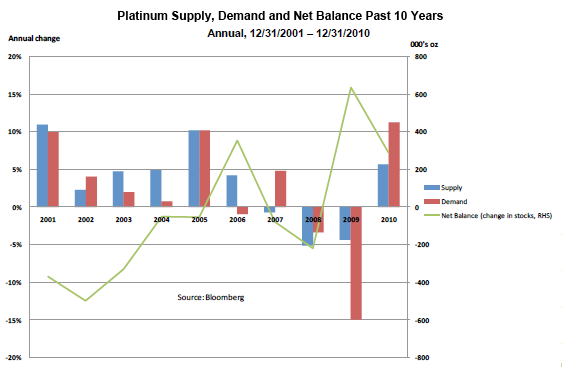
In platinum, 2009 demand contracted sharply, much more quickly than supply — which led to a market oversupply in 2010. Still, demand rebounded in 2010, which absorbed much of that oversupply, thus tempering any further price increase for the metal:

[Click all to enlarge]
Platinum Supply/Demand/Net Balance; Past 10 Years
Source: ETF Securities Platinum and Palladium - 2011 Outlook and Fundamentals

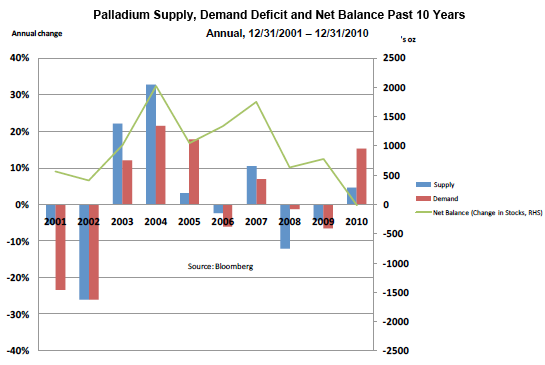
Without that oversupply created in 2009, platinum prices would have risen much higher last year — a scenario that played out in palladium:
Palladium Supply/Demand/Net Balance - Past 10 Years
Source: ETF Securities Platinum and Palladium - 2011 Outlook and Fundamentals

Palladium supply contracted by over 10 percent in 2008, and dropped another 4 to 5 percent in 2009. Demand also contracted, but not as sharply as supply. Thus, when demand for palladium rebounded sharply in 2010, it quickly outpaced supply, and prices rose accordingly.

Supply Constraints

Supply of both metals comes primarily from mining output in South Africa and Russia, with South Africa producing roughly 76 percent of all platinum and 35 percent of all palladium. Russia, meanwhile, supplies only 13 percent of platinum, but is the world's major palladium producer, supplying 52 percent of the metal. Mining supply of both of these metals has been constrained for a variety of reasons.

In South Africa, one of the main problems has been power — or the lack thereof. There just hasn't been enough steady electricity to meet mining industry needs. A new power policy is expected to be in place in South Africa by April, but it will still be a number of years before new capacity comes online. Eskom executive Kannan Lakmeeharan said that the supply-demand margin for power in South Africa will remain slim for the next five to six years, with the next two years being particularly tight. Not good news for mining production in the short run.

For Russia, figuring out the supply picture is trickier, because much of the palladium coming out of the country has originated from national stockpiles — and stockpile levels are considered a state secret. However, to get some indication of Russian inventories, the industry instead watches what gets sold in Switzerland — it being one of two major cargo hubs for the metal — and signs there suggest Russian stockpiles might be getting low. Last year, shipments from Russia to Switzerland dropped 12 percent, falling to 500,000 ounces, according to customs data reported by Bloomberg.

With palladium stockpiles most likely decreasing in Russia, and mine production forecast to decrease over 5 percent in 2011, palladium's supply picture thus remains tight.

David Davis, a mining investment analyst at Standard Bank's SBG Securities (Pty) Ltd, was quoted in Bloomberg as saying, "The palladium market, excluding any Russian stockpiles coming in, is going into an ever-increasing deficit. It'll put upward pressure on the price."

But just how high can the metal go? That depends on tomorrow's demand.

PGM Demand Depends On Jewelry, Cars

While platinum remains heavily used for jewelry, demand from that sector dropped from 40 percent to 32 percent in 2010, due to higher platinum prices. Investment demand accounted for another 7 percent, with the remainder allocated to the autocatalyst sector and for other industrial uses. (Although both platinum and palladium are commonly used in fume-scrubbing catalytic converters for cars, platinum remains the preferred choice for diesel engines. Palladium is preferred for gasoline engines.)

Palladium demand remains more concentrated in the autocatalyst sector and industrial use sectors, with only 7 percent used by jewelers in 2010 (although that is up from 3 percent in 2001). Another 7 percent was attributed to investment demand (up from 1 percent in 2006).

In 2010, palladium demand hit its highest levels in 10 years, boosted by increased environmental standards around the world and China's strong vehicle sales — over 17 million cars sold in 2010. Chinese vehicles are primarily gasoline-powered cars, as opposed to diesel; thus they require more palladium than platinum.

Global auto sales are forecasted to only increase; J.D. Power and Associates expects global light vehicle sales to rise 6 percent in 2011, with Asia leading the increase in automobile demand. Analysts predict China will sell 11 percent more cars in 2011. While that prediction is much lower than the growth rates seen in the past (33 percent in 2009 and 48 percent in 2008), it's still quite healthy and will ensure steady demand for both platinum and palladium.

But with tight supply and rising demand, price increases in platinum and palladium may begin to change the way the metals are used. Should prices rise too far, automobile manufacturers will be motivated to look for technological advances to decrease — or even eliminate — platinum and palladium usage.

In fact, that may already be occurring. As Bloomberg recently quoted Wulf-Peter Schmidt, manager for sustainability, Ford Motor Co. (F): "The amount of precious metals in catalytic converters is reduced. It's already being done."

In all likelihood, this tight supply/demand situation defines a new normal for the platinum group metals. The futures markets seem to agree; on Friday, Nymex raised the margin for palladium futures. While that doesn't really have an impact on anyone except individual futures traders, it does signal that perhaps NYMEX sees current palladium prices as a new baseline; after all, they wouldn't bother increasing the margins (which are a fixed dollar amount per contract) if they thought these prices were simply part of a bubble.

Monday, March 7, 2011

The case for palladium

by SHIRLEY WON

When it comes to precious metals, palladium may give investors more bang for their buck than its flashier cousins.

The often-forgotten white metal is expected to outstrip gains of both gold and silver again this year, thanks to concerns over supply disruptions and surging car sales in fast-growing Asian countries.

Wednesday, March 2, 2011

Palladium Seen Rising 15% in 2011 as Russian Cargoes Drop: Freight Markets

By Nicholas Larkins

Russia, the world’s biggest palladium producer, is shipping the smallest amount of metal to Switzerland in 15 years, a sign of declining state stockpiles that may drive prices as much as 15 percent higher by December.

Cargoes to Switzerland, one of Europe’s two main hubs for storing and trading precious metals, fell 12 percent to about 500,000 ounces last year and compare with the two-decade average of 1.3 million ounces, Swiss customs data show. Fewer shipments of the metal used in almost every catalytic converter may mean shortages. The five analysts ranked by Bloomberg as the most accurate over the past two years forecast prices as high as $940 an ounce in 2011, based on the median of their estimates.

While Russian stockpiles are a state secret, Johnson Matthey Plc, the London-based trader, says they were the fourth- largest source of supply in 2010. OAO GMK Norilsk Nickel, the biggest producer, said in December it expects “insignificant” amounts from reserves and Standard Bank Group Ltd. forecasts stocks will be depleted as early as this year.

“The palladium market, excluding any Russian stockpiles coming in, is going into an ever-increasing deficit,” said David Davis, a mining investment analyst at Standard Bank’s SBG Securities (Pty) Ltd. in Sandton, near Johannesburg. “It’ll put upward pressure on the price.”

The metal traded at $817.25 at about 7 p.m. yesterday in London. Prices hit a record $1,125 in 2001 when shipments were disrupted.

Mine Production

Mine output will fall 5.4 percent to 6.8 million ounces and demand from carmakers will climb 6.7 percent to about 5.5 million ounces in 2011, Barclays Capital estimates. Demand rose 15 percent last year to the highest in a decade while supply, excluding recycling, was steady, and without Russian reserve sales there would have been a shortage, Johnson Matthey said.

Palladium accounts for 90 percent to 95 percent of precious metals used in gasoline catalytic converters and about 25 percent in diesel devices, according to Johnson Matthey, which has supplied one in three of the world’s autocatalysts.

Catalytic converters each use about 4 grams (0.13 troy ounces) of precious metals, according to Mark Bedford, the director of precious-metals marketing at Johnson Matthey. Four grams of palladium cost about $105 and $237 for platinum.

Palladium jumped more than fourfold since the end of 2008, reaching a 10-year high of $862.25 on Feb. 21. Platinum doubled in that period. The Standard & Poor’s GSCI Total Return Index of 24 commodities rose 34 percent, the MSCI World Index of equities climbed 46 percent and Treasuries returned 1.9 percent, a Bank of America Merrill Lynch index shows.

Energy Prices

Prices have declined on concern that protests across North Africa and the Middle East will drive energy prices higher and weaken economic growth.

Russia mined 2.7 million ounces of palladium in 2010, worth $1.4 billion at last year’s average price, Johnson Matthey data show. South Africa produced 2.49 million ounces, for $1.3 billion, and mine output totaled about $3.2 billion. Recyclers recovered 1.32 million ounces from spent autocatalysts.

Sales of Russian stockpiles dropped to 1.01 million ounces in 2010 from as much as 1.49 million in 2007, the data show. Inventories were built up from excess output in the 1970s and 1980s and may have declined to less than 1 million ounces last year, SBG’s Davis said.

Customs Data

“We don’t know how many years it took to build them up and how they big they were, but at some time they must empty out,” said Thorsten Proettel, an analyst at Landesbank Baden- Wurttemberg in Stuttgart, Germany, and one of the members in the Bloomberg survey. “At that time it might be a problem for the market.”

Swiss customs data includes ingots, powder and half- processed material, mostly brought in by air freight. Bars are stacked on pallets, according to Afshin Nabavi, a senior vice president in Geneva at bullion refiner MKS Finance SA, which trades the metal. It is transported in plastic pots when in powder form, said Johnson Matthey’s Bedford.

Any rise in car sales and palladium may be curbed by energy prices after oil in New York jumped 27 percent from a year ago. Protests across North Africa and the Middle East have disrupted supply, sending gasoline prices to a record in the U.K., according to the Automobile Association, the nation’s largest motoring organization.

“Everybody’s suddenly nervous about high oil prices reducing the amount of distance that people are driving and pushing back the likelihood of people buying cars, and therefore it could impact on palladium consumption in the short term,” said David Wilson, an analyst at Societe Generale SA in London and another participant in the Bloomberg survey.

Auto Sales

Investor demand may overcome a drop related to auto sales. Palladium held in exchange-traded products reached a record 73.08 metric tons on Feb. 28, about 26 percent of annual gross demand, according to data compiled by Bloomberg.

Norilsk Nickel, based in Moscow, will report earnings per share rose 22 percent to $33.09 this year, based on the mean of seven analysts’ estimates compiled by Bloomberg.

Palladium slumped 87 percent over two years after reaching a record in 2001 as manufacturers switched to using more platinum. Ford Motor Co., the second-largest U.S. carmaker, wrote down the value of its precious metals by $1 billion that year, contributing to the Dearborn, Michigan-based company’s first annual loss since 1992.

An ounce of platinum bought 2.16 ounces of palladium on Feb. 18. The ratio was last that low in 2002, after which platinum climbed 29 percent and palladium fell 31 percent in the following year. While sustained prices above $1,000 may spur autocatalyst makers to use more platinum, the process “won’t happen overnight,” SBG’s Davis said.

Vehicle Sales

Asia is leading the increase in auto demand, with personal vehicle sales likely to increase 7.3 percent to 24 million this year, according to Oxford, England-based J.D. Power Automotive Forecasting.

China’s economy will grow 9.5 percent this year, according to the median in a Bloomberg survey of eight economists. While that’s down from 10.3 percent in 2010, it’s almost three times predicted growth in the U.S. and almost sixfold the forecast for the euro region.

The U.S. in 1975 introduced legislation leading to vehicles being fitted with catalysts to cut pollution, and about 95 percent of all new vehicles sold globally are fitted with the devices, according to Johnson Matthey. Ceramic or metal is formed into a honeycomb and coated with chemicals and metals, and is installed in the exhaust line in vehicles.

Even after last week’s drop, “palladium is likely to be the star performer of precious metals again in 2011,” said Anne-Laure Tremblay, a London-based analyst at BNP Paribas SA and another participant in the Bloomberg survey.

Continue reading this article >>

Tuesday, February 15, 2011

Platinum, Palladium ETFs lure investors

by Commodity Online
Platinum and palladium are two commodities precious metals investors are banking on these days. Prices of these precious metals, popularly known as PGMs, have been on the rise in the last two years. Investors are also piling their money into exchange traded funds (ETFs) in platinum and palladium, says a new research report from Standard Bank - Precious Metals Monthly.

Following is an analysis from Standard Bank on PGMs's performance:

"January saw average platinum and palladium prices for the month both rise by 5% in dollar terms compared to December. The similar percentage increase for each metal, in stark contrast to palladium’s out performance over the previous six months (as shown in the chart below right), masked greater volatility in the palladium price during the past month compared with its sister metal.

The year began with the more volatile palladium realizing a steeper correction than for platinum. As a result, palladium tested the $750 level between the 5th and the 10th as the dollar reached its strongest level against the euro since last September. Thereafter, palladium quickly rebounded; gaining $50 in just two trading days, a performance in dollar terms that was matched by platinum although this represented a markedly smaller percentage increase for the higher priced metal. Over the remainder of January, palladium traded broadly between $790 and $825, with attempts to breach the top of this range meeting strong resistance.

Platinum, meanwhile, peaked at $1,846 (a.m. fix) on the 19th but substantial US dollar weakness then saw the price fall rapidly to below $1,800, a level at which platinum largely remained over the course of the month. However, the start of February has subsequently seen both PGMs rally back towards recent highs, supported in part by improved confidence in the global economic recovery, especially in the United States.

The increasingly supportive macroeconomic data of recent weeks has buoyed the outlook for industrial demand for a range of metals, including PGMs, and not least across the auto sector. Recent figures for auto sales have generally surprised the market on the upside, with Japanese vehicle sales in January reported to have risen by more than 6% month-on-month.

In the United States meanwhile, sales were over 16.3% higher year-on-year in January and, although they were flat compared to the prior month this still led to renewed optimism about the gradual recovery across the industry. (Furthermore, sales of pickups and cross-over vehicles, which tend to have higher PGM loadings, have improved.)

Elsewhere, in the European auto market there were also signs of firmer demand, with new car registrations in December showing their smallest year-on-year decline since March. In China, automotive sales data for January is delayed due to the week long Chinese New Year holiday, making assessments of the state of that market more difficult to ascertain. However, the strength of the latest GDP figures has highlighted the likelihood that this will trigger further monetary tightening to quell inflationary pressures and in all likelihood this could hinder auto sales growth later this year.

Turning to investment, this has continued to provide a generally supportive backdrop to PGM prices over the past month. This was most clearly demonstrated in January by the trend in ETF holdings, which continued the strong inflows that had emerged in the final quarter of 2010 for both metals.

In fact, for the first time ever ETF holdings of palladium increased by more than 100,000 ounces for two successive months. As in previous months, this increase was concentrated in the ETF Securities New York and London funds, although there was also a lift of over 20,000 ounces in the ZKB fund. At the same time, platinum ETF holdings continued to grow at roughly half the rate of palladium, with a rise in January of a little more than 60,000 ounces.

Similar to recent months, but in contrast to ETF holdings, there were relatively small changes in the net investor long on Nymex for palladium, according to CFTC figures. However, it should be noted that in the case of platinum the net investor long continued to rise to a fresh all-time high, as fresh longs were placed in mid-month. As a result, the net long has more than doubled in just over 6 months, from its low on 20th July to the latest available data (for 1st February).

Turning to supply, the most significant development in the past month was the reports from Eskom, which provided some price support in the PGM market. This was due to flooding in South Africa having affected coal supply, leading to Eskom stating that the coal shortage may result in power cuts, with increasing concerns of tightness in the energy market as early as March. This is particularly important for the platinum price as South African output typically accounts for around three quarters of global mine production.

On the supply front itself there were also a slew of production figures in the past month. Lonmin stated in late January that its refined platinum production in the final quarter of 2010 dropped 17% from a year earlier to 81,982 ounces. This decline was not unexpected, due to the planned rebuild of its main furnace and poor weather but was cushioned by the tolling of some 9,000 ounces of platinum. Indeed, the company’s refined palladium production was actually up 10% over the quarter due to more than 35,000 ounces of tolled palladium output. The company had announced earlier in the month that it had reached an agreement with the National Union of Mineworkers (NUM) for workers to receive an 8% wage increase backdated to 1st October 2010, as well as a one-off payment of 850 Rand.

Elsewhere, Norilsk Nickel produced 645,000 ounces of palladium and 161,000 ounces of platinum in the final three months of 2010, down 10% and 7% respectively compared to the prior quarter. The company stated that the declines were anticipated and chiefly occurred at its Russian operations. In fact, taking 2010 as a whole the company’s annual production of platinum was 5% higher and that of palladium up 2%."

Continue reading this article>>

Wednesday, July 28, 2010

Sell Platinum or Palladium?

Segnale di vendita sul Platinum, sul cui eventuale trade avremmo però un R/R basso. Meglio operare con le stesse regole sul Palladium, che si trova nella medesima situazione tecnica. 

Sell signal on Platinum, but in which possible trade we a low R/R. Better to work with the same rule on the Palladium, that is in the same technique situation.

Friday, March 5, 2010

Grandi guadagni con Super Commodity

Ottimo trade quello chiuso oggi sul Palladium da Super Commodity, con un utile complessivo superiore a $ 8000. Il pattern che lo aveva generato all'inizio di Febbraio era quasi perfetto e le probabilità di successo erano molto elevate. Così è stato, e poteva risultare ancor più gratificante se non avessimo chiuso anticipatamente metà posizione. Assieme al trade sul Gold, chiuso ieri sul reverse della posizione long, Super Commodity ha incassato complessivamente sui due trades più di $ 18.000.

Super Commodity closed today a good trade on Palladium, with a total profit of more than $ 8K. The pattern that had generated at the beginning of February, it was almost perfect, and the chances of success were very high. So it was, and could be even more gratifying if we had not ended early middle position. With the trade on the Gold closed yesterday, Super Commodity earned a total of about two trades over $ 18K.

Sunday, February 21, 2010

Palladium

Il trade in corso sul Palladium sta dando le meritate soddisfazioni, così come quello sul Gold. Il Profit del Palladium è posto in zona 471.00, non manca ancora molta strada per arrivarci, e lo Stop Loss al momento è posizionato sul prezzo d'acquisto. Se nei prossimi giorni il mercato dovesse venirci contro e ritornare sui suoi passi ci ritroveremmo con un trade chiuso a saldo "zero". 

Sulla chart giornaliera il mercato è arrivato giusto dove doveva arrivare per incontrare il primo ostacolo e vi si è puntualmente fermato. La zona di prezzi dove il Palladium ha chiuso venerdì scorso corrisponde allo spartiacque che determinerà o meno il prosieguo del rialzo, oppure l'inizio di possibile onda tre di un ciclo ribassista di medio periodo.

Nel primo caso si andrebbe a monetizzare il Profit del trade, nel secondo caso si chiuderebbe il trade con uno "0" tondo. Chiudiamo quindi metà posizione in essere alla riapertura del mercato e manteniamo in essere gli attuali valori di Stop loss e Profit per l'altra metà della posizione. Stessa cosa sul Gold. Chi dovesse essere aperto con un solo contratto mediti il da farsi, ma in questo caso consigliamo di spostare lo Stop Loss sotto il minimo della barra di venerdì scorso.

Due è meglio di uno ... ma piuttosto di niente è meglio piuttosto ...

Friday, February 12, 2010

Gold e Palladium

Oggi Gold e Palladium hanno ritracciato verso i prezzi d'acquisto, recuperando poi da metà giornata in poi. Il ritracciamento è stato più profondo per il Palladium che aveva rivisto il prezzo d'acquisto. Al momento il movimento odierno è da configurare come un naturale e fisiologico pull back a seguito dei guadagni incassati negli ultimi giorni.

Entrambe i mercati sono inoltre alle prese con una resistenza dinamica che ne sta rallentando la salita, evidenziata nella chart del Gold a lato. Vedremo come si svilupperanno i trades nei prossimi giorni e se entrambe i mercati riusciranno a superare l'ostacolo. Il Momentum si è girato a rialzo sul Gold, mentre è leggermente in ritardo sul Palladium.

Per il Gold manteniamo lo Stop Loss sul prezzo d'acquisto, mentre lo lasciamo un tick sotto l'ultimo minimo relativo per il Palladium.

Tuesday, February 9, 2010

Gold e Palladium

Lunedì mattina di buon'ora sono entrati i Buy set up su Gold e Palladium, anticipati in uno dei post di domenica scorsa. Entrambe i trades sono in utile e bene impostati e stanno godendo del rimbalzo generalizzato del settore. In particolare il set up su Palladium ha un'elevata valenza statistica e qualitativa e ne faremo la cronaca nei prossimi giorni.

Entrambe i set up propongono Stop Loss iniziali importanti, tra i 2500 ed i 3000 $. A questo proposito anticipo una regola basilare per stabilire il numero di contratti con cui prendere posizione. Si stabilisce a priori la quantità di danaro che si è disposti a perdere su ogni trades e si calcola il numero dei contratti di conseguenza, ripetendo il procedimento su tutti i trades.

Riferendosi al trade su Palladium, se ad esempio contiamo su un capitale di $ 100K, ed abbiamo stabilito una perdita massima per trade pari al 3% saremmo entrati con un solo contratto. Dedicherò uno dei prossimi post alle regole di gestione dei volumi d'ingrsso.

Sunday, February 7, 2010

Possibili Set Up

Venerdì scorso si sono consolidati alcuni set up operativi su alcuni Metalli, in particolare su Gold e Palladium. Prestare attenzione al possibile rimbalzo del settore. Per i due mercati in questione si dovrebbe entrare in acquisto alla rottura del massimo della barra realizzata venerdì 5 Febbraio, e contestuale assunzione dello Stop Loss da porre sotto i rispettivi minimi della medesima barra. Seguiremo l'eventuale sviluppo di questi trades su questo Blog.


Follow Us