Showing posts with label sugar. Show all posts

Sunday, September 18, 2011

Commodities May be Forecasting Lower Inflation


Inflation expectations impact Commodities. After recent runs higher some of these high flying commodities have been getting hit a bit lately. Some of this would be expected with the run up in US Treasury prices, dropping yields, acting similarly to squelching some inflation expectations. But that aspect may have run its course as Treasuries stall this week. So what do the charts say now about Coffee ($KC_F), Corn ($ZC_F), and Sugar ($SB_F)? And do they give a clue about inflation expectations? Let’s take a look.

Coffee, $KC_F

Coffee, $KC_F, had a massive run higher from June 2010 until May of this year. Since it has pulled back and then attempted to move higher again. The weekly chart above shows it now pulling back to the 20 week Simple Moving Average (SMA) at 2.61 as of Thursday close and it is dropping further Friday, at 2.58 as I write this. The Relative Strength Index (RSI) sloping lower and the Moving Average Convergence Divergence (MACD) crossing negative support more downside. Look for a continuation lower that may find support at the rising 50 week SMA, but if not then a target on the Measured Move (MM) to 2.13. Coffee has been inversely correlated to Coffee stock like $GMCR, $CBOU, $SBUX and $PEET so watch them for more upside if the decline continues.
Corn, $ZC_F

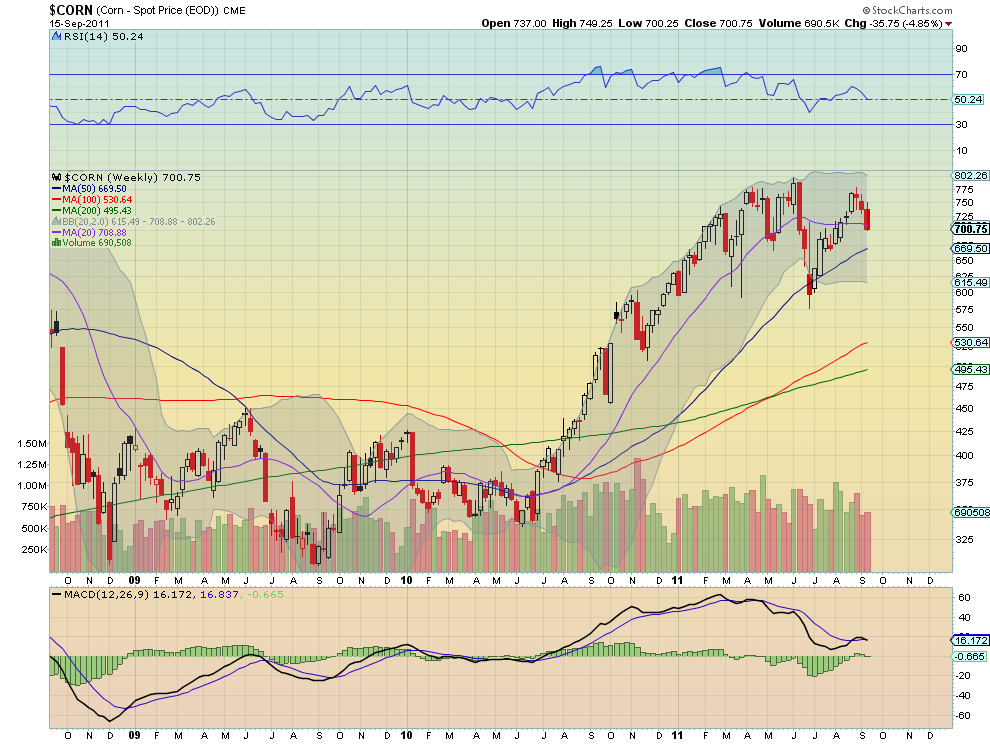
Corn, $ZC_F, had the same run higher that Coffee saw complete with the pullback and push higher again. It also has the acceleration to the downside now, under the 20 week SMA and moving lower Friday at 698 as I write. A push back over the 20 week SMA would help but with the RSI heading lower and the MACD crossing negative it is set up for more downside. A continued fall sees support near the rising 50 week SMA at 663 and below that it has a MM to 556. This same pattern is being played out in the Teucrium Commodity Trust Corn Fund, $CORN, and can be played that way.
Sugar, $SB_F

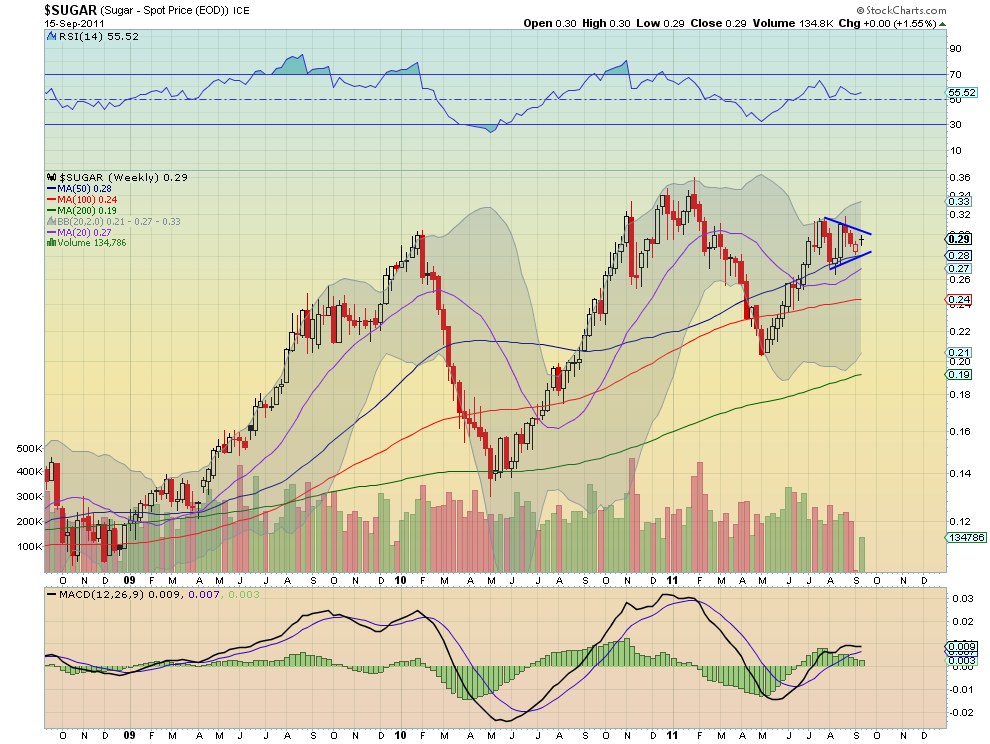
Sugar, $SB_F, had the same run higher from mid 2010 to early 2011 and the pullback and advance, but has been in a tighter symmetrical triangle the last few months. As I write this it is trading at 0.28 which would be close to triggering a break down from the pattern, ad is below the 50 week SMA. The RSI has stalled in the move lower near the mid line and is turning higher for now, but the MACD is fading lower. All the SMA’s are rising though. This looks to go either way. A continued move below 28 triggering the pattern break would see a target of 0.23, under the 20 week SMA but where there is support from April. If the pattern holds the the top rail at 0.30 is resistance and a break above that triggers a target of 0.35, near the previous high from February. This pattern is playing out with the iPath Dow Jones-UBS Sugar Subindex Total Return ETN, $SGG, so it can be played via the equity market as well. In fact, $SGG looks a bit weaker.

Each of these commodities is set up to continue lower, despite the stall and now move lower in US Treasuries. This could be a signal that inflation expectations are moderating. Only time will tell.

Wednesday, July 27, 2011

Sugar rally falters as Brazilian output recovers

by Agrimoney.com

Sugar futures received a – temporary – knock after industry data revealed an improvement in Brazil's output, following a series of downbeat data.
Sugar production in Brazil's Center South region – the biggest producing area in the top producing country – reached 2.58m tonnes in the first half of July, Unica, the cane industry associations, said.
The figure represented an increase of 2.5% year on year, an improvement on the 1.3% pace of increase seen in the second half of June.
The growth was not enough to question expectations that Brazil is on course for its first decline in sugar production in a decade, in part because of a later start to the crushing season this year, but also a hangover from two years of underinvestment which have left the country with ageing cane.
However, it reduced the rate of decline in sugar output so far in 2011-12 to 11%, from a figure of 15% at the close of last month.
'Sugar prices to ease'
The immediate market reaction was to pull sugar futures into negative territory in New York, after an early run which had taken the October contract to 31.47 cents a pound, within an ace of a four-month high.
Indeed, the data acted as a rallying point for bears also banking on an easing in the queues of ships waiting to take on sugar in Brazil, which is also the world's largest sugar exporer.
"Guess now that the news of reduced crop estimates for Brazil have made the rounds, and the delays in loading sugar in the port at Santos are expected to ease, sugar prices will follow," Jurgens Bauer at PitGuru said.
However, futures recovered amid concerns that the disappointing Brazilian output represents a sign of strategic problems, rather than just those related to poor weather.
The underinvestment in cane, which now has an average age of more than four compared with an ideal of less than three, is seen as one major concern, another being the competition for suitable, and accessible, land for expanding productions.
"With the market trending higher, the bears need a 'story' sooner rather than later as Brazil news still seems to favour the bulls," Thomas Kujawa at Sucden Financial said.


Saturday, July 23, 2011

Sugar futures jump on - another - Brazil downgrade

by Agrimoney.com

Sugar prices jumped 5% after Kingsman joined analysis groups cutting forecasts for Brazil's sugar output, blaming the age of the cane following two years of low replanting rates.
The influential consultancy cut by 35m tonnes to 525m tonnes its forecast for cane output in Brazil's Center South region – the top producing area in the main sugar-producing country.
Sugar production was pegged at 31.9m tonnes a figure which, while higher than a 30m-tonne estimate on Thursday from Brazilian consultancy Canaplan, was below the benchmark figure of 32.4m tonnes set by Unica, the cane industry group, last week.
Kingsman's stance was also viewed with particular interest as it has been one of the more upbeat on hopes for the world sugar production surplus in 2011-12, earlier pegging it at 10.6m tonnes.
'Terrible shape'
At Macquarie, analyst Kona Haque said: "The downgrades to Brazilian estimates keep on coming.
"Our colleagues in Brazil say the cane is in terrible shape. It is old, and is not going yield any better going forward," leaving the country on track for its first drop in production in a decade.
Brazil, which is also the top sugar exporter, "is likely not crushing fast enough to satisfy importers."
While Macquarie estimates the world surplus at 5m-6m tonnes in 2011-12, the impact of this in extra supplies from alternative producers such as India was not likely to be felt until November at the earliest.
Raw sugar for October hit 31.55 cents a pound in New York, a contract high, and the best price for a near-term lot since February, before easing to stand at 31.46 cents a pound in late deals, up 5.4%.
In London, white sugar for October closed 4.0% higher at $812.70 a tonne.
Feeling the cold
Kingsman attributed its downgrade to concerns that "the effect to two consecutive years of low renovation rates" in Center South cane planting was "stronger than expected".
Indeed, the low level of resowings - a hangover from the global economic crisis, and its impact on sugar enterprises with stretched balance sheets – "may be exacerbating the impact of the recent frost affecting certain planting areas".
The group noted that this was the second season when a lack of cane, rather than milling capacity, had limited Brazil's sugar output, highlighting too that concentrations of sugar per kilogramme of crop were among the lowest of the last decade.

Saturday, July 16, 2011

Sugar Price Surge Nears Resistance


After peaking in early Feb the drop back in Sugar 11 found a low in May, from whence a recovery got underway. This has made a new high on the front month chart, but certain resistance levels are now not far off.


Friday, July 8, 2011

Sugar prices leap as hopes for Brazil output wane

by Agrimoney.com

Sugar prices exploded, hitting a five-month high in London, amid growing fears for Brazilian sugar output, which is expected to fall for the first time in more than a decade, with rising oil prices seen adding a further kicker.
White sugar for August touched $821.30 a tonne in London at one point, a contract high and the best for a near-term lot since February, before losing some ground to finish at $814.80 a tonne, up 6.1%.
New York raw sugar for October closed 6.7% higher at 29.52 cents a pound.
The rises followed rumours that Unica, the Brazilian cane industry group, will unveil a bigger-than-expected drop in estimate for the crop in the key Centre South region when it unveils fresh forecasts next week. Czarnikow, the sugar merchant, and consultancy Datagro have already cut their estimates.
Unica's current forecast is for Centre South sugar output of 34.6m tonnes.
"The prominent stories on the newswires favour the bulls at the moment as analysts are all revising down the potential output from Brazil," Thomas Kujawa at Sucden Financial said in a note.
"We seem to be in a strong uptrend. Perhaps - I thought I'd never be writing this so early into the Brazil harvest, but - it's safer to buy on a dip."
'Better informed'
The rally was given further momentum by speculation of leaks in the market, after a strong rally in sugar prices last week ahead of Unica data which revealed a surprising fall in Brazilian sugar production at the end of last month.
"It is all the more difficult to go against the tide when you feel it might be being driven by people who are better informed than you," a London trader told Agrimoney.com.
Oil prices, a key influence on a crop tied to ethanol production, added further support by rising 4%, for Brent crude, which soared back above $118 a barrel, helped by retail sales and jobs data indicating that the US economy was in better shape than had been thought.
Tumble ahead?
The jump in prices defied widespread expectations that a significant drop in Brazilian sugar output had already been factored into prices, which were poised for a fall as the impact of an expected production surplus of perhaps 10m tonnes kicks in later in the year.
Rabobank analysts said in a note on Wednesday "in our view, much of the production shortfall has already been priced into the market. Prices should be poised for a correction lower."
And London-based Marex said that while most estimates of Centre South production were now at 32.5m tonnes - down 2m tonnes from previous forecasts, and a fall of 1m tonnes year on year – this was not enough to cause another season of deficit.
"So the main thrust of the bearish argument, that we are entering a period of large surplus, seems to remain intact," the broker said.

Wednesday, July 6, 2011

Brazilian hiccups raise doubts over sugar surplus

by Agrimoney.com

Czarnikow raised doubts over forecasts for sugar's first output surplus in four seasons as the merchant joined observers warning that Brazil was set for its first drop in cane production in more than a decade.
Buyers, who had looked set to regain market power thanks to raised cane and beet plantings in many countries, are "instead once again facing the risk of lower supply" thanks to the setbacks in top producer Brazil, Czarnikow said.
With the country's supplies threatened by lower cane output and logistical hiccups which lifted to 74 the number vessels queuing at Brazilian ports for sugar at the close of last month, has left hopes for an easier world market "entirely in the hands of the northern hemisphere" producers.
And this, largely beet-based, output only starts to hit markets in November, and is "some way from being realised".
"As far as the market is concerned, this raises the question – will the return to surplus once again prove to be illusive," Peter de Klerk, Czarnikow analyst, said.
'Years of underinvestment'
The comments represent a sharp deterioration in Czarnikow's outlook, which last month had foreseen a "sharp rise" in world sugar output in 2011-12 to a surplus of 10.3m tonnes, following three seasons when production had fallen a total of 25m tonnes behind demand.
However, data last week showing that Brazil's sugar output had, in late June, fallen back into year-on-year decline crystallised concerns that the country was set for its first fall in output in more than a decade.
Czarnikow on Wednesday slashed its forecast Brazilian cane output in 2011-12 by 40m tonnes to 535m tonnes, 1m tonnes below a much-cited figure from consultancy Datagro.
The lower prospects reflected "several years of underinvestment" in the sector amid the world economic downturn which now rated, with the 1997 liberalisation of the ethanol market, as one of the major upsets to Brazil's cane industry.
The ageing of Brazil's cane, which has historically been replaced every three years or so, has left "agronomists wary of drawing firm conclusions as they are working with unfamiliar data".
Indian answer?
The merchant also poured cold water on hopes of India, the second ranked producer, filling the gap in raw sugar supplies, saying the country was focused on white sugar trade.
Meanwhile, in Thailand, the second-biggest sugar shipper, has like Brazil found "the ability to get product to the export market to be a problem" thanks to logistical hold-ups.
Nonetheless, raw sugar for October fell 2.1% to 27.01 cents a pound in New York, for October delivery, on profit-taking from last month's rally, and following preliminary clearance by the European Union of alternative sweeteners based on the stevia plant.
London white sugar fell 1.4% to $760.20 a tonne.

See the original article >>

Wednesday, June 29, 2011

Brazil setbacks spur jump in coffee, sugar futures

by Agrimoney.com

Brazilian setbacks spurred jumps in prices of both sugar and coffee futures, which headed a better day for farm commodities after sell-offs of the last two weeks.
Crop futures were firm across the board on Tuesday, helped by improved appetite for risk assets which was also reflected in a decline in the dollar, which fell 0.5% against a basket of currencies.
Gains of 1% in Chicago grains were also spurred by a reluctance by investors to sell ahead of key reports on US grain inventories and sowings due on Thursday.
However, coffee added more than 2% in New York, on reports of frost in Brazil, where data showing surprisingly weal sugar output sent prices of the sweetener up 5% to a three-month high of 29.38 cents a pound at one point.
'Brazilian Clarence Beeks'
Unica, the cane industry group, said that sugar output in Brazil's Center South region - which produces some 90% of sugar in the top producing country – had fallen by 14% year on year in the second-half of June.
Crop prices as at 16:30 GMT
Sugar: 29.20 cents a pound, +5.0%, (New York)
Coffee: 256.75 cents a pound, +2.6%, (New York)
Corn: $6.68 a bushel, +1.1%, (Chicago)
Wheat: $6.31 ½ a bushel, +1.4%, (Chicago)
Prices for July contracts
Data two weeks ago had signalled that Brazilian output was recovering after a weak start blamed on wet weather.
The data confirmed market speculation of a bullish report, which prompted Nick Penney at Sucden Financial to note speculation of a "a Brazilian Clarence Beeks out there", a reference to the character in the film Trading Places who trades secret information on the orange juice market.
"There has been a great deal of short-covering. Telephone lines are buzzing with questions regarding delivery intentions against the July contract."
At Standard Chartered, Abah Ofon also noted, following a three-continents tour of investors, that sentiment was "particularly bullish" on sugar, in part because of the sweetener's use in making biofuels - and the prospect of the US removing tax perks on corn-based ethanol.
Cold talk
Coffee was spurred by reports of frosts in at least two parts of Parana.
Typically, frost damage hurts coffee plants by damaging leaves, so hindering trees ability to grow coffee cherries, meaning it is next year's harvest which would be most badly affected.
Indeed, coffee for July delivery next year rose 2.8% to 266.95 cents a pound, outpacing the 2.6% rise to 256.75 cents a pound in the soon-to-expire July 2011 lot.
Parana vs Minas
Brazilian frosts have a history of supporting coffee prices, notably after a 1975 freeze, which ultimately sent futures to a record high of 337.50 cents per pound. Prices rallied in 1979 too following frost.
However, many plantations have been moved to less frost-prone areas, such as Minas Gerais, since these events.
"It is when it gets cold in Minas that you start the real worrying," Jurgens Bauer at PitGuru said.
"They don't produce as much coffee in Parana, not like they used to."

See the original article >>

Sugar continues to lead rates

by Kimble Charting Solutions


See the original article >>

Monday, June 27, 2011

Retreats in cotton and sugar to set trend - BarCap

by Agrimoney.com

Reversals in prices of cotton, which fell the exchange limit, and sugar on Monday are a taste of things to come, given the ability of India to fill needs of both crops, Barclays Capital warned.
Both crops have defied the reversal in grains, with July cotton closing higher every day last week to gain nearly 14% in New York, where sugar added more than 4%.
However, such strength looks unlikely to last given favourable monsoon outlooks for India, the biggest producer of both crops.
"The recent pick-up in India's monsoon rains, coupled with a surge in plantings, bodes well for production prospects," said BarCap analyst Sudakshina Unnikrishnan, who correctly called the run-up in cotton prices, which hit a record in February.
Furthermore, data from the Indian government, which earlier this month added 1m bales to its cotton export quota of 5.5m bales, had shown farmers having a "strong preference" for planting the fibre.
'Prices to ease'
For sugar too, whose price rise has been accompanied by a rebound in speculative interest, Indian acreage is expected to expand year on year, a revival which helped persuade the government last week to permit a further 500,000 tonnes of exports of the sweetener.
"With India moving further into the export side of the equation and the global market moving further into a surplus, we see significant gains in sugar prices through the second half of 2011 as being capped," Ms Unnikrishnan said.
Many observers have forecast a return by sugar in 2011-12 to a large production surplus, estimated on Friday at 7.8m tonnes by ABN Amro.
"Despite the recent move up, we continue to expect front-month prices for both cotton and sugar to ease through the second half of this year on higher supply prospects," Ms Unnikrishnan said.
Chart signal?
The comments came as prices of both commodities eased on Monday, on a decline blamed in part on broader farm commodity market weakness, with grains suffering another sell-off, which sent corn and wheat down a further 3% in Chicago.
However, cotton's slide was also attributed to a cut from 12% to 6% in Chinese import duties on some cotton products, a move which sent prices on the Zhengzhou exchange down 4.6% for the January lot, which hit a contract low of 22,200 remninbi a tonne at one stage.
Meanwhile, New York sugar fell 0.2% to 27.35 cents a pound for the July contract, which expires on Thursday, while the second-in October lot dropped 1.9% to 25.50 cents a pound, with a potential chart sell sign not helping.
"It may be the case that the inability of the October contract to breach a double top in the charts at 26.31 cents a pound causes a rethink by the speculative community eventually, especially if this level remains inviolate at the July expiry," Thomas Kujawa at Sucden Financial said.

See the original article >>

Funds bet on sugar, cattle amidst grains sell-off

by Agrimoney.com

Investors continued to pile into sugar, and lifted long bets on livestock too, even while slashing their exposure to corn and soybeans to their lowest in about a year.
Large funds cut their net long position in Chicago corn futures to 214,400 contracts as of last Tuesday – down more than 20% in a week and the lowest figure since last summer, official data showed.
Net length measures the advantage of long bets on futures contracts, which gain in a rising market, with the short positions which profit when prices fall.
And with informal data showing sales continued last week - potentially at an even faster rate - funds' net long exposure to corn may have halved in a fortnight.
Assuming daily data last week are correct, large funds "will have come out of another 25+% of their length bringing the total down to around 160,000 contracts", Jon Michalscheck said.
Speculators quit
The decline highlights the extent of the exodus of investors from farm commodity markets in the face of a deteriorating macroeconomic backdrop and improved prospects for many crops too, given a change in much of the northern hemisphere to better weather.
For soybeans, the net length fell by more than one-third to 35,400 lots over the week, compared with figures of some 150,000 contracts earlier in the year.
For Chicago wheat, non-commercial investors increased their – traditional – net short position to the highest for some seven months, meaning more funds were betting on prices falling than rising.
Speculators fuelled the sell-off, with their net long position across the 14 main US crop futures markets falling, in weight equivalent, by 15m tonnes to 53m tonnes, according to Australia & New Zealand Bank.
Back in favour
However, sugar defied the sell-off, seeing net longs by non-commercial investors rise by roughly one-quarter to 95,000 lots, one of the highest levels of the year.
"Speculators continued to increase their exposure to sugar, rising 11,000 to 176,000 contracts," noted ANZ, which uses a broader interpretation of speculator than some other houses in examining investor positioning data from the Commodity Futures Trading Commission, the US regulator.
Sugar prices have proved relatively firm amidst this month's slide in farm commodities markets, amidst concerns for output from top producer Brazil, although they opened weaker in both London and New York on Monday.
Similarly, non-commercial investors also increased net long exposure in Chicago live cattle, whose price has bounced since data showed a slide in US feedlot inventories, and in lean hogs.

Saturday, June 25, 2011

Brazil fears cloud world's return to sugar surplus

by Agrimoney.com

ABN Amro echoed forecasts of a return to a sugar production surplus – but not by as far as some other observers, warning that the threat of disappointing Brazilian production left the market facing "another season of uncertainty".
World sugar output will jump to 169.3m tonnes in 2011-12, well ahead of consumption, pegged at 161.5m tonnes, the bank said.
However, the estimate of 7.8m-tonne production surplus is below some other forecasts, with Czarnikow earlier this month pegging the gap at 10.3m tonnes, and Swiss-based Kingsman expecting a 10.6m-tonne figure.
"It has become more apparent that the 2011-2012 Brazilian harvest will seriously undershoot expectations, and that disappointment will hardly be compensated for by a gradual return of India to export availability," ABN said.
"There is yet another season of uncertainty to negotiate – possibly even more than one," if Brazil's waning sugar productivity, a hangover from a dearth of investment during the world recession, proves "a structural as opposed to a merely transient problem".
'The big question'
The comments follow a weak start to 2011-12 for sugar output in Brazil's Center South region, which is responsible for most of the output in the world's top producing, and exporting, country.
While dryness in May allowed mills to catch up some production lost since February, when frequent rains slowed cane harvesting, this dearth of rain itself will come with a hangover later in the season, in terms of stunting development of the crop.
Raizen, the joint venture between Brazilian sugar giant Cosan and Anglo-Dutch oil goup Shell, warned earlier this month that Center South sugar output could fall to 31.1m tonnes, compared with industry estimates of nearly 35m tonnes.
"The big, and unanswerable, question is - how far will Brazil's cane and sugar output in 2011-2012 drop below initial expectations?" said ABN, whose research is undertaken with the VM Group.
"If the Brazilian harvest does undershoot by as much as 30% consistently throughout the rest of its season, then the price will surely rise further."
'Worries pre-eminent'
The comments came as sugar futures, once again, swung between positive and negative territory in New York, although not as strongly as in the last session, when the July lot slumped 5.6% after India announced consent for an 500,000 tonnes of exports, only to close in positive ground.
"It seems worries about Brazil's output are still pre-eminent," Nick Penney at Sucden Financial in London said.
New York's July contract closed 0.2% lower at 27.54 cents a pound, with London white sugar for August ending up $0.10 at $734.60 a tonne.

Thursday, June 23, 2011

Sugar prices tumble after India lifts exports

by Agrimoney.com

Sugar prices slumped 5% after India's government, under pressure from mills, allowed an additional 500,000 tonnes of unrestricted exports.
The concession fell short of the 1.5m tonnes in shipments that the Indian Sugar Mills Association had been seeking, after stocks reportedly rose above 23m tonnes this month – more than a year's supply.
Even so, the move by the world's second-ranked producer of the sweetener took markets by surprise, initially sending New York's July raw sugar contract down 5.7%.
"This decision was not a given," Macquarie analyst Kona Haque, in London, said.
"Only earlier this week, the government said it was going to wait until the end of the year to release more exports."
'Really strong margin'
Such caution was lent credibility by the government's proven caution over measures which risk stoking inflation, currently running at more than 9%.
However, domestic sugar prices have been on the slide, opening up a discount of some 5,000-6,000 rupees per tonne to international values.
"There is a really strong export margin now," Ms Haque said.
Mills have been especially keen for immediate concessions on exports given the likelihood of a continuing seasonal rise in shipments from Brazil, the top exporter, where the logistical hang-ups which marred trade last year have, thus far, proved less severe this time.
Terry Roggensack, at Hightower Report, said: "Traders see some tightness for spot sugar supply in the next few months. But with most major world producers expecting higher production this year, a global production surplus for the coming year is seen as a longer-term negative force."
Supply boosters
Expectations of a further rise in Indian output in 2011-12 have been lifted by forecasts of a near-average monsoon and a lift in plantings encouraged by higher prices.
Vinay Kumar, managing director of India's National Federation of Co-operative Sugar Factories, on Thursday estimated output at 26.0m-26.5m tonnes, a rise of 8-10% year-on-year, with some estimates as high as 28m tonnes.
Export supplies could also be boosted by improved weather in Europe, which could put it "in a position to allow the export of 700,000 tonnes", Mr Roggensack said, also highlighting a rise in beet sowings in Russia, a major importer.
Raw sugar for July had recovered to 26.31 cents a pound at 14:10 GMT, down 3.4% on the day, with London white sugar for August down 2.0% at $725.50 a tonne.
As an extra depressant to prices, the dollar soared 1.2% after Jean Claude Trichet, the president of the European Central Bank, warned that the Greek crisis was destabilising the eurozone.

See the original article >>

Saturday, June 11, 2011

Sugar Outlook Sweetens


The drop in sugar prices is over. In fact, prices have risen to an eight-week high after news broke that Brazilian production may fall short of expectations. 

My indicators are telling me that sweet prices could get even sweeter.

Here are a few significant factors that could move this market:

India’s export threat has disappeared. For months, sugar prices have been held hostage to the idea that India would regain its position as a global sugar exporter; as India is the second-largest producer. Fearing a rise in domestic prices from a domestic crop shortfall, the country is unlikely to set a new quota until fall. The current gap is being filled by Thailand.

China needs sugar. Sugar imports by China, the second-biggest consumer after India, may advance to 2.3 million metric tons in the year ending September 30. With the export price from Brazil or Thailand about 25 cents a pound, that makes it more attractive to China, even with an import tariff of 50 percent. The higher import volume is 28 percent more than the U.S. government forecast!

The United States is short on sugar. The U.S. Department of Agriculture has projected decreased U.S. sugar supply for 2012 with lower imports offsetting higher beginning stocks and production. A potential drop in home-grown sugar coupled with government caps on imports could drive up prices, just before the peak Christmas season.

A harsh winter has caused headaches for U.S. sugar-cane and sugar-beet farmers. Record cold temperatures in December damaged sugar cane in Florida, taking about 260,000 short tons of raw sugar out of production, according to the USDA.

Currently, soil soaked by snow melt and ongoing cool and wet weather in the Midwest is delaying the planting of sugar beets, the source of more than half of U.S. sugar production. The delays could reduce yields because the sugar content of the root increases the longer it is in the ground

The European Union wants sugar too. A European Union (EU) committee recently voted to open a quota for 200,000 metric tons of duty-free sugar imports into the bloc. EU sugar prices surged to more than 1,000 euros a ton in some places earlier this year as the domestic market suffered a supply crisis that left refiners in Portugal, Greece and Poland struggling to access supplies.

Even Mexico increased import allowances, adding to signs that demand is strengthening.

Sugar’s Brazilian Factor: This pretty much puts control on sugar in the hands of the Brazilians, the primary exporters. But Brazil is not overflowing with sugar either. Conditions have been building up against the sugar crop.

The low sugar prices of 2008 and 2009, the financial crisis impact on capital, and recent unstable weather have all contributed to a financial squeeze on farmers. In turn, the investment in crops is less than it could have been.

Brazilian cane crops are older and less efficient than they should be. Sugar cane is now aged 4.2 years, on average, whereas the ideal would be 2 years of age. Ideally 20 percent to 25 percent of the new crop should be replanted. That’s not happening, so yields are lower.

Once the crop is ready, the main issues are crushing and processing. Today, with the higher use of sugar to meet Brazil’s rising need for ethanol, a larger part of the Brazilian sugarcane is being diverted into ethanol fuel production than in the past. This further diminishes sugar for food availability.

The state of São Paulo, which answers to 70 percent of Brazilian production, should pick 4 million tonnes less than in the previous crop.

Ultimately, the big issue in Brazil may be access to capital for small farmers.

Brazil has the world’s second-highest inflation-adjusted interest rates in part because the government subsidizes lending through BNDES, its national development bank.

Last month, Brazil’s central bank announced a 25 basis point increase to the Selic rate, bringing it to 12 percent from 11.75 percent previously on concerns the Brazilian economy is overheating. This benchmark rate is almost double that of China and India, and 3 percentage points more than Russia’s.

Over time, the nation is planning to cut funding to its state development bank (BNDES) in an effort to bring down rates. But BNDES is a critical engine that runs the Brazilian economy and influences the flow of capital to agriculture.

So it’s not just weather that impacts the price of sugar. When weather strikes a system that is already under financial strain, prices worsen as supply dwindles.

The delay is set to worsen bottlenecks at ports this year as growers rush to ship the sweetener. A record 600 ships loaded sugar last year at Brazil’s Port of Santos, which handles about 80 percent of the nation’s shipments of the sweetener, according to the port’s press office.

This is likely to create a critical situation that would further spike prices in coming weeks. With the delays, more shipments will be concentrated in the July and October contracts, when the lineup tends to be normally much longer.

Markets can be sensitive to news about shipping delays.

Last February, Cosan Ltd (CZZ), which controls the world’s largest sugar-cane processor, along with Royal Dutch Shell (RDS.A), said quarterly profit plunged 83 percent after a cane shortage boosted costs.

Cosan is the largest sugar and ethanol producer in Brazil and ranks third in sugar and fifth in ethanol production in the world. Apart from its core operations, the company is also engaged in energy production from sugar-cane bagasse. CZZ shares fell to a five-month low in response to the disappointment.

In the last week, CZZ shares rebounded on news that recent shipping delays will continue and that world sugar prices are rising. As you know, this is one of my favorite stocks, and I’ll be watching it closely for an entry point at lower prices or news that works as a catalyst to drive Cosan’s valuation higher.

See the original article >>

Tuesday, May 31, 2011

Sugar Commodity Price Bounce Getting Underway


2011 has so far favoured the bears in Sugar, following the test of a long term Fibonacci level which provided strong resistance. Certain supports have been reached, or neared, which suggest a recovery phase is in the offing.


See the original article >>

Wednesday, May 25, 2011

Sugar futures 'better bet' than cocoa or coffee

by Agrimoney.com

Sugar looks a top bet among soft commodities, given that markets have already fully priced in the prospect of easier supplies – unlike for cocoa or coffee, Commerzbank analysts said.
The German bank, in the latest of a spate of bank briefings on commodity markets, forecast that arabica coffee prices "should retreat slightly initially, and then more pronounced" if fears of frost in Brazil go unrealised and the harvest in the top producing country lives up to high expectations.
"Arabica prices at around $3 a pound are exaggerated and not sustainable," the report said.
Cocoa prices, meanwhile, have further "downside scope" as exports resume from the Ivory Coast, the main producer of the bean, following the lifting of a ban imposed by Alassane Ouattara during his – successful - fight to claim the presidency won at elections last year.
'Exaggerated correction'
However, a fall of nearly 40% in sugar prices, since hitting a 31-year high of 36.08 cents a pound in February, appears "exaggerated", given the threats remaining to world production.
Supply prospects have improved, thanks to better hopes for Thailand's output which, at 9.6m tonnes looks set to trounce the previous record, and a weak start to Brazil's 2011-12 harvest appear reflect a timing issue rather than an underlying threat.
But Commerzbank cautioned over overoptimistic estimates for 2010-11 output in India, the second-ranked sugar maker, after the Indian Sugar Mills Association clocked the country's production at 24.2m tonnes, more than 2m tonnes below some other forecasts.
And flooding earlier in the year would limit Australia's rise in output to 300,000 tonnes, taking it to 4m tonnes.
'Room for disappointment'
"The good news from the supply side should be priced in already," the report said.
"There is room for disappointment regarding crop prospects in the upcoming months. Similar to last year, prices should therefore rise in the course of the year after the decline in spring."
The bank forecast the price of New York sugar, as measured by the near-term lot, averaging 25.0 cents a pound in the July-to-September period, and 26.0 cents in the last quarter of the year.
The spot contract, currently for July delivery, stood at 22.10 cents a pound at 10:00 GMT, up 0.9% on the day.
Coffee for July was 0.4% up at 262.35 cents a pound, with July cocoa up 0.1% at $2,887 a tonne.

See the original article >>

Saturday, May 14, 2011

Dilemma for Brazil mills as sugar moves to surplus

by Agrimoney.com

Czarnikow has added its voice to those forecasting a return by the sugar market to surplus in 2011-12, potentially pressuring prices – and handing a dilemma to mills in Brazil, the top producer.
The sugar merchant said that world sugar production would, after three successive seasons of deficit, return to exceeding consumption, a forecast which echoes similar assessments from many other analysts.
The forecast came shortly before the International Sugar Organisation estimated the 2011-12 surplus at "more than" 3m tonnes.
Kingsman, the Swiss-based consultancy, on Thursday hiked its forecast for the world sugar surplus in the marketing year, which it runs from April to March, from 5.607m tonnes to 10.575m tonnes, after a deficit last season it pegged at about 100,000 tonnes.
Czarnikow said that the return to surplus would be driven by a "surge" of 10m tonnes in world production – driven this time by other countries as well as Brazil, which accounted for nearly half growth in output last season.
Brazil's output growth will slow to 1.5m tonnes, although this will be enough to ensure that its exports this season are "the largest on record", including 25m tonnes from the important Centre South district.
Total Centre South production is estimated at 35m tonnes, from cane harvest up 3.3% at 575m tonnes.
To cut, or not to cut
However, the potential jump in output presents a dilemma to Brazilian mill, over whether to stick with plans that many had to build up their cane harvest later, when a more mature crop will offer greater sugar yields, or to cut now, while prices remain high.
The yield penalty from early harvest of cane - which, with its average age raised to 4.2 years by low replanting, is considered past maximum potential - was evident in data from industry group Unica on Thursday showing sugar content so far this season down 11.3% to less than 100kg per tonne of cane.
Later-harvested cane tends to provide a higher sugar concentration.
But prices are offering mills "every incentive to capture high early-season returns", with domestic sugars trading at the equivalent of more than $0.30 a pound "and strong spot physical premiums for prompt exports", Czarnikow said.
If global plans to raise sugar output succeed, "the chance of prices staying high seems quite remote".
Financial squeeze
As an extra complication, Brazilian mills face political pressure for production of ethanol, rather than sugar, from cane, following a domestic shortage which has driven many motorists to favour gasoline, and the country to import the biofuel.
Furthermore, many mills are, despite high prices, still recovering from the global financial crisis.
A squeeze on investment is behind a reluctance to replant cane on cane plantings, and a fall to five in the number of mills that Unica expects to open this season.
"With much at stake, it will be interesting to see how the industry evolves and adjusts," Czarnikow said.

Sugar maket to return to surplus - and stay there

by Agrimoney.com

The sugar market is unlikely to return for at least the next two seasons to the kind of deficits which sent prices to multi-decade highs, the International Sugar Organisation said, as it joined a rash of observers on market forecasts.
Sugar production will exceed consumption "more than 3m tonnes" in 2011-12, the influential intergovernmental group said in its first forecast for the season.
And the ISO forecast a further "modest" surplus, of 1m-1.5m tonnes, for 2012-13, despite expecting a slowdown in growth in Brazil, the top producer, where cane yields are suffering "due to a further ageing of the cane [and an] increase in harvest mechanization".
The prospects of continued world surpluses meant that "at present, the possibility of the return of the large scale deficit seen by the world sugar market at the end of the previous decade looks rather remote".
On ISO estimates, which are based strictly on an October-to-September crop year, the world sugar production deficit totalled 15m tonnes over 2008-09 and 2009-10.
Data torrent
The ISO's forecast comes amid a rash of sugar data, with Kingsman, the Swiss-based analysis group, on Thursday near-doubling its forecast for the 2011-12 surplus, pegging it at 10.575m tonnes. Kingsman uses an April-to-March crop year, which avoids cutting through the Brazilian sugar season.
London-based sugar merchant Czarnikow forecast a "return to surplus" without naming a figure.
Also on Friday, the Indian Sugar Mills Association cut its estimate for 2010-11 output in India, the second-ranked producer, by 800,000 tonnes to 24.2m tonnes.
Late on Thursday Brazilian industry association Unica revealed a 69% slump to 795,000 tonnes in Brazil's production so far this season, a decline reflecting a weaker sugar content in cane, besides the lack of crop left uncut from the previous harvest, as there was a year ago.
The ISO estimated world consumption in 2011-12 growing by 3.7m tonnes to 169.8m tonnes, but production rising by 3.4m tonnes in Brazil, and by "not less than" 1.5m tonnes overall in Belarus, Russia and Ukraine.

Friday, May 6, 2011

Sugar price correction 'could be close to ending'

by Agrimoney.com

The sugar price correction may be close to running its course, Rabobank analysts said, even as futures in the sweetener set a fresh eight-month low amid a broad commodities liquidation.
New York's near-term futures contract, for July delivery, at one point hit 20.50 cents a pound on Thursday, down 40% from a 30-year high hit in February as the sell-off in raw materials continued.
However, while prices could fall below 20 cents a pound, such a fall would not be "sustainable", Rabobank analysts said, ruling out a drop to the levels of 13 cents a pound reached a year ago.
"Despite the current downward inertia, further price corrections could be tempered."
'Compelling case to buy'
One reason for hope was the dearth of speculators with long positions in the crop, meaning pressure from liquidation on that front was limited.
The net long position in New York sugar futures held by managed funds, a proxy for speculators, has fallen by 37% in five weeks to the lowest since March 2008, regulatory data show.
While speculators may continue to sell, they may come up against increasing buying pressure from investors viewing lower prices as a "buying opportunity".
"As many investors want to take advantage of emerging market demand in commodities and use commodities to hedge against inflation and currency fluctuations, there could be a compelling case to buy sugar," Rabobank said.
Incentive for an incentive
A second was the shape of the futures curve which, in pricing March 2012 futures well above those of October next year, was suggesting that "the market may be more concerned about supply next year", in providing an incentive for buyers to delay purchases.
The relative pricing "suggests that while supply is currently abundant, worries persist about the fundamental balance sheet", the bank said.
Indeed, high prices were needed to encourage sugar output in 2012-13 to underpin supplies.
"It is important that prices do not fall below levels that would discourage sugar production, whether that means the planting of sunflower instead of beet in Europe, cavassa instead of cane in Thailand, or production of ethanol instead of sugar in Brazil," Rabobank said.
"In our view, the low end‐price level that will ensure adequate inventive for suppliers in the new year is near the 20 cents a pound level."
'End of a bull run'
The decline in sugar prices has been attributed to improved hopes for supplies, with Thailand, the world's second-ranked sugar exporter, expected to achieve record output of 9.0m tonnes in 2010-11.
Indonesia is forecasting a 16% rise to 2.6m tonnes in sugar output, while top exporter Brazil is gearing up for peak production.
ABN Amro said that the sugar market "has the feeling of coming to the end of a bullish period".
New York's July contract stood at 21.00 cents in late deals, down 1.6% on the day. London white sugar for August closed down 1.7% at $582.30 a tonne.

See the original article >>

Wednesday, April 27, 2011

Commerzbank downgrades sugar as supply fears ease

by Agrimoney.com

Commerzbank cut its forecast for sugar prices, citing the prospects of easier sugar supplies, heightened by an estimate that Russian output of the sweetener may rebound 40% to a record high this year.
The bank cut its forecast for sugar prices in the April-to-June quarter by 2 cents to 25 cents a pound, an estimate which, while in line with current values, suggests further weakness to come.
"This is a quarter average and we had higher prices earlier on," with New York's near-term May lot starting the month above 27 cents a pound, Commerzbank analyst Carsten Fritsch told Agrimoney.com.
"There is a risk that prices will decline further," echoing last year, when a price correction continued from February into May.
However, the bank urged some caution too, noting that in 2010, when prices dipped to 13 cents a pound, "a substantial market surplus was also expected", only to evaporate amid a series of weather setbacks.
'Significant easing'
The price downgrade reflected "increasing reports of a significant easing" in world sugar supplies, with India considering permission for further exports, after the release of 500,000 tonnes last month, once final production figures are known.
Meanwhile, Thailand, the second-ranked exporter, is placed for a 40% rise to 6.7m tonnes in shipments, after an increase to 9.5m tonnes in output, according to official data.
And Lanworth, the US consultancy, on Tuesday lifted by 11m tones to 585m tonnes its forecast for this year's cane harvest in Brazil, the top sugar producer and importer, citing increased soil moisture.
Brazil's sugar output looks on course to hit 37.8m-42.4m tonnes in the newly-begun harvest, up from 37.6m-38.6m tonnes last year, Lanworth said.
Russian recovery
Furthermore, a report late on Tuesday from US Department of Agriculture attaches in Moscow forecast a 40% jump to 30m tonnes in Russia's sugar output, based on a forecast of plantings reaching an all-time high of 1.2, hectares, and a better year for yields after last year's worst drought on record.
"Russian sugar beet production is expected to rebound strongly in 2011 and effectively displace a significant portion of raw sugar imports," the attaches said in a report.
Russia's imports, which have been encouraged by a temporary cut to $50 a tonne from $140 a tonne in duties until the end of this month, will fall by one-third to 2.0m tonnes, the lowest since at least Soviet times.
The report also highlighted industry expectations that investment in Russia's sugar plants will grow from 14bn roubles ($460m) last year to 15.8bn roubles ($526m) in 2012, helped by government subsidies.
"Almost half of the sugar processing plants in Russia were built before 1917, and none have been built in the last 25 years," the briefing said.
"Sixty percent of processing equipment is worn out."

Monday, April 25, 2011

China "imported enough sugar to ensure 2011 supply"

By Niu Shuping and Tom Miles

China's 2010/2011 sugar output is expected to slip this year to 10.5 million tonnes, down from 10.74 million tonnes last year, but the government has already stocked enough imports to cover any deficit, an industry website quoted government officials as saying on Monday. 

"We have already imported quite a volume to replenish reserves, far more than needed to cover the deficit in producing areas, and also enough to ensure the supply for the current year," said Liu Xiaonan from the National Development and Reform Commission, the government's top economic planning body. 

But Liu did not say how much China had imported for its reserves and, without supporting figures, it was unclear how the government could have covered a deficit that some analysts estimate at 3 million tonnes. 

In December China's Commerce Minister Chen Deming said China would import to shore up its reserves of sugar, meat and other staples. [ID:nTOE6BL05Q] 

But in the first three months of this year, sugar imports totalled only 79,000 tonnes, suggesting little change in the government's stockpiles of imported sugar since Chen's speech. 

That compares to record imports of nearly 1.8 million tonnes in 2010, which must have included about 800,000 tonnes of government buying, based on the quotas available. Private buyers are only entitled to 30 percent of China's 1.945 million tonnes of annual import quotas, leaving the government with 1.362 million tonnes of quotas in addition to up to 400,000 tonnes via a government-government deal with Cuba. 

The window for imports was open because import prices were currently lower than local prices, Liu told a national sugar conference in Kunming, according to a transcript of his speech posted on an industry web site (www.gsmn.com.cn). Liu, in an effort to calm rising prices, warned merchants and mills not to hoard sugar and said that higher prices could spur use of more substitutes. China's sugar consumption may not increase as much as earlier expected and may even be flat or lower than in 2010, he said. He did not give any numbers.

The government has already released 760,000 tonnes from reserves during the current marketing year, which started in October, as part of efforts to tame food inflation after sugar prices <0#CSR:> hit record highs. 

The sugar market was in the sights of a government crackdown in the last months of 2010, along with corn, cotton and rubber, after speculative cash poured into Chinese futures and threatened to drive up wider inflation. 

Worries about supply pushed global prices to a 30-year high in February, but subdued demand and receding supply concerns later pushed the market down by about 30 percent. 

But long-run growth in Chinese consumption and imports "should ensure that the trough in the current global sugar price cycle remains higher than levels experienced following previous price spikes", analysts from the Commonwealth Bank of Australia said in a note to clients. 

Australia and New Zealand Banking Group Ltd said last week that China could import up to 1.8 million tonnes within the next three or four months to capitalise on weak prices, especially from Brazil [ID:nL3E7FI0G8] 

"We anticipate an elevated level of sugar imports into China this year with domestic production likely to stay weak for a second consecutive year due to adverse weather impacting Guangxi," the largest sugar region, said Barclays Capital in a written report. 

Wang Ge, a divisional head from the Agriculture Ministry's crop department, forecast this year's crop at 10.5 million tonnes and said the government wanted to maintain self-sufficiency in sugar at about 85 percent, with imports at the current rate of about 2 million tonnes. 

But Liu Hande, head of the Guangdong Sugar Association, forecast a wider deficit of 3 million tonnes, with output of 10.4 million-10.5 million tonnes and consumption of more than 13.5 million tonnes. 

Liu said despite record sugar prices, farmers were not willing to expand sugar acreage by a big margin due to limited farmland and higher labour and production cost. 

China's sugar acreage has remained steady at about 28 million mu (1.87 million hectares) over the past few years. Low-yield strains coupled with low efficiency have contributed to difficulties in raising output, Wang told the conference. (Reporting by Niu Shuping Tom Miles; Editing by Jonathan Hopfner and Ken Wills)

See the original article >>

Follow Us