Showing posts with label corn. Show all posts

Sunday, September 18, 2011

Commodities May be Forecasting Lower Inflation


Inflation expectations impact Commodities. After recent runs higher some of these high flying commodities have been getting hit a bit lately. Some of this would be expected with the run up in US Treasury prices, dropping yields, acting similarly to squelching some inflation expectations. But that aspect may have run its course as Treasuries stall this week. So what do the charts say now about Coffee ($KC_F), Corn ($ZC_F), and Sugar ($SB_F)? And do they give a clue about inflation expectations? Let’s take a look.

Coffee, $KC_F

Coffee, $KC_F, had a massive run higher from June 2010 until May of this year. Since it has pulled back and then attempted to move higher again. The weekly chart above shows it now pulling back to the 20 week Simple Moving Average (SMA) at 2.61 as of Thursday close and it is dropping further Friday, at 2.58 as I write this. The Relative Strength Index (RSI) sloping lower and the Moving Average Convergence Divergence (MACD) crossing negative support more downside. Look for a continuation lower that may find support at the rising 50 week SMA, but if not then a target on the Measured Move (MM) to 2.13. Coffee has been inversely correlated to Coffee stock like $GMCR, $CBOU, $SBUX and $PEET so watch them for more upside if the decline continues.
Corn, $ZC_F

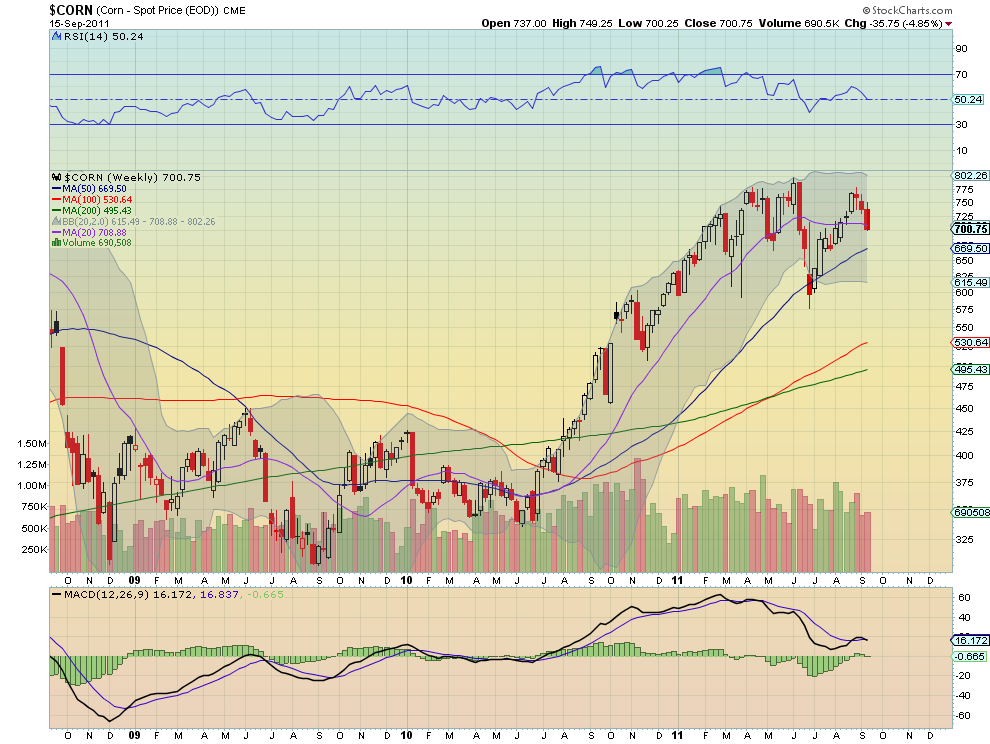
Corn, $ZC_F, had the same run higher that Coffee saw complete with the pullback and push higher again. It also has the acceleration to the downside now, under the 20 week SMA and moving lower Friday at 698 as I write. A push back over the 20 week SMA would help but with the RSI heading lower and the MACD crossing negative it is set up for more downside. A continued fall sees support near the rising 50 week SMA at 663 and below that it has a MM to 556. This same pattern is being played out in the Teucrium Commodity Trust Corn Fund, $CORN, and can be played that way.
Sugar, $SB_F

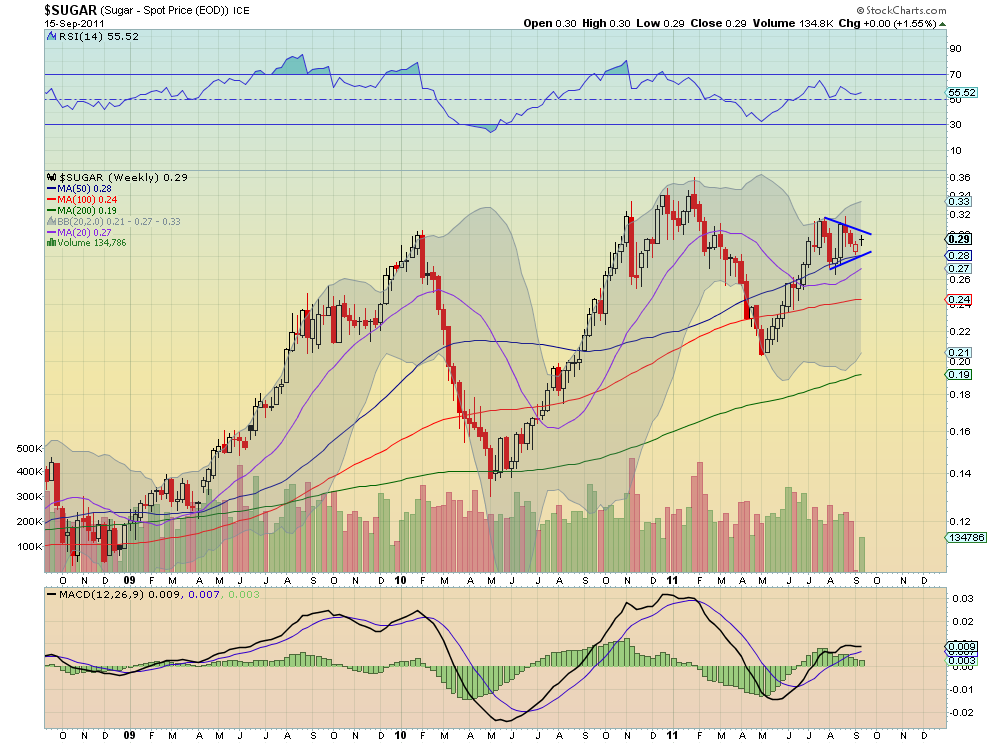
Sugar, $SB_F, had the same run higher from mid 2010 to early 2011 and the pullback and advance, but has been in a tighter symmetrical triangle the last few months. As I write this it is trading at 0.28 which would be close to triggering a break down from the pattern, ad is below the 50 week SMA. The RSI has stalled in the move lower near the mid line and is turning higher for now, but the MACD is fading lower. All the SMA’s are rising though. This looks to go either way. A continued move below 28 triggering the pattern break would see a target of 0.23, under the 20 week SMA but where there is support from April. If the pattern holds the the top rail at 0.30 is resistance and a break above that triggers a target of 0.35, near the previous high from February. This pattern is playing out with the iPath Dow Jones-UBS Sugar Subindex Total Return ETN, $SGG, so it can be played via the equity market as well. In fact, $SGG looks a bit weaker.

Each of these commodities is set up to continue lower, despite the stall and now move lower in US Treasuries. This could be a signal that inflation expectations are moderating. Only time will tell.

Friday, August 12, 2011

US corn woes to lift futures 'to record highs'

by Agrimoney.com

Corn prices are to challenge record highs set in June, boosted by the downgrade of the US crop which has left the world facing its tightest supplies of coarse grains on record.
The US Department of Agriculture's 556m-bushel downgrade on Thursday to its estimate of the American corn harvest this year made it "increasingly likely that Chicago corn prices could test" their June 10 record, when the spot contract hit $7.99 ¾ a bushel, Rabobank analysts said.
"Although farmers have clearly responded to record-high prices through increased corn plantings, the adverse weather is likely to extend the current elevated prices," the bank said.
The USDA, explaining its corn crop downgrade, said that "unusually high temperatures and below average precipitation during July across much of the Corn Belt sharply reduced yield prospects", with drought in the South raising expectations for abandoned crops.
'Critically tight'
At Commonwealth Bank of Australia, Luke Mathews said that "extremely tight" supplies of the grain highlighted by the revision meant corn futures "are likely to test, if not exceed, the June record high"
The cut to 714m bushels in the USDA estimate of domestic corn stocks at the close of 2011-12 "should continue to support near-record corn prices", he added.
Furthermore, with estimates for US barley and sorghum harvests also cut, the country's level of feed grains looked "critically tight", putting a squeeze on global supplies too.
The ratio of global carryout stocks of coarse grains, as a proportion of use, implied by the data was – at 12.8% - "the tightest on record".
Ethanol factor
Rabobank added that, while the USDA also cut estimates for domestic corn consumption and exports, as high prices ration demand, futures may have to go higher still to deter the bioethanol plants who consume nearly 40% of American production.
"[It] would require corn prices in excess of $7.50 a bushel to make ethanol production unprofitable at current ethanol prices," the bank said.
Chicago's December corn contract stood at $7.12 ¼ a bushel in early trade on Friday, down 0.3% on the day.
Ethanol for December delivery closed up 2.2% at $2.591 per gallon on Thursday.


Thursday, August 11, 2011

Big cut needed to US corn estimate to lift prices

by Agrimoney.com

US farm officials need, in one of the key crop reports of the year, to cut their estimate for the domestic corn yield by well over 3 bushels an acre to restart the rally in prices of the grain.
Traders - who have for weeks been speculating over the corn yield estimate in Thursday's US Department of Agriculture monthly Wasde crop report - believe on average that the forecast will be cut by 3.1 bushels per acre to 155.6 bushels per acre to reflect damage from July's heatwave.
Official meteorologists this week confirmed that July bought Oklahoma and Texas their warmest months on record and, crucially, in the US as a whole the "heatwave was characterised by unusually warm minimum temperatures, during nights and early mornings" – a particularly negative feature for pollinating corn.
The proportion of US corn rated in "good" or "excellent" condition has, over the last four weeks, fallen from 69% to 60%, with some of the big growing states seeing even bigger declines. In Illinois, the figure has dropped from 67% to 50%.
However, a downgrade in the USDA yield estimate at least as large as the market consensus suggests has already been factored into prices, analysts believe.
Trigger points
"We have dialled in a yield of about 155 bushels an acre," Don Roose, the president of Iowa-based broker US Commodities told Agrimoney.com.
"A yield figure of 153 or less and we would be up the limit," meaning a rise of the maximum $0.30 a bushel that the Chicago exchange (currently) allows on corn.
"A figure of 160 bushels per acre, and we would be down the limit."
Jerry Gidel, at North America Risk Management, estimated that a figure of 152 bushels an acre below "means we would not trade for two days" – meaning two sessions of limit-up prices.
Likely to be underwhelmed
At Australia & New Zealand Bank, Paul Deane estimated that a figure of 155-156 bushels per acre had been accounted for, saying that it would take a cut of at least 6 bushels an acre to foster a jump in prices.
"We think this is unlikely at this stage in the season, and so maintain the view that the market is likely to be underwhelmed by any [yield] changes," he added.
US Commodities believes that the estimate could easily be kept at 158.7 bushels per acre, noting that the majority of the crop, situated above a line represented by Interstate 80, had fared significantly better than that below.
"The question is did the better conditions to the north make up for the problems in the south?" Mr Roose said.
Data doubts
The impact of the yield figure on prices will also be complicated by a review the USDA is undertaking of its acreage forecasts in some states which suffered a particularly wet spring, with Mr Roose estimating a potential cut of 200,000 acres to corn plantings, and 300,000 acres to the soybean figure.
However, it also clouded by doubt over the likely accuracy of the USDA data, following a series of estimates which have been deeply questioned by traders.
"Industry believes that corn is in real trouble on yields due to a too wet spring planting season and the fourth hottest July in history," Tim Hannagan at PFGBest said.
"But the trade also believes the USDA is behind on its crop condition surveys and may not give a accurate yield estimates on corn, and that it may take until September or even harvest results on the October report for the true story."
Bearish risk
Sure, the report is the first of the growing season to be based largely on field observations, rather than estimates drawn from surveys and projections - but this does not necessarily mean it will give an accurate figure.
"This is not really the time of year that you get good yield estimates," Mr Gidel said, noting that they can still drop dramatically by harvest, as last year, when it fell from an estimate of 164.7 bushels an acre to a final figure of 152.8 bushels per acre.
Furthermore, the USDA will be using average data on issues such as ear weights to form its yield forecast, an issue some traders believe may end encourage a yield overestimate, given that is the potential for ear formation, rather than the density of plants, which is seen as the issue.
"If the USDA does end up using the five-year average ear weight, rather than what may actually be out in the field, it's possible the numbers could be construed as bearish as plant population was most likely on the heavy side for the majority of the Corn Belt," Jon Michalscheck at Benson Quinn Commodities said.
'Intolerable for the balance sheet'
Thursday's report will also be scoured for its estimate on the soybean yield, with traders, on average, expecting the USDA to trim its estimate for the figure by some 0.6 bushels per acre to 42.8 bushels per acre.
"A 42.8 bushels per acre yield, coupled with a 400,000 decrease in planted acres which could eventuate from the resurveyed states is probably intolerable for the balance sheet," signalling higher prices needed to ration demand, Victor Thianpiriya at ANZ said.
However, some analysts believe that the USDA may even raise the yield estimate, with the critical period for soybeans ongoing, and the crop heading into it without the damage suffered by corn.
The proportion of US soybean rated good or excellent is, at 61%, down a more modest three points over the past four weeks.

Friday, July 29, 2011

Corn, Soybeans Trading Weather Now until Augu


Market volatility is a regular feature of the grain and oilseed market this growing season and according to an Ohio State agricultural economist it will remain so until at least the next USDA production reports due in mid-August.
 
"Since the July reports, we've been in a straightforward weather market," said Matt Roberts , Ohio State University Extension economist and associate professor in the Department of Agricultural, Environmental and Development Economics. "We know planting progress was very slow this spring, which created a lot of concern about progress of development. Then the second and third week of July turned extremely hot across the country."
 
Concerns about heat- and moisture-related stress across the Corn Belt have traders as mindful as ever of Mother Nature, particularly because from a supply and demand standpoint, the markets are extremely tight.
Roberts said any major hiccup in production would likely mean higher prices for corn.
 
"Most of the country had adequate moisture because of the wet spring, but it turned extremely hot and humid during pollination so there was a lot of concern for the corn crop," he said. "We saw poor root structure, poor stands, and very patchy fields, especially in the Eastern Corn Belt."
 
With the variability of planting dates for Ohio corn, pollination has already occurred in some fields, and yet to occur in others, meaning weather will remain a factor for several weeks to come. For soybeans, August is a critical month to monitor weather-related plant stress.
 
"As crop conditions have continued to slowly deteriorate over the past few weeks, it's really focused a lot attention on the August reports," Roberts said. "Those reports will be the first that USDA attempts to actually forecast yield for the upcoming crop, based on a survey of over 1,000 sites across the country. Because of the tightness in the market, any shortfall in yield will be reflected by sharply higher process."
 
He noted that winter wheat has largely held with corn in recent weeks, while spring wheat has traded at a historical premium due to lower plantings resulting from the wet spring weather. In terms of soybeans, while the market has traded alongside corn to this point, it should move into a weather market of its own through August.
 
Corn traders are eagerly awaiting August 11, when USDA releases its latest World Ag Supply Demand Estimates, based on the first field survey data of the year.
 
"I think the market is beginning to expect that we're not going to hit that 158-bushel number," Roberts said. "If that's the case, then prices need to be at a level to ration out consumption. We do not have excess inventories, so if we don't hit 158, consumption will have to decline and prices will have to ration out the available inventory."
 
He recommended that farmers look at their new crop marketing plans and take advantage of opportunities where they exist. For the most part, he said old crop stores should already be sold.
 
"The first thing is on corn, if you can, leave basis open," Roberts advised. "I think we're going to have great basis opportunities next year just like we did this year. Basis improvements could be significant."
 
He also suspects the market will facilitate a "nice run-up" going into the August reports, which could present an opportunity to market some of the new crop. Given the production challenges facing Ohio farmers, however, he noted that many producers likely will wait to learn more about the crop in the field before being overly active in the marketplace.
 
"After those reports we'll likely see some weakness moving into harvest," Roberts said. "When we start getting harvest data in, that's when the market will start to pick a direction as we get an indication of how big the crop is, actually."

Wednesday, July 27, 2011

High corn prices may put brakes on 'soy surge'

by Agrimoney.com

Corn may make a fightback in the battle of the acres against soybeans in South America, as high prices – which have risen above even Chicago levels – encourage farmers to rethink the "soy surge".
Soybeans have been on a winning streak in South America for decades, overtaking corn for sown area in Argentina in the 1980s and now accounting for five times as much land, driving the country to third place among exporters of the oilseeds.
In Brazil, the region's top grower of both crops, soybeans took the lead 14 years ago, and now take up roughly twice the area.
Brazil-based crop consultant Kory Melby said that this "soy surge", which has encompassed 1.9m hectares nationally over the last three years, was "related to cost of production and risk management strategies".
Soybeans vs corn and wheat
However, Mr Melby also noted that "corn prices domestically are very strong", trading at a premium to Chicago futures, with the Brazilian market lifted by a disappointing safrinha crop, besides srong international values.
Oil World, the analysis group, said that the "sharp" increase in prices was likely to spur extra sowings of the grain in southern and central areas, "as farmers are responding to the improved profitability of corn production".
Indeed, in South America as a whole "further growth of soybean plantings in 2011-12 will be threatened by increased competition from corn and wheat", the group said.
China factor
In Argentina, sowings faced a longer-term impetus too, assuming talks with Beijing over opening corn exports to China bear fruit.
"It is expected that Argentina will benefit considerably from rising Chinese corn import requirements in the years ahead," Oil World said.
"This is likely to improve the attractiveness of corn growing and thus implies increased acreage competition for soybeans in Argentina."
Fight for dirt
The prospect of an intense so-called "battle for acres" between the grain and the oilseed echoes that witnessed in North America earlier in the year – a fight won by corn, despite a poor early spring seeding period.
US corn sowings are currently estimated up 4.1m acres year on year to their second-highest since World War II, in part at the expense of soybean, whose plantings are believed to have dropped by 2.2m acres.

Monday, July 25, 2011

Is Corn Being Replaced By Wheat?


It seems that the market has done its job for at least the time being. Corn prices rose to significant enough levels to curb enough demand this summer that supplies appear to be adequate enough for the remainder of this marketing year. But that brings on a new set of problems and weather remains the determining factor in success or failure.
 
"I think we’ve successfully rolled the problem of tight stocks from old crop to new crop. There is some discussion that we’re below trendline now, and I think we’ve priced in about 157-158/bu. acre national yield. If we keep the heat in here, as good as the crop is in Iowa, Illinois and Nebraska, we could hurt it at night like we did last year."
 
 
That concern is dark respiration and the fact that corn essentially get a chance to rest during the night when overnight temperatures remain too high. The plant’s energy is then spent trying to cool itself down rather than producing kernels of corn. That was the case last year and yields were lower than normal, Gulke says. It’s still too early to say if it will be a problem this year or not, but the heat wave of 2011 isn’t doing this crop any favors right now.
 
There is anticipation that crop ratings will drop again on Monday and how much will they drop? They dropped 3% last week before we had that real hot weather this week."
 
Futures for all grains and soybeans moved mostly sideways in futures trading this week. Following rains late in the week, they opened lower on Friday, which would have brought prices for the week lower. The only old crop month remaining on the CBOT for corn did close lower for the week, but new crop closed mostly even on the week as fears over the heat dome mounted throughout trading on Friday, Gulke says.
 
Wheat prices and corn prices are becoming more tied as the limited corn supplies are causing livestock feeders to look at wheat as an alternative feed. "We’re talking to more of our clients recently who are shifting to wheat for feed," he says. "One of our clients who runs a mill in California said recently that we wouldn’t believe how much wheat they are importing for feed. And he says it didn’t start a week ago…it started 2-3 months ago."

Saturday, July 23, 2011

Official corn and soy harvest estimates 'too high'

by Agrimoney.com


Lanworth, the analysis group which draws crop estimates from satellite data, has pegged the US corn harvest 570m bushels below government estimates, warning of weather damage and lower sowings than officials are counting on.
The prominent consultancy, which was also more downbeat that the US Department of Agriculture on prospects for the country's soybean output, said that yields of both the oilseed and corn would come in close to trend in the important agricultural states of Illinois, Iowa and Nebraska.
However, surrounding areas would see losses of 7-9%.
"The largest losses are expected in the eastern Corn Belt, where historically delayed planting under wet conditions has been followed by hot and dry conditions, and in drought-affected Southern areas," Lanworth said.
"Imagery confirms extremely low vegetation density in eastern Indiana, central and southern Kansas, northwest Ohio, and southern Michigan."
Harvest estimates
Corn sowings were, on a harvested basis, pegged at 83.99m acres for corn, some 900,000 acres below the USDA figure.
The data led to a production forecast of 12.90bn bushels, below an official forecast of 13.47bn bushels.
For soybeans, the estimate for harvested acreage was pegged bang in line with the government expectations, although a production figure of 3.07bn bushels was 158m bushels below the USDA forecast.
The estimates, from a consultancy with a solid forecasting reputation, come at a time when supplies of both crops are already expected to be tight, and were attributed for supporting futures prices on a day when forecasts for rainier weather might have been expected to encourage selling.
"It could be why markets have been reluctant to pullback much even with rain falling in Chicago," a US broker told Agrimoney.com.


Thursday, July 21, 2011

Weather isn't the only decider for corn prices

by Agrimoney.com

Has corn's rally run out of steam?
The grain's upswing on forecasts for hot weather, an uptick which brought Chicago's best-traded December contract 7.5% gains last week, has certainly slowed. On Wednesday, the lot fell for the second time in three sessions.
It could be that the contract has peaked for now, and could even be in for a tumble which lasts into harvest if weather forecasts change for the better.
But that doesn't mean that bears hold all the cards.
Losses containable so far?
Sure, weather damage as currently assessed does not look serious enough to warrant a fresh crack at record prices.
Corn's prospects have suffered from a hot weather blow in a sensitive spot – pollination. But the maths suggests that's well covered by current price moves.
Plug in a figure of 156 bushels per acre - the midpoint of the range of between 152 bushels per acre and 161 bushels per acre that Agrimoney.com has heard about – and the harvest comes in at 13.2bn bushels, using the US Department of Agriculture's latest acreage forecast.
While that's 230m bushels fewer than USDA officials are currently expecting, a noteworthy amount when inventories are thin, it is not enough to get the balance sheet back to where prices were in the run up to last month's high.
It's not even enough to reverse even the extra 2011 corn production the USDA factored into its latest crop data, last week, let alone the increased number for stocks left over from last year's harvest.
The acreage question
However, that's not all investors have to factor in.
Further scorching weather might cut yield forecasts nearer to 150 bushels per acre, and lift prices further.
But so would a drop in the number of acres planted - which is still a possibility even if it appears to have dropped off investors' radars for now.
Bulls could have two bites at this cherry.
The first is a cut to the official estimate for US corn sown.
The critics who attacked the USDA's upgraded figure of 92.3m acres may yet be proven right when revised data are released next month. After all, in North Dakota alone, as Rabobank pointed out, a downgrade of only 2.3m acres total sowings appeared conservative when set against separate survey data showing more than 6m acres unplanted.
Lost crop
The second is the estimate for abandonment.
The USDA currently sees 7.4m acres, or 8.0%, of US corn not making it to harvest. That figure may prove optimistic given the flooding which has claimed huge areas around the Mississippi, Missouri and Ohio rivers.
Indeed, larger losses are hardly uncommon. Half the harvests over the last decade have seen abandonment reach at least 9%, with a 10% rate "not out of the question" for this year, Australia & New Zealand Bank said.
Yield x area
Plug more aggressive estimates on these scores into the balance sheet for US corn and it is not difficult to get more worrying ideas of corn supplies.
Using a 10% abandonment rate alone takes the lost production to more than 500m bushels.
Sure, investors need to watch the how productive harvested corn crops will be. But they shouldn't forget the question about how much was sown in the first place, and how much of that will get lost along the way.

Thursday, July 14, 2011

Corn Market Waiting on August Production Report

by Darrel Good

Corn prices have made a modest recovery following the sharp declines stemming from the USDA reports released on June 30. The recovery has reflected a combination of continued strong corn demand and a few concerns about yield potential.
 
July 2011 corn futures reached a high just below $8.00 on June 10 and declined to a low of $6.15 on June 30. The price of that contract moved about $.55 higher in the first week of July.
Similarly, December 2011 futures reached a high near $7.23 on June 9, declined to $5.75 on July 1, and then moved about $.60 higher by the close on July 8.
 
Corn prices continue to react to a number of factors, including general economic and financial developments. Much of the price strength in July, however, has been associated with indications of continued strong demand and some ongoing concerns about potential yield and production.
 
Based on weekly estimates of ethanol production, it appears that ethanol production in June 2011 was 4.7 percent larger than in June 2010. To reach the level of production for the 2010-11 marketing year implied by the USDA’s projection of 5 billion bushels of corn used for ethanol and by-product production, ethanol production in July and August needs to be only 0.3 percent larger than production of a year ago. While there is some threat that the tax credit for blending ethanol could be eliminated at the end of July, current blending economics suggests that ethanol production would not be immediately reduced in the absence of the tax credit.
 
There is some ongoing disagreement above the amount of corn used for ethanol production. For the 2009-10 marketing year, USDA estimates of corn use imply a conversion rate of 2.74 gallons of ethanol per bushel of corn. Trade associations indicate that the correct conversion rate is 2.8 gallons per bushel and suggest that less corn has been used for ethanol production than implied by the USDA. The USDA’s Feed Outlook report to be released on July 14 will contain an estimate of corn used for ethanol production during the third quarter of the 2010-11 marketing year. That estimate will indicate if any change has been made in the estimate of the conversion rate.
 
Corn export prospects, particularly for the 2011-12 marketing year, have improved with recent purchases by China. For the current year, the USDA reported that China had imported about 22 million bushels of U.S. corn as of June 30. No outstanding sales to China were reported as of that date. However, unshipped sales of 103.5 million bushels to unknown destinations may have included some sales to China. On July 7, the USDA announced sales of 21 million bushels of corn to China for delivery during the 2011-12 marketing year. In addition, announcements on July 1 and July 7 reported sales to unknown destinations totaling 14 million bushels for the current marketing year and 42.5 million bushels for the 2011-12 marketing year. Some of those sales may be to China.
 
Corn production prospects were boosted by the USDA’s June Acreage report that projected area harvested for grain at 84.888 million acres, 3.44 million more than harvested in 2010. Using the calculation of expected yield of 158.7 bushels in the USDA’s June 9 WASDE report, the acreage forecast points to a record 2011 U.S. corn crop of 13.472 billion bushels, 1.025 billion larger than the 2010 crop. There is some uncertainty about the harvested acreage forecast due to late planting and extreme weather conditions (flooding and drought) in some areas.
 
That forecast may be revised in the August Crop Production report. In addition to late planting and extreme weather in some areas, corn yield concerns increased with dryness that developed in late June and early July in parts of Illinois, Indiana, Iowa, Ohio, and Wisconsin. However, some precipitation was being received in parts of those dry areas today (July 11).
 
Widespread high temperatures in the first half of July remain an issue. Crop condition ratings remain generally high. As of July 3, 69 percent of the crop in the 18 largest corn producing states was rated in good or excellent condition in the USDA’s weekly Crop Progress report. A year ago, 71 percent of the crop was rated in good or excellent condition. Without considering the potential impact of late planting, current crop condition ratings point to a 2011 U.S. average corn yield well above the current USDA calculation of 158.7. As learned the past two years, however, condition ratings in early July are not always a good indicator of actual yield.

The USDA’s July WASDE report to be released tomorrow (July 12) will provide additional information about the likely level of stocks at the end of the 2010 and 2011 marketing years. As usual, the USDA’s August 11 Crop Production report will be highly anticipated. Expect pre-report expectations about the size of the 2011 crop to be in a wide range. Until then, corn prices may remain in a relatively tight range compared to that of the past 5 weeks.

Wednesday, July 13, 2011

Are ethanol plants changing the rules on corn?

by Mike Verdin

Is ethanol's increasing take of US corn changing the rules on the grain?
Investors were certainly taken off guard on Tuesday by the firm demand that US officials are predicting for domestic corn. That strength is the reason that America's corn supplies are seen closing both the current season and 2011-12 below a snug 900m bushels.
They had expected some pick-up in consumption, after the sliding prices of the grain last month made it more affordable. Futures were dented first by liquidation, and then unexpectedly strong planting performance by US farmers.
But the extent of the rise in demand may be down to ethanol's influence.
Ethanol plants vs feedlots
And that is, after all, increasing.
Biofuels groups now consume more corn than livestock farmers, US Department of Agriculture officials said on Tuesday, bringing forward to 2010-11 the season when they see more of the grain going into ethanol than animal feed.
That could overlay fresh behaviours onto corn prices, of which a link with energy markets - and other ethanol sources such as sugar for that matter - is only the most obvious one.
They can, to some extent, switch to alternative feedstocks. Ethanol plants have proven able to take in some quantities of soft red winter wheat, as shown this week by rail-to-silos group The Andersons.
Crucially, ethanol producers may be more able to slow, or even stop, output in response to unprofitable conditions. Indeed, they factor maintenance downtime in operational schedules.
That's not so easy for feedlots relying on feeder-to-fed cattle cycles lasting half a year or so.
Volatility factor?
It may be well be that ethanol producers turn the taps on and off more quickly in response to varying corn prices than livestock feeders.
That would make corn demand more responsive to price, and help explain the kind of data changes unveiled on Tuesday.
That might also, in theory, reduce volatility in corn prices. Which would be some public relations consolation for an industry whose rise to greater prominence than the livestock industry in corn consumption may provoke a fresh round of questions over its moral value.

See the original article >>

Monday, July 11, 2011

Morning markets: cotton leads decline on China, euro jitters

by Agrimoney.com


Agricultural commodities could not maintain their ability to swim against the tide.
External markets continued on Monday the slide with which they ended last week, given an extra shove by data over the weekend showing Chinese inflation reaching a three-year high of 6.4% in the year to June.
This increase, spurred by a 14.4% rise in food prices, spurred thoughts that further interest rate rises might be in the wings, with associated risks for economic growth in the Asian powerhouse.
"We reckon [on] at least one interest rate hike in the third quarter, and view inflation will become 'structurally' higher for the following years," Australia & New Zealand Bank said.
Spread to Italy?
While Shanghai stocks managed a, typical, counterintuitive move, adding 0.2%, with separate data showing a rise to $22.2bn in China's trade surplus last month, other Asian stock markets failed to see the upbeat side.
Tokyo's Nikkei index shed 0.7%. Fresh concerns for eurozone sovereign debt gave a further dent to sentiment, after the European Union called a meeting of senior officials amid concerns that jitters could spread to Italy, the region's third-ranked economy, after Germany and France.
Furthermore, the Financial Times reported that some European leaders are considering allowing some default by Greece, the region's worst affected economy.
The euro dipped, and the dollar added 0.5% against a basket of currencies as of 07:50 GMT (08:50 UK time), making dollar-denominated assets such as many commodities that much less competitive as exports.
'Rain interruptions'
Prices of many raw materials fell, with New York crude down 1.3% at $95.00 a barrel.
And, among farm commodities, wheat was among the weakest, down 1.7% at $6.40 a bushel for September and 1.7% to $6.79 ¾ a bushel for the December lot in Chicago.
Kansas wheat for September fell 1.7% to $7.15 a bushel for September.
Pressure from harvests picking up pace in Europe too added pressure, despite some rain interruptions in France, the EU's top producer, and "further thunderstorms forecast for this Wednesday," according to Agritel.
Still, in northern France, the consultancy added that "yields seem less impacted by drought occurred this spring", helped by their late development which allowed them to benefit more from early summer rains.
Any sellers left?
Corn fell 0.5% to $6.38 a bushel against for September and 0.9% to $6.31 ½ a bushel for the best-traded, new crop December contract, given some support by fresh signs of demand.
South Korean feedmaker Nonghyup Feed bought 110,000 tonnes of corn for delivery between October and November.
Furthermore, there are some doubts as to the weight of selling left likely in corn, given the liquidation which funds have already undertaken in corn.
Regulatory data out late on Friday showed that large funds "have blown out of another 36m+ bushels of ownership which would have them reducing their length by nearly two-thirds since the beginning of April", Jon Michalscheck at Benson Quinn Commodities said.
In the latest week (to last Tuesday), "speculators liquidated a quarter of their net long position in corn, and positioning is now much closer to 'neutral'", ANZ said.
China damage
Even soybeans lost their grip on their gentle strength of late, which has been spurred by official data last month showing US sowings of the oilseed were below forecasts, at a time when supplies already look tight.
The news on China, the top importer of the oilseed, sent Chicago's best-traded November lot down 0.3% to $13.43 a bushel, with the old crop August contract shedding 0.2% to $13.44 ¼ a bushel.
Still, that was better than cotton, of which China is also the biggest buyer, which tumbled 2.2% to 111.41 cents a pound for the best-traded December contract.
The lot earlier hit 110.82 cents a pound, its weakest for five months. The decline also took the fibre below its 200-day moving average, near about 111.73 cents a pound, below which is has not fallen since August, according to Mike Mawdsley at Iowa-based broker Market 1.
Luke Mathews at Commonwealth Bank of Australia also noted the depressant to prices offered on Friday by a "bearish US jobs report and another week of [cotton] net export sales reductions in the US".
'Powerful heat dome'
More will be known on US shipments later, with the weekly data on export inspections.
Also potentially to effect market moves will be the prospect on Tuesday of the latest US Wasde report on world crop supply and demand estimates, which are of particular interest this time given the changes two weeks ago to estimates for US crop sowings, and unexpected stocks data too.
And the weather could, as ever, move the markets, particularly with attention on a US "heat dome" set to hit the Midwest – after some cooler weather and thunderstorms over the next few days.
"A powerful heat dome continues to appear in all the models," weather service WxRisk.com said.
"The dome develops around July 15 and spreads into the western Corn Belt on the 16th and looks to last for several days.
"The greatest heat is going to be from the Mississippi River westward towards of the Rockies."


See the original article >>

Tuesday, July 5, 2011

Corn could stem rally in feeder cattle prices

by Agrimoney.com

A further rebound in corn prices could curtail the rally in feeder cattle futures, which rose to a record high on Tuesday amid expectations of a scramble by feedlots for extra animals.
Feeder cattle - cattle ready for fattening on feedlots – touched 141.85 cents a pound in Chicago for August delivery, an all-time high for a spot contract, and extending to 13% gains over the last month.
The rally has been supercharged by expectations that weaker corn prices will encourage feedlots to take on extra animals, at a time when the pipeline of feeder cattle appears thin.
Farmers in drought-affected areas of the US South, accounting for roughly one-third of the national herd, sold cattle at lighter weights than normal because of the poor pasture conditions and, with the national herd at its smallest for decades, replacement supplies are expected to be hard to come by.
"We have a small herd anyway, and on top of that the picture has been distorted by placing cattle [on feedlots] early," Jerry Stowell, at broker Country Futures, based in Kansas state, said.
Corn factor
However, while there still looked considerable potential for feeder cattle prices to rise further, the upside could be limited by a further revival in the price of corn, a major fodder source for feedlots.
"We are bullish feeder cattle. But if corn yields come in slightly below expectations, we could see feeder cattle falter at the mid-150s [cents a pound]," Mr Stowell said.
Conversely, the prospect of a rash of fattened animals emerging from feedlots later in 2011, following the strong pace of placements of feeder cattle in the spring, has kept a lid on prices of live cattle- those ready for slaughter.
Live cattle for October shed 0.1% to 119.50 cents a pound, with those for August delivery adding 0.4% to 113.325 cents a pound, helped by stronger cash markets - and positive packer margins, of about $13.25 a head, even at these higher prices.
Regulatory data show speculators taking an increasing interest in cattle, with "managed money's " net long in Chicago feeder cattle tripling to 1,000 lots in the week to last Tuesday, and rising 4,800 lots to nearly 65,000 contracts for live cattle.

See the original article >>

Fears grow for Brazil corn as further freeze looms

by Agrimoney.com

Farmers in Brazil are bracing for more frosts which are already believed to have caused losses of up to 30% in corn, "halted" exports, and led to warnings that official crop forecasts may be 5m tonnes too large.
A fresh cold snap, while expected to spare coffee-growing areas freezing temperatures, will tonight bring further frosts to the southern corn-farming states of Parana and Rio Grande do Sul, meteorologists said.
The states have already suffered, last week, frost billed in western Parana as the worst since 2000, and which struck as when 75% of the state's second crop or "safrinha" corn was in the susceptible pollinating or grain-filling stages, according to state farm officials.
Corn in the Maringa region in northern Parana, hit in the flower period, "did not make it", Brazil-based agricultural consultant Kory Melby said.
Downgrades ahead?
The frost has added to the problems facing Brazil's safrinha corn crop, which typically accounts for about 40% of total production of the grain, but has been hurt further north, in Mato Grosso, by the early onset of the dry season – a blow to farmers who were forced, by a delayed soybean harvest, to plant late.
"[Frost] is just the latest problem for the safrinha corn crop, coming on the heels of continued problems in Mato Grosso caused by dry weather," Michael Cordonnier at Soybean and Corn Advisor said.
"Parana had been expected to produce a record safrinha corn crop of 7.4m tonnes, but that is now in doubt and the total production may not even match last year's production of 6.8m tonnes."
Dr Cordonnier said he was preparing to cut by up to 2m tonnes his 53.0m-tonne forecast for Brazil's total corn crop in 2010-11, a downgrade which would leave it well below the official estimate of 56.7m tonnes.
Mr Melby forecast production would be "in the 52m-tonne area".
'Difficult year ahead'
The crop fears have already been reflected in Brazilian corn prices which, unlike those in Chicago, held firm last week.
Furthermore, the prospect of a disappointing safrinha harvest has meant "all corn exports have come to a halt", while potentially presenting a problem for Brazil's livestock farmers in finding sufficient feed to meet needs of well over 40m tonnes a year, Mr Melby said.
There looks to be "a difficult year ahead for chicken and hog producers", he said.

Friday, July 1, 2011

Scepticism spreads over US estimate of ample corn

by Agrimoney.com

Investors continued on Friday to attack US crop data which signalled far more plentiful supplies of corn than had been expected, criticising the estimates as inconsistent and difficult to tally with other evidence.
Chicago corn futures, which initially tumbled 12% on the data, showed signs of stabilising on Friday, with the July lot recouping 1% in morning trade.
An estimate by the US Department of Agriculture that American corn stocks were nearly 370m bushels higher last month than investors had expected "just doesn't add up" in implying a halving in use by livestock feeders year on year, Rabobank analysts said.
"While some substitution by wheat in the feed ration may have taken place at the start of June, we expect it would have been very limited, and certainly not sufficient to support such a low corn usage number," the bank said.
Jon Michalscheck at Benson Quinn Commodities said: "In 2010, the USDA was also noted to have found 300m bushels of corn although the market saw it magically disappear later in the year. So possibly the same act will take place this year."
'Flooding ignored'
However, most of the attacks centred on an estimate that US farmers sowed 92.3m acres with corn this spring, 1.5m acres more than the market expected, and 1.6m acres above a USDA forecast issued earlier this month.
"Just where they have found these acres is the question on everyone's lips," Jaime Nolan at broker FCStone's Dublin office said.
"The figures released seem to ignore flooding and difficulties faced by farmers during the planting season," Agritel, the Paris-based consultancy, said.
In North Dakota alone, while farmers were estimated to have lost out on 2.3m acres of sowings of all crops, data earlier in the week implied losses of more than 6m acres, Rabobank said.
Harvest-time puzzle
Even if these acres do turn out to have been planted – an issue on which the market will get a better idea next month when the USDA releases the results of a resurvey – some analysts raised questions over how many would be harvested, given losses to the spring's heavy river flooding.
The USDA, which three weeks ago made a 400,000-acre allowance for floods in the Ohio and Mississippi and Missouri river valleys, on Thursday reduced by 0.4 points to 8.0% its estimate for the proportion of corn plantings not making it to harvest.
"Over the last decade, the US corn crop has had give where abandonment has been equal to, or greater than 9%," Australia & New Zealand Bank said.
"Given the weather events so far this season, a 9-10% abandonment for 2011-12 isn't out of the question."
Given that a 1% change in abandonment equates to a change of roughly 150m bushels in production, "a higher abandonment rate could easily wipe out the higher [corn] stocks gained from last night's report".
'No need to ration'
Thursday's estimates, at face value, imply a significant easing in the squeeze on US corn supplies, by enough to deal a huge blow to prices of the grain.
The data signal "carryout numbers for 2011-12 back over 1.0bn bushels, implying no need to ration any more", Mike Mawdsley at Market 1 said.
"Larger supplies means not much reason to rally unless weather takes a turn for the worse."
However, other questions that analysts have over the estimates include the apparent inconsistency of higher-than-expected stocks with tight physical market and export supplies.
Some have raised questions over wheat stocks proving larger than expected too, given that the grain should be proving in greater demand if farmers are switching away from high-priced corn.

USDA Reports to Send Shock Waves through Corn Markets


Between this morning’s Acreage and Grain Stocks reports, the U.S. corn supply for the 2011-12 corn year is close to 0.5 billion bushels higher than the industry anticipated.

First, corn stocks in all positions as of June 1, 2011, totaled 3.67 billion bushels, down 15 percent from a year earlier. On-farm stocks at 1.68 billion bushels fell 21 percent from a year earlier, while off-farm stocks, at 1.99 billion bushels, are 9 percent lower. Grain stocks, however, were well above the average trade estimate of 3.3 billion bushels. “The big shocks are in the corn numbers,” says James Bower, Bower Trading, Lafayette, Ind.
 
Soybean stocks of 619 million bushels and wheat stocks of 861 million bushels were also well above expectations of 596 million bushels and 826 million bushels, respectively. “What that shows is that feed demand backed off this spring when prices were high, especially for cattle producers,” says Chad Hart, agricultural economist with Iowa State University. “Producers likely turned to unique alternative feed sources such as processed feed, byproducts, and bakery waste. They were searching for any alternative feed source.”
 
Projected corn acres of 92.3 million will also send shock waves through the market. Projected acreage is 5 percent stronger than last year and the second highest planted acreage since 1944, behind only 2007’s 93.5 million acres. Growers expect to harvest 84.9 million acres for grain, an increase of 4 percent from last year. The average trade estimate for corn acres was 90.8 million.
 
“I’m sure the report is a disappointment to corn bulls,” says Bower. “It shows us that in the Northern Hemisphere if the producer gets an opening, he or she has the horse power to make up (planting delays) in a big way.” According to the Acreage report, even with this year’s significant planting delays, U.S. producers planted 1.6 million more acres than they indicated in the March Prospective Plantings report.
 
“The markets will focus on the corn numbers, which are bearish,” says Bower. Without weather problems during the critical upcoming pollination period, which Bower expects to run from about July 11 to August 14 this year, December corn futures could fall to as low as $5.50 or $5.40, given today’s bearish numbers, he says.
 
“If you go through the report on a state-by-state basis, you can see the impact of (planting-season) weather on some states and how other states compensated for that,” says Hart. For instance, Illinois, Ohio, South Dakota, and North Dakota all lost acreage, while Iowa, Nebraska, and Minnesota gained acres.

The additional corn acres also came at the expense of soybean acreage. “Producers gave up beans and planted corn later than they normally would have in a more typical year,” Hart says. “Prices favored corn this spring and producers responded.” USDA pegged soybean planted acres at 75.2 million acres, down 3 percent from last year.
 
Yield will be a concern in many states moving forward, including Minnesota, North Dakota, and South Dakota, but other states like Iowa, where producers planted an additional 200,000 acres, and Nebraska could make up for yield losses elsewhere. “Minnesota corn got in, but it isn’t necessarily in the best condition,” says Hart, who will be revising his price forecast lower in the wake of today’s reports.
“The wildcard is the 500,000 added acres in Nebraska,” Hart says. “How much of it was planted in the (now-flooded) Missouri River valley?”

Corn farmers' sowing victory sends prices plunging

by Agrimoney.com

Grain prices plunged more than 10%, with wheat falling below $6 a bushel for the first time since July, after data showed that US farmers had overcome a historically wet spring to plant the second biggest corn acreage since World War II.
US growers planted 92.3m acres with corn, 1.5m acres more than the market had expected. Estimates for US corn inventories as of the start of the month were also pegged higher than had been thought.
Both sets of statistics eased concerns over supplies of a grain which have been forecast to remain historically tight until at least autumn 2012 – expectations which drove corn futures to a record high earlier this month.
"The report was a bearish surprise on corn acres and corn stocks," broker US Commodities said.
"The bull fight is out of the market without a weather threat."
In a further blow to sentiment, the International Grains Council lifted by 17m tonnes, to 858m tonnes, its forecast for world corn production in 2011-12, citing "larger US sowings and improved Black Sea production prospects".
Prices plunge
In Chicago, the July corn futures contract, freed of daily trading limits by the expiry process, tumbed 10% to a three-month low.
Crop prices as of 16:30 GMT
Chicago wheat: $5.86 a bushel, -8.6%
Chicago corn: $6.23 ½ a bushel, -10.7%
Chicago soy: 13.15 ½ a bushel, -1.4%
London wheat: £156.75 a tonne, -7.0%
Paris wheat: E185.00 a tonne, -7.4%
Prices for July contracts on US exchanges, and November contracts in Europe
The weakness spilled over into fellow grain wheat, which fell more than 8% to an 11-month low of $5.80 ¼ a bushel.
In Europe, wheat fell 7% in Paris to E186.00 a tonne for November delivery, the contract's lowest for eight months, London's November wheat contract plunged 7% to a three-month low of £156.50 a tonne.
"The report leaves wheat with a stronger bearish tone despite the technically oversold nature of the current market - and we have yet to see harvest take full root across Europe," Jaime Nolan at FCStone's Dublin office said.
Corn vs soybeans
US Department of Agriculture statisticians, following a farmer survey, pegged corn area at 92.3m acres - 1.6m acres more than they estimated the figure earlier this month, after a wet spring left the pace of plantings well behind normal rates, and was feared to have forced mass abandonment of land.
Key corn and soybean data, diff. from forecasts and (previous year)
Corn stocks, June 1: 3.67bn bushels, +368m bushels, (4.31bn bushels)
Corn sowings: 92.282m acres, +1.52m acres, (88.192m acres)
Soybean stocks, June 1: 619m bushels, +23m bushels, (571m bushels)
Soybean sowings: 75.208m acres, -1.32m acres, (77.404m acres)
"Notable increases in acreage from last year are reported in Nebraska, South Dakota, and Minnesota," the USDA said.
Many of the extra acres appear to have come at the expense of soybeans, for which sowings were seen at 75.2m acres, well below the previous USDA estimate and market forecasts, despite North Dakota farmers achieving record plantings.
Nonetheless, with stocks of the oilseed as of June 1 coming in ahead of forecasts, this cut in sowings was seen unlikely to support prices on Thursday.
Durum hit
Similarly for wheat, sowings fell short of expectations, largely thanks to a 34% slide in seeding of durum, the variety used in making pasta, whose prospects suffered particularly from wet weather in northern states.
Key wheat data, difference from forecasts, and (previous year)
All wheat stocks, June 1: 861m bushels, +35m bushels, (973m bushels)
All wheat sowings: 56.433m acres, -238,000 acres, (53.603m acres)
Includes other spring wheat: 13.627m acres, +278,000 acres, (13.698m acres)
And durum sowings: 1.698m acres, -336,000 acres, (2.57m acres)
"Acreage in North Dakota is down 800,000 acres from last year due to an excessively wet winter and spring followed by severe flooding," the USDA said.
However, wheat inventories were, at 861m bushels, estimated some 35m bushels (1.0m tonnes) above market estimates.


Follow Us