Showing posts with label Softs. Show all posts

Thursday, February 16, 2012

Orange juice volatility, not what you think

Trading Places
Trading Places (Image via RottenTomatoes.com)


It is New Year’s Eve. The Harrisburg Express speeds from Philadelphia to New York City. It thunders down the rails carrying passengers Inga from Sweden, Naga Eboko from Cameroon, Lionel Joseph, an Irish priest, a gorilla and Beeks, with his briefcase. The case contains the crop report for orange juice.

Possibly every single reader of Futures can remember every major scene from the iconic movie "Trading Places." Indeed, it made many of us take up trading futures and commodities. We’ve all likely said some variation of the great line: "Pressure? Here it’s kill or be killed. Make no friends and take no prisoners. One minute you’re up half a million, the next — boom! — your kids don’t go to college and you’ve lost the Bentley!"

"Trading Places" culminates in a wonderful scene in the frozen concentrated orange juice futures pit in New York. Back in the old days, all trading was pit trading. It was hectic and exciting. How exciting? There were times in the 1980s when, in an effort to get an edge, the runners were on roller skates.

The upshot in the movie was the main characters, Winthorpe and Valentine, waiting until Wilson drove the price of orange juice way, way up. They then sold into the market, the Secretary of Agriculture announced the real crop report and the price plummeted. Our heroes cover their shorts and make millions, putting the Dukes into the poorhouse at the same time. It’s a fun story that defined trading for a generation. The movie never gets old.

It also has some good lessons, particularly for the orange juice trader. One topic is the issue of volatility and some widely held beliefs. Does orange juice really swing wildly in January because of the crop report? More important, if such volatility does exist, can we use it to our benefit?

To answer these questions, the monthly range of orange juice prices was recorded starting with January 1996. The monthly range is defined as the high price of the month minus the low price. The closing prices were disregarded for the purposes of this test. Through Nov. 30, 2011, there were 191 pieces of data. The highest trade during the sample period was $2.0940, observed during the month of March 2007. The lowest price paid was $0.5420 in May 2004. The range of the orange juice contract, therefore, is $2.095 – $0.542, or $1.553. In percentage terms, the high is an increase of 286.7% over the low price.

In performing this test, it is important to make uniform comparisons. A 10¢ range with a low of 70¢ is not the same as a 10¢ range when the market is trading at $1.65. The former is a 14.28% range, which is far more volatile than the 6.06% range of the latter. Consequently, all of the range values were converted into percentages by dividing the range by the low price to normalize them across the sample universe. With these data, it now is possible to construct a meaningful statistical test.

If the calendar plays a significant role in orange juice price volatility, we would expect certain months to have much more volatility than others. To test this, we use an Analysis of Variance with an F-test statistic. The null hypothesis is, there is no effect.

For those whose statistics knowledge is a bit rusty, the F test examines different dependent values and assumes there is no significant difference between them based upon the observation of independent values. In other words, all of the fixed variables (that is, the different calendar months) will produce essentially the same dependent observations (that is, the average volatility during the month). The null hypothesis of the test is there will be no statistically significant difference between the mean volatilities of any of the months. The alternate hypothesis is that, yes, there is. Although the F statistic measures the variance, if the variance is low, it follows the means are essentially similar. If the variance is high, the mean volatility must be significantly different among the 12 months.

The Analysis of Variance test has 12 independent variables and 16 observations in each month. (Although December is missing for 2011, it is easy to perform this slightly unbalanced test using any statistical software package.) The F statistic will have 11 and roughly 180 degrees of freedom. This is a powerful test for discovering patterns, and we can have much confidence in its results.

The average volatility for each month is shown in "O.J. monthly" (below). The results of our Analysis of Variance test was p<0.00001. Essentially, there is virtually no significant chance that the means of the months are equal. We can conclude with great confidence that the calendar does indeed play a major role in the average volatility experienced in the orange juice market over time.

Click to enlarge

It is essential to realize that this does not prevent high volatility from taking place in any month. The test simply compares the averages and finds there is more variation between the months than within the given months.


In a blow to Hollywood, and perhaps running against the assumptions of most orange juice traders, the "Trading Places" months of December and January were not the top of the volatility list. Examining the table, it is easy to discern that October, August, January and December experience greater than average volatility, but October is much higher than December. Those four months account for 17.17% of the volatility of the orange juice market.

March, April and November are relatively quiet months by comparison, experiencing only 12.3% of the volatility. It may be concluded that the best trading opportunities are likely to be presented when volatility is greatest. It might also be concluded that the greatest risk occurs at those times as well. Short-term traders might find lots of trading opportunity in orange juice during October or August. March and April may be too quiet, but also present less risk.

On average, volatility throughout the year is 14.64%. As a side note, we can examine if extremely low volatility has been a harbinger of any movement. Indeed, it turns out it is, statistically speaking. When volatility in any month dropped below 7.25%, the market often changed direction within the three months thereafter. Often, the low volatility immediately preceded a major market shift.

For example, in December 2006, the monthly low was $1.96 and the high was $2.0940 (see "Calm before the storm," below). This range of 13.4¢ was only a 6.8% swing for the month. Given December is expected to be a pretty wild month, the volatility was less than 45% of what we might normally see. January 2007 saw a major drop in the market, with volatility falling to 13.35%. The all-time high was hit only two months later in March 2007, and then the orange juice market dropped precipitously, falling to $1.1060 in the next six months.


Similarly, in April 2004, the volatility dropped to 4.42% and the market low for the month was $0.5580. The following month, orange juice bottomed at $0.5420 before beginning its wild climb into the 2007 high. Several other examples of such predictive low-volatility activity may be found.

The lessons of the orange juice market may be extrapolated to other markets and shorter time frames. The trader easily can test different hours of the trading day to see if certain periods present higher volatility than others. Similarly, it may be tested to see if sudden contraction in the range of any time bar vs. its historical norm predicts a sudden change in market direction. After all, the goal, as Valentine and Winthorpe say at the end of the movie is: "Looking good; feeling good!"

See the original article >>

Sunday, September 18, 2011

Commodities May be Forecasting Lower Inflation


Inflation expectations impact Commodities. After recent runs higher some of these high flying commodities have been getting hit a bit lately. Some of this would be expected with the run up in US Treasury prices, dropping yields, acting similarly to squelching some inflation expectations. But that aspect may have run its course as Treasuries stall this week. So what do the charts say now about Coffee ($KC_F), Corn ($ZC_F), and Sugar ($SB_F)? And do they give a clue about inflation expectations? Let’s take a look.

Coffee, $KC_F

Coffee, $KC_F, had a massive run higher from June 2010 until May of this year. Since it has pulled back and then attempted to move higher again. The weekly chart above shows it now pulling back to the 20 week Simple Moving Average (SMA) at 2.61 as of Thursday close and it is dropping further Friday, at 2.58 as I write this. The Relative Strength Index (RSI) sloping lower and the Moving Average Convergence Divergence (MACD) crossing negative support more downside. Look for a continuation lower that may find support at the rising 50 week SMA, but if not then a target on the Measured Move (MM) to 2.13. Coffee has been inversely correlated to Coffee stock like $GMCR, $CBOU, $SBUX and $PEET so watch them for more upside if the decline continues.

Corn, $ZC_F

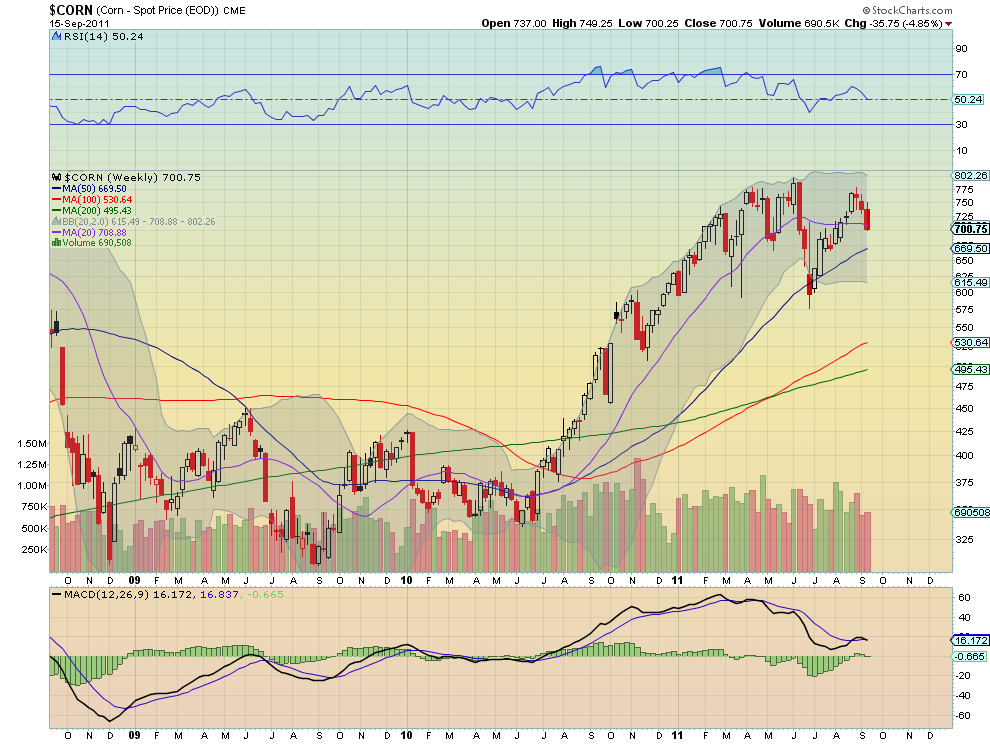
Corn, $ZC_F, had the same run higher that Coffee saw complete with the pullback and push higher again. It also has the acceleration to the downside now, under the 20 week SMA and moving lower Friday at 698 as I write. A push back over the 20 week SMA would help but with the RSI heading lower and the MACD crossing negative it is set up for more downside. A continued fall sees support near the rising 50 week SMA at 663 and below that it has a MM to 556. This same pattern is being played out in the Teucrium Commodity Trust Corn Fund, $CORN, and can be played that way.

Sugar, $SB_F

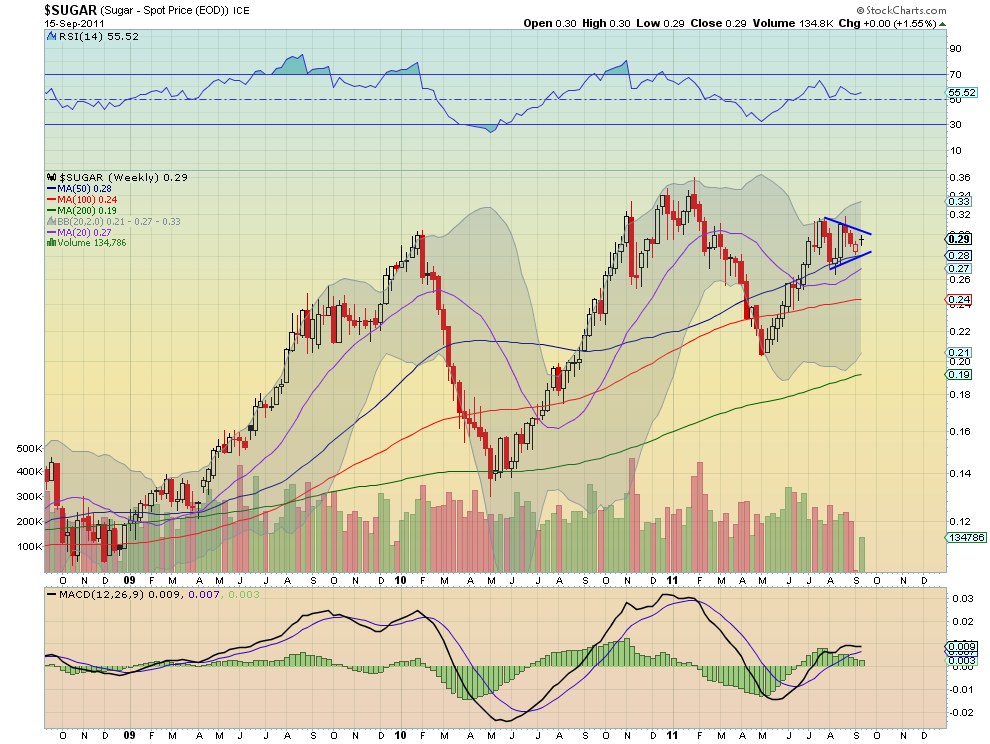
Sugar, $SB_F, had the same run higher from mid 2010 to early 2011 and the pullback and advance, but has been in a tighter symmetrical triangle the last few months. As I write this it is trading at 0.28 which would be close to triggering a break down from the pattern, ad is below the 50 week SMA. The RSI has stalled in the move lower near the mid line and is turning higher for now, but the MACD is fading lower. All the SMA’s are rising though. This looks to go either way. A continued move below 28 triggering the pattern break would see a target of 0.23, under the 20 week SMA but where there is support from April. If the pattern holds the the top rail at 0.30 is resistance and a break above that triggers a target of 0.35, near the previous high from February. This pattern is playing out with the iPath Dow Jones-UBS Sugar Subindex Total Return ETN, $SGG, so it can be played via the equity market as well. In fact, $SGG looks a bit weaker.

Each of these commodities is set up to continue lower, despite the stall and now move lower in US Treasuries. This could be a signal that inflation expectations are moderating. Only time will tell.

Thursday, July 28, 2011

West Africa prospects may help global cocoa output

by Commodity Online

Rising hopes for West African Cocoa production this year could help balance out an expected deficit in 2011-12, the head of the International Cocoa Organization said.

Ivory Coast, the world's largest producer, could reach 1.4 million metric tons in the current 2010-11 crop year, Executive director Jean-Marc Anga told Dow Jones Newswires.

Neighboring Ghana is also "on course" to reach its target of 1 million tons by the end of the season, despite flooding in cocoa-producing regions in the east of the country, he said.

Anga said he expects the ICCO will increase its current estimate of a 189,000 ton surplus for 2010-11, leaving markets in "more of a balance" than many forecasters currently expect next season.

"Most analysts are still expecting a deficit next year but we can see the surplus increasing between now and then," Anga said.
However, increasing consumption is likely to keep prices supported at $3,000/ton for the next six months, he said.
Demand is expected to rise to a record high of more than 3.9 million tons in 2011-12, up from 3.8 million tons this year, driven by Asia and the developing world as well as "robust" consumption in traditional markets, he said.
Cocoa grinding is also expected to rise in Ivory Coast following a bloody conflict there earlier this year. The country lost its place as the world's second-largest processor as companies fled during the political turmoil.
But going forward, he remains concerned that the proliferation of uncoordinated projects to expand Cocoa production in several parts of the world could have a severe impact on prices.
"We do not believe that production should go all out in meeting demand--and go beyond--as the impact on prices will be severe," he said.
With the new government of Ivory Coast due to launch initiatives to boost production in the near future, including tackling structural issues such as aging trees and little use of inputs, Anga said production there could rocket.
"If they go all out to increase investment in the next five to 10 years they could reach 1.8 million to 2 million tons," he said. Neighboring Ghana, considered a major cocoa success story, is expected to produce 1.2 million tons by 2012-13.
He added that the ICCO won't lift its estimate for Indonesia, another key producer, where production has been severely damaged by rain and disease.
"The pest and disease situation there is quite worrying," he said.

Cotton's rebound raises hope of end to correction

by Agrimoney.com

Cotton futures' "impressive turnaround" in the last session, when it rebounded from a four-month low to close up the exchange limit, has prompted talk that the fibre's correction may be over.
Luke Mathews at Commonwealth Bank of Australia, forecast that "cotton market may rise further from here", supported by the likelihood of further downgrades to the crop in the US, the top exporter of the fibre.
And Commerzbank said it sees "more and more signs" that the fibre has found a level where it will be supported by investors, after a fall of more than one-half since setting a record high in March.
The statements followed cotton's revival in the last session from a seven-month low of 93.2 cents a pound, for New York's best-traded December lot, to close at 100.76 cents a pound – the maximum gain allowed by exchange rules. Trading volumes were also unusually strong.
'Chance to buy in'
The rebound was an "overdue" response to the dismal production prospects in Texas, America's top cotton-producing state, where crops have been devastated by the worst drought since records began in 1885, Commerzbank said.
Furthermore speculators had already cleared out their long positions, with net long exposure near a two-year low, meaning limited selling pressure might be expected from short-term investors.
"We could well see brief losses again over the coming weeks, but they should be seen as a chance to buy in," the bank said.
"It seems unlikely, therefore, that the price will dip below the 100-cent mark again, or if it does, this will be just a passing phenomenon."
'Widespread devastation'
The thesis found some support too from Keith Brown, president of Georgia-based brokerage Keith Brown & Co, who highlighted the extent of crop losses in Texas, where he had heard of one 80,000-acre co-operative which was set to produce 20,000 bales of cotton.
The average yield in Texas last year was 722 pounds, or 1.5 bales, per acre.
"In Texas, there is going to be more widespread devastation than people understand," Mr Brown told Agrimoney.com.
Technically, if cotton could avoid putting in a new low before the end of the month, "it has got a good chance of trading sideways" until the US Department of Agriculture's next benchmark Wasde crop report on August 11.
Economy factor
However, Mr Brown also highlighted the influence of world economic prospects on cotton prices, attributing the decline in cotton, as in many other commodities such as crude, to reduced growth hopes.
Indeed, he attributed a weaker performance by cotton on Wednesday, when the December contract dipped 0.08 cents into negative territory in late deals to stand at 100.68 cents a pound, on broader financial market weakness.
"It does depend on what the global economy holds," he said.
"There is more to cotton prices than flat out US supply and demand fundamentals."

Wednesday, July 27, 2011

Sugar rally falters as Brazilian output recovers

by Agrimoney.com

Sugar futures received a – temporary – knock after industry data revealed an improvement in Brazil's output, following a series of downbeat data.
Sugar production in Brazil's Center South region – the biggest producing area in the top producing country – reached 2.58m tonnes in the first half of July, Unica, the cane industry associations, said.
The figure represented an increase of 2.5% year on year, an improvement on the 1.3% pace of increase seen in the second half of June.
The growth was not enough to question expectations that Brazil is on course for its first decline in sugar production in a decade, in part because of a later start to the crushing season this year, but also a hangover from two years of underinvestment which have left the country with ageing cane.
However, it reduced the rate of decline in sugar output so far in 2011-12 to 11%, from a figure of 15% at the close of last month.
'Sugar prices to ease'
The immediate market reaction was to pull sugar futures into negative territory in New York, after an early run which had taken the October contract to 31.47 cents a pound, within an ace of a four-month high.
Indeed, the data acted as a rallying point for bears also banking on an easing in the queues of ships waiting to take on sugar in Brazil, which is also the world's largest sugar exporer.
"Guess now that the news of reduced crop estimates for Brazil have made the rounds, and the delays in loading sugar in the port at Santos are expected to ease, sugar prices will follow," Jurgens Bauer at PitGuru said.
However, futures recovered amid concerns that the disappointing Brazilian output represents a sign of strategic problems, rather than just those related to poor weather.
The underinvestment in cane, which now has an average age of more than four compared with an ideal of less than three, is seen as one major concern, another being the competition for suitable, and accessible, land for expanding productions.
"With the market trending higher, the bears need a 'story' sooner rather than later as Brazil news still seems to favour the bulls," Thomas Kujawa at Sucden Financial said.


Cotton channel update ...

by Kimble Charting Solutions


Saturday, July 23, 2011

Sugar futures jump on - another - Brazil downgrade

by Agrimoney.com

Sugar prices jumped 5% after Kingsman joined analysis groups cutting forecasts for Brazil's sugar output, blaming the age of the cane following two years of low replanting rates.
The influential consultancy cut by 35m tonnes to 525m tonnes its forecast for cane output in Brazil's Center South region – the top producing area in the main sugar-producing country.
Sugar production was pegged at 31.9m tonnes a figure which, while higher than a 30m-tonne estimate on Thursday from Brazilian consultancy Canaplan, was below the benchmark figure of 32.4m tonnes set by Unica, the cane industry group, last week.
Kingsman's stance was also viewed with particular interest as it has been one of the more upbeat on hopes for the world sugar production surplus in 2011-12, earlier pegging it at 10.6m tonnes.
'Terrible shape'
At Macquarie, analyst Kona Haque said: "The downgrades to Brazilian estimates keep on coming.
"Our colleagues in Brazil say the cane is in terrible shape. It is old, and is not going yield any better going forward," leaving the country on track for its first drop in production in a decade.
Brazil, which is also the top sugar exporter, "is likely not crushing fast enough to satisfy importers."
While Macquarie estimates the world surplus at 5m-6m tonnes in 2011-12, the impact of this in extra supplies from alternative producers such as India was not likely to be felt until November at the earliest.
Raw sugar for October hit 31.55 cents a pound in New York, a contract high, and the best price for a near-term lot since February, before easing to stand at 31.46 cents a pound in late deals, up 5.4%.
In London, white sugar for October closed 4.0% higher at $812.70 a tonne.
Feeling the cold
Kingsman attributed its downgrade to concerns that "the effect to two consecutive years of low renovation rates" in Center South cane planting was "stronger than expected".
Indeed, the low level of resowings - a hangover from the global economic crisis, and its impact on sugar enterprises with stretched balance sheets – "may be exacerbating the impact of the recent frost affecting certain planting areas".
The group noted that this was the second season when a lack of cane, rather than milling capacity, had limited Brazil's sugar output, highlighting too that concentrations of sugar per kilogramme of crop were among the lowest of the last decade.

Tuesday, July 19, 2011

Correction in cotton prices 'not over yet'

by Agrimoney.com

The correction in cotton prices may have further to go even after fresh declines on Monday, when New York's best-traded contract fell to its lowest since September, and took to 24% its fall over the last month.
Cotton for December delivery, the first new crop contract, fell the maximum allowed in New York to hit 94.46 cents a pound before recovering some ground in late deals.
The old crop October contract also pared losses amid fears for the crop in Texas – the biggest cotton-producing state in the US, the top-ranked exporting country.
"The terrible Texas drought - which has already caused significant downward revisions to US cotton production prospects and may cause even further future revisions - may start supporting prices," Luke Mathews, at Commonwealth Bank of Australia, said.
"After all, US and global cotton supplies are already extremely tight."
The US Department of Agriculture last week pegged the overall abandonment of US cotton crops at "a record 30%", and is expected by many analysts to cut its yield forecast too, from levels close to last year's.
'Staggering demand losses'
But while some farmers are predicting yields of 50% below normal on non-abandoned land, Texas's "parched crop" can provide only limited support to prices, veteran soft commodities analyst Judith Ganes-Chase said.
"The loss in demand that has occurred as a result of sky high prices this year and uncertain economic conditions has far outweighed any bullishness over the Texas crop woes," Ms Ganes-Chase, at J Ganes Consulting, said.
"The losses in global demand are even more staggering."
New orders from Asian mills, major consumers, has "virtually stopped" after the rise in cotton prices to a record high of 227 cents a pound kept a lid on consumer demand, and encouraged a switch to other fibres.
And inventories in the US, while "still limited", are "just nowhere near as pinched as previously estimated".
'Room on the downside'
The dynamics of pressure on consumption, at a time when mills were being left with high-priced cotton inventories that were difficult to shift, meant that the global stocks-to-use ratio may "jumpy by a disproportionate amount", Ms Ganes Chase said.
The stocks-to-use ratio is a key measure of the availability of a crop, and therefore of its price potential.
For prices, "there still could be plenty of more room left to go on the downside as this historic bull market unravels", she said.
The longer the market remained near current levels, which are still high by a historical perspective, "the more demand is going to be lost and the harder the market will eventually fall".
'Demand is poor'
At PitGuru, Jurgens Bauer said that cotton prices "likely will seek to find a level of support between 90-100 cents a pound".
He added: "Whether or not that market can stage more than a temporary bounce is the question. Supply concerns aside, demand is poor."
US weekly cotton export sales for 2010-11 have been negative - meaning cancelled orders - in 15 out of the last 16 weeks.
New York's best-traded December cotton contract closed down 3.5% at 97.95 cents a pound, with the September lot finishing down 3.5% at 97.95 cents a pound.

See the original article >>

Saturday, July 16, 2011

Sugar Price Surge Nears Resistance


After peaking in early Feb the drop back in Sugar 11 found a low in May, from whence a recovery got underway. This has made a new high on the front month chart, but certain resistance levels are now not far off.


Wednesday, July 13, 2011

Banks caution over upbeat cotton supply forecasts

by Agrimoney.com

Investors may have taken too downbeat view of cotton price prospects from a key report which, citing lower consumption prospects, raised the estimate for world stocks at the close of 2011-12 by nearly 3m bales.
Rabobank cautioned that, while cotton prices were likely to "continue to ease", inventories "remain thin", even after an upgrade to 51.0m bales in the US Department of Agriculture's latest influential Wasde crop report.
The report implied a stocks-to-use ratio - a key measure of a crop's tightness – of 44%, signalling easier supplies than in 2010-11, for which the ratio comes in at 39%, but still making it the third-tightest season since 1994-95.
And even this made some assumptions on world production, pegged at a record 123.2m bales, which some analysts warned may prove too generous.
Big two producers
"We are still cautious about the large Indian and Chinese production forecasts," Goldman Sachs said, besides questioning the USDA's downgraded consumption estimate.
USDA officials forecast Indian harvest – the world's second biggest - rising 10.2% to 27.0m bales, despite concerns within the country over poor rainfall in Gujarat and Maharashtra and Andhra Pradesh, which account for more than 75% of its production of the fibre.
And they stuck by an estimate for production in top-ranked China rising 8.2% to 33.0m bales, despite a downgrade last week to an industry forecast for sowings, seen rising only 5.2%.
Goldman restated estimates of New York's near-term cotton contract standing at 125 cents a pound in both three months' and six months' time, before easing to 100 cents a pound in a year.
Large downgrade ahead?
Australia & New Zealand Bank analysts held out the prospect of a further downgrade to the USDA estimate for America's crop, even after a cut of 1.0m bales, to 16.0m bales, on Tuesday.
The downgrade factored in a higher figure for sowings, offset by crop losses of a record 30% thanks to "historic drought conditions, mainly in Texas", the top cotton-producing state.
ANZ said: "This latest revision to production comes with the USDA still making no change to US cotton yields," which were kept at 800 bales per acre, in line with last year's.
"This now sets the scene for US cotton yields to be revised in August, with a high probability of another large US production downgrade."
New York's best-traded December cotton contract stood 0.9% higher at 105.36 cents a pound at 09:30 GMT.

See the original article >>

Is a 50% decline enough?

by Kimble Charting Solutions


Drought-hit cotton growers face record crop losses

by Agrimoney.com

The cotton crop in the US, the top exporter of the fibre, is to suffer its worst ever abandonment rate, sapped by drought in Texas, where more than two-thirds of acres may be lost.
US officials on Tuesday forecast that America's farmers would reap only 9.6m acres of cotton, 600,000 acres less than previously expected, despite plugging an extra 1.1m acres of plantings into their forecast.
Indeed, the data implied an abandonment rate lifted to an all-time high of 30%, "due to historic dry conditions in Texas", the top producing state, Karis Gutter, America's acting secretary of agriculture, said.
In Texas, where data overnight showed 59% of the crop in "poor" or "very poor" condition, the abandonment figure "might come out at 70%, we don't know yet", said Keith Brown, the president of Keith Brown & Co, a brokerage in Moultrie, Georgia.
'Globalisation effect'
Nonetheless, despite the hike in the abandonment rate, from 18.9% last month, cotton prices fell - amid better prospects for some southern hemisphere crops, such as Australia's, which was pegged at a record 4.5m bales, up 250,000 bales on last month's forecast.
"The seasonal outlook is based on expectations of normal winter and spring rainfall coupled with substantial carry-over irrigation water and record-high water allocations in Queensland and New South Wales," USDA analyst Dath Mita said.
Indeed, the price fall was a "clear indication of the globalisation in world cotton", Mr Brown said, besides reflecting reduced hopes for consumption, as prices, which remain elevated by historical standards, temper demand and encourage a switch to man-made fibres.
"Our sources in China say that some mills are selling surplus cotton to other Chinese mills because of a build up in yarn supplies," encouraging them to pull back output.
'Unprecedented cancellations'
Indeed, the USDA highlighted an "unprecedented" level of cancellations of orders of US cotton as spinners idle "portions of their capacity, as they try to work off accumulated yarn inventory in the face of declining cotton prices".
"The dramatic fall in the level of shipments indicates weakening global demand," the department said.
Cotton for December delivery, New York's best-traded lot, stood 3.5% lower at 105.12 cents a pound in late deals.

See the original article >>

Monday, July 11, 2011

Morning markets: cotton leads decline on China, euro jitters

by Agrimoney.com


Agricultural commodities could not maintain their ability to swim against the tide.
External markets continued on Monday the slide with which they ended last week, given an extra shove by data over the weekend showing Chinese inflation reaching a three-year high of 6.4% in the year to June.
This increase, spurred by a 14.4% rise in food prices, spurred thoughts that further interest rate rises might be in the wings, with associated risks for economic growth in the Asian powerhouse.
"We reckon [on] at least one interest rate hike in the third quarter, and view inflation will become 'structurally' higher for the following years," Australia & New Zealand Bank said.
Spread to Italy?
While Shanghai stocks managed a, typical, counterintuitive move, adding 0.2%, with separate data showing a rise to $22.2bn in China's trade surplus last month, other Asian stock markets failed to see the upbeat side.
Tokyo's Nikkei index shed 0.7%. Fresh concerns for eurozone sovereign debt gave a further dent to sentiment, after the European Union called a meeting of senior officials amid concerns that jitters could spread to Italy, the region's third-ranked economy, after Germany and France.
Furthermore, the Financial Times reported that some European leaders are considering allowing some default by Greece, the region's worst affected economy.
The euro dipped, and the dollar added 0.5% against a basket of currencies as of 07:50 GMT (08:50 UK time), making dollar-denominated assets such as many commodities that much less competitive as exports.
'Rain interruptions'
Prices of many raw materials fell, with New York crude down 1.3% at $95.00 a barrel.
And, among farm commodities, wheat was among the weakest, down 1.7% at $6.40 a bushel for September and 1.7% to $6.79 ¾ a bushel for the December lot in Chicago.
Kansas wheat for September fell 1.7% to $7.15 a bushel for September.
Pressure from harvests picking up pace in Europe too added pressure, despite some rain interruptions in France, the EU's top producer, and "further thunderstorms forecast for this Wednesday," according to Agritel.
Still, in northern France, the consultancy added that "yields seem less impacted by drought occurred this spring", helped by their late development which allowed them to benefit more from early summer rains.
Any sellers left?
Corn fell 0.5% to $6.38 a bushel against for September and 0.9% to $6.31 ½ a bushel for the best-traded, new crop December contract, given some support by fresh signs of demand.
South Korean feedmaker Nonghyup Feed bought 110,000 tonnes of corn for delivery between October and November.
Furthermore, there are some doubts as to the weight of selling left likely in corn, given the liquidation which funds have already undertaken in corn.
Regulatory data out late on Friday showed that large funds "have blown out of another 36m+ bushels of ownership which would have them reducing their length by nearly two-thirds since the beginning of April", Jon Michalscheck at Benson Quinn Commodities said.
In the latest week (to last Tuesday), "speculators liquidated a quarter of their net long position in corn, and positioning is now much closer to 'neutral'", ANZ said.
China damage
Even soybeans lost their grip on their gentle strength of late, which has been spurred by official data last month showing US sowings of the oilseed were below forecasts, at a time when supplies already look tight.
The news on China, the top importer of the oilseed, sent Chicago's best-traded November lot down 0.3% to $13.43 a bushel, with the old crop August contract shedding 0.2% to $13.44 ¼ a bushel.
Still, that was better than cotton, of which China is also the biggest buyer, which tumbled 2.2% to 111.41 cents a pound for the best-traded December contract.
The lot earlier hit 110.82 cents a pound, its weakest for five months. The decline also took the fibre below its 200-day moving average, near about 111.73 cents a pound, below which is has not fallen since August, according to Mike Mawdsley at Iowa-based broker Market 1.
Luke Mathews at Commonwealth Bank of Australia also noted the depressant to prices offered on Friday by a "bearish US jobs report and another week of [cotton] net export sales reductions in the US".
'Powerful heat dome'
More will be known on US shipments later, with the weekly data on export inspections.
Also potentially to effect market moves will be the prospect on Tuesday of the latest US Wasde report on world crop supply and demand estimates, which are of particular interest this time given the changes two weeks ago to estimates for US crop sowings, and unexpected stocks data too.
And the weather could, as ever, move the markets, particularly with attention on a US "heat dome" set to hit the Midwest – after some cooler weather and thunderstorms over the next few days.
"A powerful heat dome continues to appear in all the models," weather service WxRisk.com said.
"The dome develops around July 15 and spreads into the western Corn Belt on the 16th and looks to last for several days.
"The greatest heat is going to be from the Mississippi River westward towards of the Rockies."


See the original article >>

Friday, July 8, 2011

Coffee and crude futures 'acting like sisters'

by Agrimoney.com

The two have colour in common. Both have a dark brown hue.
But that's about all. One is a liquid mineral that keeps us on the move. The other is a crop, a bean that keeps us awake.
So why should futures in crude oil and coffee have started moving as a pair? The duo have been named as the latest odd couple in commodities, following copper and wheat, and gold and farmland.
'Like sisters'
The convergence between crude and copper, both of which were showing small gains in early deals on Friday, has been noted on both sides of the Atlantic.
"A savvy old school trader points to coffee and crude prices acting like sisters," Jurgens Bauer at US-based PitGuru said.
In London, broker Marex said the correlation between the two assets was "particularly tight".
"Crude topped on May 2 and then fell 22%. Coffee topped on May 3 and then fell 22%.
"Crude has since put in a bottom on May 23 and then retraced 8.2%, and coffee put in a bottom on May 23 and then retraced 11.5%.
"The correlation between coffee and crude even goes down to the hourly charts."
Risk-on, risk-off
And this when cold weather in Brazil has, apparently, been having a big impact on coffee prices too, for fear of frost damage. Is a cold snap in the South American country big enough to move oil markets too?
The coupling looks like the latest anomaly thrown up by ultra-loose US monetary policy encouraging waves of money into financial markets, and dividing days between "risk-on" ones, when the likes of commodities and shares gain, and bonds fall, and "risk-off" ones, when caution prevails and the directions alter.
Indeed, Marex highlighted a price correlation between coffee and "all risk assets".
And, in theory, this will erode when borrowing costs rise and investors swap a shotgun approach for a rifle.
"When the money tap is turned off, these things are going to stop moving as a herd," a London-based macroeconomic analyst told Agrimoney.com.
Speculator sell-off
That thesis sounds reasonable.
Except in coffee, in which speculators have already been selling down holdings for a year, even as prices reached multi-decade highs in the spring, and now have only a small net long position. Index-tracking funds started selling even earlier, although not as enthusiastically.
Which makes it appear that it is not fast money, nor a wall of money, which is pulling coffee's strings.
So what is? It may be that the surge in interest in coffee, even in developing countries, has tied it more closely to world economic sentiment. If so, the crude-coffee coupling may last a little longer yet.

Sugar prices leap as hopes for Brazil output wane

by Agrimoney.com

Sugar prices exploded, hitting a five-month high in London, amid growing fears for Brazilian sugar output, which is expected to fall for the first time in more than a decade, with rising oil prices seen adding a further kicker.
White sugar for August touched $821.30 a tonne in London at one point, a contract high and the best for a near-term lot since February, before losing some ground to finish at $814.80 a tonne, up 6.1%.
New York raw sugar for October closed 6.7% higher at 29.52 cents a pound.
The rises followed rumours that Unica, the Brazilian cane industry group, will unveil a bigger-than-expected drop in estimate for the crop in the key Centre South region when it unveils fresh forecasts next week. Czarnikow, the sugar merchant, and consultancy Datagro have already cut their estimates.
Unica's current forecast is for Centre South sugar output of 34.6m tonnes.
"The prominent stories on the newswires favour the bulls at the moment as analysts are all revising down the potential output from Brazil," Thomas Kujawa at Sucden Financial said in a note.
"We seem to be in a strong uptrend. Perhaps - I thought I'd never be writing this so early into the Brazil harvest, but - it's safer to buy on a dip."
'Better informed'
The rally was given further momentum by speculation of leaks in the market, after a strong rally in sugar prices last week ahead of Unica data which revealed a surprising fall in Brazilian sugar production at the end of last month.
"It is all the more difficult to go against the tide when you feel it might be being driven by people who are better informed than you," a London trader told Agrimoney.com.
Oil prices, a key influence on a crop tied to ethanol production, added further support by rising 4%, for Brent crude, which soared back above $118 a barrel, helped by retail sales and jobs data indicating that the US economy was in better shape than had been thought.
Tumble ahead?
The jump in prices defied widespread expectations that a significant drop in Brazilian sugar output had already been factored into prices, which were poised for a fall as the impact of an expected production surplus of perhaps 10m tonnes kicks in later in the year.
Rabobank analysts said in a note on Wednesday "in our view, much of the production shortfall has already been priced into the market. Prices should be poised for a correction lower."
And London-based Marex said that while most estimates of Centre South production were now at 32.5m tonnes - down 2m tonnes from previous forecasts, and a fall of 1m tonnes year on year – this was not enough to cause another season of deficit.
"So the main thrust of the bearish argument, that we are entering a period of large surplus, seems to remain intact," the broker said.

Wednesday, July 6, 2011

Brazilian hiccups raise doubts over sugar surplus

by Agrimoney.com

Czarnikow raised doubts over forecasts for sugar's first output surplus in four seasons as the merchant joined observers warning that Brazil was set for its first drop in cane production in more than a decade.
Buyers, who had looked set to regain market power thanks to raised cane and beet plantings in many countries, are "instead once again facing the risk of lower supply" thanks to the setbacks in top producer Brazil, Czarnikow said.
With the country's supplies threatened by lower cane output and logistical hiccups which lifted to 74 the number vessels queuing at Brazilian ports for sugar at the close of last month, has left hopes for an easier world market "entirely in the hands of the northern hemisphere" producers.
And this, largely beet-based, output only starts to hit markets in November, and is "some way from being realised".
"As far as the market is concerned, this raises the question – will the return to surplus once again prove to be illusive," Peter de Klerk, Czarnikow analyst, said.
'Years of underinvestment'
The comments represent a sharp deterioration in Czarnikow's outlook, which last month had foreseen a "sharp rise" in world sugar output in 2011-12 to a surplus of 10.3m tonnes, following three seasons when production had fallen a total of 25m tonnes behind demand.
However, data last week showing that Brazil's sugar output had, in late June, fallen back into year-on-year decline crystallised concerns that the country was set for its first fall in output in more than a decade.
Czarnikow on Wednesday slashed its forecast Brazilian cane output in 2011-12 by 40m tonnes to 535m tonnes, 1m tonnes below a much-cited figure from consultancy Datagro.
The lower prospects reflected "several years of underinvestment" in the sector amid the world economic downturn which now rated, with the 1997 liberalisation of the ethanol market, as one of the major upsets to Brazil's cane industry.
The ageing of Brazil's cane, which has historically been replaced every three years or so, has left "agronomists wary of drawing firm conclusions as they are working with unfamiliar data".
Indian answer?
The merchant also poured cold water on hopes of India, the second ranked producer, filling the gap in raw sugar supplies, saying the country was focused on white sugar trade.
Meanwhile, in Thailand, the second-biggest sugar shipper, has like Brazil found "the ability to get product to the export market to be a problem" thanks to logistical hold-ups.
Nonetheless, raw sugar for October fell 2.1% to 27.01 cents a pound in New York, for October delivery, on profit-taking from last month's rally, and following preliminary clearance by the European Union of alternative sweeteners based on the stevia plant.
London white sugar fell 1.4% to $760.20 a tonne.

See the original article >>

Monday, July 4, 2011

Sowings upgrade fails to quell cotton crop fears

by Agrimoney.com

The threat of high rates of lost acres, to drought, remains a spectre over US cotton production prospects despite the hike by American officials to their forecast for sowings of the fibre.
American farmers planted 13.7m acres with cotton this spring, a five year high, the US Department of Agriculture said on Thursday, lifting its forecast by nearly 1.2m acres.
However, there was no certainty that this increase will end up translating into a rise to the forecast for production too, given the extent of the drought challenges facing the crop, analysts said.
The USDA earlier in June estimated the abandonment rate at nearly 19%, among the highest in recent history. Officials estimate the proportion of the US cotton crop in "good" or "excellent" condition at 27%, compared with 62% a year ago.
'Conditions remain severe'
"With 1.16m more acres, a revision [in production] higher is possible, but due to weather problems resulting in yield reductions and a high abandonment rate, such an upwards adjustment is not a given," Rabobank said.
"Conditions of drought remain severe" in Texas, the main producing state in the US, the top cotton exporter.
Goldman Sachs analysts said that such fears might support prices of the fibre despite the, ostensibly bearish, sowings upgrade.
"While this large cotton average increase could accelerate the decline in cotton prices that we forecast, we expect that concerns for large abandonment in the US South will limit price downside in the near-term," Goldman said.
Price forecasts
The bank left its forecasts for cotton prices unchanged, at 150 cents a pound in three months' time, declining to 125 cents a pound in a year, for New York's near-term contract.
However, Rabobank said that, despite its reservations over US cotton production, "our view continues to be that prices will correct lower".
New crop cotton for December stood 0.1% higher at 118.75 cents a pound in late deals in New York. The soon-to-expire July contract was 1.1% higher at 161.50 cents a pound.

See the original article >>

Saturday, July 2, 2011

Sowings upgrade fails to quell cotton crop fears

by Agrimoney.com

The threat of high rates of lost acres, to drought, remains a spectre over US cotton production prospects despite the hike by American officials to their forecast for sowings of the fibre.
American farmers planted 13.7m acres with cotton this spring, a five year high, the US Department of Agriculture said on Thursday, lifting its forecast by nearly 1.2m acres.
However, there was no certainty that this increase will end up translating into a rise to the forecast for production too, given the extent of the drought challenges facing the crop, analysts said.
The USDA earlier in June estimated the abandonment rate at nearly 19%, among the highest in recent history. Officials estimate the proportion of the US cotton crop in "good" or "excellent" condition at 27%, compared with 62% a year ago.
'Conditions remain severe'
"With 1.16m more acres, a revision [in production] higher is possible, but due to weather problems resulting in yield reductions and a high abandonment rate, such an upwards adjustment is not a given," Rabobank said.
"Conditions of drought remain severe" in Texas, the main producing state in the US, the top cotton exporter.
Goldman Sachs analysts said that such fears might support prices of the fibre despite the, ostensibly bearish, sowings upgrade.
"While this large cotton average increase could accelerate the decline in cotton prices that we forecast, we expect that concerns for large abandonment in the US South will limit price downside in the near-term," Goldman said.
Price forecasts
The bank left its forecasts for cotton prices unchanged, at 150 cents a pound in three months' time, declining to 125 cents a pound in a year, for New York's near-term contract.
However, Rabobank said that, despite its reservations over US cotton production, "our view continues to be that prices will correct lower".
New crop cotton for December stood 0.1% higher at 118.75 cents a pound in late deals in New York. The soon-to-expire July contract was 1.1% higher at 161.50 cents a pound.

See the original article >>

Wednesday, June 29, 2011

Brazil setbacks spur jump in coffee, sugar futures

by Agrimoney.com

Brazilian setbacks spurred jumps in prices of both sugar and coffee futures, which headed a better day for farm commodities after sell-offs of the last two weeks.
Crop futures were firm across the board on Tuesday, helped by improved appetite for risk assets which was also reflected in a decline in the dollar, which fell 0.5% against a basket of currencies.
Gains of 1% in Chicago grains were also spurred by a reluctance by investors to sell ahead of key reports on US grain inventories and sowings due on Thursday.
However, coffee added more than 2% in New York, on reports of frost in Brazil, where data showing surprisingly weal sugar output sent prices of the sweetener up 5% to a three-month high of 29.38 cents a pound at one point.
'Brazilian Clarence Beeks'
Unica, the cane industry group, said that sugar output in Brazil's Center South region - which produces some 90% of sugar in the top producing country – had fallen by 14% year on year in the second-half of June.
Crop prices as at 16:30 GMT
Sugar: 29.20 cents a pound, +5.0%, (New York)
Coffee: 256.75 cents a pound, +2.6%, (New York)
Corn: $6.68 a bushel, +1.1%, (Chicago)
Wheat: $6.31 ½ a bushel, +1.4%, (Chicago)
Prices for July contracts
Data two weeks ago had signalled that Brazilian output was recovering after a weak start blamed on wet weather.
The data confirmed market speculation of a bullish report, which prompted Nick Penney at Sucden Financial to note speculation of a "a Brazilian Clarence Beeks out there", a reference to the character in the film Trading Places who trades secret information on the orange juice market.
"There has been a great deal of short-covering. Telephone lines are buzzing with questions regarding delivery intentions against the July contract."
At Standard Chartered, Abah Ofon also noted, following a three-continents tour of investors, that sentiment was "particularly bullish" on sugar, in part because of the sweetener's use in making biofuels - and the prospect of the US removing tax perks on corn-based ethanol.
Cold talk
Coffee was spurred by reports of frosts in at least two parts of Parana.
Typically, frost damage hurts coffee plants by damaging leaves, so hindering trees ability to grow coffee cherries, meaning it is next year's harvest which would be most badly affected.
Indeed, coffee for July delivery next year rose 2.8% to 266.95 cents a pound, outpacing the 2.6% rise to 256.75 cents a pound in the soon-to-expire July 2011 lot.
Parana vs Minas
Brazilian frosts have a history of supporting coffee prices, notably after a 1975 freeze, which ultimately sent futures to a record high of 337.50 cents per pound. Prices rallied in 1979 too following frost.
However, many plantations have been moved to less frost-prone areas, such as Minas Gerais, since these events.
"It is when it gets cold in Minas that you start the real worrying," Jurgens Bauer at PitGuru said.
"They don't produce as much coffee in Parana, not like they used to."

See the original article >>

Follow Us