Showing posts with label coffee. Show all posts

Sunday, September 18, 2011

Commodities May be Forecasting Lower Inflation


Inflation expectations impact Commodities. After recent runs higher some of these high flying commodities have been getting hit a bit lately. Some of this would be expected with the run up in US Treasury prices, dropping yields, acting similarly to squelching some inflation expectations. But that aspect may have run its course as Treasuries stall this week. So what do the charts say now about Coffee ($KC_F), Corn ($ZC_F), and Sugar ($SB_F)? And do they give a clue about inflation expectations? Let’s take a look.

Coffee, $KC_F

Coffee, $KC_F, had a massive run higher from June 2010 until May of this year. Since it has pulled back and then attempted to move higher again. The weekly chart above shows it now pulling back to the 20 week Simple Moving Average (SMA) at 2.61 as of Thursday close and it is dropping further Friday, at 2.58 as I write this. The Relative Strength Index (RSI) sloping lower and the Moving Average Convergence Divergence (MACD) crossing negative support more downside. Look for a continuation lower that may find support at the rising 50 week SMA, but if not then a target on the Measured Move (MM) to 2.13. Coffee has been inversely correlated to Coffee stock like $GMCR, $CBOU, $SBUX and $PEET so watch them for more upside if the decline continues.
Corn, $ZC_F

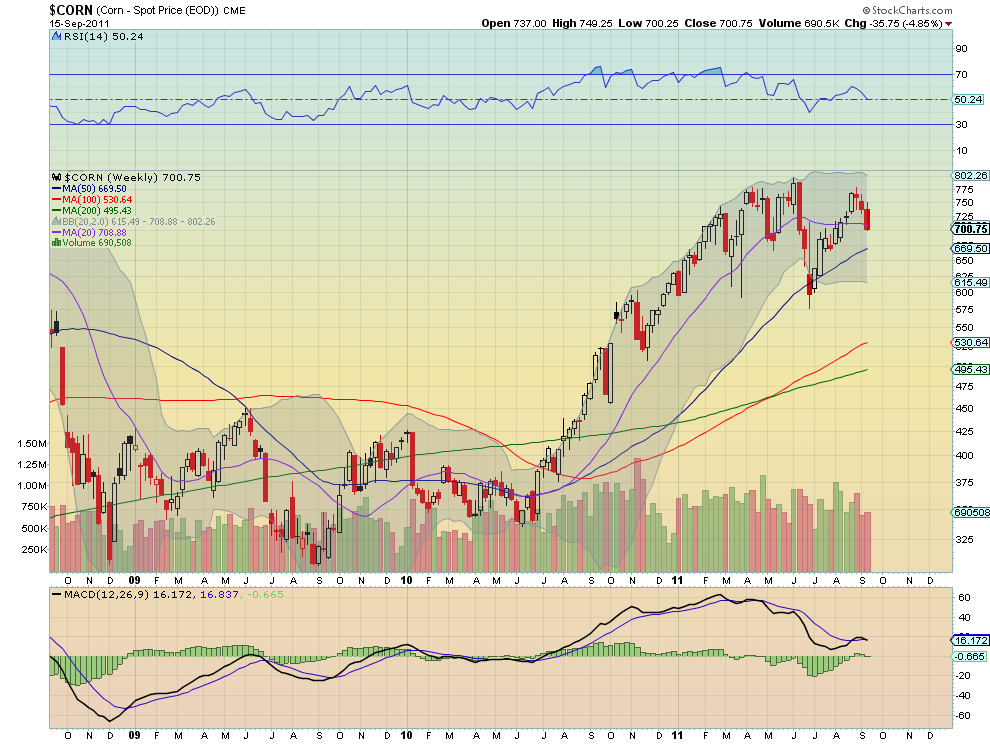
Corn, $ZC_F, had the same run higher that Coffee saw complete with the pullback and push higher again. It also has the acceleration to the downside now, under the 20 week SMA and moving lower Friday at 698 as I write. A push back over the 20 week SMA would help but with the RSI heading lower and the MACD crossing negative it is set up for more downside. A continued fall sees support near the rising 50 week SMA at 663 and below that it has a MM to 556. This same pattern is being played out in the Teucrium Commodity Trust Corn Fund, $CORN, and can be played that way.
Sugar, $SB_F

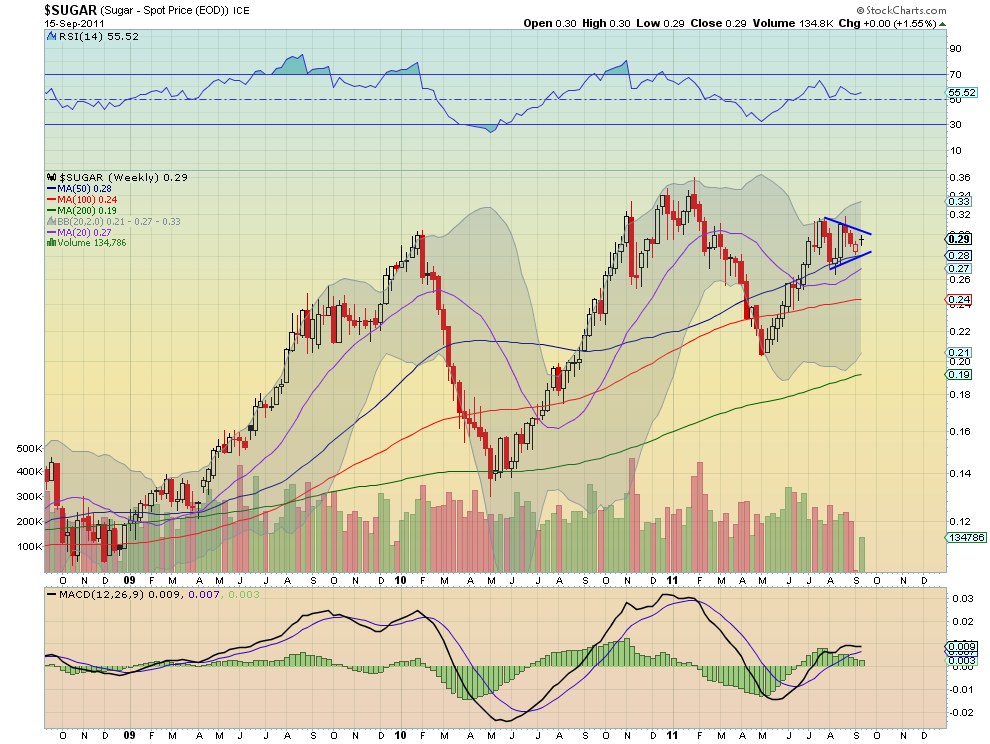
Sugar, $SB_F, had the same run higher from mid 2010 to early 2011 and the pullback and advance, but has been in a tighter symmetrical triangle the last few months. As I write this it is trading at 0.28 which would be close to triggering a break down from the pattern, ad is below the 50 week SMA. The RSI has stalled in the move lower near the mid line and is turning higher for now, but the MACD is fading lower. All the SMA’s are rising though. This looks to go either way. A continued move below 28 triggering the pattern break would see a target of 0.23, under the 20 week SMA but where there is support from April. If the pattern holds the the top rail at 0.30 is resistance and a break above that triggers a target of 0.35, near the previous high from February. This pattern is playing out with the iPath Dow Jones-UBS Sugar Subindex Total Return ETN, $SGG, so it can be played via the equity market as well. In fact, $SGG looks a bit weaker.

Each of these commodities is set up to continue lower, despite the stall and now move lower in US Treasuries. This could be a signal that inflation expectations are moderating. Only time will tell.

Friday, July 8, 2011

Coffee and crude futures 'acting like sisters'

by Agrimoney.com

The two have colour in common. Both have a dark brown hue.
But that's about all. One is a liquid mineral that keeps us on the move. The other is a crop, a bean that keeps us awake.
So why should futures in crude oil and coffee have started moving as a pair? The duo have been named as the latest odd couple in commodities, following copper and wheat, and gold and farmland.
'Like sisters'
The convergence between crude and copper, both of which were showing small gains in early deals on Friday, has been noted on both sides of the Atlantic.
"A savvy old school trader points to coffee and crude prices acting like sisters," Jurgens Bauer at US-based PitGuru said.
In London, broker Marex said the correlation between the two assets was "particularly tight".
"Crude topped on May 2 and then fell 22%. Coffee topped on May 3 and then fell 22%.
"Crude has since put in a bottom on May 23 and then retraced 8.2%, and coffee put in a bottom on May 23 and then retraced 11.5%.
"The correlation between coffee and crude even goes down to the hourly charts."
Risk-on, risk-off
And this when cold weather in Brazil has, apparently, been having a big impact on coffee prices too, for fear of frost damage. Is a cold snap in the South American country big enough to move oil markets too?
The coupling looks like the latest anomaly thrown up by ultra-loose US monetary policy encouraging waves of money into financial markets, and dividing days between "risk-on" ones, when the likes of commodities and shares gain, and bonds fall, and "risk-off" ones, when caution prevails and the directions alter.
Indeed, Marex highlighted a price correlation between coffee and "all risk assets".
And, in theory, this will erode when borrowing costs rise and investors swap a shotgun approach for a rifle.
"When the money tap is turned off, these things are going to stop moving as a herd," a London-based macroeconomic analyst told Agrimoney.com.
Speculator sell-off
That thesis sounds reasonable.
Except in coffee, in which speculators have already been selling down holdings for a year, even as prices reached multi-decade highs in the spring, and now have only a small net long position. Index-tracking funds started selling even earlier, although not as enthusiastically.
Which makes it appear that it is not fast money, nor a wall of money, which is pulling coffee's strings.
So what is? It may be that the surge in interest in coffee, even in developing countries, has tied it more closely to world economic sentiment. If so, the crude-coffee coupling may last a little longer yet.

Wednesday, June 29, 2011

Brazil setbacks spur jump in coffee, sugar futures

by Agrimoney.com

Brazilian setbacks spurred jumps in prices of both sugar and coffee futures, which headed a better day for farm commodities after sell-offs of the last two weeks.
Crop futures were firm across the board on Tuesday, helped by improved appetite for risk assets which was also reflected in a decline in the dollar, which fell 0.5% against a basket of currencies.
Gains of 1% in Chicago grains were also spurred by a reluctance by investors to sell ahead of key reports on US grain inventories and sowings due on Thursday.
However, coffee added more than 2% in New York, on reports of frost in Brazil, where data showing surprisingly weal sugar output sent prices of the sweetener up 5% to a three-month high of 29.38 cents a pound at one point.
'Brazilian Clarence Beeks'
Unica, the cane industry group, said that sugar output in Brazil's Center South region - which produces some 90% of sugar in the top producing country – had fallen by 14% year on year in the second-half of June.
Crop prices as at 16:30 GMT
Sugar: 29.20 cents a pound, +5.0%, (New York)
Coffee: 256.75 cents a pound, +2.6%, (New York)
Corn: $6.68 a bushel, +1.1%, (Chicago)
Wheat: $6.31 ½ a bushel, +1.4%, (Chicago)
Prices for July contracts
Data two weeks ago had signalled that Brazilian output was recovering after a weak start blamed on wet weather.
The data confirmed market speculation of a bullish report, which prompted Nick Penney at Sucden Financial to note speculation of a "a Brazilian Clarence Beeks out there", a reference to the character in the film Trading Places who trades secret information on the orange juice market.
"There has been a great deal of short-covering. Telephone lines are buzzing with questions regarding delivery intentions against the July contract."
At Standard Chartered, Abah Ofon also noted, following a three-continents tour of investors, that sentiment was "particularly bullish" on sugar, in part because of the sweetener's use in making biofuels - and the prospect of the US removing tax perks on corn-based ethanol.
Cold talk
Coffee was spurred by reports of frosts in at least two parts of Parana.
Typically, frost damage hurts coffee plants by damaging leaves, so hindering trees ability to grow coffee cherries, meaning it is next year's harvest which would be most badly affected.
Indeed, coffee for July delivery next year rose 2.8% to 266.95 cents a pound, outpacing the 2.6% rise to 256.75 cents a pound in the soon-to-expire July 2011 lot.
Parana vs Minas
Brazilian frosts have a history of supporting coffee prices, notably after a 1975 freeze, which ultimately sent futures to a record high of 337.50 cents per pound. Prices rallied in 1979 too following frost.
However, many plantations have been moved to less frost-prone areas, such as Minas Gerais, since these events.
"It is when it gets cold in Minas that you start the real worrying," Jurgens Bauer at PitGuru said.
"They don't produce as much coffee in Parana, not like they used to."

See the original article >>

Wednesday, June 22, 2011

Five Ways To Profit As Coffee Prices Soar

By Jack Barnes

If you're anything like me, you can't resist stopping in for a "cup of Joe" every morning. If so, you're probably also like me in that you're experiencing a bit of pain in the wallet right now, given the steady increase in coffee prices we've seen over the last year (and especially in the last few months).

If you want physical proof that we're operating in a truly global economy these days, just look at how these three factors have creamed your coffee budget:

  • Lousy weather in Latin America is threatening a big chunk of the worldwide coffee crop.
  • U.S. coffee stockpiles are reportedly at a 10-year low.
  • And Vietnam and Brazil - two of the world's Top 3 exporters - are scheming to hoard their stockpiles.
Little wonder coffee prices are at 34-year highs, and prices have zoomed 69% in the last year.

Expect the trend to continue.

This may be bad news for your pocketbook - but it's great news for your portfolio. Coffee prices are going to rocket even higher from here.

And with the strategy we're about to show you, this run-up in prices will be truly good ‘til the last drop.

Food Price Inflation

In the soft agriculture commodities sector, inflation in food and staples is starting to really hit a lot of people's food budgets. Wheat has really run up in price, and now latecomer coffee is joining the price-increase party.

The price of coffee has been brewing for years, but now it's boiling over. Coffee has zoomed 69% in the last year. Since hitting its market lows back in 2002, coffee has generated a compounded annual rate of return of about 20%.

* Our latest presentation uncovers an investment with much higher potential returns than 20%. The largest pharmaceutical players are rushing to ink deals with a tiny research lab 35 miles outside Washington DC. And why not? They've just discovered a completely new way to battle cancer. It's called "programmed cell destruction" (PCD) and could save 7.6 million lives - per year! This small company's perfectly poised to grab a huge chunk of a $120 billion market... and Big Pharma's monster appetite could shoot their stock even higher. You've got to move fast on this one. Details here.

It's forcing a reaction in the marketplace. The J.M. Smucker Co. (NYSE: SJM) - parent of the Folgers, Dunkin' Donuts and Millstone brands - has raised prices 10%.

"The J.M. Smucker Company has been committed to transparent coffee pricing that reflects the fluctuations of the global green coffee market," a company spokesman said. The Maxwell and Green Mountain brands are also raising prices as their margins get squeezed.

Trust me, you're going to see many more such announcements come along: These are just the first of many trickle-down price increases for consumers, who can expect a flood of these events in the months to come as retailers pass on the increases to their customers.

For now, weather is the biggest catalyst. Three countries combine to provide about 65% of the world's coffee supply, according to the International Coffee Organization. Those three countries, and their respective shares of the global market, consist of Brazil (38%), Vietnam (14.5%) and Colombia (12.3%).

Because the supply of coffee beans is so concentrated, weather plays a huge role in market prices. The weather in Brazil last year and Vietnam this year have played havoc with crops. And in Colombia, high levels of rainfall have caused a major outbreak of fungus.

There are concerns in Congress - specifically in the Senate, that coffee hoarding could break out at the exporter level. As noted, there are already concerns that Vietnam and/or Brazil will start to stockpile coffee, driving up prices even more.

"Stockpiling by the two largest producer countries would have adverse economic consequences for importing countries, as well as for consumers around the world," U.S. Sen. Charles E. "Chuck" Schumer, D-NY, said.

Arabica is the world's most-widely grown coffee. Vietnam is the world's largest producer of robusta beans.

"We've seen some international companies ask for more robusta than they used to," Bui Hung Manh, head of the business department at Tay Nguyen Coffee Investment, Import and Export Co., Buon Ma Thuot, Vietnam, told Bloomberg News. Tay Nguyen Coffee is Vietnam's single-biggest exporter.

Don't Forget Demand

Coffee demand has grown by 2.5% per year for the last decade. For context, demand has grown from 100 million bags in 2000, to 135 million bags today. Each bag consists of a 60-kilo sack of green, unroasted coffee beans.

This demand has continued during the recession, as people have switched from retail purchases, to brewing at home. So while the price of coffee has gone up, and retail stores are experiencing lower volumes, the overall demand for coffee has continued to rise as people drink more at home.

In 2002, when green-coffee-bean supplies were in surplus, a pound of coffee sold for 47 cents.

Today that same coffee sells for more than $3 per pound. The price was around $1.03 per pound in December 2008 during the peak of the economic crisis. That's a nearly 200% increase.

Let's review how the price of coffee has managed to compound by 19.8% per year, every year for the last 8 years, without too much notice. The reality is that:

  • Demand has grown, regardless of economic conditions worldwide in the last decade.
  • Weather conditions for the last two years have impacted the major exporters.
  • About 65% of the world's supply comes from three nations.
  • And with demand high and supplies getting squeezed, exporters may be prompted to hoard supplies to further drive up prices.
Action To Take

The price of green coffee beans has a chance to break out to even higher prices in 2011.

While I am bullish on coffee in the intermediate and long terms, I believe there is a very real possibility that we'll see a pullback in the coming days or weeks.

Once that occurs, however, I would urge investors to take a really careful look at coffee as a top profit play, particularly given the demand, hoarding and weather-related catalysts - all of which are bullish for coffee prices.

Here is how we can hedge our own personal exposure to the price of coffee, and make some profits at the same time. There are listed profit plays for coffee in both the European and U.S. markets.

If you live in the United States, you can purchase shares in the iPath Dow Jones-UBS Coffee Subindex Total Return Exchange Traded Note (ETN) (NYSE: JO).

If you live in Europe, or you have trading exposure to the London stock market, you can buy an exchange-traded-fund (ETF) equivalent, which gives you the ability to go "long" on coffee, "short" on coffee, or be 200% leveraged long on coffee.

These ETF-like vehicles also are based on the USB-DJ Coffee sub index and traded on the London stock exchange (LSE). They are, in order:

ETFS Coffee (LSE: COFF)

ETFS Short Coffee (LSE: SCFE)

ETFS Leveraged Coffee (LSE: LCFE)

With this foundation of understanding now established, let's look at some specifics.

If you're a U.S. investor, wait for a pullback of between 5% and 10% in the next few weeks, and then buy an amount of the ETN equal to 3% to 5% of your portfolio. I would suggest using a 10% moving stop loss and look for a 30% gain in the next 12 months to 18 months.

If you want to leverage this trade, look to purchase coffee futures.

Once this move up has been fully digested by the market in 2012, and the weather around the world has permitted growth of a bumper crop big enough to meet growing demand, I would consider switching out of the long side, and buying the short coffee ETN for a chance to "double down" on your profits.

In the near term, you can obviously hedge your own exposure to coffee by buying in bulk at your local Costco Warehouse Corp. (Nasdaq: COST)-type warehouse store. This will be the solution for my family, as my wife will not start her day without her pot of coffee.

You can also hedge your investments using a simple "trick" the rich use to grow infinitely richer - legally, quietly and with very little risk. (No, it's not gold.) In fact, it's already paid out a total of $910 billion to select investors over the last few years alone. Go here for our latest presentation.

See the original article >>

Coffee market may be fixed on wrong weather threat

by Agrimoney.com

Investors may be focusing on the wrong weather risk in allowing coffee prices to fall 10% over the last week to their lowest since January, a leading analysts has said.
Coffee prices set course on Tuesday for a fifth successive close, amid waning expectations for a frost in Brazil, the world's major producer – a weather event which has, in the past, proved devastating for crops and provoked large upswing in prices.
"Updated weather forecasts for Brazilian coffee production areas are calling for warmer and dryer weather, which continues to diminish the chances for a damaging freeze to this season's upcoming production," Terry Roggensack at Hightower Report said.
With frost fears fading, Rabobank highlighted that "expectations that supply will make it to the market, [which] have slowed commercial buying", at a time when harvest pressure often prompts a seasonal downswing in prices.
'Could spell trouble'
However, soft commodities specialist Judith Ganes said that the chances of a Brazilian frost were anyway "minimal, as in any given year". A march north by plantation owners to more tropical climes in recent years has cut the risk of frost.
"Where attention needs to be riveted is on the dryness that is impacting several Central American countries," she said, noting that the same high pressure ridge causing drought in Texas was keeping rain too out of countries further south, such as El Salvador, Guatemala, and Honduras.
"Farmers are worried that this could spell trouble for the 2011-12 crop, with some green beans already dropping to the ground in areas that should normally be drenched in rains at this time of year," Ms Ganes, at J Ganes Consulting, said.
"This could set the stage for continued tightness in mild arabica coffees in the season ahead."
Such a threat, during an "off" season during Brazil's two-year cycle of higher and lower production, meant coffee supplies could "easily become pinched against later this year", and that the "market is not out of the woods yet".
Vietnam acceleration?
The comments come amid reports that coffee production in El Salvador could fall by more than 20% in 2011-12.
However, caution by Ms Ganes over Vietnam - "which simply has not be able to see the strides in production that would have been expected" following strong growth in the 1990s – appeared at odds with forecasts from US Department of Agriculture attaches.
The attaches forecast that slow growth in production in 2010-11 would be followed by a 10.0% rise to 20.6m bags in output next season, thanks to "favourable" weather, and the incentive that high prices have given to farmers to invest in plantations.

See the original article >>

Friday, June 17, 2011

Uganda inches towards coffee production goal

by Agrimoney.com

Uganda, one of the world's most historic coffee producers, is this year to make only limited progress towards a goal of raising production record levels reached in the 1990s, despite some headway in tackling disease and agronomic setbacks.
The African country, which gave the world the robusta coffee variety, is to lift production by 200,000 bags to 3.2m bags in 2011-12, matching its highest of the last decade, US Department of Agriculture attaches said.
"Production is expected to increase slightly because farmers have renewed interest in coffee farming due to strong coffee prices and reinvigoration of the industry" stemming from a government "reinvigoration" campaign, the attaches said in a report.
"As a result of both, agronomic practices have improved and yields have increased."
Indeed, yield increases to 1.2 kilogrammes per tree, from 0.5 kilogrammes, have been achieved from measures such as planting robusta trees resistant to coffee wilt and government assistance to farmers with efforts such as pruning.
'Number of challenges'
Nonetheless, the Ugandan harvest remains way below the 4.5m bags the government is targeting by 2015, a harvest that would beat the record 4.3m bags set in 1997. Ugandan output topped 4m bags even in 1969, when it ranked significantly above Vietnam, now the world's second-ranked producer.
Attaches flagged "a number of challenges" to the campaign, including "unpredictable weather, pests and diseases and declining soil fertility".
"In addition, coffee tree replacement has not occurred at projected levels."
Exports were forecast rising by 200,000 bags, in line with production, in 2011-12 to 2.8m bags, an eight-year high but still well below levels above 4m bags reached in the 1990s
Weather setbacks
Uganda's drive to lift coffee output was dented in 2009-10 by persistently dry conditions in parts of the east and centre of the country, which account for more than half of production.
More recently, drought has hit parts of neighbouring Tanzania too, a factor in part behind a Tanzania Coffee Board forecast that production will fall nearly 20% to 750,000 bags (45,000 tonnes) in 2010-11.
The USDA attaches, who also pegged the Tanzanian crop at 750,000 bags, also cited a two-year cycle in Tanzania of higher and lower production seasons, as occurs in Brazil.
See the original article >>

Tuesday, June 14, 2011

Coffee output to dip next season - but not by much

by Agrimoney.com

World coffee production will fall in 2011-12 – but not by much, supported by Brazil, which is expecting a record harvest for what is an off-season in its two-year cycle.
Typically, world output suffers a notable decrease when Brazil, the top producer, enters its off-year, with the decline nearing 9m bags between 2006 and 2007, for example.
However, next season output will fall only some 3m bags from that in 2010-11 thanks to expectations of a bumper off-season crop in Brazil, the International Coffee Organization said.
At 43.5m bags, the Brazilian crop "is the highest ever recorded for an off year", the organization said. Brazilian farmers have attempted to reduce the production cycle through measures such as irrigation, fertilization and pruning.
The ICO's world estimate of a 130m-bag harvest in 2011-12 represents the second-higher output ever, after the current season's production.
Nonetheless, it is likely to fall - again - below consumption, which hit 134.0m bags in 2010 and which the ICO said "continues to grow steadily, despite the firmness in prices".
Better prospects
The organisation added that, besides Brazil, some coffee growing countries are "expecting increased production if climatic conditions remain favourable".
The current elevated coffee prices "will encourage improvements in the upkeep of coffee farms in many other countries despite increased production costs".
However, the ICO also forecast "further falls" in Indonesia's output, which continues to be dogged by the effect prolonged rains which interfered with flowering, besides testing the country's infrastructure. Indeed, Indonesia is widely expected to return to Colombia third place in world coffee producing countries.
Output in second-ranked Vietnam, which produced 18.5m bags in 2010-11, will likely "stagnate" next season, the organisation said.
Discount narrows
The forecast came as the ICO reported a rare fall last month in the physical price of arabica beans. In the case of Brazilian natural beans, the decline was the first in at least a year.
However, robusta beans continued to appreciate, by 3.9%, narrowing their historically large discount to arabicas, which are generally considered of higher quality.
On futures markets, arabica coffee for July delivery added 1.1% 267.95 cents a pound in New York.
London robusta beans, for July, eased 1.3% to $2,431 a tonne.

See the original article >>

Friday, May 27, 2011

Coffee price rally could find fresh legs, says VM

by Agrimoney.com

Flagging coffee futures could yet revive to a fresh record high, VM Group said, as it cut its estimate for the production surplus, and took another swipe at Starbucks for blaming speculators for elevated prices.
It was "difficult to avoid the conclusion" that coffee markets will in 2011-12 witness more of the supply squeezes, "record tightness and extreme price volatility" which has characterised the current season, the analysis group said.
The comments came as VM, which undertakes commodities research for ABN Amro, cut its estimate for the world surplus in production of arabica beans, the type traded in New York, by 900,000 bags to 5.6m bags for 2010-11.
For 2011-12, an off season in Brazil's cycle of higher and lower production years, the arabica surplus will come in below 700,000 bags.
While prices have retreated from the 34-year highs above 300 cents a pound reached in April, "the bullish outlook remains not only intact but, if we are correct in our estimates for 2011-12, reinforced", VM said.
"The next 'target' might be 318 cents a pound – the price spot arabica that was reached in New York in May 1997."
Starbucks 'pushing demand'
The group's revision to its forecast for the arabica surplus reflected lower hopes for production, dented by the impact of La Nina weather conditions on parts of South America, while consumption has remained steadfast despite higher prices.
Indeed, while Starbucks has consistently blamed speculators for high prices, VM noted that the coffee shop giant "is doing everything it can to push demand.
"Starbucks plans to more than triple its cafes in mainland China, from 450 currently to 1,500 by 2015.
"In any case, the idea that supply is comfortably ahead of demand on a global basis does not ring true."
Data from US regulators shows speculators halving their net long position in New York coffee futures since August, to some 20,500 lots, even as prices have appreciated by nearly 50%.
Robusta forecast
VM also cut its forecast for the world surplus in robusta coffee - the variety traded in London and which is generally viewed as of lower quality than arabica – by 290,000 bags to 4.9m bags, reflecting damage caused by La Nina rains in Indonesia.
The surplus in 2011-12 was pegged at 4.1m bags, although this "could be significantly eroded" if high prices for arabica coffee force roasters to switch beans.
Arabica for July delivery stood 0.3% higher at 266.40 cents a pound in New York at 10:40 GMT.
London robusta beans for July were 0.2% lower at $2,596 a tonne.

See the original article >>

Saturday, May 7, 2011

Growers miss out on full fruits of coffee boom

by Agrimoney.com

Coffee producers have, thanks to the depreciation of the dollar, not reaped as much as might be expected from a boom in coffee markets, raising questions over how signicantly soaring prices will stimulate extra production.
The International Coffee Organization said that coffee prices, as measured by its own indicator, rose again in April to an average of 231.24 cents a pound, a 34-year high.
The high prices, coupled with "continued dynamism of consumption", had encouraged coffee exporters to lift shipments, which hit a record 10.4m bags in March, up 19.5% year on year.
Coffee exports during the first six months of the 2010-11 crop year, which began in October, rose 15.4% to 52.9m bags, led shipments of arabica beans, the type traded in New York.
'Limiting factor'
However, the gains to producers had, in their own currencies, been eroded by a decline in the dollar which on Wednesday set a three-year low against a basket of currencies, taking losses over the past year to 13%.
"Despite this firmness in prices, the depreciation of the US dollar reduced export earnings of many exporting countries, in particular Brazil, Colombia, Guatemala, India, Indonesia and Mexico," the ICO said.
Furthermore, farmers faced growing costs.
"Prices of oil products have continued to rise, further increasing costs of the important production factors in the coffee supply chain, such as transport and fertilizers."
Indeed, the raised expenses "might be a limiting factor" to investment in plantations needed to stimulate production, which last year fell behind consumption for a fourth successive season.
Inventories drained
Indeed, coffee stocks in producing countries had fallen to 13.0m tonnes, the lowest for at least 20 years, as of the start of 2010-11, sapped by the strong pace of export and, in many countries, growing domestic consumption too.
And these inventories looked set to remain weak.
"The strong export performance is unlikely to favour the immediate reconstitution of stocks in exporting countries," the ICO said.

See the original article >>

Wednesday, May 4, 2011

Coffee output may rise substantially. And soon

by Agrimoney.com

Could soaring coffee prices bankroll a plantation revolution?
Prices which have hit a 34-year high in New York's Ice futures market, and set a record $2,424 a tonne in second-ranked producer Vietnam on Wednesday, are expected to stimulate farmers to raise output dramatically.
However, the increase may not play out as many investors expect, through growers in the major producing countries rolling out fresh plantations to accommodate extra trees.
There are far quicker, and less onerous, ways to increase coffee harvests than acquiring extra land, especially in Brazil, the top producing country, coffee expert Carlos Brando said.
'Slow and expensive'
"Will Brazil embark on a new massive coffee-planting programme? This is highly unlikely because coffee land prices have increased markedly, up to three times in some areas," Mr Brandon, at Brazil-based P&A Marketing, said.
"But actually, new planting is the slowest and most expensive way."
Besides the cost of acquiring land, on top of planting it, the three years or so it takes coffee trees to start producing cherries means that "by and large, by the time you starting harvesting coffee, prices have gone down".
Record ahead?
Substantial, and quicker, wins can be gained from better husbandry techniques, such as irrigation, pruning techniques and fertilizer.
"Even a small rainfall deficit can cause substantial crop losses," Mr Brando said, quoting research that, the Brazilian area of south Minas, 45% had been lost over a decade.
And, if trees are to be planted, more intensive strategies can reap dividends.
Brazil's jump in production this millennium has been achieved largely through a ramp up in trees per hectare, to 2,600 from 1,200 in the late 1990s, with "a lot of high yield growers getting close to 4,000 per hectare".
"The area planted with coffee has remained relatively stable."
In fact, assuming Brazil's growers opt for raising yields over major increases in plantings, "the 2012 and especially the 2013 crops should show sizeable increase, with a good potential for the 2014 crop", when new trees will have started producing, "to be the largest ever".
Yield gap
But this impact could be multiplied if other countries too fulfil their potential, Mr Brando said, noting that Brazil and Vietnam hold some 25% of world coffee plantings, yet account for one-half of production – implying yields three times those elsewhere.
"There is huge opportunity for other producing countries to increase their coffee yields."
Sure, some had a high proportion of shaded plantations, which will tend to produce lower yields.
"But there are many areas of South America, for example, which are not shaded at all, but produce lower yields," Mr Brando told Agrimoney.com.
'Think afresh'
The question is whether growers in the likes of Indonesia and east Africa do invest.
"If there is a lot of money around, you can afford to think afresh," Mr Brando said.
"There is room for countries to increase yields dramatically. Yet still people talk about more area, and taking land away from food production."
See the original article >>

Why global coffee prices are soaring?

by Sreekumar Raghavan

Adverse weather in growing regions, rising consumption in exporting countries and tight supplies have created a situation where coffee prices are witnessing record highs in futures markets.According to International Coffee Organisation (ICO), in March the monthly average of the ICO composite indicator price rose by 3.8%, from 216.03 in February to 224.33 US cents/lb, the highest level in 34 years. The price increase was marked in the case of Robusta, reducing the differential with prices of Other Milds by 2.6%.

Meanwhile in futures market, Arabica coffee rose to the highest price in almost 14 years as adverse weather threatened crops in Colombia, the world’s biggest producer after Brazil, according to Bloomberg. Arabica coffee for July delivery rose 1.05 cents, or 0.3 percent, to settle at $3.0615 a pound on ICE Futures U.S. in New York. Earlier, the price touched $3.089, the highest since May 1997, the report added. In London, robusta-coffee futures for July delivery rose $56, or 2.2 percent, to $2,611 a metric ton on NYSE Liffe.

World coffee exports amounted to 10.45 million bags in March 2011, compared with 8.74 million in March 2010. Exports in the first 6 months of coffee year 2010/11 (Oct/10 to Mar/11) have increased by 15.4% to 52.9 million bags compared to 45.8 million bags in the same period in the last coffee year. In the twelve months ending March 2011, exports of Arabica totalled 67.3 million bags compared to 59.9 million bags last year; whereas Robusta exports amounted to 33.7 million bags compared to 34.1 million bags

Crop year 2010/11 is still underway in many exporting countries and production is estimated at 133 mn bags, representing 8.1% rise over previous year. Crop year 2011/12 has begun in Brazil, Indonesia, Papua New Guinea and Peru. In Columbia, coffee plantations ahve been damaged by rain and landslide; adverse weather will continue to impact the region's coffee output.

The market fundamentals for coffee continues to remain tight, according to ICO. Volume of opening stocks in crop year 2010/11 was 13 mn bags, inventories held in importing countries were estimated at 18.3 mn bags as of December, 2010. World consumption of coffee has grown to 134 mn bags as against 130.0 mn bags in 2009.Coffee consumption is growing rapidly in exporting countries of Brazil, Ethiopia and Vietnam while consumption at traditional importing nations is growing at a slower rate, notes ICO.However, compared to 2009 an increase of 1.6% in consumption has been recorded in the European Union and the United States of America in 2010. Other importing countries including Canada and emerging markets have recorded an increase of 3.3% in 2010. The average annual growth rate of world consumption during the last ten years is around 2.4%.

In India too the crpo situation is no different with production of both arabica and robusta lower in the 2010-11 crop season. According to Coffee Board, the post monsoon crop forecast for the year 2010-11 is placed at 299,000 MT, which showed a reduction of 9,000 MT (2.92%) over the previous post blossom estimate of 308,000 MT. The arabica and robusta break up is 95,000 MT and 204,000 MT respectively. Arabica production has shown a decline of 4,500 MT (4.52%) while robusta also declined by 4,500 MT (2.16%) over the post blossom forecast. The majority of the decline in production is attributed to Karnataka state (87%) alone while Kerala contributed 12%.

Meanwhile analysts have pointed out that the rally in ICE arabica coffee could be speculative and not based on fundamentals considering some recent export figures. Some traders expect some sell-off before prices approach 14-year high of $3.18 a pound.

See the original article >>

Friday, March 18, 2011

Coffee squeeze may yet drive prices to record high

by Agrimoney.com

The rally in coffee prices could last for at least another season, and take out records set in the 1970s, driven by a market squeeze that will drive supplies to their tightest in 50 years, Rabobank said.
The tightness in the market for arabica coffee, traded in New York, which has already driven prices to 34-year highs looks set to increase further in 2011-12, as robust demand encounters a falling supply of the beans.
That will be an off-year in the two-year production cycle in Brazil, the top grower, leaving world output of arabica beans – generally considered the better quality coffee type – down 7.4% at just under 78m bags.
Although stocks are set to rebuild somewhat in the current season, "the surplus built up is not expected to be sufficient to counter the lower production expected in 2011-12", the bank said a report.
'Significant upside risk' 
"As demand growth will continue, we expect the stocks-to-use ratio for 2011-12 to be the lowest for the last half a century, resulting in high prices and continued competition for beans."
The report added that "significant upside risk" remained for prices, even after a doubling in the past year.
"If production is threatened by weather, prices could take out the record set in the 1970s."
Changing tastes 
The market tightness has been spurred by years of modest growth in arabica output, and little prospect of a significant uptick given the time needed for coffee trees to establish.
Meanwhile, demand for the beans has shown a significant increase, in line with a taste for upmarket coffee, such that even a 25% rise in prices of some US brands over the last nine months is not expected to dent consumption much.
Indeed, US demand is expected to remain flat in 2011-12 and grow by 2.0% in the European Union, while hitting 2.8% in Brazil, which is closing in on America as the top consumer of the beans.
"The growing demand comes despite the higher price tags," Rabobank said.
"The consumption of coffee was very resilient during the financial crisis, and we believe it will continue."

See the original article >>

Thursday, March 17, 2011

Global coffee prices supported by lower stocks

by Commodity Online

Coffee stocks globally are already at their lowest levels although coffee production for crop year 2010-11 is estimated to have increased 8.6% to 133.7 mn bags compared to last year. What is now further improving the coffee prices prospects are the adverse weather in coffee growing regions of the world and rise in prices of petroluem products that add to the cost of production of most agricultural products.

Brazil is estimated to have higher coffee production of 48 mn bags during crop year 2010-11 while Columbian production is slowly recovering from the low levels of the three preceding crops years. Arabica coffee is set to rise on lower availability. Arabica coffee futures on ICE rose to the highest level in 34 years earlier this month with the second month peaking at almost $3.00 per lb.

Global coffee consumption in 2010 is estimated at 132.5 million bags against 131.2 million bags in 2009. Despite signs of a slowdown in some exporting countries, domestic consumption continues to develop, particularly in Brazil, which is the world's second largest consuming country after the US. The average annual growth rate of world consumption since 2000 is around 2.3 per cent.

See the original article >>

Thursday, March 10, 2011

Higher coffee prices to stay for a while : ICO

by Agrimoney.com

International Coffee Organization said rising coffee prices are to stay on top as it cuts estimate for world crop while highlighting rising consumption.

According to ICO, coffee prices, which came within an ace of hitting $3 a pound for the first time in 34 years are to remain strong as a precarious balance between supply and demand of beans continues to favour firm prices.

Although exports, of Arabica beans – if not Robusta coffee - were soaring, up by nearly one-quarter to 23.4m bags in the first four months of 2010-11, "the prospect for replenishment of stocks in producing countries remains weak", the ICO said.

Indeed, the organization cut by 1.1m bags to 133.7m bags its estimate of world output last year, noting that "adverse weather continues to affect the coffee-growing areas in many parts of the world".

Estimates for output in Mexico, Nicaragua, Tanzania and Uganda saw particular downgrades.

Meanwhile, world consumption continues to grow, especially in producing countries - by 3.3% in 2010, the ICO said in its first forecast for the year, compared with flat demand in importers such as the European Union.

Brazil's consumption jumped 4.1% to 18.9m bags, leaving the country within 3m bags of overtaking the US as the top coffee-drinking nation, as well as the top grower of the bean.

World use rose by 1.0% to 132.5m bags last year, the ICO said, a figure signalling a production surplus of only 1.2m bags to spare – and this in an "on" year in Brazil, which has a two-year cycle of higher and lower production.

"Given the limited availability of arabica coffee on the international market, and the strength of domestic consumption in Brazil, high levels of production in Brazil… failed to have a negative impact on prices," the group said.

"Market fundamentals continue to favour firm prices."

The jump in exports so far in 2010-11 has been led, among the top producing countries, by Colombia, which is recovering from successive seasons of weather-hurt harvests, and whose shipments jumped 38% to 3.4m bags.

Brazil's exports rose by 23% to 12.8m bags.

However, world robusta shipments fell by 5.9% to 10.3m bags, depressed by a tendency among growers in Vietnam, the producer of the bean, to hold back crop in expectation of higher prices.

Robusta beans for May delivery jumped 3.9% to $2,557 a tonne in London on Wednesday, the highest close for a nearest-but-one contract for three years.

Arabica beans for May set a fresh 34-year closing high of 294.85 cents a pound, a rise of 2.7% on the day, having touched 296.65 cents a pound earlier.

See the original article >>

Wednesday, March 9, 2011

'Precarious' dynamics to keep coffee prices high

by Agrimoney.com

Coffee prices, which set fresh multi-year highs on Wednesday, are to remain strong, experts said, cutting their estimate for the world crop while highlighting rising consumption.
A "precarious balance" between supply and demand of beans "continues to favour firm prices", the International Coffee Organization said.
Although exports, of arabica beans – if not robusta coffee - were soaring, up by nearly one-quarter to 23.4m bags in the first four months of 2010-11, "the prospect for replenishment of stocks in producing countries remains weak", the ICO said.
Indeed, the organization cut by 1.1m bags to 133.7m bags its estimate of world output last year, noting that "adverse weather continues to affect the coffee-growing areas in many parts of the world".
Estimates for output in Mexico, Nicaragua, Tanzania and Uganda saw particular downgrades.
Rising demand 
Meanwhile, world consumption continues to grow, especially in producing countries - by 3.3% in 2010, the ICO said in its first forecast for the year, compared with flat demand in importers such as the European Union.
Brazil's consumption jumped 4.1% to 18.9m bags, leaving the country within 3m bags of overtaking the US as the top coffee-drinking nation, as well as the top grower of the bean.
World use rose by 1.0% to 132.5m bags last year, the ICO said, a figure signalling a production surplus of only 1.2m bags to spare – and this in an "on" year in Brazil, which has a two-year cycle of higher and lower production.
"Given the limited availability of arabica coffee on the international market, and the strength of domestic consumption in Brazil, high levels of production in Brazil… failed to have a negative impact on prices," the group said.
"Market fundamentals continue to favour firm prices."
Arabica vs robusta
The jump in exports so far in 2010-11 has been led, among the top producing countries, by Colombia, which is recovering from successive seasons of weather-hurt harvests, and whose shipments jumped 38% to 3.4m bags.
Brazil's exports rose by 23% to 12.8m bags.
However, world robusta shipments fell by 5.9% to 10.3m bags, depressed by a tendency among growers in Vietnam, the producer of the bean, to hold back crop in expectation of higher prices.
Robusta beans for May delivery rose 1.5% to $2,499 a tonne in London on Wednesday, the highest for a nearest-but-one contract for nigh on three years.
Arabica beans for May set a fresh 34-year high of 290.30 cents a pound.

Friday, March 4, 2011

Arabica coffee may keep hefty premium over robusta

by Agrimoney.com

The soaring premium in arabica coffee beans over their robusta peers may remain steep even after the rally which has driven prices to multi-year highs fades - an event on the cards for the second half of this year.
Investors typically cite supply hiccups in arabica-producing countries, and notably Colombia, for the doubling in the premium of the bean, which is traded in New York, over the robusta coffee traded in London.
"The current hunger for higher quality arabicas and smaller interest for robustas is usually attributed to reduced supply in key Latin American producers of mild washed arabicas," leading coffee analyst Carlos Brando said.
New York arabicas have jumped by 160% over the past two years to hit a 34-year high of 277.30 cents a pound on Friday, compared with 54% rise to $2,335 a tonne, equivalent to 109 cents a pound in London robustas.
Quest for quality 
However, investors may be ignoring the impact of changes in coffee drinking habits favouring arabicas, typically considered higher-quality beans, over the robustas used largely in instant coffee.
"The actual reason may lie on a change in the profile of consumption, with increased demand for better products," Mr Brando said, citing in particular a move upmarket in domestic consumption.
The quest for quality was trickling "down from the specialty coffee niche market to the more mainstream segment of single-serve consumption at home".
Indeed, the acceptance by New York's Ice exchange of Brazilian arabica beans for delivery against its futures from 2013 "may be yet another indication of this new reality", Mr Brando said, citing the "growing market for consistent quality, differentiated coffees".
'Lacking a crisis' 
Robusta beans, of which Vietnam is the top grower, have traded at a notable discount since the late 1990s, although the shortfall has tended to remain at roughly the half current level of more than 60%.
However, even arabicas' spell of heady performance may be about to wane, Rabobank analysts said, noting "some bearish indicators in the market".
"Roaster buying has faded of late, recent gains have been speculator driven, and supply from Central America has been spurred by prices, and is very strong," the bank said.
The market was lacking the "major crisis, be it frost or labour issues", that sent prices to record highs in 1977 and 1997.
Furthermore, production in Brazil looked set to be high in 2011-12, for an "off" season in the country's two-year cycle of higher and lower harvest seasons, "and we believe this will result in easing prices in the second half of 2011".
Prices of arabica, which Rabobank late last year rated as a top buy, stood 1.0% higher at 277.30 cents a pound for New York's best traded May contract, at 10:30 GMT.
London robustas for May were  0.8% higher at $2,382 a tonne.

See the original article >>

Thursday, February 17, 2011

Coffee prices perk up towards 14-year highs


Coffee roaster executives used to sit down once a year with retailers to discuss prices. On rare occasions, they sat down twice a year. Currently, however, they are holding discussions almost once a month.
“It is crazy. I have never seen anything like this in my 25-year career,” one senior coffee executive recently told me.
A closer look at the market reveals that current prices are not only the highest since 1997, but also that coffee has not traded at its current level for more than a week since the price jump of 1975-77, which was triggered by a frost that destroyed Brazil’s crop.
The industry is split about what lies behind the rally. Some roasters believe that speculative funds have taken prices well above what the fundamentals of supply and demand warrant. But other consumers – and the majority of traders and coffee brokers – say that supply shortages are leading the price increase.

Colombia has suffered a string of bad crops, in part due to heavy rains. Output plunged last year to a 33-year low of 7.8m 60kg bags, down by nearly a third from 11.1m bags in 2008. The market was betting that supplies would recover to closer to 10m bags this year, but as the crop advances, traders have scaled down their expectations to about 8.5m bags. The shortage of high-quality Colombian beans is keeping the market tense.

The problems in Colombia were well known, but traders have recently been wrongfooted by low supplies from Brazil, the largest producer of arabica coffee. Traditionally, prices in New York trade at premium to the local BM&FBovespa futures market in São Paulo. But recently Brazilian prices have surged above those of New York, a clear sign that the country’s crop is not nearly as large – and probably of lower quality – than previously thought.

Meanwhile, stocks at producing countries – the traditional cushion in a tight market – are at their lowest level since the International Coffee Organisation started tracking the statistics in the early 1960s. Stocks registered with New York’s coffee exchange have also fallen sharply over the past year and a half. With physical beans from Colombia and Central America trading at a significant premium to the New York contract, traders are unlikely to deliver to the exchange’s warehouse any time soon, so registered inventories are likely to fall even lower this year.

The strength of the arabica market has opened an unusually large arbitrage with the lower quality robusta coffee bean, which trades in London. The price difference has surged to the highest level since 1997 and is approaching an all-time high. In theory, the large price difference should encourage roasters to blend more robusta coffee at the expense of arabica, helping to rebalance the market. But the industry’s flexibility to blend has changed over the past 20 years with the arrival of premium products such as Nestlé’s Nespresso, which require high-quality beans. So roasters will continue to buy expensive arabica, sidelining cheaper robusta and, in effect, making the price arbitrage largely unworkable.

So, enjoy your morning espresso – and rush for a refill. At current wholesale prices, retailers are likely to push for another round of price increases very soon.

Continue reading this article >>

Friday, February 11, 2011

Shift north helps Brazil cut coffee harvest swings

by Agrimoney.com

It is not just the cycle of "on" and "off" years of coffee production that Brazil may be getting to grips with, but the risk of hefty bean losses to subzero temperatures too.
Global warming may have played a part in the waning danger that frost has posed to Brazil's coffee crops, the world's biggest, in the last decade, sector expert Carlos Brando said.
However, a shift north by farmers to warmer climes has worked in staving off the threat too, with Brazil now going some 15 years without major freeze damage.
"The major crop losses shown in the mid-1970s and 1990s are less likely to occur," Mr Brando, at Brazil-based P&A Marketing, said.
Brazil's production of arabica beans plunged by 60% to 9,000 bags in the frost-hit 1976-77 season, sending New York futures above 330 cents a pound.
Zero-crop harvesting
The migration in coffee plantations has further raised prospects of a less volatile outlook for Brazilian coffee output, which even without weather setbacks has historically alternated between high and low production years.
Besides the greater use of washing in processing beans - a practice which sees trees stripped earlier of cherries so increasing the recovery period - the cycle is also being reduced by the greater use of irrigation.
Watering helps trees "to recover faster and better from the stress of bearing a large crop", Mr Brando said.
The spread of so-called "zero-crop" harvesting, in which trees are pruned to produce beans only in the "off" year when prices are usually higher, has also dampened the cycle.
Deficit ahead 
Brazil faces an "off" season in 2011-12, although official forecasters have predicted a crop of 41.9m-44.7m bags, higher than that in many "on" years.
Nonetheless, information group CoffeeNetwork on Friday forecast that world coffee production would, at 131m bags, fall 4m bags behind consumption.
Arabica beans, the main variety produced in Brazil, would account for 3m bags of this deficit, CoffeeNetwork forecast.

Continue reading this article>>

Tuesday, February 8, 2011

World coffee stocks slip as exports soar

by Agrimoney.com

World coffee exports jumped by nearly one-third in December, led by demand for the arabica variety, experts said – as prices for highest-grade Kenyan beans hit the equivalent of $20,440 a tonne.
World coffee exports in December were, at nearly 10.4m bags, up 32% on the same month in 2009, data from the International Coffee Organisation showed.
The increase was particularly strong in arabica beans, the type traded in New York, for which exports jumped by some 40%.
By country, Brazil, the world's top producer and exporter, saw a 35% jump to 3.4m bags in shipments, helping make its four-quarter performance a record one, at 10m bags.
'Coffee was needed' 
The boost took exports for the whole year, which had been running 1.4% lower year on year, to 97.5m bags, a 1.4% increase over the 2009 figure.
A rise in shipments might be expected, given that 2010 was an "on" year in the Brazilian cycle, which sees alternate seasons of stronger and lower production, Jose Sette, the ICO executive director, said.
"It is unlikely that this performance will be maintained in crop year 2011-12,"
However, he noted that prices had maintained their strength despite the splurge of supplies onto export markets, and indeed have set a series of 13-year highs in New York and two-year tops in London, which trades the robusta beans of which Vietnam is the top producer.
"It looks like this coffee was needed," he said.
'Very low stocks' 
Indeed, the ICO flagged that opening inventories in exporting countries were "unlikely" to have exceeded 13m bags in 2010-11, compared with 20.9m bags a year before, and the lowest since at least the 1960s.
"Stocks are at very low levels," Mr Sette said.
This tightness was also reflected in certified inventories  held by exchanges which, in New York, fell for at least the 12th successive month in January to 1.85m bags, down 44% year-on-year.
Stocks of London's robusta beans edged higher last month but remained, at 3.88m bags, down 31% on January 2010.
All-time high
The short world supplies of coffee, coupled with concerns over north African unrest, were viewed as behind a further increase in the price of Kenyan coffee to a record $1,022 per 50kg bag at the weekly auction in Nairobi.
Kenya's supplies, which are particularly prized for their quality, have been further hit by weather setbacks.
The country, unlike African neighbours, has suffered poor coffee growing weather with unusually late and heavy rains early in 2010 damaging flowering before dry conditions damaged yields of fruit which did set.
Continue reading this article >>

Follow Us