Tuesday, January 27, 2015

Greek elections 2015: a short overview

By Vassilis Paipais

images

First reactions after such ambiguous and hotly disputed events always hide considerable dangers and possible errors of judgement. Nevertheless, some analysis has to be attempted bearing in mind that many unknowns remain to be seen and many riddles to be solved. The Greek elections are already heralded across Europe as a watershed signalling consequences of enormous proportions for better or worse. The truth usually lies somewhere in the middle. Three things can be said with certainty.

First, what has to be granted unambiguously is that, despite the loss of the outright majority in parliament, this is a landslide victory for Syriza which managed to capitalise on the people’s frustration and anger after five stagnant years of brutal austerity. It is not a coincident that electoral support for Syriza cut across the dividing Left-Right fault lines as the Greek population experienced the troika-backed programme as a form of collective punishment. Syriza is now confronted with the challenges of the next day. ‘Re-negotiating’ a new package deal may prove a lot more dangerous than what the party’s masterminds might have initially expected. Even if some breathing space is granted to the new government and a new less burdensome agreement is eventually struck, some version of an austerity programme will have to be put in place possibly renamed as a ‘national reconstruction plan’. If Greece is going to benefit from Draghi’s huge QE scheme, the new government will have to call its revolutionary dreams off for a later stage.

However, if this new reconstructive plan does not combat widespread corruption, tax evasion and state bureaucracy the deadlocks that led to the collapse of the Samaras government will soon be reproduced. Syriza leaders seem to understand that the only way Europe will listen is if they are prepared to unravel the oligarchic structure of the Greek economy and bring down the domestic kleptocracy. This is a herculean task and doubts are raised about their ability, or even sincerity, to dismantle the clientelistic networks that hold the country captive and stifle its economic potential. After all, Syriza was quickly embraced by ex-members and voters of the totally discredited socialist party (Pasok) and many fear a repeat of the hollow hopes engendered by the rise to power of Andreas Papandreou in 1981, a figure Alexis Tsipras is often compared to. Despite the possible setbacks and doubts, however, the people’s feeling is that the country is making a fresh start. Yet, if this feeling is not to be quickly turned into a nightmare, Syriza has to rapidly show signs that it can achieve what Samaras failed to deliver, i.e. put the country on the track of sustainable growth by reforming the state and attracting investment. In other words, success for Syriza is a two-side story: negotiate a new debt restructuring deal that will inevitably include some austerity measures in order to secure the country’s inclusion in the QE programme and launch a large-scale plan of internal reform. Both tough to achieve and interrelated as one cannot be had without the other while time is extremely limited. A mind-blowing challenge even for experienced politicians.

On the other hand, the right-wing party ND was heavily pounded by the electorate for two main reasons. After the negative result of the last European elections, populist sentiments prevailed leading the party astray of its reform pledges. It seems that Samaras himself never really believed in the reform agenda preferring to introduce a hugely unpopular property tax (ENFIA) rather than fight corruption, reform the tax system and oppose crony capitalism that is eating up the Greek economy. The majority of the people felt that their sacrifices were being squandered by a government that was bent on raising revenue from the usual suspects (wage workers and pensioners) rather than squeeze its clients. The second reason is almost a necessary outcome of the first. ND’s electoral campaign was a sheer disaster investing on fear and admonitions of doomsday and bank runs should Syriza win. The pre-election competition became a Manichean struggle between ND’s petty fear-mongering and the promise of hope represented by Syriza. Passion and emotional investment are always inseparable elements of the democratic process but, when fury and despair abound, terrorising tactics tend to backfire. Reason, in any case, is a rare commodity in Europe at the moment given the slumber of the European elite that produces populist ‘monsters’ in the periphery, to remember Goya.

Speaking of monsters, the third remarkable feature of these elections is the tenacity of extreme-right wing populism. GD managed to secure 6.3% suffering only a slight reduction of its electoral power from the previous elections despite the fact that most of its leaders are incarcerated. GD represents a phenomenon that leaves most domestic commentators rather disoriented and at a loss for analysis. The Greek media and political system tried many tactics against them, first co-optation and then isolation. Both failed miserably inviting the conclusion that GD is a political formation with a rock solid base and permanent characteristics. However, the conclusion that Greeks were reborn racists or Nazi-sympathizers overnight must be resisted. This is a nationalistic party whose electoral base needs further investigation but the extreme right is not a new political force in Greece (it is often forgotten that it had scored a similar result (7%) in the 1977 elections). It was simply hibernating or subsumed under ND tutelage until the crisis unleashed centrifugal forces that restored the extreme-right as an autonomous contender.

Syriza is not a disaster for Europe neither a panacea for the toils of the Greek people. What the future probably holds in store for both sides (EU and the new Syriza government) is a series of hard negotiations and brad-de-fers that one can only hope won’t lead to an accident. Syriza’s victory might signal a long-overdue policy change that would remedy the imbalances of a poorly designed currency union. On the other hand, if the Greeks labour under maximalist illusions of debt write-off and return to a paradise lost they are surely in for a sorry landing.

See the original article >>

SYRIZA and Beyond – Political Volatility Enters the Scene

by Pater Tenebrarum

Greek Election – Decisive Victory by SYRIZA

With more than 95% of the votes in Greece’s parliamentary election counted as of the time of writing, Greece’s far-left Syriza led by Alexis Tsipras was already certain to have won a decisive victory.

Greek election result

Greek election results after more than 95% of the votes had been counted – click to enlarge.

Although this is not certain yet as we type this, the chart above suggests that Syriza may well have attained an absolute majority in terms of parliamentary seats (the winning party automatically gets an additional 50 seats in Greece’s 300 seat parliament).

Whether or not Syriza has an absolute majority in parliament, it will definitely form the next government, as it has already clinched a coalition deal with the small Independent Greeks party (ironically, a centre-right party that has broken away from Antonis Samaras’ New Democracy party, but is united with Syriza in its opposition to the bailout and austerity package). However, should Syriza turn out to be able to govern without a junior partner, there is a good chance that the more radical elements in the party (which itself is a hodge-podge coalition of various leftist parties) will gain greater influence over the new government’s policies.

This is not unimportant, as we have pointed out previously (see: “Grexitology, a Mexican Standoff” for details). While Syriza’s leadership has reportedly backed away from the threat of just “tearing up the bailout agreement”, this is definitely not a stance supported by everyone in the party. Syriza is the most left-wing party to attain political power in Europe since WW2 and the leader of its left-most wing, Panagiotis Lafazanis, is on record for stating the following:

“We want to exit the euro and a complete break with the totalitarian EU.”

If Syriza is forced to form a coalition, more moderate views are likely to prevail, not least because the Greek government doesn’t exactly have a great many choices given its fiscal condition, regardless of who runs it. Keep in mind that said condition is closely intertwined with that of the country’s banking system, which serves as one of the main conduits for funding the government whenever bailout tranches are late due to disagreements with the “troika”. Ahead of the election, the four largest Greek banks were already faced with a “mini-run” on deposits and all of them applied preemptively for ELA (emergency liquidity assistance). It is up to the ECB council whether such assistance is granted or not.

The left-wingers in the party may well overestimate the fiscal leeway the government would enjoy in the event of an outright default. Given that the government currently runs a primary surplus, it theoretically won’t require outside financing if it ceases to service its debt. However, since Syriza inter alia plans to rescind the property tax introduced by the previous government and intends to vastly increase government spending, the primary surplus could prove ephemeral. Needless to say, if the party’s militant left wing were to get its way, what little investment activity there is would dry up as well and capital flight would accelerate. As of the end of 2013, government spending had already reached a record 59% of GDP (we were unable to find more up to date figures):

greece-government-spending-to-gdp

Greek government spending as a percentage of GDP – click to enlarge.

This is not to say that Syriza and the Independent Greeks are incorrect in stating that repayment of the government’s mountainous debt burden is effectively impossible. It never made any sense to prevent a debt restructuring (i.e., an outright default) and replace it with an extend-and-pretend scheme courtesy of EU taxpayers. While this scheme makes it appear as though the debt still has some value, it cannot alter the reality of the situation.

Alexis Tsipras insists that he wants to retain the euro, but that actually rules out a unilateral default. It remains unclear to us how Tsipras can possibly deliver on his election promises and retain Greece’s euro membership. Admonishments were already uttered by creditors in the wake of Syriza’s victory, as the WSJ reports:

“Within minutes of the close of the polls, Germany’s powerful central-bank chief, Jens Weidmann, pushed back. “It is clear that Greece will remain dependent on support and it’s also clear that this aid will be provided only when it is in an aid program,” he said in an interview with television broadcaster ARD.

A message on U.K. Prime Minister David Cameron’s usual Twitter account, meanwhile, warned that the Greek result will “increase economic uncertainty across Europe.”

Exiting the euro can be done of course (technically, it would be similar to joining it, only in reverse), but such an exit would be a major headache, not least due to the private sector’s euro-denominated external debt. Obviously, devaluation would not magically create prosperity, and the government would eventually be greatly tempted to fund itself with the printing press in order to pay for all its promises.

The Syriza-led government will likely be able to get some concessions from the EU regarding the bailout terms – but there is a limit to those, since other countries that have been bailed out would otherwise make similar demands. It seems highly unlikely that such concessions would be sufficient to allow Syriza to implement everything it has promised.

Beyond Syriza – More Political Earthquakes Are Likely in Store

However, Syriza’s election victory is only a small part of the European puzzle. If Greece were to default and exit the euro, the greatest hit would be taken by taxpayers elsewhere in the EU, as about €250 billion, or 80% of the outstanding Greek government debt are now in the hands of public lenders, which have financed the bulk of Greece’s debt rollovers since 2011. European banks outside of Greece, although they remain in questionable shape overall, would be unlikely to suffer a mortal blow due to a Greek default (although a lot of private sector debt would likely have to be written off).

More important is though what Syriza’s victory may mean to developments elsewhere in Europe. On January 22, Alexis Tsipras posted the following message on Twitter:

Tsipras Tweet

Alexis Tsipras and Podemos leader Pablo Iglesias share a stage at a pre-election Syriza rally

A recent poll in Spain (from January 9) shows that Podemos is establishing a lead equal to that Syriza enjoyed in Greece about a year ago. And yes, there will be elections in Spain later this year. Presumably the victory of Syriza has further invigorated support for Podemos, but there is of course a chance that it could eventually end up undermining it, depending on what Syriza does once it begins to govern.

spain poll

In this recent poll, Podemos is shown to have a lead over prime minster Rajoy’s party similar to that enjoyed by Syriza over New Democracy about a year ago.

Other recent polls in Spain show an even bigger lead, with Podemos supported by more than 28% of the electorate. This is notwithstanding the fact that its leadership team includes one Juan Carlos Monedero, a former advisor to Hugo Chavez (former advisors to the socialist governments of Bolivia and Ecuador are included as well). Venezuela is of course a well-known socialist success story, with its collapsing currency, spiraling inflation, sharp rise in crime and growing shortages of goods after many years of increasing government regimentation of the economy. While Monedero denies that he wants to replicate the Venezuelan model in Spain, it is worth noting that he advised Chavez for a full nine years, so one must assume he is not opposed to Venezuela style socialism in principle.

Not only far left wing parties are gaining ground in Europe. In France, a poll conducted last November showed that the leader of the Front National, Marine Le Pen would win the first round of a presidential election, regardless of who her opponents are, and she would win the second round as well if she were to face off against Mr. Hollande.

Ms. Le Pen is on record for wanting a French exit from the euro. Not only that, her economic policies have a heavily mercantilistic slant and appear to be oriented along the lines of the “economic autarky” so beloved by nationalist parties throughout history. Among Europe’s “protest parties”, only UKIP in the UK seems to unequivocally support free market principles and free trade – but the UK is not directly relevant for the euro. France’s 10 year government bond currently yields a mere 0.55%, an all time low. In Spain, 10 year yields are just below 1.35%, likewise an all time low. Investors are extremely complacent and are evidently counting on the ECB taking these bonds off their hands regardless of how absurdly they are priced.

10 yr. france

France, 10 year government bond yield – at 0.55%, it reminds one of Japan – click to enlarge.

It remains to be seen if this complacency will continue to prevail after Syriza’s victory. That seems actually unlikely, especially if the trends evident in voter polls elsewhere in Europe continue.

marine_au_ze_nith1

Waiting in the wings in France: Marine Le Pen, leader of the Front National

Photo credit: Martin Bureau/AFP

The yields on euro area government bonds are of course reflecting the recent collapse in inflation expectations as well. They are probably also indicative of continued distrust of the banking system, as big depositors run the risk of being “bailed in” from 2016 onward in the event of bank failures (in some countries already from 2015) as a result of the EU’s Bank Recovery and Resolution Directive. There is also a sizable element of speculation in the bond markets and banks have a strong incentive to hold government bonds as they aren’t required to set any capital aside for these holdings (according to Basel III regulations, government bonds are considered “risk free”). Lastly, banks also need to hold a certain inventory of government bonds because they need them as collateral in repo transactions.

Nevertheless, it is clear that no risk premium whatsoever is imbedded in euro area government bonds at this juncture (Greek bonds are an exception) – in spite of the fact that the debt situation of almost all European governments has continued to worsen. So far, only Germany has managed to lower its debt-to-GDP ratio slightly. Even in the face of the ECB’s sovereign bond QE announcement this seems extraordinarily nonchalant.

Conclusion:

It has long been obvious that the euro area’s economic downturn would eventually result in voters kicking out established parties in some of the countries worst affected by the bust and the austerity policies imposed by the EU and trying their luck with different snake oil salesmen. We’d be enthusiastic about this development, if not for the fact that a great many of the parties attracting the protest vote are either Marxists or extreme nationalists.

Market participants have so far shown unbridled faith in central banks, and risk premiums for risk assets have collapsed to unprecedented levels (neither stocks nor bonds have ever been more overvalued in Europe than they are now).

However, the first cracks in the dam have already appeared with the SNB’s abandonment of the CHF-euro peg. Meanwhile, the political risk posed by parties like Syriza, Podemos, the Front National and others has been completely ignored by investors so far. Only the currency markets and lately also the gold market seem to be expressing a modicum of concern over central bank policies and political developments, but this is widely viewed as an intended outcome. The probability that the happy consensus will receive an unwelcome jolt seems currently higher than at any time since 2011.

See the original article >>

The Year in VIX and Volatility (2014)

by Bill Luby

This is the seventh year in a row I have offered a retrospective look at the year in VIX and Volatility, which is my attempt to cram some of the highlights of the year in volatility onto one eye chart graphic with a (somewhat) manageable number of annotations.

In aggregate, 2014 was a very quiet year for the VIX, with a mean close of just 14.19 for the year, which is the lowest the VIX has been since 2006 and third lowest since 1995. On the other hand, as I recently documented, VIX spikes were common last year, with 2014 registering the third highest number of 20% VIX spikes since the beginning of VIX data, in 1990. In short, the VIX was susceptible to large spikes, but these were typically followed by strong mean-reverting declines. For example, the peak VIX of 31.06 on October 15 was the highest VIX reading since 2011, yet just six weeks later the VIX was back in the 11s.

When asked in October what they perceived as the biggest threat to stocks, respondents to the VIX and More fear poll pointed to the end of quantitative easing and the removal of the Fed safety net as their top concern, with Ebola narrowly edging out the much more nebulous “market technical factors” for the second slot. As best as I am able to determine, it was the panic associated with fears of an Ebola epidemic that took an already elevated VIX and pushed it up into the 30s.

At various times during the year, Ukraine/Russia, crude oil, ISIS/ISIL, Israel/Gaza, the Fed and the European Central Bank all managed to increase anxiety and perceptions of risk among investors. Also, the narrow miss in the vote for Scottish independence created turmoil in the United Kingdom and across the euro zone, but managed to avoid morphing into another nationalist crisis. Early in the year, there was a currency crisis in emerging markets that was triggered by (unfounded, in retrospect) concerns about higher interest rates in the U.S. Throughout the year there were concerns about valuations and excesses momentum trading in the likes of biotechnology, social media, internet and solar stocks. To some extent, these concerns peaked in April (see The Correction as Seen in the ETP Landscape for additional details), only to return periodically throughout the balance of the year.

The Year in VIX and Volatility 2014

[source(s): StockCharts.com, VIX and More]

Last year at this time, the prevailing worries were focused on whether or not Fed Chair Janet Yellen was leaning toward a more hawkish stance, the inevitable march to higher interest rates in the U.S., the weakening of emerging markets currencies and the potential fallout from the Fed’s tapering of bond purchases. In retrospect, investors were largely worrying about the wrong things.

The first few weeks of 2015 have seen Greece, Saudi Arabia and Ukraine back in the spotlight, with the Swiss National Bank and European Central Bank dominating news on the central banking front. If the past is any guide, the big issue for 2015 has yet to rear its ugly head, whether it turns out to be a gray, charcoal or black swan.

See the original article >>

Monday, September 22, 2014

The Difference Between Scotland And Catalonia


Low Oil Prices: Sign of a Debt Bubble Collapse, Leading to the End of Oil Supply?

by Gail Tverberg

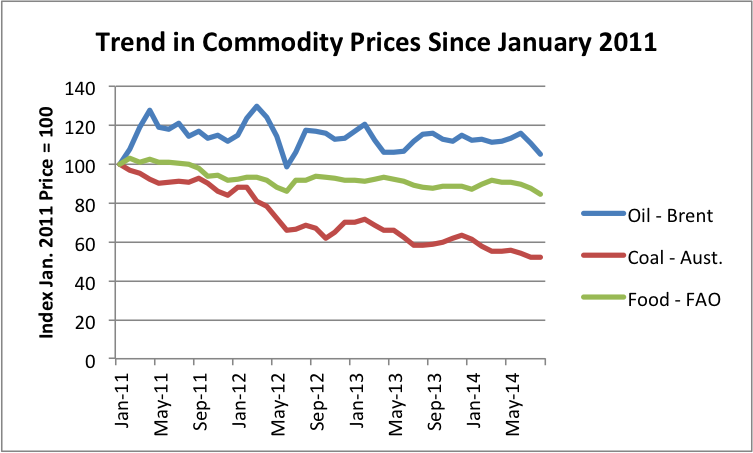
Oil and other commodity prices have recently been dropping. Is this good news, or bad?

Figure 1. Trend in Commodity Prices since January 2011. Brent spot oil price from EIA; Australian Coal from World Bank Prink Sheet; Food from UN's FAO.

Figure 1. Trend in Commodity Prices since January 2011. Brent spot oil price from EIA; Australian Coal from World Bank Prink Sheet; Food from UN’s FAO.

I would argue that falling commodity prices are bad news. It likely means that the debt bubble which has been holding up the world economy for a very long–since World War II, at least–is failing to expand sufficiently. If the debt bubble collapses, we will be in huge difficulty.

Many people have the impression that falling oil prices mean that the cost of production is falling, and thus that the feared “peak oil” is far in the distance. This is not the correct interpretation, especially when many types of commodities are decreasing in price at the same time. When prices are set in a world market, the big issue is affordability. Even if food, oil and coal are close to necessities, consumers can’t pay more than they can afford.

A person can tell from Figure 1 that since the first part of 2011, the prices of Brent oil, Australian coal, and food have been trending downward. This drop in prices continues into September. For example, as I write this, Brent oil price is $97.70, while the average price for the latest month shown (August) is $105.27. It is this steeper, recent drop, which many are concerned about.

We are dealing with several confusing issues. Let me try to explain some of them.

Issue #1: Over the short term, commodity prices don’t reflect the cost of extraction; they reflect what buyers can afford.

Oil prices are set on a worldwide basis. The cost of extraction varies around the world. So it is clear that oil prices will not match the cost of extraction, or the cost of extraction plus a reasonable profit, for any particular producer.

If oil prices drop, there is a temptation to believe that this is because the cost of production has dropped. Over a long enough period, a drop in the cost of production might be expected to lead to lower oil prices. But we know that many oil producers are finding current oil prices too low. For example, the Wall Street Journal recently reported, “Royal Dutch Shell CEO: Can’t deny returns are too low. Ben van Beurden prepared to shrink company in order to boost returns, profitability.” I wrote about this issue in my post, Beginning of the End? Oil Companies Cut Back on Spending.

In the short term, low prices are likely to signal that less of the commodity can be sold on the world market. Commodities such as oil and food are very desirable products. Why would less be needed? The issue, unfortunately, is affordability. Affordability depends largely on (1) wages and (2) debt. Wages tend to be fairly stable. The likely culprit, if affordability is leading to lower demand for desirable products like oil and food, is less growth in debt.

Issue #2: Economic growth tends to produce a debt bubble.

Many economists believe that technological innovation is the key to economic growth. In my view, economies need a combination of the following to have economic growth of the type experienced in the last 100 years:1

(Increase in debt) + (cheap-to-extract fossil fuels) + (cheap-to-use non-fossil fuel resources) +  (technological innovation)

In such a case, debt keeps increasing as an economy grows. Unfortunately, this economic growth is only temporary, because resources tend to become more expensive to use over time, making the “cheap” resources required for economic growth disappear.

The problem underlying the rising cost of resources (both for fossil fuels and others) is that we tend to use the cheapest-to-extract resources first. Technological innovation continues to occur, but as diminishing returns hit both fossil fuels and other resources, there are larger and larger demands on technology to keep costs in line with what workers can afford. Eventually, the cost of resources (net of technological improvements) rises too much, and economic growth is cut off. By this time, a huge mountain of debt has been built up.

Let me explain further how this happens. Without fossil fuels, the world is pretty much stuck with the goods that can be made with wood, or from other basic resources such as animal skins, cotton, flax, or clay. A small quantity of metal and glass goods can be made, but deforestation quickly becomes a problem if an attempt is made to “scale up” the quantity of goods that require heat in their production.2

Once inexpensive coal became available, its availability opened the door to technological innovation, because it provided heat in quantity that had not been available previously. While ideas such as the steam engine had been around for a long time, the availability of inexpensive coal made the production of metals needed for the steam engine, plus train tracks and railroad cars, available at reasonable cost.

With the ability to make steel and concrete in quantity (both requiring heat) came the ability to make hydroelectric dams and electrical transmission lines, thus enabling electricity for public consumption. Oil, as a liquid fuel, paved the way for widespread use of additional innovations, such as private passenger automobiles, mechanized farm equipment, and airplanes. Between coal and oil, many workers could leave farming and begin jobs in other sectors of the economy.

The transformation that took place was huge: from wooden tools and human or animal labor to a modern industrial society. How could such a big change take place? Before the change, the ability to generate a profit that might be used for future capital investment was very limited. Also, the would-be purchasers of products made in an industrial economy were very poor. I would argue that the only way of bridging this gap was debt. See my earlier posts, Why Malthus Got His Forecast Wrong and The United States’ 65-Year Debt Bubble.

The use of debt has several advantages:

  1. It allows the consumer to buy the end product made with the new resources, assuming the end product isn’t too expensive relative to the consumer’s earnings.
  2. It gives resource-extracting businesses the money they need to buy equipment and to hire workers, prior to the time they have earned profits from resource extraction.
  3. It gives the companies the ability to build factories, before they have accumulated profits to pay for the factories.
  4. It allows governments to fund needed infrastructure, such as roads and bridges, before having the tax revenue available to pay for such infrastructure.
  5. Most importantly, the “demand” generated by (1), (2), (3) and (4) raises the price of resources sufficiently that it makes it profitable for companies in the business to extract those resources.

Because of these issues, debt and cheap fossil fuels have a symbiotic relationship.

(1) The combination of debt, inexpensive fossil fuels, and inexpensive resources of other kinds allows the production of affordable goods that raise the standard of living of those using them. The result is what we think of as “economic growth.”

(2) The economic growth provides the additional income needed to pay back the debt with interest. The way this happens is indirectly, through what is sometimes described as “greater productivity of workers.” This greater productivity is really human productivity enhanced with devices made possible by fossil fuels, such as sewing machines, electric milking machines, and computers that allow workers to become more productive. Indirectly, the higher productivity of workers benefits both businesses and governments, through higher sales of goods to consumers and through higher taxes. In this way, businesses and governments can also repay debt with interest.

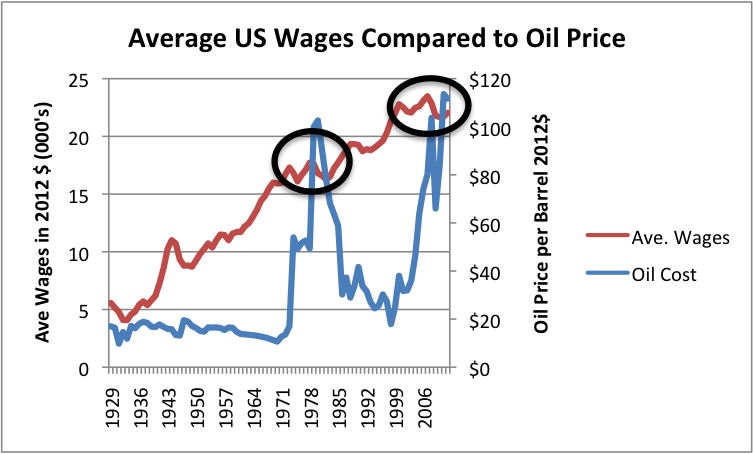
Higher-priced resources are a problem. Higher-priced resources of any kind tend to “gum up the works” of this payback cycle. Higher-priced oil in particular is a problem. In the United States, when oil prices rise above about $40 or $50 barrel, growth in wages stops.

Figure 2. Average wages in 2012$ compared to Brent oil price, also in 2012$. Average wages are total wages based on BEA data adjusted by the CPI-Urban, divided total population. Thus, they reflect changes in the proportion of population employed as well as wage levels.

Figure 2. Average wages in 2012$ compared to Brent oil price, also in 2012$. Average wages are total wages based on BEA data adjusted by the CPI-Urban, divided total population. Thus, they reflect changes in the proportion of population employed as well as wage levels.

With higher oil prices, the rise in the standard of living stops for most workers, and good-paying jobs become difficult to find. There are a couple of reasons we would expect wages to stagnate with higher oil prices:

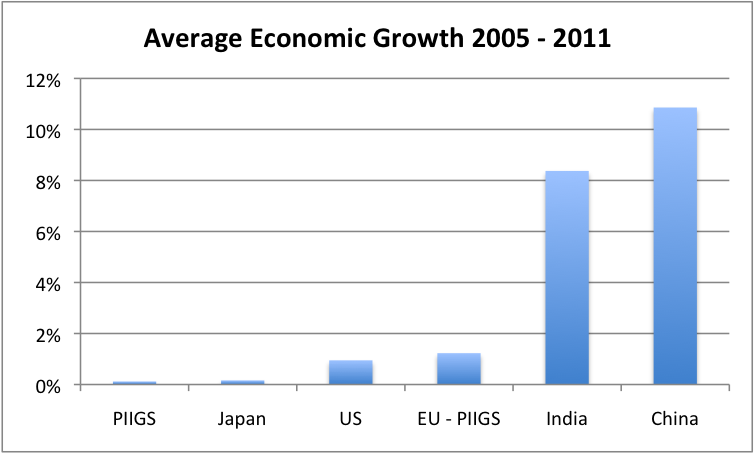
(1) Competition with cheaper energy sources. When oil prices rose, countries using a very high percentage of oil in their energy mix (such as the PIIGS in Europe, Japan, and United States) became less competitive in the world economy. They tended to fall behind China and India, countries that use much more coal (which is cheaper) in their energy mix.

Figure 3. Average percent growth in real GDP between 2005 and 2011, based on USDA GDP data in 2005 US$.

Figure 3. Average percent growth in real GDP between 2005 and 2011, based on USDA GDP data in 2005 US$.

(2) Need to keep the price of goods flat. Businesses need to keep the total price of their products close to “flat” despite rising oil prices, if they are to continue to sell as much of their product after the oil price increase as previously. Oil is one major cost of production; wages are another. An obvious way to offset rising oil prices is to reduce wages. This can be done in several ways: outsourcing work to a lower cost country, greater automation, or caps on wages. Any of these approaches will tend to produce the flattening in wages observed in Figure 2.

Based on Figure 2, an oil price above $40 or $50 per barrel seems to put a cap on wages, and indirectly leads to much less economic growth. Even if we didn’t hit this oil price limit–for example, if we had discovered a liquid fuel that could be produced in quantity for less than $40 barrel–we would eventually hit some kind of growth limit. For example, the limit might be climate change or too much population for food production capability. Even too much debt can be a limit, if citizens’ incomes don’t rise in a corresponding manner. At some point, it becomes impossible even to make interest payments if the debt level is too high. Indirectly, citizens wages even support business and government debt, because business revenues and tax revenues depend indirectly on wages.

Issue #3: Repaying debt is very difficult in a flat or declining economy.

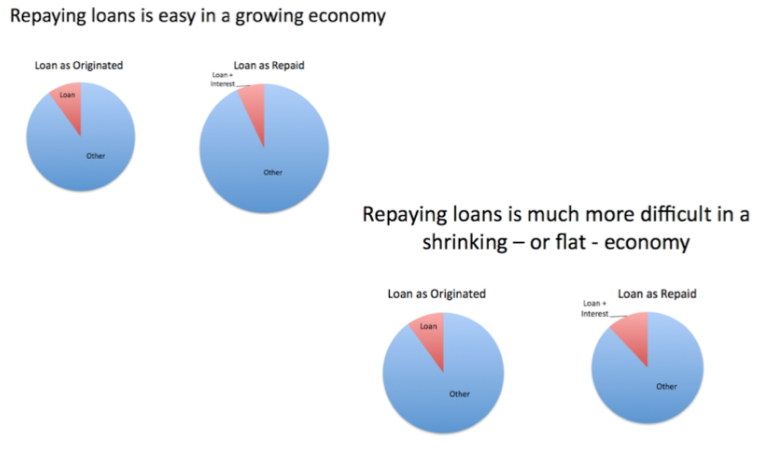
Once growth stops (or slows down too much), the debt bubble tends to crash, because it is much more difficult to repay debt with interest in a shrinking economy than in a growing one.

Figure 4. Repaying loans is easy in a growing economy, but much more difficult in a shrinking economy.

Figure 4. Repaying loans is easy in a growing economy, but much more difficult in a shrinking economy.

The government can hide this issue for a very long time by rolling over old debt with new debt and by reducing interest rates to practically zero. At some point, however, the system seems certain to fail.

Not all debt is equivalent. Debt that simply blows bubbles in stock market prices has little impact on commodity prices. In order to keep commodity prices high enough for producers to want to continue to produce them, the debt really has to get back into the hands of the potential buyers of the commodities.

Also, any changes that tend to reduce world trade push the world economy toward contraction, and make it harder to repay debt with interest. Thus, sanctions against Russia, and Russia’s sanctions against the US and Europe, tend to push the world toward debt collapse more quickly.

Issue #4: Rising oil and other commodity prices are a problem, especially for countries that are importers of those commodities.

Most of us are already aware of this issue. If oil prices rise, or if food prices rise, our salaries do not rise by a corresponding amount. We end up cutting back on discretionary purchases. This cutback in discretionary purchases leads to layoffs in these sectors. We end up with the scenario we had in the 2007-2009 recession: falling home prices (since higher-priced homes are discretionary purchases), failing banks, and many without jobs. See my article Oil Supply Limits and the Continuing Financial Crisis.

The reason that low oil and other commodity prices are welcomed by many people now is because the opposite–high oil and other commodity prices–are so terrible.

Issue #5: Falling oil and other commodity prices are a problem, if the cost of production is not dropping correspondingly.

If commodity prices drop for any reason–even if it is because a debt bubble is popping–it is going to affect how much companies are willing to produce. There is going to be a tendency to cut back in new production. If prices drop too far, it is even possible that some companies will leave the market altogether.

Even if it doesn’t look like a country “needs” the current high oil price, there may still be a problem. Oil exporters depend on the high taxes that they are able to obtain when oil prices are high. If they cannot collect these taxes, they may need to cut back on programs such as food subsidies and new desalination plants. Without these programs, civil disorder may lead to cutbacks in oil production.

Issue #6: The growth in oil sales to China and to other emerging markets has been fueled by debt growth. This debt growth now seems to be stalling.

Growth in oil consumption has mostly been outside of the United States, the European Union, and Japan, in the recent past. China and other emerging market countries kept demand for oil high.

Figure 5. Oil consumption by part of the world updated through 2013, based on BP Statistical Review of World Energy 2014 data.

Figure 5. Oil consumption by part of the world updated through 2013, based on BP Statistical Review of World Energy 2014 data.

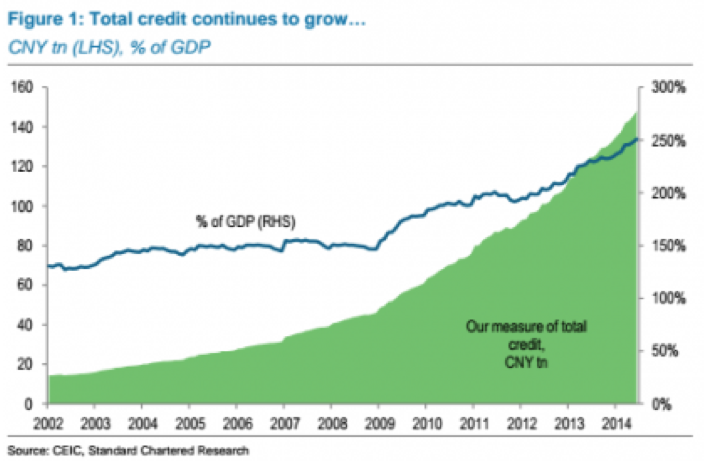
Ambrose Evans-Pritchard reports, China’s terrifying debt ratios poised to breeze past US levels. He shows the following chart of China’s growth in debt from all sources, including shadow banking:

Figure 6. China's total debt, based on chart displayed in Ambrose Evans-Pritchard article.

Figure 6. China’s total debt, based on chart displayed in Ambrose Evans-Pritchard article.

This rise in debt now seems to be slowing, based on a Wall Street Journal report. A person wonders whether this stalling debt growth is affecting world oil and other commodity prices.

Figure 7. Figure from WSJ article PBOC Struggles as Chinese Borrowers Hold Back.

Figure 7. Figure from WSJ article PBOC Struggles as Chinese Borrowers Hold Back.

Other emerging markets also seem to be experiencing cutbacks. Since 2008, the United States, Europe, and Japan have had very easy money policies. Some of the money available at low interest rates was invested in emerging markets. Now the WSJ reports, Fed Dims Emerging Markets’ Allure. According to the article investors, investors are taking a more cautious stance on new investment because of fear of rising US interest rates.

Of course, other issues affect debt and world commodity demand as well. If interest rates rise, they many have a tendency to shrink new lending, in general, because loans become less affordable. Sanctions of one country against another, such as the US against Russia, and vice versa, also tend to reduce demand.

Issue #7: Debt bubbles have been a problem in past collapses.

According to Jesse Colombo, the Depression was to a significant result the result of debt bubbles that built up during the roaring twenties. Another, longer-term cause would seem to be the loss of farm jobs that occurred when coal allowed tasks that were previously done by farm workers to be done by either electricity or by horses pulling metal plows. The combination of a debt bubble and loss of jobs seems to have parallels to our current situation.

Many believe the subprime housing bubble crash contributed to the Great Recession. The oil price spike of 2007 and 2008 played a major role as well.

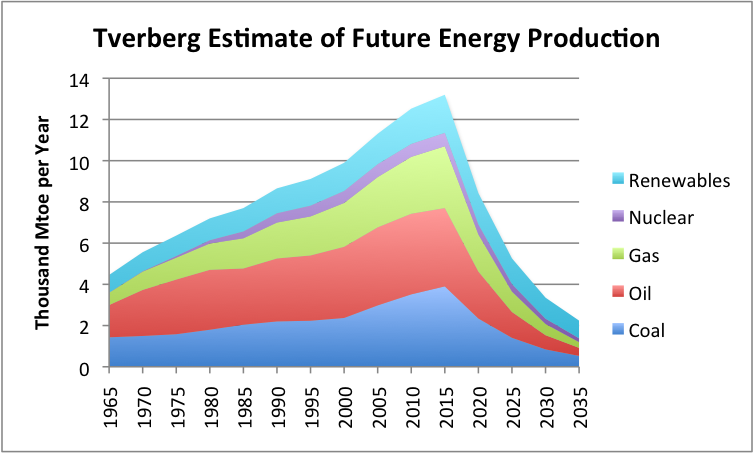
Issue #8: If we are facing the collapse of a debt bubble, it is quite possible that prices of many commodities will fall. This could possibly lead to a collapse in the supply of many types of energy products, more or less simultaneously. 

Figure 8, shown below, is a very rough estimate of the kind of decline in energy use we could be facing if a debt collapse leads to very low prices of many types of fuels simultaneously. Prices of many commodities crashed in 2008, and it was only with massive intervention that prices were propped up to 2011 levels. After the beginning of 2011, prices began sinking again, as shown in Figure 1.

Figure 8. Estimate of future energy production by author. Historical data based on BP adjusted to IEA groupings.

Figure 8. Estimate of future energy production by author. Historical data based on BP adjusted to IEA groupings.

Clearly governments will try to prevent another sharp crash in commodity prices. The question is whether they will be successful in propping up commodity prices, and for how long they will be successful. In a finite world, fossil fuel energy production eventually must decline, but we don’t know over precisely what timeframe.

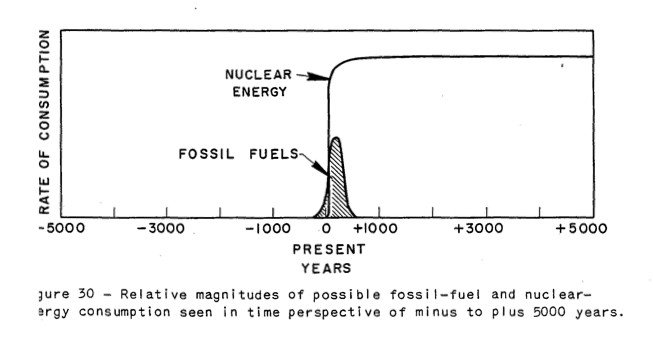
Issue #9: My steep decline contrasts with the “best case” forecast of future oil consumption given by M. King Hubbert.

M. King Hubbert wrote about a scenario where another type of fuel completely takes over, before oil and other fossil fuels are phased out. He even discusses the possibility of making liquid fuels using very cheap nuclear energy. The way he represents the situation is the following:

Figure 9. Figure from Hubbert's 1956 paper, Nuclear Energy and the Fossil Fuels.

Figure 9. Figure from Hubbert’s 1956 paper, Nuclear Energy and the Fossil Fuels.

In such a scenario, it is possible that oil supply will begin to decline when approximately 50% of resources are exhausted, and the down slope of the curve will follow a symmetric “Hubbert curve.” This situation seems to represent a best possible case; it doesn’t seem to represent the case we are facing today. If a debt collapse occurs, much of the remaining fuel is likely to stay in the ground.

Issue #10: Our economy is a networked system. Increasing debt is what keeps the economy inflated. If wages fail to keep pace with debt growth, the system seems likely to eventually crash.

In previous posts, I have represented the economy as a self-organized networked system, consisting of businesses, consumers, governments (with laws, regulations, and taxes), financial system, and international trade.

Figure 10. Dome constructed using Leonardo Sticks

Figure 10. Dome constructed using Leonardo Sticks

One reason the economy is represented as hollow is because the economy loses its capability to make goods that are no longer needed–such as buggy whips and rotary dial phones. Another reason why it might be represented as hollow is because debt is used to “puff it up” to its current size. Once the amount of debt starts shrinking, it makes it very difficult for the economy to maintain its stability.

Many “peak oilers” believe that if we have a problem with the financial system, all we have to do is start over with a new one–perhaps without debt. Everything I can see says that debt is an essential part of the current system. We could not extract fossil fuels in any significant quantity, without an ever-rising quantity of debt. The problem we are encountering now is that once resource costs get too high, the debt-based system no longer works. A new debt-based financial system likely won’t work any better than the old one.

If we try to build a new system without fossil fuels, we will be really starting over, because even today’s “renewables” are part of the fossil fuel system.3 We will have to go back to things that can be made directly from wood and other natural products without large amounts of heat, to have truly renewable resources.

Notes:

[1] This is really a simplification of the real issues. As world population grows, it is necessary to obtain an increasing amount of food from the same arable land. Thus, it is necessary to find new processes to increase food production, at the same time that soil is quite possibly degrading. Soil is in a sense a “resource other than fossil fuels,” but I have not mentioned this issue specifically.

Growing pollution problems are in some sense an indirect cost of extracting fossil fuels and other resources. These represent another growing cost that I have not specifically identified. Furthermore, there are indirect expenses that do not fit neatly into any category, such as required desalination plants to handle growing populations in areas where water is scarce. We may need to consider mitigation expenses of all types as part of the “cost of resource extraction.”

My point is that it becomes increasingly difficult to offset these many cost increases with technological innovations. Furthermore, if no changes are made, a larger and larger share of both the workforce and resources are required for maintaining the status quo, leaving fewer workers and a smaller quantity of resources to “grow” the economy.

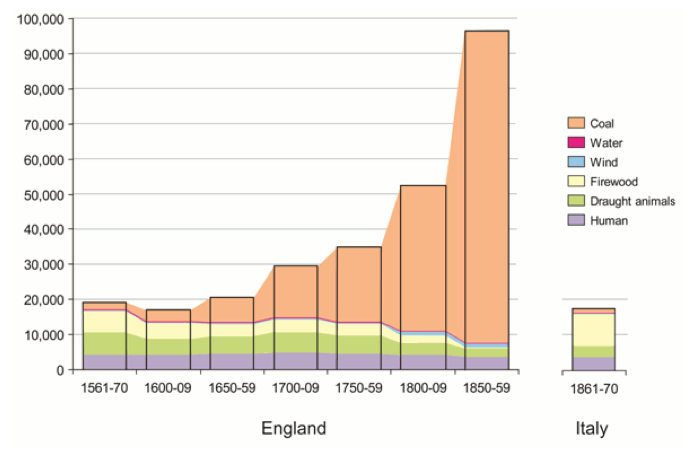
[2] Wind and water are additional sources of energy, but they are sources of mechanical energy, not heat energy, so are not helpful unless they can be converted first to electricity, and then to heat. In quantity, they never were very large in pre-fossil fuel days.

Figure 11. Annual energy consumption per head (megajoules) in England and Wales 1561-70 to 1850-9 and in Italy 1861-70. Figure by Tony Wrigley from Opening Pandora's Box. Figure originally from Energy and the English Industrial Revolution, also by Tony Wrigley.

Figure 11. Annual energy consumption per head (megajoules) in England and Wales 1561-70 to 1850-9 and in Italy 1861-70. Figure by Tony Wrigley from Opening Pandora’s Box. Figure originally from Energy and the English Industrial Revolution, also by Tony Wrigley.

[3] Of course, any existing “renewable” will continue to work until it needs repairs that are unavailable. Other parts of the system (such as electric transmission lines, batteries, inverters, and attached devices such as pumps) may fail more quickly than the renewables themselves.

See the original article >>

The Counter-Intuitive Rise of the U.S. Dollar

by Charles Hugh Smith

As things get dicier globally, assets in periphery nations typically get dumped as mobile capital flees risk and migrates to lower risk core nations and currencies.


I received many thoughtful comments on Why the Dollar May Remain Strong For Longer Than We Think. Given the many weaknesses of the U.S.--ballooning social-welfare and crony-capitalist liabilities, free money for financiers monetary policies, etc.--a strengthening dollar (USD) strikes many as counter-intuitive.

The dynamic complexities of fiscal and monetary policies, global capital flows and the foreign exchange (FX) market complicate any inquiry, so I try to keep it simple.

In my view, the USD serves both transactional (global trade) markets and the global need for currency reserves (i.e. as a store-of-value). Sorting out the various influences on its relative value in each capacity is complex enough, but there is also the X Factor--the hard-to-quantify components of any currency's relative value.

For the USD, the X Factor is hegemony, which includes financial dominance based on debt issued/denominated in USD and what might be called the real-world assets of the issuing nation: that nation's food, energy and water security (what I call the FEW resources), its proximity to potential enemies, its external environmental costs, its overseas financial assets, the strength of its legal system in protecting private assets,its demographic profile and of course its ability to project power to defend its interests.

By these basic measures, the U.S. scores pretty well. We can get some perspective on this by putting ourselves in the shoes of wealthy people in periphery nations where the risks of capital controls, currency devaluation, etc. are perceived to be high, or in the shoes of corrupt elites in countries where they fear their ill-gotten gains might not survive blowback (hence the almost universal desire of elites to leave China with their loot).

The strength of the USD is attractive to at-risk capital, even if transferring at-risk wealth into dollars requires a significant foreign-exchange haircut. Better to preserve 75% of your wealth in USD than leave it exposed to confiscation, capital control, etc. This is the basic flight-to-safety mechanism.

Ubiquity also counts. The USD is the proxy global currency. A $100 USD bill is recognized as money virtually everywhere. If you're stranded just about anywhere, USD will buy you food, transport, official "assistance" via bribes, etc. No other paper currency is even close to ubiquity/recognition. (Clean, crisp $100 USD bills are recommended--dirty crumpled bills are not highly esteemed.)

It's also critical to look at the relative scale of the money-printing that erodes the value of currencies: -China's credit expansion is much larger as a percentage of its economy and financial system than the Fed's money-printing as a percentage of the U.S. financial system.

Then there's the scramble-for-yield issue: imagine you're managing $10 billion. You need to preserve this wealth but you also need to earn a yield, or you'll be fired at the end of the quarter. Since FX (foreign exchange) is a much larger market than stocks or bonds, you're highly attuned to FX so you don't get blindsided by a shift in FX that wipes out your yield. You might wisely build an "insurance" position in precious metals, but because you need yield then you have exposure to bonds, stocks and as a result, FX.

As things get dicier globally, assets in periphery nations typically get dumped as mobile capital flees risk and migrates to lower risk core nations and currencies.

For money managers, the USD is an FX safe haven--especially since the capital flowing out of the riskier periphery pushes the USD higher. This makes for a secondary yield--as the USD rises, any asset denominated in USD will gain in relative value. So there's a self-reinforcing feedback loop: as the USD value rises, it attracts more of the money fleeing risk.

In a way, the USD acts as a currency equivalent of the English language. There are many languages and many currencies, but at present the indispensable language/currency in the global economy is English/USD.

How can we summarize this discussion?

1. FX is the "master market" of the global financial system.

2. The flow of mobile capital out of the periphery into the core will turn into a flood as global risks rise.

Both of these conditions favor the USD.

See the original article >>
Follow Us