Wednesday, June 26, 2013

Kress Cycle Market Deflation Pressure Increases

By: Clif_Droke

To many observers, deflation was a thing of the past in the wake of the QE3. The Fed’s asset purchases, which drove down bond yields to record lows, were thought to have tamed the global deflationary problem once and for all. What they didn’t count on was the floodtide of deflation breaking through the dikes and barriers carefully constructed by the world’s central banks.
The increasing deflationary pressure is most visible in Europe and Asia but will soon wash up on U.S. shores in the near future. A general deflationary trend is already visible in equity markets in several major countries, a consequence of the final descent of the 120-year Kress cycle. As that cycle approaches its final bottom in late 2014 we can expect to see an increase in some of the problems we’re just starting to see right now in the global economy.

One of the most conspicuous victims of the deflationary Kress cycle is China. China has in fact led the recent malaise in global markets starting with an 11% surge in short-term interest rates in China. China’s overnight repo rate increased by an incredible 25%.
As analyst Bert Dohmen commented, “China is extremely important for all business leaders and investors….Because whatever happens to China will tremendously influence the world economy and your investments. Many large U.S. and European companies depend on China for a significant portion of their sales and profits….A crisis in China will have global repercussions.”
China’s Shanghai Composite Index has been in a bear market since peaking in mid-2009. It’s remarkable when you consider that as the rest of the world has experienced a measure of recovery for the last four years, China’s stock market has been in decline. In fact the Shanghia index is on the verge of testing its 2008 credit crisis lows, as you can see here.

One of the most fundamental pillars of market analysis is that the stock market always predicts future business conditions. What is this telling us about China’s business and economic future? The message can’t be interpreted as anything but negative for the nations of the world that depend on China’s manufacturing sector.
Then there is Russia. Not that Russia is of any great importance to the global economy by itself, but Russia has long been a benchmark for deflationary pressures. Since much of Russia’s economy is tied to oil and natural resources, any sustained decline in the price of oil will automatically exert a negative impact on the country. Remember back in 1998 when oil prices collapsed to $10/barrel? Russia’s financial sector went into collapse and its economy was in shambles. It took an oil price recovery in the last decade to allow Russia’s economy to bounce back and grow for nine straight years. Without the artificial oil price inflation, thanks in large part to the Fed and other central banks, Kress cycle deflationary forces would have long since wiped out Russia.
Here’s what the Market Vectors Russia ETF (RSX) looks like over the last four years. Note the bear market pattern visible in this chart since 2011. Any further decrease in the price (and demand for) oil won’t bode well for Russia and will only hasten the country’s economic demise.

What about the other BRIC countries? India’s stock market is currently probing a 4-year low and the country’s debt market had to be shut recently as yields increased beyond trading bands. Brazil, which was the rising star of the emerging markets not long ago, is slowing economically and has been described recently as “dysfunctional.” Not surprisingly, the natives are growing restless. As Reuters reported on June 24, “More than a million Brazilians have taken to the streets this past week in the largest mass demonstrations since the impeachment of President Fernando Collor de Mello in 1992.”
Brazil’s stock market, as reflected in the MSCI Brazil Capped Index Fund (EWZ), has broken down from a bearish triangle pattern – a pattern much similar to the one visible in the Russia ETF shown above. This could be a preview of what’s to come for other emerging markets in the not-too-distant future as we draw closer to the 120-year cycle bottom.

Gold
After jumping 17.48 percent the previous week, net non-commercial positions in gold declined 7.13 percent during the week of June 11 to 60,227 contracts. Non-commercial long positions in gold have declined 56 percent, its lowest level in 12 months, as investors continue to the exodus from global bonds and commodities.
According to Barclays, net redemptions of gold-backed ETFs have slowed, with an outflow of 15 tons in the first half of June compared to 48 tons in the first half of May. Cash-negative gold positions have also fallen to fewer than 70 tons, according to Sharps Pixley. Most of the “smart money” capitulation selling by hedge funds and institutional investors has likely been completed; the latest decline in gold therefore likely represents the final “dumb money” capitulation phase of the bear market where smaller investors unload their holdings.

See the original article >>

Sugar is Not Sweet!

by Greg Harmon

Roses are red,
Violets are blue,
Sugar is sweet,
And so are you

There is something wrong with this poem. It is late June and the Roses are Red and the Violets Blue. But Sugar is not sweet. It has been in the toilet for over a year. The price of Sugar that is. Take a look at the chart for the Sugar ETF, $SGG, below. A straight downtrending channel bounded by falling trend support and the 50 day Simple Moving Average (SMA) since September 2012. Yes it has tried to break the channel a couple of time only to have the 100 day SMA there to kill any rally. So what about this time? Is it different? Not really, but the same characteristics that would get you excited

sgg d

about Sugar on the last two breaks over the 50 day SMA are present again. Maybe the third time is the charm. The Relative Strength Index (RSI) is rising and making a new higher high with a Moving Average Convergence Divergence indicator (MACD) that is also rising. These support further upside price action. I would wait until a sustained hold over the 100 day SMA before entering long. If you are short, congratulations and don’t take it off until the 100 day SMA is breached.

See the original article >>

Great Graphic: Another Look at Japanese Stocks

by Marc to Market

The US and Japanese equity markets have been among the best performing equity markets this year. The gains in US equities seem to be largely a function of domestic accounts.

Foreign investors appear to have played a larger role in the advance of Japanese shares. Weekly Ministry of Finance data shows foreign investors have bought $79 bln worth of Japanese equities this year (through mid-June).

Typically foreign investors focus on the big blue chip names. However, many of these companies have sophisticated currency hedging programs and had bought protection from their traditional nemesis, a stronger yen. Smaller companies are more flexible and are, arguably, better positioned to benefit from the weaker yen.

This Great Graphic,. created on Bloomberg, shows the performance of the Nikkei (white line) and the Japanese over-the-counter (JASDAQ)index (yellow line). The Nikkei is price weighted, while the JASDAQ is cap-weighted. It is difficult to see it on the chart which is not normalized, but the JASDAQ has performed twice as well as the Nikkei this year. Through today's session, the Nikkei has gained about 23.4%, while the JASDAQ is up 51.6%. Admittedly most of the rise was seen in the first three months of the year, but even here in Q2, the general out-performance has held. The Nikkei is up 3.5%, while the JASDAQ is up 7.1%.

See the original article >>

Italy’s €8bn Loss! Draghi?

By tothetick

The Financial Times has revealed that Italy is facing losses of €8 billion due to derivative contracts that were taken out in the 1990s and that were restructured during the Eurozone crisis.

The Financial Times has gained access to secret documents that show that the Italian Treasury Department is sitting on losses that were the result of restructuring of eight debt contracts. The terms seem to have been badly negotiated with foreign banks in 2012.

Apparently, the report does not go into too much detail and omits certain essential information leading analysts at the FT to believe that the €8 billion are not quite the full picture. Italy negotiated to stagger payments over a longer period of time, but the notional value of the debt stands at €31.7 billion, meaning that the losses are extremely high. Who was doing the negotiating?

Well, it turns out that none other than Mario Draghi, the President of the European Central Bank (since 1st November 2011) was the head of the Italian Treasury between 1991 and 2001. This is the man that announced that the European Central Bank had done ‘a great job’ supporting the Euro and restoring market functioning. It now looks like Mr. Draghi may have some explaining to do about those derivative deals back in the 1990s. Whether he was the main-man or not, he will have some answering to do, it seems.

The report fails to give crucial details such as the names of the banks or the original contracts, but the derivatives date back to the period when Italy was preparing to enter the Euro. It goes without saying that the derivative contracts would have enabled Italy (just like Greece) to boost their accounts in the short-term and make it look like they were flush with cash just before entering the Euro as one of the 11 countries to do so at the start. But it also meant that in the long-term when the derivative contracts had to be repaid, they would add to the debt of the country enormously. Public deficit in 1997 as reduced from 6% in the previous year to just 3%, which meant that Italy qualified for entering the Eurozone. By 1998 it had fallen to just 2.7%, which was the largest reduction in budget deficit of any of the first 11 countries to join the Eurozone at the time. Somebody was obviously trying to pull the wool over the eyes of everybody that was looking on at the time. Although, honestly, it has to be asked if that was anything unusual. Weren’t they all doing it in the EU to make themselves look like cash-flash Harry?

Italy Deficit in Euros

Italy Deficit in Euros

The Italian state auditors, the Corte dei Conte, requested the report to be submitted and the Finance Police (the Guardia di Finanza) were called in to the office of the present head of the Treasury debt-management department, Maria Cannata. Maria Cannata was also working alongside Mario Draghi at the time as a senior official working on deficit accounting.

The European Central Bank has declined to make any comment for the moment, but it certainly looks as if Mario Draghi will have some answering to do over the deals that were negotiated back then. This is particularly alarming since the report that was submitted only provides evidence of a six-month period and there are fears that Italy’s debt due to these derivative contracts may be far higher.

The current Prime Minister, Enrico Letta looks as if he may be in for a rough ride too now even more so due to the report being leaked to the press. He is currently under great pressure to keep his coalition government together and especially since tomorrow Italy will be auctioning off €5-billion worth of five and ten year Treasury Bonds. There was a bond auction yesterday already when Italy auctioned off 186-day Treasury Bonds and raised €4.5 billion. They were purchased at 1.052%, which was a rise from the previous figure of 0.538% on May 29th. Letta’s coalition is seeing a split already over fiscal reforms and the Italian economy is in dire straits with the recession.

Italy is the EU’s third largest economy. Its economy shrank by 0.6% in the first quarter this year. At a conference in London yesterday Maria Cannata stated that there was no need for concern about the fallshort in economic growth as investment from the USA was increasing. She spoke of “a good sign of confidence”. We shall see if that confidence now wanes given the leaking of the report.

The European Commission recommended removing the excessive-deficit procedure that has been held against Italy only at the end of May 2013. Italy’s deficit is projected to reach 2.9% of Gross Domestic Product this year. Quarterly deficit for Italy stood as follows last year:

  • Q1: -24,861.50 €
  • Q2: -8,974.50 €
  • Q3: -6,313.60 €
  • Q4: -5,517.40 €

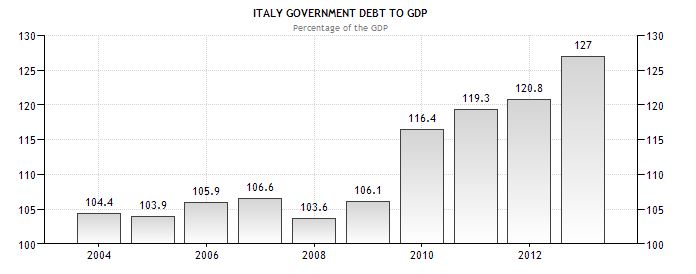
In 2012 government debt to GDP amounted to a total of 127%.

Italy Government Debt

Italy Government Debt

Whatever the report states, it shall probably come as no surprise to anyone that Italy fiddled the books to make its accounts look flush. Banking on the future always remaining positive is the worst mistake to be made. Or, perhaps Mr. Draghi didn’t imagine for one moment that he would be the head of the European Central Bank today when the report came to light. If you are going to do something, it would be well-advisable to either bury that report so deep that nobody finds it or turn yourself into a gladiator in the ring that will be championed by the people. Is that a fitting description of Mr. Draghi? Might be time to raise your hand and come clean, Mr. Draghi.

Italy's Debt

Italy's Debt

Back in January, when Silvio Berlusconi joined forces with the Northern League Party just before the elections in February 2013, he stated in a radio interview that he didn’t want to be Prime Minister again, but that he would gladly take on the job of Finance Minister. Lucky escape for the Italians that Berlusconi never made it into office. But he was briefly Finance Minister between 3rd July and 16th July 2004, while in office as Prime Minister.  In the last elections, his coalition party gained 29.1% of the votes in the Chamber of Deputies and 30.7% of the votes in the Senate, however. The present Minister of Finance is Fabrizzio Saccomanni (since 28th April 2013).

See the original article >>

Can China Handle the Liquidity Crunch?

By Mindful Money

At the end of last week markets were understandably troubled by the implications of a “tapering” of Quantitative Easing by the US Federal Reserve. Indeed one of the consequences of this which is rising bond yields has continued this morning as prices have fallen further and the yield on the benchmark ten-year Treasury Note has reached 2.6%. Whilst is still historically low it has risen by 1% since the beginning of May. However this was not the only factor in market uncertainty as increasingly disturbing developments have been coming out of China and in particular in her monetary system where liquidity has been drying up leading to fears of a credit crunch there.

What has happened?

The Shanghai Interbank Offered Rate or SHIBOR has been rising in June and on Thursday the overnight rate  rose to 13.44% and the one week rate rose to 11%. This led to fears of a liquidity squeeze in the Chinese economy in response to this although the official view from the Xinhua new agency was this.

Liquidity shortage creates opportunities

For whom? Apparently depositors were likely to get better returns. As it happens they would have had to be quick as the one week SHIBOR dropped back to 8.49% on Friday  and 7.32% this morning.

If we look back we see that this time last year the one week rate was more like 2.5% and that up to now whilst rates had been going higher there had only been one brief episode above 5%. So in a world now sensitised to the problems caused by liquidity squeezes there were obvious worries.

What was the People’s Bank of China (PBOC) doing?

At a time like this all eyes should be on the central bank as controlling money market interest-rates is its most fundamental job. This becomes even more important if the spike is accompanied by a decline in transactions as it has been in China. However the PBOC waited until Friday to respond.

In fact a squeeze was official policy

The PBOC had stood to one side because policy in China is currently attempting to trim a monetary boom. Rather unfortunately for its criticisms of “weak imperialist capitalists” its boom has had elements of profiteering,shadow banking systems and speculation just like a weak imperialist capitalist!

If we look at today’s monetary data we see this.

At end-May, broad money (M2) stood at 104.21 trillion yuan , increasing by 15.8 percent year-on-year down 0.3 percentage points from end-April but up 2.6 percentage points from the same period last year.

Narrow money (M1) registered 31.02 trillion yuan , rising by 11.3 percent year-on-year, down 0.6 percentage points from end-April but up 7.8 percentage points from the same period last year.

So we see that as of the end of May the boom was continuing particularly compared to a year ago and accordingly the PBOC was attempting to rein it in. It is via this route that we have seen it try to look the other way when monetary conditions tightened and only responded when the pot was clearly boiling over.

Today

The PBOC has released a statement on its website this morning but intriguing dated it for the 17th. It tells us this via Google Translate.

financial institutions must continue to conscientiously implement the prudent monetary policy, and effectively improve risk awareness, and constantly improve liquidity management and scientific initiatives, continue to strengthen liquidity management, promote stable monetary environment.

Commercial banks should pay close attention to the market liquidity situation, to strengthen the liquidity factors analysis and forecasting,

It does not surprise me that this statement has not calmed matters much as the PBOC as even allowing for the coded nature of official pronouncements it seem to be telling the banks that this is essentially their problem! Whilst this is true it is again following a road trod by the central banks of the weak imperialist capitalists.

A fundamental issue here is exactly how one safely deflates a boom driven by a shadow banking system as using interest-rates to do so has so far not worked. Rather than letting air gently out of the ball such moves have invariably clattered us straight from boom to bust. So if the PBOC does succeed here it will have succeeded where others have failed. But the evidence of last week and indeed this morning are that there are to say the least genuine risks here for China’s economy and those who depend on it.

The Chinese Economy

In a very unfortunate coincidence of timing new evidence of a slow down in the Chinese economy was emerging. On Thursday we got the latest business survey from HSBC.

Flash China Manufacturing PMI™ at 48.3 (49.2 in May). Nine-month low.

Flash China Manufacturing Output Index at 48.8 (50.7 in May). Eight-month low.

So in a case of be careful what you wish for the Chinese leadership got some further evidence of an economic slow down just as fears of a credit crunch were rising to a peak. If we look into the detail of that report we saw the only only factors that did not decrease were inventories and delivery times. So  a broad based decline was recorded with implications for subsequent months.

Equity Markets

In the western nations and in the Euro area in particular 2013 had until the last few days shown a clear divergence between strong stock market peformance and weak underlying economies. China has until now been a doppelganger for this as she has had strong economic growth but a weak stock market. This has gone a step further today as the Shanghai Composite Index has fallen some 5.3% taking it below the 2000 level to close at 1953. It has been heading lower since the 2444 of February 18th of this year. Indeed even Anthony Bolton appears to have given up on it,at least for now.

Adding to the fears will be the fact that today’s falls were led by bank stocks particularly ones involved in off balance sheet and shadow banking system activities. Such banks have for example been offering long-term Wealth Management Products to their customers whilst obtaining at least some of the finance from short-dated interbank funds.What could go wrong?

Comment

So we see that the world’s main command economy looks in danger of following the same route into economic trouble as the weak imperialist capitalists. Although some care is needed here as it has a capitalist tinge these days and the capitalist central bankers are doing their best to mimic command economies. However China faces a challenge which the west failed which is to safely deflate a shadow banking boom.

There are things which can be learnt from the West’s failure back in 2007 and they are as follows. Central banks should learn against any surge in market interest-rates to try to ameliorate the consequences. This is conceptually awkward as there will be an element of stimulus here when it is invariably preaching that a slow down in needed. But intellectual flexibility is required when we note that any attempt by “Mr. Market” to sort this involves an economy shooting straight from boom to bust. At the same time the effectiveness of monetary policy has been slashed as velocity collapses. So my policy prescription for the PBOC is to step into these markets and provide liquidity in an attempt to pass the test which we failed.

This will not be easy as the PBOC has become used to dealing with the opposite problems of high credit growth and a booming economy. If it can gently deflate the Chinese boom it would have done well but if we look wider afield we are left with worries about what will happen to nations who depend on trade with China. This is illustrated by the price of copper which in falling nearly 3% this morning is hovvering just above the US $3 mark or a third below the peak of early 2011. So dependent nations such as Australia are in danger of feeling further chill winds.

Looking at prospects it seems that the world overall may see disinflationary winds from such trends. How far that will progress I do not know but I do know that US index-linked government bonds or TIPS seems to be reflecting this much more than UK ones. If this is based on Mark Carney’s entry onto the UK monetary scene we do not have to long to wait.

Central Bank Swaps

Over the weekend there was a development on this front.

Governor Zhou Xiaochuan and Governor Mervyn King have signed an agreement to establish a reciprocal 3‑year, sterling/renminbi (RMB) currency swap line. The maximum value of the swap is RMB 200bn. The swap line may be used to promote bilateral trade between the two countries and to support domestic financial stability should market conditions warrant.

As ever come caution is needed but if you ask yourself the question why might this be needed? You will find yourself answering that it would be useful in a renminbi credit crunch.

See the original article >>

China central bank says it will ensure stable money markets

By Bloomberg News

China’s central bank said it will use tools to safeguard stability in money markets and tight liquidity is set to ease, giving the first official signs of relief for a cash squeeze in the world’s second-largest economy.

The People’s Bank of China has provided liquidity to some financial institutions to stabilize money-market rates and will use short-term liquidity operations and standing lending- facility tools to ensure steady markets, according to a statement posted to its website yesterday. It also called on commercial banks to improve their liquidity management.

The statement is the first public confirmation of central bank action to ease a crunch that sent China’s overnight repurchase rate to a record last week and came hours after Ling Tao, deputy head of the PBOC’s Shanghai branch, said liquidity risks were controllable. Premier Li Keqiang is seeking to wring speculative lending out of the nation’s banking system after credit expansion outpaced economic growth.

“The message is clear: the central bank doesn’t want to see a tsunami in China’s financial markets, and market rates will drop further,” said Xu Gao, Everbright Securities Co.’s Beijing-based chief economist, who previously worked at the World Bank. The PBOC is giving the market “a pill to soothe the nerves,” he said.

Policy makers’ reluctance to add liquidity contributed to tipping the CSI 300 Index of Chinese equities into a bear market on June 24. Yesterday, the nation’s stocks posted the biggest swings in 22 months. The Shanghai Composite Index fell 0.2 percent at the close after declining as much as 5.8 percent.

Tight Liquidity

“With the elimination of seasonal and emotional factors, interest-rate fluctuations and the tight liquidity situation will gradually ease,” said the central bank, which attributed the increase in borrowing costs to a rapid increase in lending, cash demand during a holiday earlier this month and changes in foreign-exchange markets.

The cost of locking in China’s interest rates fell the most since 2008 today. The one-year interest-rate swap, the fixed cost needed to receive the floating seven-day repurchase rate, slid 27 basis points, or 0.27 percentage point, to 3.805 percent at 9:25 a.m. in Shanghai, data compiled by Bloomberg show. The rate dropped as much as 39 basis points earlier, the most since November 2008. It reached an all-time high of 5.06 percent on June 20.

Financial institutions’ cash reserves stood at about 1.5 trillion yuan ($244 billion) as of June 21, compared with the 600 billion yuan or 700 billion yuan sufficient “under normal circumstances” to cover payment and clearing needs, the central bank said in the statement. “The present liquidity is not insufficient.”

Closely Monitor

“We’ll closely monitor the change of liquidity within the banking system going forward, flexibly adjust liquidity management based on international payments and the liquidity demand-and-supply situation,” Ling said at a briefing in Shanghai yesterday. The PBOC will “strengthen communications with market institutions, stabilize expectations and guide market interest rates within reasonable ranges.”

Ling’s remarks preceded the city’s annual Lujiazui Forum financial conference starting tomorrow.

While “liquidity conditions may become less volatile” the PBOC’s policy stance will probably “remain tight,” Zhang Zhiwei, chief China economist at Nomura Holdings Inc. in Hong Kong, said in a note. He sees a 30 percent chance that the economy will grow less than 7 percent in the third or fourth quarter.

China’s central bank lacks the degree of autonomy enjoyed by its counterparts in the U.S., Europe and Japan, with the State Council, or Cabinet, playing a leading role in setting policy. The nation in March completed a once-in-a-decade leadership transition, with Li becoming premier.

Decision Process

“An increased level of transparency from the central bank side is helpful,” said Sun Junwei, a Beijing-based economist at HSBC Holdings Plc. “At the same time, the decision-making process at the People’s Bank of China is very different from other central banks like the Fed, so what the People’s Bank of China can do in communicating with the market may be limited.”

PBOC Governor Zhou Xiaochuan, 65, reappointed in March after a record 10 years in office, has been silent on the cash squeeze. Ling, 58, previously worked as a deputy director at the central bank’s finance research institute in Beijing. The Shanghai branch, located in China’s financial center, is the most important local outpost and the only one called a “head office.”

The central bank told banks to handle fluctuations in liquidity “calmly” and avoid “irrational behavior,” according to the statement. The PBOC said it will provide liquidity support to those banks with temporary needs if they are lending to help the economy. For banks with liquidity- management problems, the PBOC will “take corresponding measures according to circumstances” to ensure broader market stability, it said.

Growth Target

China’s cash squeeze is increasing the chance that Li will be the first premier to miss an annual growth target since the Asian financial crisis in 1998. Goldman Sachs Group Inc. and China International Capital Corp. this week pared their growth projections this year to 7.4 percent, below the government’s 7.5 percent goal.

“I certainly agree that the credit growth does need to be brought down, but the way they’ve gone about it has been extraordinarily reckless,” said Mark Williams, a former U.K. Treasury adviser on China who is now an economist at Capital Economics Ltd. in London. “It’s good that the People’s Bank is finally talking about what it expects to happen in the future.”

See the original article >>

Follow Us