Wednesday, August 10, 2011

Moving from the Weight to the Wait


The last few days have been a panic ensuing move lower. There is a Weight on the market. A weight dragging it down. The Band wrote a classic song about Luke looking for a place to rest his head before the Judgement Day, titled ‘The Weight’. The distinction being that there was a weight dragging on him, not that he was waiting for the Judgement Day. There are signs now that the mood may soon shift from a Weight to time to Wait for basing. Waiting for stabilization. Let’s take a look.

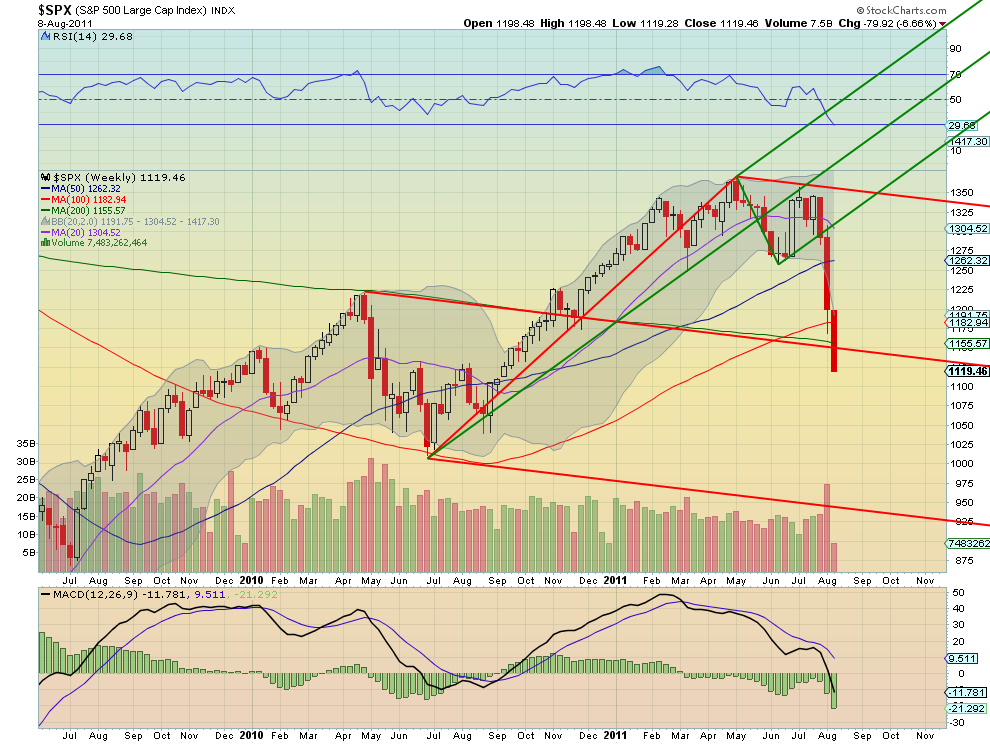
S&P 500 Pitchfork

Part of the Weight comes from the view from the Andrews Pitchfork. It has clearly lost contact with the bullish Pitchfork and is now holding onto the Median Line of the Bearish Pitchfork. This view requires more vigilance and a bias to the downside. But look at another view.

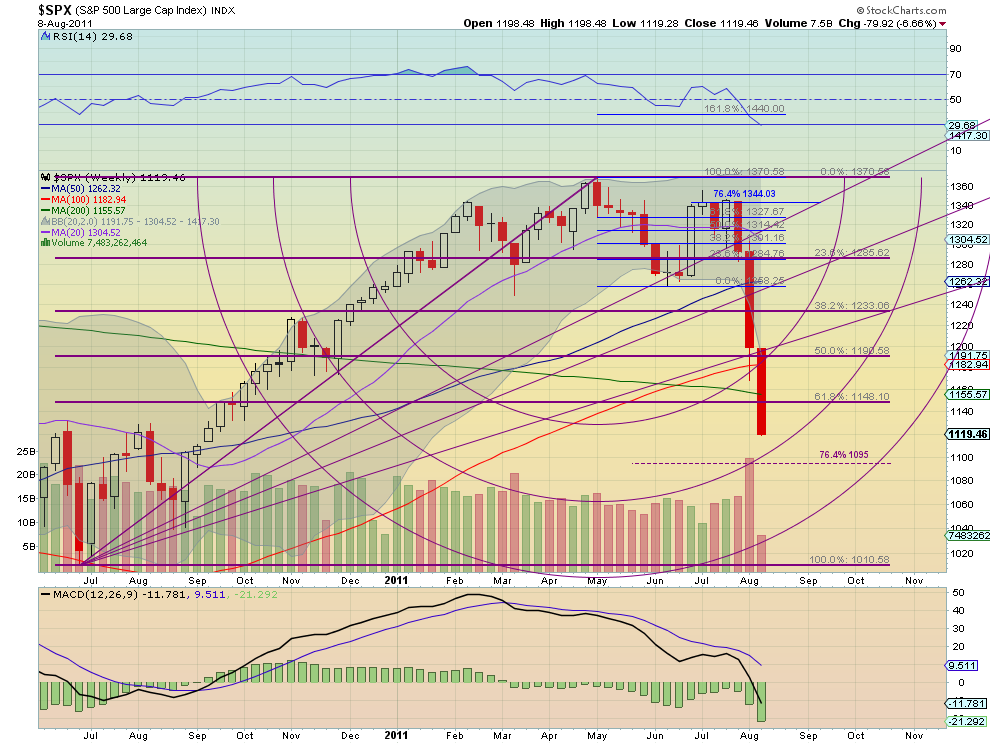
S&P 500 Fibonacci

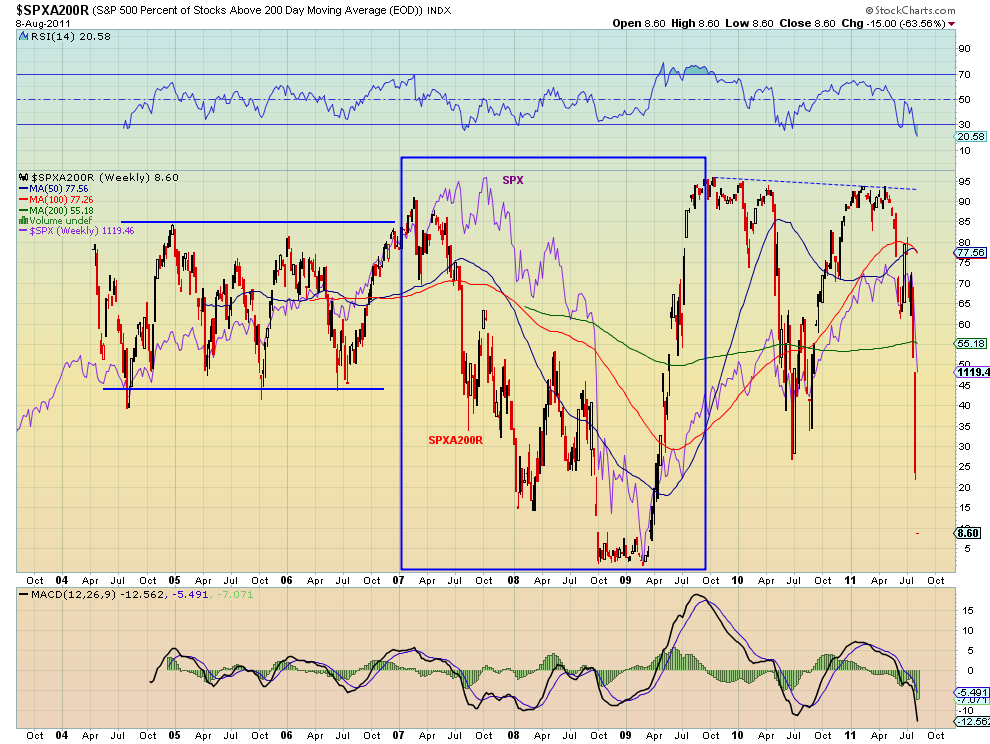
The Fibonacci chart above shows that price is now near the 76.4% retracement at 1095 and the Fib Arc near 1105. This would suggest that there is some support lower. Finally, there is one of my favorite extreme indicators, the Percentage of Stocks above their 200 day Moving Average. This indicator, the little dot at 8.6 below the long red line is near the extreme lows from the 2009 fall.

Percent of Stocks Above Their 200 Day Moving Average

None of these indicators can state that the fall is over, but rather give more context to the broad picture that suggests the bottom is near. Keep an eye on these along with your view on price and other indicators, and trade what you see, not what you want to see as we move from the Weight to the Wait.

4 Hidden Risks in Your Portfolio


In recent days, queasy investors have run from stocks to bonds and cash -- and, as of yesterday, back to stocks again. But when investors get react to daily market moves, they often go too far, experts say, when there are smaller, hidden tweaks they could make that would bolster good days and bad.

Investing is inherently risky -- stock prices drop, companies default on their debt, even sitting in cash runs the risk of failing to keep up with inflation. And much of it, investors don't control -- including an unprecedented ratings downgrade for U.S. government debt, for example, or the precipitous, unforeseen market drops of the last two weeks. Even so, there is plenty that investors can do, including making sure that there's enough diversity in their investments, to prevent everything from moving in lock-step and having a clear, long-term plan, which can offer perspective when the short-term doesn't seem to be going your way. "If you focus on those big levers that you absolutely can control then you actually stand a great chance of being successful," says Chris Philips, senior investment analyst for Vanguard's investment strategy group.

Obviously, there's no way to eliminate all the risks in investing. Sometimes, surviving a market swoon feels like exactly that: Survival. But there's no reason to make it worse than it has to be. Here are four common investing mistakes that add unnecessary risk to a portfolio -- and how to fix them:
Mistake #1: Bonds equal safety
Reality: Some bonds are safer than others

Until last week, U.S. Treasurys were considered absolutely risk-free, with no chance at all that the issuer (a.k.a. Uncle Sam) would fail to pay up. Post-downgrade, investors may be able to see a bigger picture: Bonds of all kinds can carry hidden risks. They still have a place in a portfolio, advisers say, usually to generate income and to provide stability -- when stocks fall, bonds often rise, or at least don't fall by as much. But within the universe of bonds, there's a wide range of risks that make some issues far more vulnerable to big losses than others. One big one: The more a bond pays in yield, the riskier it is. High-yield corporate bonds, for example, commonly called "junk" bonds, can offer yields an average 6.6 percentage points above Treasurys. They also have a higher risk of default. Over the last 12 months, 2.2% of high-yield bonds defaulted, according to Standard & Poor's Global Fixed Income Research; during the same period, no investment-grade bonds did.

The fix: Don't chase yield.

Even with high-yield bonds, the odds are still in the investor's favor, but they're also some of the more volatile issues around, with prices that tend to rise and fall more like jittery stocks than mellow bonds. To reduce risk, investors should have no more than 7% of their bond portfolio in high-yield bonds, says Ron Florance, managing director of investment strategy at Wells Fargo Private Bank, and they should diversify with other bonds, such as municipal bonds, investment grade corporates and foreign issues. And while investors can't control rising interest rates, which also erode the value of bonds, Florance recommends sticking to bonds with low maturities -- about seven years or less -- because they will get hurt less if rates go up. 

Mistake #2: You're plenty diversified
Reality: A dozen funds -- or even a mix of stocks and bonds -- may not cut it

Households that invest in mutual funds own about seven funds apiece, on average, according to 2010 data from the Investment Company Institute, a mutual fund industry trade group. That ought to be enough to get good and diversified, no? A closer look often reveals that even with a passel of funds, portfolios can be far more concentrated than they first appear. Investors often fail to realize that they can be holding two or more funds with very similar strategies, which isn't always apparent in a fund's name or track record, says Todd Rosenbluth, a mutual fund analyst for S&P Equity Research. An investor who owned the $61 billion Fidelity Contrafund and the $24 billion T. Rowe Price Growth Stock fund, for example, would end up essentially doubling down on information technology and consumer discretionary stocks, according to S&P.
Meanwhile, too many investors ignore the asset classes that could boost their portfolios when the typical mainstays, like stocks and bonds, aren't cutting it, says Robert Weidemer, managing director of Absolute Investment Management, a Bethesda, Md.-based wealth management firm. He says he uses exchange-traded funds to allocate about 20% of his clients' portfolios to gold and silver, which tend to hold up when stocks are tanking. And at a time when growth in the U.S. is sluggish, it may be smart to increase exposure to international stocks and says Eleanor Blayney, consumer advocate for the Certified Financial Planner Board of Standards, a nonprofit that certifies advisers.

The fix: Look beneath the hood.

Investors should take a look at the holdings in their mutual funds to watch for overlap in sectors or company names, says Rosenbluth. The fund's website should list the fund's top 10 holdings and break down its allocation to certain sectors, he says. Morningstar and S&P also offer online tools that help investors review the holdings in their portfolios.
Mistake #3: You'll know when to sell 
Reality: Most people sell too late


No one plans on riding a losing stock all the way to the basement. To the contrary, many investors plan on selling out of positions when a stock or index falls below a certain point. Then the time arrives, and they find they can't pull the trigger, says Nate Peterson, senior derivatives analyst for Charles Schwab. And it only gets worse: Eventually they sell, locking in large losses, and thus burned, they often wait far too long to get back into the market. With that kind of pattern, it can take a long time simply to get back to even, says Stephen Horan, head of private wealth management for the CFA Institute.
The fix: Make it automatic

That point at which you'd plan to sell? Set what's called a stop-loss order on your stock or fund positions, which instructs your brokerage to automatically sell stocks once they fall below a certain price. They're free to set up and they help you avoid the emotional paralysis that sets in when it's time to make a trade, says Peterson. The catch: investors who use stop-loss orders can miss out on market rebounds if they don't have a strategy for getting back into the market, says Brent Burns, president of Asset Dedication, an investment adviser firm in Mill Valley, Calif. Investors should set up stop loss orders for when certain holdings fall between 10% and 30% below the purchase price, says Horan, and rebalance their portfolios after big market movements to make sure their target allocations are in place. Taking those losses isn't all terrible, he adds, because investors can take some of the investment losses as a tax write-off.
Mistake #4: You think you have a plan
Reality: You make investment decisions on a whim

When the market had one of its worst days in history this week many investors may have found themselves without a blueprint for what to do next, says Horan. In fact, most investors tend not to have a long term investment plan at all, he adds. And even those who are working with a pro may find themselves without a concrete plan they can turn to. A June survey of 1,011 adults by KRC Research for the Certified Financial Planner Board of Standards found that just 42% of those surveyed had a written document outlining their financial plans; another 11% barely had more than a few notes and ideas. But experts warn investors can shortchange themselves in the long haul if they are too reactionary with their decisions. Says Vanguard's Philips: "If they're focusing on the here and now and lose sight of that long term objective then they could end up doing more harm than good."

The fix: Put it on paper

It can help to list out your investment preferences and outline the parameters you want to set on your portfolio, says Horan. That includes laying out how much equity exposure you can tolerate along with minimums for what you want to hold in other sectors like bonds or cash. Your financial plan can also detail what adjustments, if any, you'd like to make after a large market movement -- before it happens, says Horan: "It helps keep a much steadier hand at the wheel."

Is This the Worst Market Decline?


History proves that the current meltdown is not a first, and those who avoid panic selling now should be rewarded with better exit points as recovery unfolds in the months ahead.

The relentless nature of the stock market decline over the past 12 days has been astounding, and the Dow Industrials has dropped 15%. Given the expansion of the derivatives market, the volatility is clearly higher now than it has been in past market declines.

A great example of this is seen in the action since Monday’s close in the S&P futures. The September S&P futures closed Monday at 1111.25 with a low for the day of 1109.50. Overnight, the futures dropped as low as 1077—more than 40 points below Monday’s close—and then reached a high of 1148, which was 37 points above Monday’s close.

Monday’s drop was the largest since December 1, 2008, when the Dow dropped 680 points, although in 2008, the market regained those losses just five days later. Clearly, this decline must be looked at in a different light.

The selling in some of the individual stocks has been even more severe, as Bank of America (BAC) was down 20% on Monday alone. The relative performance, or RS analysis, for the big banks has been negative for most of the year, and in early July (see “3 Big Banks That Aren’t Cheap Enough”), this analysis suggested they were still vulnerable.

So is this market decline the worst, and if not, can past market declines help prepare us for what may happen next? Let’s take a look at some interesting historical examples.
chart
Click to Enlarge

Chart Analysis: The market decline that is most familiar to many of today’s market veterans is the plunge in 1987, when from the close on October 2 at 2640, the Dow closed 11 days later at 1738.
  • This was a 34.1% drop in just 11 days, and on day 12, the Dow made a lower low but eventually closed up for the day
  • This was followed by sideways trading and one more drop back towards the lows in December before stocks turned higher
  • It was not until July 1989 that the Dow was able to surpass the pre-crash levels
The bear market of the 1970’s is less familiar to most, but it was pretty wicked and lasted for quite some time. It has two distinct legs, and the worst occurred in the latter part of 1974.
  • The Dow peaked in June 1974 at 865 and by early August (point a), it had formed a series of lower highs
  • From the close in August until the interim low in September, point b, the Dow was down 21.3% in 21 days. A week before this low, the Dow had a two-day, 5% bounce
  • The Dow made further new lows at 584.56 (point d) in early October, which was a decline of 26.7% from the August highs
  • The Dow rallied over 20% in the next month and then dropped below the September lows in December 1974, completing the bear market bottom
chart
Click to Enlarge

The 1973-1974 bear market lasted long enough to convince many to stay out of stocks for the next decade. The Dow peaked in early 1973 at 1067 and then dropped to a low of 845 in August.
  • By early November, the Dow had rebounded 16% to close at a high of 984.80
  • Over the next 27 days, the Dow dropped 19.9% to a low close of 788.31
  • This low was followed by an eight-month trading range, and the Dow did manage to rebound over 15% from the lows before breaking to new lows in July 1974
Over the past 100 years, there have been a number of large percentage declines in the Dow Industrials, but none compare to the decline in 1929. On October 10, 1929, the Dow had a closing high of 352.80 (point a).
  • Just 14 days later, on October 29, the Dow had dropped 34.8% (point b)
  • In the following two days, the Dow rallied over 18% (point c) before the decline resumed
  • The low on November 13 at 198.7 (point d) represented a drop of 43.7% in just 22 trading days
  • The last leg of the decline was the most severe, and from the rebound high (point c) to the November low (point d), the Dow dropped 27.3% in just eight trading days
What It Means: These four examples illustrate that our current market decline is not an isolated event, but it also does not help us to determine how much further the decline can go. Before the opening on Tuesday, the Dow futures were up 140 points, but a higher close is what is needed to stem the slide.
Market history does tell us that a 15%-20% market rally is likely over the next few months. If you measure this from Monday’s close at 10,809, this could take the Dow back above 12,000.

How to Profit: Though it is very difficult to avoid when the market is plunging, panic selling is generally a poor idea. That is why I advocate placing sell stops on all long positions, because you can then avoid second guessing the original decision to buy.

If you are currently long stocks that have not been stopped out, you should get an opportunity to lighten those positions or adjust your portfolio at higher levels.

Standard & Poor's Credit Rating for each country

by ChartsBin


Marc Faber: "The Best Thing The Fed Could Do For Markets Wold Be To Collectively Resign"

by Tyler Durden

In a Bloomberg TV interview following today's quixotic "QE3/non-QE3 announcement, which is Operation Twist 2, but not LSAP, and ushers in economic recession, even as it sends risk assets soaring, and somehow pushes the 2 Year a whopping 20 bps tighter so buy,buy, buy" and is really very much ado about nothing, the always outspoken Marc Faber had some very choice words about life, the universe and especially the residents of the Marriner Eccles building. While there still appears to be some confusions as to whether today's Fed decision to peg rates at zero for 2 years is QE3 or not, Faber believes that the decision to not enact more Large Scale Asset Purchases is "the right thing" although when it comes to the market, it "is more likely to move still lower. We are very oversold. We can have a rebound like we did today, maybe we'll have a rebound next week or so, but in general I think we will test the July lows of last year, the S&P at 1,010. After that, probably we'll get probably a QE3 announcement."


On why Bernanke did not announce yet another asset purchasing round: "Essentially they spent their bullets. It is very difficult to follow through with QE3 right here, because you have gold prices going ballistic, and you have the dollar being very weak, and so there are unintended consequences with implementing QE3 right here." That said, the surge in markets apparently completely ignores that QE1 and 2 did nothing for the economy, although the goosing of the RUT should suffice. What is unclear is who will end up buying the $2.4 trillion in bonds coming down the tube. Faber also had some choice words about Treasurys: "I personally think the Treasury market, the long-dated, are a bubble and it will be one of the worst investments for the longer term if you buy a 10-year, a 30-year U.S. Treasury so I'm a bit puzzled that Treasuries are now yielding, are essentially near record lows." Naturally, Faber does not think gold is in a bubble, and as to what one can do with gold, his response is that "you give your girlfriend copper rings and I give them gold rings and I keep them longer." Indeed, no bubble there.


As to how one should trade stocks, he says: "I think right now the technical picture is so horrible that I would use a rebound as a lightning up opportunity. I think [equities] will move lower... maybe after three months people will wake up and scratch their heads and say now, we know why it started to go down, because maybe there is geo political problems, maybe the Middle East blows up, maybe the economy is horrible."
Last but not least is his suggestion what the Fed should do: "The best [the Fed] could do for markets would be to collectively resign." Precisely, which is why it will never happen.

Faber on whether he thinks the Fed did the right thing by keeping rates low:


"I think they did the right thing that they didn't allow QE3. They can watch the reaction of assets, whether they will go lower. I think the market is more likely to move still lower. We are very oversold. We can have a rebound like we did today, maybe we'll have a rebound next week or so, but in general I think we will test the July lows of last year, the S&P at 1,010. After that, probably we'll get probably a QE3 announcement."


On why he thinks the Fed is waiting on QE3:


"I think the Fed is underestimating the severity of the coming economic downturn. Essentially they spent their bullets. It is very difficult to follow through with QE3 right here, because you have gold prices going ballistic, and you have the dollar being very weak, and so there are unintended consequences with implementing QE3 right here."


On what Faber thinks the Fed should do:


"The best [the Fed] could do for markets would be to collectively resign…I think sometimes the best is to do nothing. I welcome the decision, at least today, that they aren't doing anything worse than what they have already done."


On whether it makes sense to provide any kind of stimulus:


"What has QE1 and QE2 done for the labor markets? Nothing at all. It's done nothing for the housing markets. It's lifted stocks and it created wider wealth inequality in a sense that people who own assets have done very well, and people that are the lower-income recipients groups, they are hurt by rising energy prices and food prices."


On what should be done for the U.S. economy:


"From 1981 to 2007, we have an economy that was living beyond its means. As a result of continued debt accumulation, GDP was higher than would otherwise have been the case. Now we have a period of sub-par growth that can last for quite some time now, and like in the case of Japan after 1989, people instead of being encouraged to spend, they should be encouraged to save more, and the U.S. should save more and spend less. And then capital spending will essentially pick up."


On the manic behavior in markets:


"I personally think the Treasury market, the long-dated, are a bubble and it will be one of the worst investments for the longer term if you buy a 10-year, a 30-year U.S. Treasury so I'm a bit puzzled that Treasuries are now yielding, are essentially near record lows. I would rather sell Treasuries."

"The stock market peaked out on the 2nd of May on the S&P at 1370. So we're now around 1010. For many stocks we're down 20% or so. We're very oversold. I think a rebound is coming but you can forget about a new high. That is out of the question. Because the technical picture is horrible, horrible. "


On why investors are continuing to move to Treasuries:


"I've been in this business for 40 years and on many occasions, nothing made sense to me….I think the Treasury market is another example of a gigantic bubble. The problem with the Federal Reserve policy of essentially zero interest rates is that they are essentially throwing money at the system, but they don't control where the money will flow to. It can flow at some point into commodity-related stocks. It can flow into gold, oil, treasuries, but it doesn't flow evenly into these assets. In my opinion, the Treasury, the long-dated Treasuries are essentially the short of the century thing here."


On whether gold is a bubble:


"I don't think it is a bubble, but I think the gold market has exploded to the upside recently and the correction is overdue. But as I have always maintained for the last 12 years, every responsible adult should gradually accumulate gold, because not owning any gold is the trouble with government. I don't understand. People of Bloomberg, I hardly know anyone who owns any gold physically. All of the Bloomberg employees are intelligent people. They listen to the news every day. They make the news every day. Hardly anyone owns any gold.”


On what you can do with gold:


"I disagree [that you can't do anything with gold.] You give your girlfriend copper rings and I give them gold rings and I keep them longer."


On how Faber would play the markets right now:


"I think right now the technical picture is so horrible that I would use a rebound as a lightning up opportunity. I think [equities] will move lower. I mean, some say you should move back into emerging economies because the fundamentals of emerging economies are far better than the fundamentals of European countries and the fundamentals of the United States. This is something I will consider."


"The only thing I have to say, basically the market has sold off in such a rapid way and with so much momentum that I am smelling as if something really wrong happens in the next two or three months, because the market is a discounting mechanism. Like March 2009 the market started to go up and people were baffled why it started to go up. Now it starts to go down, and maybe after three months people will wake up and scratch their heads and say now, we know why it started to go down, because maybe there is geo political problems, maybe the Middle East blows up, maybe the economy is horrible."

Diversify Globally? Lose Globally


Still think investing in foreign stocks, emerging markets, and the like is diversifying your portfolio? Think again…

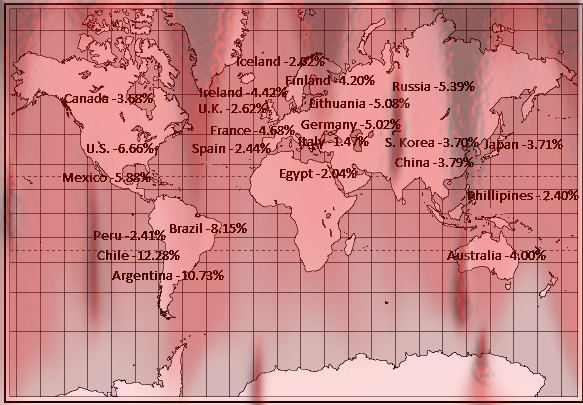
World Stock Indices – August 8th, 2011 – Bloody Monday


Follow Us