Tuesday, July 26, 2011

GLOBAL PROFIT MARGINS REMAIN STRONG

by Cullen Roche

The saving grace for the US equity markets over the last few years has been the strong corporate profit picture. Despite stagnant domestic recovery, massive cost cutting, high fiscal deficits and strong emerging market growth has been enough to bolster equities. And its not just a US story. Margins, for instance, have been improving around the globe.

In a recent note, Societe Generale discussed this phenomenon and the risk associated with record high margins – there’s generally only one direction to go….SG says the tightening cycle in many emerging markets is likely to pressure margins.
“Are corporates strong enough to maintain positive earnings trends despite the macro environment?
Apart from Europe where we still see some countries facing recessions, corporate margins are at historical highs. We could now fear that some corporates start to struggle to maintain such high margins, specifically in emerging markets as central banks continue on their tightening cycles.”

Eye on Euro


It is interesting that the EUR/USD is circling unchanged this morning while spot gold price continue to climb in reaction to the ongoing impasse in the U.S. debt ceiling debate. You would think that if the desperate elements within the EC political structure managed to find common ground to deal with (quarantine) Greece during a crisis, that U.S. politicians would be able to put aside some of their differences to end this game of brinkmanship to avert an unprecedented crisis.

Once the markets decide that the dangerous political game is becoming THE crisis in and of itself, the laws of unintended consequences kick in, leaving the U.S. economy and the well-being of its citizens vulnerable to, of all things, Moody's and S&P ratings.

How can we find ourselves hostage to the same ratings agencies that completely fell asleep at the switch before and during the 2008 financial crisis or which were (are) beholden to their own "special" interests? No wonder gold continues to tick up every day. Can a plunge in the dollar be far behind -- against the euro in particular, which represents a currency that exhibits the political will to survive and to self-correct its shortcomings?

If EUR/USD hurdles and sustains above key resistance between 1.4460-1.4580, the euro should take off towards 1.50000 -- bullish for the CurrencyShares Euro Trust ETF (FXE). 


See the original article >>

Italy Cancels August Bond Auction


Citing the most hilarious explanation we have ever heard for not daring to approach the capital markets, Dow Jones reports that following a comparable announcement from Austria earlier, none other than clutch euro Domino Italy, whose bond yields surged by about 40 bps today, has decided to take a sabbatical from accessing capital markets, and will not issue medium and long-term bonds in August. Of course, the real reason is that the spreads are prohibitively high but that's a story for another reason. The problem for Italy, however, is that it will end up burning through a lot of cash over the next 45 days and then far more will depend on the successful passage of the country's auctions in the following month, when the next scheduled medium term auction is on September 13 (full auction schedule is here). Amusingly, while all of Europe complains that the Greece, Ireland and Portugal have no capital markets access, some of the better of PIIGS make the voluntary decision to avoid price discovery. We fail to see how this can possibly result in anything than another loss of credibility in the eurozone rescue package.
From Dow Jones:
Italy will cancel its mid-month auction for medium and long-term bonds, known as BTPs, "considering the large cash availability and the limited borrowing requirement," the Treasury said in a statement Monday.

The 12-month Treasury bills will be offered, it said. The T-bill auction is scheduled August 9.
Here is the first August auction to be cancelled. We expect many more to shortly follow the same fate.


How Big Is E-Commerce?

How Big is E-commerce Industry
Infographic by – Conversion Optimization Company Invesp

Stocks and the Debt Ceiling


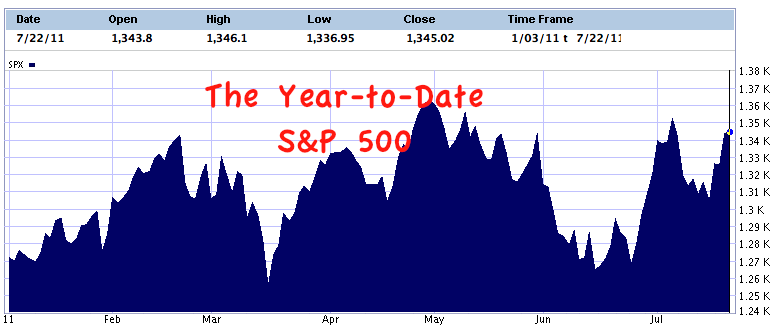
The S&P 500, at 1337, is within 30 points of its weekly closing high from April 25th (1363).

Here’s what I’m thinking is about to go down: A chilling head-fake sell-off followed by new highs for equities.

After this era of market action ends, they’re going to need to start bringing English Lit professors to the business schools to teach the students irony.

And because, in this particular cafeteria, Sloppy Irony Sandwiches are on the menu five days a week, we may as well accept how they taste at this point.

With that in mind, I’m going to lay out the most ironic outcome that you could possibly imagine for the coming two- to three-week stretch. It is not so much a forecast as it is a gut feeling with some educated inferences and a whole lotta real experience to back them up. I am not betting aggressively on the below scenario but I think there is some educational value to be found in the way I’m laying it out…

No more preamble, if we’re going to make an omelet we’d better start cracking some eggs:

1. The first thing you need to understand about the stock market is that it’s been designed to frustrate the maximum amount of people at any given time. You’ll no doubt remember the clarion calls to overweight commodities and emerging markets this past winter – both asset classes are negative year-to-date while US stocks are on pace for annualized gain of 12% – how’s that for a “how you doing?”

2. Stocks have been caught within a fairly narrow 7%-ish trading range since the beginning of the 2nd quarter as analysts spent 10 straight weeks cutting earnings estimates for the S&P 1500. This despite the fact that the S&P 500 exhibited a 60% earnings beat rate in the first quarter and a whopping 67% beat rate on revenue expectations. This recent analyst doubt coupled with persistently negative employment reports and the monotonous sound of GDP estimates being cut put a ceiling above the indices for going on six months now.

3. But a funny thing happens when Wall Street makes a concerted effort to curb their own enthusiasm – stocks become blessed with the gift of low hurdles to hop over. As of Friday, we’ve heard from 143 S&P 500 companies and an incredible 75% of them have beaten analysts’ estimates! In other words, our current “beat rate” is an order of magnitude above the one from Q1 – even as the economy itself had slowed during the quarter we’re hearing about. Irony has been hitting the weights and working out with Roger Clemens’s “trainer”.

4. In the absence of the debt ceiling drama and the European sovereign debt nightmare, it is my opinion that the market would’ve already broken out to new highs based solely on earnings growth, a new crop of leadership stocks and the p/e multiple expansion that inevitably comes after periods of both compression and a ludicrously-loose Federal Reserve. Investor sentiment, while on the rise, has not yet attained the April levels when we were hearing about the economy’s having hit “escape velocity”. But with stocks having rebounded nicely from their June 24th correction lows, some frowns have begun to turn upside-down, you can expect more of that as earnings continue to “surprise and delight”.

5. In addition, stocks should also be benefiting more from the cartoonishly-poor opportunities in today’s bond market. Many of the most tenured and demonstrably successful asset allocators of the current era are favoring the low-multiple, high-dividend payers with which this equity market is littered. With 20% of the S&P 500 yielding more than the ten-year treasury (according to Bespoke as of July 18th), we are quite literally festooned with opportunities for non-bond income.

6. Lest there be any doubt about whether investors can continue to enjoy the strong corporate picture against the backdrop of a shaky sovereign one, I call your attention to a recent JPMorgan report on CDS pricing and default risk: “As of yesterday, 22% of US high-grade issuers (from the J.P. Morgan JULI index of 250 issuers) have a CDS spread inside that of the US government. This is up from zero a year ago.” Meaning, institutions buying and selling insurance against potential default believe that Coca-Cola and its ilk have bonds that are a less risky credit than the stuff coming from the US Treasury. JPMorgan is saying that “corporates are the new sovereigns,” and the market is demonstrating its acceptance of this each day. What this means is that “haircuts” and “selective defaults” are more likely to be greeted with a “we know” than a “holy sh*t” reaction going forward.

7. Let’s turn to our own little sovereign debt deadline, the August 2nd debt ceiling ultimatum. Obama’s going to lose, but he’ll lose gradually. The GOP has challenged the President to a staring contest and when a crazy person stares down a weakling, guess who ends up blinking first? Most of the restructurings and adjustments and budgetary voodoo will take place over an extended stretch, they’ll come out with something temporary to allow everyone to breathe until an actual vote takes place months from now. Absent a miraculous breakthrough between the two sides, I think they’ll find 500 billion bucks to use in the meantime without anyone having to declare defeat this summer. Like the Europeans, we will enjoy a rolling “crisis” which will supply just enough sporadic headlines to keep the newspapers in business for another year. Joy and Pain on an endless loop, euphoric highs and dismal lows that everyone becomes completely enured to.

8. But as we get closer to that deadline, stock markets are going to freak out a bit. I think we get a sell-off as large chunks of money race each other to the sidelines ahead of that date and things seem less and less workable based on the thrice-daily press conferences in DC. But then when the deadline passes and the world doesn’t expire, we’ll simply skate back into the street, set up the goal, slap sticks on the ground and drop the puck. Game on.

9. There will have been enough cash temporarily-sidelined to fuel the mother of all relief rallies. The fact that there is now both a Grecian bailout in place as of this week along with a template for future ones will surely help. Even the strategist Felix Zulauf, who remains long-term bearish on the Euro situation, acknowledges that the relief from this bailout should be enough for the meltup. Here’s Alan Abelson paraphrasing Zulauf in this weekend’s Barron’s: “Thanks to the decision to once more bail out Greece, equity markets, he concludes, may rally and U.S. shares might even reach new highs in the next two to four weeks.”

10. So here’s my roadmap: We will hear from 180 S&P 500 companies this week, from Ford ($F) to ExxonMobil ($XOM) to Merck ($MRK). Some of the more troublesome reports are already behind us – thanks Bank of America ($BAC) – the industrials and energy companies coming up should all be solid. In the absence of Euro problems (for a brief moment, we hope) the focus should be on three things – US earnings reports, debt ceiling negotiations and the first official estimate of second quarter GDP which is announced on Friday. The latter two are almost guaranteed to put pressure on the markets while the strong profit reports should keep that jittery sell-off from becoming a wipeout. That briefly-panicked move lower will fail, and from this failed move will come the fast move of stocks tearing through the overhead resistance they’ve toiled beneath these past six months.

All the ingredients are present for a run to new highs as we pass that August 2nd deadline with our limbs still attached and the airplanes not having dropped out of the skies. What happens from there is anyone’s guess of course.

Years from now, when economic and stock market historians try to understand how a near-miss in Treasury coupons could fuel a rally in US stocks, you can pull up this post and forward it to them.

Despite Dips In Corporate Productivity, Profit Margins Should Hold Steady


It’s earnings season.

As of Friday, 143 companies in the Standard & Poor’s 500-stock index have reported second-quarter profits, and as in recent quarters the news has been generally upbeat.

But while investors may be comforted by current results, it is future earnings they are starting to worry about.

After a remarkable run over the past two years, profits are growing much more slowly than they had been earlier in the recovery. But it looks like companies can continue to crank out enough good news about earnings to keep investors happy.

Corporate America has been a profit machine in recent months, which is remarkable given the recovery’s lackluster economic growth and a dearth of pricing power. Since the recession ended in the second quarter of 2009, earnings of domestic industries have grown 53 percent, according to the Commerce Dept.’s roundup of several thousand companies.

Profits in manufacturing, which generate 20 percent of domestic earnings, have doubled, as machinery makers have seen their bottom line triple, and earnings in the computers and electronics industry are four times higher. Reflecting strong emerging markets and a weaker dollar, earnings from overseas operations are up 28 percent.
the fiscal times

Based on a mix of actual and projected reports, S&P 500 companies are expected to post growth in second-quarter earnings per share of 9.2 percent, according to Thomson Reuters.

However, excluding Bank of America, whose profits were hit hard by settlement of a lawsuit involving mortgage-backed securities, earnings are projected to grow a solid 15.2 percent. Already, 75 percent of the 143 reporting companies have beat analysts’ expectations, far above the historical average of 62 percent for any given quarter.

Given still-high levels of commodity prices vs. a year ago, the materials and energy sectors are expected to lead the gainers this quarter, along with high expectations for technology and industrials.

For guidance on future earnings, it’s important to look at how companies have been able to achieve their recent gains. Expansion of profit margins has played a central role, and it will be a crucial factor in coming quarters. Margins determine how much a company earns from a given volume of sales, and can have an explosive effect on profits in a recovery.

If margins double, for example, firms can earn twice as much from the same number of items sold. Since the recovery began, margins among nonfinancial corporations have expanded nearly 40 percent, even as sales have also grown. Of course, one reason for the margin boost is jobs, or the lack of them.

During 2008 and 2009, private-sector businesses slashed 8.5 million workers from their payrolls, resulting in a huge two-year gain in productivity, or output per hour worked. As a result, unit labor costs, which are workers’ pay and benefits adjusted for productivity gains and which play a big role in determining profit margins, plunged by the most on record. Even though product prices were barely rising, margins surged, as unit labor costs fell.

Now in 2011, productivity has slowed sharply, as it typically does in a recovery, as businesses begin to add more workers or productivity peaks Productivity growth slid to 1.3 percent in the year through the first quarter, from 6.7 percent a year ago. Productivity gains are no longer offsetting the 2 percent or so pace of workers’ pay, which means unit labor costs are starting to creep up. For now, prices are still outpacing costs, so margins are still expanding but much more slowly.
the fiscal times

Will rising costs put an end to the expansion in profit margins, which would intensify the downward pressure on the corporate bottom line? History suggests that, outside of a steep and prolonged slowdown in economic growth, margins should be able to hold up, even amid slower productivity growth.

Economists at J.P. Morgan point out that in the recoveries of the early 1990s and early 2000s, margins continued to expand for several years, even after productivity growth cooled and costs started to rise.

In this recovery, as in those past, the path of profits will boil down to the relative strengths of inflation and the labor markets. In coming quarters, prices will most likely have the upper hand. Many businesses are already flexing a bit more pricing power, as seen in the acceleration in core inflation, which excludes energy and food.

In their second-quarter earnings reports, both Coca-Cola and Pepsi announced increases in retail prices. At the same time, even though productivity has slowed, it is highly unlikely that increases in workers’ pay and benefits will speed up from their current subdued pace with the unemployment rate over 9 percent and not expected to fall rapidly. Under that scenario, unit labor costs will remain in check relative to prices, and margins will continue to expand at least gradually.

Corporate bottom lines will also get support from top-line revenue growth. Second-quarter revenues for S&P 500 companies are projected to grow 10 percent from a year ago, according to Thomson Reuters, up from 9 percent in the first quarter and 8 percent in the fourth quarter of last year.

In announcing its second-quarter results, Intel reported record double-digit revenue growth. Sales growth for the S&P 500 is more than twice the pace of overall spending in the economy, implying that the recovery in the corporate sector is much stronger than the upturn in the broader economy. This is due in part to increased global demand, with exports up 8 percent.

In addition, the government sector’s drag on GDP growth resulting from a 4 percent decline in spending is masking some of the economy’s profit potential. Over the past two quarters, real GDP has grown at an annual rate of only 2.5 percent, but excluding the weakness in federal, state, and local governments—which have no direct impact on corporate profits—private-sector GDP has grown nearly 4 percent.

About the only thing that could stand in the way of continued, if slower, earnings growth is a new bout of severe weakness in the economy, possibly the result of the debt ceiling crisis. With the bulk of the cost-cutting phase of the profits recovery now over, earnings are increasingly dependent on gains in sales.

Economists have downgraded their second-half forecasts for economic growth, but they still generally expect GDP growth in the range of 2.5 to 3 percent. As long as margins continue to expand, that should be sufficient to generate enough earnings growth to keep investors in good spirits.

Follow Us