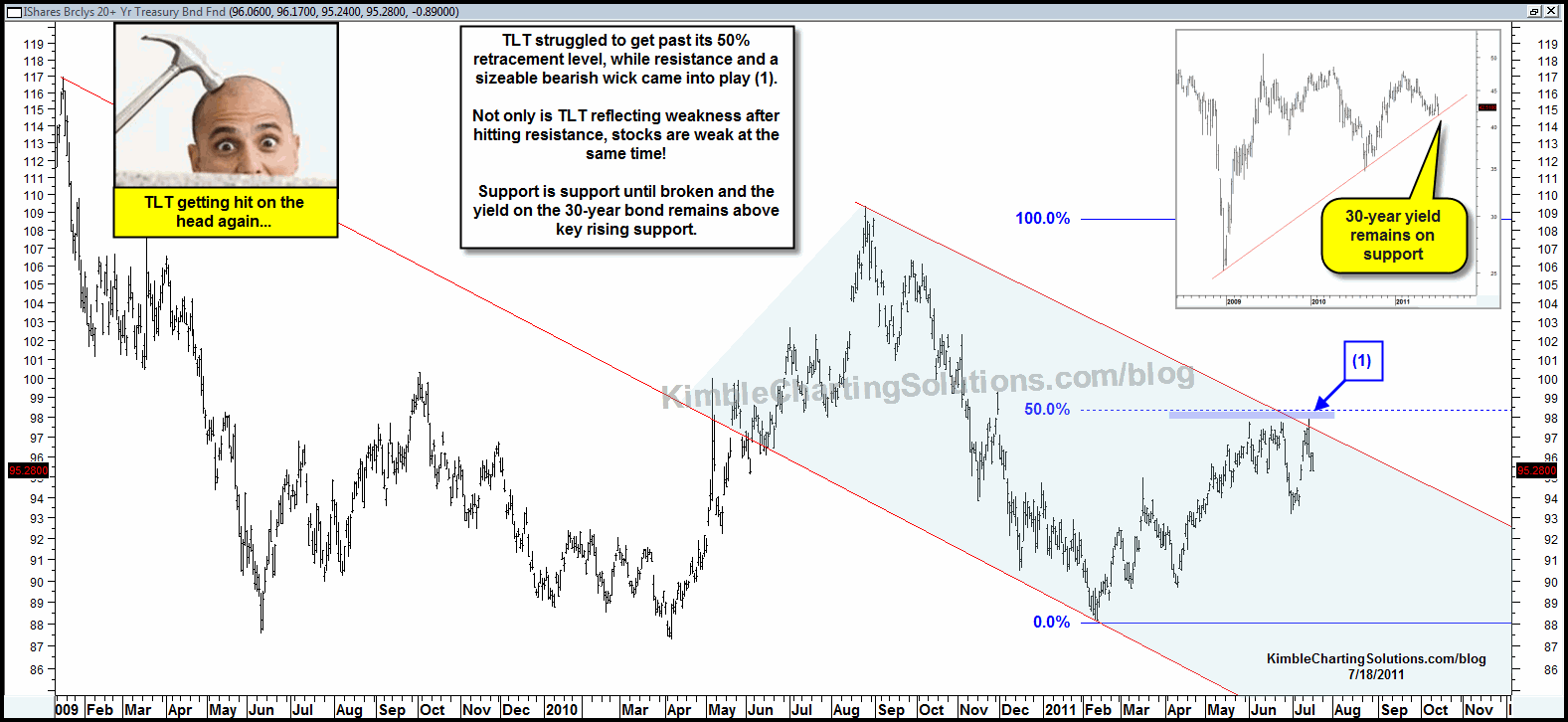
by Kimble Charting Solutions
Tuesday, July 19, 2011
The Best Time to Buy Apple Products
By Kelli B. Grant
Want to save an easy $100 on your next Apple purchase? Just wait a few days.
A new pricing study from sale-tracking site DealNews.com found that deals start popping up within days. Apple rarely offers sales, so cutting prices even a little bit is online retailers’ best chance of luring customers away from buying directly from Apple.com or one of its stores. For example, when the MacBook Air launched in October 2010, MacConnection offered a $30 off deal the next day. Deals on other Apple product lines popped up within a week or two of their debut.
But price savings aren’t likely to be enough of a lure to deter Apple devotees away from pre-orders and lengthy day-of-launch lines, says Gary Singer, chief executive for Buyology Inc., a marketing research firm. “Apple understands ‘cool’ much better than its competitors,” he says. Functionality and price take a backseat for such early adopters, especially with Apple, whose buyers have traditionally had little to worry about on either count. (The rare bug is almost always easily fixable via software, and the company is notoriously sparse on new-model price cuts and sales, he says.)
It’s also important for Apple buyers to consider when the next product is due out. “They don’t seem to mind cannibalizing sales,” says David Shepherd, a professor of marketing for Georgia Southern University. “They’re happy to bring a new product to market even if it will eat into sales of the old product.” Apple tends to announce new products just a few weeks before their availability, but the rumor mill starts swirling months in advance — so pay attention. And rest assured that even if you do buy at the wrong time, Apple products tend to hold their value well. You can easily resell an item for close to what you paid (and maybe even more than what you paid, if it’s an iPhone).
USA Debt Crisis: Is There Any Truth?
by Steven Hansen and John Lounsbury
This morning the NY Times covered the division within the economic community over the way out of the USA’s overspending / balance budgeting.
“Reasonable people can sit down and, apart from any political or policy motivations, come up with different answers,” said Robert S. Chirinko, a finance professor at the University of Illinois at Chicago who studies corporate taxation.
No doubt this is true. The economic community’s solutions range from more deficit spending stimulus (on the theory that boosting the economy will boost tax revenues to balance the budget) to out-and-out cutting spending (on the theory that re-balancing, while causing short-term pain, will spur long-term growth). Both extremes have some basis in main stream economic studies.
The economic objective is to find the best path through this crisis causing the least disruption and unintended consequences. These headline economists are macroeconomists who specialize in studying and modeling the economy as a whole – studying the forest, not the individual trees.
The unanswered question in macroeconomics is whether the past economic responses to economic management will work in the current situation. There are many forces which effect an economy – and no two situations are the same.
Much work published in Econintersect analysis looks at the trees, and not the forest. On the issue of USA debt – it seems like most macroeconomic models are ignoring many trees. Some of the trees ignored are:
- There is no way to balance the budget much before 2050 without touching entitlements (see analysis here). In fiscal year 2011 – USA tax income is less than the money being spend on entitlements. On the other hand, shotgun cutting entitlement spending reduces support to the weakest elements of the population.
- The current deficit in f/y 2011 is $1.6 trillion. How much of this money effects GDP of over $14 trillion is unknown – but a contracting government sector and a stagnant private sector spell “recession”. Budget balancers are ignoring negative spirals (less spending resulting in reduced taxes resulting in less spending…..). Is a balanced budget necessary? (analysis here)
- The NY Times states in their article that a tax increase of 1% reduces economic activity by 1.3%. Shotgun tax increases appear to do more harm than good.
- The USA’s current system requires deficit spending to be financed with treasury bonds / bills. The additional stimulus advocates ignore that the economy at some point will engage, and that the debt itself will begin to starve the economy (from higher interest payments).
Econintersect endeavors in its analysis articles to provide facts for readers to form their own opinions – and not accept the soundbites from dogmatic groups. Economies are complex, and, at this point, no good solutions exist where you can have your cake and eat it too.
And the disagreement between economists goes beyond political bias, at least in some cases. One example is the Great Debate© between Casey Mulligan (University of Chicago), who argued for lower taxes and less government spending and Menzie Chinn (University of Wisconsin), who took the other side.
In the NYT article it is pointed out that there are also a variety of opinions about the relative magnitudes of tax change impacts on GDP. And, to go further, not all taxes are created equal when the effects on growth are estimated. From a GEI Analysis article published last fall, the following graphic show just how widely different various tax rate impact estimates can be.
It depends where the taxes come from just how much the effect may be. And then the discussion can swing back to the Mulligan/Chinn debate.
The bottom line is given by the NYT: “The lack of definitive answers reflects the reality that economics is not a hard science.” That means that any policy implementation is entirely an experiment, in spite of what any proponents or opponents proclaim.
Etichette:
articles,
Economy article,
Finance article,
market articles
European Banks: Comparing Chernobyl to Banking
by Dirk Ehnts
It seems that banks in Germany are not so happy with the idea of publication of the results of the most recent stress test, as the FT reports:
But an association representing Germany’s financial industry lobby groups argues in a letter seen by the Financial Times that the disclosures could spark further market volatility, violate business confidentiality and expose banks to legal risks.
Follow up:
“Given the tense situation which already exists in money and capital markets, we believe publishing the results with the present level of detail would exacerbate the sovereign debt crisis,” the Central Credit Committee, or ZKA, wrote to the EBA, the regulator running the tests, in a letter dated July1.
“To avoid further capital market turmoil, which would fly totally in the face of what the stress test was actually intended to achieve, we believe the level of detail needs to be significantly reduced.”
This reminds me of the 1986 Chernobyl nuclear disaster, which was caused by a test of the system. It led to a nuclear meltdown in the end.
A nuclear power station and a financial market have many things in common, from a systemic perspective. Among them are both complexity and tight coupling. While complexity is easy to comprehend, tight coupling might need explanation. Let me turn over to Richard Bookstaber (2007, p. 144), who now works as a Senior Policy Adviser to the Financial Stability Oversight Council and also Senior Policy Adviser at the SEC (and runs a blog):
The complexity at the heart of many recent market failures might have been surmountable if it were not combined with another characteristic that we have built into markets, one that is described as by the engineering term tight coupling. Tight coupling means that components of a process are critically interdependent; they are linked with little room for error or time for calibration or adjustment.
Last year I had the opportunity to talk to Andrew Haldane (just a day before the UK stress tests) and brought up this point (stress test results might lead to financial market turmoil). I think he understood that point. Does continental Europe understand it as well?
Etichette:
articles,
Economy article,
Finance article,
market articles
Subscribe to:
Posts (Atom)