Tuesday, June 14, 2011

U.S. Macro in Three Charts: Credit Flows

By Global Macro Monitor

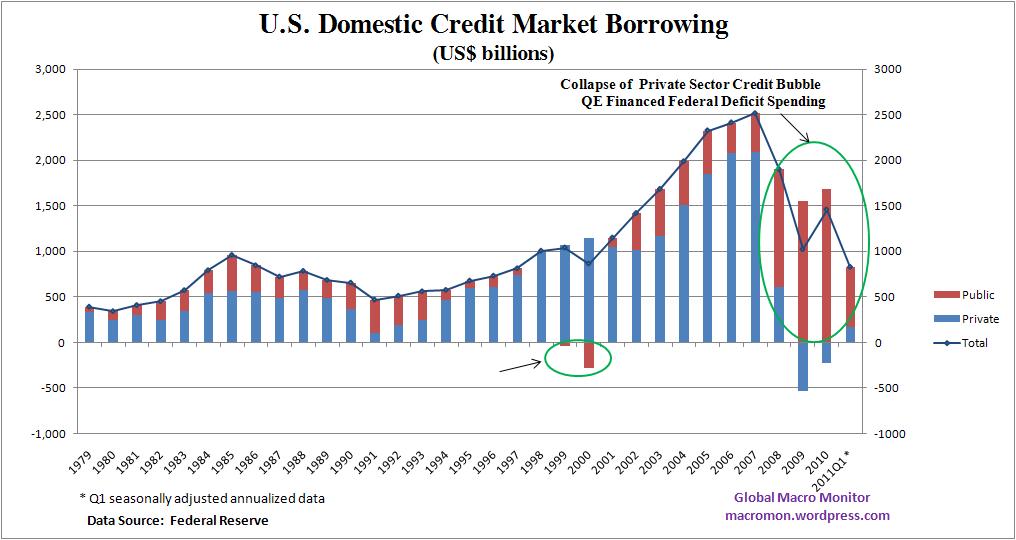
The U.S. is suffering from insufficient aggregate demand the result of the bursting of the 2004-07 credit bubble. The consumer led economy financed by borrowing, much of it backed by home equity, has given way to massive private sector deleveraging as reflected in the charts below. To cushion the blow, the federal government stepped up deficit spending in an effort to replace the decline in demand. This is clearly illustrated in the charts below.

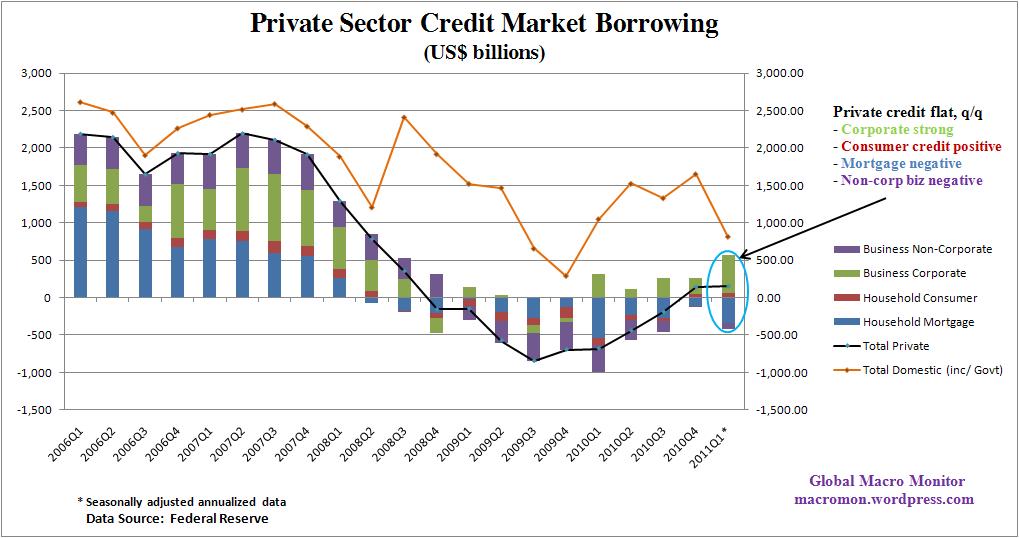
The latest data from the Federal Reserve’s Flow of Funds Accounts show that private domestic credit borrowing of the non-financial sector is still at very anemic levels (see middle chart) . Though total private non-financial credit growth was flat in Q1, corporate continued to strengthen and consumer credit was positive for the second straight quarter. This was offset, however, by continued deleveraging in the mortgage and non-corporate business sector. The negative borrowing is likely both supply and demand constrained.

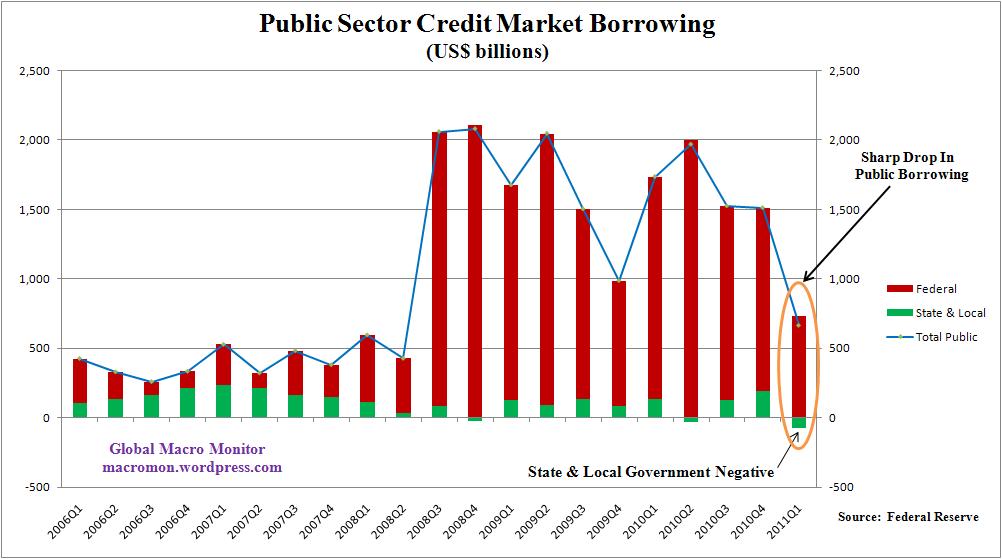
The charts are revealing as they also illustrate the sharp Q1 drop in public sector borrowing with state and local government turning negative. Unless private credit significantly improves — net mortgage lending turning positive, for example – to help finance the expansion of domestic demand, the economy will likely remain sluggish as the crunch in public spending continues. After all, President Obama did say that “the flow of credit is the lifeblood of our economy.”

Corporate spending and the export sector will have to do the heavy lifting as the U.S. works its way through the credit mess. The President needs a positive Black Swan event, such as the explosion of the internet, which drove high levels of investment spending during the Clinton Administration, for example.

Policies to free up financing for small and non-corporate businesses and renewed efforts to clean up mortgage sector, which also allow housing prices to bottom, could help strengthen the recovery. Stay tuned, we’ll be back with more analysis of the Flow of Funds.
~~~
~~~

See the original article >>

“US Debt Default Would Be a Moral Disaster”

by John Fullerton

So declared JPMorgan CEO Jamie Dimon regarding the prospect of a US default on its debt, after which he received a standing ovation at the University of Colorado’s Denver School of Business. Hmm… Let’s do a little press review—the following items quoted from recent news articles:
  • JPMorgan Chase recently lost a class-action lawsuit brought upon the bank for illegally foreclosing on military members’ homes while they were on active duty.
  • J.P. Morgan had declined to address the matter until Wednesday. But in a sworn deposition, one of the bank’s employees, Beth Ann Cottrell, admitted that she and her team signed off on about 18,000 foreclosures a month without checking whether they were justified.
  • The federal bankruptcy court judge presiding over the Bernard Madoff case has revealed the JPMorgan Chase employees who allegedly suspected they were doing business with a Ponzi schemer.
  • J.P. Morgan Chase agreed to a $722 million settlement with federal regulators over accusations that the bank and two former executives made illegal payments to win municipal bond business from Jefferson County, Alabama.
  • Deutsche Bank AG, JPMorgan Chase & Co., UBS AG and Hypo Real Estate Holding AG’s Depfa Bank Plc unit were charged with fraud linked to the sale of derivatives to the City of Milan.
  • JPMorgan Chase is being sued by Allstate insurance company for fraud, in the latest example of a big bank being accused of knowingly selling a poor-quality product.
  • The lawsuit alleges that J.P. Morgan Chief Executive James Dimon and other top executives used inside knowledge to take advantage of Lehman as its financial state worsened. J.P. Morgan, the suit alleged, coerced Lehman to turn over $8.6 billion in collateral in September 2008, triggering a liquidity squeeze that contributed to Lehman's collapse.
  • The latest settlement brings J.P. Morgan's total bill to settle regulatory and other lawsuits related to its role in the Enron collapse to more than $3.3 billion, including the $2.2 billion the bank agreed to pay in the class-action lawsuit that has the University of California as the lead plaintiff.
  • A former JPMorgan Chase & Co. banker pleaded guilty to rigging bids for municipal-bond investment contracts, becoming the eighth person to admit joining the biggest conspiracy in the $2.8 trillion market’s history.
These settlements and allegations (and there are more) collectively paint an unattractive picture of the firm I dedicated 18 productive years of my life to (although it bore no resemblance to the JPMorgan of 2011).

And this is the picture of the bank headed by America’s “least hated banker” according to the New York Times. It’s a bank whose dividend has been slashed, and whose stock price has not once seen the high fifties it was trading at when I left ten years ago. This is also despite massive implicit and explicit government subsidies worth billions over that time, a derivative book that has ballooned to a ludicrous $87 trillion in notional contracts outstanding that provides unchecked oligopoly power and alone makes the firm too big to fail and impossible to liquidate in an orderly fashion no matter what Dodd-Frank would like us to believe, a business model that would fail if true resiliency inducing capital reserves and liquidity mismatch limits were demanded by regulators not captured by the banking lobby, and grotesque compensation going to senior management along the way despite all its legal and ethical challenges and business failures.

As I contemplate unemployment of nearly 10% in the United States and far worse in places like Greece, Iceland and Ireland, made worse by crushing austerity, the violence and permanent human damage it represents, unemployment and underemployment of college graduates 25 and under of nearly 50% in the US, layoffs of good teachers in already failing schools, the economic induced suicides, the universal stress, all part of the rolling fallout of the finance-triggered Great Recession, I’m left with a simple question:

What exactly constitutes “moral disaster” Mr. Dimon?

CREDIT SUISSE: LOW RATES AND ECONOMIC UNCERTAINTY ARE BULLISH FOR GOLD

by Cullen Roche

Credit Suisse says the recent economic uncertainty only strengthens the bull case for gold as investors are likely to turn to the precious metal as a safe haven. They maintain that the economy uncertainty will force the Fed to remain very accommodative. This potent mix of uncertainty and low real interest rates creates a very bullish outlook for gold prices:
“Low real interest rates should attract further investment demand for gold. Gold should also benefit from rising uncertainty over the economic outlook.
Gold to benefit from low yield environment. Precious metals benefit from the low yield environment. In particular, gold is less cyclical than other commodity markets and should perform well in the weeks ahead.”

See the original article >>

How Texas drought helps US cotton Futures

By Chuck Kowalski

Cotton growing areas in Texas are facing very hot, dry conditions and signs point to a lower than expected cotton crop thus far in the U.S. Texas is the largest cotton growing state in the country, so losses could be significant if the weather doesn't turn soon.

Someone who hasn't been following the cotton market for the last year might get very excited about this news. However, there is another side of the equation - as there always is. When we look at the world supply and demand picture, it gets cloudier.

Exports are getting weaker with a great deal of cancellations in recent weeks. You can imagine how some buyers might be inclined to cancel their orders for cotton from March when the price was around $2.20 a pound and now it is less than $1.50.

There are also more worries about a slowing U.S. economy as well as China trying to slow their economy. China and India are also expected to expand their cotton production in the upcoming season - the first and third largest cotton producers in the world, respectively.

Cotton is under pressure this week, as it is an economically sensitive commodity. The recent weakness in the stock market creates a tough headwind for cotton. December cotton, which is the new crop contract, is trading at $1.3050 a pound.

The market fell just below 1.15 in May and I would expect that to be a good value area for cotton. I wouldn't expect prices to fall much below there as long as drought condition prevails for cotton crops in Texas. If sentiment for the global economy turns for the better and stocks rally, cotton could have a nice rally.

Corn futures managed to set another record high even though many other markets were feeling pressure on Friday. July corn futures missed touching the $8 mark by one tick and are currently trading at $7.96 a bushel in the early afternoon.

Corn received more confirmation from the USDA yesterday that supplies are getting tighter for corn in the U.S. and globally. The USDA is now estimating demands to be 55 million bushels greater than production this year.

They removed 1.5 million acres of planted acres from the equation due to weather problems, but many analysts believe that number will grow. There were more than 5 million acres yet to be planted just a few days ago. They could get planted in time, but the odds are against them.

Corn acreage is being revised lower and now we have to worry about yields. More than 20 percent of the corn crop wasn't planted by May 22nd. Yields for corn tend to drop if it isn't planted by late May and especially in June. If things remain constant, yields will probably come in lower than estimated. Weather this season will be as important as ever.

More wet weather in the Midwest over the next week will cause problems with getting the final acres planted. Extreme heat in July could whip the markets into a frenzy as corn goes through its critical pollination phase. Heat stress at this time can reduce yields significantly.

There is also the chance that weather could be spectacular for the season and yields could be revised higher. For now, corn traders know there is no room for error this season and prices tend to rise under these conditions.

Coffee output to dip next season - but not by much

by Agrimoney.com

World coffee production will fall in 2011-12 – but not by much, supported by Brazil, which is expecting a record harvest for what is an off-season in its two-year cycle.
Typically, world output suffers a notable decrease when Brazil, the top producer, enters its off-year, with the decline nearing 9m bags between 2006 and 2007, for example.
However, next season output will fall only some 3m bags from that in 2010-11 thanks to expectations of a bumper off-season crop in Brazil, the International Coffee Organization said.
At 43.5m bags, the Brazilian crop "is the highest ever recorded for an off year", the organization said. Brazilian farmers have attempted to reduce the production cycle through measures such as irrigation, fertilization and pruning.
The ICO's world estimate of a 130m-bag harvest in 2011-12 represents the second-higher output ever, after the current season's production.
Nonetheless, it is likely to fall - again - below consumption, which hit 134.0m bags in 2010 and which the ICO said "continues to grow steadily, despite the firmness in prices".
Better prospects
The organisation added that, besides Brazil, some coffee growing countries are "expecting increased production if climatic conditions remain favourable".
The current elevated coffee prices "will encourage improvements in the upkeep of coffee farms in many other countries despite increased production costs".
However, the ICO also forecast "further falls" in Indonesia's output, which continues to be dogged by the effect prolonged rains which interfered with flowering, besides testing the country's infrastructure. Indeed, Indonesia is widely expected to return to Colombia third place in world coffee producing countries.
Output in second-ranked Vietnam, which produced 18.5m bags in 2010-11, will likely "stagnate" next season, the organisation said.
Discount narrows
The forecast came as the ICO reported a rare fall last month in the physical price of arabica beans. In the case of Brazilian natural beans, the decline was the first in at least a year.
However, robusta beans continued to appreciate, by 3.9%, narrowing their historically large discount to arabicas, which are generally considered of higher quality.
On futures markets, arabica coffee for July delivery added 1.1% 267.95 cents a pound in New York.
London robusta beans, for July, eased 1.3% to $2,431 a tonne.

See the original article >>

Cattle sending a clue to the S&P 500's future direction?

by Kimble Charting Solutions


Follow Us