Monday, May 23, 2011
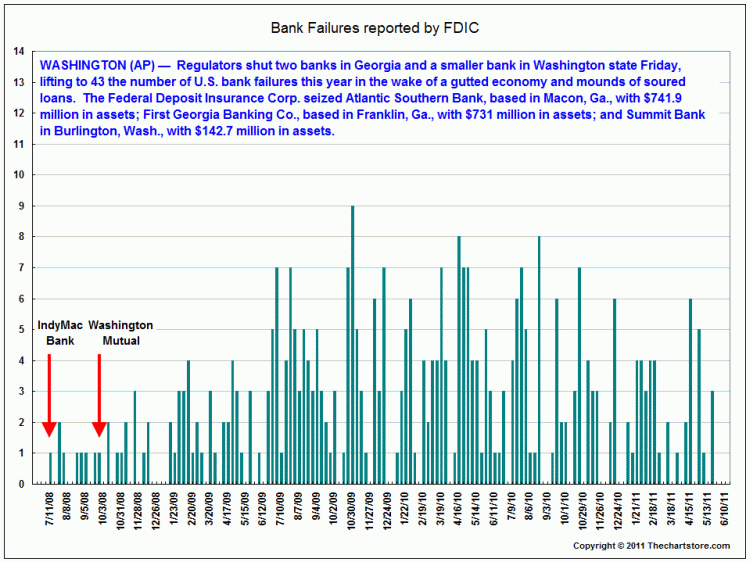
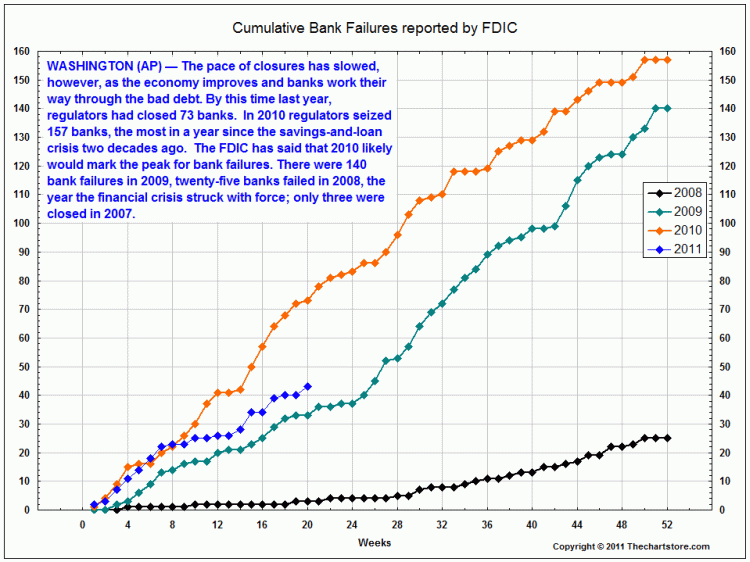
FDIC Bank Closings
By Barry Ritholtz
>
click for larger charts
See the original article >>
Saturday, May 21, 2011
Funds Come Back to Corn
The corn market roared back to the upside this week with July corn values closing nearly 80 cents above last Friday’s settlement price. This week the corn market had erased its liquidation break that had begun two weeks ago. The corn market found support from a strong cash market as well as a renewed focus on near-term demand.
The weekly ethanol data showed that the amount of corn used last week to produce ethanol had climbed to its highest level in six weeks.
In addition to the solid fundamental news this week, there was evidence that the funds were aggressive buyers of all of the grains when corn, soybean and wheat all crossed their 50-day moving averages. The function of the market continues to work. When prices rose towards their highs of early April, evidence of demand destruction was revealed. When values slipped last week to the lowest levels in two months, signs of a pickup in demand were uncovered.
There were rumors late on Friday that Russia may re-enter the world wheat trade as early as Monday. This news will have to be monitored over the weekend, as it could lead to a break in wheat and a correction to corn and soybeans to start next week’s trade. Look for all of the grain markets to be bound by its recent trading range through mid-June.
See the original article >>
Etichette:
articles,
commodity,
commodity article,
corn,
grains,
market articles
Crops ride on improved commodity sentiment
by Agrimoney.com
The weather forecasts aren't getting any better.
A broad range of commodities attracted, some, buying on Friday, on thoughts that recent declines had gone too day.
New York oil added 0.6%, not enough to get it back over $100 a barrel, but at least to see it knocking on the door of $99.
And if that underpinned the commodities complex, crops had continued concerns over weather to underpin them too.
Easy option?
In the US, talk is mounting still of the level of crops likely to be lost to the wet spring, with the approach of insurance cut-off dates suggesting that it is not just corn sowings which will be affected.
"We are hearing more talk of those in the severely wet areas may opt for [insurance claims],thus a big switch to more soybean acres may not happen," Mike Mawdsley at Market 1 said.
Soybeans, which are later sown, are sometimes considered a beneficiary, in acreage terms, of poor corn planting conditions.
At Benson Quinn Commodities, Jon Michalscheck said: "We are closing in the [claim] dates of May 25 and June 5 that has been on everyone's radar for the past few weeks, and that should provide some underlying support as we go through the next two week's worth of planting data."
Rain in Spain, but...
In Europe, those hopes of end-of-month rain for parched crops in France and Germany, the top two wheat-producing states, dried up.
"If you recall, the GFS model was developing a significant rain event for France and Germany in the 11-to-15 day period," WxzRisk.com said late last night.
The latest model, "model has this same weather system for May 31, but has the rain for Spain only. The rain does not get into any significant portion of France or Germany in the 11-15 day.
"And all of the Ukraine Eastern Europe and south west Russia stayed quite dry as well."
'Significant pent-up demand'
Analysts looked afresh, with an upbeat eye, at Thursday's US weekly export sales too, which failed in the last session to keep prices higher.
"Total US corn export sales were extremely strong this week, coming in at 1.15m tonnes versus 457,500 tonnes the week prior," Luke Mathews at Commonwealth Bank of Australia said.
"It signals that significant pent-up demand was uncovered as corn prices slumped in early May."
Sales of 672,200 tonnes of 2011-12 wheat were "heartening" too.
Wheat lags
In Chicago, corn led, adding 0.8% to $7.54 ½ a bushel for July delivery as of 07:10 GMT (08:10 UK time), with the new crop December lot up 0.7% at $6.66 ½ a bushel.
Soybeans were 0.5% higher at $13.86 a bushel for July and up 0.6% at $13.58 a bushel for the new crop November contract.
Wheat lagged, amid some worries nonetheless that the grain had done enough for now, despite potentially worsened weather.
"Wheat should probably take a breather from here until we get more good, or bad, news," Australia & New Zealand Bank said.
Chicago's July lot added 0.3% to $8.14 ¾ a bushel, but the Kansas and Minneapolis hard wheat equivalents, which avoided losses in the last session, struggled this time, falling 0.1% to $9.44 a bushel and 0.6% to $10.00 ¼ a bushel respectively.
'Could easily spike'
Cotton, which suffered another week of negative US exports, ie cancellations, struggled too, easing 0.1% to 155.50 cents a pound for July.
The new crop December lot added 0.02 cents a pound to 119.21 cents a pound.
But do bigger gains lie ahead?
"The cotton market is currently weighing up the influence of declining global demand versus worries over 2011 production prospects," Mr Mathews said.
With weather conditions in the US, the top exporter, and China, the top grower, consumer and importer, "far from perfect, in our view, if crop failures materialise prices could easily spike higher".
Etichette:
articles,
commodity,
commodity article,
market articles
S&P cuts credit outlook for Italy to "negative"
By Ian Simpson and Silvia Aloisi
The downward revision, which raises the risk of a downgrade of Italy's sovereign rating, may heighten fears that contagion from Greece's and other European countries' debt crisis could be spreading to the euro zone's third-largest economy.
"In our view Italy's current growth prospects are weak, and the political commitment for productivity-enhancing reforms appears to be faltering," Standard & Poor's said in a statement early on Saturday.
"Potential political gridlock could contribute to fiscal slippage. As a result, we believe Italy's prospects for reducing its general government debt have diminished."
Standard & Poor's affirmed its 'A+' long-term and 'A-1+' short-term sovereign credit ratings on Italy, which is slowly recovering from its worst economic downturn since World War Two and has one of the world's largest public debts.
In recent years, the ratings agency has often taken a bleaker view of the state of Italy's economy, compared to its counterparts Moody's and Fitch.
Moody's currently has an Aa2 rating for Italy, while Fitch rates it at AA-, which means S&P has Italy two notches below Moody's and one below Fitch.
Italy has weathered the financial crisis better than some of its euro zone's peers but its growth has lagged behind the bloc's average for over a decade.
Many analysts say unless it adopts reforms needed to sharply improve its growth potential, it has little chance of meeting its medium term target to cut the debt.
Italy hardly grew in the first quarter, with gross domestic product (GDP) edging up only 0.1 percent, compared with rises of 1.5 percent in Germany and 1.0 percent in France. Crisis-hit Greece grew 0.8 percent.
ITALIAN TREASURY DEFENDS ITS POLICIES
The Italian Treasury criticized the move by S&P, saying data on its economic growth and public accounts had "constantly been better than expected."
However, Italy last month cut its economic growth forecasts for 2011, 2012 and 2013 and raised its projections for the public debt. It kept the deficit outlook unchanged.
The economy is now expected to expand by 1.1 percent this year, down from a previous forecast of 1.3 percent. In 2012, GDP growth is seen at 1.3 percent, compared to 2.0 percent previously.
Public debt is expected to reach 120 percent of GDP this year, before falling slightly to 119.4 percent in 2012.
In a statement after the S&P outlook revision, the Treasury said major international organizations such as the OECD, the International Monetary Fund and the European Commission had recently given "very different" assessments on Italy from that of S&P.
Analysts from the IMF and the OECD said this month that Italy's economy was recovering slowly, but added that it would require major structural reform to boost its growth potential.
A weak economy weighs heavily on the debt and deficit ratios, and both organizations urged efforts to stimulate productivity growth and labor supply.
The Treasury ruled out the risk of political gridlock, which S&P cited as a factor that could contribute to fiscal slippage together with weaker-than-expected economic growth.
It also said measures aimed at meeting its target of balancing the budget in 2014 were "at an advanced stage of preparation" and will get parliamentary approval by July.
S&P's revision is another blow for center-right Prime Minister Silvio Berlusconi, who is embroiled in sex and corruption trials.
The media tycoon's People of Freedom party also suffered a setback this week in local elections seen as a test of his coalition government's popularity and is facing a risky run-off on May 29-30 for the city government of Milan, Italy's business capital.
The Standard & Poor's outlook change implies a one-in-three chance that the credit ratings could be lowered within 24 months.
Standard & Poor's forecast net government debt at 116 percent of GDP this year, up from 100 percent in 2007.
"Under our analysis, the economic contraction between 2008 and 2009 has negated all of Italy's fiscal-consolidation efforts over the last decade," it said.
The Italian banking sector has been strengthened by moves to strengthen capital "and is in a stronger financial position than it was six months ago," the agency said.
Etichette:
articles,
Economy article,
Finance article,
market articles
U.S. Dollar Index Reversal Signs
By: Seven_Days_Ahead
The 2011 downleg in the US Dollar Index recently violated the 2009 low but has held above the more major 2008 low, finding support on the long term chart and producing an initial reversal sign too.
See the original article >>
Subscribe to:
Posts (Atom)