Thursday, May 19, 2011

Disasters send Japanese economy into recession

By TOMOKO A. HOSAKA

Japan's economy shrank in the first quarter, veering back into recession as factory production and consumer spending wilted in the aftermath of March 11 earthquake and tsunami.

Real gross domestic product — a measure of the value of all goods and services produced domestically — contracted at an annualized rate of 3.7 percent in the January-March period, the Cabinet Office said Thursday.

The result marks the second straight quarter that the world's No. 3 economy has lost steam and undershoots an annualized 2.3 percent fall forecast in a Kyodo News agency survey.

While there is no universally accepted definition of a recession, many economists define it as two consecutive quarters of GDP contraction. Others consider the depth of economic decline as well as other measures like unemployment.

Martin Schulz, senior economist at Fujitsu Research Institute in Tokyo, said there is "no doubt" that recession has returned. More surprising is just how quickly the economy crumpled, he said.

The latest GDP report includes just 20 days following the disaster, but "the impact is huge," said Schulz, who had expected to see most of the economic fallout in the second quarter.

The Nikkei 225 stock average fell 0.4 percent to 9,620.82.

The magnitude-9.0 earthquake and tsunami left more than 24,000 people dead or missing, and wiped out entire towns in the hardest-hit areas. Damage is estimated at $300 billion, making it the most expensive natural disaster in history.

It damaged factories in the region, causing severe shortages of parts and components for manufacturers across Japan, especially automakers. A crippled nuclear power plant caused widespread power shortages that added to the headaches faced by businesses and households.

As a result, Japan's factory production and consumer spending both fell the most on record in March. Exports in March went south for the first time in 16 months. Companies are reporting lower earnings and diminished outlooks for the rest of the fiscal year.

The recent events have deeply unnerved households, who are likely to remain cautious for the coming months, Schulz said.

"The nuclear disaster showed just how much is wrong in Japan actually," he said. "And many things that seemed so stable and sure like electricity supply ... are looking not safe at all."

Toyota Motor Corp., Japan's biggest automaker, said last week that its quarterly profit tumbled more than 75 percent because of parts shortages after the tsunami. As of May, the crisis cost the company production of 550,000 vehicles in Japan and another 350,000 overseas.

Toyota is expected to lose its spot as the world's top-selling automaker to General Motors Co. this year.

Even before the disaster, Japan's economy was shaky.

In a historic shift, China overtook the country as the world's No. 2 economy last year. Japan struggled to address a slew of problems including years of deflation, a rapidly aging and shrinking population, and ballooning public debt. Japanese companies increasingly relied on exports to drive growth and offset the persistently lackluster demand at home.

After four solid quarters of growth, Japan's GDP turned negative in the last three months of 2010 due to weaker exports and consumer demand. The downturn was expected to be temporary.

Instead, Japan has now recorded consecutive quarters of contraction for the first time since the global financial crisis. GDP fell for four straight quarters starting April 2008. 

Japan's economy and fiscal policy minister Kaoru Yosano described the current slump as milder than the previous slide, when global demand "evaporated instantly." 

"The Japanese economy's ability to rebound is sufficiently strong," Yosano said, according to Kyodo News agency. 

Goldman Sachs said the economy will likely bottom in the second quarter. It expects GDP to begin growing again in the third quarter as reconstruction bolsters demand in both the private and public sectors. 

"We assume the production and exports will shift to mild growth facilitated by supply chain restoration, although power supply is an uncertain factor," chief Japan economist Naohiko Baba said in a report to clients.
The first-quarter GDP figure translates to a 0.9 percent fall from the previous three month period, according to the Cabinet Office data. 

Consumer spending, which accounts for some 60 percent of the economy, declined 0.6 percent. Capital investments by companies retreated 0.9 percent from the October-December quarter. 

To fund recovery spending, Japan's parliament passed at 4 trillion yen ($49 billion) budget supplement earlier this month. Further government outlays are expected to follow in the months ahead. 

The money will be used to build new houses for the more than 100,000 people who remain without proper shelter, clear debris and rubble, restore fishing grounds, and provide support for disaster-hit businesses and their employers.

See the original article >>

OPEC by the Numbers

By Barry Ritholtz

This is the only part of the graphic; click for the rest


Relative Performance

Wednesday, May 18, 2011

Soybeans to gain post-flood acres

by Mary Hightower

Soybeans are expected to gain acres as floodwater recedes in Arkansas, according to Extension agents with the University of Arkansas Division of Agriculture. 

Soybeans have the best odds for success in this disaster-disrupted growing season because of the relatively flexibility of their planting schedule. In March, USDA estimated 3.25 million acres of soybeans were to be planted in Arkansas, 1.04 million acres of rice.

“We’re in the best possible situation – most of our crop is still in the bag,” said Jeremy Ross, Extension soybean agronomist for the University of Arkansas Division of Agriculture.

The standard recommendation for planting soybean varieties in Arkansas is April 15 to June 30. Planting during the conventional time period usually provides for rapid seed germination and emergence.

Hank Chaney, Faulkner County Extension Staff Chair, said it’s likely that many acres intended for corn and rice will be turned over to soybeans. Preliminary estimates had about 80 percent of the county’s 10,000 farmed acres submerged at the peak of the flooding.

Faulkner County is near the center of the state and flooding was largely due to the swollen Arkansas River.

“Water has receded off of some rice fields and it appears they will survive and not have to be replanted,” said Chaney. “Farmers that had planned to plant rice are now switching to soybeans instead. Corn fields that were underwater for more than four days will either be replanted if they can be irrigated or destroyed and seeded with soybeans.”

County agents in Craighead, Jackson and Mississippi counties also said they expected corn, rice, sorghum and cotton acres to go over to soybeans.

According to the National Agricultural Statistics Service, 21 percent of the soybean crop had been planted by May 6.

For more information on crop production contact your county Extension agent, visit www.uaex.edu or visit www.arkansascrops.com.

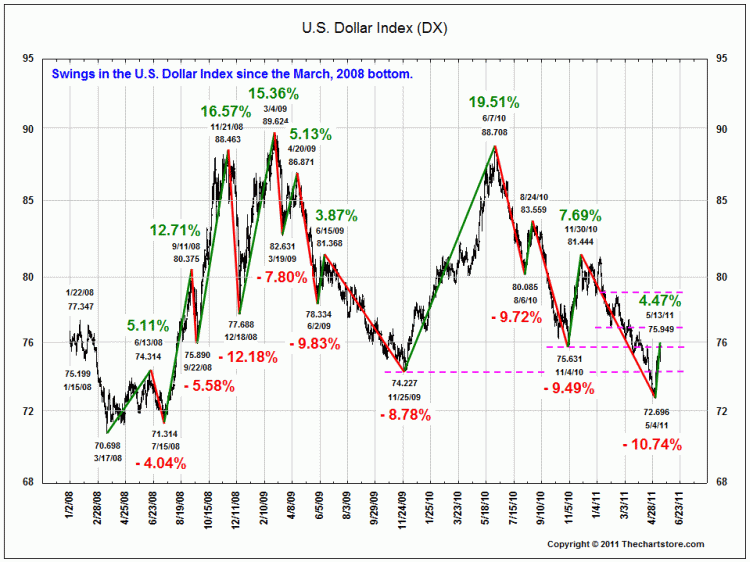
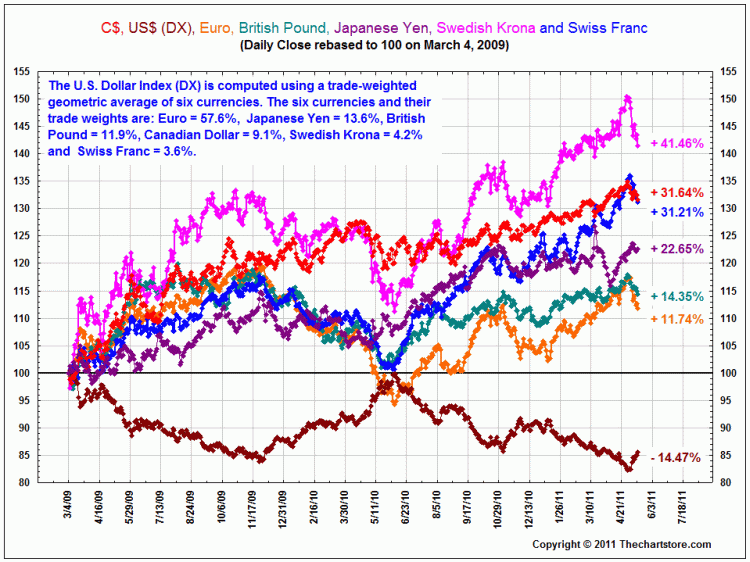
U.S. Dollar Index Components & Swings

By Barry Ritholtz

We’ve posted a few items about the dollar recently (See this and this). the recent counter-trend strength in the buck is what has roiled commodity markets as well as equities.

Today’s NYT has an article that on a possible greenback rally, Some See Rise Ahead for Dollar:
“Could the long dollar slide be over?
For the better part of the past decade, and particularly in the last few months, the American dollar has been the 98-pound weakling of the foreign exchange world. It has lost value against almost every other global currency — not just the euro, pound and yen but even the Romanian new leu and the Latvian lats.
Driven largely by the Federal Reserve’s policy of printing dollars to help spur a healthy economic recovery that remains stubbornly elusive, the dollar, weighed against a basket of other currencies, hit a 40-year low this month.
But betting against the dollar may no longer be such a safe play — not necessarily because of any sudden macroeconomic shifts but because of a sense that the long dollar sell-off may have finally gone too far. Since May 4, the dollar is up 4 percent against the euro and 2 percent against the pound, while rallying against the Romanian and Latvian currencies as well.
In light of the article, let’s take another look at a few Dollar charts:
>

US Dollar Swings

click for larger charts

>

Dollar vs Major Currencies


Corn's price to lose against soybeans' - SocGen

by Agrimoney.com

Has the march of corn prices, compared with soybeans, reached its end?
The grain's rally - fuelled by a poor US spring sowing season at a time when stocks of the grain are already near historic lows - has already seen it notch up a landmark against wheat, only sharply to surrender it.
Chicago corn last month gained premium to wheat for the first time since 1996 - temporarily. On Wednesday, Chicago wheat had a $0.45-a-bushel advantage.
Societe General believes corn might be on for a reversal in its relationship to soybeans too.
The French bank named a "long soybeans, short corn" trade, on new crop contracts, as one of its top investment bets, among a list of recommendations ranging from selling protection on China Development Bank to a trade of buying the pound and selling the yen.
Key ratio
The idea is based on the idea that corn prices rarely move near half those of corn for too long.
Indeed, as a rule of thumb, a drop in the price of soybeans below 2.0 times that of that grain is viewed as the trigger for farmers to switch sowing area from the oilseed to the grain. (The dynamic is seen working the opposite way at a ratio of about 2.5.)
Yet that is pretty much where futures prices are lodged now, on prices for the forthcoming harvest.
With November soybeans at $13.24 a bushel on Wednesday, and December corn at $6.54 a bushel, the ratio was 2.02.
Surplus vs deficit
"The end-2011 soybean-to-corn price ratio currently stands at a historically very low level which makes it much more profitable for US farmers to plant corn instead of soybeans," SocGen commodity strategist Jesper Dannesboe said.
"This means that new season US corn production is likely to increase by 3-4%, resulting in a global corn surplus while we expect a global deficit for soybean."
"Based on this, we expect the November 2011 soybean over December 2011 corn ratio to increase substantially over coming months."
The ratio should return to 2.3, near where it stood at the start of the year, Mr Dannesboe said.
'Too soon'
If that sounds appealing, remember the one sticking point is whether US farmers, many of which have been dogged by an unusually wet spring, can even get their existing corn planting plans completed, let alone any extra area that the ratio with soybean prices might dictate.
Indeed, talk has been of the loss of at least 1m acres of corn area and potentially a rise in plantings of soybeans, which can be later sown.
Still, "it is too soon to determine what kind of acreage shifts there may be way from corn to soybeans as economic factors and fall fertilizer applications, along with the calendar, will still play a vital role in any acreage shifts," Kim Rugel at Benson Quinn Commodities said.
Farmers who pumped extra fertilizer into soils in the autumn may be reluctant to switch to soybeans, which are less nutrient intensive.
Furthermore, technically, it is unclear whether the market has much appetite for weakening, relative to corn.
Rugel noted that in the last session, soybeans had fallen into negative territory, only to recover after the visit "did not uncover sell stops", automatic sell orders, which would have driven the oilseed lower still.

Follow Us