Thursday, February 5, 2015

Are Emerging Markets Ready for the Housing Earthquake?

by Alessandro Rebucci

In some parts of the emerging world, housing markets have grown well ahead of income in recent years. US interest rates are about to rise, and international capital will revert to the center, seeking higher and safer yields. This will bring about an earthquake in housing markets at the periphery of the global financial system.

Since the 2008-09 global financial crisis, housing markets around the world have cruised at different speeds. While in many advanced economies they either contracted or stagnated, housing prices in emerging markets recovered quickly and kept rising.

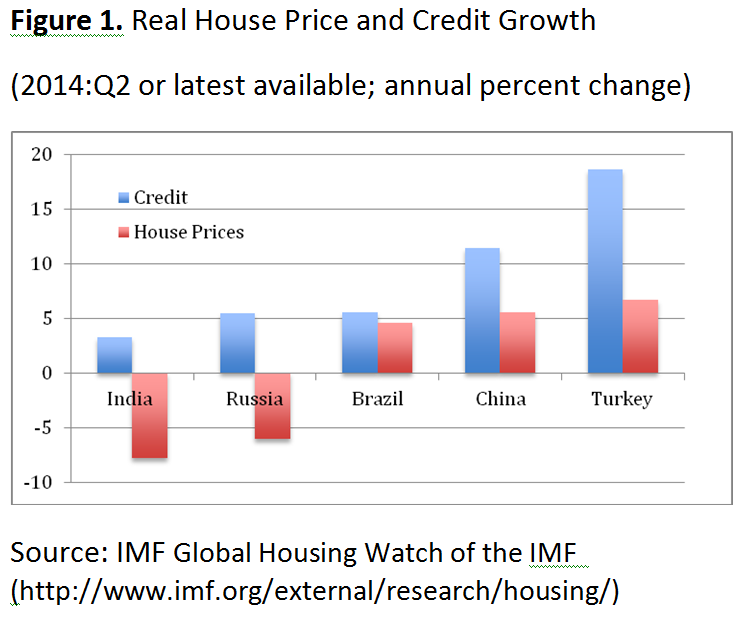
According to the Global Housing Watch of the IMF (Figure 1), for instance, house prices (and credit) in Brazil, China, and Turkey are still running well ahead of inflation, even though income growth has long slowed in these economies. Particularly worrisome in Brazil and Turkey, inflation is high and the current account deficit is quite large; these economies are still overheating and relaying on foreign borrowing to spend beyond their means. In contrast, prices in India and Russia are falling as domestic problems have already poked the housing bubble.
China’s fundamentals are seemingly more solid. But the occasional hiccups in the domestic financial systems and the erratic policy response of the central bank remind us that the ongoing transformations are challenging and far from complete. Liberalizing the financial system while rebalancing growth toward consumption with high debt and an overvalued housing market is difficult at best. It could easily turn into a systemic threat to financial stability if the easy credit policy that supports demand fails to perform the rebalancing act.

The Fed is about to raise interest rates for the first time since December 2008 when it took them to zero to fight the crisis. The US economy could be approaching full capacity and some wage pressures have already started to surface, although headline inflation remains subdued partly thanks to falling energy prices. Asset prices are at all time high while credit growth has picked up. These are all healthy signs of a rehabilitated economy capable of standing on its feet. And the Fed is worried about falling beyond the curve, repeating the mistake of 2002-04 when it raised rates too little and too late.

Historically, when the Fed tightens, capital flows reverted to the center causing earthquakes at the periphery. The ignominious Tequila crisis was preceded by a sequence of US interest rate increases, the second last and the largest of which was in November 1994. Mexico was caught off guard: after an ill-conceived attempt to defend the exchange rate earlier that year, on December 20 it capitulated under a massive speculative attack and devalued its currency in the midst of the deepest recession since the 1982 debt crisis. The banking system went under a wave of mortgage defaults triggered by the sudden increases in interest rates and unemployment. The mortgage market never recovered completely.

When capital flows out, house prices tumble, the current account balance suddenly swings into surplus, and consumption has to adjust dramatically. Loosening domestic monetary conditions and depreciating exchange rate can help cushion the blow. If borrowing is in foreign currency, however, there is only so much that can be done other than painful adjustment, like in the case of Mexico in 1994.

With limited scope for rescuing the economy after a crash, the best that can be done is to try to engineer an orderly housing correction before it is too late. Tightening the regulatory parameters of the financial system in a precautionary manner—the so-called macro-prudential policies—is one way to go. This would not only cool off housing and credit markets, but would also put them on more solid footings to face the financial earthquake that is about to come.

See the original article >>

The Lesson of Greece: Only Collapse Makes Real Change Possible

by Charles Hugh Smith

Of the many lessons we can learn from Greece's difficult path to rejection of debt-serfdom, the most important is perhaps the most obvious: no real change is possible until the Status Quo can no longer fulfill its promises, i.e. it effectively collapses.

The collapse of the Status Quo has two distinct features: the process is highly variable, and the process affects the social classes in different ways.

The process of collapse is neither sudden nor smooth. Things do not necessarily cease to function overnight; rather, the decline to effective collapse operates much like energy states in physics: systems decay and then drop to a lower energy level, where they are stable until further decay causes the next drop to an even lower level.

Pension payments provide a ready example. The pension payment is reduced, and the recipient tightens his/her belt and gets by. The next reduction (either outright or via inflation) forces drastic changes in consumption, and subsequent reductions reduce the pension to a supplement that cannot possibly support a retiree, much less their family.

The pension is still issued, but the promise of a pension that could support a household at a modest level of consumption has collapsed. Though the system for issuing pensions still exists, it no longer fulfills the original purpose.

In this sense, the collapsed pension system becomes much like the phantom legions of the late Roman Empire: the paymasters and officers still received the legion's pay, but there were no real soldiers; the legion was a bookkeeping entry in a skimming operation, not a fighting unit.

The financial Aristocracy (i.e. the kleptocracy) in Greece avoided much of the pain of debt-serfdom. What's the point of running things if you can't distribute the pain to others? I addressed this is Greece at the Crossroads: the Oligarchs Blew It (January 27, 2015).

The powerless classes were stripmined first. Bamboozled into voting for the Kleptocracy in previous elections, the powerless lower classes felt the brunt of austerity for the simple reason the kleptocracy knew there would be no blowback, as long as a few shreds of swag were being distributed.

This highlights the critical role of complicity in maintaining a corrupt, venal and parasitic kleptocracy: the passivity and silence of recipients of social welfare are bought very cheaply, as these classes will fear the loss of the miserable coins tossed to them.

This fear is a potent form of financial terrorism: any resistance or protest might trigger the loss of the reduced social welfare benefits, and so the powerless choose to remain powerless rather than rise up and take the risk of bringing down the parasitic kleptocracy.

The statist bourgeoisie (a.k.a. state-funded upper middle class) were the last to lose faith in the kleptocracy, for the simple reason that their share of the swag was sufficient to maintain the facade of middle-class comfort. It was also enough to sustain the illusion that the kleptocracy's abject kow-towing to the Lords of the European Central Bank (ECB), the European Union (EU) and the International Monetary Fund (IMF) would magically become a winning strategy for Greece, rather than a one-way ticket to permanent debt-serfdom.

When the kleptocracy lost a significant percentage of this top 20%, they sealed their fate. When the state apparatchiks, institutional functionaries, professionals, small business owners, etc. finally lose faith in the the Status Quo, the Status Quo is doomed, though it can stage a rear-guard action by brutally suppressing this class (see Venezuela for an example of this doomed defense of a failed Status Quo).

In the U.S., the top 10% are doing very well, the next 10% are getting enough to sustain the illusion that they may yet recover their former status and wealth, and the bottom 80% have been bought off with social welfare or the promise of social welfare. Some variation of these percentages are in play in Europe, China, Japan and the emerging economies that haven't already imploded.

When the illusion that the Status Quo can fulfill all its promises to everybody dies, the Status Quo starts the terminal slide to effective collapse.


Unfortunately, no real change in the social order or power structure can occur until the effective collapse of the Status Quo has taken down everyone but the kleptocrats, their high-ranking apparatchiks and the piteously delusional.

See the original article >>

Traders: Sell Stocks & Bonds - Buy Gold & Silver

by Marketanthropology

With consideration to our variant methodologies for establishing a context for the downtrend in long-term yields, we believe the move has reached the dregs of the trend. Over the past year, we've posted the following 10-year yield charts ad infinitum, with the idea that long-term yields were poised to retrace a significant portion of the move that had reached a relative performance extreme at the end of 2013.

Last Friday, 10-year yields closed just 2 basis points higher (1.68%) than the May 1, 2013 close - which served as the power low for the subsequent taper-tantrum. From our perspective, the risk/reward for traders long Treasuries here is no longer compelling. Moreover - and as alluded to in recent notes, the significant move by the ECB last month to begin quantitative easing should provide further incentive and traction over an intermediate timeframe away from the safe haven shores of long-term Treasuries.
Upstream, we continue to find constructive action in burgeoning reflationary trends - namely, in gold and silver, that have led what we suspect will become a broader pivot in other downtrodden hard commodities such as oil and copper. We reiterate our call that TIPS look attractive relative to nominal Treasuries, with the more aggressive reflationary trade still found in silver then gold. On the immediate horizon, gold has become vulnerable to completing a quick retracement back to ~$1230, before we see it attempting to break out above its highs from last March and challenging it's first major retracement level above $1400. In either scenario over the next week, precious metals remain one of our favorite positions and would look to increase long-term allocations, primarily relative to U.S. equities - but also now with respect to long-term Treasuries as well. 
Overall, the moves from the most recent deflationary scare have continued to follow the exhaustion sequence witnessed at the end of 2008, when a much larger deflationary squall hit the markets and inflation expectations. Despite the sharp retracement in equities this week, we are looking for the SPX to resume its downtrend - with a pivot inverse to what we expect will become a cyclical low in inflation expectations.

See the original article >>

Wednesday, February 4, 2015

The Longer Outlook in …..The Nasdaq 100

by Greg Harmon

The Nasdaq 100 has a long history for being the index for technology stocks. This was a great assumption for the early 2000’s, but now the index is laden with biotech companies as well. This has been good over the last few years as the strength in biotechs has benefited the Nasdaq while tech stocks have weighed it down. This has propelled the Nasdaq 100 near the 2000 highs, the height of the tech bubble. This is the last major index that has not made a new all-time high. Perhaps a rally in tech names will get it there. But the chart suggest it might take a while.

nasdaq

The monthly chart going back past the tech bubble peak is very clean. There are two main stories involved. The first is the harmonic Bat playing out, shown by the two triangles. This bearish Bat is just 11 Nasdaq points away from the Potential Reversal Zone (PRZ) at 4358. Close enough for chart art. A move lower from here would look for a retracement of 38.2% of the pattern, or to 3278.

But the funny thing about a harmonic Bat is that it can morph into a harmonic Crab. No magic spell involved, just a continuation over 4358. This would move the PRZ to 6350. There are a couple of ways this could happen. It could just continue higher. It could pullback, but less than 38.2%, and then move up to the new PRZ, or it could move sideways and then higher. Of the three, the last two carry a higher probability.

There are a couple of reasons for this. First, the index is overbought on the momentum indicators. The RSI has been running over 70 for over a year and a quick look at the price action shows that historically it has not behaved well when this ends. The MACD is not close to the extreme level in 2000 but it is well above all other levels when you pull that out. It is also starting lower towards a cross down. These could produce either a pullback or continued consolidation.

But Elliott Wave principles raise the probability of a flat move or small pullback. The price action from the 2002 low to the present looks like the first 3 waves of a 5 wave impulse higher. One of the Elliott Wave principles is that the two corrective waves in the 5 wave pattern often are of different character. That is if one if flat the other trends or zigzags for example. In this case Wave II trended lower, so Wave IV would be expected to be flatter.

Using that concept and a similar timeframe for Wave II could see Wave IV ending at 4000 in early 2016, before a final Wave V higher to between 5500 and 7500. The Crab PRZ is nearly in the middle of that range. All of the bullish cases for the longer term fail on a break below 3278 and a then a target of 2328 arises, or a 61.8% retracement of the original Bat pattern.

See the original article >>

US Dollar Reversal

by Short Side of Long

Chart 1: The strong US Dollar rally is finally showing signs of weakness

US Dollar Index 

Source: Fin Viz (edited by Short Side of Long)

Over the last few sessions, we have potentially seen first signs of weakness in the powerful US Dollar rally, which started in early July of last year. While I do not think the US Dollar bull market is over yet, there is a potential for a serious correction in coming weeks and/or months. Obviously, this should impact many asset classes, which I wrote about several weeks ago:

If the correction in the US Dollar would occur in coming weeks, it might boast many different asset classes. Firstly, the dramatic crash in Crude Oil could finally find some sort of footing. Stabilisation in energy prices could help energy stocks as well. Foreign currencies such as Japanese Yen and Australian Dollar find themselves at major historical support levels of 120 yen and 0.80 cents, so both of these could rebound for awhile.

Emerging market currencies have been under pressure recently, so a peak in the greenback could stabilise these currencies and put a bid under the extremely cheap emerging market equity complex. Finally, as already discussed in previous posts, Gold has been holding up well despite the Dollar rally. Therefore, Dollar weakness might only further strength Gold as it attempts to break out into a new uptrend.

Chart 2: Bullish sentiment has remained at super high nose bleed levels

US Dollar Sentiment 

Source: SentimenTrader (edited by Short Side of Long)

US Dollar could correct for awhile, either in a form of a prolonged consolidation or even possibly an initial sharp reversal sell off. The truth is, bullish sentiment on the currency is ridiculously high and a major shake out could occur at any point in time. If we observe Chart 2, we can see that the Public Opinion (thanks to SentimenTrader website) has been at nose bleed levels and recently hit a record high.

At the same time, commitment of traders report (thanks to CFTC), shows that hedge funds and other speculators hold an extremely high level of net long contracts. Every man and their grandmother expect higher US Dollar. Honestly, so do I, as I've been long since the summer months of 2014. All of this means that the trade is probably overdone, way too loved, over-owned and overbought... at least in the short term.

Pay attention to the USD index in the next few weeks!

Chart 3: Hedge funds continue to heavily sit on the long side of the trade

US Dollar COT 

Source: Short Side of Long

See the original article >>

2008 Deja Vu: GMAC Confirms SEC Probe Of Subprime Loans, Will "Investigate Itself"

by Tyler Durden

While not entirely surprising, the fact that GM Financial has admitted that:

  • *GM FINANCIAL: SEC PROBING SUB-PRIME LOAN SECURITIZATION

Of course, we should not worry about this... we are sure it is "contained" as GM reports it is "investigating matters internally" - just like it did with the ignition switch year ago?

Via GM's 10K,

In July 2014, we were served with a subpoena by the U.S. Department of Justice directing us to produce certain documents relating to our and our subsidiaries’ and affiliates’ origination and securitization of sub-prime automobile loans since 2007 in connection with an investigation by the U.S. Department of Justice in contemplation of a civil proceeding for potential violations of the Financial Institutions Reform, Recovery, and Enforcement Act of 1989.

Among other matters, the subpoena requests information relating to the underwriting criteria used to originate these automobile loans and the representations and warranties relating to those underwriting criteria that were made in connection with the securitization of the automobile loans. We were subsequently served with additional investigative subpoenas to produce documents from state attorneys general and other governmental offices relating to our sub-prime auto finance business and securitization of sub-prime auto loans.

In October 2014, we received a document request from the Securities and Exchange Commission in connection with its investigation into certain practices in sub-prime auto loan securitization.  We are investigating these matters internally and believe that we are cooperating with all requests. Such investigations could in the future result in the imposition of damages, fines or civil or criminal claims and/or penalties. No assurance can be given that the ultimate outcome of the investigations or any resulting proceedings would not materially and adversely affect us or any of our subsidiaries and affiliates.

Nothing to see here, move along... the rebirth of the subprime lending bubble...

and the delinquencies are alreasy surging...

See the original article >>

Follow Us