Wednesday, September 17, 2014

The Time For Caution Has Arrived

by Bret Jensen

I should feel good about the market today given my huge gains in Avanir Pharmaceuticals (NASDAQ:AVNR) yesterday. The shares rocketed up some 85% on positive Phase II trial results for its compound to treat agitation in Alzheimer's patients. The shares are now up some 150% since I provided a positive profile on the company in early May right here on Seeking Alpha in addition to my inaugural Small Cap Gems newsletter in July.

So why am I not happier with the market right now? Well, to begin with we have Jim Cramer yelling on CNBC this morning that equities currently have a horrid set up at the moment that feels like that before the huge "risk off" sell-off that occurred in early March. Ordinarily this would not bother me, but he is echoing some of my same concerns that I have recently noted on Real Money Pro.

The market has hit a major resistance point since the S&P 500 hit the magical 2,000 level earlier this month. This is something I predicted would happen at the time on Seeking Alpha. I believe the time for caution has arrived for investors especially those that have a good portion of their portfolio in "risk on" sectors such as biotech and small caps.

My biggest concerns for the overall market are the following:

Price action is deteriorating:

Monday was the perfect microcosm for the deteriorating price action in the market. The Dow Jones Industrial Average actually managed a gain yesterday and the S&P posted a small loss. However, both the more volatile and richly valued Russell 2000 and NASDAQ fell more than one percent yesterday.

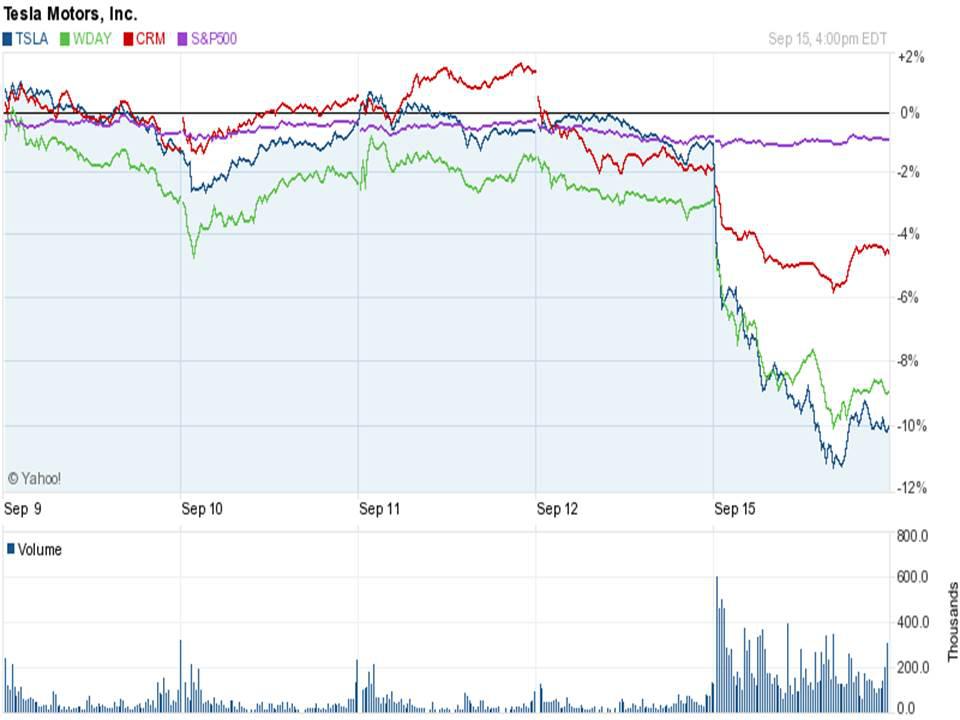
Higher beta sectors such as biotech saw even larger gains. Individual high momentum names like Workday (NYSE:WDAY), Tesla Motors (NASDAQ:TSLA) and Salesforce (NYSE:CRM) were pasted yesterday and have been very poor performers over the last week. Until this action reverses, I would be reluctant to put more money to work in this part of the market.

(click to enlarge)

The End of Quantitative Easing:

The ending of "QE1" and "QE2" both triggered double-digit declines in the overall market. Investors are rightly cautious in front of the end of "QE3" in October. This latest version of QE added more than $1 trillion in additional assets to the Fed's balance sheet, which now stands at over $4 trillion from under $1 trillion before the financial crisis.

Unfortunately, this huge infusion of liquidity by the Federal Reserve has not had all the benefits the board anticipating. The economy has grown at a two percent annual GDP level since the recession ended in June 2009. This is less than half the 4.4% annual GDP growth the nine previous post war recoveries averaged coming out of a recession. It also pales against the 5.3% annual GDP growth we got after the last deep recession (1980-82) ended.

This easy money era also has had some perverse impacts. Corporations have utilized low interest rates to raise money to buy back stock and avoid paying additional taxes from repatriating cash from overseas. Companies bought back some $340 billion of stock in the first half of 2014. This is the highest level since 2007 right before the market started to turn down.

Smart Money is getting out:

In addition to robust stock buyback activity, both M&A and IPO activity are near 2007 peak levels punctuated by Friday's massive public offering of Chinese E-commerce giant Alibaba (Pending:BABA). If the so-called "smart money" consisting of venture capitalists and company insiders are cashing out, should retail investors be getting more comfortable allocating more funds into the market at these levels?

Slowing Global Growth:

The European Central Bank recently had to announce significant liquidity measures which some have dubbed "QE Lite" in order to keep the Eurozone from tipping into recession again especially in light of increasing sanctions on Russia. Italy already has recently suffered two straight quarters of contraction - the common definition for a recession. Not surprisingly, the Euro has continued its recent decline against the dollar, which will hit the earnings of American multi-nationals that get a good portion of their earnings from Europe when they next report quarterly results.

The Shanghai posted its worst one-day decline in four months overnight as Foreign Direct Investment just hit a four-year low. Iron ore prices remain dismal as this commodity is near four-year lows as well pointing to tepid global demand. A real slowdown in China is a "black swan" that I feel is likely at some point in the foreseeable future but few pundits talk about on a consistent basis. I just don't trust a government that states economic growth is consistently within 1/10 of one percent of GDP projections quarter after quarter.

Summary:

I believe my cautious stance is warranted at the current time. I have a higher than normal allocation to cash within my portfolio at the moment. In addition, I have either exited or sold covered calls against most of my small cap positions. I will add reasonably valued blue chip stocks like Apple (NASDAQ:AAPL) or JPMorgan Chase (NYSE:JPM) on any significant dips in the overall market. Hopefully, by the end of the year it will be safe again to start moving back into some of the "risk on" sectors that seem primed for additional declines currently.

See the original article >>

Final Remarks Ahead of Scotland’s Referendum

by Pater Tenebrarum

Don’t Listen to the Scaremongers

Political elites around the world are scared of independence movements. Whether it is the allegedly sacrosanct territorial integrity of Ukraine or Iraq, the possible secession of Catalonia from Spain, of Sardinia from Italy, or the vote on Scottish independence: in all cases, visions of calamity are painted in vivid colors if the overarching nation states were to split into two or more parts.

These fears are understandable from the point of view of the ruling elites: the agents representing the force monopolist State always want to have as big a territory under their control as possible. It means more power for them and a larger tax base to exploit. However, the bigger the territory under the control of a single force monopolist, the less the individual counts, the more the State’s policies will tend toward a mixture of warfare and welfare, both of which as a rule prove disastrous for the average citizen.

Ask yourself why the most prosperous places on earth are all tiny political entities. There is a reason for that. No-one expects Liechtenstein to bomb ISIS in Iraq, or whoever the US enemy du jour is. Liechtenstein doesn’t even have a military. It doesn’t need one, because it is not busy making enemies left and right. Contrary to the larger European nations, it is also not up to its proverbial eyebrows in red tape and taxes. Incidentally, no Islamist extremists have yet thought of attacking Liechtenstein; most probably they don’t even know where it is, and if they did, they wouldn’t regard it as attack-worthy. After all, it has never meddled in the affairs of their homelands.

The UK on the other hand can be expected to waste both blood and treasure on every single war cooked up in Washington, no matter how cockamamie a scheme it is. Just remember the effort to free Iraq of Saddam’s mythical “WMD” and the associated fairy tale chemical rockets, which Mr. Blair asserted “could reach London in 45 minutes”. As long as Scotland is part of the UK, everyone in Scotland is involved in these schemes as well (at a minimum as a payer), whether they want to or not.

What about the alleged inability of Scotland to go it alone on economic grounds, or on grounds of being “too small”, or any of the other reasons that have been dragged up in recent weeks? These objections were already answered in this pages in great detail (see the list below this article), but let us just say that given that there exist much smaller independent countries possessing far fewer natural resources than Scotland and all of them are rich, simple common sense should tell one that such arguments cannot possibly hold water.

The one thing every eligible voter in Scotland needs to be aware of before making the decision is this: those who tell you that you aren’t up to it, that Scotland and its people won’t cut it, all have motives, interests and priorities of their own. Rest assured that the world will keep turning after Scotland gains independence.

We should also mention that what holds for Scotland is also true, if to a lesser extent, for the remainder of the UK – that fact that it will be somewhat smaller, is likely to be to the long term advantage of the average citizen.

camr-on

UK prime minister Cameron: He just doesn’t want to be the guy who “lost Scotland”

(Photo credit: dailystar.co.uk)

A Bastion of Socialism?

Some people have argued that the fact that Scottish voters have essentially switched their allegiance from one left-wing party, the SLP (the Scottish Labor Party, which is a local chapter of the UK-wide Labor Party) to another, namely the SNP (the Scottish National Party, which has a very social democratic-sounding platform), an independent Scotland will become a bastion of socialism.

It seems actually likely that the remainder of the UK will become a tad more conservative overall. However, we believe these fears about the Scottish desire for socialism are overblown. A major reason why many Scots have voted for the SNP seems to be their disdain of the Tories in Westminster and not necessarily their great love of socialism (obviously, we cannot possibly speak for all Scots here. It appears to us that this is a major motive for many though).

Moreover, here is another example of a fairly recent amicable parting of ways in a European country, namely the split of Czechoslovakia into the Czech Republic and Slovakia. As John Fund writes, this particular split had many parallels to the potential secession of Scotland from the UK. As it turns out, the results of this particular experience have been quite happy and represent a heartening and favorable indication for a future independent Scotland. An excerpt from Fund’s article:

“The two halves of the country had struggled for three years after the fall of Communism to stay together, but the Slovaks thought the state was too centered on the Czech capital of Prague, and the Czechs resented subsidies and over-representation of Slovaks in key bodies. The same complaints are echoed in Britain, where members of Scotland’s parliament may vote in the Westminster parliament on matters involving all of the U.K., but non-Scottish members of the U.K. parliament are unable to vote on the domestic legislation of the Scottish parliament. In addition, Scotland has more seats in the U.K. parliament than its population would normally be allocated.

There were strains and disputes in the Czech-Slovak divorce, especially over jointly owned gold reserves, but after a few years all was sorted out. Back then, Czechs viewed the Slovaks as more statist and slower to seize economic opportunities than they were. But today, both countries have shown remarkable improvement in the Heritage Foundation’s Index of Economic Freedom; and last year, Slovakia’s economy grew by 2.1 percent — three and a half times faster than it’s grown in the Czech Republic.

“We are doing very well,” Miroslav Lajcak, Slovakia’s deputy prime minister, told the BBC last year. “The Czech republic is doing well, and our friendship is better than ever,” he said.

Slovakia’s population of 5.4 million is almost precisely that of Scotland, and its success shows how small countries can do well on their own.

There was also one other tangible benefit of separation to Slovakia, though it’s one many don’t want to discuss. “After we became independent, people couldn’t blame every problem on Prague anymore or look to it for subsidies,” a former top minister in Slovakia’s government told me. “We had to drop some outmoded socialist thinking and scapegoating and stand on our own two feet.”

Even with its oil revenue, the same phenomenon could occur in Scotland, where the ruling Scottish National party has often pursued foolish economic policies. With independence, a new government might be more realistic. A recent white paper produced by the Scottish government proposes cuts in corporate tax rates to attract business as well as a more skill-based immigration system as new policies to set in place after independence.”

(emphasis added)

We can confirm that there was indeed a remarkable transformation in Slovakia after it gained independence. It is doing quite well with a population almost the same size of Scotland’s, even without any off-shore oil.

It is in any case unrealistic to expect that an SNP government or any other future Scottish government will be able to fund a kind of welfare nirvana from its oil-related tax revenues. It seems rather more likely to us that the points addressed in the white paper which Fund mentions above will come to the fore. Any government of an independent Scotland will have to think about ways to make the country attractive to entrepreneurs and investors. In fact, even its oil-related revenues will largely depend on whether it manages to institute policies that make it attractive to foreign investment. This should automatically lead to more economic freedom for everyone.

Counties

Urquhart Castle, Loch Ness.

(Photo via aldi-reisen.de / Author unknown)

Addendum – Famous Quotes About and by Scots

“We look to Scotland for all our ideas of civilization.”

  • Voltaire

“There are few more impressive sights in the world than a Scotsman on the make.”

  • James M. Barrie

For so long as one hundred men remain alive,

we shall never under any conditions submit to the

domination of the English. It is not for glory or riches

or honours that we fight, but only for liberty, which

no good man will consent to lose but with his life.

  • The Declaration of Arbroath, 1320

“The Baird Undersock is medicated, absorbent and soft, keeping feet warm in winter, cold in summer. Nine pence a pair, post free.”

  • John Logie Baird, electrical engineer and early television pioneer, advertising an early invention

“Tell your king that William Wallace will not be ruled. Lower your flags and march straight back to England, stopping at every home to beg forgiveness for a hundred years of theft, rape, and murder.”

  • William Wallace’s reply to a final plea of King Edward I to surrender shortly before the battle at Stirling Bridge in 1297, which Wallace’s numerically much inferior force won (using the old Spartan trick demonstrated at the Battle at Thermopylae: get a numerically superior enemy to fight you on terrain where numbers don’t count).

wallacesco-368349

William Wallace, who was involved in the early stages of the first war of independence.

For we have three great avantages;

The first is, we have the richt,

And for the richt ilk man should ficht,

The tother is, they are comin here…

To seek us in our awn land…

The third is that we for our livis

And for our childer and our wifis

And for the fredome of our land

Are strenyeit in battle for to stand

  • William Barbour, in his epic poem “The Bruce”

“The dawn of legibility in his handwriting has revealed his utter inability to spell.”

  • Attributed to Ian Hay, Scottish novelist and dramatist 1876-1952

“Blythe to meet,

Wae to part,

Blythe to meet aince mair”

  • This is known as the Bon-Accord toast – “Happy to meet, sorrowful to part, happy to meet once again.” “Bon-Accord” was the password used by the citizens of Aberdeen in 1308 when they rose up, killed the English garrison and captured the town for Robert the Bruce. Bon-Accord is now the motto of the City of Aberdeen.

map_of_scotland

In case anyone is wondering where exactly Aberdeen is, here’s a map. Note also the location of Hadrian’s Wall, which the Romans erected to keep the Picts and Celts out of their hair.

“I understand that perfectly. We feel very much the same in Scotland.”

  • Queen Elizabeth, the Queen Mother, speaking to a Boer in South Africa who told her that he could not forgive the British for having conquered his country. The Queen Mother, daughter of Lord Strathmore and Kinghorne, was born in 1900 and spent much of her childhood in Glamis Castle, Scotland.

“I would hate to die with a heart attack and have a good liver, kidneys and brains. When I die, I want everything to be knackered.”

  • Folksinger Hamish Imlach (1940-1996)

“I have always agreed with the old saying that the only difference between the sacrilegious and the sanctimonious is that the sacrilegious have a sense of humor”

  • Michael McMahon MSP, during the debate on the format of prayers at the start of each day’s session of the Scottish Parliament.

“I went to the butchers to buy a leg of lamb. ‘Is it Scotch?’ I asked. ‘Why?’ the butcher asked. ‘Are you going to talk to it or eat it?’ ‘In that case, have you got any wild duck?’ ‘No,’ he said, ‘but I’ve got one I could aggravate for you.’”

“My wife went to a beauty parlor and got a mud pack. For two days she looked nice, then the mud fell off. She’s a classy girl though, at least all her tattoos are spelled right.”

“This friend of mine had a terrible upbringing. When his mother lifted him up to feed him, his father rented the pram out. Then when they came into money later, his mother hired a woman to push the pram – and he’s been pushed for money since! I asked him once what his ambition was and he replied it was to have an ambition. In the end tragedy struck – as he lay on his death bed he confessed to three murders. Then he got better”

  • all three by Scottish comedian Chic Murray (1919-1985)

“It’s wee surprises like that which keep our marriage alive”

  • Rab C. Nesbitt, after his wife has clubbed him over the head for coming home drunk. This is a Scottish TV comedy – Rab C. Nesbitt is an unapologetic alcoholic, described by his wife as “not anunemployed person, but the original  unemployed person”

“I dinna ken muckle about the law,” answered Mrs Howden; “but I ken, when we had a king, and a chancellor, and parliament-men o’ our ain, we could aye peeble them wi’ stanes when they werena gude bairns – Bit naebody’s nails can reach the length o’ Lunnon.”

  • From “The Heart of Midlothian” by Sir Walter Scott, in 1818.

“Hard by, in the fields called the Leith Links, the citizens of Edinburgh divert themselves at a game called golf, in which they use a curious kind of bat, tipt with horn, and small elastic balls of leather, stuffed with feathers, rather less than tennis balls, but of a much harder consistence. This they strike with such force and dexterity from one hole to another, that they will fly to an incredible distance. Of this diversion the Scots are so fond, that when the weather will permit, you may see a multitude of all ranks, from the senator of justice to the lowest tradesman, mingled together in their shirts, and following the balls with the utmost eagerness.”

  • Tobias Smollet, writing in 1771.

“His worst is better than any other person’s best”.

  • William Hazlitt (1778-1830) the essayist praising the work of Sir Walter Scott

“We are often unable to tell people what they need to know because they want to know something else.”

  • Poet and novelist George MacDonald from Huntly (1824-1905)

“Whaur’s yer Wully Shakespeare noo?”

  • Shouted by an anonymous, over-enthusiastic Scot in the audience at the first performance of the play “Douglas” by John Home, in Edinburgh, December 1756.

“For me, independence is a simple choice between accepting the current state of play or aiming for something better.”

  • by Exclamation Mark of the PoP Campaign, a duo of music-makers in Glasgow

Note: the source of most of these quotes is the Rampant Scotland page, where you will find more quotes, as well as a lot of other information about Scotland.

103446-dunnottar-castle-near-stonehaven-in-aberdeenshire-in-warmer-times

Dunnottar Castle … yes, we have a thing for Scottish castles. So sue us.

(Photo via aberdeen.stv.tv / Author unknown)

Addendum 2: Even in Bavaria They Are Getting Their Hopes Up

NBC reports that yet another European – as of yet fringe – independence movement is looking with hope toward the Scottish referendum and the knock-on effect it might have. This one is based in Bavaria:

“It’s been more than 100 years since the Kingdom of Bavaria was a sovereign state – but the so-called “Bavaria Party” has long campaigned for independence to come once more to the region’s rolling hills. The fringe Bavaria Party has just over 5,000 members – in the southern state of 12.4 million people – and regularly campaigns with slogans such as “Bavaria can also succeed on its own,” but so far has failed to gain widespread support for its ideas. The party hopes all of that will change if Scotland gains independence – envisioning a domino effect – and is putting their voice out in front to support the referendum to their west.

“We hope that the vote will send a clear signal for Europe and that in the long run, Bavaria will become an independent member of the European Union,” party chairman Florian Weber told NBC News. The Scottish vote also has fueled hopes for independence in Italy’s Sardinia and Spain’s Catalonia.”

(emphasis added)

It is certainly no wonder that the centralizers/globalists and statists of all stripes are campaigning so heavily against Scottish independence. The inspiration a Yes vote could be to others is undeniable (there was incidentally also a giant pro-independence rally in Barcelona over the weekend).

And lastly, here is the official US government position (against Scottish independence, natch), plus one final reason to vote “Yes” on Thursday for those who are still undecided and need a bit more prodding:

palinsscotlandtweet

Taking a brief break from watching for invaders from Vladivostok, Sarah Palin opines on Scottish independence.

(Twitter screenshot)

List of Previous Articles on Scottish Independence and Secession Movements:

All you need to know about the philosophical and economic background re. Scotland’s possible secession, by Dr. Jim Walker of Asianomics:

Scottish Independence, Part 1 (It’s Not all About Pounds and Oil)

Scottish Independence, Part 2 (The Currency: Sterling or Not?

Scottish Independence, Part 3 (Fiscal Policy, The Real Difference and The Case Against)

PT on Scotland and Secession in General:

Scotland’s Independence Movement Gains Lead in Polls

Are Nation States Beginning to Splinter?

Secession – An Alternative View

Could the Spanish State Fall Apart ?

Scottish-freedom

Guess what his vote will be …

(Photo via ricksteves.com / Author unknown)

See the original article >>
Why the Dollar May Remain Strong For Longer Than We Think

by Charles Hugh Smith

For those understandably disgusted by the reckless expansion of the US money supply over the past six years, it's vitally important to remember that the road to our monetary endgame is not a straight line, nor necessarily intuitive.


I have long been a dollar bull, not for any over-arching reasons based on inflation, deflation, rising geopolitical multi-polarity or any of the other issues that touch on the dollar’s valuation vis-à-vis other currencies. My analysis focuses on a few basics:  the dollar’s status as the global reserve currency, Triffin’s Paradox (a.k.a. Triffin’s Dilemma) and global capital flows into the dollar and dollar-denominated assets such as U.S. Treasury bonds.

Reserve Currencies vs. Trading Currencies


When we say the U.S. dollar is the global reserve currency, what does that mean?  There is often some confusion about the difference between a trading currencyand a reserve currency.  Let’s use an example to explain the difference.

Country A trades $10 billion of goods and services with Country B, which does $10.01 billion of trade with Country A.  The two nations agree to a trade pact that enables the two nations to trade currencies directly, that is, without converting the payments for trade into a third currency such as the dollar.

Once the bilateral trade is settled, a modest $10 million remains as a surplus/trade deficit.  The owner of the surplus (Country B, in this example) can trade that excess currency on the global foreign exchange (FX) market, use it to buy goods or services, or hold it. The modest $10 million is a tiny slice of the two trading nations’ money stock and gross domestic products (GDP), and it has little effect on either global or domestic finance. The $10 million is a small claim against the currency of the nation running the trade deficit (Country A, in this case).

The main takeaway is that billions of dollars of trade transactions may yield very little surplus/deficit.

Trading currencies are examples of the transactional nature of money: money enables transactions.

A reserve currency, on the other hand, is an example of money as a store of value: nations hold reserve currencies as stores of value that can be sold to support their own currency if the need arises.

A reserve currency is quite different from a trading currency an it must meet these minimum requirements to function as a reserve currency:

1. It must be liquid - that is, it can be readily bought and sold on the global foreign exchange market in size, i.e. large quantities, without affecting the value of the currency;

2.  Its value must be relatively stable - that is, it trades in a narrow range with other currencies, and

3.  Its value is set by supply and demand - i.e. capital flows and market forces, rather than an arbitrary peg.

Many observers greet the announcement of recent bilateral or multi-lateral currency agreements as evidence the U.S. dollar is weakening.  But this is mixing apples and oranges: the U.S. doesn't gain much by issuing a currency that serves transactional needs — it offers no profit to the U.S. if trade between other nations is conducted in yen, renminbi, euros or quatloos.

The demand for transactional currency is temporary. Transact the trade, and then the cash moves on to the next transaction.

The demand for reserve currency is not transactional. A nation that wants to build reserves must acquire the reserve currency and hold it.

Nations that issue reserve currencies must issue enough of their currency to satisfy the global demand for reserves, and the only way to do this is run substantial *and* permanent trade deficits.

Triffin’s Paradox/Dilemma


This brings us to Triffin’s Paradox, which has two basic parts:

1.  Any nation that issues the reserve currency must run a trade deficit to supply the world with surplus currency to hold in reserve and as a result,

2.  The issuing nation faces the paradox that the needs of global trading community are generally different from the needs of domestic policy makers.

The global trading community requires that the issuer of the reserve currency run trade deficits large enough to satisfy the demand for reserves, while domestic audiences want a strong export sector, i.e. a trade surplus.

You can’t have it both ways: if you want to issue a reserve currency, you have to run a trade deficit that is commensurate in size with the global demand for your currency.

Since supply and demand set price, this push-pull affects the value of the U.S. dollar: U.S. exporters want a weak dollar to spur foreign demand for their products, while foreign holders of the USD want a strong dollar that holds its value/purchasing power.

It is impossible for any nation to maintain the reserve currency and run trade surpluses. If you run trade surpluses, you cannot supply the global economy with the currency it needs for reserves, payment of debt denominated in the reserve currency and domestic credit expansion.

Why Hold Reserves?


Why do countries need reserves in the first place?  The answer can get complicated, but the basic dynamic is supply and demand: if Nation A prints vast quantities of its own currency (let’s call it the quatloo) and uses the cash to buy goods and services without creating an equivalent amount of goods and services to sell to other nations, it will run a large trade deficit.

The supply of quatloos will soon exceed the demand: everybody who accepted freshly printed quatloos for their exports wants to trade them for goods or unload them as soon as possible. As a result, the value of quatloos on the global FX market falls, and Nation A is in danger of plunging into a currency crisis: as the value of the quatloo declines, the price of imports rises within Nation A, and soon people can no longer afford imports from other nations—for example, grain and oil.

One way Nation A can support the value of its quatloos is to sell its reserve currency and use the cash to buy quatloos, soaking up the excess supply that is depressing the quatloo’s value. So currency reserves act as a stabilizing anchor for the nation’s own currency.

There is another often-overlooked role for currency reserves: they act as the asset base for the expansion of credit within the domestic economy. A central bank with substantial reserves can issue credit in the domestic currency commensurate with its holdings of assets such as gold or currency reserves.

The Supply and Demand for Dollars


There are number of reasons why nations might choose to buy or sell U.S. dollars, or assets denominated in dollars such as Treasury bonds. Let’s start by noting that the dollar is not the only reserve currency; the USD is roughly 62% of global currency reserves, the euro is about 25% and other currencies make up the balance.

Nations might sell dollars and buy another reserve currency to diversify their holdings, hedge against a decline in the dollar relative to other reserve currencies, or perhaps as a form of geopolitical weapon or protest against American hegemony or specific policies.

Much has been made of global capital leaving U.S. Treasury bonds. Yet if we glance at a chart of foreign holdings of Treasuries, we note that foreign owners have steadily increased their holdings of Treasuries, other than a shallow dip in 2013:

For years, observers have seen the massive Treasury holdings of China as a potential financial weapon: if China were to dump a trillion dollars of Treasuries, that sale would disrupt the global market for U.S. bonds. (I have always held the Fed could issue a fresh $1 trillion and buy the lot in one fell swoop.)

But interestingly, we find instead that China’s holdings of Treasuries have been relatively stable recently, at around 20% of total foreign-owned Treasury bonds:


The discussion of major foreign holders of Treasury Securities, i.e. foreign states and central banks, often overlooks one key driver of this trade: states seeking to weaken their own currency to boost their exports sell their own currency and buy U.S. dollars (or dollar-denominated assets such as Treasuries). This increases the supply of their own currency, pushing the value lower, while the increased demand for dollars pushes the value of USD higher.

In terms of foreign trade, this weakens the currency of the buyer of Treasuries in relation to the dollar.

In other words, major holders of U.S. Treasuries such as China and Japan have an over-riding incentive to keep buying Treasuries: buying dollars stabilizes or weakens their currency vis-a-vis the U.S. dollar, making their goods and services cheaper in the U.S. and thereby boosting their exports.

There are two other reasons nations might buy dollars: the dollar is available in size, unlike smaller currencies such as the Swiss franc, and it is widely viewed as a proxy of U.S. economic, military and diplomatic stability: in other words, in periods of crisis, the dollar is widely viewed as a safe haven currency.

Conclusion


We now have a basic understanding of the forces of supply and demand for the dollar as a reserve currency: nations buy dollars as reserves, and also to weaken or stabilize the value of their own currency against the dollar, a strategy designed to boost their exports to the U.S.

On the supply side, the U.S. issues a surplus of dollars for others to use as reserves by running a trade deficit. Should that deficit shrink, the supply of dollars will also shrink.

In Part 2: Why The US Dollar Could Strengthen - A Lot From Here we analyze the surprisingly likely drivers that may keep the US dollar strengthening over the next few years, especially if another economic/financial crisis arrives. While there are many reasons to fear for the longer term viability of the US dollar given America's current misguided monetary policy and exponentially increasing debt & liabilities, the next few years could well see it appreciate further by 50-100% relative to the world's other major fiat currencies.

For those understandably disgusted by the reckless expansion of the US money supply over the past six years, it's vitally important to remember that the road to our monetary endgame is not a straight line, nor necessarily intuitive. To have the best chance of remaining solvent, understanding the likeliest pathways the route will take is often nearly as important as correctly predicting the final destination.

See the original article >>

Fed could hint on rate-hike plans as it prepares for policy turn

By Michael Flaherty

(Reuters) - The U.S. Federal Reserve on Wednesday could offer fresh clues on when it plans to begin lifting interest rates and how quickly it will move, as it prepares for a momentous policy turn after years of aggressive monetary stimulus.

Although a tightening of monetary policy is not expected until mid-2015, the central bank could use a policy statement on Wednesday to lay important groundwork.

In particular, speculation is rife the policy-setting Federal Open Market Committee may change its guidance on how long it is likely to keep rates near zero. The panel may also alter its depiction of the labor market to suggest further progress toward its goal of full employment.

Both would signal that a six-year freeze on rates is thawing. Although the market is betting on a policy change, the Fed could also stick to its script.

Along with the policy statement it will issue at 2 p.m. (1800 GMT), the Fed will lay out new economic and interest rate projections that will extend out to 2017 for the first time. The rate projections - or "dots chart" - show where individual Fed officials think rates should be at the end of each year.

Some economists think a spate of mostly good news on the economy could spur officials to hint at a more aggressive rate-hike path, which would widen the distance between their views and those held in the bond market.

"The committee’s median projection for interest rates at the end of 2015 and 2016 could be pushed up a bit as they were in June, providing a hawkish signal to markets," economists at IHS Global Insight said in a note earlier this month.

But because the individual forecasts are not labeled, and some policymakers, such as Chair Janet Yellen, deserve more weight than others, "it will be difficult to separate the signal from the noise," the economists warned.

It will be up to Yellen, who holds a news conference a half hour after the statement and projections are released, to clarify the Fed's policy intentions.

EYES ON THE LABOR MARKET

The path to a rate increase is hugely important for investors. In June, the median of the Fed's projections suggested rates would reach 1.125 percent by the end of next year, more than a quarter point higher than futures markets have priced in.

The Fed also needs to decide whether to maintain a pledge to keep near-zero rates in place for a "considerable time" after its bond-buying stimulus program ends. With the central bank set to reduce its monthly purchases to $15 billion this month, the program will likely end in October.

A number of officials have said they are uncomfortable with an assurance that is based on the calendar and not the economy's progress.

"If that language isn't softened at this meeting, then it will surely be weakened at October's meeting," economists at Capital Economic said a research note on Tuesday.

Another phrase some economists think could come under the knife is the Fed's description of slackness in the labor market as "significant," although they appear to be in the minority.

While the unemployment rate dipped back down to 6.1 percent in August, job growth slowed and wage gains remained sluggish, factors that are likely to bolster Yellen's resolve not to move too hastily in tightening policy.

See the original article >>

The U.S. National Debt Has Grown By More Than A Trillion Dollars In The Last 12 Months

by Michael Snyder

The idea that the Obama administration has the budget deficit under control is a complete and total lie.  According to the U.S. Treasury, the federal government has officially run a deficit of 589 billion dollars for the first 11 months of fiscal year 2014.  But this number is just for public consumption and it relies on accounting tricks which massively understate how much debt is actually being accumulated.  If you want to know what the real budget deficit is, all you have to do is go to a U.S. Treasury website which calculates the U.S. national debt to the penny.  On September 30th, 2013 the U.S. national debt was sitting at $16,738,183,526,697.32.  As I write this, the U.S. national debt is sitting at $17,742,108,970,073.37.  That means that the U.S. national debt has actually grown by more than a trillion dollars in less than 12 months.  We continue to wildly run up debt as if there is no tomorrow, and by doing so we are destroying the future of this nation.

The chart that I have posted below shows the exponential growth of the U.S. national debt over the past several decades.  Anyone that would characterize this as "under control" is lying to you...

National Debt 2014

This is the greatest government debt bubble in the history of the world, but very few people seem to have any desire to do anything about this anymore.  We are literally gorging on debt, and most Americans seem to think that it is just fine and dandy.

Perhaps that it is because we have never really experienced any serious consequences for going into so much debt yet.

But when it comes to running up debt, a day of reckoning always comes eventually.

Just ask Greece.

And the absolutely insane spending policies of this administration and this Congress are hastening the day when our day of reckoning will arrive.

Consider the following facts...

-The U.S. national debt has increased by more than 7 trillion dollars since Barack Obama has been in the White House.  By the time Obama's second term is over, we will have accumulated about as much new debt under his leadership than we did under all of the other U.S. presidents in all of U.S. history combined.

-The U.S. national debt is now more than 5000 times larger than it was when the Federal Reserve was first established in 1913.

-If the U.S. national debt was reduced to a stack of one dollar bills it would circle the earth at the equator 45 times.

-Right now, the United States already has more government debt per capita than Greece, Portugal, Italy, Ireland or Spain.

-In August, the average rate of interest on the government’s marketable debt was 2.028 percent.  In January 2000, the average rate of interest on the government’s marketable debt was 6.620 percent.  If we got back to that level today, we would be paying well over a trillion dollars a year just in interest on the national debt.

-At this point the U.S. government has accumulated more than 200 trillion dollars of unfunded liabilities that will need to be paid in future years.  In other words, we have made more than 200 trillion dollars worth of promises that we do not have money for yet.

Thomas Jefferson once said that "the principle of spending money to be paid by posterity, under the name of funding, is but swindling futurity on a large scale."

What we are doing to future generations is absolutely unconscionable.  We are stealing trillions upon trillions of dollars from our children and our grandchildren, and we are willingly consigning them to a lifetime of debt slavery.

I have said this before, but it bears repeating.  If future generations get the chance, they will look back and curse us for what we have done to them.

And shame on anyone that would dare to suggest that we should continue to run up more debt that future generations will be expected to repay.

But government debt is far from the only massive debt bubble that we are dealing with as a country.

40 years ago, the total amount of debt in our nation (all government debt plus all business debt plus all individual debt) was sitting at a grand total of about 2.3 trillion dollars.

Today, that total has grown to 59.4 trillion dollars.

As the chart posted below shows, our total debt bubble is now more than 25 times larger than it was just 40 years ago...

Total Credit Market Debt 2014

If you were to take all forms of debt in our country and divide it up equally to each person, the average family of four would owe approximately $735,000.

This is not anywhere close to being sustainable, but most Americans don't seem to care.  They just continue to recklessly run up even more debt.

However, there are signs that we are starting to hit a wall with all of this debt.

For example, an astounding 35 percent of all Americans have debts that are so overdue that they have been referred to collection agencies.

Our nation has become an ocean of red ink from sea to shining sea, and the only way to keep the bubble from bursting is for the total amount of debt to continue to grow much faster than the overall economy is growing.

Obviously this cannot happen indefinitely, and when this house of cards comes crashing down it is going to be absolutely horrific.  For much more on all of this please see my previous article entitled "The United States Of Debt: Total Debt In America Hits A New Record High Of Nearly 60 Trillion Dollars".

The big question is how long our "bubble economy" can keep going before it finally collapses.

It has gotten to the point where even some of the biggest banks in the world are admitting that what we have been doing is completely and totally unsustainable.  Just consider the following excerpt from a recent article by Joshua Krause...

*****

Recently, strategists for Deutsche Bank released a startling study in regards to government debt. They decided to investigate whether or not the bond market is currently in a bubble. What they found was, unlike previous eras, the past 20 years has seen no lag between economic booms and busts:

It has long been our view that over the last couple of decades the global economy has rolled from bubble to bubble with excesses never fully being allowed to unravel. Instead aggressive policy responses have encouraged them to roll into new bubbles.

This has arguably kept the modern financial system as we know it a going concern. Clearly there have always been bubbles formed through history but has there been a period like the last 20 years where the bursting of one bubble has consistently led directly to the formation of the next?

Essentially, our current system has been dying a very slow death. It’s running out of steam.

*****

Sadly, most Americans have no idea that we are living in a giant debt-fueled bubble that has a limited lifespan.

Most Americans just assume that since the politicians tell them that everything is going to be okay that they don't need to be concerned about any of this.

But every single day our debts get even larger and our long-term financial problems get even worse.

Someday this bubble is going to burst and then all hell will break loose.

It is just a matter of time.

See the original article >>

Why Goldman Sachs Is Wrong On Gold

by Michael Pento

Wall Street powerhouse Goldman Sachs has recently reiterated its negative view on gold, which it has held for the past year. However, it is now doubling down on this view and advising clients to actually go short the metal. Jeff Currie, head of commodity research at Goldman noted "Our target is really driven by the view that we think that the Fed will ultimately be the dominate force here and put more downward pressure [on prices]."

While I am in agreement with Goldman that the Fed will be the dominant force behind the price of gold, I believe the central bank will soon be back into the QE business, rather than raising interest rates and crushing the dollar price of gold.

Here’s why:

Since Nixon closed the gold window in 1971, gold has made an impressive move upward from its fixed price of $32 an ounce, to where it sits now around $1,250. But few seem to grasp what actually causes gold to move higher. An increase in the gold prices occurs when the market becomes convinced that a currency will lose its purchasing power due to central bank-induced money supply growth and real interest rates that have been forced into negative territory. And nothing convinces a market more of a rising gold price than when debt and deficits explode.

But while the parabolic move higher in gold from 2009 to 2011 did contain a period of low nominal interest rates, real rates did not fall. And, the surging gold price was not accompanied by a growing money supply either. In fact, the growth rate of M3 plummeted during 2009 thru 2010—it wasn’t until 2011 that the money supply rebounded. So what would explain the steady move in gold from $800 to $1,900 per ounce during that time period? The gold price simply got ahead of itself because the market feared that out of control deficits would force the Federal Reserve into an unending cycle of debt monetization, which would engender a protracted period of negative real interest rates, booming money supply growth and inflation.

However, those fears were temporarily ameliorated by the reduction of Federal Budget deficits starting in 2011. This is because the Fed was, ironically, able to temporarily re-engineer asset bubbles, while sending borrowing costs lower, causing revenues to increase and expenditures to decrease. Annual deficits fell from $1.3 trillion in 2011, to $500 billion today. Adding to the gold market’s recent woes is the specious belief held by U.S. dollar bulls that the Fed will be aggressively raising interest rates while the rest of the world is cutting rates. This is the explanation to why gold and gold mining shares have suffered mightily during the past three years.

Today, the equity and bond markets have positioned themselves for the best outcomes of all possible scenarios. These markets are assured that the Fed can painlessly exit QE in October and real interest rates will rise with no ill effects on the economy. The pervasive belief being that US bonds, stocks and dollars will be the sole beacons of economic hope in an otherwise slumping worldwide economy; and, having complete faith that budget deficits will continue to shrink.

I don’t buy any of it, and here are the reasons:

Last week we learned that mortgage applications plunged to a 14 year low. This is because home prices are still so unaffordable that just a slight tick higher in interest rates is enough to stall both potential home buyers and borrowers looking to refinance their loans.  This confirms that after six years of unprecedented Fed manipulation of markets, our economy has become hypersensitive to the slightest interest rate blip.  It also supports my contention that the rise in rates which occurred during the second half of 2013, was much more influential on the first quarter’s negative 2.1 percent GDP print than what can be attributed to snow.  Our economy is not anywhere near strong enough to sustain growth during a rising interest rate environment. And is why the Fed won’t venture very far into this game.

Furthermore, economies in Europe and Japan are in recession, while the once mighty emerging market economies are flailing.  As their respective Central Banks frantically print money, the US dollar is soaring due to the belief that the US economy will remain unscathed from a global economic slowdown.  But, the belief that the U.S. economy will stand alone on a pristine island, while Europe and Japan sinks into the sea, is just as preposterous and unprofitable as the belief held back in 2008 that economies around the world would remain untouched by the U.S. housing meltdown.   

The markets also seemed to shrug off last week’s disappointing jobs report as an anomaly. Perhaps a colder-than-normal August is a good scapegoat. But this week, Janet Yellen gave us an interesting glimpse into the Fed’s view of the jobs picture with her “Labor Market Dash Board”.  It showed that only three out of nine metrics regarding the labor market are better than they were prior to the start of the Great Recession. Investors should think again if they believe the Yellen Fed will be aggressively raising rates and boosting the value of the dollar given the labor market’s already-fragile condition.

Most importantly, the tide of shrinking budget deficits is about to turn.  For instance, since 2011, we have seen a significant reduction in defense spending (down 5.5% during 2014 alone), due to the drawdown of troops in Iraq and Afghanistan.  And although we have yet to learn the full costs associated with Obama’s plan to destroy ISIS--we can safely assume it will be very expensive.

Adding to this, is the drastically underestimated cost of Obamacare.  Insurance risk pools failed to get the proper demographic mix, and the Cadillac tax--delayed until 2018--has companies scheming to redesign existing plans in order to avoid these taxes.  Add to this the unexpected costs of illegals flooding the border, demographics moving far out of favor, and an increase in interest rates that will drive up debt service costs, and you can see why deficits will rise. But nothing adds to the deficit like a recession. Our asset-bubble addicted economy faces another reduction in GDP growth very shortly. This factor alone will send deficits north of $1 trillion in short order.

Faced with a worldwide economic slump, central banks remain the only game in town. And today’s central banks, determined to smooth out every hiccup in the economy, only have one answer--print money. When all you have is a printing press, every problem looks like a monetary crisis.

The Fed will not be raising rates anytime soon. To the contrary, Ms. Yellen will soon be forced back into the money printing business in an attempt to; force higher money supply growth, push real interest rates further into negative territory, keep the dollar from rising, and to make sure debt service payments remain under control.

Soon we will have a perfect storm in which gold will rise. The next phase in the gold bull market will include the four conditions of; negative real interest rates, rapid money supply growth, a falling dollar and skyrocketing deficits.  Investors that have the foresight to realize this opportunity today stand to benefit greatly in the near future.

See the original article >>

Follow Us