Globally equities have fallen amidst fears that European quantitative easing will not be enough to counteract rising interest rates for U.S. Treasuries and falling money supply growth in China.
In early morning trading, the U.S. S&P 500 fell sharply below 2,000 amidst fears that the Federal Reserve may raise interest rates sooner than expected. The Federal Reserve Bank of San Francisco yesterday released a report that said policy makers could increase benchmark interest rates sooner than expected, as quickening inflation rate and a declining unemployment rate encouraged a more hawkish monetary regime.
“An important concern is that the public might not give enough weight to how dependent the central bank’s guidance is on both current and incoming data. Thus, the public could underestimate the conditionality and uncertainty of interest rate projections,” the Federal Reserve report said.
The writers also noted that policy makers themselves were uncertain of future policy decisions: “The public also may be less uncertain about these forecasts than policymakers.”
China Money Constrained
China money supply growth unexpectedly slowed, falling to a five-month low. The Chinese government’s broadest measure of money supply, known as M2, rose 12.8% in August year over year, lower than the 13.5% growth rate in July and below most analysts’ expectations.
Analysts have expected easing monetary conditions to help China growth rates from falling at an accelerating rate, but China’s Premier Li Keqiang surprised experts by a surprisingly hawkish comment at a speech for the World Economic Forum. “There’s already a lot of money in the pool, and we can’t rely on monetary stimulus to spur economic growth,” said Li, adding that China’s monetary policy will remain “prudent”.
The decline in money supply growth indicates continued weakening demand in the Chinese economy as it attempts to shift from an export-driven to domestic demand focused economy. Analysts expect total financing by the Chinese central bank to have rebounded in August, although still below levels seen in August for the past three years.
The decline in financing and the tightening money supply suggest that China may reaching its limit of stimulating domestic demand for goods and services by loosening credit. While China is still seeing high inflation and overall domestic growth, some analysts believe that a slowdown in China could have a strong impact on European and American markets. The EU is China’s biggest trading partner.
U.S. Volatility
After reaching the psychologically significant 2,000 mark in trading, the S&P 500 has remained at that level in recent weeks, but traders’ expectation of volatility has risen in recent days as global deflationary pressures and a slowdown in China may stunt growth for companies in the coming weeks and cause equities’ bull run to reverse.
The Chicago Board Options Exchange Volatility Index, or VIX, rose 2.7% in early morning trading on Tuesday, rising over 13. The VIX, which measures volatility in the S&P 500, has been at historic lows throughout 2014 after remaining very low in 2013, signaling little fear amongst investors of a large crash in U.S. stock prices.
Some analysts have said that the tapering of the Federal Reserve’s bond purchasing program known as Quantitative Easing could cause equities to fall quickly. In previous years, the S&P 500 fell either shortly before or shortly after previous rounds of QE stimulus ended.
Wednesday, September 10, 2014
U.S. QE Tapering while China Money Constrained

Banks, credit-card companies see Apple Pay as boon for customers
NEW YORK (MarketWatch) -- All it takes is one touch to pay.
Apple Inc. AAPL, -0.38% has introduced a new, easier way for customers to make purchases by simply swiping their phones, called Apple Pay.
“Consumers love the tap and pay experience,” said Ed McLaughlin, chief emerging payments officer at MasterCard. “It’s the fastest way to check out and once consumers use this they never go back.” Paying your cab fare, eating McDonald’s and ordering from OpenTable just got easier, he said. “You are always holding your phone, but might not know where your wallet is.”
Apple claims using Apple Pay to shop in stores and online is more secure and private than handing over your credit or debit card, because cashiers won’t see your name, credit card number or security code. Instead, the system assigns and stores unique account numbers on your device for each card, then generates one-time codes to process payments. Shopping on iPhone apps with Apple Pay will also be a lot easier, since payment can be done with a single tap.
Apple says the new payment system will work with top bank issuers that handle 83% of credit card volume, including MasterCard Inc. MA, -0.21% Visa Inc. V, -0.69% and American Express Co. AXP, -1.16% cards issued by Bank of America Corp. BAC, -1.28% , Citigroup Inc. C, -1.52% , Wells Fargo & Co. WFC, -0.78% and J.P. Morgan Chase & Co. JPM, -1.39%
JPM, -1.39% Mobile payments are seeing rapid growth outside the U.S., says McLaughlin -- more than 20% of MasterCard transactions in Canada are touch-to-pay -- and Apple Pay may go a long way toward increasing touch-to-pay transactions in the U.S.
J.P. Morgan Chase & Co. is “very excited” about the new payment system, said the bank’s CFO Marianne Lake on Tuesday at a financial conference in New York. Lake endorsed Apple Pay by saying it is “significantly supreme” and safe. J.P. Morgan hopes to unveil its own mobile wallet in the coming months.
Apple Pay is expected to be available to use in October in the U.S. with more than 220,000 stores, including Target Corp. TGT, +0.53% Macy’s Inc. M, -0.35% Bloomingdale’s, Walgreen Co. WAG, -0.56% and Nike Inc. NKE, -0.68% Apple says it won’t store users’ purchasing history and if the iPhone gets lost or stolen, payments can be suspended from the device.
“We’re providing our customers with tools to make their financial lives better, including our 30 million digital banking customers,” said Brian Moynihan, CEO of Bank of America, in a news release about Apple Pay. “For them, better means simple and convenient.”
Apple Watch: Disruptive, Profitable, And Yes, The Next Big Thing
by Alex Cho
Summary
- Apple Watch comes with new technology and is set to be launched in early 2015.
- Apple Watch will come in three different variations and has a unique user interface.
- I estimate that Apple Watch will contribute $6.91 billion in net income in FY 2015.
The Apple (NASDAQ:AAPL) Watch took the spotlight at the September 9th event. While other products like the iPhone 6 and 6 Plus offered immense insight into supply chain mechanics, the real show stopper was the disruptive innovation that Apple was able to demonstrate in its new product, the Apple Watch.
Technologically, aesthetically, the Apple Watch is a marvel. But more importantly, I have high conviction that Apple's upcoming device will add meaningful contribution to bottom and top line results.
Here's what we know about the Apple Watch
The watch will come in three different formats - the Apple Watch, Apple Watch Sport Edition, and Apple Watch Edition. The three different watches will be differentiated by materials and wrist straps. The Apple Watch Edition is made of 18k gold, whereas the Apple Watch is made of stainless steel.

The device uses a digital crown, basically a rolling knob, which allows you to zoom in and out of applications, and scroll through stuff. It's the mouse wheel for the Apple Watch, and it works in combination with both touch and voice commands. The Apple watch OS also comes with advanced software to simplify the process of communicating and even includes Siri.
Apple Watch is different from the Galaxy Watch as it's not a shrunken-down version of the smartphone. Instead, it completes the smartphone in ways that the device by itself cannot.
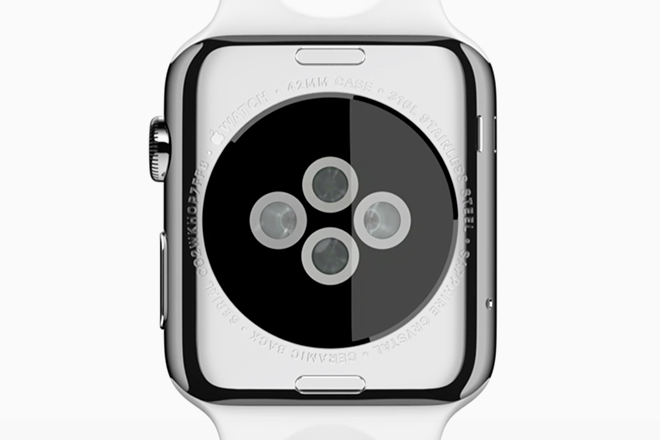
The entry-level iWatch, i.e. the Apple Watch is priced at $350. The device comes with new features, such as a new health and fitness application that will track physical activity. Furthermore the Apple Watch will come in two size form factors, 38mm (height), and 42 mm (height).
(click to enlarge)
Source: Apple
The Apple Watch comes with an accelerometer, gyroscopes, sensors to check heart pules, GPS and Wi-Fi. To use the device, you would need to have an iPhone 5 or above. This gives the iWatch an installed base of 200 million users to work with. Furthermore, the device is set to be launched sometime in early 2015.
The launch will come sometime after the holiday shopping season, which isn't exactly a good thing, but it does give consumers enough time to save money after spending so much during the Christmas holidays. My suspicion is that the sapphire display is what's delaying the shipment of the smartwatch.
The Apple Watch will have NFC capabilities, allowing legacy Apple iPhone 5 and 5S owners to get their hands on Apple's new payment application.
How much will the Apple Watch add to the bottom line?
Based on pricing, the device will start at $350, and will increase from there. The Apple Watch Edition (the one made with 18k gold) will be priced significantly higher, for a very limited market. However, I'm going to work with a $350 figure, just to stay a little conservative, and to stay consistent with the mass market product the Apple Watch is meant to be.
Furthermore, I think that shipment figures will come in at the mid-point of the shipment figures that Apple anticipates (50 million) and what I estimate (42 million). However, for the sake of simplicity I'm going to go with 45 million, between 50 million and 40 million units.
(click to enlarge)
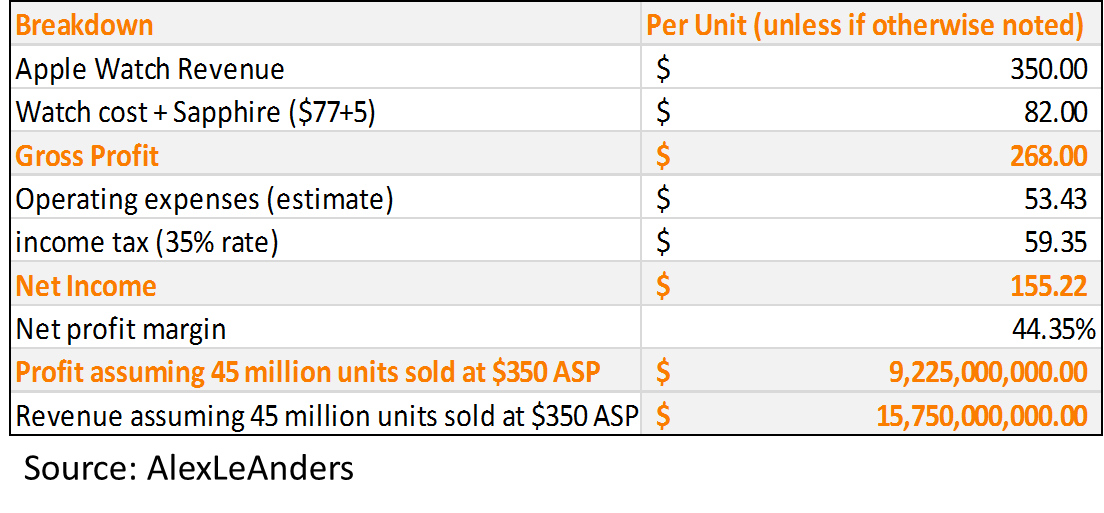
The Apple Watch base cost is $77. However, when including the cost of sapphire, it should cost $82. The base cost came from the Taiwan Topology Institute, whereas the cost of sapphire came from Charles Margolis.
After breaking the figures down, I think the device is an extremely high margin device, as it will leverage the pre-existing R&D and OPEX costs from other business segments. Furthermore, I estimate that after a full-year the new category may contribute $9.225 billion to bottom line, and $15.75 billion to top line results. The added impact from Apple Watch will help Apple beat analyst estimates in its next fiscal year.
Assuming the device is sold in the beginning of 2015, the device will only contribute to sales for 3 out of 4 fiscal quarters. Therefore, I think the device contributes $6.91 billion in net income and $11.81 billion in revenue in fiscal year 2015. I'm highly confident that consumers will line-up for the Apple Watch product launch, and demand will be robust in the early innings of the product adoption cycle. Furthermore, because the device connects directly to the iPhone, the device won't need a separate wireless internet subscription, which diminishes the barrier of entry.
Conclusion
Investors should feel more confident than ever with Apple's product line-up. Beyond the favorable impact a new wearable should have, iPhone shipment growth paired with better margins will drive bottom and top line results. Assuming consumers refresh their iPhone and iPad, and purchase a smartwatch, Apple will report a fairly strong fiscal year. Not to mention, the median income of the average iPhone owner is $85,000, according to comScore Mobile Metrix, therefore, there's further room in a typical Apple owner's budget to afford additional devices, and make upgrades from older devices.
How the China Boom Unravels: One Person at a Time
by Charles Hugh Smith
The dashing of youthful expectations of open-ended wealth and security for everyone with a college degree is highly combustible when combined with a popping real estate bubble and systemic corruption.
Those enamored of China's ability to build empty apartments, empty malls and empty train stations are missing the big story, which is China's boom is unraveling one person and one trade at a time. While the production of new subway systems and empty cities is definitely impressive, those focusing on capital projects are missing the erosion of faith in the China Boom story and the erosion of the foundations of the Boom Story: foreign direct investment, shadow banking, the real estate bubble and a central planning-dominated economy.
Central planning, booms and bubbles unravel in the same way: one person and one transaction at a time. The China Boom Story is falling apart not as a result of large-scale geopolitical crises but from the decisions of individuals.
Every wealthy Chinese who secures a non-Chinese passport and smuggles his/her wealth out of China is weakening the Boom, removing capital and perhaps even expertise and entrepreneurism.
Every individual who buys manufacturing equipment from Alibaba and ships the equipment out of China to a factory elsewhere weakens the workshop of the world story.
Every executive who decides not to invest capital in China, choosing to invest it elsewhere, weakens a critical pillar of the Boom.
Every Chinese household that decides not to gamble the family's entire savings on an overpriced flat is deflating the real estate bubble.
Every young college graduate who can't find a secure white-collar job and thus joins the millions of underemployed "ant people" living on the margins of the glitzy mall/Maseratis facade is living evidence that the Boom can't deliver what was implicitly promised by the Central Planners.

China's Ant People (1 hour video, BBC Four)
China’s "Ant Tribe" Lives In The World’s Most Cramped Apartments
The conventional Western observer's enthusiasm for China's glitzy facade is matched by his abysmal ignorance of China and on-the-ground realities. East-Asian culture is centered around face, i.e. appearances and how they reflect, positively or negatively, on public image. Maintaining and burnishing appearances is more important than the substance, especially if the reality is negative.
This obsession with appearance/show is reflected in the glitzy exteriors of buildings, the jet-black-dyed hair of the ageing leadership, the ginned-up official statistics of perpetual growth, and perhaps most visibly in the typical product assembled in the workshop of the world: it looks great but falls apart long before its time due to low quality of key components. Only one component needs to fail to render the item useless junk that is hauled to the garbage dump.
This is the story few tell because it's not positive and actually requires long experience in China. A culture obsessed with first appearances simply doesn't provide much of a foundation for a long-term commitment to maintenance and built-in quality, the two essential parts of longevity and long-term efficiency.
The headline story is China's amazing rush into building X,Y,Z: today high-speed rail, tomorrow, thousands of wind turbines. What few care to examine is the maintenance requirements of every one of those thousands of wind turbines. Without obsessive attention to the quality of each component and regular maintenance of each turbine, those initially impressive thousands will dwindle to hundreds and then dozens of operable turbines as the years grind away at inferior components and a lack of maintenance takes its toll.
Those seeking a more productive knowledge of China might start with Evan Osnos' latest book, Age of Ambition: Chasing Fortune, Truth, and Faith in the New China. Here are excerpts from an insightful review of the book: Can't Buy Me Love: China's New Rich and Its Crisis of Values:
A growing segment of Chinese society now not only yearns to be well clothed and well fed but also feels a keen desire for truth, meaning, and spiritual fulfillment.Although Osnos does not explore it in depth, his book also suggests a link between many Chinese citizens’ quest for meaning and a set of gnawing worries churning beneath the frothy good times. The search for dignity is no mere embrace of New Age positivity.
It also reflects the fears and frustrations of a society laden with systemic risks: environmental devastation, bursting economic bubbles, the collapse of institutions hollowed out by corruption. Each of those threats has the potential to dramatically alter China’s course in unpredictable ways. The growing awareness among Chinese citizens of their society’s fragility has yet to translate into an overt political sentiment. But if and when that happens, it will come as a rude, and potentially earthshaking, shock to the ruling regime.
Yet for several years in a row now, the average starting salary of a college graduate in China has been less than that of an entry-level factory worker. Of course, after their families have sacrificed and poured their meager resources into the pursuit of an education, most college students find the thought of settling for blue-collar work after graduation inconceivable. In their desperate search for office jobs, graduates from rural towns and small cities congregate in cramped apartments and boarding houses in China’s wealthy coastal cities: “the ant tribe,” the Chinese call them.
Perhaps even more frustrating to China’s young and ambitious is a sense that the golden years of opportunity have already passed them by -- the impression that, in Osnos’ words, China’s boom was “a train with a limited number of seats.”
Increasingly, a young person’s success depends on his or her parents’ connections, and one can find considerable vitriol directed against the so-called second-generation rich (fuerdai) when stories of them crashing Ferraris and enjoying $12,000 dinners circulate online.
The dashing of youthful expectations of open-ended wealth and security for everyone with a college degree is highly combustible when combined with a popping real estate bubble, systemic corruption, the implosion of a shadow banking credit bubble and the impending global recession.
Yes, China's trade deficit with the U.S. just notched a record, but this is more likely to be a high-water mark rather than just another extreme on a trend that will march on unchanged for years or decades to come.
Gold, Stocks and US Dollar Long Cycles, Trend Changes
By: Gary_Tanashian
Several markets seem over-extended and about to reverse their current trends.
S&P 500 Index: It bottomed in March 2009 about 670 and is currently about 2,000. The S&P, thanks to QE, ZIRP, Central Bank purchases, and who knows what other contrivances, has levitated to the magical 2,000 level. Will it go higher?
Dollar Index: The dollar index, currently about 83, is well below its high in 2002 at about 120. However it is also well above its 2008 low around 72. Will capital flows into the US and the fear trade continue to levitate the dollar?
Gold: Gold prices peaked in August 2011 about $1,920 and today gold sells for about $1,260. However, prices have retreated to 2010 levels but are still far above the lows in 2001 at about $255. Is gold ready to rally?
What about cycles?
- I have little faith in short term cycles which can be easily overwhelmed by other forces.
- I prefer longer cycles as I believe they are more reliable.
- I think any cyclic analysis should be confirmed with additional technical and fundamental analysis.
S&P 500 Index: Consider the following graph of monthly prices for 30 years. The blue vertical lines are drawn every 81 months - about 7 years. Note the highs in 1987, 1994, 2000, 2007, and 2014, and note the current "over-bought" condition of the S&P as indicated by the MACD and TDI indicators. This graph does not conclusively inform us that the S&P is ready to correct, but it does indicate that the S&P could be forming a 7 year cyclic top with a low due perhaps in 2016 - 2019.

Dollar Index: Consider the following graph of monthly prices over nearly 30 years and the vertical blue lines every 75 months. Note the alternating high - low pattern with a high in 1989, low in 1995, high in 2002, low in 2008, and possible high in 2014. The dollar index might move higher and take longer but it could be topping now. The monthly TDI is modestly over-bought and the weekly (not shown) is strongly over-bought. The dollar index could be peaking.

Gold: The gold chart shows 20 years of prices with blue vertical lines every 56 months. Note the lows in 1999, 2004, 2008, and 2013. Gold appears to have made a long term low in 2013 - 2014 and has built a base from which another rally should appear. The MACD and TDI indicators are oversold and indicate strong rally potential. Further, my long-term empirical gold model indicates that current gold prices are too low by about 20%, which will provide a "tail-wind" for gold prices over the next several years, independent of massive QE, more wars, dollar weakness, and economic slumps that create even more unpayable debt.

Given the troublesome economic conditions in the world and potential expansion of war in the Ukraine, Iraq, Syria, North Africa, and elsewhere, there is considerable risk that the S&P could fall substantially and a strong probability that gold will rally. Furthermore, there is a growing global movement away from the use of the dollar in global trade, led by China and Russia, and that bodes poorly for long-term dollar strength, particularly as cycles indicate a potential top due in 2014. A fall in the dollar would likely be accompanied by a rise in gold prices.
Markets can move farther and take longer than most people expect, but it is certainly time to consider that the S&P is quite high and ready to reverse its five plus year uptrend, and that gold is too low and set to reverse its three year downtrend.
Ebola Outbreak Doubles In 3 Weeks, WHO Warns "Conventional Means Of Control Not Working"
by Tyler Durden
The Ebola outbreak in West Africa has now killed 2,288 people (with 4,269 cases) according to the World Health Organization, but is accelerating dramatically. In a rather stunning admission, WHO warns, conventional means of controlling the outbreak are not working as the last 3 weeks have seen the number of cases and deaths double.
The Ebola outbreak in West Africa has killed 2,288 people, with half of them dying in the last three weeks, the World Health Organization (WHO) says.
It said that 47% of the deaths and 49% of the total 4,269 cases had come in the 21 days leading up to 6 September.
The health agency warned that thousands more cases could occur in Liberia, which has had the most fatalities.
...
In Nigeria, eight people have died out of 21 cases, while one case of Ebola has been confirmed in Senegal, the WHO said in its latest update.
On Monday, the agency called on organisations combating the outbreak in Liberia to scale up efforts to control the outbreak "three-to-four fold".
...
However, the WHO says conventional means of controlling the outbreak, which include avoiding close physical contact with those infected and wearing personal protective equipment, were not working well in Liberia.
Where it is...

Where it will be...

As the case and death count accelerates...

