Friday, April 4, 2014

The Energy “Crisis Curve” is Accelerating in a Dangerous Part of the World

By: Money_Morning

Dr. Kent Moors writes: Sitting in a new land of plenty, Americans rarely notice disturbing energy trends elsewhere in the world.

But in the course of my global work, it’s impossible not to recognize there are serious energy shortages developing in other parts of the world.

In fact, I’m beginning to see worrisome indications this “crisis curve” is now accelerating.

Oddly enough, the latest danger signals are coming in from parts of the world normally thought of as net energy producers: The Middle East, North Africa and Central Asia.

Now, there are new concerns that this brewing energy crisis may well be the next serious step in an ongoing “Arab Spring.”

And while countries like Saudi Arabia, Kuwait, and the United Arab Emirates have largely been untouched by this sweeping regional political unrest, elsewhere matters are getting worse.

Suddenly, energy has become a bigger trigger point in a highly volatile part of the world…

A Fast Growing Electricity Crisis

Over the past week, new warnings have emerged in Egypt, Yemen, and Pakistan that the situation is deteriorating.

In Egypt and Yemen, the crisis is a direct result of political strife. Both countries are facing a massive collapse in electricity availability because of the unrest.

Egyptian energy officials are now publically stating the country could face a grid shutdown in the next few months, an effect of a systemic breakdown in both the generation and distribution components. In fact, even as Cairo seriously looks at massive imports of coal to arrest a fuel supply shortage, there are increasing questions about the ability of the infrastructure to even support it.

Meanwhile, in Yemen, the problem is a direct result of opposition attacks on the electricity generation facilities themselves.

As for Pakistan, they have been in dire straits for some time, as we have discussed here previously. The country has suffered through increasingly frequent blackouts and the inability to provide industries regular power for more than a few hours each day.

That has a direct, and very negative effect, on production, employment and overall economic conditions.

The Pakistani government in Islamabad had put their hopes on a combination of natural gas imports – pipelines from Iran and Turkmenistan, along with liquefied natural gas (LNG) coming to proposed new onshore and offshore terminals.

But the LNG possibilities are facing significant investment difficulties along with a time delay for implementation that the country may not be able to weather. Then there is the added uncertainty of sourcing a regular supply of gas as the feeder stock for the LNG.

Recently, there have been some indications it may come from Iraq, where the rise in oil production has resulted in a surfeit of associated gas that needs to find a market. Separate production in the autonomous region of Kurdistan in the Iraqi north is another possibility.

Both, however, require their own pipeline systems – almost certainly running through Turkey – to move out the gas. What’s more, there is also the question of where the LNG would be liquefied for the tanker traffic to any receiving terminal the Pakistanis come up with.

The primary conventional natural gas pipelines also have significant roadblocks and have experienced inordinate delays. The Iranian venture is now dead until such time as Western sanctions against Tehran are eased.

The Turkmen venture is supported by Washington. Yet it is also dependent on the participation of an avowed enemy.

India.

In this case, the proposed pipeline would cross both Pakistan and Afghanistan. Yet the demand in both of these markets together is too small to justify the project. So the pipeline won’t be built unless it can reach just inside the border of India. This is the reason why the pipeline is known as the TAPI (Turkmenistan-Afghanistan-Pakistan-India). No India, no TAPI.

Gaming the Energy Chessboard

Of course, India has a huge energy shortage crisis of its own, one that has already cut into its economic performance and threatens to have a multiplier effect throughout the country. And while it has numerous domestic drilling efforts in the planning stages, including some huge proposed projects offshore in the Bay of Bengal, these will not be nearly enough.

The Indian economy has been hit hard on the energy front from two directions.

The first has been the sanctions against Iran. Aside from China, India has been the largest market for Iranian crude. In fact, Indian refineries are largely designed to operate on Iranian grade oil.

But the collapse in international currency exchange to pay for the imports (a direct result of the global banking sanctions) added to the rising price and made matters very difficult for New Delhi.

The second factor is perhaps the most obvious. India’s population has for some time exceeded the country’s ability to support it with any system of reliable energy. That population continues to grow.

As a result, India has been negotiating with Pakistan for pass through access to the Turkmen gas. That would allow both nations access to essential energy, while Pakistan would also receive revenue from transit fees on the gas going over the border.

Nonetheless, negotiations have been excruciatingly slow. The process has hardly been helped by radical groups in both countries who are set against any cooperation at all.

Then there is the problem that TAPI has to move through areas controlled by radical groups in both Afghanistan and Pakistan. Neither central government can provide security in these regions nor has anybody come up with a genuine idea of who could provide the necessary protection.

So once again, energy becomes the chessboard upon which geopolitics is played out.

But you should note this very carefully: Energy prices are determined by the worldwide play of supply and demand. That means energy problems abroad will come back to effect even the most oil and gas endowed of nations

Like us

See the original article >>

Rail Traffic Bouncing Back Strongly

By Cullen Roche

There was a good deal of skepticism earlier in the year about the impact of weather and a slow start to the economy in 2014, but if rail traffic is any guide then we’re starting to see a significant bounce back.  Intermodal traffic just reached its highest weekly reading in 5 months and has recorded its strongest three consecutive weeks since 2010.

Here’s more via AAR:

“U.S. rail traffic rebounded strongly in March 2014 following a sub-par February. Grain led the way, as railroads are working hard to move the biggest grain harvest in history,” said AAR Senior Vice President John T. Gray. “In addition, coal carloads rose in March, something that’s happened just one other time in the past two years. March also demonstrated that we have every reason to be optimistic that 2014 will break 2013’s intermodal volume record.”

AAR today also reported increased rail traffic for the week ending March 29, 2014. U.S. railroads originated 301,317 carloads last week, up 7.2 percent compared with the same week last year, while intermodal volume for the week totaled 265,188 units, up 13.5 percent compared with the same week last year. Total U.S. rail traffic for the week was 566,505 carloads and intermodal units, up 10 percent compared with the same week last year.

See the original article >>

No Earnings, Big Problems

by Bespoke

Both the Dow and the S&P 500 held up well today, falling slightly but not suffering any kind of major setback.  But not all was well in the market by any stretch, as we saw a lot of the "high-fliers" take nosedives once again. 

Companies can have the best long-term growth prospects in the world right now, but if they don't already have earnings, they're getting taken to the woodshed.  A month ago, investors were paying sky-high premiums for companies that make no money now but have huge growth prospects, but those premiums are falling fast. 

In the Russell 1,000, there are 85 stocks in the index with negative trailing 12-month P/E ratios (negative earnings).  Those 85 stocks were down an average of 1.78% today, and they're down an average of 3.9% over the last month.  The other 932 stocks in the Russell 1,000 were down just 20 bps today on average, and they're up an average of 2% over the last month.

Below is a look at the biggest losers in the Russell 1,000 today.  There were 36 stocks in the index that fell more than 3.5%, which is a high number for a flat day in the market.  As you can see, the large majority of the biggest losers today were stocks with negative or sky-high P/E ratios.  And most of them were stocks that have also taken huge hits over the last month as well.  Stocks like FireEye (FEYE), ServiceNow (NOW), Workday (WDAY), Palo Alto Networks (PANW), Tableau Software (DATA), Splunk (SPLK), Under Armour (UA), Facebook (FB), SolarCity (SCTY) and Pandora (P) are all names that have sky-high valuations and sky-high expectations, but they all got slaughtered today.  These kind of stocks were market darlings in 2013 and early 2014, but the tide has shifted quickly since the beginning of March.  Investors clearly want to own companies with strong fundamentals right now, and they're exiting the "high-fliers" that they were willing to own just a few weeks ago at a remarkable rate. 

What has really been amazing is that all of these huge declines have come during the earnings off season, and most of the companies that have taken hits did very well following their last earnings reports.  The first quarter earnings season is coming soon (next week), so all these companies that have taken big hits lately will have a chance to prove investors wrong.  Some will do so, and some won't.

See the original article >>

The Meaning of Weak February Imports: US Economy Not Decoupling, Not Accelerating

by Jeffrey P. Snider

The word decoupling has made a comeback in recent months. In 2008, it was believed that the world would be able to withstand a slowdown in US growth, as global markets would “decouple” from the primacy of US consumers. In some ill-conceived instances, it was even argued that financial markets would as well. Of course, we know that the interconnected nature of global finance (through eurodollars mostly) rendered such thoughts nothing more than flights of fancy, but the cursory attractiveness of this idea has persisted in real trade terms.

The current incarnation seeks to solve the “mystery” as to why the US seems relatively robust in the face of obvious slowdowns elsewhere – most notably and dangerously with China. In a bit of a reversal, the US is thought decoupled and isolated from emerging markets turmoil (which includes both economy and finance). Even in a very basic sense of global trade and the supply chain, that could only be the case if there was a durable and evident internal change within the US. In other words, that would mean a total reversal of offshoring.

There is a much easier explanation for this sort of “mystery”, namely that the original premise if flawed beyond repair. Looking at actual data (as opposed to sentiment surveys and other corruptions) you see quite clearly that the US is in no way different than the rest of the world. In fact, trade data, including today’s release, makes plain how the US fits within the wide reversal of the global supply chain, and thus global trade.

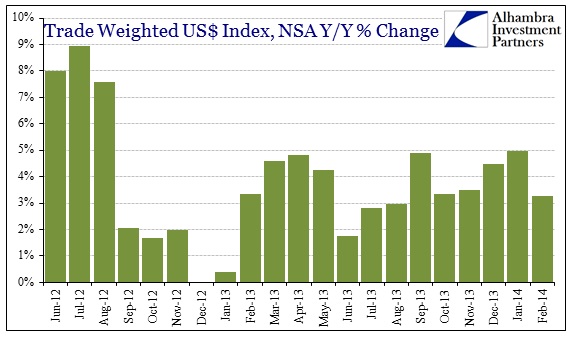
I don’t usually refer to the US dollar indices of various types because I don’t consider them all that helpful. The US dollar “price” is driven far more by finance than trade, but I refer here to the trade weighted dollar index to eliminate any currency factor from the discussion. A “stronger” dollar is believed to be, in the simplest of orthodox terms, favorable toward imports, i.e., US consumers can purchase more imported goods per dollar.

ABOOK Apr 2014 US Imports USD Index

According this index, the US dollar has continued to rise in relatively steady fashion, meaning currency terms should be favorable toward imports.

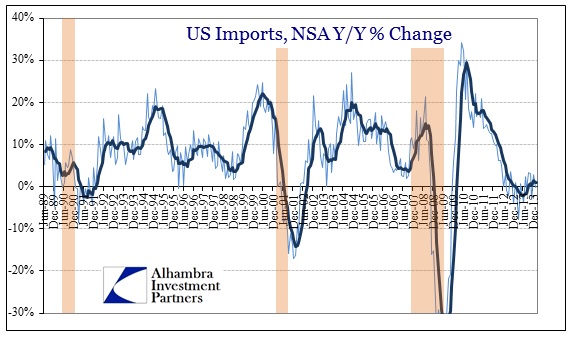
ABOOK Apr 2014 US Imports

Looking at the actual data, we see that US demand for imports is at levels far more consistent with recession than anything else. While I have eliminated the US dollar as a potential culprit, there is the fracking boom in energy to consider. US imports historically have been driven by petroleum, so an increase in domestic energy production may well be the source of diminished pace of importation.

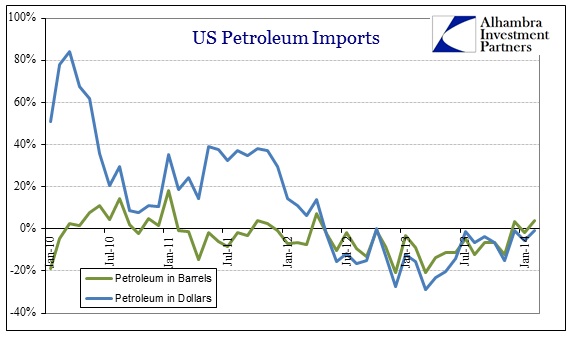
ABOOK Apr 2014 US Imports Petrol Recent

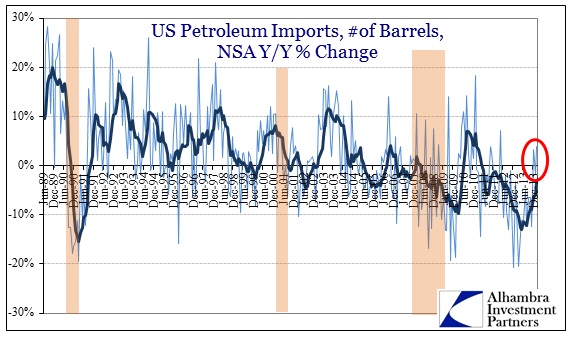
And that has been the case for much of the past two years. US imports of oil have fallen considerably. However, in two of the past three months US imports of oil have gained Y/Y – something that has not occurred since the end of 2011. So while the fracking and shale processes have dampened enthusiasm for foreign energy, we are beginning to see signs of an end to that marginally.

ABOOK Apr 2014 US Imports Petrol Longer

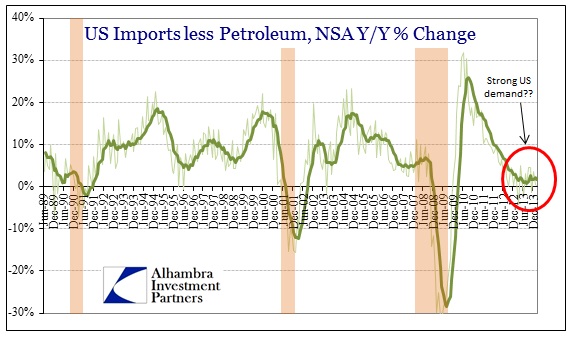
If we eliminate petroleum from the import figures, the pace of US demand for foreign goods still looks recessionary.

ABOOK Apr 2014 US Imports less Petrol

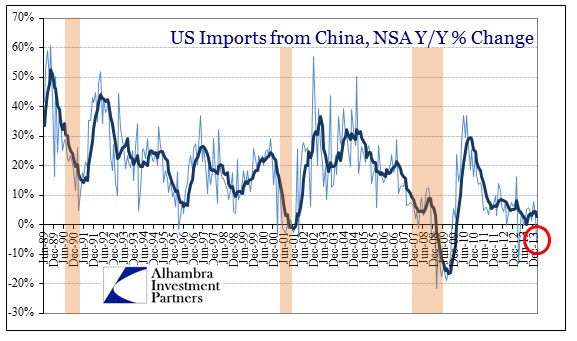
With those factors in mind, US trade in terms of the supply chain – US consumers buy products from manufacturers in Asia, who in turn buy resources from Brazil, Australia and elsewhere – shows exactly what you would expect given recent turmoil in exactly those places. American end market demand for the next level’s (namely Asia) produce is clearly a cause for contraction and instability further down the line.

ABOOK Apr 2014 US Imports China

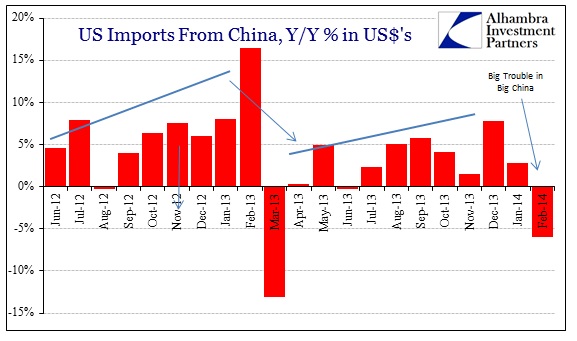
First, and maybe most importantly, is China. The initial trade data on the Chinese side indicated a February collapse in exports to the US. That was pretty much confirmed by the Census Bureau estimates in dollar terms.

ABOOK Apr 2014 US Imports China Recent

Given this data, we don’t have to wonder why the process of defaults has begun in the weaker Chinese firms. Without “unlimited” credit growth, there is no way businesses at the margins can continue to survive under these lackluster trade conditions. An export economy cannot long continue toward trend growth without similar and concurrent growth in its end markets (or else it will have to find other sources of growth, such as property bubbles).

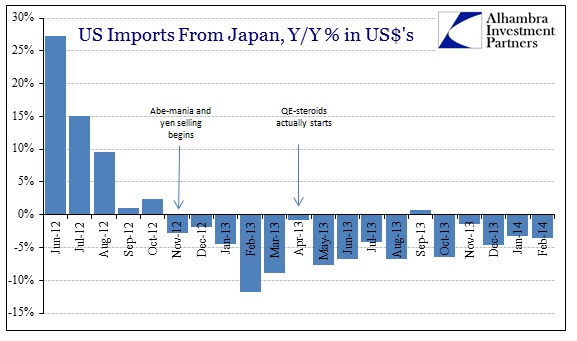
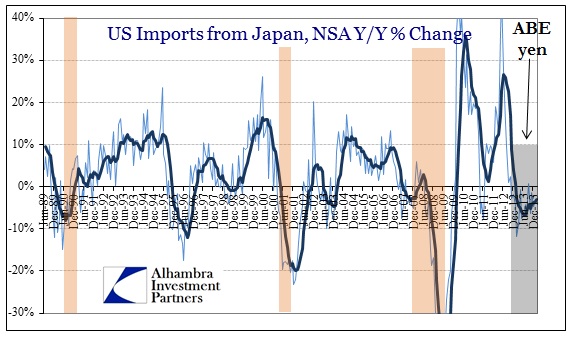
That also applies to Japan. In what can only be classified as a direct rebuke of Abenomics, Japan’s second largest export market refuses to “realize” and take advantage of the weaker yen. Again, a stronger US dollar against the yen is supposed to (according to orthodox theory) make Japanese goods far cheaper and more competitive in US terms. So it was simply expected that US imports of Japanese goods would surge.

ABOOK Apr 2014 US Imports Japan RecentABOOK Apr 2014 US Imports Japan

Perhaps the entire economics profession needs to rethink the idea of ceteris paribus when constructing its theories and models.

This data simply confirms all sides of the global trade contraction. There is no growing US demand for imported goods despite every orthodox measure to make it so. Further, that lack of US demand is eroding the supply chain as it wraps in various manners around the globe. There is no decoupling because there is no American economic acceleration.

See the original article >>

The Economic Catastrophe That Is Abenomics Sends Japanese Gas Prices To Five Year Highs

by Tyler Durden

While we have heard all the usual excuses that "Japan had no other choices" and that Abe simply had to slay the "deflation ogre" (it is still unclear why deflation is bad for the common man, if quite clear why it is disastrous for massively insolvent and overlevered banks) the simple truth is that it was clear from the very beginning that Abenomics would be an abysmal failure. Ironically, in recent months the cheerleaders of Japan's last ditch effort to delay the inevitable have gotten a second wind: "look at all the inflation" they say, and point to it as evidence that Abenomics is indeed working. There is a problem - it is inflation of all the wrong "non-core" items.

That inflation, it was also clear from the beginning, would surge. Read our take on just this from September:

... even the most absurdly clueless economist is silent this morning in their praise of Abenomics, which supposedly has succeeded in its one goal - bringing sexy inflation back. Why? Perhaps the reason is that whereas Keynesian inflation in which prices and wages are broadly if modestly rising as a result of a properly functioning monetary system, is indeed just what the Doctor of modern economics ordered, soaring input costs driven by FX differentials and current account flows, "offset" by plunging wages is precisely the opposite of what Abenomics was supposed to be. Which is exactly what is going on in Japan.

In other words, all that Abenomics' cratering of the Yen has succeeded in doing is causing gas and energy prices, and to a lesser extent food, to surge, just as we warned would happen in February. And of course, to make a few US-based hedge funds investing in the Nikkei that much richer.

In other words, all Japan managed to do is import the bad "non-core" inflation, which has sent food and energy prices through the rood (confused why the rest of the world is suffering from an episode of acute deflation? look no further than deflation-exporting Japan) and made "non-core" purchases like food and gas increasingly more unaffordable to the ordinary Japanese consumer.

Today it just went from bad to worse, because as Nikkei reports, gasoline prices at the pump surged to a 5-year high in Japan this week, due to tax increases.  The Oil Information Center says the average retail price was 164.1 yen, or about 1.6 dollars, per liter, as of April 1st. That's an increase of about 4.9 cents from the previous week.

More from Nikkei:

The average price rose for the 4th straight week, and hit the highest since October 2008.

Japan raised the consumption tax rate from 5 to 8 percent on April 1st. The country also increased the anti-global warming tax on fossil fuel by 0.2 cents per liter.

Officials at the center say gasoline sales will be weak for a while after a rush in demand before the tax hikes. They say prices will level off or rise slightly next week as the weak yen is pushing up costs of imported crude oil.

Actually gasoline sales, and all other sales will be weak for a long, long time. Why? The one reason all the above-mentioned cheerleaders of Abenomics fall strangely silent when it comes to the one all important, beneficial inflation that by now should have arrived. That of wages.

Unfortunately for Japan and those same clueless economist cheerleaders, as we reported on Tuesday, in February Japan announced that not only has there not been any base wage inflation, but wages have now declined for a Lehman-crisis like 21 consecutive months.

So what next?

Well, more pain until the locals get so sick of Abenomics, that Abe meets yet another prematue, Diarrhea-coated exit. Because while the Japanese stock market, which is still down materially YTD and hence instead of providing a "wealth effect" is merely adding to the "misery effect", may provide some temporary solace to those - about 20% or so - who are invested, everyone else is looking at even faster wealth destruction as the value of the Yen continues to slide, as "non-core" products like food and energy continues to rise to multi-year highs, and as wages continue to slide.

This is what we said last time to summarize the dead end Japan is about to crash into head first:

So let's see here: a consumption crippling sales tax increase, soaring input prices which are cratering corporate profit margins just as Abe is really begging firms to hike wages, sliding confidence (which in Japan usually is a leading indicator to government change) as consumers can no longer even afford gasoline, and oh, we almost forget, core deflation. But, hey, look over there, just like in Caracas, the Nikkei is exploding.

All the same is true now. Only this time it's even worse.

See the original article >>

Unearthing The World's Gold Supply

Follow Us