Wednesday, March 26, 2014

More rains needed to resolve Aussie grain fears

by Agrimoney.com

Drought fears for Australian grain production are lingering despite the return of rains to dry eastern areas, with far more needed to resolve a precipitation deficit which on some farms is amongst the biggest on record.

Northern areas of New South Wales and central Queensland, where drought concerns have been focused, have received widespread rainfall of 25mm-75mm this week, with some farms receiving 150mm, equivalent to about inches.

However, while the rains, which came ahead of the autumn sowing window, "have injected at least some confidence that we might get a winter crop planted" in the region, "we are still a long way from filling in water deficits", grains broker Pentag Nidera said.

Furthermore, the rain might have actually made a short-term squeeze on grain supplies worse by causing yield and quality "issues" for standing sorghum crops.

'Soothed rather than healed'

National Australia Bank said that recent rains had "helped ease the extreme rainfall deficiencies" in parts of Queensland, where rain on many farms had in the 17 months to the end of February been amongst the lowest 10% on record.

"That said, the recent scattered rain events have merely soothed the wound rather than healed it," NAB agribusiness economist Vyanne Lai said.

"Much more rain is needed for any major turnaround in conditions.

"Soil moisture in the upper layer soil of eastern Australia has improved from recent rainfalls to some extent, but remains very much below average for the current drought-affected north eastern New South Wales and south eastern Queensland."

Rainfall outlook

The comments follow a forecast from the Australian Bureau of Meteorology on Tuesday which, in raising the likelihood of an El Nino weather pattern developing by winter, cautioned over the potential for below-average rainfall in eastern Australia this year.

El Ninos are linked to dryness in eastern Australia, as well as in parts of South East Asia, India and West Africa.

Indeed, there is a 60-65% chance of below-average rainfall for much of the grain belt between northern New South Wales and central Queensland, the bureau said.

This contrasts with a 60-70% chance of better-than-average rains in Western Australia, the top grain producing state, in the April-to-June period, the major sowing window.

Market impact

On the Sydney grain markets, east coast wheat futures for January 2015 delivery, having dropped 2.5% to Aus$313.00 a tonne on Monday because of the rainfalls, have recovered most of these losses, closing on Wednesday at Aus$318.50 a tonne.

On the Queensland cash market, the impact has been to lower prices by some Aus$5 a tonne from levels which in Brisbane had reached Aus$330 a tonne for APW (Australian premium white wheat).

"Whatever the case, historically these prices represent very strong physical levels this far ahead of sowing," Pentag Nidera said.

See the original article >>

Russia Raises Gold Holdings By Over 7 Tonnes In February To Over 1,040 Tonnes

By Mark O’Byrne

Today’s AM fix was USD 1,314.50, EUR 952.74 and GBP 794.98 per ounce.
Yesterday’s AM fix was USD 1,314.75, EUR 951.82 and GBP 796.87 per ounce.   

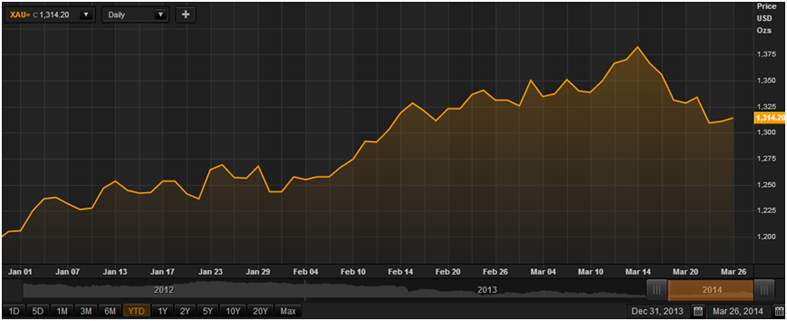
Gold climbed $2.30 or 0.18% yesterday to $1,311.80/oz. Silver rose $0.02 or 0.1% at $20.00/oz.


Gold in U.S. Dollars, YTD 2014 - (Thomson Reuters)

Gold traded above a five week low today as investors weighed the crisis over Ukraine. Gold reached a six-month high on March 17th near $1,400/oz as brinkmanship and tensions between Russia and the West intensified and the worst geo-political crisis since the Cold War escalated.

Yesterday U.S. President Barack Obama warned Russian President Vladimir Putin that Russia would face more sanctions if it moved further into eastern Ukraine after its annexation of Crimea. Worryingly for residents of New York and for financial markets, Obama also warned that he was more worried about the risk of a nuclear bomb going off in Manhattan then he was about Russia. 

Geopolitical risk in the form of terrorism, financial and economic war and actual war remains high and should support gold.


President Putin Holds A Gold Bar

Russia has increased its gold holdings by 7.247 tonnes to 1,042 tonnes in February. Turkey and Kazakhstan also raised their bullion reserves, data from the International Monetary Fund showed today.
Turkey's gold holdings rose 9.292 tonnes to 497.869 tonnes, the data showed.

Many analysts are ignoring the important context of today's new geopolitical backdrop. Russia alone has some $400 billion in foreign exchange reserves - mostly in U.S. dollars. If they were to diversify just 5%, worth some $20 billion, of those reserves into gold - it would be equal to nearly 500 tonnes of gold or nearly 25% of global annual production.


Demand By Country (GFMS via Thomson Reuters)

Russia bought another 7.247 tonnes of gold in February. It will be interesting to see what Russian demand is in March and indeed in the coming months. Sanctions could lead to materially higher demand from the Russian central bank, Bank Rossii.

This would cause a material strain on the already fragile supply demand dynamics of the physical gold market. The possibility of a default on the COMEX gold exchange would become more likely, with a consequent surge in the cost of gold coins and bars and a difficulty of securing physical gold either in
allocated gold accounts or for delivery.

Hong Kong's net gold exports to China jumped 25% in February after a small drop in the previous month, data showed overnight.

Net gold exports to China from Hong Kong rose to 112.31 tonnes from 89.75 tonnes in January. Total gold exports rose to 125 tonnes in February from 102.64 tonnes in the previous month.

China imported about 1,158.16 tonnes from Hong Kong alone in 2013, more than double its 557.48 tonnes in 2012, according to data from the Hong Kong government.

China, the world's biggest gold buyer, does not publish trade data for gold and there is the possibility that demand was even higher.Official sector demand from the People’s Bank of China is not declared and is not reflected in these figures. Nor are direct imports into other cities such as Shanghai from gold producing nations and countries that have seen rising gold exports in recent months such as the UK and Switzerland.

This has been due to large London good delivery bars (400 oz) being shipped to Switzerland from bullion banks in London to be refined and cast into smaller kilo bars for the Chinese and Asian market.

The numbers from Hong Kong, a main conduit for gold into China, give an indication of Chinese demand for gold but should not be relied on solely as there is clandestine importation of gold into China in recent months and years.

The People's Bank of China is widely believed to have engineered a sudden and sharp fall in the yuan in recent weeks to punish speculators who have seen the currency as a one way appreciation bet. The yuan gained some 30% since 2005. Thus, Chinese retail buyers have pulled back and demand has fallen in the short term.

However, it is important to realise that there is more to Chinese demand than the so called “Chinese aunties”. Ignore noise regarding fluctuations in short term demand for gold and focus on the big picture quarterly and annual Chinese gold demand data which we believe will continue to be very positive.

This is especially the case given the increasing risks emanating from the Chinese shadow banking system, the Chinese property market and indeed the Chinese banking system with localised bank runs being seen in recent days.

See the original article >>

World awash with raw Sugar, El Nino threat in Brazil keeps bulls in charge

by CommodityOnline

positive trends continue in ICE Raw Sugar futures for May delivery which is up 1.18% at US$ 0.171 a pound on possible El Nino impacting sugar production in Brazil later this year.But markets have calmed down after ral..

NEW YORK (Commodity Online): The world is awash with sugar as Brazil sugar is being offered at deep discounts for export and new harvest a few weeks away.

However, positive trends continue in ICE Raw Sugar futures for May delivery which is up 1.18% at US$ 0.171 a pound on possible El Nino impacting sugar production in Brazil later this year.But markets have calmed down after rallying to a four-month high of $0.1846 a pound.

In the short run, however, raw sugar is being offered at 10 points below ICE futures which suggests abundant stocks worldwide, a Reuters report quoting trade sources said.

Cane crush in Thailand, the world's second largest exporter,is also expeced to reach an all time high in 2013-14 season. Meanwhile, markets concerned over El Nino phenomenon appearing this year have pushed up prices of raw sugar at ICE. in the past month.

Climate models show Pacific Ocean surface temperatures are rising with an increasing probability of turning into El Nino for the first time since 2009.

Meanwhile, U.S. sugar futures for May delivery declined 0.36% to trade at $0.1678 a pound. The May sugar contract eased up 0.06% to settle at $0.1684 a pound on Monday.

Standarad Chartered Plc is bullish on March 2015 ICE futures as global supplies may fall on El Nino phenomenon. Dry weather in Brazil's Center south threatens to reduce this year's crop that begins harvest next month. Temperatures in Sao Paulo state reached the highest in 10 years in January and February, Stan Chart said.

According to UNICA, Brazilian mills have produced 34.27 mn tn of sugar from the start of the cane season on April 1, higher by 0.58% last year. Sugar output in Brazil's main cane region in December stood at 1.13 mn tn. The ISO has estimated sugar surplus to fall to 4.5 mn tn in 2013/14 as against 10.3 mn tn last year.

On daily charts, US sugar futures is indicating strong buy as RSI of 64.73 is bullish while StochRSI at 88 indicates overbought positions.

India Sugar
Meanwhile, Sugar futures for April delivery at India's National Commodity and Derivatives Exchange (NCDEX) rose 1.32% to Rs 3074 per 100 kg.According to the latest estimates by ISMA, production is estimated 23.8 mn tn for 2013-14 season A good monsoon last season led to higher output for fourth consecutive year in row in 2013-14.

ISMA has estimated that the opening balance as on October 1, 2013 (for the new season 2013-14), at around 88 lakh tonne, which is about 20 lakh tonne more than the normal opening balance.

In 2012/13, mills could export only a small amount of sugar due to lower global prices. It could export as much as 3-3.5 million tons of sugar in the season beginning October to get rid of excess supply.

See the original article >>

Is Coal about to heat up and breakout?

by Chris Kimble

CLICK ON CHART TO ENLARGE

Coal has not been too hot of late, nor hot over the past few years. Coal ETF KOL has lost nearly two-thirds of its value and momentum is oversold and could be creating  a higher low, while KOL "may" have created a double bottom...nothing proven yet!

Should KOL breakout, it would be an initial positive for this hard hit asset. Two plays to watch in the Coal industry are Arch Coal  (ACI) and Cliff Natural Resources (CLF).

If one believes in the ole concept of "Buy Low and Sell Higher" in my humble opinion, this hard hit asset is worth watching closely right now!

See the original article >>

Why you should care about the yield curve

By Mark Hulbert

Opinion: Inverted yield curve can signal a recession — is it likely?

CHAPEL HILL, N.C. (MarketWatch) — There are — as always — plenty of things to worry about. But a flattening yield curve is probably not one of them — at least not yet.

The yield curve refers to the difference between short-term and long-term interest rates. Normally, of course, shorter-term rates are lower than the longer-term ones — such that a graph plotting interest rates as a function of maturity distinctly rises as maturity lengthens.

But, now and then, the difference begins to narrow, or flatten — and, eventually if this process continues, short-term rates will rise above long-term rates, at which point the yield curve is said to be “inverted.”

Many economists pay very close attention to this flattening process because an inverted yield curve is one of the more reliable leading indicators of an economic recession. Which is why recent headlines have gotten a lot of investors worried: Given changes on the interest rate front over the last couple of weeks, the yield curve is now the flattest it’s been since 2009.

But a five-year perspective on the current yield curve tells us next to nothing. The economy was emerging from a recession in 2009, after all, not about to slip into one. And today’s yield curve is no where near as bad as it was in 2007, before the Great Recession.

Take a look at the accompanying chart, courtesy of the New York Federal Reserve, which takes a far longer term perspective on where the yield curve is now. Because the chart focuses on average monthly levels of the yield curve, it will be another week before it’s updated with March’s data. But the current yield curve is only marginally flatter than it was at the end of February.

And it’s no where near as low as it was in 2007, right before the last recession.

Duplex loft in TriBeCa: $6.75 million

A new $6.75 million TriBeCa listing is perfect for photography lovers: the two-bedroom duplex has plenty of space to showcase the owner’s photography collection, and it's currently set up with a darkroom.

How likely is a recession to occur in coming months, given where the yield curve currently stands? Consider one famous econometric model based on the slope of the yield curve that was introduced more than a decade ago by Arturo Estrella, currently an economics professor at Rensselaer Polytechnic and, from 1996 through 2008, senior vice president of the New York Federal Reserve Bank’s Research and Statistics Group, and Frederic Mishkin, a Columbia University professor who was a member of the Federal Reserve’s Board of Governors from 2006 to 2008.

Based on February’s data, the model gauged the probability of a recession in the next 12 months at just 1.33%. Though we don’t yet know what the precise outcome of the model will be at the end of March, I can confidently predict that it will not be appreciably different.

One comeback might be that Treasury rates are not an accurate reflection of the real yield curve, on the grounds that it is being skewed by the Fed’s monetary stimulus policies. But the same conclusion would be reached if we focused on corporate yield curve, over which the Fed has little direct control.

Bank stocks

Though a flattening yield curve doesn’t therefore appear to be that worrisome from a macroeconomic point of view, it will undoubtedly have a bigger impact on certain industries.

Financials is one such sector, according to Doug Kass, the hedge-fund manager who is president of Seabreeze Partners. He believes that the flattening yield curve “portends disappointing net interest income (and [bank] margins) through the remainder of 2014.”

Why pay attention to Kass? After all, the financials sector has been leading the market higher in recent weeks, despite the flattening yield curve. According to FactSet, the financials sector is by far the best-performing sector for the month to date, up 3.3%, versus an average of 0.4% for the other seven major S&P 500 /quotes/zigman/3870025/realtime SPX +0.44%  sectors.

In other words, the overall market’s strength in this month of higher rates traces almost exclusively to the financials sector alone.

But in an email Tuesday morning, Kass pointed out that he has a long history as a banking industry analyst — including, he said, being “voted the No. 1 buy-side banking/thrift industry analyst by Institutional Investor.” And, he insists, the slope of the yield curve “is the most important... contributor” to banks’ profits.

So, even though he continues to have positions in a couple of bank stocks — Citigroup /quotes/zigman/5065548/delayed/quotes/nls/c C +0.08%   and Northwest Bancshares /quotes/zigman/115804/delayed/quotes/nls/nwbi NWBI +0.14% — he says that he would “consider paring down [banking industry] exposure” because of the flattening yield curve.

See the original article >>

El Niño Threatens Australian Crops

By Isabella Steger

    Bloomberg Combines harvest a field of barley at a farm in Australia.

    Meteorologists from Australia say the chances are increasing that the volatile El Niño weather pattern will return this year, adding to already difficult growing conditions globally that have sparked a rally in agricultural commodities from coffee to palm oil.

    Australia’s Bureau of Meteorology said Wednesday that it forecasts drier-than-normal weather for parts of the north and east of the country, and wetter-than-normal weather for the southwest, potentially causing problems for the production of crops such as sugar cane and cotton.

    El Niño is the abnormal warming of the Pacific Ocean that causes droughts in some areas and flooding in others, and happens every three to five years. El Niño last hit in 2009 and typically affects India especially hard because the country is reliant on seasonal monsoon rains for rice and sugar-cane crops.

    The return of El Niño this year also would add to a strong rally in agricultural commodities prices because of existing droughts in large commodity-growing regions such as Brazil, California and Southeast Asia. Already, dry weather in the U.S., Eastern Europe, Australia and southern Ukraine is a worry and could impact wheat prices this year if there is damage to the crop, said Australian investment bank Macquarie. Wheat futures have risen in recent days because of dry weather in the U.S. southern plains region and persistent cold in the Midwest.

    “Australia has seen dry conditions build in both the eastern and western portions of the country. Today this isn’t a specific threat to production, but given the country’s generally low moisture profile, dry conditions now could encourage the Australian farmer to reduce planting area,” said Macquarie.

    Luke Mathews, commodities analyst at Commonwealth Bank of Australia, said the drier weather in Australia would raise “question marks around sugar cane production,” and “northern irrigation primarily for crops such as cotton.” Sorghum and barley could also be affected, but Australia can still expect a “sizeable national wheat crop” in 2014 as there should be no impact from El Nino on grain production in the south and west of the country.

    While there currently is a global glut of sugar, traders are watching to see whether sugar production could be adversely affected later this year, for example if El Niño brings wetter-than-normal rainfall to Brazil, the world’s largest sugar cane grower.

    If El Niño comes early to India, the world’s second-largest sugar cane producer, it could be a “real disaster [if it] causes the monsoon…to fail,” said broker Marex Spectron. “That happened in 2009 when Indian sugar production fell from 26 million tons the year before to 15 million tons.”

    While Indian meteorologists have said that El Niño is likely to develop this year, they have downplayed its potential impact. Officials said it will be felt only in the second half of the June-to-September monsoon season. The Meteorological Department is due to release its official forecast in April.

    Mirza Adityaswara, a senior deputy governor at Bank Indonesia, said in an interview with The Wall Street Journal this week that food inflation could pick up again this year if El Niño returns. Dry weather and the specter of El Niño have already helped push up palm oil prices this year, which is mainly produced in Malaysia and Indonesia. El Niño is usually associated with drier weather in Asia.

    See the original article >>

    Follow Us