Monday, March 24, 2014

(Mis)understanding the public? An independent Scotland and the EU

By Jan Eichhorn and Daniel Kenealy

Scotland’s debate on its constitutional future has frequently focused on its future role within the EU. Despite uncertainty about the precise terms of an independent Scotland’s EU membership we show that the issue is not one that divides ‘Yes’ and ‘No’ voters. Furthermore, recent years have shown a marked rise in sceptical attitudes toward the EU in Scotland.

The issue of an independent Scotland’s relationship with the European Union (EU) has intermittently animated the referendum debate. Most recently, the BBC’s Andrew Marr found himself in hot water after appearing to express a personal opinion on the difficulties that an independent Scotland might face in seeking to join the EU. Marr’s comment built on a statement, delivered on the same BBC programme, a month earlier by European Commission president José Manuel Barroso. “I believe it’s going to be extremely difficult, if not impossible,” remarked Barroso, for a new state emerging from an existing EU Member State to be admitted to the club.

Scottish independence would present the EU with an unprecedented situation. Never before has part of an existing Member State gained independence whilst seeking to remain within the EU. There is no EU Treaty article dealing with the scenario and there is no relevant EU case law.

The European Commission’s official position is that Scotland would have to reapply for membership and complete the standard accession process as Croatia did most recently. The Scottish Government has countered that, because Scotland has been part of the EU since 1973, it cannot be expelled. Instead of the standard application process followed by states such as Croatia, the Scottish Government argues that the EU Treaties ought simply to be amended and that Scotland should enjoy so-called ‘continuity of effect’, guaranteeing it the same opt-outs and special provisions that the UK currently enjoys.

Whether through a formal accession process or an amendment to the existing Treaties, it is clear that each EU Member State would hold a veto in the process (although no Member State has yet to suggest they would exercise it). It is also clear that the 18-months between ‘Referendum Day’ and ‘Independence Day’ represents a tight, but not completely unrealistic, timeframe in which to agree and ratify a deal. Finally, it is also clear that to trigger a scenario in which Scotland would find itself outside of the EU would be deeply imprudent. It would cause significant turmoil by creating a hole in the single market and altering the legal status of every non-Scottish EU citizen living, studying, or working in Scotland.

In addition to the pragmatic argument about keeping Scotland, uninterrupted, within the EU is a normative argument based on the EU’s general principles of democracy, self-determination, solidarity, and sincere cooperation. Excluding a part of existing EU territory, and several million existing EU citizens, because they exercised a democratic right with the consent and recognition of their parent state is hard to reconcile with those aforementioned principles.

Whilst it is fair to conclude that “almost all independent expert analysis … [agrees] that Scottish EU membership would be uninterrupted,” there remains ambiguity over the precise details of the relationship. In terms of the broader political debate the EU issue has simply become grist to the mill of two meta-narratives. For Yes Scotland the EU is one of the many ways in which an independent Scotland would remain deeply embedded in existing political and economic structures. For Better Together the EU is yet another issue on which ‘no guarantee’ exists.

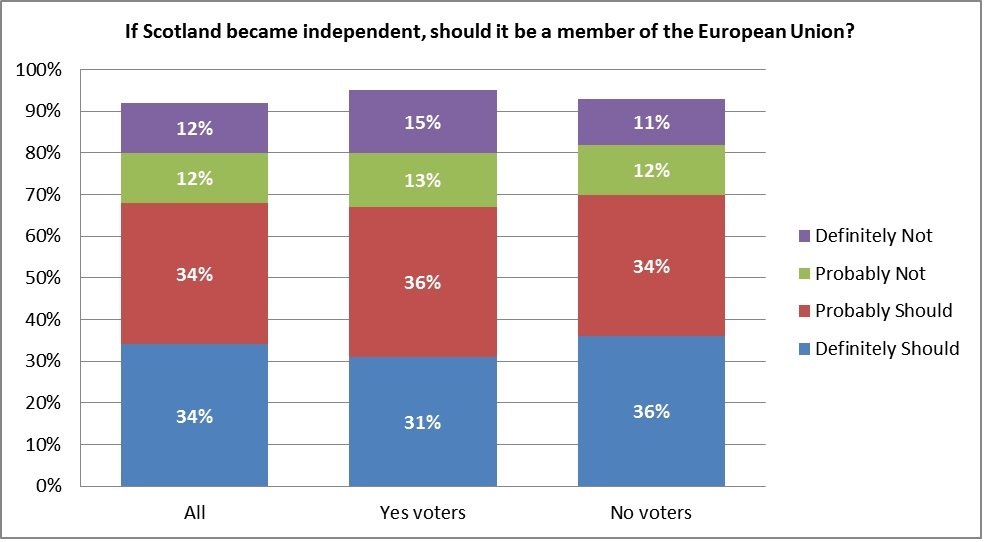
But does this ambiguity pose a barrier to voters in the referendum in making up their minds? The answer is no. The EU issue is not one that appears to be decisive in the formation of people’s views on the referendum question. Put simply those voters indicating an intention to vote ‘Yes’ cannot be distinguished from those planning to vote ‘No’ on the issue of an independent Scotland’s membership of the EU.

Figure 1, showing data from the 2013 Scottish Social Attitudes Survey, illustrates this. 67% of ‘Yes’ voters favour an independent Scotland being part of the EU while 70% of ‘No’ voters think the same. There is no marked difference.

Figure 1: Views on an independent Scotland’s relationship
to the EU by voting intention
Neues Schottland

Source: Scottish Social Attitudes Survey 2013. Missing percentages to 100 indicate ‘don’t know’ responses.

These results, from the only representative probability sample-based survey, have been externally validated by polls that asked people more directly about the issues that are most relevant to them in making their decision about the referendum. When, for example, asked which issue was the most important to people in a poll conducted in January 2014 only 3% of respondents said EU membership.

Such findings might surprise those who think Scots are particularly Europhile and enthusiastic about the EU as to opposed to voters in England where the UK Independence Party is an increasingly potent force. Indeed it is often suggested that Scots have a distinctively positive view of the EU compared to their neighbours south of Hadrian’s Wall.

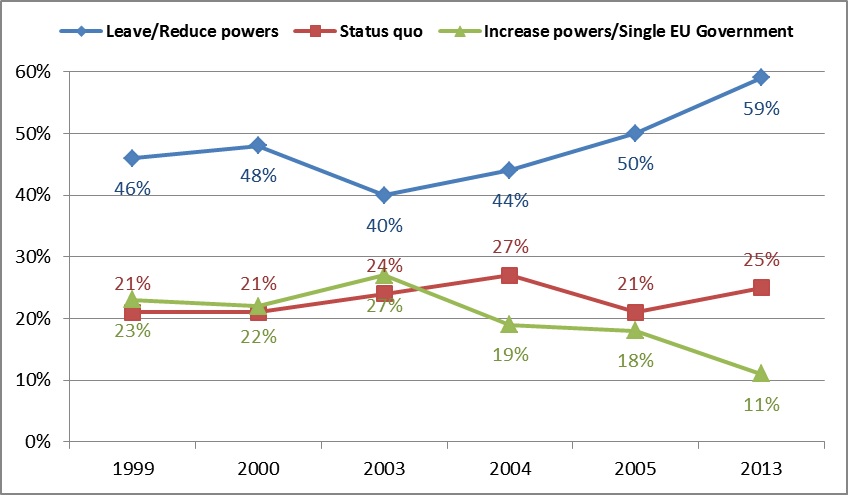
Figure 2: Scottish views on Britain’s relationship
with the European Union 1999-2013
Scotland2

Source: Scottish Social Attitudes Survey 2013. Missing percentages to 100 indicate ‘don’t know’ responses. Question wording: “Do you think Britain’s long-term policy should be to leave the European Union, to stay in the EU and try to reduce the EU’s powers, to leave things as they are, to stay in the EU and try to increase the EU’s powers, or to work for the formation of a single European government?”

Such an image of Scots is far from accurate. Attitudes towards the EU have grown more sceptical in Scotland. As figure 2 shows in 2013 59% of Scots would have liked either for Britain to leave the EU (19%) or to see the EU’s powers reduced (40%), substantially more than at any previous time that Scots were surveyed on this question in the Scottish Social Attitudes Survey. While the majority still prefers for Britain, or an independent Scotland, to remain part of the EU, Scots are far from being Euro-enthusiasts.

So why have Better Together been focussing on the EU issue? Two explanations are plausible: either they wanted to have the political and media agenda dominated by an issue that is not a vote winner – preserving their lead in the polls and trying to ensure ‘Yes’ could not shift the discourse to more decisive themes. Indeed a lot of attention has been paid to this issue without showing any significant effect on the polls. If however, Better Together tried to win more ‘No’ votes, the strategy was not successful, as voters do not seem to respond to the topic in either direction.

________________

Jan Eichhorn is a Chancellor’s Fellow in Social Policy at the University of Edinburgh. His research focuses on political participation and culture as well as subjective well-being and unemployment. He is the Principal Investigator of two ESRC-funded projects examining public attitudes to the referendum of adults and young people respectively.

Daniel Kenealy is Lecturer and Associate Director at the University of Edinburgh Academy of Government. His research focuses on the history of European integration and British foreign policy, including UK-EU relations. Since December 2013 he has been adviser to the Scottish Parliament’s European and External.

See the original article >>

Markets dismiss the risk of higher rates inhibiting growth

by SoberLook.com

Many continue to argue that the rate normalization taking place now will slow business activity in the US. Good luck betting on that however. There is no question that corporate America had benefited tremendously from extraordinarily low rates. Many US firms have locked in these rates over the past couple of years by refinancing - interest expense savings that go directly to the bottom line. But what will happen now as rates "normalize"?
One approach is to see what the markets are telling us. To start, let's look for example at the 5-year tenor where a great deal of corporate America borrows. Over the past year, the 5-year treasury yield has almost tripled.

Source: Investing.com

The markets however do not seem to imply slower growth. For example one indicator of corporate activity expectations is the Dow Jones Transportation Index (DJTI) - the oldest equity index that is still in use (launched in 1884). Increased transport usage is thought to precede improvements in industrial activity. When the DJTI outperforms the Dow Jones Industrial Average, the market is expecting stronger corporate performance going forward. And in spite of significantly higher rates (chart above), the DJTI outperformance has been quite pronounced.

Source:Ycharts

Some would say the markets are undergoing a bout of Greenspan's "irrational exuberance". Perhaps. But here we are not talking about the market's lofty absolute levels - only the transport shares' outperformance. Other cyclical shares have been outperforming as well (see chart).
At the same time the current treasury yield curve shows the 5-year yield to almost double over the next two years based on implied forward yield (see methodology). Significant rate increases are therefore already priced in. This tells us that at least for now the markets don't view higher rates (rate normalization) as inhibiting growth.

See the original article >>

What's the Primary Cause of Wealth Inequality? Financialization

by Charles Hugh Smith

Financialization results when leverage and information asymmetry replace innovation and productive investment as the source of wealth creation.

Emmanuel Saez and Thomas Piketty are leading lights in the exploration of rising wealth inequality. Both are academic economists who have devoted considerable time and effort to assembling data that deepens our understanding of the issues.
For example, Saez's recent essay Striking it Richer: The Evolution of Top Incomes in the United States, provides an in-depth look at the widening gulf between the top 1% and the bottom 90% from 2009 to 2012.
Here is a chart of the top 10% share of income, based on their research: (the note in red marking the beginning of financialization in 1982 is my own)

What is the primary driver of this era's widening wealth inequality? Thomas Piketty's new book Capital in the Twenty-First Century provides an answer: financialization. While definitions vary, mine is:
Financialization is the mass commodification of debt and debt-based financial instruments collaterized by previously low-risk assets, a pyramiding of risk and speculative gains that is only possible in a massive expansion of low-cost credit and leverage.

Another way to describe the same dynamics is: financialization results when leverage and information asymmetry replace innovation and productive investment as the source of wealth creation.

When the profits from financializing collateral and leveraging those bets to the hilt far exceed generating wealth by creating products and services, the economy is soon hollowed out as the perverse incentives of financialization start driving every business decision and strategy.
Author David Cay Johnston recently wrote an insightful review of Piketty's book,Trickle-Up economics:

Coming out of the Great Recession in 2009, inequality increased dramatically, the opposite of what happened when the Great Depression ended nearly eight decades earlier. Why?
The short answer: When investment returns exceed economic growth, the rich get richer, increasing inequality.
When an economy grows at 1 percent annually but investment returns are 5 percent, the already wealthy need to reinvest only a fifth of their gains for their fortunes to grow at the same rate as the overall economy. The rest can be spent on a sumptuous lifestyle.
Since by definition the very rich do not need to consume 80 percent of their incomes — the portion by which investment returns exceed the growth of the economy in Piketty’s model — they can reinvest most of their annual gains in the market. Over time this accumulating capital will snowball.
The official American income numbers, crunched by Piketty and his sometime colleague Emmanuel Saez, show that in the 21st century wealth and income increases are almost all taking place among the tiniest sliver of the wealthiest and highest-earning.
The top 1 percent of Americans raked in 95 cents out of every dollar of increased income from 2009, when the Great Recession officially ended, through 2012. Almost a third of the entire national increase went to just 16,000 households, the top 1 percent of the top 1 percent, Piketty and Saez’s analysis of IRS data shows.
The income changes for the vast majority are just as revealing. The bottom 90 percent saw their average incomes rise 8.8 percent in 1934 over the prior year, while in 2012 the same statistical group had to get by on 15.7 percent less than in 2009.
Piketty shows that whether capital is taxed or not, inequality will grow under current policies because savings from current wages and salaries cannot grow as much as returns to existing riches.
The process of accumulating “becomes more rapid and inegalitarian as the return on capital rises and the [overall economic] growth rate falls,” Piketty writes.

It's important to note that capital is not monolithic, nor is all capital qualitatively equal. Capital that is invested in rigged financier games funded by the Federal Reserve (for example, carry trades and high-frequency trading) is entirely different from capital that is placed at risk in a start-up company.
Capital invested in building a house is quite different from capital invested in pyramiding the mortgage into mortgage-backed securities (MBS) and exotic financial instruments based on the MBS.
Productively invested capital is at risk and generates additional production of goods and services. Financialized capital skims profits from leveraging debt: nothing of any real-world value is produced, it's just a giant skimming operation based on information asymmetry (or outright fraud and misrepresentation) and leverage.
Fed-funded financialization creates a perverse set of incentives: talent and capital flow to unproductive skimming operations because that's what generates the outsized profits, effectively starving the real economy of talent and capital.
The Fed makes essentially limitless funds available to banks and financiers at near-zero interest rates. Try borrowing $100,000 from the Fed at 0.1% interest; you can't. That privilege is reserved for financial predators and parasites.

Financier skimming operations stripmine productive assets and labor. With the Fed providing free money to financiers and no limits on debt, leverage, information asymmetry and sleight-of-hand accounting, the only result possible is widening wealth inequality.


You want to fix wealth inequality? Abolish the Fed, eliminate the too-big-to-fail banks, tax speculative profits from high-frequency trading and other skimming operations at 90% and lower the corporate tax rate on productively invested capital to 5%. The only way to reduce wealth inequality is to change the incentives and disincentives to favor productive investments and innovation rather than financialization.

See the original article >>

89% Of Venetians Vote For Independence From Italy, Will Withhold Taxes To Rome

by Tyler Durden

Inspired by Scotland's hopes for independence and hot on the heels of Crime'a 95% preference for accession to Russia, 89% of the citizens of Venice voted for their own sovereign state in a ‘referendum’ on independence from Italy. As The Daily Mail reports, the proposed ‘Repubblica Veneta’ includes the five million inhabitants of the Veneto region and has been largely driven by the wealthy 'who are tired of supporting the poor and crime-ridden south' (Venice pays EUR71bn in taxes and receives only EUR21bn in services and investment). The ballot appointed a committee of ten who immediately declared independence from Italy. Venice may now start withholding taxes from Rome. Wonder why the US, Europe, and Japan have not announced the referendum "illegal" and announced sanctions yet?

Residents of Venice have voted 89 per cent to leave Italy and become an independent state in protest at high taxes levied on the wealthy in order to prop up the poor and crime ridden Mezzogiorno south

Via The Daily Mail,

Venetians have voted overwhelmingly for their own sovereign state in a ‘referendum’ on independence from Italy.

Inspired by Scotland’s separatist ambitions, 89 per cent of the residents of the lagoon city and its surrounding area, opted to break away from Italy in an unofficial ballot.

The proposed ‘Repubblica Veneta’ would include the five million inhabitants of the Veneto region and could later expand to include parts of Lombardy, Trentino and Friuli-Venezia Giulia.

...

Wealthy Venetians, under mounting financial pressure in the economic crisis, have rallied in their thousands, after growing tired of supporting Italy’s poor and crime ridden Mezzogiorno south, through high taxation.

...

Campaigners say that the Rome government receives around 71 billion euros  each year in tax from Venice - some 21 billion euros less than it gets back in investment and services.

...

The ballot also appointed a committee of ten who immediately declared independence from Italy. Venice may now start withholding taxes from Rome.

...

Campaigner Paolo Bernardini, professor of European history at the University of Insubria in Como, northern Italy, said it was ‘high time’ for Venice to become an autonomous state once again.

‘Although history never repeats itself, we are now experiencing a strong return of little nations, small and prosperous countries, able to interact among each other in the global world.’

‘The Venetian people realized that we are a nation (worthy of) self-rule and openly oppressed, and the entire world is moving towards fragmentation - a positive fragmentation - where local traditions mingle with global exchanges.’

...

'We are only at the Big Bang of the movement - but revolutions are born of hunger and we are now hungry. Venice can now escape.’

So how long will it before Barosso, Van Rompuy, Obama, Abe and th rest declare this referendum "illegal" and seek sanctions against the people of Venice...

See the original article >>

Analysts Give Soybeans the Nod

By: Fran Howard

Analysts expect planting intentions to favor soybeans when USDA releases its long-awaited Prospective Plantings report on March 31.

"I think USDA will increase acreage in beans significantly, by 5 million or 6 million acres and keep corn acreage close to last year," says Peter Georgantones, account executive at Abbott Futures in Minneapolis. "Spring wheat could be shortchanged." An increase of 5 million acres would by far be a record-high planting of soybeans.

Producers planted a record 77.4 million acres to soybeans in 2009. Last year, they planted 76.5 million acres to soybeans.

Allendale, a brokerage firm in McHenry, Ill., expects soybean planting intentions to surpass 83 million acres. Using Allendale’s estimate of harvested acreage and a trend yield of 44.29 bu. per acre, this year’s soybean production would be a record high 3.639 billion bushels. Last year’s production was 3.289 billion bushels.
With November soybean futures near $11.90 per bu., Georgantones thinks producers should have a third of their corn marketed.

Corn Not Forsaken

Georgantones expects producers to plant between 93 million and 94 million acres to corn this year, but some estimates call for only 91 million acres. USDA’s latest projection was 92 million acres.

"Farmers love to plant corn," he says. With July futures at $4.90, corn still provides a profit, assuming a breakeven of $4.25.

Allendale expects corn plantings of 92.349 million acres, the fourth largest since 1944. Using the firm’s estimate of harvested acreage and a trend yield of 163 bu. per acre, this year’s corn crop would be the second largest ever at 13.781 billion bushels. Last year’s record-large crop was 13.925 billion bushels.

"It’s going to be a tough year for farmers to make money. Next year could be even more challenging," says Georgantones. He recommends that corn producers have one-third of their crop sold at current price levels.

"I think we are close to the highs on corn," he adds.

One issue that USDA has not yet factored into its balance sheet is the effect that porcine epidemic diarrhea virus (PEDV)—first found in the United States in May 2013—will have on feed demand for corn. PEDV is being blamed for the recent sharp increase in hog and pork prices.

Late Planting

While it is way too early to talk about late planting, it’s not too late to talk about this year’s delayed spring.

"The Ohio River Valley could be two to three weeks behind this year due to snow and cold, and the Upper Midwest has so much frost in the ground from this cold weather, I think we’ll start planting late as well," says Georgantones. "But you can still make good yields planting corn in May.

See the original article >>

Spanish 'Anti-Austerity' Protesters "Sick Of This System They Call Democracy"

by Tyler Durden

"I'm here to fight for my children's future," exclaims one father as Spaniards rallied in Madrid against poverty and EU-imposed austerity. As Reuters reports, the largely peaceful protest later marred by violent clashes in which police fired rubber bullets. The so-called "Dignity Marches" brought hundreds of thousands to the capital with banners making it clear what their feelings about record 26% unemployment were - "Bread, jobs and housing for everyone" and "Corruption and robbery, Spain's trademark." One protester summed up the people's views of the government, "I'm sick of this system they call democracy... I want things to change."

Via Reuters,

The so-called "Dignity Marches" brought hundreds of thousands to the capital, according to estimates of Reuters witnesses. Travelling from all over Spain, they were protesting in support of more than 160 different causes, including jobs, housing, health, education and an end to poverty.

...Spaniards rallied in Madrid on Saturday against poverty and EU-imposed austerity in a largely peaceful protest later marred by violent clashes in which police fired rubber bullets.

Some protesters started to throw stones and bottles at the large numbers of riot police present and attacked cashpoints and hoardings. The police fired rubber bullets to disperse them, according to video footage seen by Reuters.

Central government representative Cristina Cifuentes said 19 protesters had been arrested and 50 police officers had been injured, one of them very badly, in the clashes.

Once again the issue is government corruption combined with austerity (or at least slowing growth in spending to be perfectly clear) - a combination that we have discussed numerous times tends to end in social unrest...

A housing bubble burst more than five years ago, forcing a 41-billion euro ($56 billion) bailout of Spain's banks, squeezing homeowners and throwing millions out of work.

The government introduced public sector austerity to whittle down the deficit, provoking widespread anger amongst middle- and low-income families as dozens of cases of corruption in the ruling class are investigated by judges.

The people's feelings were clear as the OECD says the economic crisis has hit Spain's poor harder than in any other country in the euro region.

Banners urged the conservative government not to pay its international debts and to tackle Spain's chronically high unemployment of 26 percent.

"Bread, jobs and housing for everyone", read one banner, "Corruption and robbery, Spain's trademark," said another.

"I'm here to fight for my children's future," said Michael Nadeau, a 44-year-old entrepreneur.

"For those who are in power we're just numbers. They value money more than they value people," he said, shouting to be heard above the din of chanting, whistling and drumming.

"(I'm here because) I'm sick of this system they call democracy," said Jose Luis Arteaga, a 58-year-old teacher whose wage has been cut 20 percent. "I want things to change."

It seems that almost record low bond yields and high stock market levels did not appease the people of Spain either...Time for that IMG income inequality equalizing wealth redsitriburion it would seem...

See the original article >>

Follow Us