Tuesday, March 4, 2014

Ukraine: Follow the Energy

by Charles Hugh Smith

Scrape away the media sensationalism and geopolitical posturing and it boils down to a simple dynamic: follow the energy.

Though many seem to believe that internal politics and geopolitical posturing in Ukraine are definitive dynamics, I tend to think the one that really counts is energy: not only who has it and who needs it, but where the consumers can get it from.
Let's cut to the chase and declare a partition along long-standing linguistic and loyalty lines a done deal. Let's also dispense with any notions that either side can impose a military solution in the other's territory.
Media reports on the weakness of Ukrainian military forces abound (for example, Ukraine Finds Its Forces Are Ill Equipped to Take Crimea Back From Russia), but Russia's ability to project power and hold territory isn't so hot, either.
A knowledgeable correspondent submitted these observations:

RE: Russian Army. Effective draft evasion is running 80%. Morale is low, training is very poor and poorly funded. The Russian army has also gone through 22 years of near continuous contraction.
And this standing army has heavy commitments in the Caucasus and Far East Siberia. Moreover, at least half of these Russian ground troops are short term 12 month conscripts. I don't think these kids will produce many usable and motivated troops. The low morale recently seen in the Ukrainian Berkut and other police will be multiplied by at least 10x.
Russian speaking Ukrainian bands are rumored to already be crossing the borders into Russia territory. They're to be ready to sabotage bridges and infrastructure and generally retaliate. Fluent Russian speakers with many years experience of living in Russia. Who can say for sure if this has already happened or is just being threatened? We can say this is a very real danger. These people look just like "Russians."
And we can also say this threat will seriously complicate Russian rear area security and logistics. And speaking of logistics, the distances in south Ossetia and Abkhazia were very short and the populations were entirely friendly. Neither condition prevails in the Ukraine outside the Crimea.
Supplying moving armored units over hundreds of miles of occupied country is very difficult logistically. The logistics for air assault helicopter units are just as bad. These helo units look mobile but they're a lot like a yoyo being twirled around your head on the string. They only go fast within a fixed radius anchored by logistics that are about as heavy to move as an armored division's supply columns. That is years in the 101st Airborne Division talking. The fuel consumption rates are immense. Stuff starts breaking down fast.
Conclusion: a de facto partition is already baked in because neither side can force a re-unification. Various jockeying and posturing will undoubtedly continue for some time, but the basic end-game is already visible: de facto partition.
Let's move on to correspondent A.C.'s observations about energy.
This map rounds out the European energy Rosetta Stone. When they hear that Italian fighter jets are over Tripoli, or that the French Foreign Legion has returned to the deep Sahara Desert, they can can better understand the reasons and real objectives of such operations.

source:
Many have noted that the Russia economy is critically dependent on oil and gas exports to the EU. It should be noted that the converse is less true every day about EU dependence on Russian oil and gas. The Wall Street Journaleven had a line about an EU proposal to push natural gas EAST to the Ukraine. It's hard to understand that passage or where the natural gas could come from unless one understands the North Africa to southern Europe gas pipelines.
The factors bringing the conflict in Ukraine to a head are:
1. The natural gas discoveries in eastern Poland and western Ukraine played the largest role.
2. The reduced importance of the gas pipeline running through the Ukraine to Europe as compared to 2009. Since that time the Nordstream lines have been finished and Gazprom acquired commercial control of the Belarus pipeline. The South Stream lines are well along in development.
3. Fast developing liquid natural gas (LNG) seaport terminal infrastructure.
Events in Libya, Mali and Algeria are not hermetically isolated from this. They are part of a comprehensive energy policy problem being dealt with by the same leaderships. It increasingly looks like a series of peripheral Energy Wars that are being fought out for control of Europe.
LNG exports are going to become a weapon in the struggle for geopolitical influence and control.
This highlights another problem for Russia/Gazprom. Its present natural gas advantage in Europe now rests mainly on its pipeline infrastructure. This advantage is fading due to the current and proposed pipeline projects running through Turkey to Europe, plus LPG terminal & ship developments, plus the five trans-Mediterranean pipelines from Libya, Algeria and Morocco to southern Europe, plus local shale gas plays...
The Ukraine is not the only country becoming less systemically important to Europe for natural gas supply. So is Russia. Current events will only accelerate everyone's efforts to diversify away from such an unstable and apparently dangerous supplier.
I think the long-term fallout from the Ukrainian Crisis will be similar to China's attempt to exploit its temporary low price monopoly position in rare earth metals a few years ago. The result is rare earth metals are becoming less rare by the day as alternate mines outside China are opened and reopened.

See the original article >>

Corn, wheat, soybean markets reach to tension in Ukraine

By Allendale Inc.

Corn: Corn continued to rally Monday, supported by the ongoing conflict in the Ukraine. The May contract settled at 470-1/2, up 7 cents. Russia continued to flex its muscles, threatening to seize Ukraine’s warships in Crimea. They later claimed to make no such threat. It seems evident that this is more a media driven political event that, when all is said and done, will not result in a major military conflict.

Ukraine has shipped 14.2 million tonnes of corn out of USDA’s estimated 18.5 million total exports through the end of February. Any talk of port delays due to this conflict seems unfounded at this point. We will continue monitor events as they unfold.

It should be noted that we have hit our target price for the upside in corn and have now turned to a neutral to bearish bias. At this point, making sales or getting more price protection in place is not to be discouraged…Scott Donarski

Soybeans: The bean markets had another volatile day to begin the week’s trading. Three of the last four Sunday/Monday nights have been launching pads to the upside and after Sunday night, you could say four out of five of the last Sunday/Monday have been launching pads for the bulls.

With the events in the Ukraine taking a turn for the worse over the weekend, shorts in the market ran for cover when the market opened Sunday night. Later in the day session, the bean rally faded and eventually went negative on the day. Trade action suggests that funds were liquidating their soybean and meal position and buying corn and wheat.

With the Ukraine being the number three world corn exporter and the number six wheat exporter, it seems someone wanted to book bean and meal profits and put money on wheat and corn to go higher. For the day, funds bought an estimated 20,000 contracts of corn, 18,000 contracts of wheat and sold 5,000 contacts of beans…Jim McCormick

Wheat: Wheat finished the day higher but well off the highs we saw earlier in the trading session. We mentioned the Ukraine unrest as a reason to see some shorts cover their wheat positions, but with the recent escalation of the situation in Crimea we would have to suspect additional short covering may be seen.

The Ukrainian government only has about 2.7 million tonnes of additional wheat to export as part of this year’s export program. There may be a concern about wheat acres in the ground but right now it doesn’t appear that Russia is going to advance much beyond their current hold of the Crimea Peninsula.

The major rejection from the highs we saw today on big volume could actually spell trouble for the markets as we are also looking at a gap on the chart below this most recent move. The Ukrainian government has also announced they are going to continue moving wheat even with this recent confrontation with Russia. With a new government in place and with little available money in the country, the best way to generate some capital is with exports so this may actually promote additional sales. It doesn’t appear this situation is going to slow down the Russian export of wheat through the Black Sea either…Cordon Sroka

See the original article >>

A Century of Policy Mistakes

By Niels Jensen

”There are four types of countries: the developed, the underdeveloped, Japan and Argentina.”

- Simon Kuznets, Nobel Laureate

When Archduke Franz Ferdinand and his wife Sophie were assassinated in June 1914 whilst visiting the city of Sarajevo, little did the people of Argentina realise what would follow. Not only did it mean four years of death and devastation in Europe but, for the good people of the Pampas and beyond, it would also mark the beginning of a very long slide from riches to rags.

It is not my intention to pick on Argentina; however it represents a unique opportunity to analyse and understand the long-term consequences of policy mistakes. In the case of Argentina, the fact that the ruling classes were kleptocrats didn’t exactly make the situation any better.

Don’t cry for me Argentina

Now, before you accuse me of having converted to the philosophy of Karl Marx, consider the following: A century ago Argentina ranked as one of the wealthiest countries in world, behind the United States, the United Kingdom and Australia but ahead of countries such as France, Germany and Italy. Its per capita income was 92% of the G16 average; it is 43% today. Life in Argentina was good. It enjoyed the benefits of one of the highest growth rates in the world and attracted immigrants left, right and centre. Boom times galore.

Argentina’s wealth was based on agriculture, but also on its strong ties with the UK, the pre-World War I global powerhouse. Equally importantly, it understood the importance of free trade and took advantage of the relatively open markets which prevailed in the years leading to the Great War. Most importantly, though, it benefitted from, but also relied upon, enormous inflows of capital from the rest of the world. All of this is well documented in a recent piece in The Economist which you can find here.

However, World War I changed all of that. The British Empire began to lose its gloss during the period that followed. The depression of the early 1930s effectively put an end to the free trade system which Argentina relied so much on and, critically, foreign investments dried up. These factors alone do not fully explain Argentina’s demise, though. The misery was amplified by a series of policy mistakes. At the most basic level, it failed to educate its children. For a country of such wealth, it is an embarrassing fact that it had a much lower literacy rate than its peers. The land owners provided primary education but little or nothing beyond that. They had no real interest in doing so, and the government did nothing to change it.

In the post war years, as the rest of the world reduced its reliance on commodities and became more and more industrialised, Argentina got stuck in the old system. Having failed miserably to use its wealth to develop other industries, its over-reliance on commodities eventually caught up with them. Furthermore, post-World War II, as the rest of the world began to open its borders again, under the leadership of Peron, Argentina chose to go the other way and became more and more closed. A succession of military coups beginning in 1930 didn’t really help its course either.

More recently, decisions seemingly designed to please the uninformed, but having the effect of peeing off the rest of the world (such as the decision to boot Repsol out of the country), haven’t exactly done their standing in the international community any good either. All in all a fairly capacious catalogue of policy mistakes. No wonder foreign investors are not lining up to invest in the country today.

Enough about Argentina. After all, I will be going there for the very first time a few short weeks from now, and I don’t want to be turned away at the border!  Sitting here in the relatively cosy surroundings of Southern England (if it weren’t for the flooding), it is tempting to conclude that we are smart enough to avoid the sorts of problems that have dragged Argentina down over the past century. At the same time, that is probably the most uneducated, and certainly the most dangerous, conclusion to reach. Time and again we have seen our political leaders demonstrate that they have spines no stronger than that of boiled spaghetti. Business partner and good friend John Mauldin often jokes that politicians are like teenagers. They opt for the easy solutions until there is no other way out. Only when their backs are firmly nailed against the wall, will they make the difficult choices. Sadly he is spot on.

The challenges facing Europe

Here in Europe we face at least two massive challenges over the next decade or two, and how they are handled will probably determine the welfare path in our part of the world for many, many years to come. At the moment our political leaders largely ignore both of them.

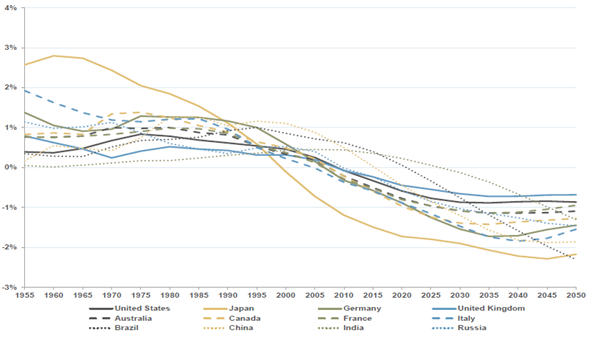
At the most basic level, economic growth is driven by population growth and improvements in productivity – i.e. how many people are there in the workforce and how much can they produce? Simple as that. Whilst productivity can, and does, vary modestly, the size of the workforce can be predicted many years out with only limited uncertainty. It is therefore possible to establish relatively precise long-term growth expectations based on demographic models. That is precisely what our friends at Research Affiliates have done (chart 1).

The picture is worrying to say the least. Most countries will be facing significant headwinds from demographic forces in the decades to come. Now, as many people ask me when I bring up this issue, why is economic growth so important? Couldn’t we all live happily in a low – even zero – growth environment? After all, isn’t Switzerland a prime example that you don’t need much economic growth to stay rich? (Switzerland has enjoyed one of the lowest growth rates in the world over the past couple of decades, yet it is one of the most prosperous.)

I have several problems with that argument, the first one being how expectations are managed by the political leadership. Precisely because the political establishment is a profession dominated by moral pygmies and mental midgets (Bertrand Russell’s words, not mine), policy makers won’t have the nerve to tell the truth, meaning that the current climate of debt financed consumption – whether in the private or public sector – could quite conceivably continue until it collapses under its own weight. As pointed out in a somewhat more diplomatic tone by the authors of the Research Affiliates paper:

“If we expect our policy elite to deliver implausible growth, in an environment in which a demographic tailwind has become a demographic headwind, they will deliver temporary outsized “growth” with debt-financed consumption (deficit spending). If we resist the necessary policy changes that can moderate these headwinds, we risk magnifying their impact.”

Chart 1:  Forecasts of Economic Growth Based on Demographic Forces

arp1

Source: Research Affiliates, Mind the (Expectations) Gap, June 2013.

The second issue I have with the Switzerland argument has to do with the absolute level of debt which continues to rise despite all the talk about austerity. In simple terms, the higher the overall level of debt, the more economic growth one needs to service that debt. The debt trajectory in some of the largest countries in the world is nothing short of frightening, yet we continue to pile on more debt (chart 2). The projections provided by the Bank for International Settlements are quite obviously meant as a stark warning to politicians around the world. Do nothing and this is what will happen. You should be aware that the projected rise is a function of changing demographics; more specifically the result of the entitlement programmes that are currently in place. An end to the crisis environment we have been in since 2008 will not change the path, only the steepness of the curve.

Chart 2:  Long-Term Sovereign Debt Projections

arp2

Source: Bank for International Settlements

It is pretty obvious that something will have to give. Otherwise we will end up in a situation where only a modest rise in interest rates could destroy entire countries. So, when Switzerland has been able to maintain its high living standards despite it sub-par growth path, it is at least partly down to the fact that the country, unlike most, is not heavily indebted.

The third reason Switzerland is a poor proxy for the rest Europe is the massive difference in youth unemployment. Whereas in Switzerland it is hovering around 8%, youth unemployment in the Eurozone is now 25%. Even though I have some issues with how the EU calculates youth unemployment (they back out students from the overall youth population which has the effect of dramatically reducing the denominator) there is no denying that Europe is facing an unemployment crisis of gigantic proportions.

We are at great risk of losing an entire generation of people to permanent unemployment which is nothing short of tragic. Rapid economic growth (in the range of 3-5% per annum) over an extended period of time would probably be required to bring most of these people back into the workforce but, for the reasons outlined earlier, it simply isn’t going to happen; however, that should never be used as an excuse to do nothing.

There are solutions

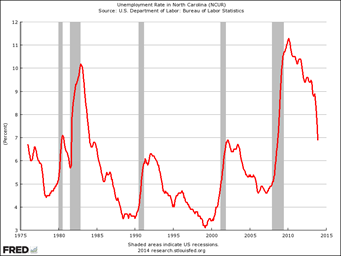
The single most potent pro-growth policy tool is deregulation. Deregulation of labour markets first and foremost but also of products markets, in particular across borders. Policy makers in North Carolina removed long-term unemployment benefits last summer. Since then the rate of unemployment has plummeted from over 11% to less than 7% (chart 3). Obviously the downward path has benefitted from an overall decline in U.S. unemployment and probably also from many people dropping out of the workforce altogether as a consequence of the loss of benefits, but the effect has been significant nevertheless.

Chart 3:  Unemployment in North Carolina less National Average

arp3

Source: http://www.businessinsider.com/north-carolina-unemployment-rate-2014-1

Infrastructure spending is another powerful tool and one which I have written about in the past. If we accept that we cannot eliminate public deficits from one day to the next without creating a deep recession, we should at least aim to spend the money on infrastructure projects where the return on invested capital is measured in future economic growth and not in number of votes at the next parliamentary elections.

At the moment, policy makers seem to have forgotten that there is more than one knob to turn on the control panel. To quote the brilliant Woody Brock who is kind enough to share his insights with us and our clients:

“Monetary policy on its own will not and cannot achieve these long-overdue goals. Repeat: Fed Watchers go jump in the lake!”

Conclusion

This month’s Absolute Return Letter is a short one by my standards. I have delivered the key message. No reason to go on for much longer. Unless serious action is taken, Europe in particular (but the U.S. is not far behind) is at risk of falling into a very deep hole from which it may be extraordinarily difficult to dig itself out of. Once in, it will prove ever so hard to get out again. That is one of the key lessons learned from Argentina, even if the nature of Europe’s problems is different from those of Argentina.

Let me round this month’s letter off with a couple of investment implications:

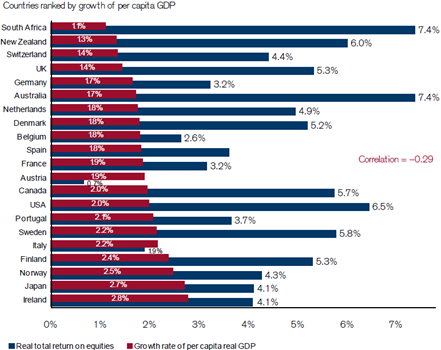
There appears to be a widespread belief amongst investors that wealth creation (here measured as GDP growth per capita) and equity returns are highly correlated. In other words, invest in those countries with the highest GDP per capita growth, and you will achieve the most attractive returns. After all, it would be a perfectly logical conclusion to arrive at. In reality, nothing could be further from the truth. Over the long term the two have actually been negatively correlated (chart 4). It could therefore prove to be a costly mistake to exclude Europe from a global equity portfolio just because you have (valid) reasons to believe that growth – and thus wealth – will stagnate in the years to come.

Chart 4:  Real Equity Returns & Per Capital GDP, 1900-2013

arp4

Source: Credit Suisse, Global Investment Returns Yearbook 2014

Secondly, when it comes to managing a debt crisis of sorts, currency issuers have a significant advantage over currency users. The latter have to go outside their own country to fund their deficit, hence the risk of default if they can’t access international markets (usually the result of mis-management). Currency issuers, on the other hand, can issue unlimited amounts of IOUs in their own currency and may, as a result, avoid overt default in perpetuity. This distinction is highly significant, given the elevated levels of debt at present.

As sovereign debt continues to grow in many countries, should interest rates begin to rise, servicing the debt would take a bigger and bigger toll on public budgets. It is therefore reasonable to expect governments to collude with central banks to try and keep interest rates under control in the years to come. Now, investors are not stupid. They will look to get paid for the added risk they take, either explicitly or implicitly. If interest rates are perceived to be grossly manipulated, market mechanisms will ensure that investors will instead turn their attention to exchange rates to seek the necessary adjustments. Consequently, we expect currency markets to take the brunt of the adjustments that will have to happen over the next several years as it becomes increasingly clear who is in the ‘deep hole’ and who is not.

See the original article >>

High soybean prices may be storing up trouble

by Agrimoney.com

The soybean market may be storing up trouble for itself.

Agrimoney.com cautioned investors two weeks ago, as soybean prices were falling, against expecting weakness to continue.

Now, as prices hit multi-month highs, the website is warning investors to avoid believing that high prices will stick around for ever either.

Paranagua roulette

This feeling of vertigo does not surround so much the front contracts which are making the biggest waves.

The best-traded May contract, which set a seven-month high on Thursday, is certainly looking expensive, up more than 12% for February.

But that could be warranted given the resilience of US exports in the face of cheaper South American supplies.

It looks like buyers are importers to pay a premium for certainty of deliveries from the US rather than the playing Paranagua roulette – taking a risk on whether competitively-priced Brazilian supplies will negotiate the pitfalls and potholes of the country's transport system to arrive in time.

The rally may extend until imports become a realistic option, encouraged by the east coast US livestock producers which have rarely been shy of publicising large discounts in foreign supplies.

Sowing signals

The real discomfort is the height at which new crop soybeans are trading.

November 2014 soybean futures are up nearly 7% this month, hitting a five-month high on Thursday, sending a strong signal to US producers to sow the oilseed this spring.

Indeed, at a historically-high ratio of 2.53: 1 compared with the price of December corn futures, they are telling farmers to ditch the grain in favour of soybeans.

But when it comes to harvest this autumn, the market could look very different from today's.

Not going away…

Sure, Brazil's soybean supplies may not be currently proving as popular as investors had thought.

And there may not be quite as many of them as the 90m tonnes or so investors had thought. Current estimates are some 3m-5m tonnes less, after damage to crops from too much rain, or too little.

But they will hit the market some time. Brazil will still leave some 40m tonnes to sell - even if that means getting them to port before signing up buyers, and leaving deals until later in the calendar year.

Furthermore, Argentine farmers may start selling up later this year too. They have hoarded stacks of soybeans from last year, perhaps 7m tonnes, as a dollar-denominated hedge against a falling peso. The US Department of Agriculture sees overall Argentine soybean stocks rising 37% over 2013-14.

Hoarded crops are going to make quite a splash when they do make it to market, on top of the 53m-54m tonnes Argentine growers are seen as about to harvest.

Upside vs downside

It is not obvious that the need for US soybeans is as strong as the market is suggesting.

Producers would be wise to price some crop.

Sure, the return of front Chicago futures contracts above $14 a bushel highlights the upside to values from the $11.78 a bushel that November futures are trading at.

But the US Department of Agriculture's projection of prices averaging $9.65 a bushel next year highlights the downside too.

See the original article >>

Funds, stocks 'surprise' may give sugar extra lift

by Agrimoney.com

The rally in sugar prices, spurred by Brazil's drought, could gain some further support from hedge fund buying, and the discovery that inventories are not as large as had been thought.

Raw sugar futures on Monday rebounded from pre-weekend selling, closing up 0.8% at 17.80 cents a pound in New York for May delivery.

The gains came as Sucden Financial said that, given the fears over the extent of damage to the cane crop in Brazil's Centre South from drought, hedge funds may yet continue the bullish swing in positioning which has turned them net long on raw sugar for the first time since before Christmas.

Last month, managed money turned from a net short position in raw sugar futures and options of 58,657 contracts to a net long of 21,818 lots, data from the Commodity Futures Trading Commission, the US regulator, show.

Given "uncertain" weather prospects in Brazil's Centre South, responsible for some 90% of domestic output, "and the expected reworking of cane figures for the up-coming harvest, and a potential delay to the start of crushing activity, it could be argued that the speculative community has more buying to come", Sucden said.

Hedge funds held a net long in raw sugar of more than 200,000 contracts as recently as October.

'Don't trust consumption estimates'

Separately, London broker Marex Spectron raised the prospect that ideas of huge inventories of sugar, which had been weighing down prices until concerns over Brazil's dryness kicked in in earnest a month ago, may prove to have been exaggerated.

"If the world has produced more than it has consumed, that extra sugar goes to stock somewhere," the broker said.

"But since we don't trust consumption estimates, we do not trust stock levels."

After four years of production surplus, there has been "plenty of time" for "unintended" sugar stocks "to begin to melt away", Marex said, adding that this may be occurring in India, which will, after encouraging exports, "probably will not have excessive stocks at the end of this season".

'Stuck for longer'

The conclusion from this view was that "world consumption has been underestimated to some extent", with supplies also sapped by an increase of supplies in the so-called "pipeline".

"International trade has grown substantially in the last decades. Therefore more sugar is stuck for longer than in the past."

Observations that investors may have underestimated consumption have also been made by the likes of Czarnikow, the London-based sugar merchant.

However, Marex acknowledged that there were still "plenty of sugar stocks" in the likes of China, the European Union and the US, on paper "more than sufficient to compensate for any foreseeable production problem in Centre South Brazil.

"But some of these stocks will only become available if prices, and/or spreads [between near and more distant futures contracts], rise considerably."

The conclusion for prices was to "trust the range - but that range has moved up a notch".

See the original article >>

Soymeal, China drive DDGs to record premium over corn

by Agrimoney.com

A twin boost from elevated prices of soymeal and a quirk of Chinese import levies is driving prices of distillers' grains to record premia above corn.

Distillers' dried grains, or DDGs, are selling for March in US Gulf export market at $325 a tonne, the highest in the spot market in nearly a year, according to the US Grains Council.

The increase contrasts with a sharp drop, of nearly one-quarter, in corn export prices over the last 12 months to $220.17 a tonne for March.

The dynamics have turned a feed ingredient regarded initially as a little-regarded byproduct of making corn from ethanol, sold originally to livestock farmers at bargain prices, into a key part of biofuel production margins.

DDGs vs soymeal

The relative resilience in prices of DDGs reflects in part its status as a substitute protein source in feed to soymeal.

"It is not the greatest protein source in the world," at 20-25%, compared with levels above 40% for soymeal, said Jerry Gidel, chief feed grains analyst at Chicago-based Rice Dairy.

"But it is certainly not a bad one, and worth considering in these kind of markets," which have in the last two years seen spot soymeal futures make only fleeting forays below $400 a short ton ($441 a tonne).

"Given its high nutritional value and often competitive pricing, feeding of DDG can sometimes result in significant cost savings for livestock producers," the International Grains Council said, flagging its use in particular by dairy and beef farms, which account for as much as 85% of consumption.

Container factor

Demand is being further boosted by Chinese buyers, who use it largely as an alternative to corn, in hog and poultry feed, rather than for ruminants, thanks to pricing benefits afforded by a relatively low import taxation rate.

DDGs, while subject to a 5% import tariff, are exempt from the 13% VAT applied to both corn and soymeal buy-ins, and are not regulated either by a tariff rate quota system.

"Even for Chinese buyers who can get import quota for corn, it is given only in small amounts, meaning a lot of buyers have to band together to get a cargo's worth," IGC economist Nathan Kemp told Agrimoney.com.

Indeed, an extra advantage of DDGs is that it is backhauled to Asia in shipping containers empty after being used to carry exports to the US, so cutting transport costs.

"I have tried and failed to find out how much is carried in containers, but I'll bet it is over 90%," Mr Gidel said.

'Relatively little disruption'

Furthermore, "being in containers mean you can easily get it to the small guy away from port," he said, adding that it may be an advantage in bypassing China's restrictions on imports of crops containing traces of genetically modified varieties.

China on Friday issued a reminder of these by estimating at 887,000 tonnes it rejections of corn since November.

"It is that much more difficult to test DDGs in containers which may be scattered all over the place than a single boat in the docks," Mr Gidel said.

The IGC said: "While China's authorities have rejected a few cargoes due to the presence of an unauthorised GM trait, there has been relatively little disruption to DDG trade, with customs data showing an acceleration of imports in January."

'Potentially less desirable'

Exports of DDGs from the US, by far the biggest producer and exporter, to China reached 2.20m tonnes in the September-to-December period, up 325% year on year, and more than shipments to the rest of the world put together.

However, while this is all good news for ethanol plants – for which the grains offer not just a financial lift but a political benefit, in boosting their case as suppliers to the food chain as well as the biofuels industry – there is a risk that they might try to exploit their unexpected DDG windfall a bit too much.

"Almost all US ethanol producers are now extracting non-food grade maize oil, mostly for use in biodiesel production," from corn residues left over after making ethanol, the IGC said.

However, the oil extraction process "changes the feeding characteristics" of these leftovers, cutting the energy content in the resultant DDGs.

"While studies have shown that low-oil DDG remains a useful ingredient, some buyers have expressed concerns that its lower fat content makes it potentially less desirable for feeding monogastrics, such as hogs and poultry."

See the original article >>

Follow Us