Tuesday, December 3, 2013

QE Deflationary? No Kidding!

by Lance Roberts

There was a very "wonkish" article by Stephen Williamson over the weekend discussing the impact of quantitative easing on inflationary expectations.  The article is filled with economic equations discussing interest rates and inflationary expectations but the real crux of the article was:

"In general, if we think that inflation is being driven by the liquidity premium on government debt at the zero lower bound, then if the Fed keeps the interest rate on reserves where it is for an extended period of time, we should expect less inflation rather than more.
But that's not the way the Fed is thinking about the problem. What I hear coming out of the mouths of some Fed officials is that: (i) Things are bad in the labor market, and the Fed can do something about that; (ii) inflation is low. Thus, according to various Fed officials, the Fed can kill two birds with one stone, so it should: (a) keep doing QE; (ii) make it clear that it wants to keep the interest rate on reserves at 0.25% for a very long period of time.
What I hope the discussion above makes clear is that this is a trap for the Fed. There is not much that the Fed can do on its own about the short supply of liquid assets. They can get some action from QE, but the matter is mostly out of their hands, and more QE actually pushes the Fed further from its inflation goal. If the Fed actually wants more inflation, the nominal interest rate on reserves will have to go up. Of course, that will lead to some short-term negative effects because of money nonneutralities."

This is not "new news" for anyone that has either a) been paying attention or; b) reading my posts (see here, here and here) on the deflationary impact of the Fed's "QE" programs.  If we set the "math" aside for a moment, and focus on a consumption based economy, it becomes clear that stimulating asset markets will have little effect on economic or labor growth which is ultimately driven by end demand.

Take a look at the chart below of interest rates, GDP and inflation.

Fed-Funds-GDP-Inflation-120213

Since 1980 economic growth rates, inflationary pressures and interest rates have all been in a steady decline.  This has been due to increased productivity through technological advances which have suppressed wage growth and labor demand.  This pressure has become even more rampant since the financial crisis as corporations slash costs to increase profitability while topline revenue has remaind sluggish. During that time the illusion of economic strength have largely been the result of massive increases in debt to fill the gap between slowing rates of income growth and rising living standards.

Personal-Income-120213

While the Federal Reserve's programs have massively increased the excess reserve accounts of the member banks; those reserves have remained there.  This is shown in the chart below and is the result of weak demand for credit in the real economy.

Banks-ExcessReserves-M2V-120213

In order for there to be inflationary economic pressures there must be an increase in the demand for credit by businesses to increase production.  Increased production results in rising pressures on wages and commodity prices.  The chart below shows the real problem for the Fed.

High-Inflation-Index-120213

While the Federal Reserve has successfully inflated asset prices; the ongoing interventions have failed to translate from Wall Street to Main Street.  A large amount of labor slack has kept wages suppressed which has reduced aggregate end demand keeping pricing power under pressure.

The Federal Reserve's programs certainly assisted in offsetting the risk of the economy falling into a much deeper recession immediately following the financial crisis.  The current problem for the Federal Reserve is ceasing programs which are potentially inflating an asset bubble while the economic underpinnings remain to frail to function autonomously.

As Stephen concluded in his article:

"The Fed is stuck. It is committed to a future path for policy, and going back on that policy would require that people at the top absorb some new ideas, and maybe eat some crow. Not likely to happen. The observation of continued low, or falling, inflation will only confirm the Fed's belief that it is not doing enough, not committed to doing that for a long enough time, or not being convincing enough."

The sheer beauty in the Keynesian argument for ongoing monetary interventions is in its simplicity.  If the programs work; then the Keynesian model was correct.  If the economy fails, or worse, it is only because the Federal Reserve did not do enough.  With that kind of logic what could possibly go wrong?

See the original article >>

Argentine soybean crop to set a record - with ease

by Agrimoney.com

The Argentine soybean crop will set a record after all, boosted by late rains and relatively high prices of the oilseed, which have boosted its appeal over corn in farmers' planting plans.

Argentine growers will in 2013-14 harvest 57.5m tonnes of soybeans, the US Department of Agriculture bureau in Buenos Aires said – a figure 4.0m tonnes higher than the department is officially banking on.

A crop at that level would overtake the all-time harvest of 54.5m tonnes set in 2009-10.

The bureau's forecast is also above figures many other commentators are factoring in, with the International Grains Council last week nudging its number 500,000 tonnes higher to 55.0m tonnes, a figure in line with Oil World's estimate.

'Unanimous consent'

The bureau's forecast reflects an estimate for plantings of 20.5m hectares, some 800,000 hectares more than the USDA is factoring in.

"There is unanimous consent among the industry that area will be above 20m hectares - some contacts even maintain forecasts above 21m hectares," the bureau said.

The Buenos Aires grains exchange last week raised its forecast by 250,000 hectares to 20.45m hectares.

Extra soybean area is expected to come at the expense of corn, for which seedings were curtailed by dry weather last month, the ideal corn-sowing time in many areas.

Farmers who missed this window, "will either plant late season corn, which yields less, or plant soybeans", the bureau said.

Corn prices vs soybean prices

The allure of soybeans, for which sowings will continue into January, is being boosted by price incentives too.

"The issue this season is the fact that corn prices are dropping at a faster rate than soybean prices are dropping," the bureau said.

"This, along with higher costs of production for corn, makes corn a less profitable, more risky crop and it is likely many will switch to soybeans which have low input costs in comparison."

However, the extra soybeans will not boost much Argentina's exports of the oilseed itself in 2013-14, which the bureau pegged at 10.0m tonnes, some 440,000 tonnes more than the official USDA figure.

Argentina crushes most of its crop domestically, and is in fact, by a margin, the world's top exporter of soymeal and soyoil.

Argentina is the world's third-ranked soybean producer, behind the US and Brazil.

See the original article >>

China To Become the Fastest Growing Consumer Market in the World

It’s the season for shopping. We have Cyber Monday in the United States and Singles Day in China (November 11 or 11/11). So, while we are pondering shopping, try to guess which consumer market is growing the fastest. The answer is…China!

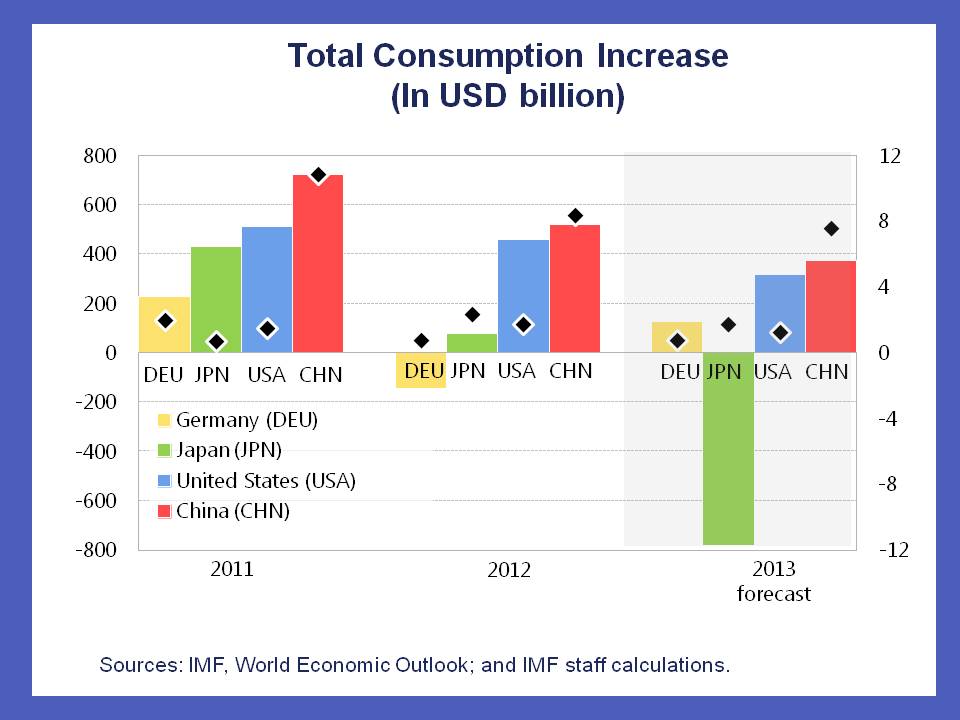
China had the largest consumption increase in the world. This was true in 2011, true in 2012, and likely to be true again this year (see chart). Consumption in China is also generally thought to be weak. Indeed, the government and the IMF are calling for more consumer-based growth. How could consumption, in effect, be both weak and strong at the same time?

Consumption is not weak…

China Fastest Growing Consumer Market in the WorldThe chart shows the US$ increase of consumption in China and other large economies. China has been tops for the past few years (see the bars). It has also had the fastest real growth in consumption (see the dots). The US$ increase (bars) is a combination of the pace of consumption growth, size of the economy, and exchange rate. For China, exchange rate appreciation also contributes to the large measured increase in US$, as well as the negative bar for Japan this year. So whether measured in US$ terms or real growth, among major economies, China’s consumer market is the fastest growing in the world.

It is also true that consumption as a share of GDP has been declining. It has fallen by some 10 percent of GDP over the past 10 years or so. However, a big reason for the decline is that GDP has been growing fast, even faster than consumption. This is just arithmetic. In real terms, however, consumption has grown about 9 percent a year for the past decade—a fantastic outcome! This just happens to be less than the 10 percent average growth in GDP.

Two factors are behind the declining share of consumption. First, household saving has been rising. The reasons are complex, and perhaps not fully understood, but pre-cautionary motives are a popular explanation. Households are uncertain about how much health, education, and pension the government will provide, so self-insure by increasing saving. Second, household income has been growing slower than GDP. Same story as above: Household income has been growing fast, but just not as fast as GDP. These factors are each discussed further in “Sino-Spending”.

Moving to consumer-based growth

Rebalancing toward more consumer-based growth means, in short, boosting the consumption to GDP ratio. Consumer-based growth, however, is a foreign concept to macroeconomists. We tend to look at growth from the supply-side of the economy: Capital (factories) and labor (workers) are combined with technology (total factor productivity) to produce output (GDP). The consumer-based growth story, however, can also be told from the supply-side of the economy.

Expanding the service sector is a critical step for achieving more consumer-based growth. The service sector, while growing, is smaller in China in terms of output and employment than comparator economies. As the service sector takes a larger and larger share of the economy, household income (and thus consumption) will naturally rise as a share of GDP.  Moreover, advances in the service sector could also lower the price for many consumer services and thereby increase sales (e.g., consumption) see IMF Working Paper.

Other reforms will also help. Strengthening the financial sector will help finance the expansion of the service sector, a part of the economy that currently has difficulty accessing credit. It will also boost household income directly, as new financial products boost investment income. Social security reform, meanwhile, could help reduce pre-cautionary saving. Moreover, payroll taxes are very high and regressive (employee plus employer social contributions often exceed 40 percent of wages). Reducing the contribution rates will help boost labor income directly through lower taxes and indirectly by boosting employment.

These are just some examples. In fact, many other reforms announced at the recent Third Plenum will also help lift the consumption ratio. Higher resource taxation, labor market reforms, and land reform could all help boost household income and lower household saving—either directly or indirectly by shifting the economy more toward services.

As reforms take hold, the end result should be a rise in the consumption to GDP ratio. It happens as a welcome by-product of moving to a more balanced and sustainable growth path, which also leads to a larger service sector, lower household saving rates, and a higher labor share of income. It also means a more inclusive (improved labor market) and environment-friendly (services are less polluting than industry) growth path.

And, since consumption will be growing faster than GDP, it will also be more consumer-based growth.

See the original article >>

By Steven Barnett

Amazon tests drones for same-day parcel delivery, Bezos says

By Bloomberg News

Source: BloombergSource: Bloomberg

Amazon.com Inc. is testing drones to deliver goods as the world’s largest e-commerce company works to improve efficiency and speed in getting products to consumers.

Chief Executive Officer Jeff Bezos unveiled the plan on CBS’s “60 Minutes” news program in the U.S., showing interviewer Charlie Rose the flying machines that can serve as delivery vehicles. Bezos said the gadgets, called octocopters, can carry as much as 5 pounds within a 10-mile radius of an Amazon fulfillment center. Amazon may start using the drones, which can make a delivery within 30 minutes, within five years pending Federal Aviation Administration approval, Bezos said.

“It will work, and it will happen, and it’s gonna be a lot of fun,” he said in the “60 Minutes” interview broadcast yesterday.

Amazon, based in Seattle, has been introducing ways to get products to consumers faster, seeking to keep shoppers coming back to its Web store instead of going to brick-and-mortar retailers. The company said last month it was teaming up with the U.S. Postal Service to begin Sunday delivery to members of its $79-a-year Prime program.

Delivery drones also are being used by the Australian company Zookal to deliver textbooks, said Oliver Lamb, director of Sydney-based Pacific Aviation Consulting. In China, the SF Express delivery company is experimenting with drones in the southern city of Dongguan, according to a report by the Civil Aviation Resource Net of China.

Regulatory Issues

“When and how to allow this kind of delivery is going to be a big question,” Lamb said. “Regulators will have to deal with this, and I’m sure each jurisdiction will come up with regulations to allow this in due course.”

Amazon’s drone plan spurred Senator Edward Markey, a Democrat from Massachusetts, to issue a statement today saying the machines should be vetted before they are used for delivery. Markey introduced the Drone Aircraft and Privacy Transparency Act last month, calling for measures to ensure drones aren’t used to spy on U.S. citizens.

“Before drones start delivering packages, we need the FAA to deliver privacy protections for the American public,” he said in the statement. “Convenience should never trump constitutional protections.”

New Uses

Experimentation with delivery by drones is part of a shift from the craft’s use by the U.S. military to spy on and kill suspected terrorists.

The U.S. Congress has directed the FAA to develop a plan to integrate drones into U.S. airspace by 2015. That led U.S. venture investors to pour $40.9 million into drone-related startups in the first nine months of this year, more than double the amount for all of 2012, according to data provided to Bloomberg News last month by PricewaterhouseCoopers and the National Venture Capital Association.

As Amazon and EBay Inc. step up their push to get customers goods as quickly as possible, United Parcel Service Inc. and FedEx Corp. are focusing on developing and testing strategies for a same-day delivery market. Their efforts build off the ground networks that are the last link in a global chain that includes planes and trucks. The companies haven’t discussed specific plans for using drones.

FedEx, UPS

Potential industrywide revenue from intracity delivery of small packages in the U.S. may be as much as $12 billion, FedEx has estimated. UPS, the world’s largest shipping company, had total revenue of $40.5 billion through the first nine months of this year, while sales at FedEx, operator of the biggest cargo airline, totaled $44.3 billion in its fiscal year ended May 31.

“We have made a name for ourselves in innovation and technology,” FedEx Senior Vice President Patrick Fitzgerald said today in a Bloomberg Television interview. “This is something we have a lot of focus on. As it stands today, there are no drones in the delivery network.”

Carla Boyd, a FedEx spokeswoman, declined to comment further about drones. UPS said the technology won’t be in use anytime soon.

“We certainly have had, in our technology steering committee, presentations from drone vendors,” UPS Chief Sales and Marketing Officer Alan Gershenhorn said in an interview today. “The commercial use of drones is certainly an interesting technology and we’ll evaluate it ongoing.”

Developments that would allow commercial use of small drones “are pretty far off,” he said.

Blue Origin

Drones aren’t the first futuristic technology to attract the interest of Bezos. Separate from Amazon, Bezos created a closely held spaceflight venture called Blue Origin, which in October said it planned to soon begin offering suborbital flights on a commercial basis.

The electric motors of the drones will help reduce the environmental impact of package deliveries, Bezos said.

“It’s very green,” Bezos said. “It’s better than driving trucks around.”

Still, the challenges to achieving a safe delivery at the end of the day may prove insurmountable, said Jeff Lowe, general manager of Asian Sky Group, a Hong Kong-based aviation consulting company.

“You’d have to make it idiot-proof,” Lowe said. “From a height, a 5-pound load hitting anything is going to be fairly destructive, so that can never happen. The first time it does, the FAA will ground all these drones and they will never fly again.”

Prime Customers

The research into delivery by drone is a reflection of the fact that some of Amazon’s most lucrative customers are members of its Prime program, which promises fast delivery.

The company invests heavily in distribution and delivery, which made up the largest portion of Amazon’s expenses in the third quarter. Investors have endorsed the spending on capacity -- the costs increased 35% to $2.03 billion -- pushing up the company’s shares 57% so far this year even as it posts losses.

The company had 89 warehouses in 2012 and is planning 7 more this year. Amazon also unveiled plans in July to increase staff by 5,000 in 17 centers this year and is hiring 70,000 seasonal workers in the U.S. to meet holiday order demand.

Bezos showed the drones as the growth of e-commerce sales outstrips total retail sales. On Black Friday, e-commerce spending increased 15% to a record $1.2 billion as more consumers opted to shop from their couches rather than battle long lines at stores, according to ComScore Inc.

Amazon ranked as the most visited online retail store, said ComScore.

Online shopping is also anticipated to be heavy today, which is dubbed Cyber Monday for the number of Web deals that retailers offer. ComScore projected that Cyber Monday sales will increase more than 20% to about $2 billion.

See the original article >>

The Road To 'Rational Markets' in China

By Michael Pettis

Last month’s award of the Nobel Price in economics set off a great deal of chortling because one of the three recipients, Eugene Fama, received the award for saying that markets are efficient at capital allocation and another, Robert Schiller, received the award for saying they are not. Typical is this response by John Kay:

The Royal Swedish Academy of Sciences continues to astonish the public when awarding the Nobel Memorial Prize in Economics. In 2011 it celebrated the success of recent research in promoting macroeconomic stability. This year it pays tribute to the capacity of economists to predict the long-run movement of asset prices.


People with knowledge of financial economics may be further surprised that this year Eugene Fama and Robert Shiller are both recipients. Prof Fama made his name by developing the efficient market hypothesis, long the cornerstone of finance theory. Prof Shiller is the most prominent critic of that hypothesis. It is like awarding the physics prize jointly to Ptolemy for his theory that the Earth is the centre of the universe, and to Copernicus for showing it is not.


To me, much of the argument about whether or not markets are efficient misses the point. There are conditions, it seems, under which markets seem to do a great job of managing risk, keeping the cost of capital reasonable, and allocating capital to its most productive use, and there are times when clearly this does not happen. The interesting question, in that case, becomes what are the conditions under which the former seems to occur.

I wrote about this most recently in my most recent book about China, Avoiding the Fall, and I think it might be useful to recap that argument. I argued in the book (based on some articles I published in 2004-05) that an “efficient” market is one that has an efficient mix of investment strategies. Without this efficient mix, the market itself fails in its ability to allocate capital productively at reasonable costs.

Investors make buy and sell decisions for a wide variety of reasons, and when there is a good balance in the structure of their decision-making, financial markets are stable and efficient. But there are times in which investment is heavily tilted toward a particular type of decision, and this can undermine the functioning of the markets.

To see why this is so, it is necessary to understand how and why investors make decisions. An efficient and well-balanced market is composed primarily of three types of investment strategies—fundamental investment, relative value investment, and speculation—each of which plays an important role in creating and fostering an efficient market.

  • Fundamental investment, also called value investment, involves buying assets in order to earn the economic value generated over the life of the investment. When investors attempt to project and assess the long-term cash flows generated by an asset, to discount those cash flows at some rate that acknowledges the riskiness of those projections, and to determine what an appropriate price is, they are acting as fundamental investors. 
  • Relative value investing, which includes arbitrage, involves exploiting pricing inefficiencies to make low-risk profits. Relative value investors may not have a clear idea of the fundamental value of an asset, but this doesn’t matter to them. They hope to compare assets and determine whether one asset is over- or underpriced relative to another, and if so, to profit from an eventual convergence in prices. 
  • Speculation is actually a group of related investment strategies that take advantage of information that will have an immediate effect on prices by causing short-term changes in supply or demand factors that may affect an asset’s price in the hours, days, or weeks to come. These changes may be only temporarily and may eventually reverse themselves, but by trading quickly, speculators can profit from short-term expected price changes.

Each of these investment strategies plays a different and necessary role in ensuring that a well-functioning market is able keep the cost of capital low, absorb financial risks, and allocate capital efficiently to its more productive use. A well-balanced market is relatively stable and allocates capital in an efficient way that maximizes long-term economic growth.

Each of the investment strategies also requires very different types of information, or interprets the same information in different ways. Speculators are often “trend” traders, or trade against information that can have a short-term impact on supply or demand factors. They typically look for many opportunities to make small profits. When speculators buy in rising markets or sell in falling ones—either because they are trend traders or because the types of leverage and the instruments they use force them to do so—their behavior, by reinforcing price movements, adds volatility to market prices.

Different Investors Make Markets Efficient


Value investors typically do the opposite. They tend to have fairly stable target price ranges based on their evaluations of long-term cash flows discounted at an appropriate rate. When an asset trades below the target price range, they buy; when it trades above the target price range, they sell.

This brings stability to market prices. For example, when higher-than-expected GDP growth rates are announced, a speculator may expect a subsequent rise in short-term interest rates. If a significant number of investors have borrowed money to purchase securities, the rise in short-term rates will raise the cost of their investment and so may induce them to sell, which would cause an immediate but temporary drop in the market. As speculators quickly sell stocks ahead of them to take advantage of this expected selling, their activity itself can force prices to drop. Declining prices put additional pressure on those investors who have borrowed money to purchase stocks, and they sell even more. In this way, the decline in prices can become self-reinforcing.

Value investors, however, play a stabilizing role. The announcement of good GDP growth rates may cause them to expect corporate profits to increase in the long term, and so they increase their target price range for stocks. As speculators push the price of stocks down, value investors become increasingly interested in buying until their net purchases begin to stabilize the market and eventually reverse the decline.

Relative value investors or traders play a different role. Like speculators, they tend not to have long-term views of prices. However, when any particular asset is trading too high (low) relative to other equivalent risks in the market, they sell (buy) the asset and hedge the risk by buying (selling) equivalent securities.

A well-functioning market requires all three types of investors for socially useful projects to have access to appropriately-priced capital.

  • Value investors allocate capital to its most productive use.
  • Speculators, because they trade frequently, provide the liquidity and trading volume that allows value investors and relative value traders to execute their trades cheaply. They also ensure that information is disseminated quickly.
  • Relative value trading forces pricing consistency and improves the information value of market prices, which allows value investors to judge and interpret market information with confidence. It also increases market liquidity by combining several different, related assets into a single market. When buying of one asset forces its price to rise relative to that of other related assets, for example, relative value traders will sell that asset and buy the related assets, thus spreading the buying throughout the market to related assets. It is because of relative value strategies that we can speak of a unified market for different assets.

Without a good balance of all three types of investment strategies, financial systems lose their flexibility, the cost of capital is likely to be distorted, and the markets become inefficient at allocating capital. This is the case, for example, in a market dominated by speculators. Speculators focus largely on variables that may affect short-term demand or supply for the asset, such as changes in interest rates, political and regulatory announcements, or insider behavior.

They ignore information like growth expectations or new product development whose impact tends to reveal itself only over long periods of time. In a market dominated by speculators, prices can rise very high or drop very low on information that may have little to do with economic value and a lot to do with short-term, non-economic behavior.

Value investors keep markets stable and focused on profitability and growth. For value investors, short-term, non-economic variables are not an important or useful type of information. They are more confident of their ability to discount economic variables that develop and affect cash flows over the long term. Furthermore, because the present value of future cash flows is highly susceptible to the discount rate used, these investors tend to spend a lot of effort on developing appropriate discount rates. However, a market consisting of only value investors is likely to be illiquid and pricing-inconsistent. This would cause an increase in the required discount rate, thus raising the cost of capital for borrowers.

Because each type of investor is looking at different information, and sometimes analyzing the same information differently, investors pass different types of risk back and forth among themselves, and their interaction ensures that a market functions smoothly and provides its main social benefits. Value investors channel capital to the most productive areas by seeking long-term earning potential, and speculators and arbitrage traders keep the cost of capital low by providing liquidity and clear pricing signals.

Where Are the Value Investors?


Not all markets have an optimal mix of investment strategies. China, for example, does not have a well-balanced investor base. There is almost no arbitrage trading because this requires low transaction costs, credible data, and the legal ability to short securities. None of these is easily available in China.

There are also very few value investors in China because most of the tools they require, including good macro data, good financial statements, a clear corporate governance framework, and predictable government behavior, are missing. As a result, the vast majority of investors in China tend to be speculators. One consequence of this is that local markets often do a poor job of rewarding companies for decisions that add economic value over the medium or long term. Another consequence is that Chinese markets are very volatile.

Why are there so few value investors in China and so many speculators? Some experts argue that this is because of the lack of investors with long-term investment horizons, such as pension funds, that need to invest money today for cash flow needs far off in the future. Others argue that very few Chinese investors have the credit skills or the sophisticated analytical and risk-management techniques necessary to make long-term investment decisions. If these arguments are true, increasing the participation of experienced foreign pension funds, insurance companies, and long-term investment funds in the domestic markets, as Beijing has done with its QFII program, is certainly seems like a good way to make capital markets more efficient.

But the issue is more complex than that. China, after all, already has natural long-term investors. These include insurance companies, pension funds, and, most important, a very large and remarkably patient potential investor base in its tens of millions of individual and family savers, most of whom save for the long term. China also has a lot of professionals who have trained at the leading U.S. and UK universities and financial institutions, and they are more than qualified to understand credit risk and portfolio techniques. So why aren’t Chinese investors stepping in to fill the role provided by their counterparts in the United States and other rich countries?

The answer lies in what kind of information can be gathered in the Chinese markets and how the discount rates used by investors to value this information are determined. If we broadly divide information into “fundamental” information, which is useful for making long-term value decisions, and “technical” information, which refers to short-term supply and demand factors, it is easy to see that the Chinese markets provide a lot of the latter and almost none of the former. The ability to make fundamental value decisions requires a great deal of confidence in the quality of economic data and in the predictability of corporate behavior, but in China today there is little such confidence.

How to develop the investor base

Furthermore, regulated interest rates and pricing inefficiencies make it nearly impossible to develop good discount rates. Finally, a very weak corporate governance framework makes it extremely difficult for investors to understand the incentive structure for managers and to be confident that managers are working to optimize enterprise or market value.

And yet, when it comes to technical information useful to speculators, China is too well endowed. Insider activity is very common in China, even when it is illegal. Corporate governance and ownership structures are opaque, which can cause sharp and unexpected fluctuations in corporate behavior. Markets are illiquid and fragmented, so determined traders can easily cause large price movements. In addition, the single most important player in the market, the government, is able—and very likely—to behave in ways that are not subject to economic analysis.

This has a very damaging effect on undermining value investment and strengthening speculation. In the first place, unpredictable government intervention causes discount rates to rise, because value investors must incorporate additional uncertainty of a type they have difficulty evaluating.

Second, it puts a high value on research directed at predicting and exploiting short-term government behavior, and thereby increases the profitability of speculators at the expense of other types of investors. Even credit decisions must become speculative, because when bankruptcy is a political decision and not an economic outcome, lending decisions are driven not by considerations of economic value but by political calculations.

China is attempting to improve the quality of financial information in order to encourage long-term investing, and it is trying to make markets less fragmented and more liquid. But although these are important steps, they are not enough. Value investors need not just good economic and financial information, but also a predictable framework in which to derive reasonable discount rates. And here China has a problem.

There are several factors, besides the poor quality of information, that cause discount rates to be very high. These include market manipulation, insider behavior, opaque ownership and control structures, and the lack of a clear regulatory framework that limits the ability of the government to affect economic decisions in the long run. This forces investors to incorporate too much additional uncertainty into their discount rates.

Chinese value investors, consequently, use high discount rates to account for high levels of uncertainty. Some of this uncertainty represents normal business uncertainty. This is a necessary component of an economically efficient discount rate, since all projects have to be judged not just on their expected return but also on the riskiness of the outcome. But Chinese investors must incorporate two other, economically inefficient, sources of uncertainty. The first is the uncertainty surrounding the quality of economic and financial statement information. The second is the large variety of non-economic factors that can influence prices.

This is the crucial point. It is not just that it is hard to get good economic and financial information in China. The problem is that even when information is available, the variety of non-economic factors that affect value force the appropriate discount rate so high that value investors are priced out of the market.

Speculators, however, are much more confident about the value of the information they use. Furthermore, because their investment horizon tends to be very short, they can largely ignore the impact of high implicit discount rates. As a result, it is their behavior that drives the whole market. One consequence is that capital markets in China tend to respond to a very large variety of non-economic information and rarely, if ever, respond to estimates of economic value.

During the past decade, Beijing was betting that increasing foreign participation in the domestic markets would improve the functioning of the capital markets by reducing the bad habits of speculation and increasing the good habits of value investing and arbitrage. But it has become pretty clear that this faith was misplaced: the market is as speculative and inefficient as ever. This should not have been a surprise. The combination of very weak fundamental information and structural tendencies in the market—such as heavy-handed government interventions and market manipulation—reward speculative trading and undermine value investing. This forces all investors to focus on short-term technical information and to behave speculatively. In China even Warren Buffett would speculate.

Investors in Chinese markets must be speculators if they expect to be profitable. As long as this is the case, investors will not behave in a way that promotes the most productive capital allocation mechanism in the market, and such efforts as bringing in foreigners will have no meaningful impact.

What China must do is something radically different. It must downgrade the importance of speculative trading by reducing the impact of non-economic behavior from government agencies, manipulators, and insiders. It must improve corporate transparency. It must continue efforts to raise the quality of both corporate reporting and national economic data. Finally, it must deregulate interest rates and open up local markets to permit arbitragers to enforce pricing consistency and to allow better estimates of appropriate discount rates.

If done correctly, these changes would be enough to spur a major transformation in the way Chinese investors behave by permitting them to make long-term investment decisions. It would reduce the profitability of speculative trading and increase the profitability of arbitrage and value investing, and so encourage a better mix of investors. If China follows this path, it would spontaneously develop the domestic investors that channel capital to the most productive enterprise. Until then, China’s capital markets, like those of many countries in Latin America and Asia, will be poor at allocating capital.

When efficient markets become inefficient


But this is not just an issue for China. In the US there have been times when markets seemed efficient and rational, and times when they clearly were not. Of course this cannot be explained by the disappearance of the tools needed by value investors – for example the market for internet stocks seemed rational in the early 1990s and clearly became irrational by the late 1990s, but this did not occur, I would argue, because fundamental investors were suddenly deprived of their analytical tools.

What happened instead, I would argue, is that conditions that led to a too-rapid expansion of liquidity at excessively low interest rates changed the environment in which fundamental investors could operate. As excess liquidity forced up asset prices, the likes of Warren Buffet found themselves unable to justify buying assets and so they dropped out of the market. As they did, the mix of investment strategies shifted until the market became dominated by speculators, and when this happened what drove prices was no longer the capital allocation decision of value investors but rather than short-term expectations of changes in demand and supply factors that characterize a highly speculative market.

This, I would argue, made the US stock market of the late 1990s (and perhaps today, too) “irrational”, not because they are fundamentally irrational or inefficient but rather because they can only function efficiently with the right mix of investment strategies. When the mix was altered – and this can happen when liquidity is too abundant, or when a sudden shock undermines the confidence value investors have in their ability to analyze data, or when a political event cause uncertainty to rise so high that value investors are priced out of the market, or for a number of other reasons – the markets stopped functioning as they should.

Perhaps what I am saying is intuitively obvious to most traders or investors, but it seems to me that it suggests that the argument about whether markets are efficient or not misses the point. There are certain conditions under which markets are efficient because the tools needed for each of the various investment strategies are widely available and ate credible. When those conditions are not met, because the tools are not available, or when they are temporarily overwhelmed by exogenous events, perhaps because the credibility of those tools are temporarily undermined, or when excess liquidity causes fundamental investors to drop out, markets cannot be efficient.

See the original article >>

From LIBOR to Fed Funds: 5 facts about the interbank lending market in the US

by SoberLook.com

Contracts worth hundreds of trillions - ranging from corporate loans to mortgages to rate swaps and LIBOR futures - are all priced based on a relatively small unsecured interbank lending market. Also a fairly large group of contracts (in the trillions) is linked to the fed funds rate, which is derived from the bank-to-bank loan market as well. Given its importance, here are some facts about the interbank lending market in the US.
1. The volume of unsecured loans among US banks has collapsed in recent years. Banks fund themselves with deposits, bonds, repo, commercial paper, etc. After the 2008 experience, borrowing from other banks is rarely a material part of banks' funding strategy. The situation in Europe's interbank markets is even worse.

Interbank loans outstanding

2. While most of the LIBOR-based contracts are linked to the 3-month rate, the bulk of the interbank market on which these contracts are based is overnight. It is rare to see banks lending to each other for more than a week or two. This is the main reason that some trading desks were able and incentivized to manipulate the LIBOR index (1-3 month lending market often just didn't exist).
3. Some may find this a bit confusing but the overnight LIBOR rate and the "fed funds effective" rate are two different ways of measuring essentially the same thing: the rate at which banks lend dollars to each other overnight.  The reason for the differences in the two indices is the universe of banks and the methodology used to determine the averages.

Red = Fed Funds Effective; Blue = O/N LIBOR

4. The largest lenders in the US overnight unsecured market are not even commercial banks. According to the NY Fed, most overnight liquidity is provided by the Federal Home Loan Banks (FHLBank System), which are government-sponsored entities (h/t Kostas Kalevras  - @kkalev ). Unlike regular US banks, FHLBs receive zero rate on the reserve cash with the Fed. That's why they tend to lend their cash out to banks overnight at 7-12 bp (which is still better than zero). That is also why the fed funds rate and the overnight LIBOR are significantly lower than the 25bp paid on reserves.
And here is the kicker. Some privately owned commercial banks borrow these funds from FHLBs and often leave them on deposit with the Fed at 25bp. This spread between the interest on reserves and the interbank loan rate (fed funds effective) is basically free and riskless revenue for the banking system - courtesy of the federal government.

NY Fed: - FHLBs aren’t eligible to earn IOER [interest on excess reserves], they have an incentive to lend in the fed funds market, typically at rates below IOER but still representing a positive return over leaving funds unremunerated in their Federal Reserve accounts. Institutions have an incentive to borrow at a rate below IOER and then hold their borrowed funds in their reserve account to receive IOER and thus earn a positive spread on the transaction.

Source: NY Fed

5. It's enough of a problem that trillions worth of contracts are priced based on this shrinking market. Now consider the fact that the Fed's traditional tool to target monetary policy is based on the overnight interbank market where participants use government agencies to create a riskless arbitrage. And unless there is a change, the Fed will return to targeting the fed funds rate as its primary tool, once QE ends. That is why the pressure is building on the central bank to develop alternative methods (see post) for targeting short-term rates that will actually impact the broader economy.

See the original article >>

Follow Us