Monday, July 25, 2011

U.S. Debt Ceiling Deadlock, Default & the Markets


EU Black Debt Crisis in Remission
On Thursday, Euro-area leaders stepped up their efforts to resolve the ongoing Greek debt crisis, announcing €159Bn ($229Bn) in new aid for Greece. They arranged for bondholders to foot part of the bill and expanded the power of the €440Bn Euro rescue fund to buy debt across stressed European nations - “after a market rout last week sparked concern the crisis was spreading. The fund can also aid troubled banks and offer credit-lines to repel speculators.” The Euroland leaders hope to construct a financial “firewall” around struggling countries like Spain and Italy, while assuaging fears that the debt crisis is spreading. French President Sarkozy compared the transformation of the bailout fund to the creation of a “European Monetary Fund.” (EU Leaders Offer $229 Billion in New Greek Aid)

Hopes for saving the Eurozone from multiple defaults by weaker EU members strengthened the Euro against the Dollar. We view the solution as another attempt to kick the can down the road. It was, however, a substantial kick and probably good for at least a few months. It whacked the Dollar, and conversely rallied the equity market. As Bruce Krasting wrote, “The Council of the European Union statement makes it pretty clear that the Euro folks are going to do everything they can (including direct intervention in the bond market) to stop the spread of contagion. I think they will succeed in maintaining market peace for a few months. But sometime this fall the issue of default by some Euro members will rise up again. It has to. I think the leaders in Europe are dreaming.” (Whoopie! We got a Greek Deal!)

U.S. Debt Ceiling Deadlock
In the United States, a fierce battle over raising the debt ceiling raged on, with both sides refusing to negotiate a settlement.
 
A team of six senators, three Republicans and three Democrats, the “gang of six,” put together a decade-long, $3.7 Tn deficit reduction plan. President Obama remarked to reporters before the Tuesday White House press briefing that the Senate “Gang of six” proposal was a “very significant step” towards resolving the impasse, representing a “potential for bipartisan consensus.” (President Obama praises ‘Gang of Six’ debt ceiling plan)

The proposal, however, drew considerable opposition. House members of both parties feel their side had given away too much. “We don’t have to increase the debt ceiling,” says three-term Rep. Paul Broun (R) of Georgia, who voted against the bill. “There are other ways to raise revenue without going into receivership,” he added, suggesting that the government could increase federal revenues by opening up energy reserves or selling unused federal buildings. (Trillion-dollar question in debt-ceiling talks: What can pass the House?)
Robert Borosage of Politico was also displeased: “[T]his isn’t a New Deal or a Fair Deal. It’s a Raw Deal — one that every citizen concerned about rebuilding the middle class should oppose. It would add to unemployment in the short term, increase Gilded Age inequality, leave seniors more vulnerable and shackle any possibility of rebuilding America. It puts the burden of deficit reduction on the elderly, the poor and the vulnerable; endangers jobs and growth; and lards even more tax breaks on the rich. (Senate Gang offers ‘raw deal’)

One line of reasoning from the “no tax hikes” crowd is the inaccurate premise that the very wealthy, the top 0.1%, are job creators. If they’re the “job creators,” it might be in the public interest to protect them from excessive taxation - thereby allowing these top 0.1% to spend money on creating jobs. This is incorrect. The overwhelming majority of U.S. jobs are ‘created’ by ordinary Americans when they spend their paychecks. Consumer spending drives about 70% of our GDP. When average Americans are struggling with high unemployment, which recently popped back up to 9.2%, they are reluctant to spend money on anything beyond basic necessities. The broader U6 unemployment number - which includes the underemployed and “discouraged workers” - is 16.2%.

Meanwhile, U.S. companies are not stepping up hiring due to weakness in the economy - there is no demand. As Paul Ashworth of Capital Economics wrote, “Businesses aren’t confident enough, and the longer this goes on, the harder it is to convince them that they should be.” (Dearth of Demand Seen Behind Weak Hiring)
The impasse between the President and the Republican leadership reached new lows on Friday when talks broke down and Rep. Boehner walked out of negotiations. “The White House deal for the House would have required that alongside these cuts, tax revenues would go up by $1.2 trillion, largely through a rewrite of the tax code to eliminate many deductions and loopholes. That’s substantially less in revenue than the $2 trillion in the “Gang of Six” plan. The problem is that while much of the cutting would start right away, most of the revenue increases would be put off, in part because a tax-code revision would take months, and in part to allow spineless House Republicans to say they did not agree to any specific tax revenue increases (i.e. they planned on lying to their constituents).

“Democratic lawmakers were rightly furious when they heard about these details, calling the plan wholly unbalanced. But, in the end, it was Mr. Boehner who torpedoed the talks. He said Friday evening that he and the President had come close to agreeing on $800 billion of the revenue increases (the equivalent of letting the upper-income Bush tax cuts expire as scheduled next year — not much of a heavy lift) but could not stomach another $400 billion ($40Bn a year!) which the White House wanted to raise by ending tax loopholes and deductions.

“So, on the eve of economic calamity, the Republicans killed an overly generous deal largely over a paltry $40 billion in annual deductions. Mr. Obama was willing to take considerable heat from his liberal critics over the deal, and the Republicans were not willing to do a thing to anger their Tea Party base. As Obama forcefully said, there is no evidence that House Republicans are capable of making those tough decisions. If last-ditch talks beginning Saturday fail, they will have to take responsibility if the unimaginable — a government default — happens in 10 days and the checks stop going out.” (Weekend Reading - Deal or No Deal?)

The Republicans are standing firm against raising taxes, in an era when many American corporations are already paying surprising little in taxes.

Russ Winter of Winter Watch at the Wall Street Examiner discussed the gap between what people think corporations pay in taxes, versus what they really spend. For example, Microsoft “lowers its effective tax rate a full 7% by taking foreign income to $19.2 billion from $15.4 billion, and lowering US income (and expenses) from $9.6 billion to $8.9 billion. Today MSFT is effectively a 68% foreign operation. In return it gets all the benefits of stimulus and minimizes the costs of supporting the US system...

“One of the big economic winners, Apple Computer, is even worse, hardly paying a thin dime to a U.S. Gumnut tottering towards insolvency. Here is the big picture of this foreign company getting U.S. benefits going back a few years [chart by Capital IQ].


Little wonder so much largesse flows into the hands of so few. Matt Taibbi gets into some of the particulars. Bloomberg’s Jesse Drucker estimated that Google all by itself has saved $3.1 billion in taxes in the past three years by shifting its profits overseas. If the U.S. is looking for a source to close its out of control deficits I have some suggestions...

“When one hears talk of tax reform, and closing tax loopholes, prepare to duck and cover if you are an ordinary American. Taxes collected for CY 2011 for the corporation year to date were $131.5 billion, versus $167.2 billion for the same period in CY 2010, down nearly 17% YoY. Little wonder there are so many earnings beats from the corporate sector...

“Mark Kreiger writes a spot on piece regarding the high end luxury bubble that includes this gem - ‘The social crisis facing the country as a result of the most egregious plundering in modern American history will spell the end of the ‘high end’ theme. Buying into this trend now is like getting long Marie Antoinette’s unsevered head in 1792.’”

One fear regarding a U.S. default is that creditors will demand higher interest in return for issuing new debt. Considering how enormous the U.S. debt load currently is (roughly $14.5Tn), higher interest rates would add a crippling burden to an already high burden. This leads to the question of how the markets would react if the U.S. defaults on its debt obligations.

Default & the Markets
Analyzing market action last week and next, Lee Adler of the Wall Street Examiner submits,
“Last week I worried about the possibility of a short squeeze in Treasuries if there’s no deal on the debt ceiling, because of the temporary lack of supply during the period where the Treasury is unable to issue new debt. I dismissed that outcome as unlikely.

Now, having seen the markets rally in the face of all this nonsense, I’ll rate it as a tossup. For sure, the Treasury will make the interest payments and will redeem maturing bonds, and that will reassure investors, regardless of any action by the hated ratings agencies. I would not want to be short the Treasury market until it becomes a little clearer how this drama will unfold. It just doesn’t look like a good bet to me right now. In fact, in spite of the consensus bearishness on Treasuries, the charts suggest that my concern of a continuation of the rally may not be crazy at all. Sorry, Russ [Winter].

“Going into the end of next week, bears will face a huge test. The Treasury has a lot of paper to sell. Most of the new paper will settle on Monday,

August 1. On Thursday, July 28, a sizable paydown will put cash back in investors’ pockets. Continuing fears over the European situation may drive ongoing capital flight out of European paper and European banks into shark infested U.S. pool. So what will happen to all that cash?
 
“If Monday’s settlement is accompanied by no noticeable disruption to stocks or bonds, then that could be a sign that a perversely bullish scenario could be playing out. If bonds crack but stocks hold up, then the “stocks as safe haven” thesis would be gaining currency. That could be grounds for an upside breakout and an extended run in U.S. equities. If both stocks and bonds sell off, that could be great news for precious metals.
 
“Again, I don’t want to give the impression that I know what might happen... I’ve given you my contrarian concern on what might happen if there is no deal. It goes against the grain of the universal consensus that a failure to increase the debt ceiling would lead to catastrophe. It may, but I’ve put an opposing view out there for you to consider. It could be bullish because of the lack of new supply.
 
“What if there is a deal? There could be a deal to increase the debt ceiling with the issue of the debt being deferred. I’m pretty sure that would be bearish because supply would increase, and the ratings agencies almost certainly would downgrade. A grand bargain deal which raised the debt ceiling and set draconian targets for cutting the deficit should be bearish because the economy would slow so fast that revenues might shrink faster than outlays, thereby increasing supply, and worsening the nation’s credit outlook.

“For now, the tax data suggests that the economy has stabilized in recent weeks after a June swoon. I do believe that without POMO, the economy should weaken further, but that irrational capital inflows into the US are skewing the picture. Until that stabilizes, the US Treasury and stock markets will apparently get the benefit. I’ll just have to let the data and the markets’ behavior say when those trends might be ending... (Why Not Having Debt Ceiling Deal May Be Bullish - Are Stocks The New Safe Haven?)
Discussing the market on Friday, Russ Winter observed,

“Friday looked like one of the strangest market days yet. Going into the weekend and hours before the wheels fell off the fiscal negotiations, the markets just drifted cluelessly higher on extremely low volume and volatility. The intermediate-term volatility, the VXZ, is now within earshot of breaking to lowest number witnessed back in 2007. The same is true of the 2-year T-Note yield. This goes beyond cognitive dissonance. There is no fear, no worry in this market. It’s completely brain dead and comatose. It’s ironic given the end-of-the-line ungovernable situation we are witnessing. I have compared it to the last days of the Soviet Union - if that system had financial trading markets. The best comment I’ve spotted on the causa proxima of all this was made in the public feedback section of another site. Someone who goes by the name ‘sbernard’ used the term ‘hubris obliviana.’ It’s such an apt descriptor that I’m going to adopt it as a Winterism.

“Wrote sbernard: ‘The truth is that Wall St suffers from a serious disease called hubris obliviana, fueled by endless government interventions, bailouts, stimulus, and Fed money expansion. One of the ‘unexpected’ consequences of this monetary heroin in that Wall St has lost all perception of risk. They reflexively have too much unending faith in the power of government to fix all their troubles. Thus, they are setting us all up for even more risk — risk the government cannot avert because it is the (weak link)!’” (Unbrindled Faith in Hubris Obliviana)

For the latest update on the debt negotiations before this newsletter concludes, Zero Hedge predicts: “With 23 hours left until the Asian open (or, more importantly, 19 hours until FX trading resumes) and with today's round of talks now officially over after a one hour meeting in Boehner's office with congressional leaders achieving nothing, it is becoming clear that the final debt ceiling outcome will be "no change" in spending or taxing habits and a temporary hike in the debt ceiling, so that the soap opera can be repeated again every three months...and again...and again...and so forth for an ‘extended period of time’ as ‘transitory solutions' become the new grand consensus. At least we now know the phrase for complete, impotent incompetence on the Hill is: ‘Two tiered approach’ which is how Nancy Pelosi called the last minute attempt at compromise." (Good News: It's Almost Over After Pelosi Says Congress Looking At "Two-Tiered" Deal)

We have several option trade ideas for the coming week, two shorts (GMCR and oil) and two longs (PLX and SONC). These plays can be revised using stock strategies rather than option strategies, for those so inclined. See the inset boxes on this page (for the full newsletter, sign up for a free trial here). Have a great week!

DEFICIT DEAL COULD DERAIL GROWTH


Since both the Chamber of Commerce and most of Wall Street are strongly urging political leaders to raise the debt limit and avoid a U.S. default, it is likely—but not absolutely certain—-that this will happen. Political leaders of both parties realize that defaulting would be a global disaster, and Speaker Boehner today indicated that he can bring enough House Republicans to vote for some sort of compromise even though some members may vote against it. The way events are shaping up, however, it is highly possible that an agreement to raise the debt limit will include provisions calling for significant near-term cuts in spending that will further impede an already weakening economy.

To understand the current state of the economy we again repeat our long-standing view that the main reason why the current recovery is so weak is the lack of the consumers’ ability to spend as households build up their savings and pare down debt after decades of using excessive credit. We have published a number of comments showing how key economic series have undergone the worst declines and the weakest recoveries in the post-war period (see archives). An excellent article in last Sunday’s New York Times (see www.nytimes.com/2011/07/17/sunday-review/17economic.html) by David Leonhardt, based on a New York Federal Reserve Bank study, explains the nature of the decline in terms of discretionary consumer spending. This is consumer spending excluding outlays on such necessary items such as food, housing and healthcare.

According to the article discretionary spending never fell more than 3% per capita in any recession of the past 50 years, but is now down 7%. As an example, the auto industry, even in this year of recovery is on pace to sell 28% fewer vehicles than ten years ago in 2001 when the economy was in recession. Oven and stove sales are at the lowest level since 1992. The article repeats our long-held contention that business is not hiring because of slack consumer demand since households are facing a sharp downturn in wealth and historically high debts. Since 1980 spending has significantly exceeded income and consumers compensated by reducing savings and running up debt through credit cards, mortgages, home equity loans and cash-out refinancing that used the run-up in home prices. Now those sources of cash are gone and consumers are forced to limit spending.

The weak economic recovery was spurred by the most massive government stimulation in history, both fiscal and monetary. However even this weak recovery has faltered in the first half of the year despite QE2 and some fiscal stimulation. Now QE2 has ended while the fiscal stimulus has gradually been turning into restraint.

This brings us to the problem of what kind of deficit reduction deal will be agreed to in order to raise the debt ceiling and avoid a U.S default. So far it appears that a deficit cutting agreement could very well be based on some form of the “Gang of Six” proposal. This would roughly include $3 trillion of spending reductions along with tax reforms of some kind resulting in about $1 trillion of revenue enhancements.

The major problem for the economy arises from the prospect that a deal that includes large near-term cuts in government spending will add significant fiscal restriction to a fiscal outlook that is already tightening without the deal. And this will happen just as QE2 is no longer in effect. History indicates that further spending cuts to an already weak economy leads to even less growth and even a recession. From 1932 to 1937 the U.S. economy took major steps toward recovering from the depression. However, subsequent fiscal tightening shoved the economy back into a serious depression in 1938. A recent example has occurred in Europe where fiscal restraint has further weakened the economies of the so-called PIIGS.

Therefore while the stock market seems ready to cheer any agreement that increases the debt ceiling and avoids a default, such cheering may be extremely short-lived as the economy sinks further under the burden of additional near-term cuts in spending. This conclusion is based not on any particular political ideology or economic theory, but on the historical record.

THE GOLD PRICE AND THE POWER LAW

By Rohan Clarke

The Financial Crisis Observatory (here) publishes research that gravitates around a model proposed by Didier Sornette that suggests that bubbles follow a predictable pattern – and that their collapse can be forecast with reasonable accuracy.

The key insight of Didier and his comrades is that financial market prices tend to follow a power law as they accelerate into bubbles. Specifically, they fit a log periodic function to observed price movements to forecast the evolution of prices to a ‘singularity’ whereupon prices collapse.

I’ve been reading the pieces coming out of the observatory for a while. They appeal to my fatalistic nature, in addition to mirroring the trader’s wisdom that parabolic price rises tend to end in tears. (Note, I’d caution that forecasts can be subject to revision based on ‘new information’.)

One of the latest papers, “The Second Wave of the Global Crisis” (published 3rd July), has a satisfyingly specific target for the end of the ‘gold price bubble’ – 27 July 2011 (here for the full piece). Following is a chart from the paper. The thick black line that sits over the gold price illustrates this price acceleration and the forecast terminal point:

“…the thin line indicates daily gold price between November 3, 2003 and May 26, 2011, whereas the smooth thick black line has been generated by the following version of equation (1) with parameters chosen by the least squares:
p(t) = 1978.2 – 734.8 (2011.573 – t)0.36 {1 + 0.024 cos[16.5 ln(2011.573 – t) – 36.3]}, (1b)
where p(t) is gold price at the moment t. Note that the quasisingularity moment (tC) here equals 2011,573, which corresponds to July 27 and suggests that the gold bubble should start collapsing before this date anyway.”

See the original article >>

SPY Trends and Influencers 7/24/2011


Last week’s review of the macro market indicators looked for for Gold ($GLD) to continue its run higher and for Crude Oil ($USO) to continue to consolidate with a bias for any breakout to the upside. The US Dollar Index ($UUP) looks ready to move higher but could consolidate further, while US Treasuries ($TLT) move sideways. The Shanghai Composite ($SSEC) looks ready to break the flag higher while Emerging Markets ($EEM) consolidate in a broad range between 44.2 and 48.2. Volatility ($VIX) looks to remain subdued but despite this Equity Index ETF’s, $SPY, $IWM and $QQQ look biased to the downside in their broad ranges, but near support. A true stock pickers market.

The week began by Gold and Crude Oil reversing roles, with Gold consolidating around the 1600 level and Crude Oil moving higher. The US Dollar Index tested higher Monday but then fell throughout the week while Treasuries did consolidate. The Shanghai Composite continued its flag, and Emerging Markets kept the range drifting towards the top end. Volatility came back in and as it did the SPY, IWM and QQQ dropped Monday and rose through out the rest of the week, with the QQQ’s making a new high. What does this mean for the coming week? Let’s look at some charts.

As always you can see details of individual charts and more on my StockTwits feed and on chartly.)

Gold Weekly, $GC_F
gold w3 stocks
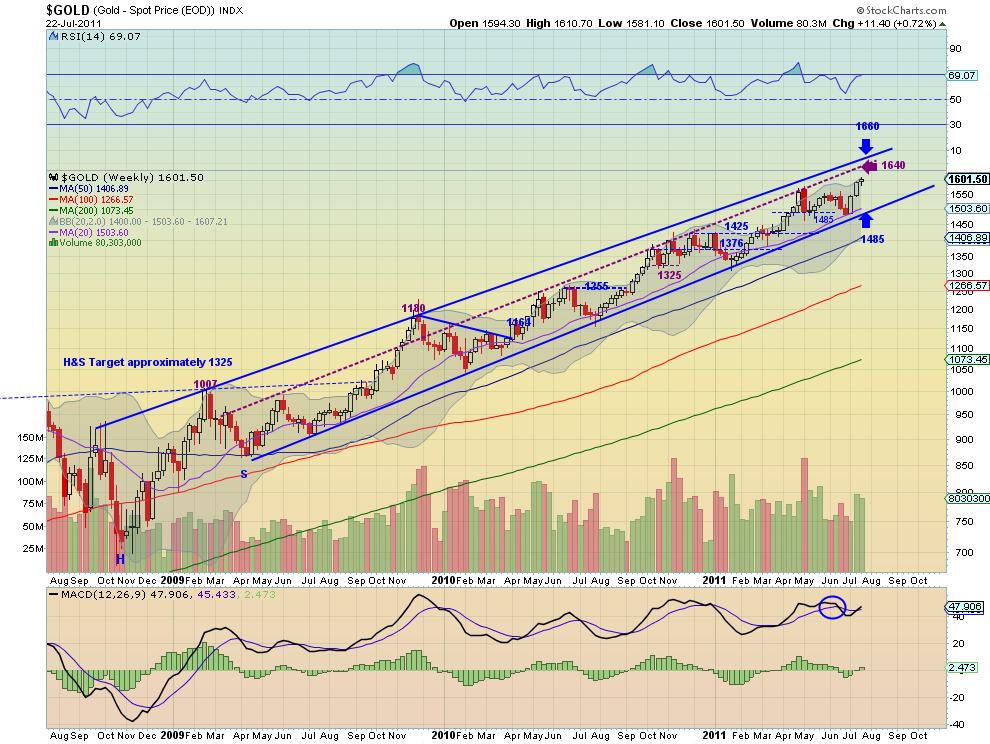
Gold spent the week building a bull flag between 1580 and 1600. On the daily chart it has positive reinforcement for more upside from the Relative Strength Index (RSI) and the rising Simple Moving Averages (SMA). But the diverging Moving Average Divergence Convergence (MACD) waning has led to consolidation. On the weekly chart the bull case for Gold remains very strong. The RSI is high and the MACD has crossed positive to join the upward sloping SMA’s. look for Gold to continue higher next week with short term targets in the 1640-1665 area and with any pullback limited to 1560 area.

SPY Daily, $SPY
spy d5 stocks
SPY Weekly, $SPY
spy w4 stocks
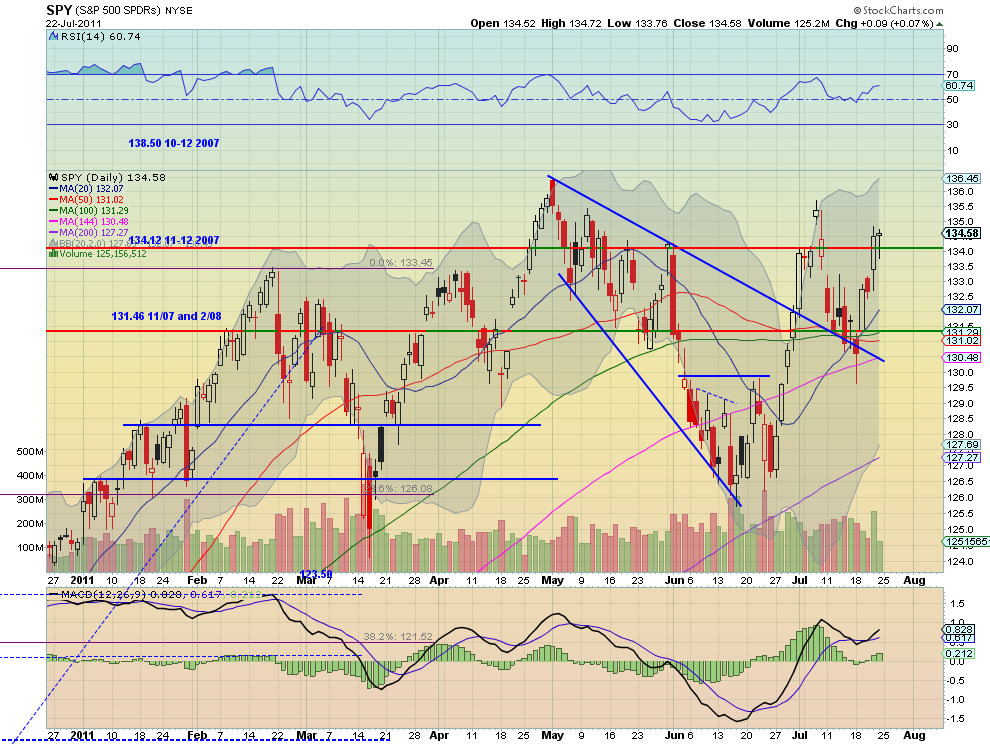
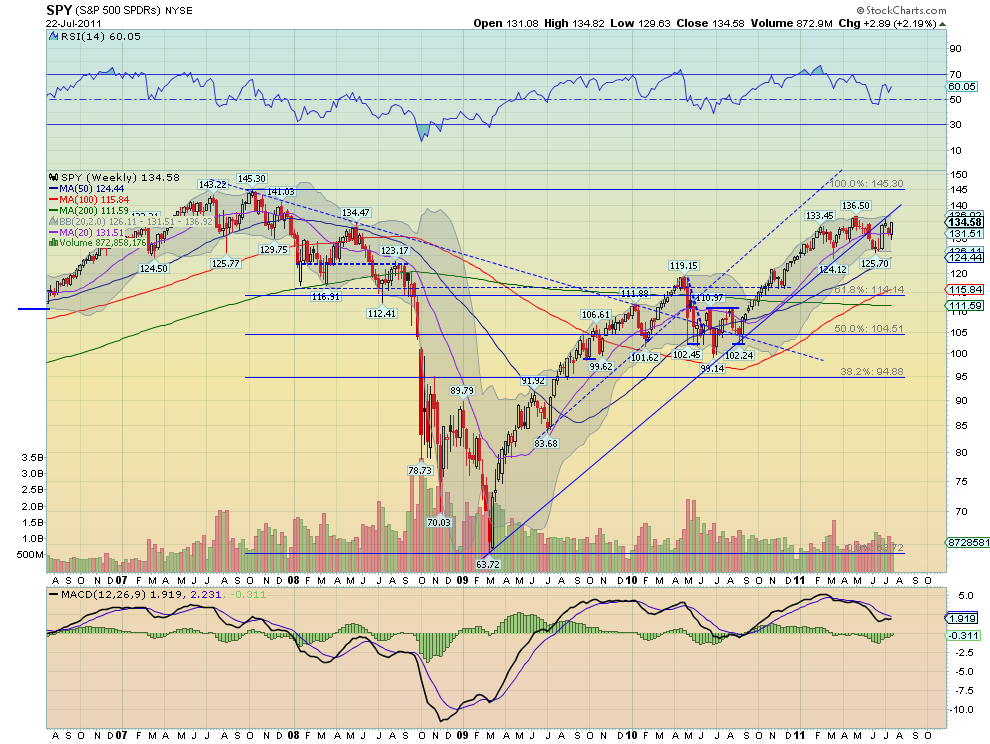
The SPY found a bottom Monday printing a Hammer reversal candle near the previous downtrend support and then rising through the week, finishing with a Hanging Man. It is over long term support/resistance at 134.12 and with a MACD that is increasing and a RSI that is slowly moving up, looks positive. The weekly chart shows that it bounced off of the 20 week SMA and is now approaching resistance. The RSI is trending higher and the MACD is about to cross up. Look for next week to be biased to the upside with resistance higher at 135.60 followed by 136.50 and then 141. Any pullback should find support at the 134.12 or 131.46 levels. A hold and move higher above 136.50 would signal an end to consolidation and a trend change to higher.

Next week looks for the move higher in GOLD and Crude Oil to continue. The US Dollar Index and US Treasuries conversely are set up to move lower, with a chance of Treasuries just running in place. The Shanghai Composite and Emerging Markets look as though they may test the top of their consolidation ranges. Volatility appears to remain muted and allow for the Equity Indexes SPY IWM and QQQ to continue to test higher and perhaps break their consolidation ranges, with the QQQ already making a new high. Use this information to understand the major trend and how it may be influenced as you prepare for the coming week ahead. Trade’m well.

See the original article >>

June Low Must Hold For SP500


The drama of the debt negotiations continue, but the pattern in the SP500 seems clearer than ever. The only requirement for a positive resolution is that the June low not be violated. I think we will see a positive resolution to the triangle once the debt deal is resolved, however it is resolved, and we will finally be off on the final major leg of the cyclical bull market that began in March 2009.
 stocks
March 6, 2009 to February 18, 2011 was 23 months and 12 days. If the numbskulls in Washington take it down to the wire, then wave (E) will end on Monday August 1, 2011. If the duration of wave [Y] equals wave [W], then the final top will be on or around July 13, 2013, probably +/- 2 months. If the length of [Y] equals the length of [W], then the final high will be on or around, unbelievably, 1963.72. At 0.618*[W], the final high will be on or around 1705.00. This is about 27% to 46% above current levels.

I know this is not the consensus view, and perhaps a retest of the 1500 level is the best that can be expected, but barring a breakdown of the June low I think wave [Y] up to new stock market highs is the most likely outcome. We will know within 2 to 4 weeks if so.

See the original article >>

9/11/11 "U.S. Files for Bankruptcy!"


9/11/11 New York – Ten years to the day of the terrorist attacks on the World Trade Center in New York City and Pentagon in Washington, D.C., President Barack Obama made the stunning announcement to the General Assembly of the United Nations that the United States was filing for bankruptcy and for protection along the lines of what is provided in the Chapter 11 provisions of the United States Bankruptcy Code. As Greece had sought and received protection from the European Union, Obama said that the United States was seeking the same from the world’s financial communities.

In a sober, but calm voice Obama said: “Due to economic challenges facing our largest foreign creditors, China and Japan, as well as internally facing the Federal Reserve, and all of their demands for repayment, the U.S. Treasury had no other choice than to file for bankruptcy and follow the provisions in Chapter 11 of the United States Bankruptcy Code.”

The President explained: “Real cooperation and collaboration between the Republican and Democratic Parties hasn't materialized, the consumer confidence needed to drive the economy didn’t come back as hoped for and sustained levels of unemployment all added to this decision.” Obama added, “Wall Street and Main Street haven't found a way to narrow the chasm between them and have used up precious time and even more precious money which has also moved us to this decision. We are hopeful that using the same opportunity to restructure that companies that file Chapter 11 use and that following the upcoming painful period, we will return to financial health, stability and to a position of world prominence and leadership. That day will not come soon or easily and we will all need to endure this painful period pulling together instead of pulling apart. Although Congress could not come to an agreement, since this happened on my watch, the responsibility rests squarely on my shoulders and I will not rest until we are back on solid footing. I am dedicating my entire political future whether I be in office or not to getting America off its heels and back on its feet and I would like your help it making that happen.”

Other nations were not surprised by America finally realizing that it had no choice. The rest of the world has been aware for several years that the valuation of America and its near term potential was overinflated and that it had become a debtor nation instead of a creditor nation a number of years ago. And with its poorly educated and poorly skilled masses and no scalable solution for reversing that widespread problem, America appeared to be even more of a risk as an investment.

This shocking, but not surprising development may have occurred even sooner had it not been that America’s two largest creditor nations, China and Japan, had remained enamored with the United States as a vital place to invest. With time, those nations along with many others in the world realized that they were thinking of an America that existed from the 1950′s through the 1990′s and one that has not existed for more than a decade.
The lesson taken from this to all countries and peoples, “You can never be too big to fail.”

Enter Orson Welles, October 30, 1938. On that date on the eve of Halloween, Welles narrated a portion of H. G. Wells’ novel The War of the Worlds over the Columbia Broadcasting System (CBS) Radio Network. The first two thirds of the 60-minute broadcast were presented as a series of simulated “news bulletins,” which suggested to many listeners that an actual alien invasion by Martians was currently in progress. In the days following, panic and then outrage filled the minds of many of the listeners to the broadcast who had felt it was true and then realized it was a hoax.

Now that of course was science fiction and the tale of the United States declaring bankruptcy above is fiction of a different kind.

But maybe such fiction could serve as a wake up call and the chance to do something before a disaster such as America going bankrupt occurred.

My late mentor and respected psychologist Dr. Edwin Shneidman told me on numerous occasions, “The best time to do something is when you don’t need to.” By that he meant to say that you often make more informed and wiser decisions when your back is not up against the wall. For example, he once told me that the best time to buy a house is when you don’t need to, the best time to switch careers is when you don’t need to and the best time to plan for your death by getting your affairs in order is before you are diagnosed with a terminal illness.

Given that the above scenario is an act of fiction and our backs aren’t against the wall, maybe the best time to take steps to resolve our financial problems is when we don’t need to.
What for instance would our actions be if the above scenario was true?
What if the United Stated did declare bankruptcy? What steps would it take to get back on its feet? Which of those steps could we start to take now?

I have some thoughts. I believe too much of the world has fallen prey to “transactional myopia” which is about: find the deal, do the deal, next deal and also now lives as if: it’s not about how you play the game it is about whether you win or lose. And in such a game, “win win” is just a woo-woo concept that everyone ignores whilst in reality most people seem to be playing a “zero sum” game. When winning is everything and everyone does whatever they need to win and eto not lose, including lying, you have a world in which “basic trust” is lost.

Developmental psychologist and psychoanalyst, Erik Erikson (1902-1994), created a model of psychosocial development that placed “Basic Trust vs. Basic Mistrust” at the foundational stage that he labeled “Hope.” By that he meant that when you look at the world through eyes of mistrust vs. trust, the world appears completely different to you and that drives the way you interact in and with the world. When you look at the world with trust, you feel hopeful; when you look at it with mistrust, you feel hopeless and in danger.

What could we do to bring back trust? One solution would be to think way into the future to a disruptive possibility that we would all want to make happen. Since most parents love their children, one such possibility would be to imagine the world in which our grandchildren (the children of the children we love) are borne. Imagine it as a world where right out of the womb and out of the gate they have the opportunity for personal health, environmental health, success, happiness, peace on earth and peace of mind. What would that world need to look like to fulfill that possibility?

We are in a stage of looking at the world through the lens of mistrust which may explain the veil of hopelessness that so many people live with or live close to. Until that changes, the world will continue to be in a dire situation.

What would you propose to turn around a world that is teetering on the edge of bankruptcy in financial areas and beyond?

Follow Us