Wednesday, July 20, 2011

Currency Markets Driven by Euro Zone Turmoil, US Debt Ceiling Debate


Major Currencies vs. US Dollar (% change)

11 Jul 2011 – 15 Jul 2011
Currency Markets Driven by Euro Zone Turmoil US Debt Ceiling Debate body Picture 5 forex
EUR/USD: Euro Vulnerable Ahead of EU Summit on Soft Data

The centrality of the Euro Zone debt crisis for overall market sentiment continues to assure a firm link between EURUSD and the MSCI World Stock Index, a proxy for broad-based trends in investors’ optimism. This week, the spotlight is pointed at a Thursday meeting of the EU heads of state as they attempt to hammer out a confidence-boosting solution to the Greek fiasco.

In the interim, the preliminary set of July’s PMI figures is set to show continued slowdown in manufacturing- and service-sector growth while Germany’s business confidence gauge puts sentiment at the lowest since January 2010 over the same period. This ought to reinforce expectations of a pause in ECB interest rate hikes for the time being, keeping the Euro broadly under pressure.
Currency Markets Driven by Euro Zone Turmoil US Debt Ceiling Debate body Picture 6 forex
Source: Bloomberg

GBP/USD: US Data Key as BOE Rates Outlook Remains Static
While the correlation between GBPUSD and the MSCI World Stock Index is not eye-catching in and of itself, risk sentiment remains the most-pronounced of the conflicting catalysts driving the British Pound. Interest rate expectations seem likely to take over the spotlight this week however as the Bank of England releases minutes from the monetary policy meeting held earlier this month. The aggressive deterioration in UK economic data in June may have planted the seeds of a dovish shift on the rate-setting MPC committee, and any indication of growing support for another round of QE is likely to weigh heavily on Sterling.
Currency Markets Driven by Euro Zone Turmoil US Debt Ceiling Debate body Picture 7 forex
Source: Bloomberg

USD/JPY: Sentiment Trends Key as Yen Tracks Treasury Yields
The spread between US and Japanese 2-year Treasury bond yields remains the core driver of USDJPY. With no serious waves likely to be made in the outlook for Japanese rates, this puts the onus on the US portion of the rates differential. Broadly speaking, this points toward three leading catalysts: the Euro Zone debt crisis, the lingering debate on raising the US debt ceiling, and the second-quarter corporate earnings reporting season.

So far, positive earnings surprises have outpaced negative ones by over 9 percent among those S&P 500 companies that have already reported (22 in total); if this trend continues, risk appetite ought to prove somewhat supported and US yields should rise as safe-haven demand for Treasuries declines and prices retreat, pushing USDJPY higher. Needless to say however, this can only be truly relied upon unless an eye-catching headline regarding either the Euro Zone debt fiasco or the US one grab center stage. The former will almost certainly do so on Thursday as EU heads of state convene to hash out the Greek situation in Brussels. The latter remains a wildcard as Republicans and Democrats continue to jostle for political points, with no sign of an end to the deadlock yet in sight.
Currency Markets Driven by Euro Zone Turmoil US Debt Ceiling Debate body Picture 8 forex
Source: Bloomberg

USD/CAD, AUD/USD, NZD/USD: Comm Bloc Still Anchored to Stock Markets
The so-called “commodity bloc” currencies remain firmly anchored to stock markets, reflecting a shared sensitivity to the trajectory of broad-based global economic growth expectations. As with the Yen, this puts the trinity of familiar macroeconomic drivers – the Euro Zone debt crisis, the US debt ceiling debate, and the second-quarter earnings season – firmly in focus, with the overall implications largely the same as discussed above.

Specifically, if corporate profits dominate attention, there seems to be a good chance for upside in commodity bloc as shares recover, but there is clearly no reason to assume this will prove to be the case (or is necessarily probable, for that matter). The Bank of Canada interest rate decision headlines the calendar. No changes to existing policy are expected, and traders will be keep a close eye on how policymakers frame the recent uptick in headline inflation readings to shape their outlook going forward.
Currency Markets Driven by Euro Zone Turmoil US Debt Ceiling Debate body Picture 9 forex
Source: Bloomberg
Currency Markets Driven by Euro Zone Turmoil US Debt Ceiling Debate body Picture 10 forex
Source: Bloomberg
Currency Markets Driven by Euro Zone Turmoil US Debt Ceiling Debate body Picture 11 forex

See the original article >>

The Real Estate Market in 2030.


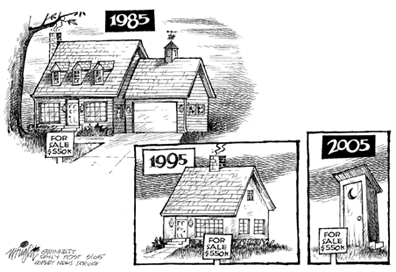
A number of analysts, and even some of those in the real estate industry, are finally coming around to the depressing conclusion that there will never be a recovery in residential real estate. Long time readers of this letter know too well that I have been hugely negative on the sector since late 2005, when I unloaded all of my holdings (click here for “The Hard Truth About Residential Real Estate”). However, I believe that “forever” may be on the extreme side. Personally, I believe there will be great opportunities in real estate starting in 2030.

Let’s back up for a second and review where the great bull market of 1950-2007 came from. That’s when a mere 50 million members of the “greatest generation”, those born from 1920 to 1945, were chased by 80 million baby boomers born from 1946-1962. There was a chronic shortage of housing, with the extra 30 million never hesitating to borrow more to pay higher prices. When my parents got married in 1948, they were only able to land a dingy apartment in a crummy Los Angeles neighborhood because he was an ex-Marine. This is where our suburbs came from.

Since 2005, the tables have turned. There are now 80 million baby boomers attempting to unload dwellings on 65 million generation Xer’s who earn less than their parents, marking down prices as fast as they can. As a result, the Federal Reserve thinks that 50% of American homeowners either have negative equity, or less than 10% equity, which amounts to nearly zero after you take out sales commissions and closing costs. That comes to 70 million homes. Don’t count on selling your house to your kids, especially if they are still living rent free in the basement.

The good news is that the next bull market in housing starts in 20 years. That’s when 85 million millennials, those born from 1988 to yesterday, start competing to buy homes from only 65 million gen Xer’s. By then, house prices will be a lot cheaper than they are today in real terms. The ongoing melt down in residential real estate will probably knock another 25% off real estate prices. Think 1982 again. Fannie Mae and Freddie Mac will be long gone, meaning that the 30 year conventional mortgage will cease to exist. All future home purchases will be financed with adjustable rate mortgages, forcing homebuyers to assume interest rate risk, as they already do in most of the developed world. With the US budget deficit problems persisting beyond the horizon, the home mortgage interest deduction is an endangered species, and its demise will chop another 10% off home values.

For you millennials just graduating from college now, this is a best case scenario. It gives you 15 years to save up the substantial down payment banks will require by then. You can then swoop in to cherry pick the best neighborhoods at the bottom of a 25 year bear market. People will no doubt tell you that you are crazy, that renting is the only safe thing to do, and that home ownership is for suckers. That’s what people told me when I bought my first New York coop in 1982 at one tenth its current market price. Just remember to sell by 2060, because that’s when the next intergenerational residential real estate collapse is expected to ensue. That will leave the next, yet to be named generation, holding the bag, as your grandparents are now.

Opportunities for Careful Investors

by The Investment Insight

THE current financial climate is making it harder to decipher where investors are going to find returns. The rates on holding cash are low, bond yields in general have narrowed substantially and there is much uncertainty on the outlook for the stock market. In addition, with macro risks on our minds and the sovereign debt crisis raising concerns, risk aversion is on the rise. In this environment, investing in something tangible that could provide a potentially uncorrelated return is attractive. Nevertheless, there has been a vast difference in returns from various investments in this market. Therefore, it will pay to be particular.

There has been a stark divergence of fortunes between property prices inside and outside of London. Location within or access to the city is a price-setter. Fundamentally, prime assets in attractive sectors should see a level of demand providing a floor on prices. Foreign investors have been quoted as spending £3.7bn per annum for London residences, due to the inviting exchange rate, national ties, as well as in some case the greater political stability that our city can offer. The emergence of an appetite for second homes has created demand in another segment of property investing, where the right location will again be crucial.

Students are another opportunity. Regional student housing is the UK’s best performing sector with around a 15 per cent ROI last year thanks to a shortage of suitable one-bed apartments. Broadly speaking, this is a “buy-to-let” approach. Rental rates are at all-time highs and the short-let market is booming. It is predicted that for the Olympics, rates will increase six-fold.

Therefore, depending on your strategy, timing may also be crucial. To play the school or student market, the run up to September is a key window of opportunity. The challenge is in finding the investments that fit your aspirations, and putting your plan into action at the right time. In a desired area, properties can attract multiple buyers, making this task tougher.

Nevertheless, with inflation one of the biggest threats to the market currently, implementing the right strategy and picking the right property will help provide some protection.
Source: www.workforce.com


Commodities are Different (in a "Full World")

by John Fullerton

Foreign Policy’s recent “How Goldman Sachs Created the Food Crisis” reflects the dangerous, myopic thinking all too prone to “blame Wall Street” that is a natural consequence of Wall Street’s appalling, anti-social behavior in recent years.

I am no apologist for Wall Street’s modern business practices and ethics, and certainly not for Goldman Sachs, as reflected in this blog and in my 2009 Blankfein Letters. But to confuse the historic shift underway in the commodities markets that is a result of our “full world” economy with Goldman’s or any other Wall Street speculator’s bad behavior is missing the critical point.
 
The Foreign Policy article begins with a brief nod to supply and demand, but then proceeds to blame the rise in commodity prices on speculation, aided by the creation of the Goldman Sachs Commodity Index (GSCI) in 1991 and the deregulation of futures markets in 1999, which, according to the article, removed position limits for speculators.

As the chart on food prices below shows, neither 1991 nor 1999 were particularly relevant years in the history of food prices. In fact, it took nearly a decade after speculators were free to roam before we found ourselves in a food crisis beginning in 2007 and continuing today, interrupted only by the global recession.
It’s also no surprise that the food price crisis is highly correlated with oil prices, given the oil intensity of our unsustainable industrial agricultural system.
Contrary to what the FP article suggests, there are some very real supply-and-demand factors driving commodities, as experts—ranging from environmentalist Lester Brown (whose “The Great Food Crisis” also appeared in Foreign Policy earlier this year), to peak oil experts, to speculator Jim Rogers (and many others)—have been saying for years. And the pressure is just beginning, as this chart Richard Zimmerman just sent me from Business Insider on Chinese automobile ownership (and its implication for oil demand) suggests:
I am confident that speculation has exaggerated the degree of the move and the volatility of world food and energy prices. But to suggest speculators caused the quadrupling of oil prices and tripling of food prices (overall) since about 2004 when the structural shift appears to have begun is plain wrong. 
Supply appears to be having trouble meeting demand at prices that previously cleared the market for literally decades. This is new. This is what happens when perpetual growth runs into the limits on a finite planet ruled by the laws of thermodynamics. It will get worse in the decade ahead, even if pressure is “relieved” by the next great recession.

The FP article is correct however in drawing attention to speculation in commodities. I ran the Global Commodities Business at JPMorgan back in the 1990s, and the thought of unlimited speculation in commodities in the age of resource constraints is indeed alarming and must be addressed.

There is too much to discuss in a blog, but here are some ideas needing further attention:
  • As ecological economist Herman Daly has reminded us, free markets (regulated or not) do not solve scale problems. We’ve learned this though the depletion of the global fisheries and in the disaster in the California electricity market (remember Enron). In the face of supply constraints in individual commodities that are not resolved by markets without unacceptable demand destruction (in the basic needs of food and energy), some form of market intervention/control will be needed to avoid unacceptable short “squeezes.” This will be resisted by free market ideologues, but their ideology is flawed.
  • The first step in market intervention must be to limit the scale of speculation. This will be very challenging and must be done comprehensively. It will be fiercely resisted by the powerful interests of bank and non-bank speculators, their institutional investor clients, and by the private exchanges that benefit from trading volume. Real end users in the real economy (farmers, airlines, food companies), whose interests commodity futures markets were initially designed to serve, will be relieved.
  • Some amount of speculation in markets facilitates the price adjustment process and provides needed liquidity. This does not imply that more speculation is better.
  • The notion of commodities as an “asset class” is now accepted conventional wisdom. This concept made sense in the framing of (flawed) modern portfolio theory, given the diversification and correlation benefits. But if any commodity becomes structurally scarce, which I believe is happening, MPT abstraction must be overridden by real-world economy limitations. Indeed, defining “commodities as an asset class” will in the future be seen as an unintentional but immoral error.
  • The Bank Holding Company Act of 1956 precludes “banks” from operating in the physical commodities business. During the panic of 2008, all the investment banks rushed to convert to Bank Holding Companies, in order to have access to the Fed’s discount window as their lender of last resort. Lehman didn’t make it. Over the years, the Fed has loosened up this restriction on certain banks, such as JPMorgan, to allow them efficient hedging of their customer-driven commodity derivatives portfolios. Customer hedging of jet fuel for example is a different activity in kind and scale than Goldman and Morgan Stanley’s physical trading driven commodities businesses, including all aspects of fuel trading, even ownership/control of refineries and tanker fleets. Morgan Stanley, and now JPMorgan as a result of its acquisition of Bear Stearns, own power plants and no doubt actively trade the relationships between natural gas and electricity, an interesting business, but not one we the taxpayers should be subsidizing and providing a liquidity backstop for via the Fed. Imagine if Enron had had privileged access to the Fed’s discount window? The creators of the Bank Holding Act understood the risk (think Exxon Valdez) and potential for abuse (think Enron and the California electricity markets) if large banks came to dominate physical commodity markets. It’s time we enforced the law.
  • An obvious policy tool to dampen the speculative activity in commodity markets is the Financial Transactions Tax (FTT). My arguments in favor of a FTT and my rebuttal to the liquidity argument against FTT is laid out in my 2010 press briefing on FTT.
  • Additional tools to contain speculative trading in commodities include open position limits, much higher margin requirements for traders (I see no reason why we don’t impose 50% margin requirements on positions exceeding a certain threshold), similar collateral requirements for over-the-counter derivatives trading, and even a surtax on short-term speculative profits from strategic commodities.
  • A conversation needs to begin with institutional investors about how to place limits on passive commodity index speculation (regardless of anticipated holding period), where a little activity is systemically harmless, but a lot in the face of physical scarcities will carry unacceptable human and political consequences.
This is a complex subject, requiring careful consideration and planning. While we fight over bank capital requirements and liquidity ratios, we had better add commodity speculation to the priority list with a heightened sense of urgency.

Political Resolution is Very Bullish

By David Kotok

The Senate Gang of Six has presented a plan to settle the American debt ceiling debate. The market reacted positively, with a rally in both stocks and bonds.

Released tonight, the polling results from the Wall St. Journal help explain the political shift that will now get this done. 38% of Americans say the debt ceiling should be raised; a month ago this was 28%. 31% say don’t raise it; a month ago this was 39%. 58% of the thousand people polled now support Obama’s approach.

Markets are assuming this Senate announcement will be the catalyst to bring a resolution to the very divisive federal politics we have been witnessing in the government of the United States. We agree.

We expect the market rally to carry to new recovery highs. This expectation assumes a debt ceiling resolution is completed before the August 2 deadline.

We also expect that the European leadership will find a construction by which they, too, will bring their high uncertainty to some settlement. That may come this week.

The euro-based markets and the dollar-based markets are the two largest capital markets of the world. We estimate their size by adding the total values of the stock markets and bond markets tied to those two currencies. 
Our data sources are the Bank for International Settlements (BIS) and the World Federation of Stock Exchanges. We track their data as it is released.

The issues of sovereign-debt creditworthiness, budget austerity, and deficit financing have been hanging like a pall over these two largest global capital markets. It appears that the crisis in the euro zone and the dollar zone became sufficiently intense that political leadership in both zones are stepping up and concluding action. Those leaders are forced to do so by market vigilantes.

We believe that lifting these massive uncertainties from these two largest capital markets will act as a huge catalyst for the upward movement of financial assets. These events of political resolution are very bullish.

We remain fully invested.

Financial Crisis Phase II Is Ahead


In late 2007, I wrote the book Prelude To Meltdown, predicting the global crisis that occurred the following year. I now see a similar confluence of events that warns of phase II of the global crisis.

Once again I see all the “canaries in the mine,” which warned of the 2008 crisis. My just released book, Financial Apocalypse , provides the clues and the road map, with charts, of how my indicators successfully predicted the meltdown that occurred in the fall of 2008. This book is a guide for detecting the next crisis whenever it occurs. History repeats, or at minimum, it rhymes.

My work shows that “the new recession has started.” The May 9 issue of the Wellington Letter was headlined: “Return of the Double-Dip.” At the time, economists were looking for a great economy in the second half. Now they talk about a “soft patch.” Over the past 33 years, we have called the start of every recession, often on the exact month, or within one month, of the official start as determined one year later by the official arbiter of recession, the National Bureau of Economic Research (NBER).

How can we be in recession now when the GDP still shows growth? Because of improper inflation adjustments. “Real” GDP growth, the headline number, is nominal growth minus the rate of inflation. 
However, inflation is far understated for political reasons.

Currently, the GDP deflator is 1.8%, which hardly reflects the true rise in prices. Therefore, what is counted as “growth,” is actually price increases. Actual inflation, according to free market economists who calculate inflation as it was done in 1980 before the politician re-engineered it, is now more than 11%. Using that to adjust GDP for inflation, would show that the economy is now in a very sharp contraction.

When the current euphoric earnings forecasts of Wall Street finally reflect that via significant “earnings downgrades,” the stock market will see a serious “adjustment” as well.

On July 18, Goldman Sachs (GS) substantially lowered its economic growth forecast. Marketwatch.com had this headline: Goldman Sachs slashes Economic Forecasts. The next step will be for them to substantially reduce earnings forecasts for the S&P 500.

Will the phase II be as bad as the 2008 crisis? The last crisis was confined to the private sector, i.e. financial institutions. The next one will be involve the threatened default of entire countries. The last time, the central banks bailed out the financial firms and even Warren Buffett bailed out several firms. Who is big enough to bail out entire countries? Or will the term of “too big to fail” turn to “too big to bail?”

Bert Dohmen is editor of the Wellington Letter and author of Financial Apocalypse.

Follow Us