Tuesday, July 19, 2011

Psicoterapie, cure termali e rimborso dei ticket costa 10 milioni l'assistenza sanitaria ai deputati

by CARMELO LOPAPA

Subito la stangata sui ticket per almeno 15 milioni di italiani, 10 euro sulle ricette, 25 per gli interventi in pronto soccorso. Potranno tirare un sospiro di sollievo i 630 deputati e 315 senatori con le loro famiglie, che viaggiano con un’assistenza tutta loro. E per una casuale e beffarda coincidenza, proprio alla vigilia della stretta sulle famiglie, la Camera dei deputati rende pubblici per la prima volta i costi della sanità integrativa sostenuta negli ultimi anni a beneficio degli onorevoli. Sufficiente a svelare un costo per le casse pubbliche che sfiora i 30 mila euro al giorno, quasi 850 mila euro al mese.

Già, perché solo nel 2010 la copertura finanziaria approntata per tutta una serie di interventi non esattamente salva-vita a beneficio dei 630 di Montecitorio, degli “ex” e delle loro famiglie ha toccato i 10 milioni 117 mila euro. Dati – sintetizzati nella tabella ufficiale pubblicata qui di fianco – che finora erano rimasti coperti nelle pieghe dell’amministrazione. Sono stati i sei deputati radicali guidati da Rita Bernardini a portare avanti la battaglia per la pubblicazione della spesa “al dettaglio”, dopo molteplici istanze ai vertici della Camera. Finché il 13 luglio scorso, dagli uffici dei questori, parte con protocollo 19751 la tabella completa. Il meccanismo, va da sé, è analogo a Palazzo Madama per i 315 senatori (e famiglie). Si chiama Asi, Assistenza sanitaria integrativa e stando all’ultima rilevazione dei questori di Montecitorio risulta che ne beneficino oltre ai “630, anche 1.109 loro familiari, 1.329 titolari di assegni vitalizi e 1388 loro familiari, 484 titolari di assegno vitalizio di riversabilità e 25 loro familiari, 217 deputati in attesa di vitalizio diretto e 386 loro familiari, 2 giudici emeriti della Corte Costituzionale e 2 loro familiari, 2 familiari dei giudici della Corte titolari di reversibilità”. In tutto una platea di 5.574 privilegiati.

Fragilità, insicurezze, disturbi della personalità, delusioni, amarezze. Dura la vita del deputato. Così, l’esborso forse più inatteso è quella che sbuca alla sesta voce della tabella, che rivela come i deputati nel 2010 hanno fatto spendere all’amministrazione 204 mila euro per “psicoterapia”. Ma è solo il dato più curioso e assorbe appena il 2 per cento del totale. Il vero boom è da ricercare alla voce “odontoiatria”, che da sola assorbe il 30 per cento dell’intero budget: 3 milioni 92 mila euro. Carie, piombature, dentiere per sorrisi smaglianti a beneficio di telecamere. Il plafond per 5 anni è di 23.240 euro per ciascun nucleo familire. Un esborso per i conti pubblici che segue di poco quello per “ricoveri e interventi”, costati lo scorso anno alla Camera 3 milioni 173 mila.

Ma ci sono anche i ticket rimborsati agli onorevoli, per 153 mila euro, e gli accertamenti di varia natura per quasi mezzo milione di euro. “I trattamenti termali portano benefici all’apparato locomotore, respiratorio, cardiovascolare, alla circolazione sanguigna, coadiuvano la cura delle stomatologie, delle malattie dermatologiche: incrementano il turismo e creano posti di lavoro” raccomandava giusto ieri il “responsabile” Domenico Scilipoti nel suo milionesimo comunicato stampa. I suoi colleghi deputati lo sanno da tempo e solo lo scorso anno a spese della Camera hanno usufruito di cure termali per oltre 204 mila euro (plafond annuo da 1.240 euro ciascuno). Ma se è per questo, sembra che abbia molto a che fare con la chirurgia estetica (ma non solo quella per la verità) la chiusura delle vene varicose o comunque malate, così antiestetiche soprattutto per le deputate e mogli di parlamentari: va sotto la voce “sclerosante” e la spesa è di 28 mila euro (plafond da 775 euro l’anno).

Poca cosa rispetto per esempio al rimborso di cui gli inquilini di Montecitorio continuano a usufruire per l’acquisto dei loro occhiali da vista: si viaggia quasi sul mezzo milione di euro, 488 mila per l’esattezza. Ma è un crescendo. Non sarà tanto per l’età media elevata dei beneficiari, più probabilmente perché la voce “fisioterapia” comprende talassoterapia e altri generi di assistenza antistress, sta di fatto che per questo genere di trattamenti sono stati impiegati nel 2010 quasi un milione di euro, il dieci per cento del totale, con plafond annuo di tutto rispetto: 1.860 euro ciascuno. “A noi non interessa la demagogia, ma da anni portiamo avanti la nostra battaglia per la trasparenza delle spese sostenute dal Parlamento” spiega Rita Bernardini, nell’apprezzare il passo avanti compiuto comunque dalla presidenza Fini. È il secondo dossier reso pubblico dopo quello corposo sugli affitti.

Cattle Futures Down As Drought Continues

by TheCattleSite

US - Beef production was up slightly this week in comparison to last years levels, whilst cattle futures saw a sharp decline, write Steve Meyer and Len Steiner.
Beef production for the week rose just 0.2 per cent from a year ago, mostly due to higher cow slaughter levels.

Nevertheless, cattle futures declined sharply this week as market participants fretted over the impact of extremely hot weather on beef demand as well as the pace of cattle auction sales.

Faced with deteriorating pastures and high feed costs, cow-calf operators have been trying to push more feeders into feedlots.

The nearby feeder cattle futures contract (August) lost almost eight dollars per/cwt or 5.5 per cent last week.

Nearby live cattle futures also declined by almost 400 points for the week.

The beef cutout actually managed to gain modestly from the prior week but the heat wave and surging cash corn values were seen as short term negative for feedlot sales.

As the heat wave spreads across multiple states, keep an eye on hog and cattle weights and the resulting impact on overall protein supplies.

On Friday, CME issued a special executive report noting that due to “a prolonged lack of trading volume and after significant discussion with industry participants, CME will be delisting Frozen Pork Bellies Futures and Options effective Monday, 18 July, 2011.”

Many agricultural futures contracts, including hogs and cattle, have been extremely successful in recent years as evidenced by the steady increase in open interest volume.

The delisting of the belly contract shows that, in the end, futures contracts needs to strike a delicate balance between hedgers and speculators.

The frozen pork belly contract was no longer seen by end users as an effective hedging instrument, particularly given the shift towards using more frozen bacon.

Also, the seasonality of pork belly prices no longer is what it used to be, with bacon becoming a staple of foodservice menus year round.

As a result, the industry found the frozen belly contract trading between February - August as insufficient to meet its hedging needs.

The weekly production data showed only modest increases in meat protein supplies for the week ending 16 July.

See the original article >>

Crop Progress: Excessive Heat Diminishes Crop Conditions

by Colvin & Co

According to today’s USDA weekly progress report of the 18 primary corn producing states, the percentage of crop rated good or excellent fell by three percentage points to 66% over this past week. The percentage of crop rated poor or very poor increased by two percentage point to 11%, while the percentage of crop rated fair increased to 23% from 22% the previous week. Condition ratings still remain behind the 2010 crop, as 72% of the corn crop was in good or excellent condition, 19% was in fair condition, and 9% was in poor or very poor condition. Challenges continue to mount for the 2011 corn crop as seasonality hot weather and limited amounts of precipitation are anticipated over much of the corn belt for the next 7-10n days.

The USDA estimates that for the week ending July 17th, 35% of the 2011 corn crop has silked compared to estimates of 62% and 47% for the 2010 crop and 5 year historical average respectively. Of the 18 primary producing states, this past week saw the last three remaining states report silking progress. Missouri is the only state whose corn crop is ahead of its five year average and 2010 pace at 74% silked.

For the 18 primary soybean producing states, crop conditions worsen over the past week. The percentage of crop rated good or excellent decreased two percentage points to 64%. The percentage of crop rated fair remained unchanged at 26%, and the percent rated poor or very poor increased two percentage points to 10%. Compared to last year 67% was rated good or excellent, 24% was rated fair, and 9% was rated poor or very poor.

The USDA estimates that 40% of the soybean crop has bloomed, compared to 58% last year, and a 5 year historical average of 52%. For the week ending July 17th, only Missouri and Louisiana are ahead of their five year average and 2010 blooming pace.

Progress in the winter wheat harvest continued over the past week, with harvest concluding in Texas, beginning in Oregon, South Dakota, and Washington, but harvests in Idaho and Montana yet to start. The USDA reports harvested winter wheat estimates for the week ending July 17th, at 68% of the total crop, compared to a 5 year average and 2010 estimate of 72% and 70% respectively.

The USDA estimates that 73% of the spring wheat crop was rated good or excellent, unchanged from last week, but still below the 82% registered a year ago. Headed spring wheat, is also lagging its five year average and 2010 performance. The USDA reported that 60% of the crop has headed compared to 84% for the same period in 2010 and a 5 year historical average of 88%.

Bullish trend-lines in both old and new crop contracts appear to be forming in corn, soybeans, and wheat after last week’s WASDE Report. We expect this to continue as weather patterns conducive to high yields appear to be nonexistent across most major growing regions. Corn prices rebounded from two weeks ago and were $0.18 higher over the past week closing at $6.97 per bushel, soybeans increased $0.37 to close at $13.83 per bushel, and wheat jumped $0.49 to $6.88. Corn, soybean, and wheat prices all remain higher year-over-year up, 83%, 37%, and 18% respectively.

Next week we will have our first look at the USDA corn crop dough and soybean pod setting estimates, along with the usual estimates provided in this report.

Pork prices to stay 'unusually high' as China buys

by Agrimoney.com

Hog prices are set to remain elevated, and retail pork values "unusually high", thanks to a slide-off in production at a time when demand is being stoked by China, whose own prices have hit record highs.
The US Department of Agriculture warned that expansion throughout the domestic livestock industry was "tenuous", with high grain prices to force a year-on-year drop in broiler production in the second half of 2011, while drought in the South prompts cattle farmers to slaughter cows they had earmarked for breeding from.
"The high rate of cow slaughter will likely limit calf crops for at least this year and next," USDA analyst Rachel Johnson said.
However, she highlighted in particular the squeeze facing the hog and pork markets as a fall-off in output expected to accelerate into a year-on-year decline in the October-to-December quarter, thanks to lighter animals.
'Important outlet'
"While the spring pig crop points to slightly higher fourth-quarter slaughter, dressed weights will likely average below 2010 levels, which were achieved when a combination of corn quality and optimal feeding weather boosted weight gains," Ms Johnson said.
Meanwhile, demand will boosted by exports expected to rise by 12% in the second half of 2011, fuelled by demand from China, the biggest pork consumer.
Since the lifting last year of trade restrictions on US pork, imposed following the swine flu, or H1N1, scare, "China has developed a pattern of consistent purchases of important quantities of US pork products", often ranking in weekly export data in the top five destinations for shipments.
China, already "becoming an important outlet for US pork products", was likely to see its "evolution as an export destination for US pork products… continue to evolve".
The impact in the US meant that "continued year-over-year higher hog prices and unusually high retail pork prices are the most likely outcome for second-half 2011", Ms Johnson said.
'Extreme heat'
The comments come a week after Chinese inflation data showed pork prices soaring 57% year on year, as demand for the meat in a country responsible for half world consumption far outstripped domestic supplies.
The US Meat Export Federation, an industry group, said that US pork exports to China so far this year were, at 99,400 tonnes, "comparable in volume to the record pace of 2008", besides being worth more than $150m.
Meanwhile, US Commodities also highlighted the prospect of a fall-off in hog weights, noting that they had been behind year-ago levels for seven successive weeks.
"The extreme heat in the US will help keep weights below 2010. This will offset the larger slaughter [numbers]," the Iowa-based broker said.
However, lean hogs for August delivery fell 1.5% to 97.45 cents a pound on Monday, a weak day for many commodities and other assets deemed riskier investments.
Belly flops
*Monday also brought the delisting of pork belly futures, made famous by the film Trading Places, which the CME Group scrapped following a drop in investor interest.
Trading volumes in Chicago's near-term contract had totalled two lots, both on January 25, so far this year.
"The frozen pork belly contract was no longer seen by end users as an effective hedging instrument, particularly given the shift towards using more frozen bacon," a report from Steve Meyer and Len Steiner, for the CME Group, said.
"Also, the seasonality of pork belly prices no longer is what it used to be, with bacon becoming a staple of foodservice menus year round."
This meant a gap in contracts between August and February was "insufficient to meet the industry's hedging needs".

Correction in cotton prices 'not over yet'

by Agrimoney.com

The correction in cotton prices may have further to go even after fresh declines on Monday, when New York's best-traded contract fell to its lowest since September, and took to 24% its fall over the last month.
Cotton for December delivery, the first new crop contract, fell the maximum allowed in New York to hit 94.46 cents a pound before recovering some ground in late deals.
The old crop October contract also pared losses amid fears for the crop in Texas – the biggest cotton-producing state in the US, the top-ranked exporting country.
"The terrible Texas drought - which has already caused significant downward revisions to US cotton production prospects and may cause even further future revisions - may start supporting prices," Luke Mathews, at Commonwealth Bank of Australia, said.
"After all, US and global cotton supplies are already extremely tight."
The US Department of Agriculture last week pegged the overall abandonment of US cotton crops at "a record 30%", and is expected by many analysts to cut its yield forecast too, from levels close to last year's.
'Staggering demand losses'
But while some farmers are predicting yields of 50% below normal on non-abandoned land, Texas's "parched crop" can provide only limited support to prices, veteran soft commodities analyst Judith Ganes-Chase said.
"The loss in demand that has occurred as a result of sky high prices this year and uncertain economic conditions has far outweighed any bullishness over the Texas crop woes," Ms Ganes-Chase, at J Ganes Consulting, said.
"The losses in global demand are even more staggering."
New orders from Asian mills, major consumers, has "virtually stopped" after the rise in cotton prices to a record high of 227 cents a pound kept a lid on consumer demand, and encouraged a switch to other fibres.
And inventories in the US, while "still limited", are "just nowhere near as pinched as previously estimated".
'Room on the downside'
The dynamics of pressure on consumption, at a time when mills were being left with high-priced cotton inventories that were difficult to shift, meant that the global stocks-to-use ratio may "jumpy by a disproportionate amount", Ms Ganes Chase said.
The stocks-to-use ratio is a key measure of the availability of a crop, and therefore of its price potential.
For prices, "there still could be plenty of more room left to go on the downside as this historic bull market unravels", she said.
The longer the market remained near current levels, which are still high by a historical perspective, "the more demand is going to be lost and the harder the market will eventually fall".
'Demand is poor'
At PitGuru, Jurgens Bauer said that cotton prices "likely will seek to find a level of support between 90-100 cents a pound".
He added: "Whether or not that market can stage more than a temporary bounce is the question. Supply concerns aside, demand is poor."
US weekly cotton export sales for 2010-11 have been negative - meaning cancelled orders - in 15 out of the last 16 weeks.
New York's best-traded December cotton contract closed down 3.5% at 97.95 cents a pound, with the September lot finishing down 3.5% at 97.95 cents a pound.

See the original article >>

Sovereign Debt and Geriatric Deadbeats

By Global Macro Monitor

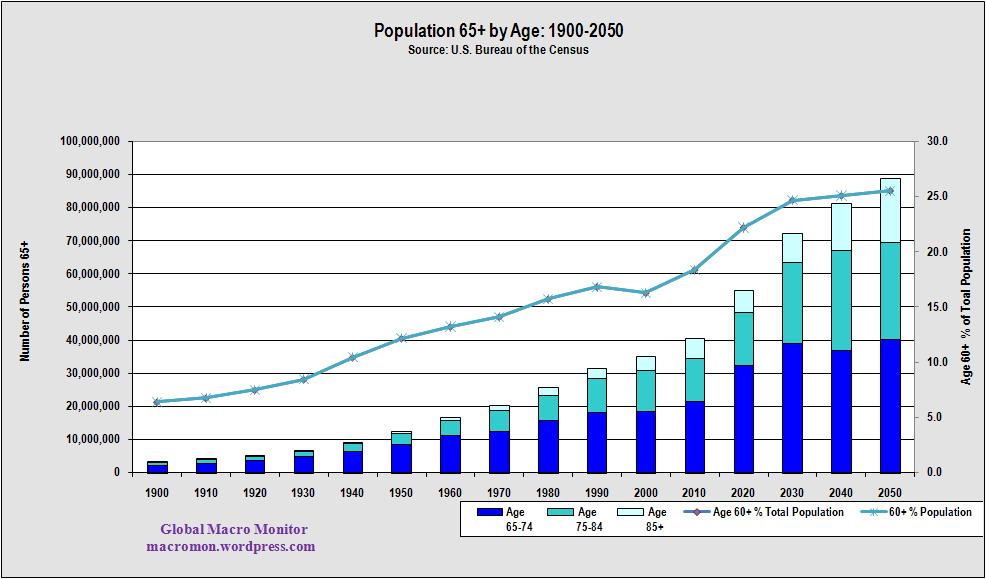
In the spirit of our earlier post, The Clash of Generations, we point you to an interesting piece, Geiatric Deadbeats, written by Ali Alichi of the International Monetary Fund (IMF). He argues the age of a country’s population is inversely correlated with a sovereign government’s willingness to pay its debt obligations.
Because holders of sovereign loans and bonds generally have no explicit recourse to hard assets or a “sovereign balance sheet” in the event of default, a debtor government’s willingness to pay is almost as important as its ability to pay. Go no further than Europe or the debt ceiling negotiations in the U.S. Congress for confirmation.
Mr. Alichi writes,
Studies have shown that a country’s willingness to repay is as important as whether it has the resources to repay. This willingness deteriorates as voters age because they have a shorter period to benefit from their country’s access to international capital markets and become more likely to opt for default on current debt. Moreover, older voters generally benefit more from public resources—such as pension and health care benefits—which could shrink if debt is repaid. If the old are a majority, they might force default, even if it is not optimal for the country as a whole. Lenders will take this into account and reduce new lending to an aging country.
Thomas Friedman spoke yesterday in his New York Times column of the “powerful sense of ‘baby boomers behaving badly’ and their legacy of the “incredible debt burden and constraints” they will leave on their children. According to Mr. Alichi this bad behavior of the boomers may not end at retirement. He writes,
Now if the old are altruistic and care about their children as much as themselves, they will not vote for default with its negative consequences for future generations. But Altonji, Hayashi, and Kotlikoff (1997) have shown that altruism does not hold at the overall level in the United States—although there are few studies of this sort for most other countries.
The next ten years will surely be interesting. We at the Global Macro Monitor are baby boomers and implore our generation, at least, those who can afford it, to take one for the kids. If this means we have to play muni golf courses instead of Pebble Beach and Pinehurst and hitting Top Fiites instead of Pro V1s (sorry FILA) in our twilight years, so be it.

Mr. Alichi has some good ideas on how to improve our national credit profile. His piece is short and sweet and well worth your time. Click here for the article.
>

(click here if charts are not observable)

See the original article >>

Follow Us