Thursday, June 30, 2011

Major Index Correction Retracement Levels

by Bespoke Investment Group

The Nasdaq and Russell 2000 became the first two major US indices to retrace 50% of their declines from the May highs to the June lows. Below we highlight the various levels each index has to reach to surpass some of the more widely followed retracement levels. Green shading indicates levels which have already been surpassed.


See the original article >>

A Short Covering Rally?

by Bespoke Investment Group

We've been hearing from a lot of talking heads over the past few days that this has been nothing but a short covering rally. But has it really been? We broke the S&P 500 into deciles (10 group with 50 stocks each) based on a stock's short interest as a percentage of float and then calculated the average performance of the stocks in each decile over the last three days. Below is a chart highlighting the average performance of the stocks in each decile. 

The average S&P 500 stock is up 2.96% over the last three days. As shown below, the 50 stocks in the S&P 500 that are the most heavily shorted are up an average of 3.1% over this time period, while the 50 stocks that are the least heavily shorted are up an average of 2.8%. So while the most heavily shorted stocks have outperformed the least heavily shorted stocks, the difference has been minimal. The performance across deciles has been very scattered, with deciles 4, 6, and 8 doing the best, and deciles 2, 5 and 7 doing the worst. This has hardly been a short covering rally.

So which stock characteristics have been driving the market higher this week? Over at Bespoke Premium, we just released a B.I.G. Tips report where we ran our decile analysis on a number of stock characteristics including market cap, P/E ratios, dividend yield, institutional ownership, revenue exposure, analyst ratings, and more. Some of these characteristics have indeed impacted performance this week, while some (like short interest) have not. Bespoke Premium members can view the report here. If you're not a Premium member and would like to become one, subscribe today!

Why Europe Can’t Afford a Greek Haircut

By Global Macro Monitor

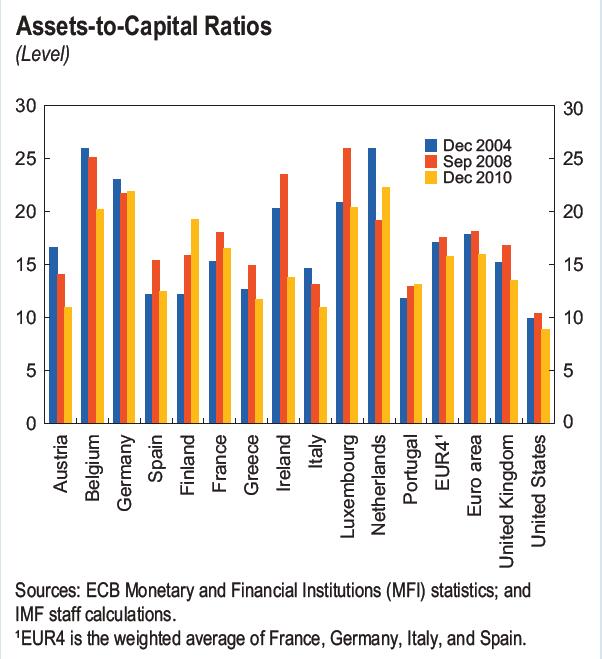
If a picture is worth a thousand words, the following chart from the IMF encapsulates all the analysis one needs to understand why Mr. Trichet and the rest of the Eurozone bureaucracy are so adamant about not letting Greece restructure its debt. The leverage ratios of some of Europe’s country banking systems are nothing less than stunning. At the end of the day, it was Lehman’s leverage coupled with its overexposure to a declining asset class that brought it down. Once the markets sniffed this Lehman’s liquidity was cut off and rest is history.

A Greek sovereign restructuring followed by, say Ireland and Portugal, and market speculation that Spain and Italy may be next, could bring down many of Europe’s thinly capitalized country banking systems. Fed Chairman, Ben Bernanke, believes the Great Depression was not caused by 1929 stock market crash, but by the the 1931 failure of Austria’s Creditanstalt. In a 2009 conversation with the Council of the Foreign Relations, the Chairman reflects,
I learned basically two lessons from my studies of the depression. The first is that monetary policy needs to be supportive, not contractionary…The second lesson is that — to reiterate what I said before, is that when the financial system breaks down, becomes highly unstable, then that has very severe adverse effects on the economy… The Federal Reserve did not intervene to stop the failure of about a third of all the banks in the United States. Globally, there were massive bank failures. I think perhaps the most critical, in May of 1931, the Creditanstalt, which was one of the largest banks in Europe, failed, which generated a wave of financial crisis around the world. Up till early 1931, arguably the 1929 downturn was just a ordinary — severe but ordinary downturn. It was the financial crises and the collapse of banks and other institutions in late 1930 and early 1931 that made the Great Depression great.
Does anyone hear the rhyme of history? These European banks can either raise new capital or shrink their balance sheets by reducing loans, for example, which, if done in mass, creates a credit crunch and an adverse impact on economic growth Hopefully, European policymakers are twisting the arms of these banks to reserve every single Euro of bailout money against loan losses as their Greek, Irish, and Portuguese sovereign bonds mature. This will require taking a hit to profits and pushback from the banks. Then, let the haircuts begin. That is, if the European political structure can endure for that long.

See the original article >>

Exclusive: U.S. small business borrowing surges


(Reuters) - Borrowing by small U.S. businesses rose at a record pace in May, data released by PayNet Inc on Thursday showed, a sign that economic growth is poised to pick up in coming months.

The Thomson Reuters/PayNet Small Business Lending Index, which measures the overall volume of financing to U.S. small businesses, rose 26 percent in May from a year earlier, PayNet said.

The index is now at its highest since July 2008, two months before the collapse of Lehman Brothers and the near derailment of the world financial system.

Borrowing by small businesses is seen as a harbinger for the broader economy because they account for as much as 80 percent of new hiring. The loans PayNet tracks are typically used to buy or update plants and equipment.

The Federal Reserve has kept rates near zero since December 2008 to try to pull the economy from the worst downturn since the 1930s.

Last week Fed officials reiterated their promise to keep rates low for an extended period, but predicted a slower-than-expected Spring would give way to faster growth later this year.

Dallas Fed President Richard Fisher on Tuesday said he expects 4 percent growth in the second half, more than twice the 1.9 percent pace in the first quarter.

Thursday's data on small business borrowing bears up that optimistic view. Changes in the index typically signal developments in the overall economy two to five months in advance.

"If small businesses are taking these kind of chances, taking risks, making long term investments, they are seeing some long-term opportunities on the horizon," PayNet founder Bill Phelan said in an interview. "That's got to be a big positive sign for the economy."

Separate data also released on Thursday showed small business loan defaults at their lowest in five years, tying records set in April and May 2006.

Accounts in moderate delinquency, or those behind by 30 days or more, fell in May to 1.95 percent from 2.06 percent in April, PayNet said on Thursday.

Accounts 90 days or more behind in payment, or in severe delinquency, fell to 0.59 percent in May from 0.63 percent in April.

Banks with improving asset quality outnumbered banks with deteriorating asset quality by four to one, Phelan said.

Accounts behind 180 days or more, or in default and unlikely to ever get paid, fell to 0.75 percent of total receivables in May, from 0.77 percent in April, according to PayNet, which provides risk-management tools to the commercial lending industry.

Chinese Homebuyers Throw a Life Raft to the U.S. Housing Market

By Jason Simpkins

From New York to Honolulu, Chinese homebuyers are swooping in to help salvage the U.S. housing market.

Indeed, California, Florida, New York, and even Hawaii have seen a marked up-tick in home sales to Chinese buyers who are exporting their country's real estate boom to the United States, according to Bloomberg News.

Increased regulation at home and education and investment opportunities are chief among the reasons real estate in the United States - as well as the United Kingdom, Australia, and Canada - has piqued Chinese interest.

According to a survey by the National Association of Realtors, Chinese buyers accounted for 9% of foreign home purchases in the 12 months ended in March of both 2010 and 2011. That's up from 5% in 2009.

"The purchase restrictions in China drove them overseas, while they look for investments to counter the inflation," Mo Tianquan, founder and chairman of Beijing-based SouFun Holdings Ltd. - a company that runs China's biggest real estate Website and organizes buying excursions abroad - told Bloomberg. "Some of them will buy homes considering better education opportunities for their kids, while others look for immigration options."

Take Cupertino, Calif., for example. Sales of existing single-family homes in Cupertino rose 21% in the first quarter from a year earlier, largely due to an influx of Chinese shoppers who are making huge cash purchases.

"We're seeing a huge number of all-cash transactions, and most of those are from mainland China," Nina Yamaguchi, managing broker at Coldwell Banker's residential office in Cupertino, told Bloomberg. "The thing that draws the Asians here is the schools are so highly touted. Cupertino is certainly not beautiful. It doesn't have wonderful architecture." 

Of course, education isn't the only reason many Chinese people are seeking abodes abroad. They're mainly concerned with the high prices and increasingly strict regulations they're finding at home, and looking for better investment opportunities.

Bailing on the Bubble

China's housing market certainly seems to have gotten ahead of itself.

Goldman Sachs Group Inc. (NYSE: GS) said in a recent report that housing price increases have outpaced wage hikes by 30% in Shanghai and 80% in Beijing in recent years.

The value of homes sold in the first quarter of 2011 increased to $132 billion (860.7 billion yuan), driving overall property transactions 27% higher to $157 billion(1.02 trillion yuan), according to the Statistics Bureau.

Overall investment in China's real estate market rose 34% to $136.4 billion (885 billion yuan) in the first quarter.

Furthermore, UBS AG (NYSE: UBS) economist Jonathan Anderson estimates that property construction alone accounted for 13% of gross domestic product (GDP) in 2010, twice the share of the 1990s. That means China's economy has grown increasingly vulnerable to a real estate bubble.

As a result, China's government over the past year has sought to cool the housing market by increasing regulation.

In January, Beijing raised the minimum down payment for mortgages on second homes to 60% from 50%. The government has also increased down payment requirements on homes that cost more than $770,000 (HK$6 million) and enacted China's first property tax.

However, the measures have had only a modest effect. Annual property inflation eased to of 4.2% in May - its slowest pace this year, but down only slightly from April's 4.3%.

And the value of home sales climbed 16% in the January-May period, as property investment rose 35%.

An Investment Opportunity

Higher prices and tougher regulations at home may be the biggest reason many Chinese homebuyers have sought shelter overseas, but it's not the only reason. There's also an investment aspect.

"The majority of these buyers are not buying trophy properties, but cash flow as they understand fundamentals," Andrew Waite, publisher of Personal Real Estate Investor Magazine. "They are buying managed turn key rental properties. One of my clients is selling about 25 homes a month to Asian buyers at an average price point of $60,000 with positive cash flow. They understand that rental real estate offers one of the few inflation indexed assets available with inflation-indexed income."

Indeed, one of the most popular properties among Chinese buyers is the Trump SoHo in New York. The Trump SoHo is a condominium hotel where the apartments are rented out as hotel rooms for more than half the year and owners share the revenue.

"Chinese love the Trump," Asher Alcobi, president and co-founder of Peter Ashe Real Estate, told Bloomberg. "Anything that has the Trump name is good."

Given the huge mark-up in Chinese real estate, even luxury properties in New York look like a bargain.

"From a price perspective, New York is actually cheap," Wei Min Tan, founder of Castle Avenue Partners, a group within New York's Rutenberg Realty that assists buyers from overseas, told Bloomberg. "Hong Kong is 50% more expensive than Manhattan on a square-foot basis."

Other pricey assets in Las Vegas and Honolulu have garnered a lot of attention as well, helping to stabilize home prices across the country.

And that help is desperately needed.

Sales of previously owned U.S. homes fell 3.8% month-over-month in May to an annual rate of 4.81 million units - the lowest level since November. Home resales were down 15.3% in the 12 months through May.

Meanwhile, the median price for a home fell 4.6% year-over-year to $166,500. That compared with a 6.6% decline in April.

Three Ways to Slash Your Risk Despite the Negative Investing Outlook

By Keith Fitz-Gerald

With everything from the Greek debt crisis to worries about China's growth roiling the markets these days, the investing outlook seems to get shakier by the minute. And that means the same old tricks won't work any longer.

It's not going to be enough, for example, to simply pick stocks or spread your risk among large-cap, small-cap and a blend of domestic and international stocks and bonds thrown in for good measure.

Those things don't work when everything goes down at the same time - a painful reality that investors experienced during the financial crises of 2000-2003 and 2007-2009.

If we've all learned one thing from those crises, it's that stability matters when it comes to producing higher, more consistent returns - especially in a world in which the investing outlook is clouded by uncertainty.

But there are three strategies that can bolster your personal investing outlook and help you even out the rough sailing I see ahead.

Let me show you what I mean.

Three Strategies You Can't Ignore

The three strategies I'm talking about represent a break with the so-called "tried-and-true" approaches that were once in every investor's playbook, but don't seem to work so well in today's markets. So I'm recommending that you replace those old tactics with these three new ones, which will have you:

  • Build your own "hedge fund."
  • Adopt a "long/short" bond strategy.
  • And consider a solid "alternative" to alternative investments.
Let's take a look at each one - starting with the personal hedge fund.
Creating your own hedge fund is actually much simpler than you'd think. To illustrate, let's take a look at how a portfolio that was evenly apportioned in large caps, small caps, growth, value, domestic and international stocks (in other words, a portfolio allocation that's fairly standard fare among investors) would have performed from 2007 to 2009, a period in which the Standard & Poor's 500 Index declined "only" 50%, according to Kiplinger's Personal Finance Magazine.

This portfolio - diversified in a way that's supposed to diffuse risk - would actually have plunged a full 57% during that same stretch.

The message is clear. In a world in which entire countries are leveraged to the hilt, in which out-of-control financial institutions are calling the shots, and in which clueless regulators are playing a constant game of catch-up, that diversification strategy is no safe harbor.

What you really need to do is seek out investments that move in opposite directions when the investing outlook turns negative.

Hedge funds do this all the time by combining investments that are in favor with those that aren't - pairing those things they like against those things they don't in what's called a classic "long-short" strategy. This helps them generate higher, more-consistent profits - regardless of whether the markets want to run higher or fall lower. And it's a strategy that doesn't force you to try and "time" the markets, or take excessive risk.
You can do the same thing using two investments that are among my personal favorites:

  • The Vanguard Wellington (VWELX).
  • And the Rydex Inverse S&P 500 Strategy Fund (RYURX).
Vanguard Wellington is one of the world's best-run mutual funds and has a remarkable track record of stability, solid returns and high income that dates back to 1929 - making it one of the longest-established mutual funds in existence today. At a time in which exchange-traded funds (ETFs) are all the rage, many folks scoff at old-fashioned mutual funds. But with an expense ratio of only 0.30%, the Vanguard Wellington is one of a very few funds I believe to be worth it.

The Rydex Inverse S&P 500 Fund is one of a specialized class of so-called "inverse" investments, and is truly "negatively correlated" to the markets, which means that it rises when the S&P 500 falls. Its expense ratio is 1.44%.

For the sake of discussion, let's say you put $50,000 in each on Jan. 1, 2000, and then let the funds ride undisturbed until June 24 of this year. Combined, you'd have an expense ratio of 1.74%.

But even more important, you'd have a 4.18% return over the last 11 years - compared to the S&P 500, which suffered a 12% decline (see accompanying chart).


In other words, had you split your money between these two negatively correlated choices on Jan. 1, 2000 - and just walked away - you'd have trounced the S&P 500 by nearly 16.2% over the last 11 years. That's a much simpler - and more effective - strategy than anything most folks were employing at the time, which was to diversify their money across the key asset classes and then just hold on.

In fact, this "personal-hedge-fund" (long/short) strategy would even have outpaced "indexing." Indexing was another investing strategy that was in vogue a decade ago, but has lost a lot of its following due to the currently uncertain investing outlook.

The classic "long/short" strategy as I've described it is a great choice for investors who are really worried about what may happen next. And it doesn't just work for stocks - you can use it for bonds, too.

In fact, let me show you how.

The Investing Outlook for Fixed Income

Many investors, particularly those who are closer to their sunset years, are loath to get back into the stock market in any way, shape or form - especially given the current investing outlook. It doesn't help that many of these same investors saw their stock-market holdings get "halved" twice in the past 10 years.

So these folks have turned to bonds and the income they provide as a means of sustaining themselves.

The problem with this strategy is that our nation is literally drowning in debt and the bond market is every bit as suspect as the stock market - and maybe even more so, given that Team Bernanke at the U.S. Federal Reserve seems hell-bent on keeping interest rates artificially low as part of its well-intentioned but badly flawed "all gain - no pain" bailout plan.

The good news is that bond investors, like their stock-investing brethren, have alternatives. That's especially true if they want to use a bond-only variation on the classic "long/short" strategy we've just discussed.

My favorite choice here is the Forward Long/Short Credit Analysis Fund (FLSRX), which takes both long and short positions in municipal bonds, corporate bonds and U.S. Treasuries. It can also invest in interest-rate swaps, credit default swaps, futures, options and even sovereign debt.

It's net annual expense ratio is a high 3.22%, according to YahooFinance, but the 4.41% yield and beta of 0.09 help make up for that when it comes to stability.

In fact, since its inception in 2008, the fund has demonstrated very little, if any, correlation with the bond markets - which is exactly what we want and is just why I'm suggesting it.

The Forward Long/Short Credit Analysis Fund is best-suited to investors who want to hold bonds, or must hold bonds, but who are concerned by the risks associated with potential bond defaults, or the rising interest rates and inflation ahead.

One Last "Alternative"

With one eye on the recovery and one eye on the monster that may surface from under their beds, investors have gotten a lot more interested in alternative investments.

That's good because most investors have historically ignored alternative investments. But it's also bad because investors often have an overly narrow view of what an alternative investment can be. Too many investors view commodities as the only type of alternative investment, and commodities can be every bit as volatile as the overall markets - and sometimes even more so.

That's why I think making a slight refinement to include an "alternative alternative" makes sense.

Take the Calamos Market Neutral Income A (CVSRX), for instance. As the name implies, the fund's goal is to provide a neutral approach to markets that is considerably less volatile than traditional asset-class-based alternative choices. Instead, the fund diversifies itself by investment methods that include covered calls and convertible arbitrage.

This fund offers the best of both worlds for investors interested in bond-like income and steadier returns.

The beta is an ultra-low 0.39 versus the broader market (which carries a beta of 1.0), so I'd say the fund's strategy is paying off. The fees are 1.39% a year, but it seems to me the Calamos investors are definitely getting what they're paying for.

There is a bit of a wrinkle with this investment, however: If you're interested, you're going to have to put the Calamos fund on your "wish list." The fund closed to new investors on Jan. 28, and remains so, while management waits for the investing outlook to change - for interest rates to rise and U.S. companies to resume issuing new convertible debt in earnest.

See the original article >>

Follow Us