Monday, June 27, 2011

The Contagion Risk of Europe

By John Mauldin


The Contagion Risk of Europe
Will the Euro Survive?
A Greek Coup?
No Good Deed Goes Unpunished
Home Again, Home Again


I am back from Europe. The last three weeks I spent quite a bit of time talking with money managers and investors from a lot of countries, as well as numerous locals about the European situation. This week’s letter is a collection of my thoughts, as I recover from jet lag. I expect the letter will thus be shorter than usual, but hopefully a few pithy comments will emerge. But first…

As you know, I am a firm believer that the state of the global economy is such that we as investors have to be especially agile and focused today. Consequently I spend a great deal of time and effort looking into alternative investment strategies and managers. I’m very pleased to announce that I am relaunching my special newsletter for accredited investors, to share the latest opportunities and pitfalls in alternative assets.

The good news is that this Accredited Investor Letter is completely free. The only restriction is that, because of securities regulations, you have to register and be vetted by one of my trusted partners before you can be added to the subscriber roster. They include Altegris Investments in the US, Absolute Return Partners in Europe, Nicola Wealth Management in Canada, and Fynn Capital in Latin America. This is a painless process (I promise!), and just to sweeten the pot, after you register my partner will provide you access to the video of Gary Shilling’s speech from my Strategic Investor Conference in La Jolla, as well as those of Martin Barnes and David Rosenberg; and we have just added Louis-Vincent Gave, who focused on China. These guys are all great speakers with absolutely compelling presentations.

I do not like limiting the letter to accredited investors, but those are the rules under which I work. This is not of my choosing, and I have worked in front of and behind the scenes to try to change what I think is a very unfair rule. (See important risk disclosures below. In this regard, I am president and a registered representative of Millennium Wave Securities, LLC, member FINRA.) And now to the letter.


The Contagion Risk of Europe

Bernanke gave another press conference after the FOMC meeting this week. Taking his time to address the situation in Europe, and the increased urgency of the crisis in Greece, Bernanke said US bank exposure to Greece was minimal and only indirect, via positions in large, core-nation banks in Germany and France. Raising a red flag, the bearded academic said that money-market mutual funds had substantial exposure to those same banks and could take a big hit if push came to shove in Europe. “A disorderly Greek default would have significant effects on the US” economy, he added.

About the only thing there was seeming consensus on in Europe was that Greece will eventually default. The question is when. European leaders, along with the IMF, have caved and will give Greece €12 billion to tide them over while they debate on finding €70-100 sometime late next month. By some accounts that amount will have to be a lot more. Meanwhile, the ECB is adamant that Greece cannot be allowed to default.

The whole process is somewhat akin to trying to help someone who is drunk by giving them another bottle of whiskey. Trying to cure a problem of too much debt with even more debt is simply irrational, and everyone but Europe’s leaders can see that. So why are they doing it?

Because if Greece is allowed to go, there is real reason to believe that the problems will spread rather quickly to the rest of peripheral Europe. By the way, it is not just French and German banks that US money markets have exposure to; there are a lot of Spanish banks that have issued commercial paper as well. And my sources told me that many of the state-owned German Landesbanks are essentially insolvent, with massive amounts of sovereign debt. By the way, another source notes that US money-market funds are not rolling over the commercial paper to some of the banks (like Spanish ones), so there is a liquidity squeeze coming to European banks in peripheral countries.

The ECB has taken on some €100 billion of Greek, Irish, and Portuguese debt, if I remember the number right. They have capital of only about €10 billion. They want to take on even more debt from the banks, as the banks are using sovereign debt as collateral. The whole process is a way to paper over the fact that many European banks are essentially insolvent if they have to mark to market their Greek debt.

I think it is a given that in the near future Ireland is going to tell the ECB that the line item on their balance sheet for €60 billion that says “Loans to Ireland to bail out their banks” should be moved from the line that says loans to the line that says capital. They will simply walk away from the debt. “Here are the keys to your banks. What are you going to do with your banks?”

Let’s assume (generously) that there is only a 50% haircut on Greek debt. Add in the Irish debt, assume a smaller haircut on Portugal, at least initially, and you can easily get to €100 billion in losses for the ECB. That makes Lehman look like small potatoes.

The ECB would either be forced to print money to cover the losses or have a massive capital call to ECB members. Germany is 27% (again, from jet-lagged memory), so their portion would be a mere €27 billion. How do you think that will play with the voters in Bavaria? The ECB was not supposed to take on bad debt, according to its original charter. More than one person speculated to me that Germany might simply use that as an excuse to leave the euro. Not by the current set of politicians running the place but the new set that will be elected when things go bad.

And printing? Not all that good for the value of the euro.


Will the Euro Survive?

We had dinner on Monday night at the home of Hervig von Hove of Notz-Stucki Bank, where I was speaking the next morning. There were 16 of us at the table, and these people represented a great deal of money as managers and investors. All very well-informed. We sat outside in perfect weather in the Swiss countryside. Charles Gave sat across from me at the middle of the table, and we talked and debated as the rest asked questions and offered opinions for 3-4 hours. The wine was flowing, and it was a most interesting evening. Now, with that set-up…

I was asked if I still thought the euro was going to parity with the dollar, and I said I did, although I was not sure what the euro would look like in three years, or who would be in it. There was some pushback from people who thought the dollar would be the weaker currency. So I asked for a show of hands as to how many people thought the euro would be higher in one year’s time. There were 6 hands raised, but one gentleman said he was actually abstaining. So I asked how many thought the euro would fall, and we got 12 hands. Yes, that is 19 votes for 16 people. Clearly there were at least three economists in the group who voted both ways!

Then someone asked Charles about the issue. Now, for those who have never had the extreme pleasure of time with Charles, he is a powerful, white-haired French patrician, and one of the better economists I know. Quite a brilliant thinker and not afraid to express his mind forcefully with a voice that sounds like God talking, with about the same assurance (note to self: never again follow Charles on a speaking stage).

“The question is entirely irrelevant” – punctuating the air for added emphasis. “The euro will not exist in a year. The whole thing was dysfunctional from the beginning.”

I suggested that was a tad bearish.

“Not at all. I think it is extremely bullish. The demise of the euro and the return of national currencies will allow for proper allocation of investments and resources. It is the best thing that could happen for the markets.”

I could not get him to commit to exactly how that process of dissolution would look.

“I didn’t create the euro so it is not my responsibility to solve the problem for them.”

But I cannot help but think that any exit by anyone from the euro will be disorderly, giving rise to Bernanke’s “significant effects.” Many European banks are simply not solvent if there are major sovereign defaults. The US banks have sold some $90 billion in credit default swaps on Greek, Irish, and Portuguese debt to European banks. That is supposedly balanced with other purchases of CDS, but my sources say that much of that insurance is from German Landesbanks. Yes, the same ones I mentioned above that are basically insolvent. We are joined at the hip to Europe. A European recession would certainly be felt here. And a credit event could cause the same problem as in 2008, as banks start to refuse to lend to each other again. Ugh.

The potential for a real crisis is far too high for comfort. It would mean another recession for sure, with the US already close to stall speed and global growth slowing. I hate to sound alarmist, but I am worried. Absent a problem in Europe, the US should be fine, if slow. And maybe European leaders can stall the crisis off longer, buying time for banks to move their debt to the ECB and raise capital. We have to really keep our eyes on this.

At some point, Europe needs to realize that the problem with Greece, Portugal, et al. is not illiquidity, but that they are insolvent and have few prospects for economic growth anywhere close to what is needed to solve their problems.

Europe would be better off just taking the money they are giving to Greece and using it to recapitalize their banks. Let Greece go. Give it up. Let them enter a 12-step program or whatever it is that insolvent nations do. That is harsh, but it is also the truth.

But there are very sad things going on. It is not just banks that are losers here. Pharmaceutical companies are starting to refuse to deliver to Greek hospitals, as they are up to two years behind on their payments. It turns out that Greece owes some €6 billion to private businesses like hospitals and simply cannot pay. Those costs are rising, and much of it is to hospitals for medical care supported by the government. They are issuing bonds (shades of California) for the debt in some cases, which sell for a discount of 50%, if they can be sold. And we thought finding €12 billion was a hard thing.

This is not just a Greek problem, it is a concern in many countries that are having financial difficulties.


A Greek Coup?

Now, time for some speculation on my part. For Greece to leave the euro, the politicians would have to make a rather serious decision. That will not happen overnight. The minute there was any speculation or a “secret” meeting of Greek leaders to discuss leaving the euro, the run on the banks would be massive and fast. It would all come down quickly.

To go back to the drachma would require a bank holiday for a week, and it would have to be a surprise move. About the only way for that to happen would be a military coup coupled with a bank holiday and promises to return to elections after the currency issue was solved. The current government does not have the votes or the power to declare a holiday and move to the drachma, or at least they don’t as I read it. Just a thought.


No Good Deed Goes Unpunished

Switzerland was irrationally expensive. Small Diet Cokes at the Mandarin Hotel were $12. That is not a typo. I get a full 12-ounce can on sale here for about $.25. A casual meal, not particularly outstanding, was easily $100. Taxis are outrageous, with a one-mile trip costing up to $70.

In the category of no good deed goes unpunished, the Swiss are suffering such high prices due to managing their country responsibly. Everyone wants the Swiss franc. It was about $1.20 for one franc. I remember when it was $.25. Then again, so was the German mark.

In the Biggest Loser category, the award for the central bank that made the worst trade in history goes to Switzerland, with losses of 21 billion francs in 2010, trying to keep the value of the franc down against the euro. That’s about $25 billion at today’s valuation.


Home Again, Home Again

I have been gone for 31 days, and it is good to be back home. And I am home for much of the next three months, at least the way it looks now. I have a speech at the Agora conference in Vancouver late July, and my annual trip to Maine to fish with my son at David Kotok’s event (with so many friends) in early August (which I will likely combine with a few days in New York). And not all that much travel in September, though that could change. That really sounds good right now, as I have almost 100,000 miles on American Airlines alone this year. I hope I can cut that down to about a third for the last half of the year.

Kiev was amazing. I don’t know what I was expecting, but what a vibrant place with lots of things going on and building everywhere. Our host, Andy Bain, came to Kiev in 1992, fresh from Yale with an MBA. He started going east in Europe and kept finding too many MBAs to compete with, until he got to Kiev. He now has some 20 companies and is quite successful.

He invited us to his annual company picnic on Saturday, at a lake park outside the city. There were about 200 people there. The unusual thing was how young the group was. I remarked on that to his CFO, who is only 38 himself. Who are all these young girls and guys?

He pointed them out: “This girl manages that company and that one has this account…” One woman started out as a receptionist two years ago and is now managing three national advertising accounts. I looked around. The only “gray hair” was the expatriates. It turns out that when Andy started, he had to hire young people who were trained under Soviet management styles and who would work. They were right out of college, and as the business grew they simply got promoted fast. Andy was essentially training a new generation. This was also an alumni picnic, so many people came who had been trained at his companies but now run other operations. Quite the eye-opener.

My son Trey had a great time, with so many young ladies in bikinis. Kiev may have the most beautiful girls of any city I have ever been to. I think Trey is thinking of learning Russian, which many of them spoke. He is certainly begging to go back. It was fun to have him on this trip. But for Dad, the best moment was when he said, “I have to learn another language. I don’t want to be stuck in the US all the time.” Italian? French? He now gets it. It made the whole trip worth it. I wish I had figured that out at 17. I truly regret not being multilingual. C’est dommage.

It is time to hit the send button. I have to start in tomorrow on the 400 emails that are still in my inbox. I owe a lot of people responses and will work hard to catch up, plus I have some writing to do, etc. While I love the internet and it has been very, very good to me, it has also got me busier than at any time in my life. But who’s complaining? It is a fun life! Have a great week.

Your happy to be home analyst,

Macro Week in Review/Preview 6/25/2011


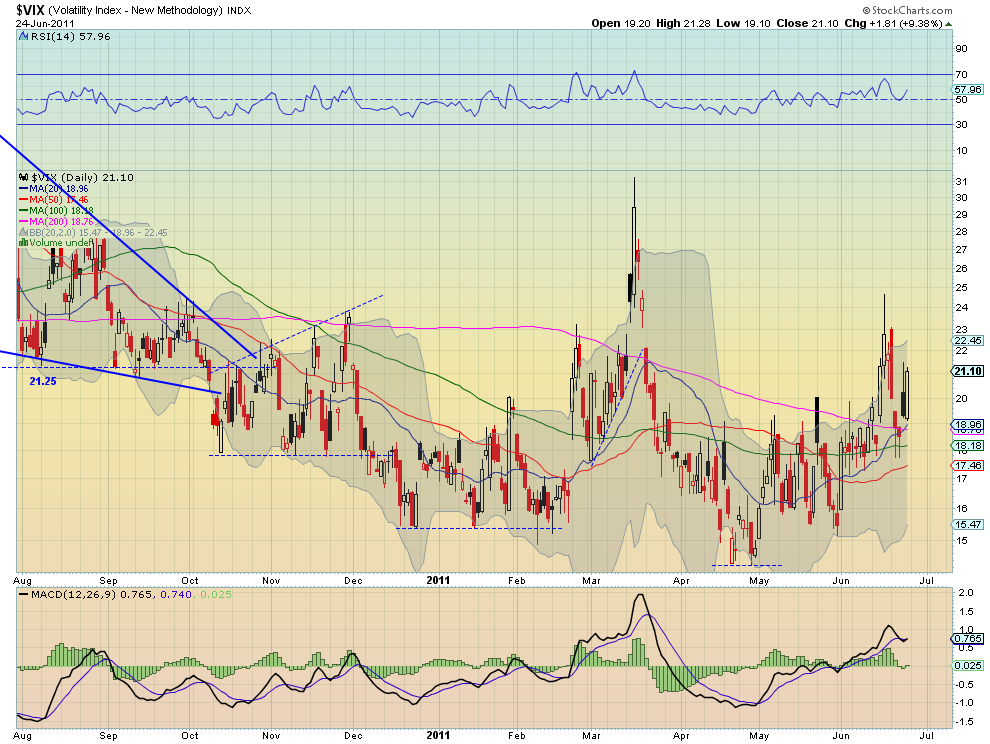
Last week’s review of the macro market indicators looked for Gold to drift higher while Crude Oil headed lower. The US Dollar Index was primed to continue its upside move while Treasuries consolidated with an upside bias. Both the Shanghai Composite and Emerging Markets should see continued weakness. The Volatility Index will be important next week and is poised to move higher. US Equity Index ETF’s, were mixed but generally biased to the downside. The QQQ is the worst looking with the SPY mixed but biased lower and the IWM looking as it may consolidate. A move in the Volatility Index over 24 could trigger coordination among the Index ETF’s and a move lower. Consolidation in the weaker Indexes should bring the Volatility Index back under 20 and could lead to a trend change. 

The week began with Gold and Oil acting as expected only to have Gold fall later in the week. The US Dollar Index and US Treasuries both behaved as the charts foretold. But while Emerging Markets continued lower the Shanghai Composite reversed higher at the end of the week. The Volatility Index continued to drift up as Equity ETF’s moved within their bearish ranges. What does this mean for the coming week? Let’s look at some charts. 

As always you can see details of individual charts and more on my StockTwits feed and on chartly.)

Gold Daily, $GC_F
gold d3 stocks
Gold Weekly, $GC_F
gold w3 stocks
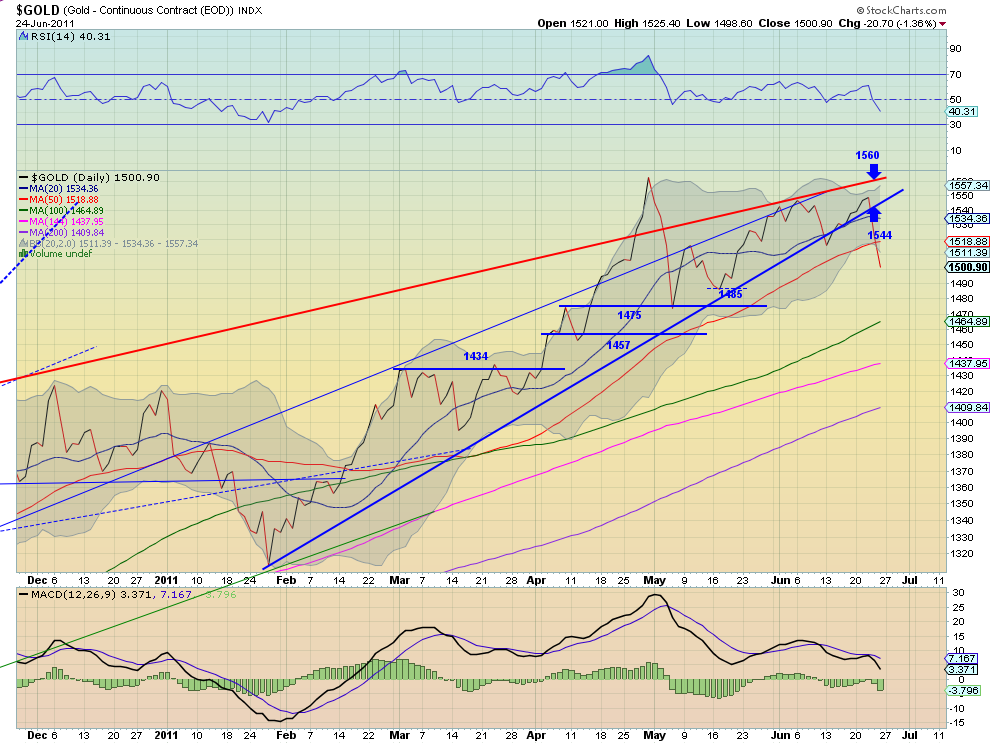
Gold had a rough week. On the daily chart it broke down through the rising wedge and is now through the 50 day Simple Moving Average (SMA) and the lower Bollinger band. The Relative Strength Index (RSI) and Moving Average Convergence Divergence (MACD) indicator both suggest more downside to come. 

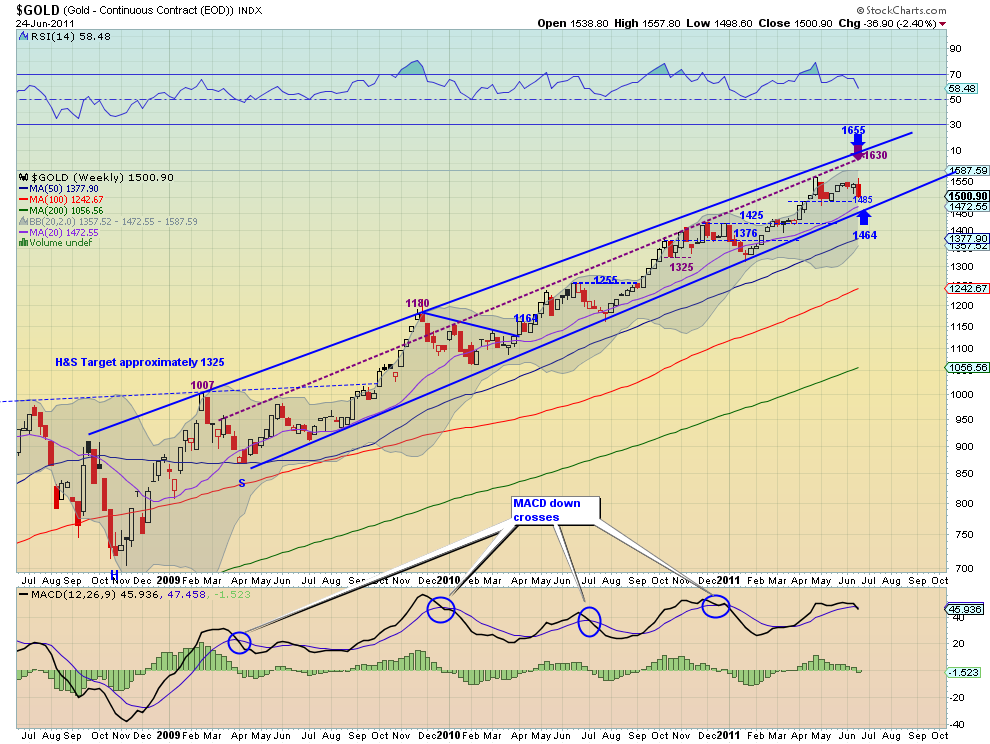
Stepping back to the weekly chart shows the long uptrend unaffected, but a definite consolidation move. The RSI on the weekly chart points to more downside and the MACD concurs with a bearish negative cross. Look for next week to bring more downside with support at 1485 then 1475 and the 100 day SMA at 1464 coinciding with the channel on the weekly chart. A move over 1544 would be bullish. 

West Texas Intermediate Crude Daily, $CL_F
oil d3 stocks
West Texas Intermediate Crude Weekly, $CL_F
oil w3 stocks
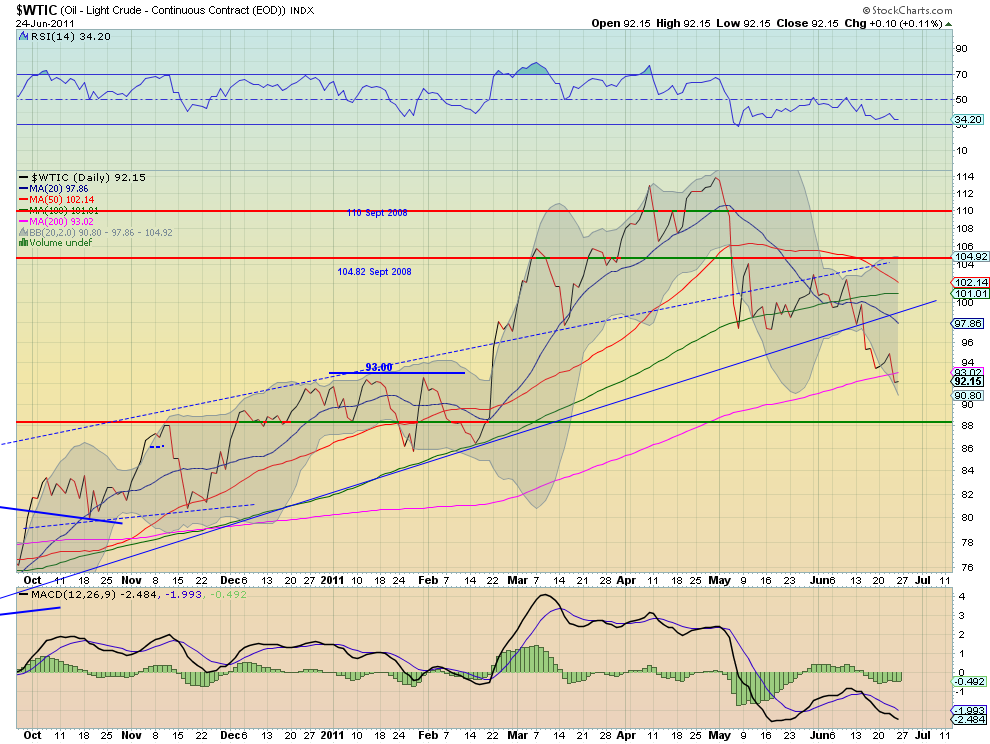
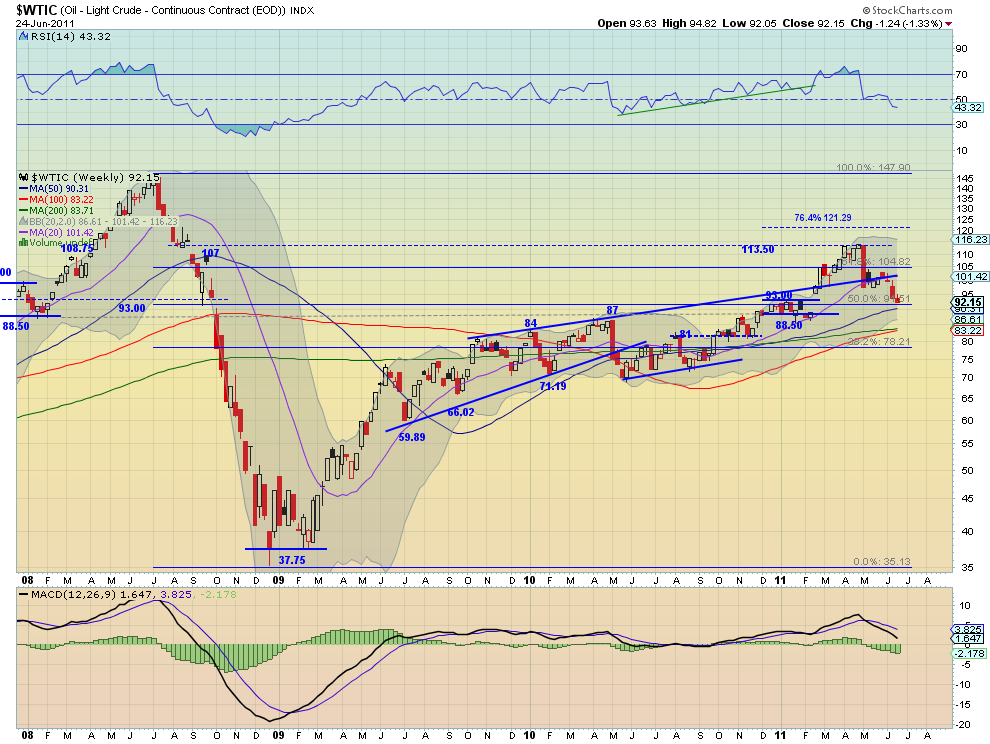
Crude Oil continued its fall out of the bear flag on the daily chart, now through the 200 day SMA. The RSI looks to be settling near 30 and the MACD has also leveled as is entered the previous channel between 88 and 93. The weekly chart shows this channel and that it’s mid point is the 50% Fibonacci retracement of the 2008 move. The RSI on the weekly chart suggests more downside as does the MACD. Look for Crude Oil to continue lower but to start to find some support by the bottom of the 88-93 range next week.

US Dollar Index Daily, $DX_F
usd d3 stocks
US Dollar Index Weekly, $DX_F
usd w4 stocks
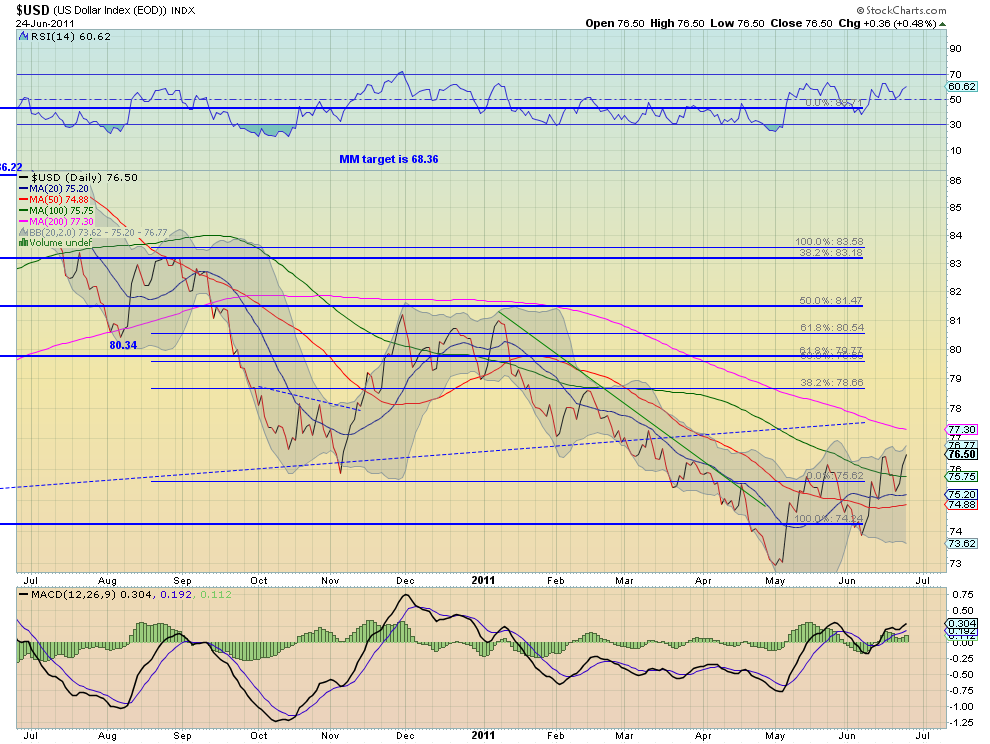
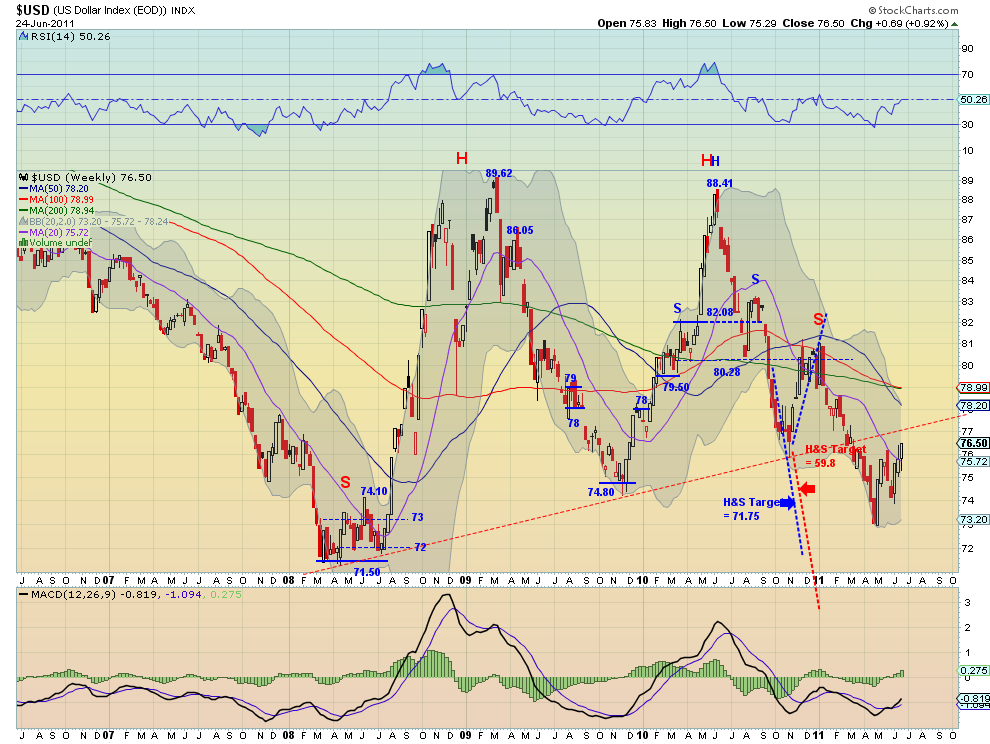
The US Dollar Index moved higher this week off of a higher low. It looks to be headed to test the neckline and breakdown level seen on the weekly chart near 77.10. The RSI on the daily chart is rising and the MACD is increasing. On the weekly chart The RSI and MACD also support more upside. Look for a test of the trend line higher next week at 77.10 and if through resistance higher at 78. A failure at the trendline will have Dollar bears piling in short with first support at 76. 

iShares Barclays 20+ Yr Treasury Bond Fund Daily, $TLT
tlt d3 stocks
iShares Barclays 20+ Yr Treasury Bond Fund Weekly, $TLT
tlt w3 stocks
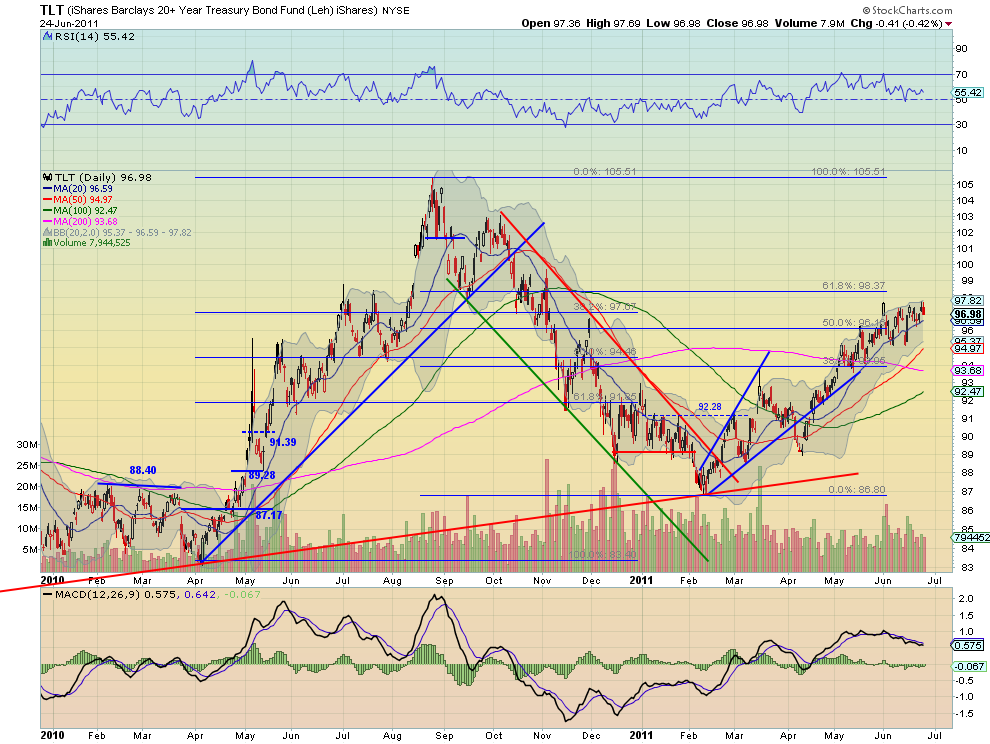
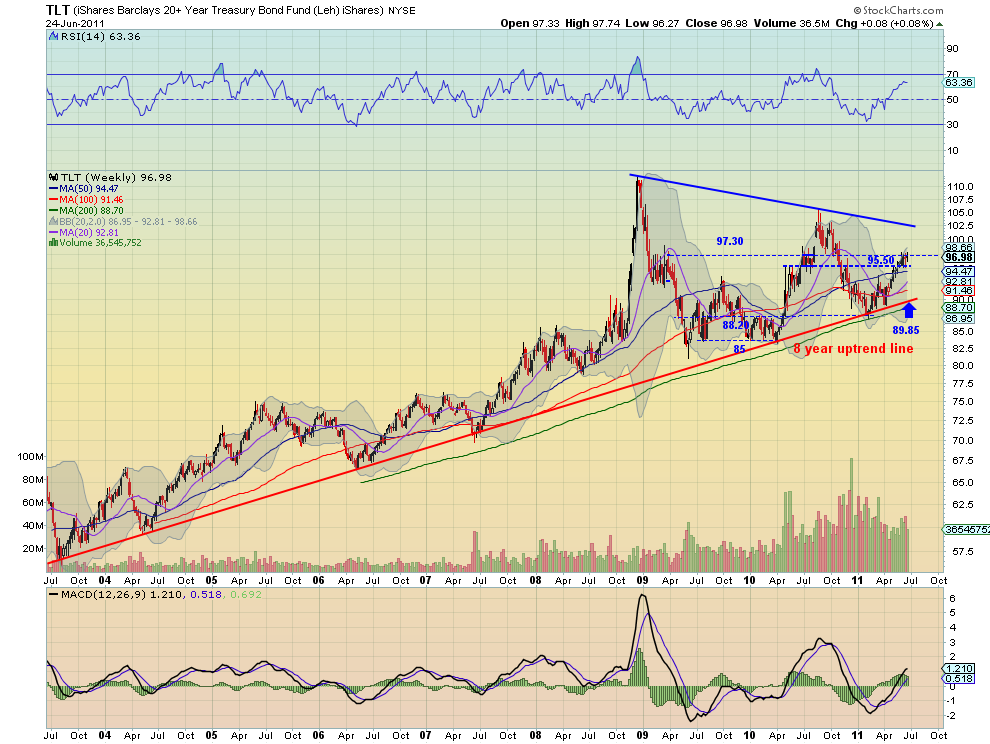
US Treasuries, measured by the ETF TLT, have been moving in a tight range between 95.50 and 97.30 for several weeks. The daily chart offers the tangle of Fibonacci retracement levels as an explanation. The RSI has held over the mid line maintaining a bullish stance and the MACD is fairly flat as it rides the 20 day SMA support higher. The weekly chart shows the consolidation range from this same time last year. The RSI is bullish and rising on the weekly chart and although the MACD is positive it is waning. Look for more consolidation between 95.50 and 97.30 with a slight bias to the upside for the coming week. If it can get through 97.30 then a test of 102.5, the top rail on the weekly chart will come shortly. 

Shanghai Stock Exchange Composite Daily, $SSEC
ssec d2 stocks
Shanghai Stock Exchange Composite Weekly, $SSEC
ssec w3 stocks
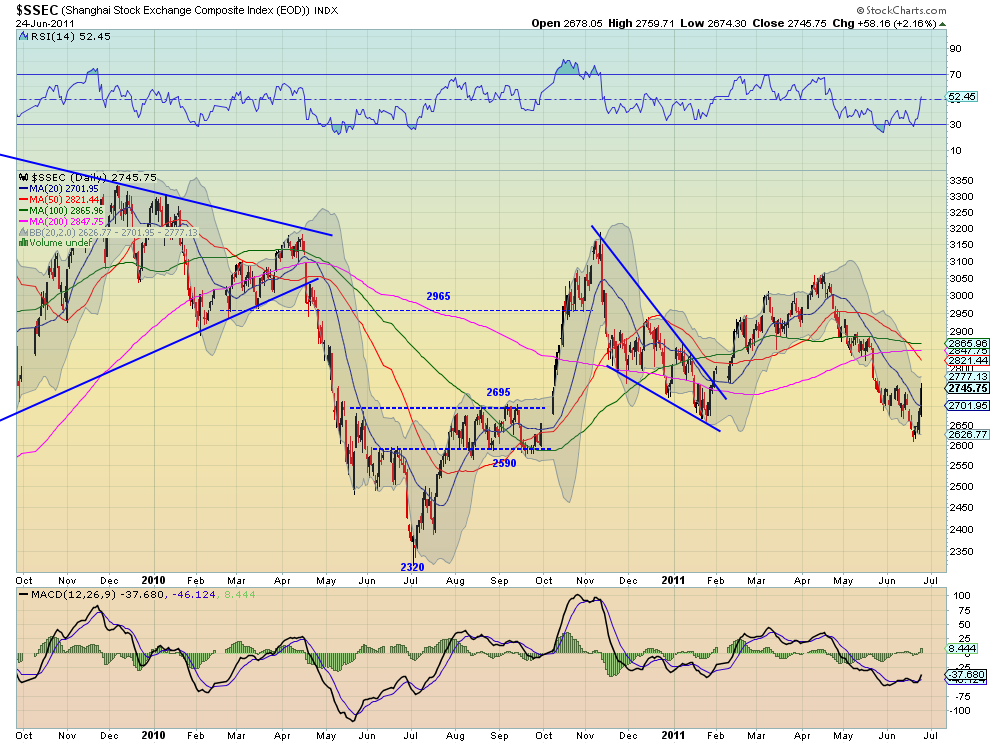
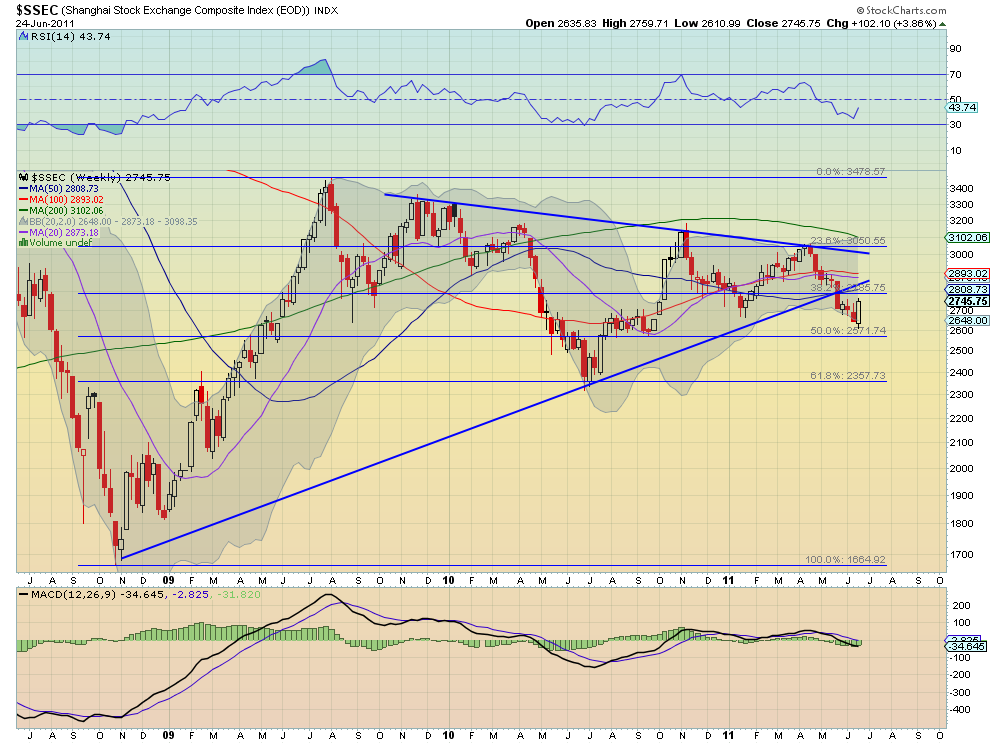
The Shanghai Composite found a bottom mid week and started higher with a vengeance printing two strong candles to end the week. The RSI and MACD on the daily chart suggest that there is more upside to come. The weekly chart shows it now likely to retest the break down level near 2800, with the RSI moving higher but the MACD lagging. Look for more upside next week with some possible roadblocks at the 2785 Fibonacci level and the 2800 lower rail and then the mid line of the symmetrical triangle at 2900. A fall back sees support in the 2590-2695 channel. 

iShares MSCI Emerging Markets Index Daily, $EEM
eem d3 stocks
iShares MSCI Emerging Markets Index Weekly, $EEM
eem w3 stocks
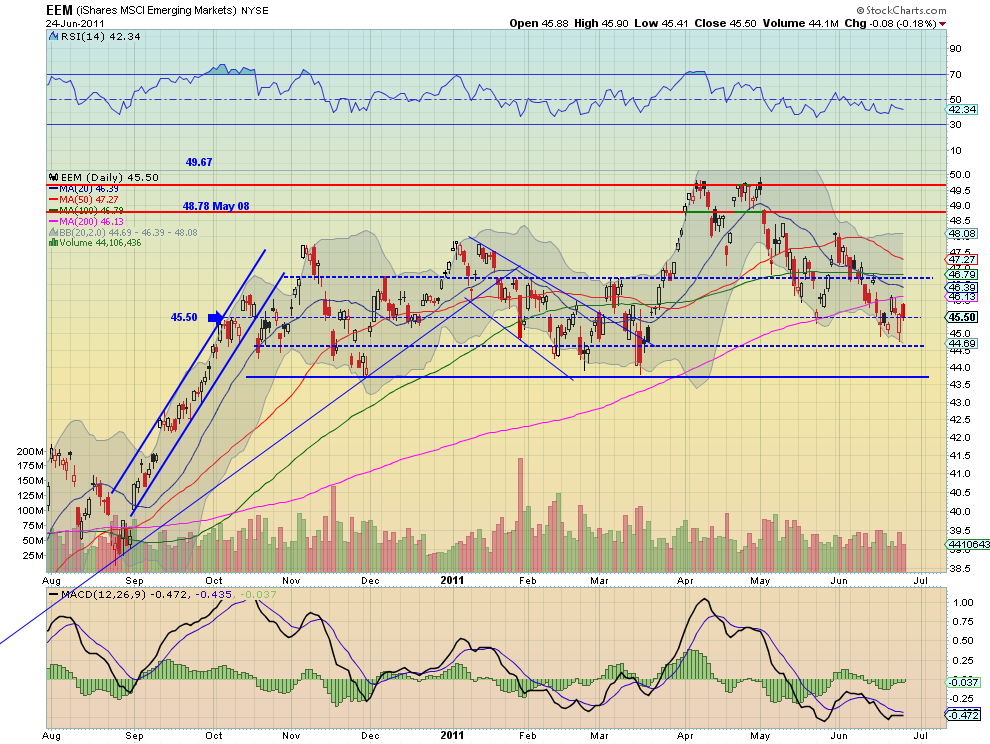
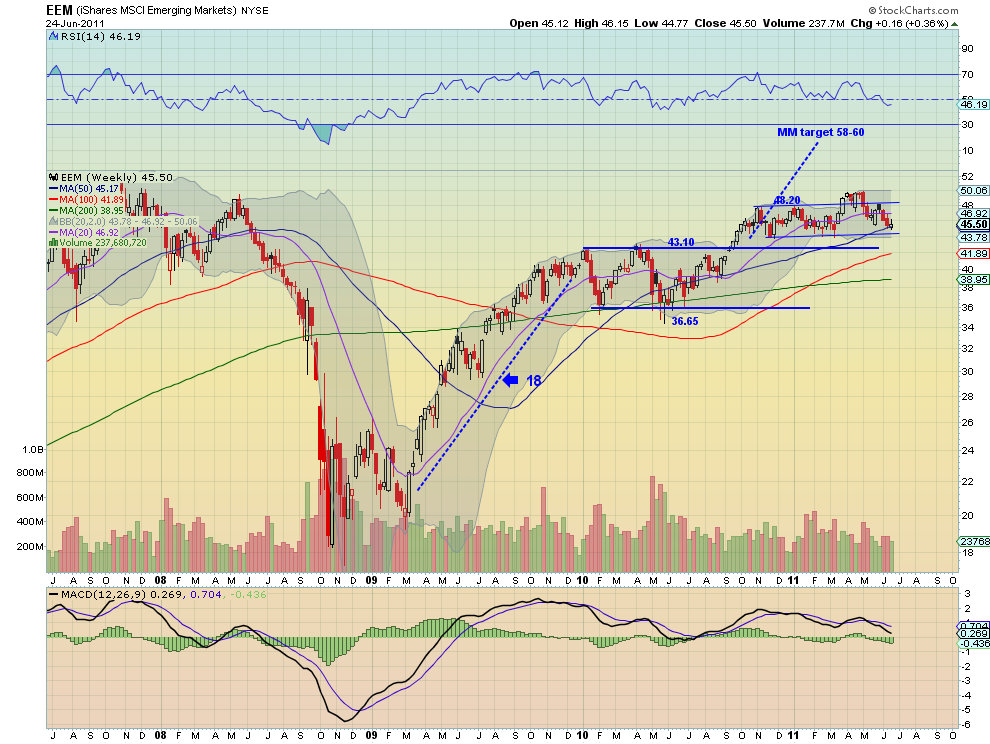
Emerging Markets, measured by the ETF EEM, are basing at the 45.50 support level after a third stair step lower. The falling RSI suggests that there will be another step, although the MACD has not confirmed as it is still decreasing. The weekly chart shows room lower to the small channel above the larger channel from 2010, with the RSI and MACD both pointing lower. Look for any upside move next week to be capped at 46.70 and the bias to be to the downside out of the consolidation, with support lower at 44.60 followed by 44.15 and 43.10.

VIX Daily, $VIX
vix d3 stocks
VIX Weekly, $VIX
vix w3 stocks
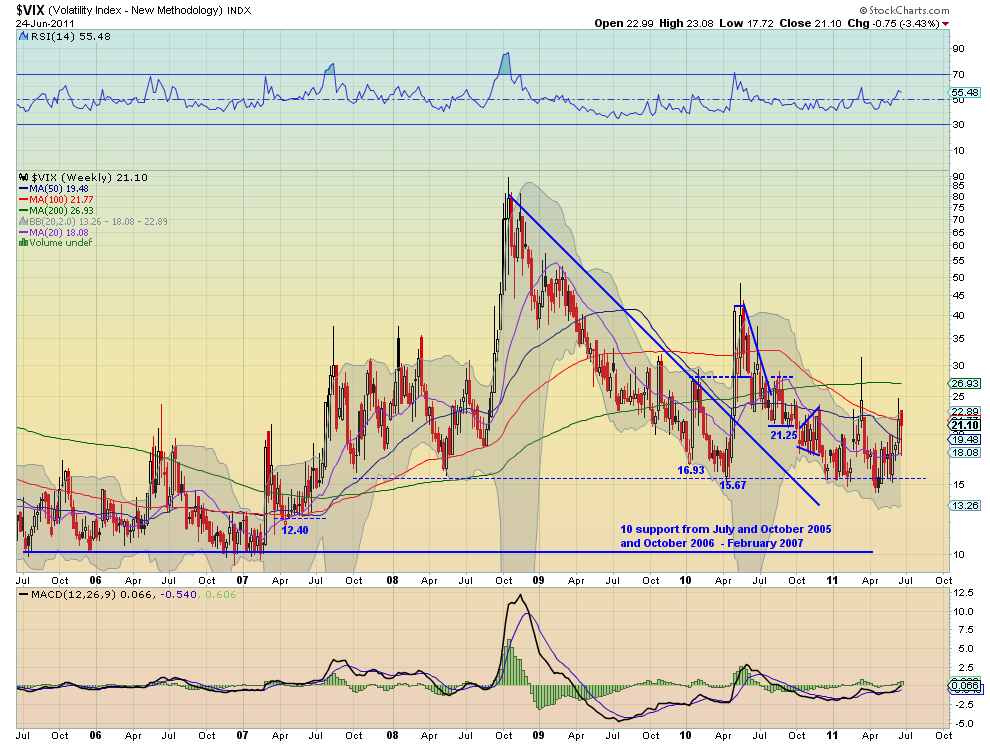
The Volatility Index continued its drift higher with a slightly tighter range for the week. It is now firmly above all of its SMA’s on the daily chart and near previous support/resistance at 21.25 with the RSI turning higher. The weekly chart also shows the continued move higher with the rising RSI and MACD. It is near the top of the Bollinger bands and near resistance. Look for continued low range to continue next week with a drift higher. Should the VIX get over 26 it would likely signal a sharp downturn in equities. 

SPY Daily, $SPY
spy d4 stocks
SPY Weekly, $SPY
spy w5 stocks
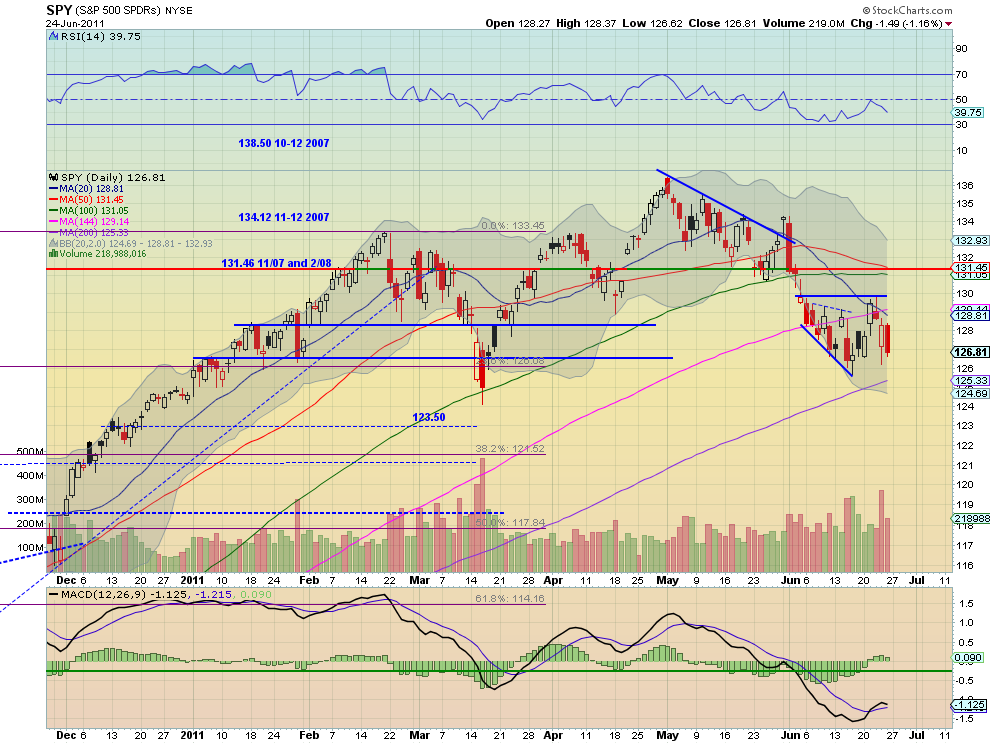
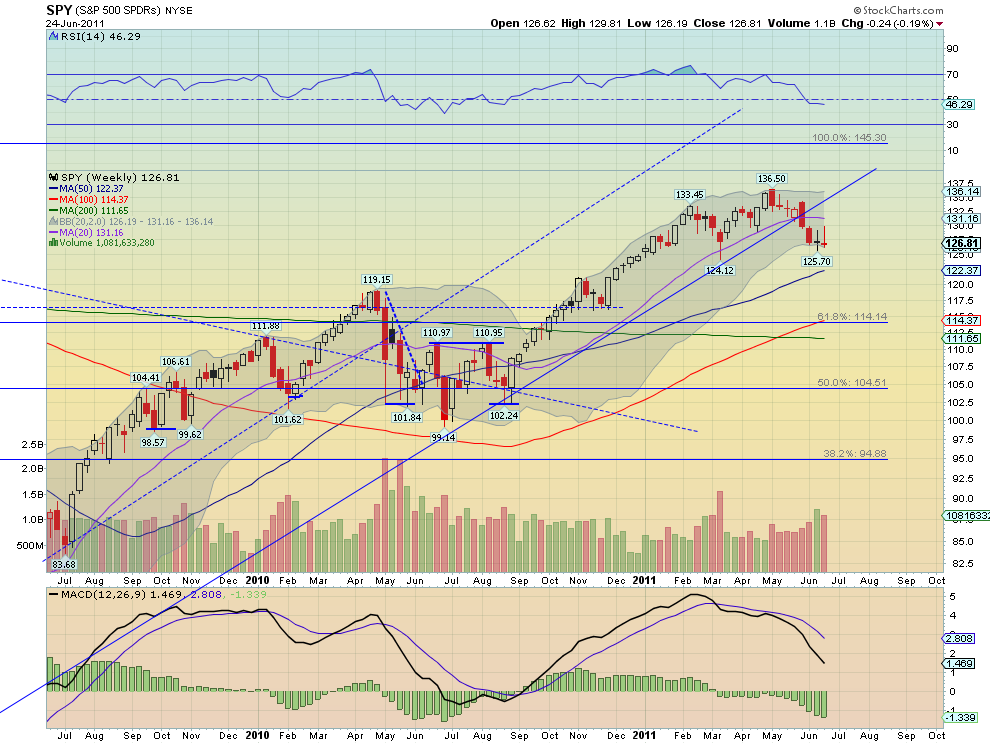
The SPY looked like it was going to break it’s fall this week only to end the week near the lows, with the expanding wedge still in tact. The RSI tested the mid line and rejected lower with the MACD ready to recross negative, pointing to more downside. The weekly chart shows a second doji week, building a bear flag, but signaling indecision with the RSI flat lined but the MACD diverging, pointing to more downside. Look for the SPY to continue to consolidate next week but with a slight downside bias and a move below 126.30 leading to another leg down with support at 125 and 123.50 below that. It would take a move over 130 to become bullish.

IWM Daily, $IWM
iwm d3 stocks
IWM Weekly, $IWM
iwm w3 stocks
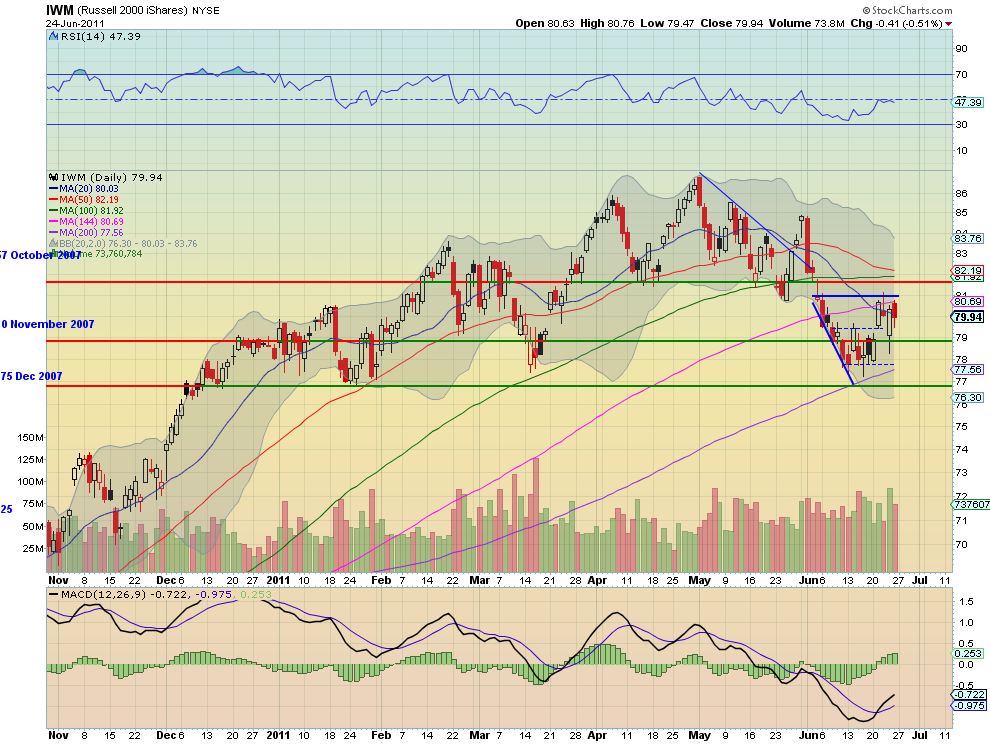
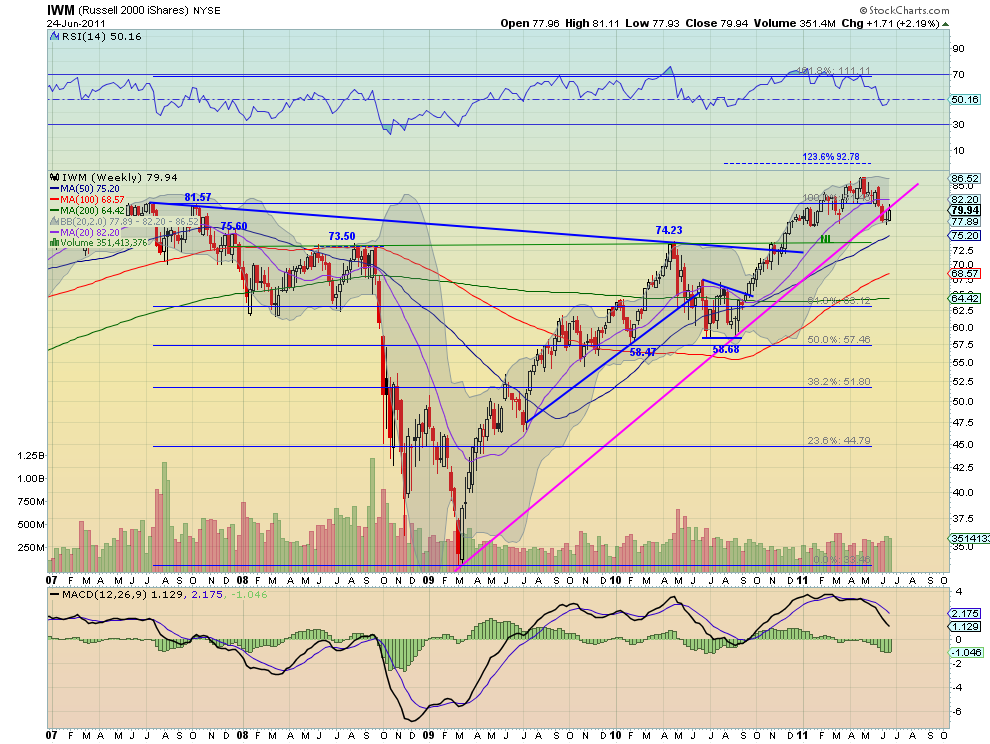
The IWM had even more promise to break it’s fall jumping from the basing channel but then unable to break through the top of the wedge. The RSI tested the mid line and flat lined with the MACD building , pointing to the upside. The weekly chart shows a move back to the trend resistance line, with the RSI turned up, but the MACD diverging, pointing to more downside. Look for the IWM to continue to consolidate next week but with a slight upside bias in the short term. A move below 79.10 and then 77.85 leading to another leg down with support at 76.75-77 and 75.50 below that. A move over 81 would shift to a bullish focus. 

QQQ Daily, $QQQ
q d3 stocks
QQQ Weekly, $QQQ
qqq w stocks
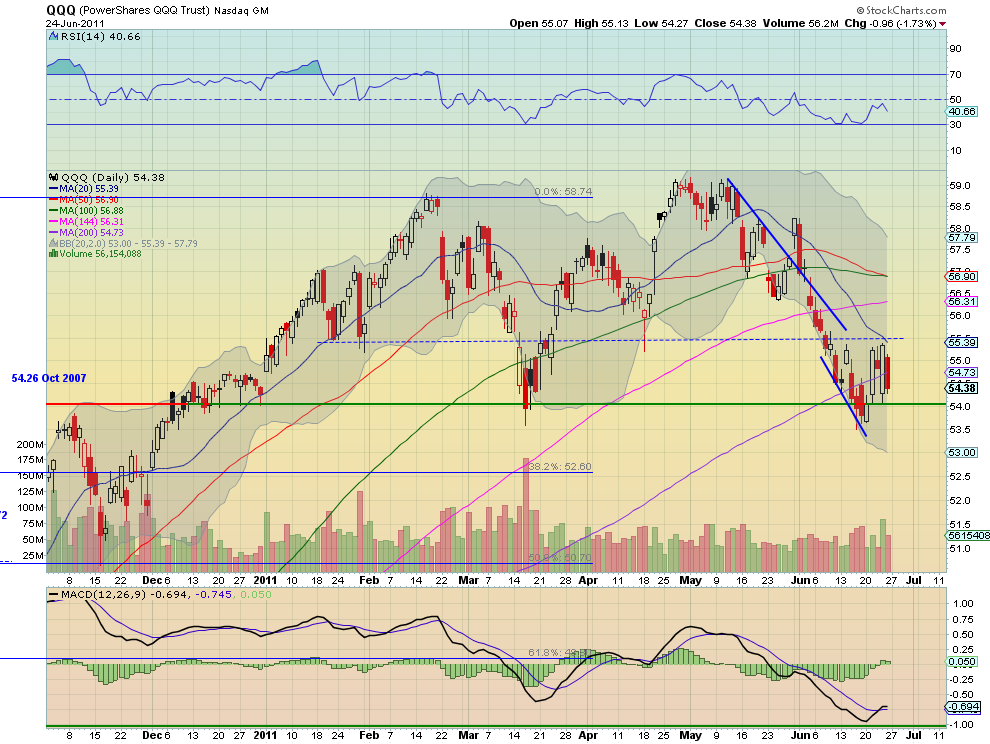
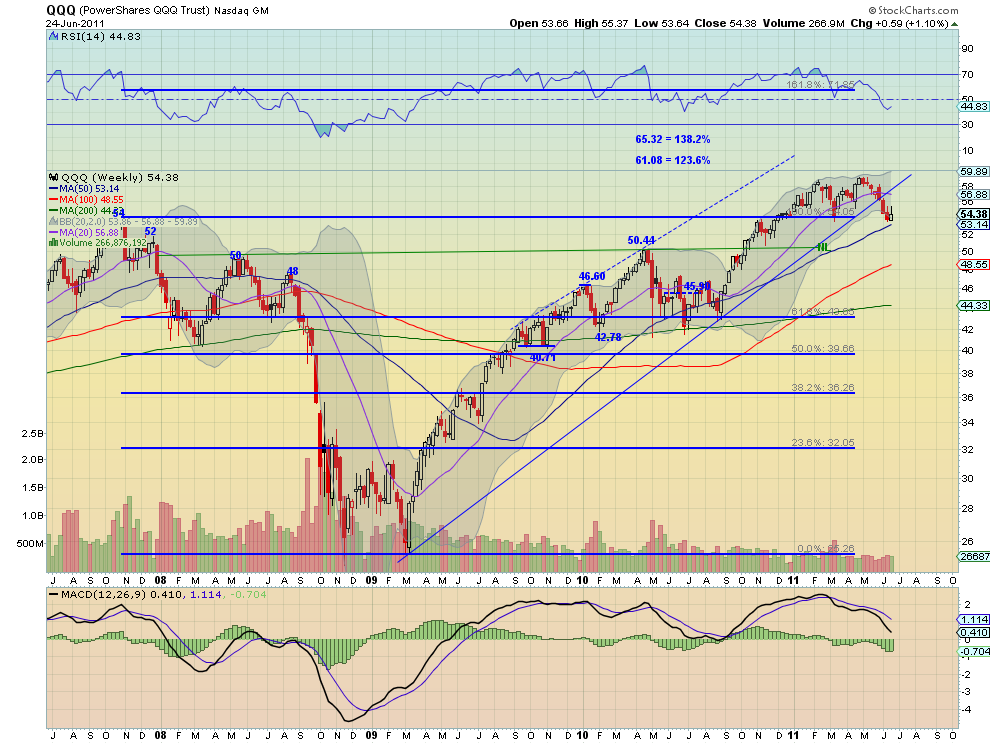
The QQQ also had a lot of promise to break it’s fall jumping from the base at previous support/resistance at 54.26 but then unable to break through the top of the wedge at 55.50. The RSI tested the mid line and rejected lower with the MACD crossing positive but then waning. The weekly chart shows a second Morning Star, but building a bear flag, signaling indecision with the RSI turning up but the MACD diverging, pointing to more downside. Look for the QQQ to continue to consolidate next week but with a slight downside bias. A move below 54.26 and then 53.60 leading to another leg down with support at 52.10. A move over 55.50 would shift to a bullish focus. 

The coming week looks to bring more red to Gold and Crude Oil, although likely at a slower pace in Crude. The US Dollar Index seems headed to a test with the 3 year trend line while US Treasuries look to continue to consolidate, but with an upward bias. The Shanghai Composite looks higher if only to retest the weekly breakdown level while Emerging Markets consolidate, with a chance of more downside. Volatility looks to continue to drift higher with a spike a possible signal of a further downside move in the Equity Index ETF’s. Otherwise they look to continue to consolidate but with the SPY and QQQ biased to the downside while the IWM is biased higher. Use this information to understand the major trend and how it may be influenced as you prepare for the coming week ahead. Trade’m well.

See the original article >>

U.S. Economy: Low Money Velocity Signals Troubles Ahead


Federal Reserve Chairman Ben Bernanke continues to be the enemy of savers. On June 23, the Boston Red Sox fan reiterated his belief that interest rates should be kept at rock-bottom levels for an extended period of time. He views this as necessary in order to keep the economy growing.

Part of Bernanke’s problem has been his inability to accelerate the pace of money movement, or velocity. Velocity is an economic measure of how many times a dollar is used to purchase goods and services. For instance, if I give you a $100 bill and you put it into your dresser, there is no real velocity. However, if you use it to make a repair on your car and then your mechanic spends the cash on buying a replacement part, velocity accelerates. Thus, there are advantages to sustaining a certain level of velocity.

An example more applicable to the current environment is the housing market. The National Association of Realtors reported a 3.8% decline in existing home sales and a 4.6% drop in home prices on Tuesday. A homeowner who cannot sell his house, either because he is underwater on his mortgage or simply can’t find buyers for a price he wants to sell at, has capital that is stationary.

The same homeowner is therefore unlikely to buy someone else’s house, much less spend additional money on items and services often associated with a home purchase. Thus, the capital tied up in the homeowner’s current house is not circulated back into the economy, thereby slowing velocity.

How slow is velocity currently? The chart below, from the St. Louis Federal Reserve Bank, shows the long-term trend in M2 money stock velocity. (This is the ratio of quarterly nominal GDP to the quarterly average of M2 money stock. M2 is a broad set of financial assets, including cash held outside of depository institutions, savings deposits, and money market accounts. Nominal GDP is economic growth that has not been adjusted for the impact of inflation.) The gray bars show when recessions have occurred.


As you can see, velocity is at historically low levels. Velocity is, however, just one snapshot of the economy and not a sole indicator you should rely on. However, when you factor in other signposts, a picture of money not changing enough hands is formed.

For example, economist Lawrence Yun complained about “overly restrictive loan underwriting standards” in the National Association of Realtors’ existing home sales press release. At the same time, U.S. corporations remain apprehensive about spending money, particularly when it comes to hiring, despite having large cash balances.

In simplistic terms, Bernanke’s hope is that if money is both cheap and accessible, velocity will eventually increase, thereby spurring growth. The short-term downside of his policy is that bond rates are staying at historically low levels. The long-term danger is that inflation will jump, forcing the Federal Reserve to hike up interest rates.

Though the fed Chairman’s margin for error is large and he has many detractors, we still don’t know what the actual end result will be. Many of you have assumptions, but the future is rarely what we expect it to be.

"Probably inevitable" a country will exit euro: Soros


(Reuters) - Billionaire investor George Soros thinks a country will eventually exit the euro zone and urged policymakers on Sunday to come up with a "plan B" that could rescue the European Union from looming economic collapse.

Soros, famous for making $1 billion by betting against the British pound in 1992, did not name any country he thought might exit the currency, but speculation is mounting about the fate of Greece as its politicians struggle to agree more austerity measures demanded by international lenders as the price for staving off bankruptcy.

Soros reiterated his view in a panel discussion in Vienna that the euro had a basic flaw from the start in that the currency was not backed by political union or a joint treasury.

"The euro had no provision for correction. There was no arrangement for any country leaving the euro, which in the current circumstances is probably inevitable," he said.

While he called survival of the European Union a "vital interest to all," he said the EU needed structural changes to halt a process of disintegration.

"There is no plan B at the moment. That is why the authorities are sticking to the status quo and insisting on preserving the existing arrangements instead of recognizing there are fundamental flaws that need to be corrected."

With a debt crisis in some peripheral members testing the EU's cohesiveness at a time of popular disquiet in wealthier countries over bailouts, he said leaders had to adopt measures now to remedy the situation.

"Let's face it: we are on the verge of an economic collapse which starts, let's say, in Greece but could easily spread. The financial system remains extremely vulnerable...

"We are on the edge of collapse and that is the time to recognize the need for change."

Some steps the EU could adopt included creating a larger central budget; directing some of the income from value-added tax or a levy on financial transactions to Brussels; having a European institution guarantee banks, and tripling the size of its bailout fund by topping it up with tax revenue, he said.

See the original article >>

Interest rates need to rise globally


(Reuters) - Global interest rates must rise to avoid high inflation becoming entrenched, the Bank for International Settlements said on Sunday.

It also warned that delaying deficit cuts could risk intensifying the sovereign debt crisis and have grave consequences were investors to lose confidence in a major economy such as the United States.

"With the arrival of sharper price increases for food, energy and other commodities, inflation has become a global concern," the BIS said in its annual report.

"Tighter global monetary policy is needed in order to contain inflation pressures and ward off financial stability risks."

Of the four major central banks, the European Central Bank is the only one which has raised rates since the intensification of the financial crisis in late 2008.

Central banks may have to raise rates at a faster pace than previously, BIS said, adding that as long as global growth is robust, food and commodity prices may remain high or even rise further.

The Group of 20 economic powers agreed in Paris on Thursday to tackle high food prices by boosting farm output, food market transparency and policy coordination, after world food prices hit a record high earlier this year.

The deal is another sign that global policymakers are reaching beyond traditional economic policy tools to sustain global growth, which has shown signs of slowdown in recent months.

BIS said inflation expectations suggest central banks' long-term credibility has so far survived the inflation surge, but added that rates have to rise to ensure this anchoring.

"The great danger is that long-term inflation expectations will start to climb, and current price developments and policy stances are sending us in the wrong direction."

The annual report also said the Bank of England should think about tightening its policy in the face of high inflation.

"In the United Kingdom, CPI inflation had exceeded the Bank of England's 2 percent target since December 2009," it said. "As yet, there has been no move by the Monetary Policy Committee, but one wonders how long its current policy can be sustained."

FISCAL TIGHTENING

Turning to fiscal policies, the BIS said that a major economy being drawn into the debt crisis could have catastrophic consequences.

"We should make no mistake here: the market turbulence surrounding the fiscal crises in Greece, Ireland and Portugal would pale beside the devastation that would follow a loss of investor confidence in the sovereign debt of a major economy," it said.

"The time for public and private consolidation is now."

It added that markets might not continue to view U.S. public debt as favorably as now were it to continue carrying heavy deficits.

"The current ability of the United States to easily finance its deficit cannot be taken for granted. Past examples of a number of smaller economies in deficit suggest that market confidence can evaporate quickly, forcing sudden and costly adjustment."

Emerging countries should do their part to reduce global imbalances by easing exchange rate pegs, the BIS said, adding that China should let the yuan appreciate against the dollar.

"The large costs of monetary instability mean that adjustment should principally work through more flexible nominal exchange rates," the report said.

"In the case of the United States and China, the costs of that adjustment would probably fall mostly on China."

The BIS also said that while extremely low interest rates help commercial banks, they can delay necessary action.

"At the same time as ultra-low interest rates have given banks the breathing space to take the necessary actions, they have weakened incentives to pursue the clean-up," the report said.

"When banks are not forced to write down loans, they are actually provided with incentives to "evergreen", i.e.. to roll over non-performing loans to firms that should have been bankrupt."

China's Wen signals doubt inflation goal can be met

By Victoria Bi and Donny Kwok

(Reuters) - Chinese Premier Wen Jiabao signaled for the first time that China would struggle to meet its 4 percent inflation target this year, underlining expectations that interest rates will rise further even as economic growth slows down.

Wen, who is traveling in Europe, was quoted by Hong Kong media on Monday as saying that while he sees the Chinese economy growing above 8-9 percent this year, it was hard for China to keep inflation under 4 percent in 2011.


"China's financial situation will still be among the best in the world this year, with economic growth kept above 8-9 percent, and CPI controlled under 5 percent," Wen told Hong Kong television media during the England leg of his Europe tour.


Wen's latest comments sounded somewhat less sanguine than his remarks on Friday, when he said China's inflation was firmly under control this year and should cool steadily. However, they may not alter investors' thinking about monetary policy.


Many economists had assumed China would overshoot its 4 percent target given that the inflation rate has stayed well above that mark since January, and is expected to peak at 6 percent in June or July.


Inflation rose in May to a 34-month high of 5.5 percent.


Economists polled by Reuters in June predicted China would stay in a tightening mode, raising its benchmark lending rate by one-quarter of a percentage point and its deposit rate by a half-point this year.


Investors are watching carefully to see whether Beijing can ease inflation without stifling growth. A string of disappointing readings on factory activity and exports raised concerns that China's economy may be slowing down more sharply than expected.


Copper prices lost ground on Monday in part because of concern that inflation pressures may prompt top buyer China to tighten credit further.


A sharper China slowdown would be particularly damaging for global growth now that the U.S. economy looks shaky and Europe is mired in a sovereign debt mess.


China is keen to keep prices in check to preserve social stability. Food and energy prices have been the primary culprits behind the steep inflation rate, and that tends to hit lower-income households the hardest.


STAYING THE COURSE


Judging by a recent stream of comments from Beijing, the market's bias toward tighter policy in China appears to be in step with that of the Chinese government.


Vice Premier Li Keqiang said on Saturday that fighting inflation was still China's top priority, effectively rebutting arguments among some investors that China could face a hard landing if it over-tightens when growth is already slowing.


Wen also took a stab at worries that China's economy risks a hard landing on Friday when he said China is "fully capable" of keeping its economy growing briskly.


Writing in an opinion piece in the Financial Times, Wen said: "There is concern as to whether China can rein in inflation and sustain its rapid development. My answer is an emphatic yes."


The economy grew 10.3 percent in 2010 and in the first quarter that pace eased to 9.7 percent.

China's central bank has made clear that its focus is squarely on inflation.


It raised banks' required reserve ratio to a record 21.5 percent earlier this month, hours after the May inflation data was released. The higher reserve ratio means banks have less money available for lending, which policymakers hope will help to cool growth and inflation.

See the original article >>

Follow Us