Wednesday, June 22, 2011

Update Oil: Those Simple Bear Necessities


While European leaders are still rolling over the floor about what to do with Greece, the pressure on the international markets keeps on rising. Unmercifully, the clock keeps ticking, with the moment of truth for Europe just around the corner.

We will probably know within weeks if the Greeks will be receiving another bailout, or if EU officials choose to haircut. We are still counting on the first option, as a haircut implicates the end of the European Monetary Union!

The ongoing uncertainty is starting to weigh on various markets. Stock markets, especially in Europe, are almost dropping on a daily basis, as most technical indicators are showing that we are currently in a severe correction mode, following the post-2008-crash revival of about 100 percent.

From the current levels, we could expect another downward acceleration of 10-15% for most indices.

Even commodities aren’t immune for the destructive market forces. We have already been pointing at the weakness in copper. Today, oil is taking it on the chin! Last week, the price of the energy commodity dropped by 6 percent, already losing about 20% from its previous top in April 2011. The price chart has arrived at its 200-day moving average, the long term trend.

And all of a sudden, we start reading ‘doom & gloom’ headlines on populair financial media outlets like Bloomberg. “Oil is about to go into a new bear market!” Analysts are warning the masses: if oil prices drop below their long term averages, better watch your back!
Before you decide to jump out of your window, please have a look at the chart above. The experts have been overlooking the same period last year, as oil was also cracking the 200-day-level. Following the downward break-through, a fast correction of 10 percent took place.

But this fierce price correction only lasted a few months, as in November 2010, the price of oil was simply resuming its upward trend. This was the time when the Fed officialy launched its QE2 program.

Of course, many market observers are referring to the 2008 crash of oil, when the price collapsed from $147 a barrel towards below $40! With the acceleration of the European debt problems, we can see how these professionals are having their flashback moments.

But we are not convinced, this time around, it will be 2008 all over again. Back in those days, the Fed was completely behind the curve, as they dodged a deflationary depression within just a few days. Ever since, Bernanke and his team have been vigilant, closely monitoring the stock and commodity markets, especially the price of oil!

The Fed wants to avoid a repeat of the 2008-drama at all costs. If oil tumbles another 10%, rest assured the markets will receive more dollar stimulus, as was the case last year, with the launch of QE2, injecting another $600 billion.

We expect the current price pressure for oil could persist for some weeks, even months, but we don’t count on another bear market like most analysts are all of a sudden expecting. Even if oil drops towards $80, the price would still be in its uptrend and the secular bull market would stay intact.

We, on the contrary, are going to load up on positions in the oil complex in the coming weeks, as we don’t see any bears down the road.

THE MISERY INDEX APPROACHES NEW HIGHS

by Cullen Roche

The misery index, the sum of inflation and the unemployment rate, is back on the climb in recent months. The index is now higher than any point during the credit crisis and just shy of the 2010 highs. If this is a measure of the Fed’s dual mandates I think it’s safe to say that they are failing miserably. But that’s to be expected when the man at the steering wheel doesn’t even understand the system he’s in charge of….


Coffee market may be fixed on wrong weather threat

by Agrimoney.com

Investors may be focusing on the wrong weather risk in allowing coffee prices to fall 10% over the last week to their lowest since January, a leading analysts has said.
Coffee prices set course on Tuesday for a fifth successive close, amid waning expectations for a frost in Brazil, the world's major producer – a weather event which has, in the past, proved devastating for crops and provoked large upswing in prices.
"Updated weather forecasts for Brazilian coffee production areas are calling for warmer and dryer weather, which continues to diminish the chances for a damaging freeze to this season's upcoming production," Terry Roggensack at Hightower Report said.
With frost fears fading, Rabobank highlighted that "expectations that supply will make it to the market, [which] have slowed commercial buying", at a time when harvest pressure often prompts a seasonal downswing in prices.
'Could spell trouble'
However, soft commodities specialist Judith Ganes said that the chances of a Brazilian frost were anyway "minimal, as in any given year". A march north by plantation owners to more tropical climes in recent years has cut the risk of frost.
"Where attention needs to be riveted is on the dryness that is impacting several Central American countries," she said, noting that the same high pressure ridge causing drought in Texas was keeping rain too out of countries further south, such as El Salvador, Guatemala, and Honduras.
"Farmers are worried that this could spell trouble for the 2011-12 crop, with some green beans already dropping to the ground in areas that should normally be drenched in rains at this time of year," Ms Ganes, at J Ganes Consulting, said.
"This could set the stage for continued tightness in mild arabica coffees in the season ahead."
Such a threat, during an "off" season during Brazil's two-year cycle of higher and lower production, meant coffee supplies could "easily become pinched against later this year", and that the "market is not out of the woods yet".
Vietnam acceleration?
The comments come amid reports that coffee production in El Salvador could fall by more than 20% in 2011-12.
However, caution by Ms Ganes over Vietnam - "which simply has not be able to see the strides in production that would have been expected" following strong growth in the 1990s – appeared at odds with forecasts from US Department of Agriculture attaches.
The attaches forecast that slow growth in production in 2010-11 would be followed by a 10.0% rise to 20.6m bags in output next season, thanks to "favourable" weather, and the incentive that high prices have given to farmers to invest in plantations.

See the original article >>

Graham Summers’ Weekly Market Forecast (Get Defensive Edition)

by Graham Summers

Stocks have taken out the critical support lines of 1,294 and 1,275. We’ve also taken out the 50-DMA in a big way and are now closing in on the 200-DMA. If that line doesn’t hold: LOOK OUT BELOW.

I warned investors to shift into more defensive positions last week. The warning was well place: small caps suffered a far worse decline (nearly 4%) compared to the Dow (less than 2%).

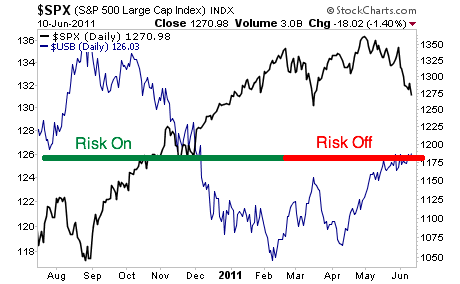
Indeed, we’ve now entered a period of “risk off”. Small cap and Tech stocks, which lead to the upside, are falling hardest. Stocks in general are in full-scale correction mode, while Treasuries have begun to rally:

Treasuries and commodities were ahead of stocks here. And given the sharp rally we’ve seen in the former (and correction in the latter), stocks still have some catching up to do.

In the very near-term, we are oversold and could see a bounce early this week. However, every rally should be used to get more defensive as the primary prop for the stock market (QE 2) is ending in the next two weeks.

The one event traders will be hanging on to is the Fed’s FOMC meeting (June 21-22). If the Fed DOESN’T hint at additional liquidity measures, then stocks could enter a free-fall (the next Fed FOMC is August 9 2011).

Indeed, the Fed has gotten itself into an absolute bind. QE 2 bought roughly three months’ worth of improved economic data while simultaneously blowing energy and food prices through the roof. With public outrage soaring the Fed needs things to cool down before it can announce QE3 or anything like it.

The one exception to this would be if the markets enter a full-scale Crisis and stocks close in on 1,000 on the S&P 500. The most likely candidate to trigger this would be the Euro-zone where the “bailout game” might in fact be about to end. This combined with the ECB’s decision not to raise rates could result in the Euro currency getting VERY ugly in no time.

On that note, if we take out 140 on the Euro, that would be a major warning sign that we could be entering another round of systemic risk.

See the original article >>

China Lending Unexpectedly Tumbles, Adding to Evidence Economy Is Slowing


China’s lending tumbled in May and money supply grew at the slowest pace since 2008, adding to signs that the world’s second-biggest economy is cooling. 

Loans were 551.6 billion yuan ($85 billion), less than the 650 billion yuan median estimate in a Bloomberg News survey of 20 economists and 639 billion yuan a year earlier. M2, the broadest measure of money supply, rose 15.1 percent, the People’s Bank of China said on its website. 

The Shanghai Composite Index slid 0.2 percent as the data fueled concern that interest-rate increases to combat inflation will trigger a slowdown. A report tomorrow may show that consumer prices jumped 5.5 percent in May from a year earlier, the biggest gain in almost three years, the median forecast in a Bloomberg News survey shows. 

“This provides another data point highlighting the growth risk,” said Tao Dong, a Hong Kong-based economist for Credit Suisse Group AG. “I think the economy is heading to a soft landing in the second half of 2011, but the risk of a hard landing seems to be on the rise,” Tao said, adding that small companies are short of credit. 

New loans in the first five months of the year totaled 3.55 trillion yuan, 12 percent lower than the same period last year and 40 percent smaller than in 2009 when credit surged to cushion the nation from the impact of the global financial crisis. 

A moderating expansion in the Chinese economy is adding to concerns that global growth is faltering.

‘Elements of Fragility’

In the U.S., the world’s largest economy, the unemployment rate in May climbed to 9.1 percent, the government said last week, and a report tomorrow may show retail sales fell for the first time in 11 months. 

Japan’s economy shrank by more than economists estimated in the first quarter, government data showed last week, and European economies are struggling with debt restructuring. 

“There are already elements of fragility,” Nouriel Roubini, the New York University professor and co-founder and chairman of Roubini Global Economics LLC, said in an interview in Singapore on June 11. World expansion may slow in the second half of 2011 as “the deleveraging process continues,” fiscal stimulus is withdrawn and confidence ebbs, he said. 

Non-deliverable yuan forwards traded at 6.3920 per dollar, indicating the currency may gain about 1.4 percent in the next 12 months.

Lending Squeeze

At Bank of America Merrill Lynch, economist Lu Ting said that “the chance of a hard landing is very small and the market could be overly concerned about a ‘lending squeeze’ in China.” Lu said that changes to the way that money-supply data is calculated may have contributed to smaller gains. He added that bank lending is “firmly under control.” 

China has been reining in lending to control inflation and the risk that bad loans will swell after a record expansion in credit that was the nation’s main response to the global financial crisis. Companies pushing up prices have included McDonald’s Corp. (MCD), the world’s biggest restaurant chain. 

The central bank has raised interest rates four times since September and also ratcheted up lenders’ reserve requirements to record levels. The benchmark one-year lending rate is now 6.31 percent and the one-year deposit rate is 3.25 percent.

Inflation Accelerates

Credit Agricole CIB today forecast one more rate increase this year, in June. Daiwa Securities Capital Markets economists led by Sun Mingchun also expect a boost this month in response to an acceleration in May inflation, with no further adjustments after that. 

Citigroup Inc. sees one or two benchmark interest-rate increases in the “next couple of months.” Consumer prices may jump by about 6 percent in June and gains will remain elevated in the second half of the year, the bank’s Hong Kong-based economists led by Shen Minggao said in a note today. 

“Concerns about over-tightening are unwarranted given that the current pace of monetary growth at around 15 percent is more than sufficient to support economic growth of around 9 percent,” Qu Hongbin, Hong Kong-based economist with HSBC Holdings Plc said in a report after today’s data was released. 

China’s slower gains in manufacturing and industrial production have prompted “a shift in market worries from overheating to a hard landing,” UBS AG economist Wang Tao said in a May 31 report. While power shortages and de-stocking by companies will trim growth this quarter, the economy is set to expand more than 9 percent this year, according to Wang. 

That pace would compare with International Monetary Fund projections in April of 2.8 percent growth in the U.S. and a 1.6 percent expansion in the euro area.

See the original article >>

Platinum to Gold Ratio Declines

by Bespoke Investment Group

As gold has rallied over the past week or so, platinum has gone in the opposite direction. As shown in the first two charts below, gold remains in a nice long-term uptrend and close to all-time highs. Platinum, on the other hand, is currently closer to its lows of the last six months than its highs. 


This recent divergence between gold and platinum has caused the ratio of platinum to gold to drop by quite a bit. As shown below, the current ratio is just 1.13, which means platinum is trading at 1.13 times the price of gold. Throughout the 2000s, platinum traded at around twice the price of gold. Once the financial crisis hit, however, the ratio collapsed as platinum significantly underperformed gold. This is largely due to the fact that platinum actually has an industrial use, while gold is simply a currency/inflation play. When the economy went in the tank, demand for platinum declined while demand for gold as a protection play soared. The ratio did bounce back after dropping below 1 as the economy recovered from the recession, but it has now been trending lower for more than a year. Another reason for the gold outperformance likely has to do with the way gold is marketed these days as a can't lose investment. Even though platinum is much more rare than gold, the yellow metal gets all the attention. With the ratio as low as it is, however, platinum may be the way to go. 


Follow Us