Thursday, June 16, 2011

CREDIT SUISSE: IT’S TIME TO BUY EQUITIES AGAIN

by Cullen Roche

Credit Suisse’s Andrew Garthwaite is sounding the bullish siren after the 8% decline in equities over the last 6 weeks. He says short-term indicators are becoming consistent with market troughs and that the odds of a bounce are increasing. In the note he cited the CS Surprise Indicator (similar to the CitiGroup Economic Surprise Indicator) and notes that equities have tended to rally 7% after readings at these levels:


From a broader perspective, they remain quite bullish on stocks in the long-run and still believe equities have quite a bit of upside into year-end. They see a 1,450 target in the coming 6 months:
“Fundamentally, we remain bullish and stick to our year-end S&P 500 target of 1,450 (our US strategist is more cautious): a) we think this is only a mid-cycle slowdown and look for global growth of 4% this year and for US growth to reaccelerate to 3% in 2H 2011, with global IP momentum bottoming now, according to our fixed income strategy team and our 10-factor indicator of US growth recently stabilising; b) equities offer relative value: the equity risk premium is 6.3% versus our warranted equity risk premium (dependent on ISM and credit spreads) of 4.8% (potentially falling to 4.5% if the ISM improves); c) equities hedge investors against rising inflation, until inflation rises above 4% (currently inflation expectations are 2.4%); d) margins typically peak 7 months after the developed market output gap has closed and the non-financial profit share of GDP is below its 1950-70 average. We forecast 14% US EPS growth this year and 9% next; we estimate releveraging can boost EPS by 10%; e) equities are still underowned by insurance companies, while 85% of mutual fund flows since the start of 2009 have gone into bonds.”

VIX Sell Signal


The VIX broke out today giving its first valid sell signal since February 22. The body of today’s candle was completely outside the 50d x 2sd Bollinger band closing above the previous swing high. This type of action usually indicates that the selling is heading into its climax phase with approximately 1 to 3 more weeks of selling to go. To repeat today’s earlier conclusion – this rules out the triangle pattern completely and leaves 3 possible outcomes: 1) the market is nearing the end of a flat correction that began in February which will be followed by a resumption of the cyclical bull market, 2) the market is nearing the end of a flat correction that is the first part of a combination correction that will last several more months, or 3) the market is in the early stages of a resumption of the bear market. It will probably not be possible to confirm the last option until much more time elapses.
 stocks
At the moment I am beginning to lean more toward option 2, which means traders should be on guard against overtrading and buying into false rallies. Traders will also have to guard against aggressive shorting that will most likely be difficult as most of the selling pressure may be realized in the next two weeks and then again later in the year for a brief period with choppy action in between.

There really is not much to do at the present time for intermediate term traders except sell weak positions, protect profits and stand aside for better days.

FAO Food Price Index vs. Oil Price (Guest Post)


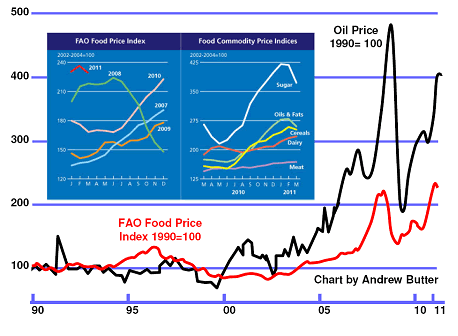
This is a chart of oil prices (Nominal-Brent-30 Day Moving Average) superimposed on the FAO Food Price Index (Nominal) as of April 2011.
crude 30 economy
Three points:
  • Given that energy (mainly oil) accounts for 30% of the cost of food, it’s not surprising that when oil prices went up by a factor of about five since the average in 1990 to 2000, food prices about doubled (5/3 = 1.67…plus whatever).
  • In spite of the dire predictions, the world probably isn’t coming to an end…just yet.
  • The peak in food prices in 2008 slightly preceded the peak in oil prices (by about a month)…so perhaps the food price index (one measure of what the world is ready to pay for oil), is a leading indicator for the oil price?
That’s a thought. The Saudi’s are saying that the current spike is all because of speculators and that the “fair price” is about $90 (they changed their minds on that one, a year ago they were saying $75 was “fair”). 

Perhaps they are getting freaked-out by Donald Trump who’s big idea is to TAKE THE OIL! His argument is that (a) the correct price of oil as far as he is concerned is $40 and that (b) it doesn’t make any sense to have the largest army in the world, and spend trillions in wars, if you don’t make a profit on the enterprise. One wonders how much the price will have to go up before he starts winning votes.

There is a certain logic in that argument, although another option might be to stop spending trillions of dollars, and to either drill more oil in USA and/or persuade Americans to drive Fiat’s or Lambrettas.

Meanwhile, in my humble opinion, the correct price of oil right now is $90 (Brent), that’s as determined by “Parasite Economics” (where America is “Daisy” and the oil producers are the parasites).
I’m sure Donald would love that analogy.

And unless the schizophrenia about replacement cost takes hold, that story-line says oil prices are going to $70, someday soon.

Shiller Sees ‘Substantial’ Probability of Recession

By Bradley Davis

Noted economist Robert Shiller said Wednesday there was a “substantial” probability the U.S. could lurch again into recession.

Noting weak global data — including a stubbornly depressed U.S. housing market — were flashing warning signs, the Yale University economist said the economy right now faced a “tipping point.”

“Forecasting models would say no” on the question of whether the U.S. will face a double-dip, Shiller said. “But I’m seeing signs that encourage me to worry about that.”

Shiller, who is one of the two men behind the S&P Case-Shiller home-price index, said home prices could still decline despite being lower than where they were more than five years ago. The summer season could see a pickup in prices, he said, but “I still worry about the general downtrend.”

“There might be a turnaround if psychology changes,” he said. But “I fear that it may just continue down.

“It just doesn’t look good,” he said in an interview with The Wall Street Journal.

General confidence about the economy is waning, Shiller said, leading to a so-called liquidity trap, in which the Federal Reserve has pumped the economy full of stimulus and consumers are still not opening their pockets.

“When the demand isn’t there, you can lower interest rates all the way to zero and people are still not willing to spend — that’s where we are right now,” Shiller said.

Meanwhile, as Greece teeters on insolvency, Shiller said the continuing stream of negative headlines was likely to have a negative impact on global confidence. “Stories like this, even if it’s from a small country, can have a vivid impact,” he said.

“I don’t think it’s overblown,” Shiller said of concerns Greece could threaten to topple the global financial system much the way the failing of Lehman Brothers brought the global system to its knees in 2008.

Related News:China .Soros Says China Missed Window to Stem Inflation, Now Risks ‘Hard Landing’

By Josiane Kremer

China has missed its opportunity to stem inflation and may now risk a hard landing, billionaire investor George Soros said. 

The world’s second-largest economy is in a “bit of a bubble,” Soros, 80, said today at a conference in Oslo. There are some signs that China is “losing control,” he said. 

China today ordered lenders to set aside more cash as reserves after inflation last month accelerated at the fastest pace in almost three years. Consumer prices rose an annual 5.5 percent in May, even after the central bank raised interest rates four times since September. Inflation has exceeded the government’s 4 percent target every month this year. 

China’s formula for steering its economy is “running out of steam,” Soros said, adding the country is seeing the beginnings of wage-price inflation. 

At the same time, efforts to restore growth in the U.S. and Europe have failed to address underlying imbalances and the global economy is not “out of the woods at all,” Soros said. 

Banks have “not been properly recapitalized” and “underlying imbalances have not been corrected,” he said. 

Recovery prospects are being hampered by the fact that the “authorities are not providing a solution,” he said.

Europe has yet to persuade investors its single currency is a functioning system and the euro continues to have “inherent problems,” Soros said. The region is displaying a “two-speed” recovery, led by Germany, while the region’s bailout recipients Greece, Ireland and Portugal struggle to stay afloat.
Turning to Africa
 
In the U.S., policy makers are trying to balance the target of job creation against the need to reduce debt levels. The World Bank last week cut its estimate for global growth this year to 3.2 percent from a January estimate for 3.3 percent expansion. 

Soros said economic turmoil in the developed world is prompting him to turn to Africa, a region he called a “very attractive area to invest in,” adding he is “very much engaged” there. 

Soros is chairman of Soros Fund Management LLC, which has about $28 billion in assets. He is best known for reportedly making $1 billion in 1992 on a successful bet that the U.K. would fail to keep the pound in a European exchange-rate system that pre-dated the euro.

Investing like it's 1999: Tech bubble 2.0 is here


With alarmists sounding the alarms and naysayers saying, “nay,” it’s certainly looking very similar to the way things were over a decade ago right before the dotcom bubble burst. Did we learn our lesson back then or are we in the process of repeating our mistakes?

Few can argue against the concept that we’re in another tech bubble. The only real debate is whether or not the bubble will burst. With Facebook leading the way with valuations far exceeding prospects of revenue and slowdown in growth, it’s the poster child for both high-value investors as well as those warning of a more catastrophic collapse than we saw the first time.

This infographic by our friends at Udemy breaks down some of the key points hinting towards a bubble bursting. Whether it’s imminent, a few years away, or never to happen at all, we should still take a look at the data and make educated choices of how to spend our time and money. If the bubble bursts this time, the effects will be felt more universally thanks to a much higher reliance on the web in day-to-day life.
Click to enlarge.

Tech Bubble 2.0

Follow Us