Sunday, May 15, 2011

Cycles Analysis Says that the Stock Market Bears are About to Roar


The Stock market pushes higher and higher, what fool would take a short position against this mighty liquidity pump up, however there are a few dark clouds in the next few months: US Summer is seasonly poor, QE2 ending, earnings are peaking, Greek woes. When the SP500 sinks, historically the US dollar rallies, transports fall and funds rotate out of aggressive stocks to defensive stocks. Let's review these cycles to see what we can expected next.

Dow Transports: If Transports fall, this can lead to a Dow Theory Sell signal.

Defensive Stocks: If folks are bearish, they begin to rotate monies into defensive stocks.

US Dollar: If the risk off trade is the theme, then the commodity currencies and the Euro will fall, the offset will be a rally in the US Dollar. A rising US dollar will wipe millions off the sales revenue of SP500 companies, thus earnings will be lower.

Between 2009/10, many cycles suffered an inversion to price, this was due to very bearish sentiment reversing on massive quantitative easing (QE1) from central banks around the world.

The cycles show all are due for a rollover, it is going to be very interesting in the next three months. No wonder sector rotation into defensive stocks is the current theme in the SP500. 

QUESTION: Are the bears about to roar ?

If you concur, SPY puts and bearish ETFs should be on your menu near the end of May 2011.


See the original article >>

Inflation Fears: Real or Hysteria?


Debate continues to rage between the inflationists who say the money supply is increasing, dangerously devaluing the currency, and the deflationists who say we need more money in the economy to stimulate productivity. The debate is not just an academic one, since the Fed’s monetary policy turns on it and so does Congressional budget policy.

Inflation fears have been fueled ever 2009, when the Fed began its policy of “quantitative easing” (effectively “money printing”). The inflationists point to commodity prices that have shot up. The deflationists, in turn, point to the housing market, which has collapsed and taken prices down with it. Prices of consumer products other than food and fuel are also down. Wages have remained stagnant, so higher food and gas prices mean people have less money to spend on consumer goods. The bubble in commodities, say the deflationists, has been triggered by the fear of inflation. Commodities are considered a safe haven, attracting a flood of “hot money” -- investment money racing from one hot investment to another. 

To resolve this debate, we need the actual money supply figures. Unfortunately, the Fed quit reporting M3, the largest measure of the money supply, in 2006. 

Fortunately, figures are still available for the individual components of M3. Here is a graph that is worth a thousand words. It comes from ShadowStats.com (Shadow Government Statistics or SGS) and is reconstructed from the available data on those components. The red line is the M3 money supply reported by the Fed until 2006. The blue line is M3 after 2006.


The chart shows that the overall U.S. money supply is shrinking, despite the Fed’s determination to inflate it with quantitative easing. Like Japan, which has been doing quantitative easing for a decade, the U.S. is still fighting deflation. 

The part of M3 that collapsed in 2008 was the “shadow banking system,” including money market funds and repos. This is the non-bank system where large institutional investors that have substantially more to deposit than $250,000 (the FDIC insurance limit) park their money overnight. Economist Gary Gorton explains:

[T]he financial crisis . . . [was] due to a banking panic in which institutional investors and firms refused to renew sale and repurchase agreements (repo) – short‐term, collateralized, agreements that the Fed rightly used to count as money. Collateral for repo was, to a large extent, securitized bonds. Firms were forced to sell assets as a result of the banking panic, reducing bond prices and creating losses. There is nothing mysterious or irrational about the panic. There were genuine fears about the locations of subprime risk concentrations among counterparties. This banking system (the “shadow” or “parallel” banking system) ‐‐ repo based on securitization ‐‐ is a genuine banking system, as large as the traditional, regulated banking system. It is of critical importance to the economy because it is the funding basis for the traditional banking system. Without it, traditional banks will not lend, and credit, which is essential for job creation, will not be created. [Emphasis added.]

Before the banking crisis, the shadow banking system composed about half the money supply; and it still hasn’t been restored. Without the shadow banking system to fund bank loans, banks will not lend; and without credit, there is insufficient money to fund businesses, buy products, or pay salaries or taxes. Neither raising taxes nor slashing services will fix the problem. It needs to be addressed at its source, which means getting more credit (or debt) flowing in the local economy. 

When private debt falls off, public debt must increase to fill the void. Public debt is not the same as household debt, which debtors must pay off or face bankruptcy. The U.S. federal debt has not been paid off since 1835. Indeed, it has grown continuously since then -- and the economy has grown and flourished along with it. 

As explained in an earlier article, the public debt is the people’s money. The government pays for goods and services by writing a check on the national bank account. Whether this payment is called a “bond” or a “dollar,” it is simply a debit against the credit of the nation. As Thomas Edison said in the 1920s:

If our nation can issue a dollar bond, it can issue a dollar bill. The element that makes the bond good, makes the bill good, also. The difference between the bond and the bill is the bond lets money brokers collect twice the amount of the bond and an additional 20%, whereas the currency pays nobody but those who contribute directly in some useful way. . . . It is absurd to say our country can issue $30 million in bonds and not $30 million in currency. Both are promises to pay, but one promise fattens the usurers and the other helps the people. 

That is true, but Congress no longer seems to have the option of issuing dollars, a privilege it has delegated to the Federal Reserve. Congress can, however, issue debt, which as Edison says amounts to the same thing. A bond can be cashed in quickly at face value. A bond is money, just as a dollar is. 

An accumulating public debt owed to the IMF or to foreign banks is to be avoided, but compounding interest charges can be eliminated by financing state and federal deficits through state- and federally-owned banks. Since the government would own the bank, the debt would effectively be interest-free. More important, it would be free of the demands of private creditors, including austerity measures and privatization of public assets. 

Far from inflation being the problem, the money supply has shrunk and we are in a deflationary bind. The money supply needs to be pumped back up to generate jobs and productivity; and in the system we have today, that is done by issuing bonds, or debt.

See the original article >>

THE PERPETUAL WALL OF WORRY

by Cullen Roche

Here’s a nice chart from Fidelity Investments showing the perpetual struggles that the global economy and the equity markets have endured over the last 40 years. It shows that economies will enter substantial periods of hardship, however, if the citizenry are moving in the right direction, they are likely to continue making progress. After all, when taken to an extreme that is the story of man. We innovate, overcome, survive.

Many readers might think of me as a pessimist because I tend to focus on the negatives. As I’ve described before, butterflies and rainbows don’t ruin your day. It would be easy to focus on the positives during the climb to the top of the investment mountain. But it’s not the butterflies and rainbows that get in your way. It’s the loose rocks. And if you’re not keeping an eye out for them they’ll ruin more than your day. In managing your downside risks you actually increase the odds of greater upside.

And while this isn’t an advertisement for “buy and hold” or similar approaches it is an advertisement for common sense and good risk management. Common sense says that mankind will always wake up in the morning attempting to be better than he/she was yesterday. Fighting this powerful trend through persistent pessimism might pay-off in the short-term, but it is guaranteed to lose in the long-term. And a good risk manager knows there will be bumps along the way. Plan accordingly.

See the original article >>

Corn is the Rosetta Stone of the Markets and Economy


It has taken years of trading and research to come to the conclusion that Corn is the Rosetta Stone to the Financial World. Whether you are interested in the forecast for inflation, fuel costs or sovereign value or the trade off between real and paper assets, the answer can be found in Corn. To understand this you first need to shift your thinking from the view that Corn is something you eat a few months in the Summer with butter and salt on it. Start by thinking of Corn as Gold, but with a use. 

Corn as Store of Value
corn gld1 e1305209536602 stocks
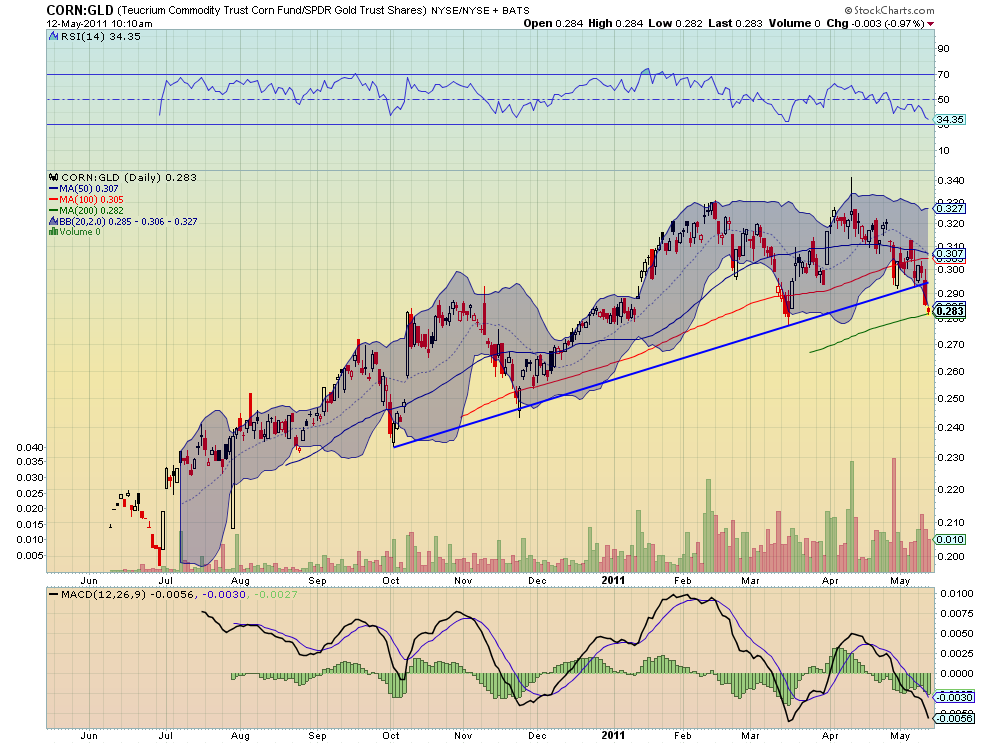
Looking at the ratio of the Corn ETF, Teucrium Commodity Trust Corn Fund (ticker: $CORN) to the SPDR Gold Trust Shares (ticker: $GLD) above you can see the steady rise of the trend since October. It is outpacing Gold has been store of value. Not a surprise as it has real uses. Both reflect a rise in the value of real goods. But Gold also is seen as a safe haven for foreign market debt crises. Now the ratio is breaking lower. Should this continue does it forecasts that the need to own real assets is waning. Or is this just an inflation related rotation while Gold rises on global fear?

Corn as Measure of Inflation
corn tlt1 e1305209564986 stocks
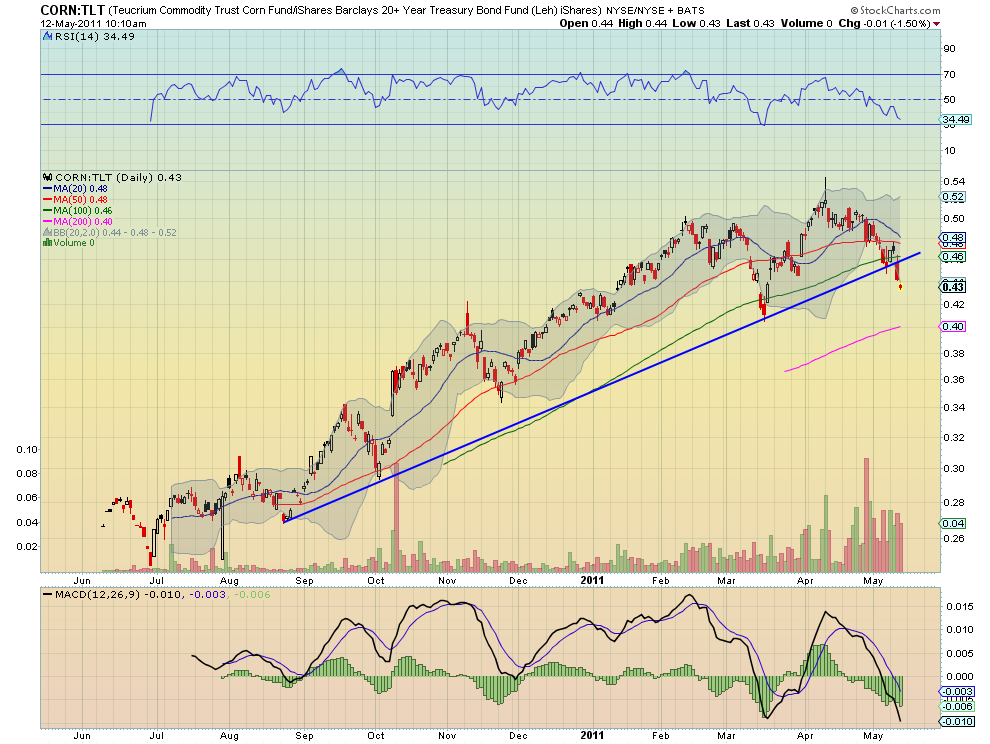
In the ratio of CORN to the iShares Barclays 20+ Year Treasury Bond Fund (ticker: $TLT) it can be seen that this ratio had been rising steadily. But now that US Treasuries are strengthening it has broken the trend line and risks heading much lower. So yes there is some information about lower inflation expectations in Corn prices.

Corn vs Paper Assets
corn spy2 e1305209595383 stocks
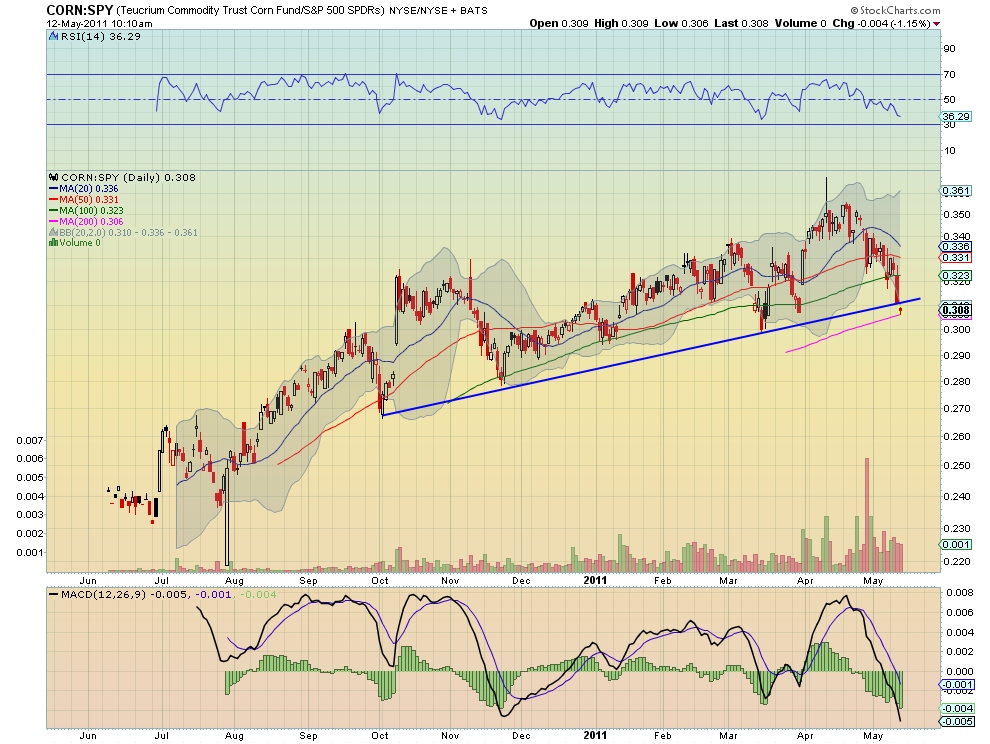
The ratio of CORN to the S&P 500 SPDR (ticker: $SPY) shows that the trend has been for real assets over paper assets but that it is being tested. Should the trend line be broken and the ratio continue lower then it would signal a shift back to paper assets.

Corn as Measure of Devaluation
corn uup1 e1305209628118 stocks
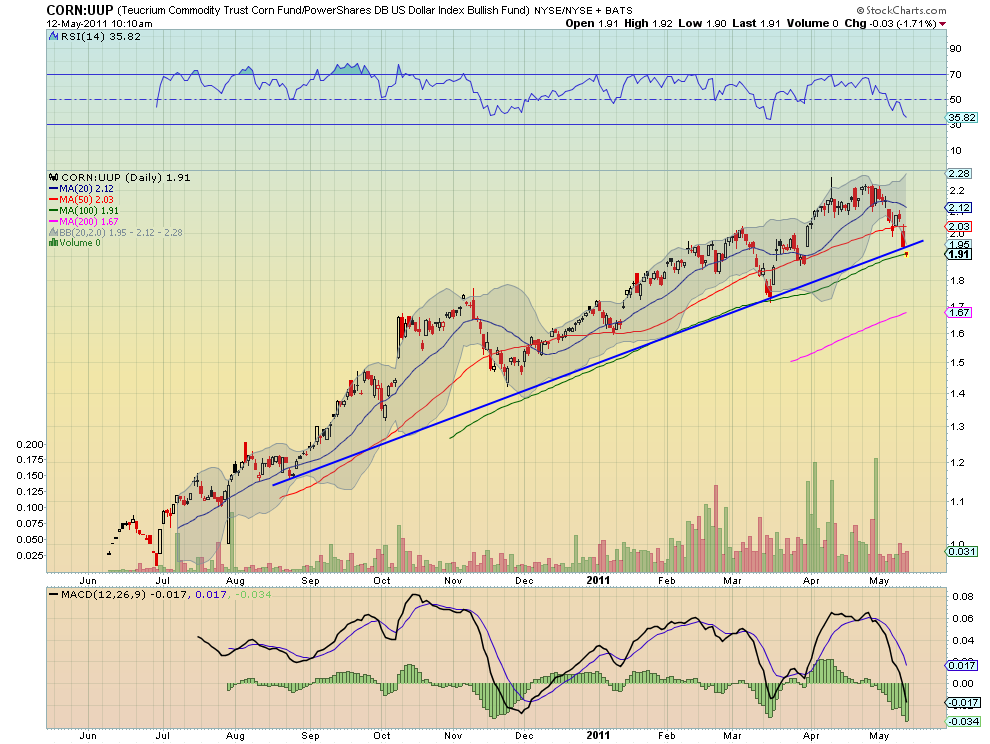
Studying the ratio of CORN to the Power Shares DB US Dollar Index Bullish Fund (ticker: $UUP) shows that Corn has been rising at the expense of the US Dollar as well, so it has been predicting devaluation to continue. But this trend is also being tested. Should it break and continue lower it would also suggest that devaluation of the Dollar is reversing.

Corn as Measure of Fuel Costs
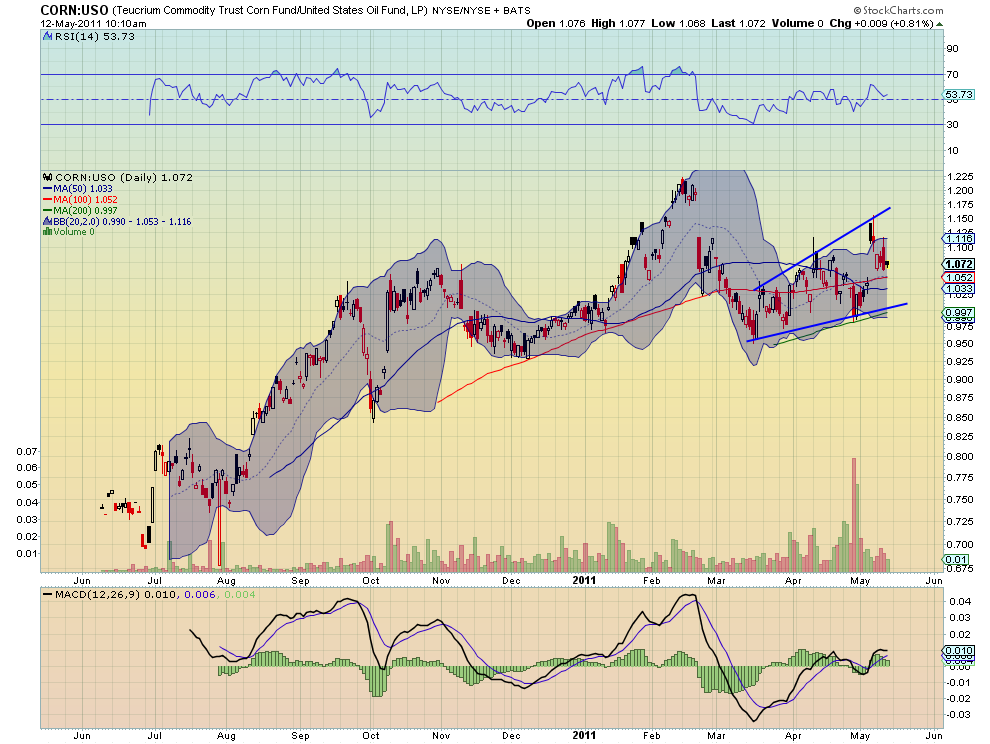
corn uso1 e1305209663329 stocks
Finally the ratio of CORN to the United States Oil Fund (ticker: $USO) shows that CORN price growth has been outpacing the cost of Oil outside of a set back in March. Now it is slowly trending higher again in a rising expanding wedge pattern. There is no talk of peak Corn so what does this mean? A reflection that from a fuel perspective it is holding value better than Oil. Does this suggest that Corn is the future fuel?

Corn is at a critical juncture. It is at a inflection point in the choice between real and paper assets, the growth of inflation, the devaluation of the Dollar and the future of energy usage in this country. Do you still need to be convinced that it is not just a Summer treat? Continue to watch these ratios as they will give a great forecast of the future of the economy and the markets. As these trends breakdown they will be leading indicators.

See the original article >>

How to Trade Silver Options for BIG Profits


Hi-Yo Silver, Away, Last week silver was the focus of incredible price swings which left many licking their wounds and shaking their heads at the trading losses they had incurred. This sell off was likely triggered by the increase in margin requirements for futures contracts, but the stunning price decline extended to all vehicles like exchange traded funds use to trade the glimmering metal. 

I recognized the potential opportunity early in the week, and began to look at various position structures using options on Tuesday morning. In order to understand the thinking behind this trade, it is necessary to understand the concept of implied volatility of an option contract. Implied volatility, together with time to expiration and price of the underlying security, form the three primal forces that rule the world of option pricing. This measure of volatility is best described as the collective opinion of traders as to the future volatility of the price of the underlying. Implied volatility is the variable which determines if options are priced cheap or overvalued. 

One of the fundamental behavioral characteristics of options is the reaction of implied volatility to rapid price change. As a general rule, implied volatility goes down as the price of the underlying increases and vise-versa. Another functional characteristic is that it tends to revert to its historic mean once rapid price movements have moderated and actual price volatility returns to its historic range. The chart below is from a historical database of SLV implied volatility. Note the dramatic rise, indicated by the blue line, beginning in mid April and reaching historically unprecedented levels in early May.


Books have been written to describe details of various option trade structures, and a discussion of all potentially useful strategies is beyond the scope of my mission today. Suffice it to say that individual trades can be structured to respond either positively or negatively to reductions in implied volatility. Given the extremely elevated state of the SLV implied volatility, which side would you want to take? Hint: Volatility doesn’t remain elevated forever. A well-established characteristic of implied volatility is its tendency to revert to its historic mean. 

The trade structure I chose to use was that of a calendar spread. This two legged spread is constructed by selling a short dated option and buying a longer dated option. The options selected to construct each spread are at the same strike price and are of the same class, either puts or calls. Maximum profit of each spread occurs at expiration of the shorter dated option when the price of the underlying is at the strike price of the spread. The main profit engine for this spread is the more rapid time decay of option premium in the shorter dated option relative to the longer dated option. 

My trade plan was to buy the May monthly option series which had 18 days of life remaining and sell the weekly options, an option series with only 4 days of life remaining when the trade sequence was started. An essential part of my plan was to adjust the spread as required by price movement to keep in the profit zone of the P&L curve. 

It is important to recognize the “secret ingredient” of the spread that put the wind at my back; this special ingredient was the much greater implied volatility of the option I was selling compared to the option I was buying. In the language of the option trader, this situation is termed a positive “volatility skew”. This positive volatility skew increases our odd of success because we are selling a richly priced option and buying a more reasonably priced option; the old adage of “buy low, sell high” applies to volatility as well as price.

The trade that I will discuss began mid-morning on Tuesday, May 3 when SLV was trading around $42.50. My opening traded was to establish the calendar spread at the 42 strike, in options peak, this is known as an at-the-money calendar spread. The opening trade is displayed below:


Price continued to decline for the next several hours and by mid afternoon, SLV was trading around $40. This rapid decline was beginning to approach my lower breakeven price point at $39.24 and I felt I needed more room to allow for price action movement. At this point I chose to add an additional calendar spread at the 38 strike using puts to create a double calendar spread. The resulting trade lowered my breakeven point on the low side from the original $39.24 to $36.21. The new spread’s profitability curve is graphed below: 


Price action the next day, Wednesday May 4, was a bit more subdued, and price remained within my profitable zone. Time decay of the short option premium was accelerating and no further action was required. All systems were “go”. 

The following day, Thursday May 5, price movement resumed its rapid decline and price had moved beyond the profitable zone of our double calendar spread. Action was required; “wishing and hoping” in these situations is strictly not allowed The original position needed to be modified in order to re-establish a new zone of profitability surrounding the current price of SLV. Because SLV had moved well below the lower breakeven point of the double calendar, radical surgery was necessary. I chose to remove the entire position and re-center the spread. I closed both the 42 call calendar and the 38 put calendar and bought 2 put calendars at the 34 and 35 strikes. As Thursday ended, I had the position illustrated below:


Price movement during the next day, Friday, remained within the range of $33.60 to $35.57. These price extremes for the day were within our limits of profitability of the new double calendar. I closed the spread by mid afternoon when the time premium of the options I had sold short had largely eroded.

This trade had a profit of 15.9% net of commissions for trade duration of approximately 72 hours. I think the lesson to be learned from this trade is that a knowledgeable option trader can survive and prosper in a variety of market conditions. This demonstration is, I think, an example of the tremendous power of options to mitigate risk and provide controlled risk trading opportunities in fast moving markets.

This trade has been part of a strong period of performance for members at OptionsTradingSignals.com. Recent performance has been outstanding as 6 out of 7 trades have produced profits while the final trade remains open. The following returns are based on trade entry and executions. Commissions have not been factored in as option commission structures are different and members may have received a better or worse trade execution. With that said, the gross returns are listed below:

GLD Call Calendar Converted To Vertical Spread – 58%
RUT Call Calendar Spread – 12%
SPY Call Vertical Spread – 32%
SLV Call Calendar Spread Converted to Double Calendar Spread – 18%
AMZN Call Calendar Spread – 37%
SLV Call Calendar Spread Discussed Above – 20%

The cumulative return of the most recent 6 trades is 177%. Obviously the recent track record has been strong and the overall return for members would differ based on position size, risk tolerance, and account size. Since the beginning of the service in December, the overall win / loss record is 14 winning trades, 1 breakeven trade, and 8 losing trades. The overall successful trade percentage based on the trades that have been closed is just shy of 61%. In full disclosure, two trades remain open at this time. 

Recently I have used a lot of calendar spreads due to the low volatility environment we have been trading in. The trade constructions that I use adjust based on volatility levels of underlying assets and the VIX index in general. Essentially the service does not use the same trades over and over unless the volatility environment is little changed. Recently we have had consistently low volatility levels and calendar spreads have been attractive. In the future, volatility levels will likely change and other trade constructions would be warranted at that time.

The special offer currently being presented to new members is an extreme value. Most long term members have pointed out that they would be willing to subscribe just for the daily technical analysis provided as well as the 2 – 3 weekly videos that members receive that contain technical analysis of key indices, futures, and ETF’s. My primary focus is to deliver value to members beyond just solid trade management and performance. 

I am focused on performance, but my greatest thrill is watching novice option traders start to learn how to trade options in spreads effectively and for consistent profits. Options are one of the most overlooked trading tools in financial markets and the power they offer individual investors is consistently overlooked. Options are more than just hedging tools; they offer individual investors the power to diversify away from standard assets.

Kicking the Can to the End of the Road

By John Mauldin

The Biggest Bubble of Them All
Ireland is a Different Story
Kicking the Can to the End of the Road
Philly, Boston, Trequanda, Kiev, Geneva and London

>

The Biggest Bubble of Them All

This week we turn from the crisis brewing in the US to the one that is coming to a slow boil in Europe. We visit our old friends Greece and Ireland and ponder how this will end. It is all well and good to kick the can down the road, but what happens when you come to the end of the road? The European answer seems to be to haul in the heavy equipment and extend the road.

I am asked all the time what my biggest worry is, and I quickly answer, the European Sovereign Debt Crisis. Of course, then we have to think about the Japanese Sovereign Debt Crisis, followed by the one in the US; but today we will focus on Europe. The biggest bubble in history is the bubble of government debt. It is a bubble in a world full of pins. It will take a great deal of luck and crisis management to keep it afloat, without wreaking havoc on the financial system and markets of the world.

The rumors have been flying all this week. Greek is going to leave the euro. No, it won’t. Germans are demanding debt restructuring, and then they say no. A German newspaper is reporting that the EU, IMF, and Germany want a Greek debt extension, while the ECB (holders of Greek debt) and France oppose it. Greek two-year bonds are now paying 25% if you care to buy them in the open market, which is effectively the market voting for some type of debt restructuring or outright default.

I sat down this week and read two lengthy reports on how Greek debt could be restructured in an orderly manner. One was from HSBC and the other from Roubini Global Economics. There are ways it can be done. But the costs of the various options may be more than the affected parties want to bear. It is not a matter of pain or no pain; it is a decision as to who will bear the pain.

The fundamental problem for Greece is that there is no sign of economic recovery, with GDP at -4.5% in 2010 and still likely to be -3.0% in 2011 (IMF). If your economy slows down by 10%, then your debt-to-GDP ratio rises by 11% without any new debt. And Greece is being asked to further reduce its deficit by what is in effect 15% of GDP, while taking on no more debt. Within two years Greece will have a debt-to-GDP ratio of 160% that can only come down under very optimistic growth scenarios. And that assumes that Greece can right its own house. I have mentioned the wonderful article by Michael Lewis in Vanity Fair last October (http://www.vanityfair.com/business/features/2010/10/greeks-bearing-bonds-201010). He refers to the massive corruption in Greece:

“The scale of Greek tax cheating was at least as incredible as its scope: an estimated two-thirds of Greek doctors reported incomes under 12,000 euros a year—which meant, because incomes below that amount weren’t taxable, that even plastic surgeons making millions a year paid no tax at all. The problem wasn’t the law—there was a law on the books that made it a jailable offense to cheat the government out of more than 150,000 euros—but its enforcement.

‘If the law was enforced,’ the tax collector said, ‘every doctor in Greece would be in jail.’ I laughed, and he gave me a stare. ‘I am completely serious.’ One reason no one is ever prosecuted—apart from the fact that prosecution would seem arbitrary, as everyone is doing it—is that the Greek courts take up to 15 years to resolve tax cases. ‘The one who does not want to pay, and who gets caught, just goes to court,’ he says. Somewhere between 30 and 40 percent of the activity in the Greek economy that might be subject to the income tax goes officially unrecorded, he says, compared with an average of about 18 percent in the rest of Europe.

“… The Greek state was not just corrupt but also corrupting. Once you saw how it worked you could understand a phenomenon which otherwise made no sense at all: the difficulty Greek people have saying a kind word about one another. Individual Greeks are delightful: funny, warm, smart, and good company. I left two dozen interviews saying to myself, ‘What great people!’ They do not share the sentiment about one another: the hardest thing to do in Greece is to get one Greek to compliment another behind his back. No success of any kind is regarded without suspicion. Everyone is pretty sure everyone is cheating on his taxes, or bribing politicians, or taking bribes, or lying about the value of his real estate. And this total absence of faith in one another is self-reinforcing. The epidemic of lying and cheating and stealing makes any sort of civic life impossible; the collapse of civic life only encourages more lying, cheating, and stealing. Lacking faith in one another, they fall back on themselves and their families.

“The structure of the Greek economy is collectivist, but the country, in spirit, is the opposite of a collective. Its real structure is every man for himself. Into this system investors had poured hundreds of billions of dollars. And the credit boom had pushed the country over the edge, into total moral collapse.”

It is a seven-page article and worth reading, as it gives you the scale of the problem that is Greece.

This week has seen yet more rioting by Greek unions. In effect they are protesting the latest debt negotiations, because they mean even more austerity. The French and Finns are demanding about $50 billion in privatization of government-owned enterprises, which means the loss of public jobs. The Germans have their own demands.

Both HSBC and Roubini assume there are options that can work to extend the debt maturities, lower the interest rates, and give Greece some room to work out its problems. But the solution to too much debt is not to increase the debt. No country save Britain at the height of its empire has ever recovered from a debt-to-GDP ratio of over 150% without a default. None.

And the reason is simple arithmetic. Even a nominal interest rate of 6% means that it takes 10% of your national income just to pay the interest. Not 10% of tax revenues, mind you; 10% of your total domestic production. That is a huge burden on any country. It sucks up half your tax revenues (or more), leaving not enough to pay for ordinary government services like police, defense, education, pensions, health care, etc.

Greece runs a massive trade deficit with the rest of Europe, which just makes the problems worse. 

Unemployment in Greece is now 15% and rising. And everyone can clearly see that the current loan facility will run out at the beginning of 2010, yet Greece will need at least another 30 billion euros right after that. They clearly are not going to be able to access the private markets, so they are negotiating now to get more money to carry them into 2013, when the new European Stability Mechanism will in theory be in place (more below).

But an interesting thing is happening. Greece consumer and business debt is rising in the midst of what can rightfully be called a depression. How can that be? Don’t consumers and businesses retrench in a recession? Look at this chart from Stratfor:

As they write:

“Despite further expected unemployment, the Greek household sector remains considerably indebted, with only marginal deleveraging occurring. This is a worrying sign because it shows that Greek consumers have not been able to cut down their debts and have not reduced their standards of living in light of severe economic crisis. They may be unable to reduce their debts precisely because many have lost jobs or had their public sector salaries significantly reduced and are therefore depending on consumer credit to maintain their levels of expenditure and to service their debts (paying credit card bills with more credit card debt, as an example).

Meanwhile, the overall banking sector has actually increased the amount of credit it has extended to consumers, corporations and the government. The total amount of credit outstanding was more than 333 billion euros in February — more than the 325 billion euros-worth of credit outstanding in May 2010, with the most significant increase in lending from banks going to the government itself.

“The problem, however, is that the government cannot decrease lending to consumers or force its banks to do so. That would not only throw Greece into an even deeper recession, it would also cause considerable pain to Greek citizens already frustrated to the point of protest.”

I am not persuaded that it is all an inability of Greek consumers and businesses to pay down debt. The rumors that Greece will go back to the drachma are not without reason, as I will detail shortly. If they did, it makes real sense for someone who wants to buy a car to do so today, as the drachma will quickly fall 50%, which doubles the price of that German, French, or Italian car. If you are a business, you might be thinking it makes sense to move forward your capital investment, as any non-Greek equipment will become decidedly more expensive post leaving the euro.

Note: I am not saying that Greece will behave this way, just that it makes sense for those who want to make capital investments to hedge their bets, just in case.

Roubini writes:

“A haircut of 20-50% is required to achieve debt sustainability. To put things into perspective, it is worth considering the magnitude of haircut required to make debt clearly sustainable. For simplicity at this stage, we consider face-value haircuts in our debt sustainability analysis toolkit and find that a haircut of around 20% on the total stock of debt would allow Greece to achieve a debt-to-GDP ratio of 60% by 2030. This assessment is based on the macroeconomic projections in the IMF’s April 2011 WEO; however, more conservative macroeconomic projections suggest a haircut of around 50% could be necessary.”

But such a haircut would also mean that the Eurozone member countries would have to fund Greek debt for a long time, as the private markets would simply shut them out until real credibility was established. And that might take some time. The Greeks have long made a practice of defaulting on debt. The first recorded sovereign debt defaults were the Greek city-states, over 2,000 years ago. Greece has been in default 150 of the last 200 years.

Such perpetual funding will not be popular, and already one can see the rise of euro-skeptic parties all over Europe. Nothing can be done without Germany, and Angela Merkel is in danger of losing her coalition. One of her junior members, the right-of-center and very pro-euro Free Democratic Party, which is very necessary to Merkel, might not even get enough votes to qualify for representation in parliament if a new election were held today.

And the ESM mentioned above has to be voted on and approved by all 27 countries that are treaty members, as it requires a change to the treaty that created the EU. I think getting unanimous approval might be difficult if it means countries have to be responsible for Greek debt.

One of the reasons normally given for extending the debt to Greece is that it would avert a crisis of the euro. I am not so sure. If Greece were allowed to leave I think the euro would get stronger.

I think both Greece and the EU would be better off if Greece did default, but it’s not my decision. Just saying.

Ireland is a Different Story

Morgan Kelly is professor of economics at University College Dublin. He is not popular at times with the establishment, as he points out their foibles, but he has a very good track record of being right. He recently wrote a devastating piece for the Irish Times, which has gone viral in Ireland. (http://www.irishtimes.com/newspaper/opinion/2011/0507/1224296372123_pf.html )

He basically points out that the Irish cannot afford to pay the debts of their banks. He suggests they simply walk away. His conclusion:

“The original bailout plan was that the loan portfolios of Irish banks would be sold off to repay these borrowings. However, foreign banks know that many of these loans, mortgages especially, will eventually default, and were not interested. As a result, the ECB finds itself with the Irish banks wedged uncomfortably far up its fundament, and no way of dislodging them.

“This allows Ireland to walk away from the banking system by returning the Nama assets to the banks, and withdrawing its promissory notes in the banks. The ECB can then learn the basic economic truth that if you lend €160 billion to insolvent banks backed by an insolvent state, you are no longer a creditor: you are the owner. At some stage the ECB can take out an eraser and, where “Emergency Loan” is written in the accounts of Irish banks, write “Capital” instead. When it chooses to do so is its problem, not ours.

“At a stroke, the Irish Government can halve its debt to a survivable €110 billion. The ECB can do nothing to the Irish banks in retaliation without triggering a catastrophic panic in Spain and across the rest of Europe. The only way Europe can respond is by cutting off funding to the Irish Government.

“So the second strand of national survival is to bring the Government budget immediately into balance. The reason for governments to run deficits in recessions is to smooth out temporary dips in economic activity. However, our current slump is not temporary: Ireland bet everything that house prices would rise forever, and lost. To borrow so that senior civil servants like me can continue to enjoy salaries twice as much as our European counterparts makes no sense, macroeconomic or otherwise.

“Cutting Government borrowing to zero immediately is not painless but it is the only way of disentangling ourselves from the loan sharks who are intent on making an example of us. In contrast, the new Government’s current policy of lying on the ground with a begging bowl and hoping that someone takes pity on us does not make for a particularly strong negotiating position. By bringing our budget immediately into balance, we focus attention on the fact that

Ireland’s problems stem almost entirely from the activities of six privately owned banks, while freeing ourselves to walk away from these poisonous institutions. Just as importantly, it sends a signal to the rest of the world that Ireland – which 20 years ago showed how a small country could drag itself out of poverty through the energy and hard work of its inhabitants, but has since fallen among thieves and their political fixers – is back and means business.

“Of course, we all know that this will never happen. Irish politicians are too used to being rewarded by Brussels to start fighting against it, even if it is a matter of national survival. It is easier to be led along blindfolded until the noose is slipped around our necks and we are kicked through the trapdoor into bankruptcy.

“The destruction wrought by the bankruptcy will not just be economic but political. Just as the Lenihan bailout destroyed Fianna Fáil, so the Noonan bankruptcy will destroy Fine Gael and Labour, leaving them as reviled and mistrusted as their predecessors. And that will leave Ireland in the interesting situation where the economic crisis has chewed up and spat out all of the State’s constitutional parties. The last election was reassuringly dull and predictable but the next, after the trauma and chaos of the bankruptcy, will be anything but.”

I totally agree. I have been writing for a long time that Ireland should not bail out their banks. They simply cannot afford to. Tell the EU and British banks to go pound sand. Kelly is right, it will mean serious budget cuts; but like Iceland when it rejected baking its banks, it will mean a quick recession and then growth can start again. The Irish have a very different national character than Greece; and once things get righted, the markets would soon be willing to take Irish debt. Russia and Argentina other countries have defaulted and within a few years were back in the capital markets. Ireland could be too.

I am very seriously thinking of going to Ireland this summer to just talk to local people and see for myself what is going on. Ireland sounds a lot better than the Texas heat in August.

Kicking the Can to the End of the Road

European leaders will continue to try to kick the can down the road. I would not be surprised to see no real “crisis” this year. But there is an Endgame. And I think it involves voters and not just leaders. The guy in the street can see that bailing out countries is really just a back-door way to bail out banks on the backs of taxpayers and the currency. If it were just Greece, maybe. But it is Portugal and Spain. Especially Spain. Spain is too big to save. I love Spain; it is one of the most beautiful and gracious of countries. But there are real problems. The banks have maybe – maybe – written down their housing-related losses 10%. It should be more like 40%, which would make most Spanish banks insolvent, so they won’t write them down. 

Unemployment is over 20% and rising. Like Ireland, they allowed their housing market to get away from them. They believed that someone was going to buy all those homes they were building. And now they are teetering on recession and likely to fall back soon, which makes collecting taxes and cutting spending more difficult. With each new data point this year, Spanish debt costs will rise.

Each new version of the crisis will spook the bond markets yet again. When you look at the economies of the euro-peripheral countries, it is hard to see how they can dig themselves out without a great deal of pain and serious spending cuts, which of course means slower economies and even more pain. But that is the only way through, short of the Eurozone basically guaranteeing all debt for a long time, which means you are asking Finnish and German and Dutch and French voters to agree to take on more taxes to pay that debt. Or it means a real loss of sovereignty and control for debtor nations. (Maybe I should take in a trip to Portugal as well. Another country I have yet to visit, and another crisis to take note of firsthand.) I cannot see European countries giving up their national sovereignty willingly.

In the end, this comes down to elections. It becomes not a matter of high finance and political will on the part of European leaders, but of how you convince the burghers in Germany and the practical Dutch (et al.) of the need to share some Greek pain. It requires convincing the Irish people to assume that bank debt, when they have already told their leaders no. I am glad that is not my job.

In short, we are watching the biggest bubble of all time, the bubble of government debt, try to keep from popping. My bet is that it can’t. And while the ride will be bumpy, the world our kids get will be better off at the end of the process.

Philly, Boston, Trequanda, Kiev, Geneva, and London

Next Monday a week I head for Philadelphia for a night, then on to Boston, and then the next Sunday leave for Italy to catch up with my kids in Tuscany, in the small village of Trequanda. I will vacation for a few days with them, and then take a few weeks working vacation, working on my next book and visiting with friends who drop by. I am really looking forward to it.

Then I will take my youngest son, Trey, to Kiev for a few days, on to Geneva for some meetings and speeches, and a side trip to visit CERN. Then one day in London to guest host Squawk Box on CNBC. While flying in Europe is not especially pleasant (the seats are small and the baggage costs are high), the trips do sound nice.

The only down side to leaving is that my Dallas Mavericks may be poised to go back into the NBA Finals while I am in Europe. I have been blessed with good seats and do love professional basketball. I think it is the most beautiful of team sports. What these guys can do is simply not possible for mere mortals.

This coming week Dallas will host two games for the Division Championship, and I will be there. I missed the Lakers series by being on the road. I watched the last Dallas-Lakers game from the Admirals Club in Los Angeles, where I was the only person at the bar who was happy. That was a true blowout. It was hard to believe. Can you think of a Dallas – Miami Heat final series again? Can they get past Chicago? You gotta love this game.

I am taking it a little easier, not setting the alarm clock and getting some much-needed rest. And the doctor says I can get back into the gym soon, as my heel is healing well. Enjoy your week.

Your trying to figure all this out analyst,

See the original article >>

Follow Us