Wednesday, April 27, 2011

The Real Reason Stocks Keep Rising

by Alan Zafran

“It’s earnings, Stupid” a bullish investor is currently shouting from his rooftop. Ever so right he is. But what really is the driving force behind this latest surge in equity prices?

Last I checked, a madman despot is holding oil prices hostage (not to mention hundreds of thousands of innocent civilians). Those oil prices, along with an ever-higher grocery bill, are now taking up 22% of the average American’s spending budget. For good measure, over one-fourth of Americans’ homes are “underwater” (the mortgage is larger than the home is actually worth). Not surprisingly, roughly 15% of Americans are now on food stamps, and over 15% remain “underemployed” (unemployed, involuntarily working only part-time, or so despondent that they are out of the labor force).

My stock portfolio, on the other hand, is doing just fine, thank you. Who cares about the fiscal debauchery of the PIIGS (Portugal, Ireland, Italy, Greece and Spain)? Who cares about the out-of-control level of U.S. Debt? Who cares about the rampant level of inflation in emerging markets and the fact that many central banks are raising interest rates and imposing capital controls which will slow down their economic growth rates? Who cares about the social unrest throughout the Middle East and North Africa?

Well, with gold trading at over $1,500 per ounce (and the price of silver and some soft commodities moving up even faster), apparently the traders in the Chicago pits have taken notice. But not the U.S equity market, with the VIX (the Volatility Index, a measure gauging future anticipated stock market volatility) trading at an astonishingly low level. Truly eye-opening.

The answer, my friends, is not blowing in the wind. It’s earnings. Plain and simple. Albeit early in this latest array of quarterly earnings reports, 81% of the 124 companies so far to report earnings from the S&P 500 Index and 71% of the 188 companies in the MCSI World Index have reported earnings per share figures that have beaten the consensus analysts’ estimates. Indeed, profits of those 188 companies reporting to-date in the MSCI World Index have beaten forecasts by nearly 9%! What gives?

Oddly enough, bad news is actually good news. You see, U.S. productivity, which is a measure of employee output per hour, is now increasing at an unusually high rate of 4%, the fastest pace since leaving the depressed recession of 2002. And what causes this thrust in productivity? Better technology? A more streamlined approach to organizational management? Highly efficient, just-in-time inventories clicking along? Perhaps a bit of each of these elements helps to answer this quandary, but there is one overriding factor to the corporate earnings momentum: the lack of wage pressures on businesses.

That is, what’s really driving productivity growth, and hence earnings growth, and hence stock market appreciation, is the fact that wages as a percentage of revenues keep falling!

That’s right. America’s pain is also the stock market’s gain. Labor costs fell 1.5% in 2010 (they also dropped 1.6% in 2009). No wonder corporate profits have meaningfully beaten consensus analyst estimates for 8 consecutive quarters. Corporations haven’t experienced this much good fortune (at the expense of the average American’s poor fortune) since 1962-1963.

So while the headlines bombard us with depressing news, stocks are “climbing a wall of worry” ever so steadily higher. In this case, climbing on the back of America’s employees who are shouldering the burden to graciously accept a day’s wage, thankful that they aren’t out of work like one of their friends, neighbors or relatives. Go figure.
See the original article >>

STRATEGIC DEFAULTS: IT COULD GET VERY UGLY

By Keith Jurow

In an article posted on Minyanville last September — Strategic Defaults Threaten All Major US Housing Markets – I discussed the growing threat that so-called “strategic defaults” posed to major metros which had experienced a housing bubble. With home prices showing renewed weakness again, now is a good time to revisit this important issue.

What Is Meant By Strategic Default?

According to Wikipedia, a strategic default is “the decision by a borrower to stop making payments (i.e., default) on a debt despite having the financial ability to make the payments.” This definition has become the commonly accepted view.

I define a strategic defaulter to be any borrower who goes from never having missed a payment directly into a 90-day default. A good graph which I will discuss shortly illustrates my definition.

Who Walks Away from Their Mortgage?

When home prices were rising rapidly during the bubble years of 2003-2006, it was almost inconceivable that a homeowner would voluntarily stop making payments on the mortgage and lapse into default while having the financial means to remain current on the loan.

Then something happened which changed everything. Prices in most bubble metros leveled off in early 2006 before starting to decline. With certain exceptions, home prices have been falling quite steadily since then around the country. In recent memory, this was something totally new and it has radically altered how most homeowners view their house.

In those major metros where prices soared the most during the housing bubble, homeowners who have strategically defaulted share three essential assumptions:
  • The value of their home would not recover to their original purchase price for quite a few years.
  • They could rent a house similar to theirs for considerably less than what they were paying on the mortgage.
  • They could sock away tens of thousands of dollars by stopping mortgage payments before the lender finally got around to foreclosing.
Put yourself into the mind and shoes of an underwater homeowner who held these three assumptions. Can you see how the temptation to default might be difficult to resist?

Who Does Not Walk Away?

Most underwater homeowners continue to pay their mortgage. An article posted online in early February by USA Today discusses the dilemma faced by underwater homeowners in Merced, California, a city which has suffered one of the steepest collapses in home prices since their bubble burst in 2006.

The author cites the situation of one couple who had bought their home in 2006 for $241,000. They doubted it would bring more than $140,000 today. The husband considered the idea of looking for a better job in another state. But that meant selling the house for a huge loss or giving the house back to the bank and walking away. They refused to do that. The reason was simple in their mind. They made an agreement when they took out the mortgage.

The same explanation was given by another couple in their 50s who owe $375,000 on their loan and believe it would not sell for more than $150,000. They both work and can afford the mortgage payment. They are very attached to their home and feel a moral obligation to pay the mortgage. Yet they know that many others have walked away. Because they refuse to bail out of their loan, they concede that they are stuck and described their situation as a “bitter pill.”

Two Key Studies Show that Strategic Defaults Continue to Grow

Last year, two important studies were published which have tried to get a handle on strategic defaults. First came an April report by three Morgan Stanley analysts entitled “Understanding Strategic Defaults.”

The study analyzed 6.5 million anonymous credit reports from TransUnion’s enormous database while focusing on first lien mortgages taken out between 2004 and 2007.

The authors found that loans originated in 2007 had a significantly higher percentage of strategic defaults than those originated in 2004. The following chart clearly shows this difference.
Why are the 2007 borrowers strategically defaulting much more often than the 2004 borrowers? Prices were rising rapidly in 2004 whereas they were falling in nearly all markets by 2007. So the 2007 loans were considerably more underwater than the 2004 loans.

Note also that the strategic default rate rises very sharply at higher Vantage credit scores. (Vantage scoring was developed jointly by the three credit reporting agencies and now competes with FICO scoring.)

Another chart shows us that even for loans originated in 2007, the strategic default percentage climbs with higher credit scores.
Notice in this chart that although the percentage of all loans which defaulted declines as the Vantage score rises, the percentage of defaults which are strategic actually rises.

A safe conclusion to draw from these two charts is that homeowners with high credit scores have less to lose by walking away from their mortgage. The provider of these credit scores, VantageScore Solutions, has reported that the credit score of a homeowner who defaults and ends up in foreclosure falls by an average of 21%. This is probably acceptable for a borrower who can pocket perhaps $40,000 to $60,000 or more by stopping the mortgage payment.

Why Do Homeowners Strategically Default? 

Is there a decisive factor that causes a strategic default? To answer this, we need to turn to the other recent study.

Last May, a very significant analysis of strategic defaults was published by the Federal Reserve Board. Entitled “The Depth of Negative Equity and Mortgage Default Decisions,” it was extremely focused in scope. The authors examined 133,000 non-prime first lien purchase mortgages originated in 2006 for single-family properties in the four bubble states where prices collapsed the most — California, Florida, Nevada, and Arizona. All of the mortgages provided 100% financing with no down payment.

By September 2009, an astounding 80% of all these homeowners had defaulted. Half of these defaults occurred less than 18 months from the origination date. During that time, prices had dropped by roughly 20%. By September 2009 when the study’s observation period ended, median prices had fallen by roughly another 20%.

This study really zeroes in on the impact which negative equity has on the decision to walk away from the mortgage. Take a look at this first chart which shows strategic default percentages at different stages of being underwater.
Notice that the percentage of defaults which are strategic rises steadily as negative equity increases. For example, with FICO scores between 660 and 720, roughly 45% of defaults are strategic when the mortgage amount is 50% more than the value of the home. When the loan is 70% more than the house’s value, 60% of the defaults were strategic.

This last chart focuses on the impact which negative equity has on strategic defaults based upon whether or not the homeowner missed any mortgage payments prior to defaulting.
This chart shows what I consider to be the best measure of strategic defaulters. It separates defaulting homeowners by whether or not they missed any mortgage payments prior to defaulting. As I see it, a homeowner who suddenly goes from never missing a mortgage payment to defaulting has made a conscious decision to default.

The chart reveals that when the mortgage exceeds the home value by 60%, roughly 55% of the defaults are considered to be strategic. For those strategic defaulters who are this far underwater, the benefits of stopping the mortgage payment outweigh the drawbacks (or “costs” as the authors portray it) enough to overcome whatever reservations they might have about walking away.

Where Do We Go From Here?

The implications of this FRB report are really grim. Keep in mind that 80% of the 133,000 no-down-payment loans examined had gone into default within three years. Clearly, homeowners with no skin in the game have little incentive to continue paying the loan when the property goes further and further underwater.
While the bulk of the zero-down-payment first liens originated in 2006 have already gone into default, there are millions of 80/20 piggy-back loans originated in 2004-2006 which have not.

We know from reports issued by LoanPerformance that roughly 33% of all the Alt A loans securitized in 2004-2006 were 80/20 no-down-payment deals. Also, more than 20% of all the subprime loans in these mortgage-backed security pools had no down payments.

Here is the most ominous statistic of them all. In my article on the looming home equity line of credit (HELOC) disaster posted here in early September (Home Equity Lines of Credit: The Next Looming Disaster?), I pointed out that there were roughly 13 million HELOCs outstanding. This HELOC madness was concentrated in California where more than 2.3 million were originated in 2005-2006 alone.

How many of these homes with HELOCs are underwater today? Roughly 98% of them, and maybe more. Equifax reported that in July 2009, the average HELOC balance nationwide for homeowners with prime first mortgages was nearly $125,000. Yet the studies which discuss how many homeowners are underwater have examined only first liens. It’s very difficult to get good data about second liens on a property.

So if you’ve read that roughly 25% of all homes with a mortgage are now underwater, forget that number. If you include all second liens, It could easily be 50%. This means that in many of those major metros that have experienced the worst price collapse, more than 50% of all mortgaged properties may be seriously underwater.

The Florida Collapse: Is This Where We Are Heading?

Nowhere is the impact of the collapse in home prices more evident than in Florida. The three counties with the highest percentage of first liens either seriously delinquent or in pre-foreclosure (default) are all located in Florida. According to CoreLogic, the worst county is Miami-Dade with an incredible 25% of all mortgages in serious distress and headed for either foreclosure or short sale.

An article posted on the Huffington Post in mid-January 2011 describes the Florida “mortgage meltdown” in grim detail. Written by Floridian Mark Sunshine, it begins by pointing out that 50% of all the residential mortgages currently sitting in private, non-GSE mortgage-backed securities (MBS) were more than 60 days delinquent – either seriously delinquent, in default, bankruptcy, or already foreclosed by the bank. I checked his source – the American Securitization Forum – and the percentage was correct.

The author then goes on to discuss a strategic default situation among his friends in Florida. One of them had purchased a condo in early 2007 for $300,000. By mid-2010, it had plunged in value to less than $100,000 and he decided to stop paying the mortgage. When he expressed his concerns about the possible consequences to his buddies – including an attorney, an accountant, and a doctor – all expressed the same advice to him. They told him to walk away from the mortgage, save his money, and prepare to move to a rental unit. To them, it seemed like a no-brainer.

The author was a little surprised that no one thought there was anything wrong with strategically defaulting. The attorney actually suggested that the defaulter file for bankruptcy to prevent the bank from going after a deficiency judgment for the remaining loan balance after the repossessed property was sold.

The conclusion expressed by the author has far-reaching implications. As he saw it, “More and more Floridians who pay their mortgage feel like chumps compared to defaulters; they turn over their disposable income to the bank and know it will take most of their lifetimes to recover.”

As prices slide to new lows in metro after metro, will this attitude toward defaulting spread from Florida to more and more of the nation? A May 2010 Money Magazine survey asked readers if they would ever consider walking away from their mortgage. The results were sobering indeed:
  • Never: 42%
  • Only if I had to: 38%
  • Yes: 16%
  • Already have: 4%
In late January of this year, a report on strategic defaults issued by the Nevada Association of Realtors seemed to confirm the findings of the two studies I’ve discussed. The telephone survey interviewed 1,000 Nevada homeowners. One question asked was this: “Some homeowners in Nevada have chosen to undergo a ‘strategic default’ and stop making mortgage payments despite having the ability to make the payments. Some refer to this as ‘walking away from a mortgage.’ Would you describe your current or recent situation as a ‘strategic default?’”

Of those surveyed, 23% said they would classify their own situation as a strategic default. Many of those surveyed said that trusted confidants had advised them that strategic default was their best option. One typical response was that the loan “was so upside down it would never have been okay.”

What seems fairly clear from this Nevada survey and the two reports I’ve reviewed is that as home values continue to decline and loan-to-value (LTV) ratios rise, the number of homeowners choosing to walk away from their mortgage obligation will relentlessly grow. That means growing trouble for nearly all major housing markets around the country.

See the original article >>

What Is Outsourcing?

by The Economic Collapse

Once upon a time in America, virtually anyone with a high school education and the willingness to work hard could get a good job. Fifty years ago a "good job" would enable someone to own a home, buy a car, take a couple of vacations a year and retire with a decent pension. Unfortunately, those days are long gone. Every single year the number of "good jobs" in the United States actually shrinks even as our population continues to grow. Where in the world did all of those good jobs go? Economists toss around terms such as "outsourcing" and "offshoring" to describe what is happening, but most ordinary Americans don't really grasp what those terms mean. So what is outsourcing? Well, it essentially means sending work somewhere else. In the context of this article I will be using those terms to describe the thousands of manufacturing facilities and the millions of jobs that have been sent overseas. Over the past several decades, the U.S. economy has become increasingly merged into the emerging "one world economy". Thanks to the WTO, NAFTA and a whole host of other "free trade" agreements, the internationalist dream of a truly "global marketplace" is closer than ever before.

But for American workers, a "global marketplace" is really bad news. In the United States, businesses are subject to a vast array of very complex laws, rules and regulations that make it very difficult to operate in this country. That makes it very tempting for corporations to simply move out of the U.S. in order to avoid all of the hassle.

In addition, the United States now has the highest corporate tax rate in the entire world. This also provides great motivation for corporations to move operations outside of the country.

The biggest thing affecting American workers, however, is the fact that labor has now become a global commodity. U.S. workers have now been merged into a global labor pool. Americans must now directly compete for jobs with hundreds of millions of desperate people willing to work for slave labor wages on the other side of the globe.

So exactly how is an American worker supposed to compete with a highly motivated person on the other side of the planet that makes $1.50 an hour with essentially no benefits?

Just think about it.

If you were a big global corporation, would you want to hire American workers which would cost you 10 or 20 times more after everything is factored in?

It doesn't take a rocket scientist to figure out why millions of jobs have been leaving the United States.
Corporations love to make more money. Many of them will not hesitate for an instant to pay slave labor wages if they can get away with it. The bottom line for most corporations is to maximize shareholder wealth.
Slowly but surely the number of good jobs in the United States is shrinking and those jobs are being sent to places where labor is cheaper.

According to the U.S. Commerce Department, U.S. multinational corporations added 2.4 million new jobs overseas during the first decade of this century. But during that same time frame U.S. multinational corporations cut a total of 2.9 million jobs inside the United States.

So where are all of our jobs going?

They are going to places like China.

The United States has lost an average of 50,000 manufacturing jobs per month since China joined the World Trade Organization in 2001.

In addition, over 40,000 manufacturing facilities in the United States have been closed permanently during the past decade.

What do you think is eventually going to happen if the U.S. economy continues to bleed jobs and factories so badly?

As the U.S. has faltered, China has become an absolute economic powerhouse.

Ten years ago, the U.S. economy was three times as large as the Chinese economy. At the turn of the century the United States accounted for well over 20 percent of global GDP and China accounted for significantly less than 10 percent of global GDP. But since that time our share of global GDP has been steadily declining and China's share has been steadily rising.

According to the IMF, China will pass the United States and will become the largest economy in the world in 2016.

Should we all celebrate when that happens?

Should we all chant "We're Number 2"?

Our economy is falling to pieces and the competition for the few remaining good jobs has become super intense.

The average American family is having a really tough time right now. Only 45.4% of Americans had a job during 2010. The last time the employment level was that low was back in 1983.

Not only that, only 66.8% of American men had a job last year. That was the lowest level that has ever been recorded in all of U.S. history.

Just think about that.

33.2% of American men do not have jobs.

And that figure is going to continue to rise unless something is done about these economic trends.
Today, there are 10% fewer "middle class jobs" in the United States than there were a decade ago. Tens of millions of Americans have been forced to take "whatever they can get". A lot of very hard working people are basically working for peanuts at this point. In fact, half of all American workers now earn $505 or less per week.

Things have gotten so bad that tens of thousands of people showed up for the National Hiring Day that McDonald's just held. With the economy such a mess, flipping burgers or welcoming people to Wal-Mart are jobs that suddenly don't look so bad.

Right now America is rapidly losing high paying jobs and they are being replaced by low paying jobs. According to a recent report from the National Employment Law Project, higher wage industries accounted for 40 percent of the job losses over the past 12 months but only 14 percent of the job growth. Lower wage industries accounted for just 23 percent of the job losses over the past 12 months and a whopping 49 percent of the job growth.

Thanks to the emerging one world economy, the U.S. is "transitioning" from a manufacturing economy to a service economy.

But it certainly doesn't help that China is using every trick in the book to steal our industries. China openly subsidizes domestic industries, they brazenly steal technology and they manipulate currency rates.

A recent article on Economy In Crisis described how the Chinese paper industry has been able to grow by threefold over the past decade while the U.S. paper industry has fallen apart....
From 2002 to 2009, the Chinese government poured $33.1 billion into what should be an unproductive industry. But, with the help of government subsidies, China was able to ride export-driven growth to become the world’s leading producer of paper products.
In the same time frame that China pumped $33 billion into its paper industry, U.S. employment in the industry fell 29 percent, from 557,000 workers to just 398,000.
So why should we be concerned about all of this?

Well, just open up your eyes. As I have written about previously, our formerly great cities are being transformed into post-apocalyptic hellholes.

In a comment to a recent article, Trucker Mark described what he has seen happen to the "rust belt" over the past several decades....
I am a product of Detroit’s northwest suburbs and the Cleveland, OH area, where together I lived almost 2/3rds of my 54 years. As a 30-year semi driver, I am intimately familiar with large areas of the industrial Midwest, the Northeast, and even much of central and southern California, and everything in-between. I am also college-educated, in Urban Planning and Economics. What has happened to not just Detroit, but to virtually every city in the southern half of Lower Michigan and northern Ohio is mind-boggling. When I was 18, it was quite common to head over to a car plant and get hired immediately into a middle-class job. At one time I had dozens of friends from school working at car plants, dozens more in other large factories, dozens more in major grocery warehousing and distribution, and me, I was a semi driver delivering to all of those places. Between 1979, when I started driving semis, and now, I must have seen 10s of thousands of factories across just the southern Great Lakes region close their doors. Some of them were small, and some of them employed 10,000 workers or more.
The former Packard plant from your photo closed in 1957, and at one time it employed 12,000 workers, and my roommate in 1982 in Birmingham, MI had been laid-off from the old Dodge Main plant in Hamtramck, which once employed over 20,000 workers, which closed in 1981. In 1970 just Chrysler had over 40 plants in the Detroit-area, and now there are just 11 left open. The Willow Run plant, which at one time turned-out a brand-new B-29 bomber every 40 minutes, and employed 50,000 workers, is long dead too, as is the tank plant north of town too. Even fairly new car plants like Novi Assembly are closed, Pontiac’s ultra-modern robotic car assembly plant too. In Cleveland 100 or more huge old plants stand empty, car plants, steel mills, and machine tool builders, in Akron dozens of rubber plants are long gone, Sharon, Warren, and Youngstown have all lost huge numbers of industrial jobs, Canton and Massillon too, where the NFL started, have been reduced to mere shells of their former selves. Along with the plant closings have gone the hopes and dreams of many thousands of retail operators, restaurant owners, and thousands of other small businesses too. Hundreds of entire major shopping malls stand vacant, as seas of potholes consume local roads. The city of Hamtramck, MI a Detroit suburb of 40,000 people, is bankrupt and has had to layoff all but two employees, one of whom works part-time. The traffic lights are shut-off and stop signs now appear at those intersections instead, as the city can’t even pay its power bill. I could go on & on & on for days but I don’t have the time.
I haven’t driven a semi in almost 2 years as my eyesight has begun giving out early. My last 10 years in the industry was spent delivering fresh and frozen meat on a regular multi-stop route through the Chicago-area and throughout southern Michigan. Between 2001 and 2009, my boss lost 14 of 19 major weekly customers in Michigan to bankruptcy, including three major grocery chains, plus numerous less-frequent customers. The Detroit News reported before Christmas of 2007 a 29% unemployment rate within the city limits of Detroit, with an estimated 44% of the total adult population not working, and another news story reported a 1 in 200 chance of selling a house across the entire metropolitan area, which still has 4 million people total. Since 2003, home prices within the city limits of Detroit have fallen by 90%, and today there are thousands of houses in move-in condition on the market there for $5K to $10K. The suburbs are not immune either.
You know what? Detroit and Cleveland used to be two of the greatest cities in the entire world.
Today very few people would call them great. They are just shells of their former glory.

Sadly, this cruel economy is causing "ghost towns" to appear all across the United States. There are quite a few counties across the nation that now have home vacancy rates of over 50%.

Another reader, Flubadub, also remembers how things used to be....
I am also a product of that generation and remember well the opportunities that existed for anyone with even a high school diploma in those days. Just within a reasonable commute to where I grew up we had US Steel, 3M, General Motors Fisher Body, Nabisco, The Budd Co., Strick Trailer and others providing thousands of jobs that enabled you to provide a decent living for your family. There were also plenty of part time jobs to keep high school students busy enough to avoid the pratfalls of idle youth and afford the 28 cent/ gallon gas for their used cars. Most of it is gone now and I don’t blame the Mexicans or the Chinese for stealing it. I blame the greed of the globalists and their flunkies, the phony free trade advocates in office, who’ve spent the last twenty years giving it all away.
Our jobs are being shipped overseas so that greedy corporate executives can pad their bonuses and our politicians are allowing them to get away with it.

According to a new report from the AFL-CIO, the average CEO made 343 times more money than the average American did last year.

Life is great if you are a CEO.

Life is not so great if you are an average American worker trying to raise a family.

Another reader, Itsjustme, says that things are also quite depressing In New Jersey....
I live in northern NJ in a suburb a very short ride from NYC.
Our region was hit very hard — we once had a very prosperous and booming industrial area; mixed use with many warehouses and commercial buildings, hirise and lowrise.
The majority of companies that were in those buildings are gone. Long vacant; the signage is left and nobody is inside them.
One large commercical building with 15 floors now is home to 2 tenants: a law firm and a Korean shipping company.
It’s very sad what’s happened out here.
The only “companies” moving into these buildings are small change tenants that that are usually Chinese or Middle Eastern; you’ll see them subletting out 2 or 3 offices in these buildings and they operate out of those offices. They’re mostly importers of apparel or soft goods.
My guess is that they are there on very short term leases.
This will benefit our local and state economy not. These groups usually send the money home.
If this is the shape of things to come, we can hang it up right now. No viable companies are moving into our area; if anything new is being built it is retail and service industry garbage, like crummy fast food chain restaurants. No livable wage jobs are entering our local economy.
As I have written about previously, the standard of living of the middle class is being pushed down to third world levels. We have been merged into a "global labor pool", and what that means is that the standard of living of all workers all over the world is going to be slowly equalized over time.

Our politicians never told us that all of these "free trade" agreements would mean that soon we would be living like the rest of the world.

America used to be the greatest economic machine on the planet. But now we are just another region of the one world economy that has workers that are too expensive to be useful.

In the end, there is not some great mystery as to why we are experiencing economic decline as a nation.

If millions of our jobs are being shipped overseas, it was basically inevitable that we were going to experience a housing crisis. Without good jobs the American people simply cannot afford high mortgage payments.

Today we consume far more wealth as a nation than we produce. We have tried to make up the difference by indulging in the greatest debt binge that the world has ever seen.

We have lived like kings and queens, but our debt-fueled prosperity is not sustainable. In fact, the collapse of our financial system is a lot closer than most people would like to believe.

Things did not have to turn out like this, but we bought into the lies and the propaganda that our leaders were feeding us.

Now our economy lies in tatters and our children have no economic future.

See the original article >>

How Dangerous Is Finland to the Euro?


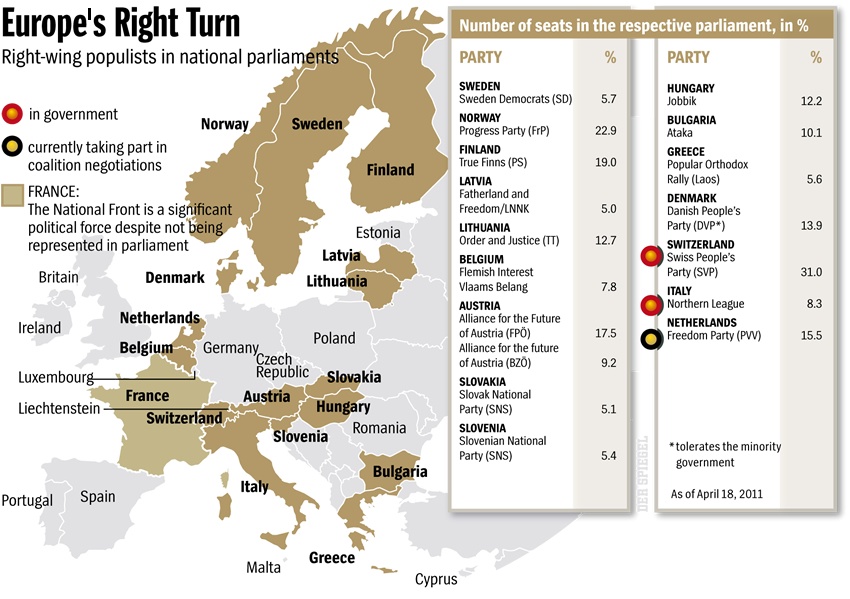
Across the 17-member euro zone, government heads had a hunch April 17 might not be a very good day for the future of Europe. The strong ballot box performance of the euroskeptic True Finns means it is very likely the party will be part of the next government. It appears that a country long seen as an EU anchor may soon become a source of irritation for Brussels and in capitals across the bloc.
>


During the election campaign, True Finn party head Timo Soini lashed out repeatedly against the European Union and bailout plans for debt-ridden euro-zone members. Bolstered by an election that saw the party more than quadruple its standing, with 19 percent of the vote, an emboldened Soini remained vocal on Monday, saying it was unacceptable that Finland "must pay for the mistakes of others." And that "the content of politics must change. We have been too soft on Europe." 

Does the party represent a threat to the common European project? Do Finland's right-wing populists truly have the power to bring the euro to its knees? Or does it merely have the capacity to create a threat to the euro's stability and thus protract the current currency crisis? 

If the party becomes part of Finland's next government, that answer could come within a matter of weeks. A coalition between the conservatives, who drew the most votes, the opposition Social Democrats and the True Finns is one viable option currently being discussed.

Will Remainder of Euro Zone Be Left to Foot the Bill?

Under current euro-zone rules, all 17 members must approve bailout packages for countries in need -- and next month, an €80 billion package for Portugal is up for approval. During the campaign, Finland's major parties said they wouldn't form a governing coalition with the True Finns if doing so would create a threat to the future of Europe's common currency. As such, it seems likely that, should the True Finns join the government, the party's euro-critical positions will be watered down. It remains possible, however, that a future Helsinki coalition could refrain from vetoing a bailout package for Portugal, but would then refuse to provide funding. 

Were Finland to back out of any future rescue packages, it would have a significant impact on the common currency. The timing is bad, too, given that Europeans are currently faced with three euro-related problems that need to be solved at the same time:
  • The temporary euro rescue fund (EFSF), valid until 2013, needs to be expanded.
  • The permanent crisis mechanism (ESM), intended to replace EFSF starting in 2013, needs to be formally agreed to.
  • Financial aid to Portugal needs to be released.
Within the framework of the temporary rescue fund, all 17 euro-zone member states are providing credit guarantees valued at a total of €400 billion ($579 billion). In order to preserve the highest possible credit rating for the fund, however, a maximum of €250 billion from the fund can be lent to troubled euro-zone countries. Euro-zone leaders are now discussing nearly doubling the sum of money that is actually lendable as quickly as possible so that €440 billion can be disbursed in emergencies. That will be crucial if, following Ireland and Portugal, larger EU countries like Spain require bailouts in the future. 

Looking ahead to elections in Finland, EU leaders in March delayed a final decision on the expansion of the existing bailout fund until June, well after Finns would go to the polls. 

Finnish Pullout Would Be 'Politically Uncomfortable'

It is now possible that if the right-wing populists with the Real Finns party join the government, that a deal will be blocked by Finland or that the Finns place additional hurdles before passage. Helsinki is currently responsible for providing credits valuing €7.9 billion, representing a share of about 1.8 percent of the EFSF. Under the current deal, Finland would also have to increase its credit guarantees in proportion to its shares in the EFSF. By comparison, Germany is covering around 28 percent of the total sum. At €119.4 billion, that figure is almost 15 times greater than Finland's. 

If the Finns decide not to take part in the expansion of EFSF, then other countries would have to plug the gap. Daniel Gros of the Brussels-based Center for European Policy Studies, however, says this wouldn't be a major problem. Still, he says "it would then be politically uncomfortable" because if one country decided to stop supporting the rescue program, others might soon follow suit.

Nevertheless, throughout its history, individual countries have demanded exceptions on a number of issues and the European Union has still managed to get by. Slovakia and the other new EU member states, for example, have been given a sort of discount on the amount they are required to put up for the permanent ESM rescue fund. The countries had complained because they felt they were being overly burdened by the bailout. 

A Finnish 'No' Could Get Expensive for Germany

But the effect of a Finnish withdrawal would be greater on Germany than it would be on most other euro-zone member states. Germany and Finland, together with France, the Netherlands and Austria, are the only countries in the euro zone that possess the best possible rating, Triple A, from the ratings agencies. If one of these countries with the best credit ratings ceases to participate, the additional burden would likely fall on the other countries with Triple A ratings and not on countries with lesser ratings such as Estonia or Malta. 

It could also create problems for the permanent European Stability Mechanism (ESM), which is expected to replace the temporary rescue package in 2013. ESM is intended to be able to loan a maximum of €500 billion. In order to be able to loan that much, the euro-zone states would have to put €700 billion into the fund. And in order to obtain the highest rating from ratings agencies, ESM would have to include credit guarantees totalling €620 billion. As security collateral, it would also have to include €80 billion in cash.
That would mean the first infusion of actual cash from taxpayers into a rescue fund since the start of the euro crisis. All of the bailout measures undertaken so far have been covered with credit guarantees, with the exposure to taxpayers existing only on paper -- at least until a country fails to repay its loans. But whereas Germany will have a share of 27.1 percent of the ESM, meaning €168 billion and €22 billion in cash reserves, Finland's share is also relatively small. The government would have to provide €11.1 billion in guarantees and €1.4 billion in cash. If the True Finns party becomes part of the coalition, it is conceivable that the Finnish government would either not participate in EFSF or ESM or that it will want to reduce its participation. 

Threats from Finnland Create Uncertainty on Markets

Close attention is being paid by the financial markets to the political tug o' war. "So far, there has already been a tendency towards palpable skepticism about further aid in the donor nations," analysts at Germany's Commerzbank have written. With the election victory of the euro critics, the bank's analysts write, the risk has increased "that a donor country will pull out of the rescue mechanism." They add: "A pullout by the Finns would mean more than a termination of solidarity because the agreement of all 17 euro-zone members is required to approve aid." 

The analysts are referring to an important means of pressure the Finns have at their disposal. In order for the ESM to go into effect, the Treaty of Lisbon, which governs the workings of the EU, must be modified. The change would not require countries to cede sovereignty on any additional issues to the EU, but it would nevertheless require ratification by the national parliaments of member states, including the Eduskunta in Helsinki. 

So the future Finnish government actually does have the ability to block the increased funding of the EFSF and the creation of the ESM. But that remains speculative at this stage. Ognian Hishow, an expert on EU integration at the German Institute for International and Security Affairs (SWP), doesn't believe that Finland would withdraw from the currency union or the EU. "Finnish companies wouldn't tolerate that," he said, adding that the financial risks would be too great. "Finland has so far done well with the euro," Hishow said. "Reason will prevail in the end." 

'Overall Political Picture in Europe Has Worsened'

Nonetheless, the Finns could stir up trouble in terms of disbursing financial aid for Portugal. A unanimous decision is required by all euro-zone finance ministers in order to disburse loans under the current EFSF agreement. This is expected to take place in May. In the worst-case scenario, this would provide the Finnish finance minister with an opportunity to strike. He could demand that Finland would only agree to the bailout if Helsinki didn't have to participate financially. 

Given the relatively small, single-digit billion volume of Finland's share of the bailout, this quasi veto power probably wouldn't threaten Portugal's bailout. But economist Gros at Center for European Policy Studies argues that the political symbolism of a pullout would be important, especially if other countries followed suit -- particularly countries that have been leaders in a united Europe until now. Gros says it could create huge problems if sentiment like that crossed over into Germany.
"The overall political picture in Europe has worsened," Gros said.

Prices Widening Confidence Gap Among Higher, Lower Income Groups

By Kathleen Madigan

Income inequality is nothing new within the U.S. consumer sector, but the recession created a new split between those who managed to keep their jobs and those who didn’t. The gap is widening now that staples like energy and food are much more expensive.

Consumer confidence edged up in April, but not everyone was happier. The gain in confidence was concentrated among those households earning $35,000 or more. The indexes fell among consumers with yearly incomes less than $25,000.

Higher-income families would be expected to be more upbeat than those earning less. But all income groups were nearly unanimous in their pessimism during the recession. In the fourth quarter of 2008, the indexes were separated by less than 10 points.

By this April, however, the highest earners’ index towered almost 43 points above that of the lowest earners.
One reason for the gap is that higher-income families have benefited more from the soaring stock market. 

Equity gains are helping to offset the accelerating drop in home values. Standard & Poor’s reported home prices in 20 major U.S. cities fell 3.3% during the year ended in February.

Another explanation is the unequal sting from rising gasoline and food prices. Higher costs for these consumer basics are eroding overall household buying power, but higher-income families are better able to absorb the increases.

Of course, gasoline prices typically increase in the months before the summer driving season. But this year, the runup has been turbo-charged.

In the previous decade, gas prices, on average, were up about 42 cents from the end of the previous year to the last week of April. This year the increase is 86 cents. (Even in 2008, when gas tipped over $4 a gallon by the summer, prices were up by less than 60 cents by the last week of April.)

More pain is on the way. As senior energy correspondent David Bird reports on Dow Jones Newswires, the recent rise in oil futures suggest retail gasoline prices will move toward $4 a gallon.

No wonder the confidence survey reported consumers think the U.S. inflation rate will tip over 6% a year from now. Yearly inflation, as measured by the total consumer price index, was just 2.7% in March.

The consumer split creates a bifurcation within the business sector as well. Luxury companies are doing well. 

Leather goods maker Coach Inc. reported Tuesday that its profits jumped 34% in the first quarter and comparable-store sales in North America increased 8.5%. High-end shoe maker Jimmy Choo is on the block, expected to fetch more than double what it sold for in 2007.

More downscale companies are seeking ways to lift revenue. Wal-Mart Stores Inc. is experimenting with home delivery in order to drum up sales, and consumer-goods makers, Kimberly-Clark Corp. and Procter & Gamble Co., are planning to raise prices.

Whether those price increases stick, however, will depend on consumers lower down the economic ladder feeling better about their economic future.

What to Watch in Fed Statement: ‘Inflation Expectations’

By Jon Hilsenrath

Federal Reserve Chairman Ben Bernanke will be getting all of the attention Wednesday when he holds his first ever post-Fed-meeting press conference. But don’t forget the statement that the entire Fed policy committee will issue nearly two hours before the chairman utters a word. That meeting statement, due at 12:30, will set the tone for the press conference.

One key passage worth watching is the Fed’s description of long-term inflation expectations. After Fed officials met on March 15, they said this:

“Commodity prices have risen significantly since the summer, and concerns about global supplies of crude oil have contributed to a sharp run-up in oil prices in recent weeks. Nonetheless, longer-term inflation expectations have remained stable, and measures of underlying inflation have been subdued.”

Will the policy makers be as comfortable this week about long-run inflation expectations as they were then? Trading in inflation-protected Treasury bonds suggests investors are expecting a little more inflation in the long-run than they were.

This chart, for example, shows how much inflation investors expect in the five years between 2016 and 2020, based on calculations that grow out of a 2008 Fed research paper.


It’s not an alarming rise and the latest downward drift should comfort some officials
Over a longer stretch of time, it doesn’t like much of a big move:


Still, it does look like long-run inflation expectations are creeping up, and this may make some Fed officials uncomfortable. “It will definitely raise some eyebrows around the FOMC table and reinforce concerns about upside risks to the inflation outlook,” says Laurence Meyer, of Macroeconomic Advisers LLC, a former Fed governor. Michael Pond, a bond strategist at Barclays Capital who follows expectations closely, has a similar take: “It may be a little bit above its previous highs on our measure but not dramatically so.”

The worry is that if people’s expectations for future inflation move up, they could become a self-fulfilling prophesy. The Fed’s vice chair, Janet Yellen, in recent comments in New York, described expectations as “reasonably well anchored.” Perhaps that’s a clue about how the Fed will treat the question in its post-meeting statement, not alarmed but not completely comfortable either. (Read her full remarks.)

As the following excerpts from Ms. Yellen’s comments suggest, the underlying message is that the Fed is watching inflation expectations very carefully:

In this regard, surveys and financial market data indicate that longer-run inflation expectations remain reasonably well anchored even though near-term inflation expectations have jumped in the wake of the surge in commodity prices. For example, the Thomson Reuters/ University of Michigan Survey of Consumers indicates that median inflation expectations for the coming year moved up about 1-1/4 percentage points in March, whereas the median expectation for inflation over the next 5 to 10 years increased only 1/4 percentage point. While such movements obviously bear watching, I would note that such a combination–namely, a substantial jump in near-term inflation expectations coupled with a relatively modest uptick in longer-run expectations–has often accompanied previous sharp increases in gasoline prices, and when it did, those movements were largely reversed within a few months.

Information derived from the Treasury inflation-protected securities (TIPS) market also suggests that financial market participants’ longer-term inflation expectations remain well anchored even as the near-term outlook for inflation has shifted upward. In particular, while the carry-adjusted measure of inflation compensation for the next five years has increased about 1/4 percentage point since earlier this year, forward inflation compensation at longer horizons is roughly unchanged on net. Much of the increase in five-year inflation compensation has been associated with the surge in food and energy prices, and the level of this measure appears consistent with a normal cyclical recovery after adjusting for those effects.

This all matters, because if the Fed starts to think that long-run inflation expectations are moving up too much, it could prod the central bank toward a faster exit from its easy money policies.

Follow Us