Friday, April 22, 2011

Gold and Silver, What’s Driving Their Prices Higher?

By: Submissions

Ian R. Campbell writes: 

Gold and Silver continued making headline news yesterday and this morning, with everyone reading this likely being well aware that both breached, and so far have held above U.S.$1,500 and U.S.$45 respectively. At 11:30 a.m. ET this morning they trading at U.S.$1,504.14 and U.S.$46.02. To put these two prices in context, on January 1, only 80 calendar days ago:

physical gold closed at U.S.$1,338.30 (or thereabouts depending on which exchange one looks at). This morning's gold price is 12.4% higher only 80 calendar days later. This is an annualized price increase of 56.6%; and

· physical silver closed at U.S.$28.02 (or thereabouts depending on which exchange one looks at). This morning's silver price is 64.2% higher only 80 calendar days later. This is an annualized price increase of 292.9%.

So what are today's gold and silver prices telling us?

The first question I ask is "what macro-economic events have occurred since January 31 that reasonably can be said to not have been predicable on that date, but are now 'in the market'"? My thoughts:

· riots began in Tunisia in December, 2010, and hence can be said likely to be 'well considered' by January 31;

· riots began in Egypt on January 25, and hence by January 31 might reasonably be said to have been 'relatively new' with their impact being more speculative on January 31 than currently is the case;

· the Libyan revolution that has led to the current ongoing turmoil in that country started on February 15, so awareness of that was not 'in the market' on January 31;

· the largest of the recent Japanese earthquakes and resultant tsunami occurred on March 11, with the ongoing Fukushima nuclear disaster happening in its aftermath. Clearly, these events were not 'in the market' on January 31;

· the U.S.$ exchange rate has deteriorated from $0.74 to just under $0.69 against the Euro in that 80 day period, notwithstanding the EuroZone Sovereign Debt issues have again 'come to the fore' in the past two weeks;

· after January 31 the political polarization in Washington has become (or so I think) ever more apparent. Witness the 11th hour (literally) budget debate that on April 8 came close to shutting the U.S. Government down, and the issues of the U.S. Debt Ceiling and 2012 Federal Budget that will be debated in the next few weeks and months;

· there has been an increased emphasis on U.S. non-durable goods inflation after January 31 - or again, so I think. Note that the WTI oil price was over U.S.$112 this morning;

· there has been increasing discussion around whether the U.S.$ will continue as the world's reserve currency;


· from my perspective there is comparatively little change in the volume of commentary that has been made about gold after January 31. However, that is not to say that more people and investment groups have not become more conscious of physical gold, and it potential importance to them as a 'real money' 'safe haven'. 
Silver, on the other hand, seems to me from observation to have been much more in the public eye after January 31 than it was before that date, with the possibility that increased 'silver publicity' has caused more physical silver buying traction for 'investment' purposes than was the case prior to January 31; and,

· add your own thoughts here to what I am not holding the foregoing out to be an 'all inclusive' list.

The second thing I continue to think about is how much froth currently may be in the silver market in particular, resulting from 'lemming like' activity on the part of investors and speculators. I have to believe there is currently some 'exuberance influence' currently in the silver market, and to some degree perhaps in the gold market as well. When I read articles and listen to interviews or presentations I look for balanced positive and negative commentary (on any subject, not just on gold and silver). I don't see much negative commentary these days.

All that said, gold and silver are priced in U.S.$. Can the rising gold and silver prices simply be the result of the gold and silver markets telling us they are becoming each day more convinced that in the face of America's debt load, ongoing monthly net trade deficits, lost manufacturing jobs and unemployment levels, and broad-based world uncertainties, the U.S. Federal Government and Mr. Bernanke will be unable to 'economically right the good ship America' in a way that will get the U.S. even close to where it was on the world economic stage ten years ago? 

Only last Friday (April 15), when the physical silver price was about U.S.$42.50, in a commentary titled 'Silver - Too Fast?' I said that "having regard for my own circumstances, I am prepared to hold my physical silver position for the time being, but plan to watch things very closely every day, and make a new decision on my sell/hold/buy view each day. Six days later, having read numerous further articles speaking to the run-ups in both the gold and silver price, I am still of that same mind - but particularly in the case of silver, I am becoming ever more wary of its rapid price increase (about 8% since last Friday).

Silver Set to Soar as Fiat Paper Currencies Fold


As a result of active "demonetization" efforts by the IMF and its member central banks, gold and silver have experienced the type of volatility that has given conservative investors reasons not to perceive the metals as dependable cash alternatives. Instead gold and silver have become known as the asset class to hold as a hedge against inflation.

However, during the 1990's, when inflation was in general much higher than it has been since the turn of the millennium, gold and silver prices drifted lower and stagnated. However, since 2000, gold and silver have risen by over 400 and 700 percent respectively. Remarkably, this has occurred over a time frame during which, by most accounts, low inflation has prevailed. How can this be explained?

In 1944 when the U.S. dollar was considered 'as good as gold,' it was made the international reserve currency. This unique status is the reason that Fed Chairman Ben Bernanke was recently able to say that, "The U.S. Government has a technology, called the printing press that allows it to produce as many dollars at it wishes at essentially no cost."

Today, with the Federal Reserve treating the greenback as a never ending lottery ticket for deficit spending politicians, many investors feel the U.S. dollar is good for nothing. As a result there is an increasing international pressure to remove the U.S. dollar's reserve status. Given that there is no widely accepted alternative to the dollar (the euro has many problems of its own), this is creating fears of an international currency crisis, which has fueled interest in precious metals. So metal prices have risen even with low inflation expectations.

In order to paper over the effects of the financial collapse, central banks around the world are printing as fast as their presses can manage. But unlike prior periods of monetary inflation (like the 1970's), some major powers (China) are withdrawing liquidity. In addition, emerging market manufacturers are holding down prices even as currencies lose value. This may explain the strong performance of metals despite seemingly manageable inflation. But if higher prices emerge into the light of day (as they already have in commodities), currency uncertainty combined with high inflation should intensify the market for precious metals. The question then becomes how to play the market.

Gold has always been the reserve asset of choice for central banks and major private investors. But now, as smaller investors become aware that paper dollars are under threat, many are looking towards silver. Taken in aggregate, these smaller investors have enormous buying power. Through ETF's and mining stocks they are not bound by government restrictions on holding precious metals in retirement funds. In contrast to gold, central banks do not hold much silver. They are therefore less able to push down the price of silver by dumping inventory when rising metal prices undermine currency confidence.

Indeed, so far this year, silver is up nearly 50% while gold is up only about 6%. Given these figures, investors may be forgiven if they feel that the big move in silver may be over. Technical analysis may provide comfort.

According to the U.S. geological survey silver is about 17.5 times more abundant than gold in the earth's crust. This ratio has long been appreciated by civilizations throughout history. Thus, in 1792 the newly formed U.S. Congress passed the First Coinage Act, which legally set the valuation ratio of gold/silver at 15 (it was raised to 16 in 1834). In the early 1990's, with silver out of favor with investors, the ratio approached 100. At the beginning of this century gold stood at some $250 an ounce and silver at $4, putting the ratio at about 62. Today, with gold at around $1,500 an ounce and silver at $45, the ratio has closed to around 33. But this is still far higher than the ratio seen in the late 1980's (silver's last mega spike), and if far higher than the natural proportions of gold and silver would suggest.

The demand for physical silver also remains strong, which supports the market for spot silver. Smaller investors may find gold too expensive at $1,461 an ounce, but may be nevertheless prepared to buy several ounces of silver for much less. Potentially, this 'poor man's gold' market may help drive silver prices far faster than gold.

Yuan continues climb to end at record; revaluation seen unlikely

By Lu Jianxin and Jason Subler

The yuan ended at a fresh record high on Friday as the central bank continued to allow the currency to rise to help fight imported inflation, but onshore traders remained convinced it would not resort to any one-off revaluation despite rumors overseas.

The People's Bank of China (PBOC) has set repeated record highs for the yuan's daily mid-point over the last several weeks, engineering an accelerated rise against the dollar that means it has now gained nearly 5 percent since it was depegged last June.

Those recent gains, together with comments this week by PBOC adviser Xia Bin that he would not rule out another one-off revaluation, have sparked talk among forex traders, especially those offshore, that such a move could be imminent.
But a number of reasons argue against such a possibility.

Policymakers as senior as Premier Wen Jiabao have repeatedly ruled out the possibility of another one-off revaluation, meaning any surprise would put the government's credibility at risk and could spark a backlash from the politically strong export sector.

Traders also point to the fact that the PBOC could allow a spurt in the yuan of 2 to 3 percent over the course of a few trading days if it wanted to, just by continuing to set its mid-point higher and allowing the currency to rise in daily trade, negating the need for any one-off move.
"There would be huge pressure for the government to explain if it conducted another one-off yuan revaluation of 2 or 3 percent -- a goal it can now easily reach via the market," said a senior trader at a major Chinese state-owned bank in Beijing.

"An even larger one-off yuan rise would surely create a huge political storm in a country where quite a large number of people still believe yuan appreciation is part of a Western conspiracy aimed to contain China's development."

CONTAINING FALL VERSUS BASKET

Still, what has become clear is that Beijing is increasingly ready to let the yuan strengthen against the dollar as a way to help contain the rising cost of imports, which was one reason why the country racked up a rare trade deficit in the first quarter.

While the official view in Beijing is that the yuan is no longer vastly undervalued, PBOC governor Zhou Xiaochuan pointed to the need to rely on the yuan in the inflation fight a week ago, echoing earlier comments by Premier Wen.

The need to move further on appreciation comes in part because the dollar has recently fallen to three-year lows.

Even though the yuan has risen by over 1 percent against the dollar so far this year, it has been falling against the currencies of other major trading partners given the dollar's weakness, making imports from places such as Europe more expensive.

So in a sense, the PBOC is just limiting the yuan's fall against other currencies, not engineering a rise outright, something traders said showed the government's continuing caution about disrupting exporters and other rate-sensitive sectors.

Spot yuan closed at a record high 6.5067 versus the dollar, up from Thursday's close of 6.5205. It has now risen 4.91 percent since it was depegged in June 2010, and 1.27 percent so far this year.

The PBOC has set a series of record high mid-points -- the level from which the dollar/yuan exchange rate can trade up or down 0.5 percent on a given day -- to express the government's intentions for the yuan to rise.

FASTER, PLEASE

Judging by official comments, one might not expect a rise such as that over the last few weeks to continue for long.

Guan Tao, an official with the State Administration of Foreign Exchange (SAFE), said in remarks published in China Finance that the yuan should not be allowed to rise sharply, even while Beijing takes steps to rein in the growth in the country's foreign exchange reserves.

Still, traders said it may be more to China's benefit to let the yuan appreciate faster to take advantage of the higher value of the currency to fight inflation, while the PBOC could still pull back the currency quickly if market conditions change.

If the yuan rises too slowly, lagging conditions in the global market, China's economy may not be cushioned in time from the effects of imported inflation, traders said, noting that it was possible that policy makers had reached a common understanding on the necessity for quicker appreciation.

Revaluation or no revaluation, offshore traders continued to price in heightened expectations of accelerated appreciation over the next several months.

One-year dollar/yuan non-deliverable forwards (NDFs) were bid at 6.3220 in late trade, down from 6.3400 at Thursday's close.
Those levels imply the yuan will appreciate 3.06 percent in a year's time, compared with 2.76 percent implied a day earlier, leaving open a window to bet on more yuan strength in the NDFs.

NDFs appeared to be playing catch-up with widespread expectations of 5 to 6 percent yuan appreciation for 2011 after they lagged in forecasting the rise so far this year, partly due to capital outflows from the NDF market into Hong Kong's expanding yuan market.

See the original article >>

JEFF GUNDLACH SAYS THE USA WILL DEFAULT

by Cullen Roche

At last week’s Morningstar Investor Conference in Chicago Jeff Gundlach, bond guru and founder of DoubleLine Capital said the USA is confronted with a terrible deflationary battle that will ultimately end in default (see the full presentation here). I was shocked to read this from Gundlach who is truly a master of the debt markets. He appears to connect all of the dots with near perfection only to come to what I believe is a maniacal conclusion (that we will default).

At the presentation Gundlach focused primarily on the government debt level without focusing heavily on the difference between private sector and public sector debt levels (which is absolutely crucial in my opinion). He said:
“The problem for the near term is that the load of all of this debt is deflationary. We need to work through these deflationary outcomes. Debt growth creates a headwind where we need more and more and more debt.”
Of course, deficits are as American as apple pie. As you can see below, the USA has essentially always run deficits. Throughout many of our most prosperous periods we have run large deficits and been deep in the red. Government has spent more than its brought in for almost the entirety of the existence of the USA yet we have never had trouble paying for our children’s futures or “financing” anything. This confounds the inflationistas and those arguing that we will default. How can a nation never be in surplus and still be, arguably, the greatest economic engine ever known to man?

The answer is a matter of accounting. Private sector net savings is public sector deficit. TO THE PENNY. This is simply an accounting identity. The government cannot be in surplus at the same time the private sector is in surplus.
The Gundlach commentary got decidedly more negative from there. He essentially blames government spending for our current woes:
“Government workers are being paid with taxes on borrowed money. If you are going to create government jobs, you are just borrowing more money. Those aren’t real jobs.”
This is a blanket falsehood. First of all, the USA doesn’t “borrow” money. We are no different than an alchemist who funds his spending internally. As the monopoly supplier of currency in a floating exchange rate system we are our own banker. Not China, not Japan. Just like the alchemist, we simply press a button and wahlah! Money appears. The bogey for the alchemist is not “funding” himself. The bogey for the alchemist is ensuring that there continues to be demand for his currency – that he does not inflate away its value. But as Gundlach earlier pronounced there is no risk of inflation….Only deflation as the private sector continues to destroy money via debt reduction.

The other flaw in his thinking is with regards to jobs. I don’t know where this idea comes from that government spends no money on productive labor. Most of us know our local police officers, fire fighters, perhaps someone in the military? Government employees are VERY real. These are not fake jobs at all. These are productive jobs that put real dollars into Main Street’s pockets. We can argue over the effectiveness of a large portion of these jobs or whether they are all necessary, but saying they are fake is simply erroneous. Would you rather we put those dollars into the pocket’s of bankers because that is what Ben has done for the last 18 months. How is that working out for us? I am the last person on earth to advocate a fully run government economy (I wouldn’t refer to the site as Pragmatic CAPITALISM if that were the case), but this idea that government is always and everywhere a bad thing is simply false. They are blanket falsehoods based on nothing more than political beliefs that cloud rational thought.

Where Gundlach nails the argument is in his deflation/stimulus argument. He clearly recognizes that the environment we are in has been and remains a deflationary threat. As I have argued for several quarters, Gundlach says that the removal of government aid will reveal a private sector that is still deeply in debt and unable to “run with the baton” (as I have previously described):
“Take the stimulus away, and you’re going to have a double-dip recession or a significant contraction or slowdown of economic growth.”
The flaw in Gundlach’s larger argument is the same one that David Einhorn and Alan Greenspan have recently made. It is this inability to differentiate between private sector debt and public sector debt (of which there is really none – a sovereign nation which has monopoly supply of currency in a non-convertible floating exchange rate system never really has any “debt”) which leads them to believe that the US government is no different than a household. This of course is what is leading us all to believe we are the next Greece. It’s sheer lunacy. And it is why we are implementing austerity measures almost universally. Because of this, Gundlach says tax increases are on the way:
“You have a tax increase coming and a radical policy shock that will affect investments in the economy.”
Ultimately, however, Gundlach says the USA will be forced to default as we truly are the next Greece:
“some type of polite default, at a minimum, will happen.”
And I would like to politely say, that Mr. Gundlach is wrong. The United States will not default unless we choose to default due to some mental lapse by the US Congress. On the other hand, we could effectively default by creating hyperinflation, but that is in direct contradiction to the rest of Mr. Gundlach’s argument. The US consumer might be on the verge of default, but there is no solvency risk in the United States at the government level, unlike the single currency nations in Europe.

Unfortunately, no one cares to listen to these vitally important facts (and simple accounting identities) so bring on the tax hikes. Bring on the austerity. Bring on the pain. We’ve become a world of masochists. Let’s see how well we handle it. My guess is not so well. Fortunately for Mr. Gundlach his bond portfolios will likely benefit enormously.

World Gold Bug Article on WSJ Front Page

Front page WSJ story today — World Is Bitten by the Gold Bug:
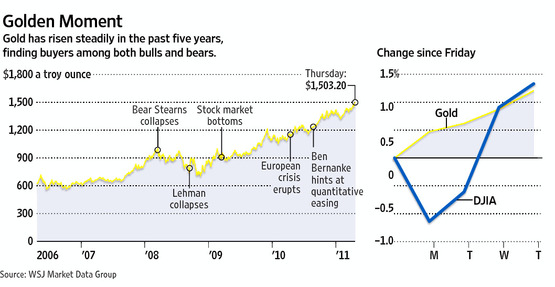
“Gold continued its upward march in a time of global financial tumult, closing above $1,500 an ounce Thursday for the first time as investors seek safe haven in the metal
In a remarkable performance for any sort of asset, gold has notched a record high every day this week—on days when investors were alternately gloomy and optimistic. On Monday, as stocks swooned after Standard & Poor’s warned about the credit rating of the U.S., gold reached a new high. It kept rising on Tuesday and again on Wednesday, as stocks soared on impressive corporate earnings.
On Thursday, gold rose $4.90 an ounce to $1,503.20, another nominal record high and its first settlement above $1,500. Gold is up for five straight weeks, and has gained 5.8% so far this year.”
Front page stories are not great usually for investments — although this is the WSJ, not Time or Newsweek. It has much less of a contrarian indication.
>


See the original article >>

TradeStation to be acquired by Monex

by Futures Magazin

PLANTATION, Fla. and TOKYO, April 20, 2011 (GLOBE NEWSWIRE) -- TradeStation Group, Inc. (Nasdaq:TRAD - News) ("TradeStation" or the "Company") and Monex Group, Inc. (Tokyo Stock Exchange: 8698) ("Monex") today announced that they have entered into a definitive agreement pursuant to which a subsidiary of Monex (the "Merger Sub") will acquire all the outstanding common stock of TradeStation for $9.75 per share, or approximately $411 million in aggregate, through a cash tender offer followed by a merger.
  Under the terms of the agreement, which has been unanimously approved by TradeStation and Monex's respective Boards of Directors, TradeStation's shareholders will receive $9.75 in cash for each outstanding share of TradeStation common stock they own, which represents a 39% premium to TradeStation's share price 30 days ago, on March 21, 2011, and a 32% premium to TradeStation's closing stock price on April 20, 2011, the last full trading day before today's announcement.

"We are pleased to announce this transaction, as it delivers significant value to our shareholders," said Salomon Sredni, Chairman and Chief Executive Officer of TradeStation. "Monex is a leader in Japan's online brokerage market, and we believe it will be a great partner as we go forward as part of the Monex family."

Oki Matsumoto, Chairman and CEO of Monex said: "TradeStation has a well-established, award-winning platform that is poised for continued growth and has a proven track record among the active trader segment of the United States. Through this acquisition, we expect TradeStation and Monex to complement one another via cross-utilization of technological development capabilities, customer and revenue bases. We are truly excited to work with TradeStation to realize our global vision."

Under the terms of the agreement, it is anticipated that Merger Sub will commence a tender offer for all of the outstanding shares of TradeStation by May 10, 2011.

If the tender offer is successfully completed, the parties expect the transaction to close early in the 2011 third quarter. Completion of the tender offer is subject to, among other things, the satisfaction of the minimum tender condition of at least a majority of TradeStation's outstanding common shares on a fully diluted basis, required regulatory approvals, including those of the Federal Trade Commission under the Hart-Scott-Rodino (HSR) Antitrust Improvements Act of 1976, the Financial Industry Regulatory Authority (FINRA), and the United Kingdom Financial Services Authority (FSA), and other customary closing conditions.

J.P. Morgan is acting as financial advisor and Bilzin Sumberg Baena Price & Axelrod LLP is acting as legal counsel to TradeStation on this transaction. Deutsche Bank is acting as financial advisor and Simpson Thacher & Bartlett LLP is acting as legal counsel to Monex.

See the original article >>

Follow Us