Tuesday, April 19, 2011

Financial Scam Behind Rising Crude Oil and Food Prices?

By: Danny_Schechter

The global economy and its recovery, and the living standards of millions of plain folks, are now at risk from the sudden rise in oil and commodity prices. 

Gas at the pump is up, and going higher. Food prices are following. 

The consequences are catastrophic for the global poor as their costs go up while their income doesn’t. It’s menacing American workers too, who in large part have not seen a meaningful raise since the days of Reagan (keeping it this way is clearly behind the current flurry of attacks on unions). 

Already, unrest in the Middle East and many African countries is being blamed for these dramatic increases. It seems as if this threat to global stability is being largely ignored in our media, one that treats the oil business as just another mystical world of free market trading. 

Why is it happening? Why all the volatility? Is oil getting scarcer, leading to price increases? Is the cost of food, similarly, a reflection of naturally increasing commodity prices? 

While it’s true that natural disasters and droughts play some role in this unchecked price inflation, it also seems apparent that something else is attracting increasing attention, even if most of our media fails to explore what is a political time bomb while most political leaders shrug their shoulder and ignore it. 

President Obama recently said there is nothing he can do about the hike in oil and food prices. 

Critics say the problem is that government and media outlets alike refuse to recognize what’s really going on: unchecked speculation! 

Not everyone buys into this suspicion. In fact, it is one of more intense subjects of debate in economics. Princeton University economist Paul Krugman pooh-poohs the impact of speculation counter posing the traditional argument that oil prices are set by supply and demand. 

The Economist Magazine agrees, summing up its views with a pithy phrase, “Speculation does not drive the oil price. Driving does.” 

Others, like oil industry analyst Michael Klare of Hampshire College in the US see demand outdistancing supply: 

“Consider the recent rise in the price of oil just a faint and early tremor heralding the oilquake to come. Oil won’t disappear from international markets, but in the coming decades it will never reach the volumes needed to satisfy projected world demand, which means that, sooner rather than later, scarcity will become the dominant market condition.” 

Usually you hear this debate in scholarly circles or read it in political tracts where orthodox views collide with more alarmist projections about the oil supply “peaking.” 

But officials in the Third World don’t see the subject as academic. Reserve Bank of India Governor Duvvuri Subbarao charges "Speculative movements in commodity derivative markets are also causing volatility in prices," he said. 

The World Bank is meeting on this issue this week because it is seen as a matter of “utmost urgency.” 

“The price of food is a matter of life and death for the very poorest people in the world,” said Tom Arnold, CEO of Concern Worldwide, the international humanitarian agency, ahead of his participation at The Open Forum on Food at World Bank headquarters. 

He adds, “…with many families spending up to 80% of their income on basic foods to survive, even the slightest increase in price can have devastating effects and become a crises for the poorest.” 

Journalist Josh Clark argues on the website “How Stuff Works” that much of the oil speculation is rooted in the financial crisis, “The next time you drive to the gas station, only to find prices are still sky high compared to just a few years ago, take notice of the rows of foreclosed houses you'll pass along the way. They may seem like two parts of a spell of economic bad luck, but high gas prices and home foreclosures are actually very much interrelated. Before most people were even aware there was an economic crisis, investment managers abandoned failing mortgage-backed securities and looked for other lucrative investments. What they settled on was oil futures.” 

The debate within the industry is more subdued, perhaps to avoid a public fight between suppliers and distributors who don’t want to rock the boat. But some officials like Dan Gilligan, president of the Petroleum Marketers Association, representing 8,000 retail and wholesale suppliers has spoken out. 

He argues, “Approximately 60 to 70 percent of the oil contracts in the futures markets are now held by speculative entities. Not by companies that need oil, not by the airlines, not by the oil companies. But by investors who profit money from their speculative positions.” 

Now, a prominent and popular market analyst is throwing caution to the wind by blowing the whistle on speculators. 

Finance expert Phil Davis runs a website and widely read newsletter to monitor stocks and options trades. He’s a professional’s professional, whose grandfather taught him to buy stocks when he was just ten years old. 

His website is Phil’s Stock World, and stocks are his world. He’s subtitled the site, “High Finance for Real People.” 

He is usually a sober and calm analyst, not known as maverick or dissenter. 

When I met Phil the other night, he was on fire, enraged by what he believes is the scam of the century that no one wants to talk about, because so many powerful people armed with legions of lawyers want unquestioning allegiance, and will sue you into silence. 

He studies the oil/food issue carefully and has concluded, “It’s a scam folks, it’s nothing but a huge scam and it’s destroying the US economy as well as the entire global economy but no one complains because they are ‘only’ stealing about $1.50 per gallon from each individual person in the industrialized world.” 

“It’s the top 0.01% robbing the next 39.99% – the bottom 60% can’t afford cars anyway (they just starve quietly to death, as food prices climb on fuel costs). If someone breaks into your car and steals a $500 stereo, you go to the police, but if someone charges you an extra $30 every time you fill up your tank 50 times a year ($1,500) you shut up and pay your bill. Great system, right?” 

Phil is just getting started, as he delves into the intricacies of the NYMEX market that handles these trades: 

“The great thing about the NYMEX is that the traders don’t have to take delivery on their contracts, they can simply pay to roll them over to the next settlement price, even if no one is actually buying the barrels. That’s how we have developed a massive glut of 677 Million barrels worth of contracts in the front four months on the NYMEX and, come rollover day – that will be the amount of barrels "on order" for the front 3 months, unless a lot barrels get dumped at market prices fast.” 

“Keep in mind that the entire United States uses ‘just’ 18M barrels of oil a day, so 677M barrels is a 37-day supply of oil. But, we also make 9M barrels of our own oil and import ‘just’ 9M barrels per day, and 5M barrels of that is from Canada and Mexico who, last I heard, aren’t even having revolutions. So, ignoring North Sea oil Brazil and Venezuela and lumping Africa in with OPEC, we are importing 3Mbd from unreliable sources and there is a 225-day supply under contract for delivery at the current price or cheaper plus we have a Strategic Petroleum Reserve that holds another 727 Million barrels (full) plus 370M barrels of commercial storage in the US (also full) which is another 365.6 days of marginal oil already here in storage in addition to the 225 days under contract for delivery. “ 

These contracts for oil outnumber their actual delivery, a sign of speculation and market manipulation, as oil companies win government authorizations for wells but then don’t open them for exploration or exploitation. It’s all a game of manipulating oil supply to keep prices up. And no one seems to be regulating it. 

What Phil sees is a giant but intricate game of market manipulation and rigging by a cartel—not just an industry—that actually has loaded tankers criss-crossing the oceans but only landing when the price is right. 

“There is nothing that the conga-line of tankers between here and OPEC would like to do more than unload an extra 277 Million barrels of crude at $112.79 per barrel (Friday’s close on open contracts and price) but, unfortunately, as I mentioned last week, Cushing, Oklahoma (Where oil is stored) is already packed to the gills with oil and can only handle 45M barrels if it started out empty so it is, very simply, physically impossible for those barrels to be delivered. This did not, however, stop 287M barrels worth of May contracts from trading on Friday and GAINING $2.49 on the day. “ 

He asks, “Who is buying 287,494 contracts (1,000 barrels per contract) for May delivery that can’t possibly be delivered for $2.49 more than they were priced the day before? These are the kind of questions that you would think regulators would be asking – if we had any.” 

The TV news magazine 60 Minutes spoke with Dan Gilligan who noted that, investors don't actually take delivery of the oil. "All they do is buy the paper, and hope that they can sell it for more than they paid for it. Before they have to take delivery." 

He says they make their fortunes “on the volatility that exists in the market. They make it going up and down."
Payam Sharifi, at the University of Missouri-Kansas City, notes that even as the rise in oil prices threatens the world economy, there is almost total silence on the danger: 

“This issue ought to be discussed again with a renewed interest – but the media and much of the populace at large have simply accepted high food and oil prices as an unavoidable fact of life, without any discussion of the causes of these price rises aside from platitudes.”
What can we do about that?

Standard & Poor's U.S. Sovereign Debt Downgrade Watershed Event

By: Richard_Mills

"Common sense tells us that a government central bank creating new money out of thin air depreciates the value of each dollar in circulation." ~ Congressman Ron Paul (R-TX)


Billions of Dollars


Declining confidence in paper money is pushing gold and silver from the shadows to center stage.


"The surge in commodity prices over the past year appears to be largely attributable to a combination of rising global demand and disruptions in global supply. These developments seem unlikely to have persistent effects on consumer inflation or to derail the economic recovery and hence do not, in my view, warrant any substantial shift in the stance of monetary policy." ~ Federal Reserve Vice Chairman Janet Yellen

"There is only one difference between a bad economist and a good one: the bad economist confines himself to the visible effect; the good economist takes into account both the effect that can be seen and those effects that must be foreseen... the bad economist pursues a small present good that will be followed by a great evil to come, while the good economist pursues a great good to come, at the risk of a small present evil." ~ Frederic Bastiat (1801-1850)
The federal deficit this year is a record $1.6 trillion -- a number that requires the government to borrow 43 cents out of every dollar it spends. The US government's total debt will mushroom from $14.2 trillion now to almost $21 trillion by 2016.

Obama's projected $1.6 trillion deficit for the current year would be the highest dollar amount ever. It represents 10.8 percent of the total economy, the highest level since 1945 when the deficit was 21.5 percent of GDP and reflected heavy borrowing to fight the Second World War.

The president's 2012 budget projects that the deficits total $7.2 trillion over the next 10 years with the shortfalls never coming in below $607 billion.

Professor Peter Bernholz, from the University of Basel, examined 12 of the 29 hyperinflationary episodes where significant data exists.
"Hyperinflations are always caused by public budget deficits which are largely financed by money creation...The figures demonstrate clearly that deficits amounting to 40 percent or more of expenditures cannot be maintained. They lead to high inflation and hyperinflations."
Most analysts quote government deficits as a percentage of GDP:
"The president's projected $1.6 trillion deficit for the current year...would also represent 10.8 percent of the total economy."
This reporting is misrepresenting the true size of the problem because it doesn't say how big the deficit is relative to expenditures.

On February 14, 2011, President Obama released his 2012 Federal Budget. The report updated the projected 2011 deficit to $1.645 trillion. This is based on estimated revenues of $2.173 trillion and expenditures of $3.818 trillion.

He then unveiled a $3.73 trillion budget for 2012 with a projected deficit of $1.1 trillion - a lot of savings/cuts and revenue assumptions in the 2012 budget appeared to this author, to put it politely, to be pie in the sky. 

The savings and revenue projections have more to do with the 2012 election than reality - Obama is trying to appear fiscally responsible to the voters. It also doesn't look like either party can agree to any cuts except to those in someone else's (somebody from the other party) back yard.

The US government cannot sell enough of its debt to its own citizens and foreigners to finance its deficit and pay the interest on its existing debt.
"Yes, we are monetizing debt. You buy bonds and you monetize debt. Right now, a lot of that is going into excess reserves so it is not having an immediate effect on inflation. It will initiate inflationary impulses. It takes time." ~ Thomas Hoenig, President, Federal Reserve Bank of Kansas City, early March 2011
The US government is already buying its own debt - this is the most inflationary thing a country can do - and it looks like we can expect this trend to continue and probably increase.

The Event

April 18th 2011 - Standard & Poor's Ratings Service lowered its long term outlook for the United States sovereign debt to Negative from Stable.

Moody's issued a warning earlier in 2011 saying that its rating could be downgraded if progress isn't made soon on the $1.5 trillion US budget deficit.

Conclusion

Are any countries in the world going to enter into a hyperinflationary episode anytime soon? This writer doesn't know - I do know we are experiencing inflation, I think it's going to get to much higher levels than today's and I've been saying so for quite a while.

Gold and silver shine brightest in inflationary times - when your cash is trash your gold and silver are shining - and history proves the greatest leverage to rising precious metal prices are junior companies involved in the discovery and development of precious metal projects.

Junior precious metal companies should be on every investors radar screen. Are they on yours?
If not, maybe they should be.

See the original article >>

Wheat prices soar as threats from dryness escalate

by Agrimoney.com

Wheat futures soared more than 3% in Paris, and 4% in Chicago, despite the US debt fears which sank many other markets, as weather fears prompted investors to reinject a risk premium into prices.
A range of assets sold off after Standard & Poor's cut to "negative", from "stable", its outlook for its rating on US sovereign debt, signalling that a downgrade may be on the way.
London shares ended down 2.1% and prices of many raw materials fell, including copper, which lost more than 1%, and New York crude, which shed 2.7%, with soft commodities also falling.
New York cocoa for May shed 3.5%, with losses also prompted by growing expectations of shipments out of Ivory Coast.
'Problems around the world'
However, grains - with gold, a safe haven in times of global uncertainty – showed substantial gains after weather forecasts over the weekend removed a forecast of rain for America's hard red winter wheat districts in the southern Plains, where grain ratings have suffered from a dearth of moisture.
"That's what started it, the idea that [the southern Plains] will not after all get rain on April 19-20," David Tallentis at WxRisk.com told Agrimoney.com.
While some models were now predicting rain for April 22-23, a series of wrong forecasts meant "people are getting pretty sceptical".
Furthermore, the forecast for northern Europe, where a lack of moisture is raising growing concerns for crops the region's four main grain-producing countries, including France, Germany, Poland and the UK, "still looks pretty dry".
"China is seeing problems too, especially in the north east. There are all sorts of problems all around the world."
'Not looking good'
Wheat for May closed 3.3% higher at E246.00 a tonne in Paris and, at 16:45 GMT, stood 4.5% higher at $7.78 a bushel in Chicago, regaining most of its losses of last week.
In Kansas, where the hard red winter variety of wheat is traded, the May lot added 4.2% to return back over $9, to $9.02 a bushel.
"If we did not have these negative outside market force, we would probably be limit up in wheat," Mike Mawdsley at Iowa-based Market 1 said. In Chicago, the maximum daily rise would take the grain to $8.04 ¼ a bushel.
Meanwhile, forecasts remain wet for major US corn districts, and are expected to land up to five inches of rain on some areas over the next week, hampering the spring sowing campaign.
"It is too early to say we have a problem. But it is not looking good for much of the Corn Belt," Mr Mawdsley said.
However much progress US farmers had made in sowings, which will be revealed later by weekly official US crop progress data, "I do not see it being added to much by next Monday around here", he added.

US downgrade would help stocks, hurt bonds

By DAVE CARPENTER and STAN CHOE

When Standard & Poor's says it might lower its top AAA rating on U.S. government debt, the stock market fell sharply. Traders were worried that if a downgrade happened, it would send interest rates higher. And, in turn, raise companies' borrowing costs.

But short-term investors were driving the markets Monday. For individual investors who are in the market for the long haul, a downgrade might not be as devastating as it seemed at first — especially if their biggest investment is in the stock market.

The downside of a lower U.S. credit rating would be another drop in Treasury prices. And they've already been falling because interest rates are expected to rise as the economy grows. But some analysts say that stock prices would rise over the long term because they'll have better returns than bonds and cash.

"For people who bought bond funds and think they won't lose money -- you're wrong," says Linda Williams, director of fixed income investments for Minneapolis-based private wealth management firm Lowry Hill. "When rates rise, those bond funds will be worth less than what you paid for them."

Stocks, meanwhile, will look more appealing compared to other investments that are losing value.

"The equity market may be the best alternative, and it could improve," says Randy Bateman, chief investment officer of Huntington Funds. He noted that U.S. businesses have strong balance sheets with record amounts of cash — unlike the indebted federal government.

A U.S. downgrade would also likely hurt the dollar's value. That would help stock prices of U.S. exporters, because their products would be cheaper for customers buying in foreign currencies, says Philip Tasho, chief investment officer of TAMRO Capital.

"The federal government's financial position is terrible," Tasho says. "Corporate America's is the best in a generation."

S&P's warning called attention to the fact that investors owning the 10-year Treasury note, or Treasurys with longer maturities, are particularly vulnerable.

"They have to realize that their bond portfolio is not where they want to be taking risk. You need to have a short maturity to protect yourself against a rising interest-rate scenario," says Tom Atteberry, co-manager of the FPA New Income Fund.

Investors shouldn't overreact based on Monday's news, however, cautioned Bill Stone, chief investment strategist for PNC Wealth Management. It shouldn't come as a surprise to anyone because the government has been taking on billions of dollars in debt since the financial crisis.

"If you had all your money in U.S. Treasurys, I'd say there might be some other places that are more attractive," he says, citing corporate debt and stocks. "But I don't think there's a reason to panic."

The risk that the U.S. government will default on its debt any time soon remains "infinitesimally remote," he says.

Some past downgrades - and threats of them - have had little impact on a country's stock market.
On May 21, 2009, S&P says it was considering a downgrade of Britain's AAA rating. The country's FTSE 100 index sank 5 percent over the next month and a half, but investors quickly shrugged it off. It rose 24.6 percent between May 21 and the end of 2009.

“Officialdom” Downgrades US

By Guest Author

S&P’s revision to the outlook on the United States’ sovereign credit rating to negative from stable this morning provoked a wide range of reactions. Not terribly significant in the sense that the outlooks on issuers’ credit ratings are revised up and down by the ratings agencies every day, and not terribly significant in the sense that the markets didn’t move all that much, the revision has nonetheless touched a nerve. Why?

For starters, it is the first admission by what I call “officialdom” that the means by which we extricated ourselves from the debt deflation of 2007-09 carry negative consequences. Who knows if the big swings in the market are caused by shifts in the dominant narrative or whether the narrative shifts in response to the swings in the market, but either way today’s action by S&P introduces a new narrative into the mix. This crisis isn’t over; it’s just entered into a new phase. This was never a mere cyclical recession anyway and now we have a choice: tighten our belts to preserve our preeminent financial standing in the world, or roll the dice on further policy accommodation at the risk of the a debilitating, Greece-like implosion.

That’s a far cry from the present dominant narrative which goes something like this: Short-termism of the kind displayed during last December’s “budget compromise” is irresponsible and will cost us dearly at some point, but it also symbolizes policymakers’ desire to do “whatever it takes” in the short term in order to keep this recovery going. Don’t fight these policymakers – at least, not until after the 2012 elections.

One of these narratives is bearish for financial asset prices and one of them is bullish. No prizes for guessing which is which.

Secondly, should an actual downgrade of the U.S.’s issuer rating to AA+ materialize, and should it be followed by downgrades by Moody’s and Fitch, there are all sorts of question marks about what kind of friction would result from institutional rigidities. For example, many institutions around the world have mandates to invest certain percentages of their funds in AAA securities. Presumably, downgrades by two or three of the agencies would spark a good deal of selling by those institutions.

What about Treasuries’ hypothecation value? If they’re not AAA anymore, would they be accepted as collateral in the repo market on the same terms that are offered today? Or, would extra collateral need to be posted – or would the interest rate charged need to rise? What effect would this have on liquidity, on the very “money-ness” – to borrow Doug Noland’s term – of Treasury securities? Male model Derek Zoolander once said, “Water is the essence of wetness, and wetness is the essence of beauty.” Likewise, 100% hypothecation value is the essence of risk-free, and risk-free is the essence of moneyness. In Minskian terms, a decline in the moneyness of Treasuries would make it more difficult for levered entities to “make position” which in turn would make the financial system more fragile, more susceptible to crises.

I’ll go one step further: this revision, this oh-so-minor revision, is in fact a policy tightening. Despite the fact that several additional steps would need to be taken by the ratings agencies before any of these liquidity difficulties came to pass, I believe that the shock of today’s announcement amounts to a more significant policy tightening than that which will occur in June when the Fed ends QE2. The end of QE2 is part of a carefully prepared script and therefore will have no real impact on market participants’ behavior (by design). Besides, quantitative easing produces diminishing returns (it puts cash assets on banks’ balance sheets, enhancing their ability to make position, but relaxed FAS 167 guidance has already alleviated any difficulty in making position by absolving the really bad assets from mark-to-market accounting) which means that ending QE2 will not be significant in the context of financial sector liquidity.

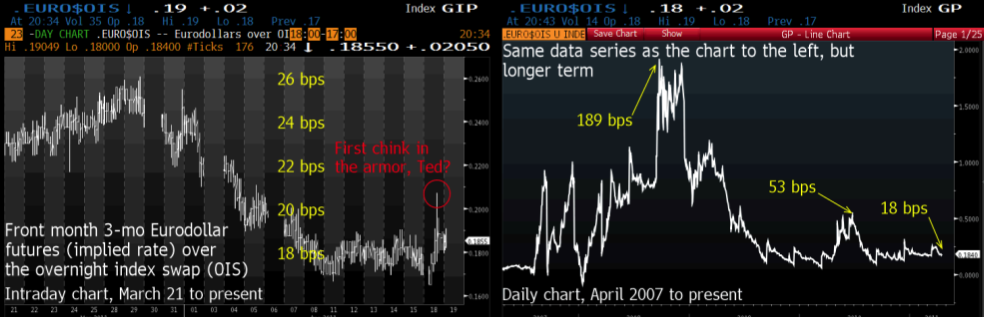
Check out the chart below which shows the implied yield difference between 3-month Eurodollar futures and the 3-month overnight index swap (a proxy for interbank lending risk) on an intraday basis going back about a month. It shows that the yield difference spiked about 3 basis points higher on the heels of S&P’s announcement this morning.
>

>
It’s not an insignificant move, that 3 basis point spike, but the chart above on the right puts it into context. If I’m right and S&P’s announcement does in fact constitute an actual policy tightening, it either hasn’t hit full bore yet or it’s simply a very slight tightening. This context is important because even the cleverest theories amount to nothing if there’s no follow-through in the markets.

However, if, after the political and financial establishment gets done telling us all to quit our worrying and that today’s action by S&P has no practical significance, traders get to thinking about the very real implications this action has for financial instability in the future (and traders are forward-looking, right?), we might be looking at a downside catalyst for risk assets including stocks.

At this point, I want to soak up any and all arguments the conclusion of which is that S&P’s revision is not significant before revising my own near-term bullish stance. It was definitely an unnerving day, though, wasn’t it? Between that and the European difficulties (the True Finns!), it’s a testament to traders’ undying optimism that the market managed to pare nearly half of its losses in the afternoon.

Y2K = QE2

By Erik Swarts

History shows us that each bubble needs a tragic muse.

The Nasdaq Bubble had both the allure and fear of a new millennium. Y2K was on one hand a software and infrastructure motivator, as well as a philosophical romance; drunk on the notion of a new era that would transform all that we understood and perceived about the world through technology.

With gold and silver today, it’s just as manic, evermore disturbingly romantic – and really just plain dark.
It’s a bubble with a raging mood disorder.

At once both manic and depressive. Currency debasement! Manipulated markets! The experiment that was the fiat monetary system is over! Raging inflation is coming!
Protect yourself!

In the end, the inflation debate is a matter of relativity and coordination. We are not the only ones intervening in the marketplace with a monetary policy stopgap approach – it is entirely a global effort. And while it does make for a juicy soundbite (that is typically 9 times out of 10 either politically motivated or borne out of ones position in the market), there’s a lot less hyperbole and a great deal more logic behind the Feds efforts than most give them credit for. Here’s the byline for the Financial Crisis for Dummies softcover:

The private sector stopped spending – the government filled the gap. 

And although it is quite true that our current fiat monetary system is inflationary over the long run, the degree of distortions that are currently being reflected in both the precious metals market, the commodities market and the currency markets – likely do not reflect a representable correlation to inflation today, but more of a serious bubble in the commodities sector. I believe this minority opinion will prevail in the not so distant future as we emerge from the crisis relatively intact, albeit bruised nonetheless.

FT/Alphaville had a very interesting piece detailing the work from the boys at Deutsche Bank – that succinctly describes what I believe has been a massive misinterpretation by the risk trade into the commodity and currency markets.
“The $2 trillion in purchases have literally gone down a black hole. Required reserves haven’t been required to increase and the Fed reserve add has literally simply been hoarded as cash. Excess reserves at the Fed have subsequently soared by the same. In short, QE has been a spectacular disappointment in its impact on bank lending, whether via whole loans or securities. It was as if the banks conducted the very sterilization of QE that many thought perhaps the Fed should do to “contain” inflation expectations.
Risky security prices have risen since QE but not Treasuries, the main instrument of QE2. Yet banks’ balance sheets have gone sideways. Effectively investors have marked asset prices higher by the Fed from an investor simply triggered a series of deposit for security switches through the investor base with banks never making an additional loan. This is consistent with a greater concern for risky asset post QE2 end, than Treasuries. The danger for investors is that they confuse the result of higher asset prices as reflecting excess liquidity rather than “irrational” exuberance given that actual liquidity (as broadly defined by the banking system) hasn’t gone up at all.
- Dominic Konstam and Alex Li, Deutsche Bank”
While I agree with their descriptions of a rather large miscausation within the risk trade, I disagree with their disappointment with bank lending. Once critical mass arrives in the economy – bank lending will resume a glide path towards normalcy. Post financial crisis, both the private and government sectors perceive critical mass through the lens of the stock market – not lending. To their detriment, economist always seem to forget the psychological perspective to the argument. It is why accurate market forecasts are a hybrid discipline of both art and science.

From Lemons to Lemonade

Personally, I would never advocate the path that the Fed and Treasury have embarked on in the last 40 years. However, to the best of his ability, Bernanke has utilized the tools at his disposal to mitigate the collateral damage to the broader financial system.

I like Ben Bernanke, I really do.

There, I said it.

Don’t hate me because I chose the unpopular position – it’s an inherent character trait.

During these contentious times, I think he is about as balanced – without ego, smart and creative as we could hope for in a central banker. The pundits will always use every opportunity to argue his ignorance towards what they perceive as practical banking methods and how they should function during ideal market conditions. They will cite example after example, such as his downplay of the subprime crisis right before the broader credit crisis erupted, as proof that he is unfit to lead the worlds largest economy. And although he surely deserves criticism towards aspects of his communications and transparencies with the market, the net result of his bold monetary approach has been a system that avoided catastrophic failure and recovered much faster than almost anyone predicted.

And while I would never willingly choose the To Big To Fail paradigm, it has facilitated the efficiency and efficacy that the Fed could respond to illiquid market conditions. Granted, the crisis was magnified by the To Big To Fail model, but the rapid recovery was also a direct result of their size and scope and considerable bandwidth within the global economy. Dealing with only a handful of mega banks with very similar infrastructures is infinitely easier to navigate and dispense stopgap capital, then thousands of separate and smaller entities with disparate business models and means of capital conveyance. No doubt about it, it’s a house of cards in the right market conditions, but it also can be utilized to neatly reflate a deflationary market environment in a crisis.

With that said, there can be some rather large side effects of operating capital within such a dynamic system – even if they are just figments of the markets imagination (see below).

The Bubble that is Silver

Since I last checked in on the state of the precious metals market (a whopping three weeks ago – and 400 posts before Silver Bubble Mania hit the blogosphere), the silver bullet train has continued its ascent higher – in what I like to refer to as its quest for its ephemeral peak.

It’s not a matter of if, it’s a matter of… yada, yada, yada – you’ve heard it all before.

It is a very crowded topic to broach these days. Definitely a bit disconcerting from a contrarian perspective, if you are positioned on the opposing side of the plate. You may ask, why would anyone ever willingly step in front of a train such as silver?

(thick BBC english accent)

Purely Ego.

I’m smarter than the market; I’m smarter than you; therefore…(insert tragic personal anecdote here). It’s typically a widow maker towards your net worth. Trust me.

We all know, as so eloquently stated years back by the godfather of our modern fiscal debate, John Maynard Keynes, “that market’s can remain irrational longer than one can remain solvent.”.

Truer words have never been spoken.

With that said, there are a number of reasons – both fundamentally, technically and psychologically speaking that silver’s historic rise is running out of motivational propellant. The crescendo of central bank fedspeak (previously described here) towards quantitative easing exit strategies and inflation concerns has reached a dissonant pitch in the market. What’s the old market axiom, “Buy the rumor, sell the news”? Well the news flow has been absolutely tidal towards inflation expectations as of late.
Internationally, the drumbeat from China has been as steady as Ringo’s right foot in Come Together. They have raised rates twice since October, and just yesterday, their central bank governor declared they would continue to raise rates, “for some time”. Meanwhile, the ECB has eschewed Bernanke’s willingness to give the markets the benefit of the doubt and have followed rhetoric with action.

Domestically, the inflation debate has intensified, and although the governing powers that be have yet to align a concerted approach towards addressing inflation expectations – the wheels are in motion and proceeding along that path.

Two days ago, it was Fed Governor Plosser declaring his concern with “choreographing” an exit strategy towards quantitative easing. Moments before, it was Federal Reserve Bank of Richmond President Jeffrey Lacker stating his concerns with the, “need to heed the lesson of the last recovery that inflation is capable of rising even if the level of economic activity has not returned to its pre-recession trend.”.
First rhetoric then action.

Technically speaking, the silver market is as exuberant as the Nasdaq was in March of 2000.
I also like to look at the monthly charts as an apples to apples comparison of these two historic bubbles. For comparison, I bracketed both the Y2K hysteria trade in the Nasdaq and the current QE2 trade in silver.

The RSI, MACD, Full Stochastics and CCI have all exhibited very similar artifacts of manic market conditions. Namely, a slope as steep as the current monthly MACD for silver is almost always immediately followed by only one phenomenon.
Exhaustion.
Not a correction or consolidation of trend.

Exhaustion.

The Nasdaq had Y2K as its tragic muse. Silver, and by extension the entire commodity sector, has QE2. It’s ending in one month. Best look for a seat before the music stops.

Just remember, Y2K=QE2

See the original article >>

Follow Us