Friday, April 15, 2011

20 Signs That A Horrific Global Food Crisis Is Coming

The Economic Collapse

In case you haven't noticed, the world is on the verge of a horrific global food crisis. At some point, this crisis will affect you and your family. It may not be today, and it may not be tomorrow, but it is going to happen. 

Crazy weather and horrifying natural disasters have played havoc with agricultural production in many areas of the globe over the past couple of years. Meanwhile, the price of oil has begun to skyrocket. The entire global economy is predicated on the ability to use massive amounts of inexpensive oil to cheaply produce food and other goods and transport them over vast distances. Without cheap oil the whole game changes. Topsoil is being depleted at a staggering rate and key aquifers all over the world are being drained at an alarming pace.

Global food prices are already at an all-time high and they continue to move up aggressively. So what is going to happen to our world when hundreds of millions more people cannot afford to feed themselves?

Most Americans are so accustomed to supermarkets that are absolutely packed to the gills with massive amounts of really inexpensive food that they cannot even imagine that life could be any other way. 

Unfortunately, that era is ending.

There are all kinds of indications that we are now entering a time when there will not be nearly enough food for everyone in the world. As competition for food supplies increases, food prices are going to go up. In fact, at some point they are going to go way up.

Let's look at some of the key reasons why an increasing number of people believe that a massive food crisis is on the horizon.

The following are 20 signs that a horrific global food crisis is coming....

#1 According to the World Bank, 44 million people around the globe have been pushed into extreme poverty since last June because of rising food prices.
#2 The world is losing topsoil at an astounding rate. In fact, according to Lester Brown, "one third of the world's cropland is losing topsoil faster than new soil is forming through natural processes".
#3 Due to U.S. ethanol subsidies, almost a third of all corn grown in the United States is now used for fuel. This is putting a lot of stress on the price of corn.
#4 Due to a lack of water, some countries in the Middle East find themselves forced to almost totally rely on other nations for basic food staples. For example, it is being projected that there will be no more wheat production in Saudi Arabia by the year 2012.
#5 Water tables all over the globe are being depleted at an alarming rate due to "overpumping". According to the World Bank, there are 130 million people in China and 175 million people in India that are being fed with grain with water that is being pumped out of aquifers faster than it can be replaced. So what happens once all of that water is gone?
#6 In the United States, the systematic depletion of the Ogallala Aquifer could eventually turn "America's Breadbasket" back into the "Dust Bowl".
#7 Diseases such as UG99 wheat rust are wiping out increasingly large segments of the world food supply.
#8 The tsunami and subsequent nuclear crisis in Japan have rendered vast agricultural areas in that nation unusable. In fact, there are many that believe that eventually a significant portion of northern Japan will be considered to be uninhabitable. Not only that, many are now convinced that the Japanese economy, the third largest economy in the world, is likely to totally collapse as a result of all this.
#9 The price of oil may be the biggest factor on this list. The way that we produce our food is very heavily dependent on oil. The way that we transport our food is very heavily dependent on oil. When you have skyrocketing oil prices, our entire food production system becomes much more expensive. If the price of oil continues to stay high, we are going to see much higher food prices and some forms of food production will no longer make economic sense at all.
#10 At some point the world could experience a very serious fertilizer shortage. According to scientists with the Global Phosphorus Research Initiative, the world is not going to have enough phosphorous to meet agricultural demand in just 30 to 40 years.
#11 Food inflation is already devastating many economies around the globe. For example, India is dealing with an annual food inflation rate of 18 percent.
#12 According to the United Nations, the global price of food reached a new all-time high in February.
#13 According to the World Bank, the global price of food has risen 36% over the past 12 months.
#14 The commodity price of wheat has approximately doubled since last summer.
#15 The commodity price of corn has also about doubled since last summer.
#16 The commodity price of soybeans is up about 50% since last June.
#17 The commodity price of orange juice has doubled since 2009.
#18 There are about 3 billion people around the globe that live on the equivalent of 2 dollars a day or less and the world was already on the verge of economic disaster before this year even began.
#19 2011 has already been one of the craziest years since World War 2. Revolutions have swept across the Middle East, the United States has gotten involved in the civil war in Libya, Europe is on the verge of a financial meltdown and the U.S. dollar is dying. None of this is good news for global food production.
#20 There have been persistent rumors of shortages at some of the biggest suppliers of emergency food in the United States. The following is an excerpt from a recent "special alert" posted on Raiders News Network....
Look around you. Read the headlines. See the largest factories of food, potassium iodide, and other emergency product manufacturers literally closing their online stores and putting up signs like those on Mountain House's Official Website and Thyrosafe's Factory Webpage that explain, due to overwhelming demand, they are shutting down sales for the time being and hope to reopen someday.
So what does all of this mean?

It means that time is short.

For years, many "doom and gloomers" have been yelling and screaming that a food crisis is coming.

Well, up to this point there hasn't been much to get alarmed about. Food prices have started to rise, but the truth is that our stores are still packed to the rafters will gigantic amounts of relatively cheap food.

However, you would have to be an idiot not to see the warning signs. Just look at what happened in Japan after March 11th. Store shelves were cleared out almost instantly.

It isn't going to happen today, and it probably isn't going to happen tomorrow, but at some point a major league food crisis is going to strike.

So what are you and your family going to do then?

You might want to start thinking about that.

See the original article >>

THREE THINGS I THINK I THINK

by Cullen Roche

1) How will we know when the QE2 trade is over?

It’s about that time when the smart money is beginning to think 10 moves ahead in the chess game. And in this game, the only piece worth focusing on is QE2. QE2 ends on June 30th and traders are already jockeying for position. How soon will the QE2 trade end? No one can tell. It could be a sell in May or it could be a sell the news. But one thing will be very clear when it occurs – the US dollar will stage a counter-trend rally.

One of the primary fuels during this speculative fervor has been the decline of the dollar. With the exception of a brief period in November no sector has benefited more than commodities. As I’ve previously discussed, this hasn’t generated some great economic benefit for the United States (that wasn’t already occurring), but it most certainly has translated into speculative behavior.

The dollar’s decline was relatively benign until the ECB began forecasting rate hikes earlier this year. And the usual inverse correlation can be seen in a sizable Euro rally. The end of QE2 will be seen as a pseudo form of tightening and a step in the direction towards US rate hikes. This could be an excuse for short covering and a USD rally. And while that doesn’t necessarily mean the commodity bull market is over it is likely to put a dent in the QE2 trade.
When currencies converge?

When will it happen? As I mentioned above, the timing is impossible to know, but if I had to venture a guess I’d say we’re closer to a EUR/USD bend in the trend as opposed to a continuation of the trend. And we all know what they say about the trend and friends….

2) Collapsing lumber prices portend a weaker economy?

Did you completely miss the utter collapse in lumber futures in recent weeks? I certainly did. In just the last 3 weeks lumber futures have fallen 25%. The Wall Street Journal says the decline has been due to a number of factors including fears of slowing Asian demand, weak US housing markets and excess supply:
“The recent decline in lumber futures was blamed on increased first-quarter mill production that met stagnant domestic demand and exports that were strangled by shipping bottlenecks.
China emerged last year as a dominant buyer in western U.S. and Canadian lumber markets. Mills responded by ramping up production to meet export demand and take advantage of an expected seasonal surge in U.S. house construction as spring arrived. Yet shippers couldn’t keep up with export sales to China and the spring housing demand failed to materialize, creating an oversupply problem that fueled the selloff, which started late last month.
…Despite the growth in Chinese demand, the U.S. remains the top market for North American lumber, so when the U.S. housing market is dormant, lumber futures prices soften, said Jamie Greenough, a broker and lumber market analyst at Global Securities Corp., a securities and commodities brokerage in Vancouver, B.C.”
Lumber prices have had a very close correlation with the US economy. While prices appear to have stabilized in recent days you have to wonder if this isn’t a sign of more serious weakness overall. One thing is for certain – the US housing market remains mired in a deep recession.
3) Why does the cost of a house get such a bum rap?

Whenever I talk to someone about inflation in the current environment and I tell them housing costs are near their lows they always reply: “sure, but I don’t buy a house every month”. Well, that might be true, but most Americans pay their mortgage every month – so you kind of do buy a house every minute of every day if you think of it in terms of the duration of the loan. Unless you paid in full upfront (which most homeowners don’t) you’re in a persistent state of buying the home. You could actually argue that you buy your home more often than you buy anything else because you can be damn sure the bank is calculating their loan value by the millisecond. Okay, that’s an exaggeration, but why do people downplay their largest monthly expense?

With interest rates near all-time lows mortgage refinancing is very beneficial – even after the recent rally in rates. In addition, new buyers are swooping in at a 30% discount in the real estate market. In essence, homeowners are able to lock-in deflationary prices in the current environment. That’s a significant price decrease for a vast majority of Americans. While many other prices are rising, housing has rarely been more affordable. Some recent charts from Liz Ann Sonders at Charles Schwab put this into perspective:
It’s no coincidence that the Housing Affordability Index troughed with inflation in the 70′s!
Inflation?
The moral is, the cost of owning a home has plummeted in recent years and this accounts for the majority of one’s monthly non-discretionary spending! Whether you are looking to purchase a home or have an old mortgage you are able to take advantage of significant deflation in your largest monthly expense. This isn’t an attempt to downplay the damaging impact of inflation in other markets, however, when assessing the bigger picture it is very important that we keep things in perspective. According to the BLS, housing related expenditures account for 47% of total consumer expenditures. The price you see on the gas sign every day isn’t nearly as important as the one you see on your monthly mortgage statement. And there is absolutely zero inflation in that payment.

See the original article >>

Thursday, April 14, 2011

Google 1Q earnings miss analysts' target

By MICHAEL LIEDTKE

Google's first-quarter earnings came in below analyst projections as the Internet search leader sped up hiring and increased spending other areas to drive up its expenses.

The results released Thursday may heighten investor fears that Google's earnings might suffer because of the company's commitment to hire at least 6,200 workers this year. That would be the most in Google's 13-year history.

Google co-founder Larry Page, who replaced Eric Schmidt as CEO after the quarter ended, has indicated he plans to keep investing in long-term opportunities that may take years to pay off, even if that crimps the company's short-term results.

Page, known for his aloofness, made a few tame remarks on Google's earnings conference call Thursday before turning the presentation over to the company's chief financial officer, Patrick Pichette, who has been steering the presentations for the past year.

"I'm very excited about Google and our momentum, and I'm very, very optimistic about our future," Page said. He also assured that the management transition that Google announced three month ago is unfolding as the company envisioned, with Page overseeing day-to-day operations while Schmidt handles government relations and stalks possible acquisition targets in his new role as executive chairman.

Google shares shed $27.74, or nearly 5 percent, to $550.77 in extended trading. The stock closed the regular session at $578.51, up $2.23.

The company earned $2.3 billion, or $7.04 per share, in the period ending in March. That was an 18 percent increase from nearly $2 billion, or $6.06 per share, last year.

If not for the cost of employee stock rewards, Google said it would have earned $8.08 per share. That was below the average estimate of $8.11 per share among analysts surveyed by FactSet.

Revenue was nearly $8.6 billion, a 27 percent increase from last year.

After subtracting the commissions paid to ad partners, Google's revenue stood at $6.54 billion. That figure topped the average analyst estimate of $6.33 billion, according to FactSet.

Expenses grew faster than revenue. The company added 1,916 employees to end March with more than 26,300 workers. More than half of the new staff is working on products and services to supplement the search advertising network that makes most of Google's money. The new growth opportunities include video ads on Google's YouTube site, ads on smartphones, and more banner advertising.

A 10 percent raise that Google gave all its employees at the beginning of the year contributed to rising costs.
Google also spent $890 million on data centers and other capital projects in the quarter, more than triple the $239 million it spent in the same period last year.

Crude Oil Set to Break $150 by Mid Summer


Jason Simpkins writes: Money Morning predicted in its 2011 Outlook series that oil prices would see $100 a barrel by summer. And that's proven to be true - but not entirely for the reasons we discussed.
In addition to the increased demand we talked about in January, violence in the Middle East and North Africa (MENA) has driven oil prices into the stratosphere. The price of light, sweet crude climbed above $112 a barrel last week, up more than 22% from where it started the year.

A recent pullback has driven prices back down to about $107 a barrel, but don't be fooled. Strong demand in emerging markets, a weak dollar, political turmoil in the MENA region, and a strong speculative sentiment will continue to push oil prices higher.

In fact, oil prices could reach $150 a barrel by midsummer and $200 a barrel by the end of the year.
"I believe we will reach $150 a barrel by midsummer," Money Morning Contributing Writer and Editor of the Oil & Energy Investor Dr. Kent Moors said in an interview. "Dollar weakness is a factor,as is rising demand from non-OECD [Organization for Economic Cooperation and Development]countries. Other factors include supplyconcerns, quality of crude extracted, reserve replenishment, level of stockpilesand the occasional saber rattling."

What to Make of the MENA Region
The so-called "Jasmine Revolution" taking place throughout the Middle East and North Africa more than anything else has affected the price of oil. 

In February, Egypt's revolution gave oil prices the impetus to breach the $100 a barrel level for the first time since 2008. Soon thereafter Libya descended into civil war, adding further momentum to the oil market.
Egypt's conflict was in large part resolved by the resignation of President Hosni Mubarak, but Colonel Moammar Gadhafi remains in power in Libya. 

NATO allies have assisted the Libyan rebels by enforcing a United Nations-sanctioned no-fly zone, but have stopped short of ousting Gadhafi from power. What will happen next is far from certain. 

If the situation is quickly resolved, oil prices could fall as the cloak of uncertainty is lifted from the market and production resumes. But if the conflict drags out - or the Jasmine Revolution continues to spread through countries such as Yemen - oil prices could remain at elevated levels, and perhaps even top their record highs by midsummer. 

More bearish analysts say that speculators have gotten carried away by the regional unrest and that higher oil prices will dent demand, leading to a price decline. 

"We have a hedge-fund community, a Wall Street community that is way over-extended on their bets on rising oil prices," Stephen Schork, president of the Schork Group Inc. and author of the Schork Report told Bloomberg News. "Speculators on Wall Street now own more barrels of sweet oil than are actually sitting in the Strategic Petroleum Reserves (SPR). They own twice as many futures contracts in gasoline than there are at the NYMEX delivery hub in New York Harbor." 

Furthermore rising gasoline prices risk driving off would-be consumers, says Schork, who believes prices at the pump may rise 20 cents to 25 cents this summer.

"Consumers just simply can't pay any more," he said. "We are at the demand point where elasticity is certainly going to wane. Americans cannot afford that. They will alter their discretionary behavior when it comes to gasoline." 

However, that hasn't been the case so far. Gasoline inventories dropped by 7 million barrels in the week ended April 8, as demand rose 3.7% to 9.18 million barrels a day, according to the Energy Information Administration (EIA). The EIA forecasts a 0.5% increase in gasoline consumption this summer compared to last year.

If higher gasoline prices fail to ward motorists away from the pumps oil will likely continue its advance - and political unrest in oil producing regions will only add further momentum.

Money Morning's Moors agrees that oil prices could pull back if order is restored throughout the MENA region. But he doesn't believe such an abrupt end to hostilities is likely. Furthermore, underlying supply-demand imbalances and market volatility will continue to push prices significantly higher.

"There is certainly some inflation in the current price resulting from the risk factor," said Moors. "The underlying effective market value of the crude is probably about $95 a barrel. However, even without any other exogenous factors, that would still result in $150 by midsummer."

And as far as speculation is concerned, Moors doesn't believe the futures markets are overly distorted. 

"There are less than 800 million barrels in the SPR; while daily trade internationally is about 85 million barrels - less than 10 days of global trading equals theSPR," he said."Since those contracts are held by parties seeking a return several months in the future, it's not unusual to have more barrels held in futures than available in the SPR. That's a red herring argument if there ever was one."

Indeed, for Moors and many other analysts it comes down to simple supply and demand. 

"Libya is the centerof media attention but not the primary problem," said Moors. "Remember this market is no longer driven by the developed countries. For instanceDouglas-Westwood came out with a report last week indicatingthat Chinese oil demand will not be lessening any time soon. I'd say $200 oil is guaranteed even without the current unrest, probably by 2015 unless demand really surges"

Douglas-Westwood LLP Douglas-Westwood Managing Director Steve Kopits on April 4 delivered to the U.S House of Representatives Subcommittee on Energy and Power a dire warning about the likely development of China's future energy demand.

"China's conventional oil fields are mature. Today, it must be active in global markets to secure domestic needs ...and the situation will deteriorate markedly in the coming decade," said Kopits. "By 2020, China's dependence on foreign oil may be as much as 80%, versus an anticipated 40% for the U.S. China's vulnerability is cause for concern for the country's policymakers."

Emerging Markets Driving Demand
China has been at the forefront of a huge surge in oil demand among developing markets. Oil demand in China is expected to grow 10.4% this year - the fastest rate of any country in the world. 

"It is hard to overstate the growing importance of China in global energy markets," Fatih Birol, chief economist for the International Energy Agency (IEA) said in that organization's annual report. "The country's growing need to import fossil fuels to meet its rising domestic demand will have an increasingly large impact on international markets." 

Birol says that 700 out of every 1,000 people in the United States and 500 out of every 1,000 in Europe own cars today. In China, only 30 out of 1,000 own cars. And Birol thinks that figure could jump to 240 out of every 1,000 by 2035.

Furthermore, when Japan hit $5,000 of gross domestic product (GDP) per capita, oil demand grew at a 15% annual rate for the next 10 years, according to oil-industry consultant firm PIRA. The same is true of South Korea. However, China reached the $5,000 GDP per capita mark in 2007, and oil demand has only grown at a 7% compounded annual growth rate.

"The U.S. citizen uses twice the amount of oil per annum than a European and 10 times the amount of a Chinese citizen -- but Chinese demand is growing strongly," said Douglas-Westwood Chairman John Westwood. "We face a future where China needs to fuel its economic development and it is likely that can only be achieved by outbidding the West for the world's increasingly limited oil supplies."

Oil demand is growing briskly in other economic hot spots around the globe, as well. China's "BRIC" counterparts - Brazil, Russia, and India - are all expected to grow strongly this year. 

Asset management firm DWS Investment forecasts over 7% growth for the BRIC economies as a whole. It also anticipates strong growth in smaller emerging markets such as Singapore, Thailand, South Korea, Taiwan and Indonesia.

That, in turn, has lead to increased demand for oil.

In fact, the usage gap between developed markets and their emerging counterparts has shrunk from 12 million barrels per day (bpd) in 2010 to just 4 million bpd today.

Meanwhile, consumption in developed economies remains 8% below 2007 levels, which means supplies could be squeezed very tightly if the United States is able to finally emerge from its economic malaise. 

Worldwide oil consumption will increase by 1.4 million barrels a day, or 1.6%, this year to 87.94 million a day, according to the most recent estimate from the Organization of Petroleum Exporting Countries (OPEC), which controls about 40% of the global oil supply.

OPEC has pledged to support oil market stability, but so far the cartel has been slow to react - choosing instead to blame high oil prices on speculation, rather than any shortage of oil supplies.

"The response from OPEC to the loss of Libyan crude has been quite modest," David Fyfe, head of the industry and markets division at the IEA, told Reuters. "We are still waiting to see much sign of a pickup in terms of rising OPEC supplies." 

Global oil output fell by around 700,000 barrels per day in March to 88.27 million bpd because of violence in Libya, according to the IEA.

"Hypothetically, if global supply were to chug along at March levels for the rest of 2011, OECD inventory could slip to near five-year lows by December," the organization said in its March report.

The IEA noted that higher oil prices have had a negative effect on demand, but Fyfe doesn't expect that to become a serious concern until later this year. 

"We are quite early in the cycle, we have only been above $100 a barrel for the first quarter," Fyfe said. "We would expect sustained economic effect from prices to take 6 to 12 months to feed through."

Cashing in on Crude
Ultimately, violence in the MENA region has only exacerbated an already existing problem - namely that supply increases can't keep up with accelerating demand growth.

There is a danger that if the Jasmine Revolution subsides and oil supply resumes in full, oil prices will suffer a setback. But such a setback would only be temporary, as rising demand in emerging markets, an ongoing recovery in the developed world, and the general weakness of the U.S. dollar will conspire to push prices higher.

That means we could see West Texas Intermediate Crude (WTI) climb as high as $150 a barrel on the New York Mercantile Exchange (NYMEX) as soon as this summer. 

At the very least, any decline in the price of crude would offer a strong buying opportunity for long-term investors who believe $200 oil is unavoidable.

That said, one of the simplest ways to profit from surging oil prices -- outside of investing in futures on the NYMEX exchange -- would be to invest in an exchange-traded fund (ETF) that tracks the commodity's movement.
The iPath S&P GSCI Crude Oil Total Return ETF (NYSE: OIL), the PowerShares DB Oil Fund (NYSE: DBO), the SPDR S&P Oil & Gas Explorers & Producers Fund (NYSE: XOP) and the SPDR Oil & Gas Equipment & Services Fund (NYSE: XES) are all options to consider.

If you're looking for specific companies, it may be best to look in China, where the most growth is currently occurring. To that end, China National Offshore Oil Corp. (CNOOC) (NYSE ADR: CEO) is one option.
CNOOC is often referred to as the most "Western" of China's oil majors because it was founded with a mandate to form joint ventures with foreign companies. CNOOC is the vessel through which China is acquiring foreign expertise in the energy sector. 

CNOOC in October announced it would pay $1.08 billion for a 33% stake in Chesapeake Energy Corp.'s (NYSE:CHK) Eagle Ford shale acreage in Southern Texas, a deal that highlighted China's desire to develop its shale-gas extraction techniques.

China has 26 trillion cubic meters of shale-gas reserves that are largely unexplored due to a lack of drilling ability. Chesapeake is a pioneer in the shale gas industry.

"China's natural gas production has tripled in the last decade, a growth rate of 13.3%," said Douglas-Westwood's Kopits. "We project this to double in 2015 and nearly triple to 8.6 trillion cubic feet in 2020, implying 10% annual growth."

Another company to look at is Suncor Energy Inc. (NYSE: SU). Suncor was the focus of a recent "Buy, Sell or Hold" feature in Money Morning. 

Suncor has refineries, wholly owned pipelines and specialty lubricant products. It sells gasoline in retail locations in Canada under the Petro-Canada brand and in the United States under the Phillips 66 and Shell brands. But most importantly, it boasts strong and reliable crude oil production from its oil sands operations in Canada.

At a time when the many traditional Middle Eastern oil producers are besieged by civil unrest, reliable oil production from a stable country such as Canada is especially valuable. Additionally, higher oil prices make expensive tar sands production more cost effective.

"Of the Canadian oil plays, I most like Suncor because of its position as the most important producer of tar sands oil," said Money Morning Contributing Editor Martin Hutchinson. "This is only modestly profitable at current oil prices, but if prices run up or a global crisis restricts supplies, Suncor can be expected to increase hugely in profitability. It is currently at 19 times trailing earnings, but only 16 times expected 2012 earnings - which probably have not been adjusted for oil prices well above $100 per barrel."

See the original article >>

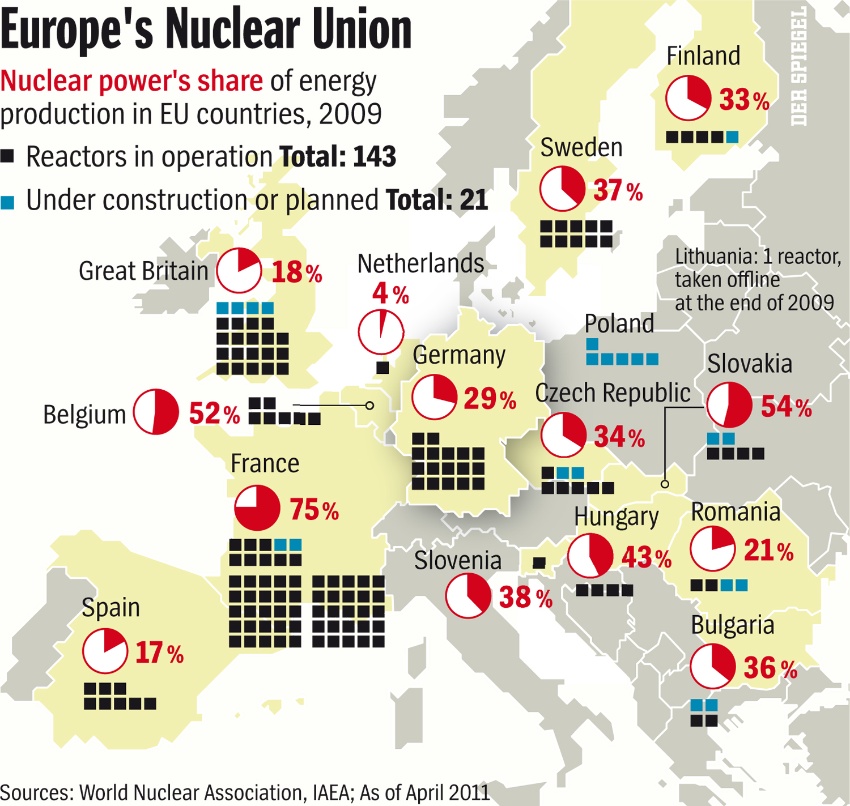
European Nuclear Union

>

Drought imperils moves to end decline in US cattle

by Agrimoney.com

The drought in the US Great Plains, which is causing consternation among wheat growers, is also threatening moves among cattle farmers to rebuild herds after a decline lasting since the 1970s, US farm officials said.
More than one-third of the American cattle herd is held in the southern states has been left parched by a dearth of rain which has reached "critical" levels in Oklahoma, and encouraged bush fires, largely in Texas, which have burned more than 360,000 acres of land in the past week.
The harsh conditions are threatening to snuff out an apparent willingness among farmers to restock, encouraged by high cattle prices, which set a record 122.875 cents a pound in Chicago last week.
A 5% fall in the slaughter of beef cows in the first three months of the year "could be an indication that producers may be beginning to consider cow-herd stabilisation or even expansion", US Department of Agriculture analyst Rachel Johnson said.
"However, continued dryness in the southern tier of States and scattered additional areas will likely dampen expansion plants in those affected areas."
Indeed, the conditions "could lead to further cow herd reductions", and reduced regional demand for feeder cattle for fattening up on pasture in spring and summer grazing programmes, Ms Johnson said.
Long-term fall
A rebound in cattle numbers would end, or at least interrupt, a decline in cattle numbers dating back to 1974, when US herd numbers peaked at 132m head before beginning a fall which has cut their numbers by 30%.
Part of the decline since has been down to breeding improvements which have increased vastly milk yields in dairy cows, whose total nearly halved over the last 50 years.
Americans' lower beef consumption rates, per person, have also played a part, along with the efficiency savings, and higher returns, which can be made by switching to arable farming.
Fatter margins
Nonetheless, cattle feeders have, so this year, "been in a positive situation, with margins not seen since last May", Ms Johnson said.
"Despite increasing grain and feed prices, margins in Match were well over $100 per head."
However, she warned that beef values "may begin to slip" as the rise in cattle placed on feedlots in the winter feeds through into growing supplies of the meat.
Separate data showed wholesale beef values falling, after rising on Tuesday for the first time in week.
Broker US Commodities said: "Boxed beef continues to struggle to hold recent strength", adding that it expected that live cattle futures have already set a seasonal high.
Ms Johnson added that a USDA cattle report on July 1 would provide an insight on prospects for a herd rebuild, revealing the numbers of heifers that farmers are keeping to breed from.

Follow Us